
Attention Autism Attention Autism was developed by specialist
Attention Autism ‘Attention Autism’ was developed by specialist speech and language therapist, Gina Davies. The approach is based on: An understanding of the ‘typical’ attention levels and development of infants This enables us to think about where the child is at with their attention and communication development and what to work on next. The common strengths of people with autism We know that people with autism are visual learners and have good visual skills, therefore, we should use visuals and pictures to share a message, reduce anxiety and add structure. We must also ensure we demonstrate an activity first, as well as modelling how to take part in an activity. This aids the children’s understanding of what they need to do. The characteristics of autism Including difficulty with social communication, interaction, rigidity of thought and sensory processing differences. The knowledge that successful communication is dynamic, motivating and fun! As Gina says, we must “offer an irresistible invitation to learn”.
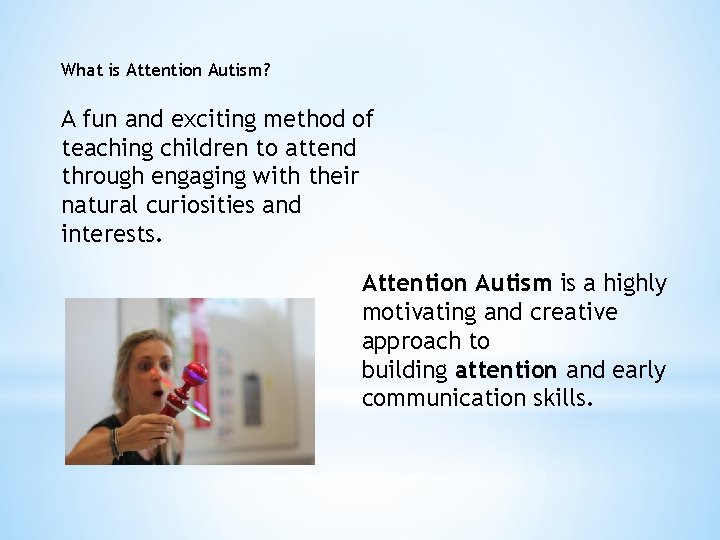
What is Attention Autism? A fun and exciting method of teaching children to attend through engaging with their natural curiosities and interests. Attention Autism is a highly motivating and creative approach to building attention and early communication skills.

Attention Levels in typically developing children-Cooper, Moodley, Reynell 1997 Stage 1. 0 -1 year Stage 4. 3 -4 years Fleeting attention. Extreme distractibility. The child’s attention is held momentarily by whatever is the dominant stimulus in the environment and is easily distracted by any new stimulus. Attention focus under voluntary control. The child is beginning to control their own attention. Attention is still single channelled but it can be stopped /restarted under the child’s control without adult support Stage 2. 1 -2 years Rigid attention. Attention inflexible. The child can concentrate for some time on a concrete task of their own choosing. The child has difficulty tolerating intervention or attempts to modify the task by an adult. Stage 3. 2 -3 years Single channelled attention. Some flexibility is developing in that they can tolerate a well timed intervention or interruption more readily. The child can only cope with doing one thing at a time. Stage 5. 4 – 5 years Two channelled attention. At this stage the child can do 2 things at once The child’s attention span may be short but they can be taught in a group. The child is ready for whole class teaching. Stage 6. 5 -6 years Integrated attention. Well established and sustained. The child can easily listen to information whilst doing something else at the same time even in a distracting environment. The child can cope in a group learning situation for long periods of time.
Some of the rules: As a leader: • Remember the bucket belongs to you and only you! • Be the most interesting and amazing thing in the room. • Use simple relevant language. • Teach! Don’t test! • Practise first. • Have fun! As a supporting adult: • If you are in the room then you participate. • You do not leave your seat. (It gives a message to the children that they have permission to leave too!) • You do not record anything. • You don’t ask questions or communicate with the lead person or other staff members. • You model how to sit and look at the bucket as if it is the most exciting thing you have ever seen. • Aim to prevent a child from touching without speaking.
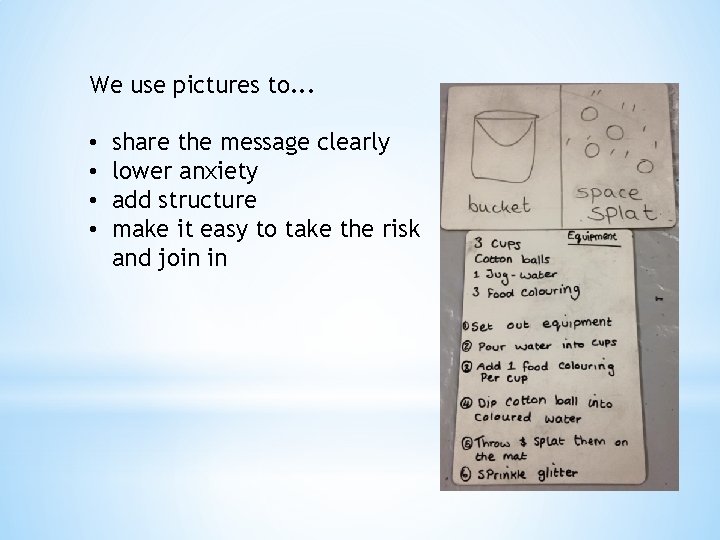
We use pictures to. . . • • share the message clearly lower anxiety add structure make it easy to take the risk and join in
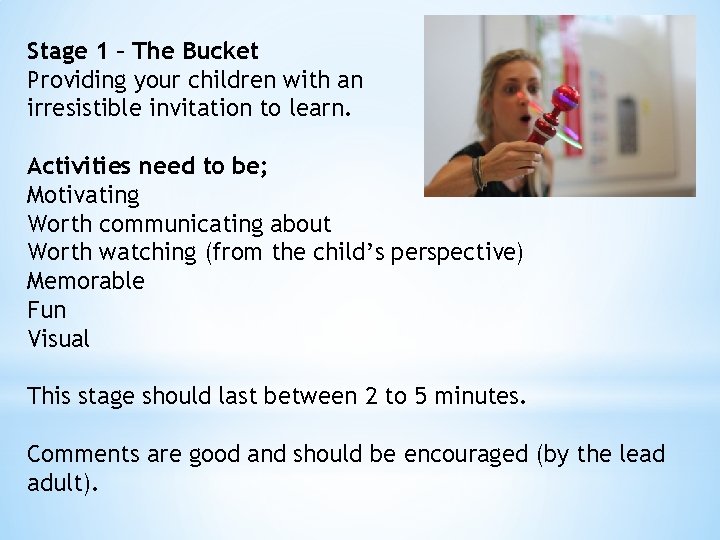
Stage 1 – The Bucket Providing your children with an irresistible invitation to learn. Activities need to be; Motivating Worth communicating about Worth watching (from the child’s perspective) Memorable Fun Visual This stage should last between 2 to 5 minutes. Comments are good and should be encouraged (by the lead adult).
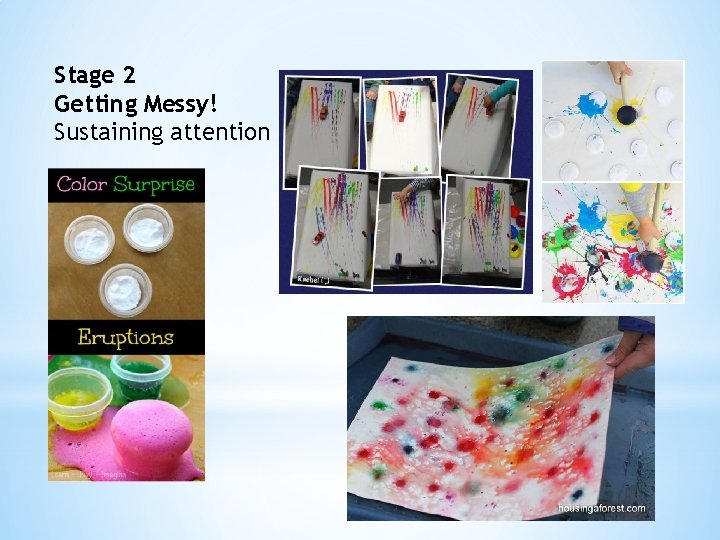
Stage 2 Getting Messy! Sustaining attention
Stage 3 Taking turns To shift attention Adults always ‘go first’ using their involvement as a model for. . • how to join in and that taking the risk is worth it • demonstrating what’s expected • enthusiasm and fun • shared attention

Stage 4 Individual activities To focus and sustain attention in a group, then transition shifting attention to individual activity and then refocus on the group. Take it to the table • children to learn to transition from one activity to another • Adults go first • Independence skills • Opportunity to ‘recreate’ learning

Attention Autism Videos http: //www. youtube. com/watch? v=J 8 h 12 X 4 s. PTY https: //www. youtube. com/watch? v=88 o. Pmb. EDg-k Facebook https: //www. facebook. com/ginadaviesautism/timeline
- Slides: 11