
Attending to Language Craft and Structure Grades 6
- Slides: 38
Attending to Language, Craft and Structure Grades 6 – 8 ELA I Day 4
Welcome Back! 2
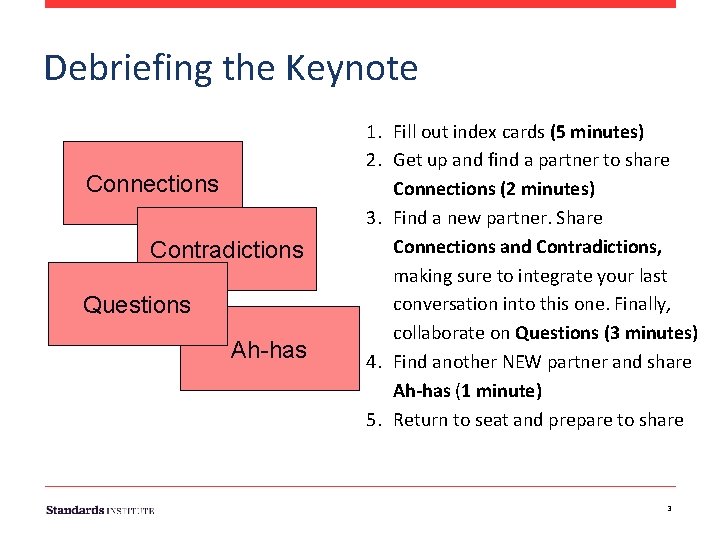
Debriefing the Keynote Connections Contradictions Questions Ah-has 1. Fill out index cards (5 minutes) 2. Get up and find a partner to share Connections (2 minutes) 3. Find a new partner. Share Connections and Contradictions, making sure to integrate your last conversation into this one. Finally, collaborate on Questions (3 minutes) 4. Find another NEW partner and share Ah-has (1 minute) 5. Return to seat and prepare to share 3
Today’s Session • Today we are moving from building text sets to analyzing the specific standards a given text will help students practice. • We will hone in on the features of texts that are great for lessons focused on the craft and structure standards. • At the end of the day, you will design your own lesson(s) grounded in the craft and structure standards. 4
Session Objectives Participants will: • Understand the demands of the Craft and Structure ELA Standards and plan a sequence of instruction aligned to these standards using a complex text • Understand how conducting a structure analysis (standard 5) of a text helps students better understand a complex text • Apply learning by planning instruction 5
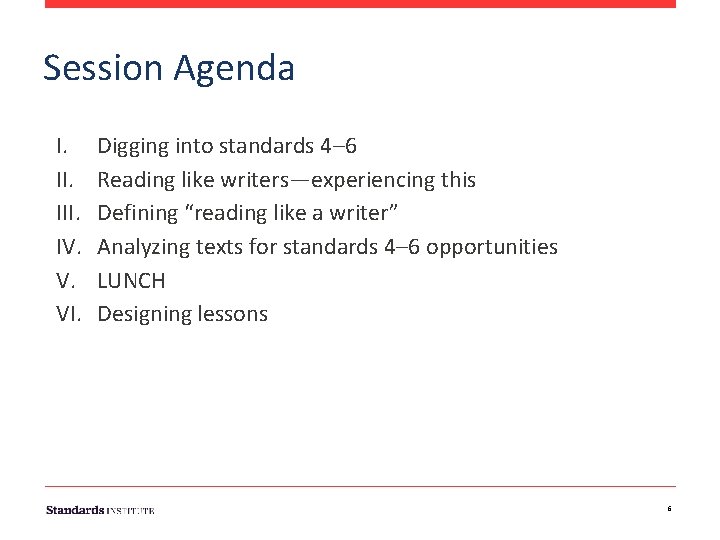
Session Agenda I. III. IV. V. VI. Digging into standards 4– 6 Reading like writers—experiencing this Defining “reading like a writer” Analyzing texts for standards 4– 6 opportunities LUNCH Designing lessons 6
Norms that Support Our Learning Today’s session is going to involve some challenges that might make you uncomfortable… • Don’t check out! Use technology to enhance learning. • Strive for equity of voice…listen to understand. • Contribute to a learning environment in which it is “safe to not know. ” 7
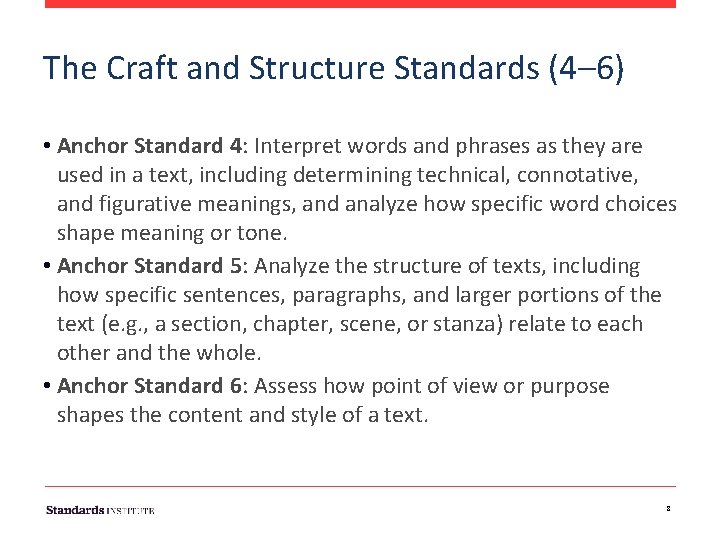
The Craft and Structure Standards (4– 6) • Anchor Standard 4: Interpret words and phrases as they are used in a text, including determining technical, connotative, and figurative meanings, and analyze how specific word choices shape meaning or tone. • Anchor Standard 5: Analyze the structure of texts, including how specific sentences, paragraphs, and larger portions of the text (e. g. , a section, chapter, scene, or stanza) relate to each other and the whole. • Anchor Standard 6: Assess how point of view or purpose shapes the content and style of a text. 8
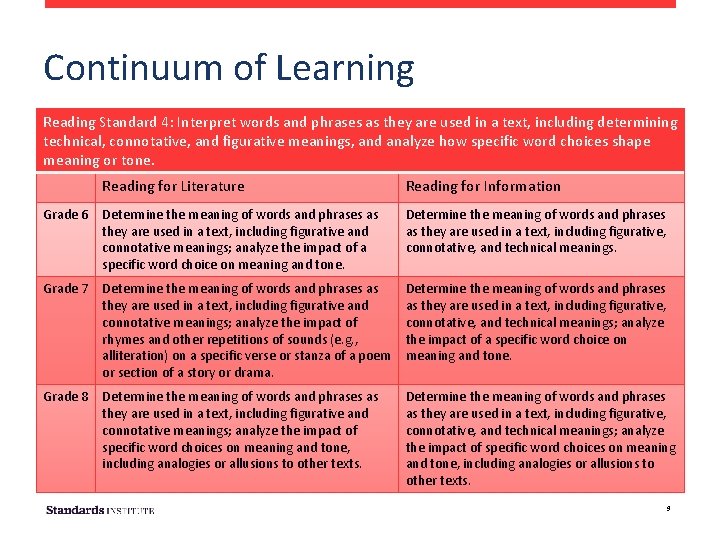
Continuum of Learning Reading Standard 4: Interpret words and phrases as they are used in a text, including determining technical, connotative, and figurative meanings, and analyze how specific word choices shape meaning or tone. Reading for Literature Reading for Information Grade 6 Determine the meaning of words and phrases as they are used in a text, including figurative and connotative meanings; analyze the impact of a specific word choice on meaning and tone. Determine the meaning of words and phrases as they are used in a text, including figurative, connotative, and technical meanings. Grade 7 Determine the meaning of words and phrases as they are used in a text, including figurative and connotative meanings; analyze the impact of rhymes and other repetitions of sounds (e. g. , alliteration) on a specific verse or stanza of a poem or section of a story or drama. Determine the meaning of words and phrases as they are used in a text, including figurative, connotative, and technical meanings; analyze the impact of a specific word choice on meaning and tone. Grade 8 Determine the meaning of words and phrases as they are used in a text, including figurative and connotative meanings; analyze the impact of specific word choices on meaning and tone, including analogies or allusions to other texts. Determine the meaning of words and phrases as they are used in a text, including figurative, connotative, and technical meanings; analyze the impact of specific word choices on meaning and tone, including analogies or allusions to other texts. 9
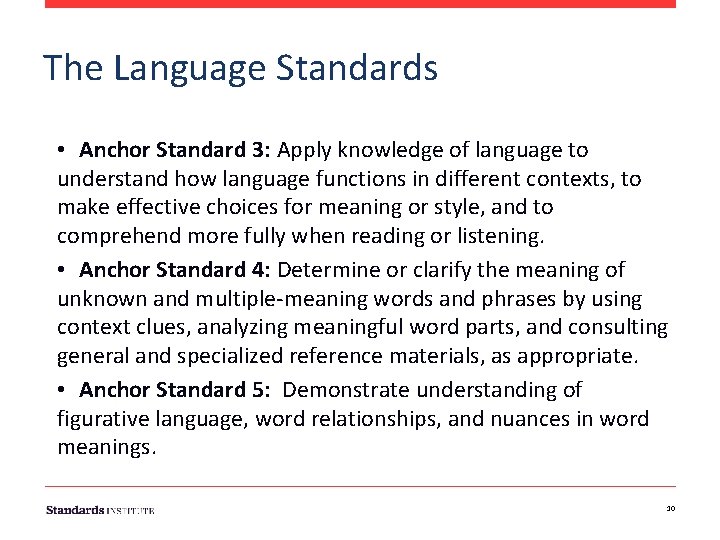
The Language Standards • Anchor Standard 3: Apply knowledge of language to understand how language functions in different contexts, to make effective choices for meaning or style, and to comprehend more fully when reading or listening. • Anchor Standard 4: Determine or clarify the meaning of unknown and multiple-meaning words and phrases by using context clues, analyzing meaningful word parts, and consulting general and specialized reference materials, as appropriate. • Anchor Standard 5: Demonstrate understanding of figurative language, word relationships, and nuances in word meanings. 10
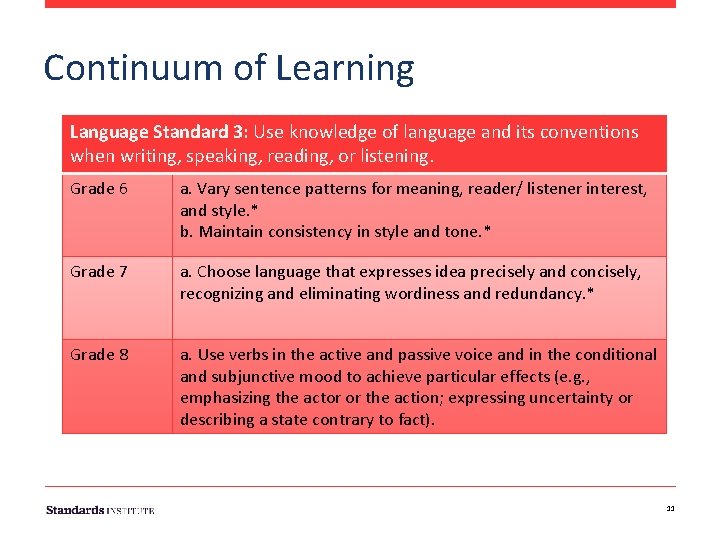
Continuum of Learning Language Standard 3: Use knowledge of language and its conventions when writing, speaking, reading, or listening. Grade 6 a. Vary sentence patterns for meaning, reader/ listener interest, and style. * b. Maintain consistency in style and tone. * Grade 7 a. Choose language that expresses idea precisely and concisely, recognizing and eliminating wordiness and redundancy. * Grade 8 a. Use verbs in the active and passive voice and in the conditional and subjunctive mood to achieve particular effects (e. g. , emphasizing the actor or the action; expressing uncertainty or describing a state contrary to fact). 11
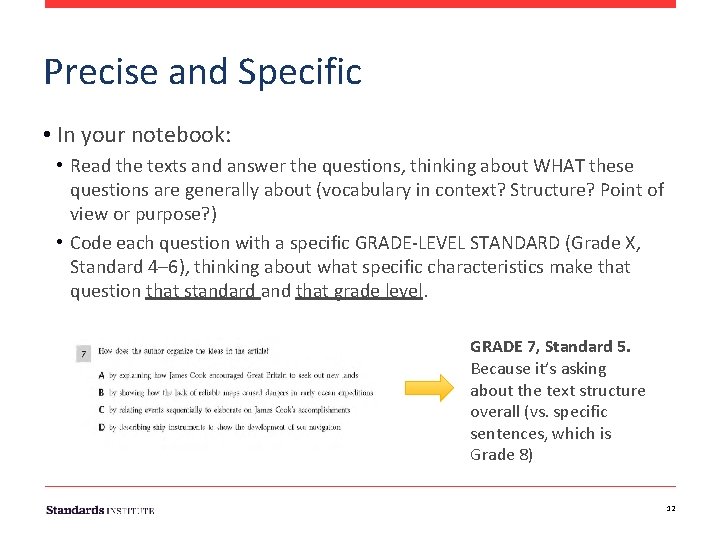
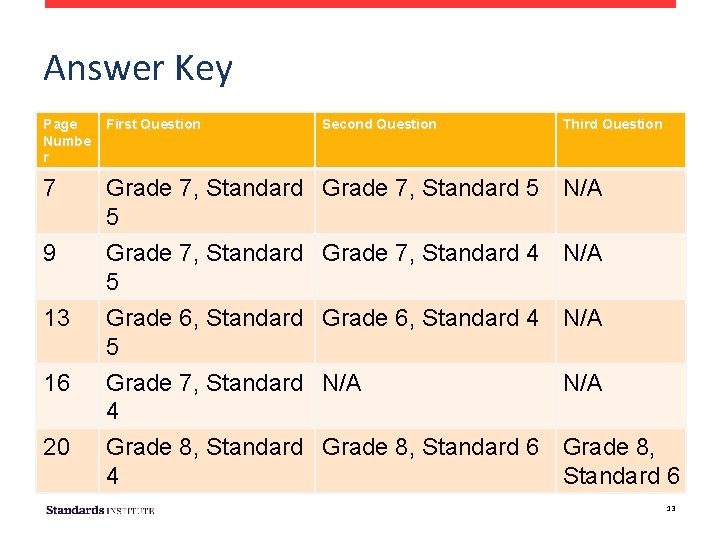
Precise and Specific • In your notebook: • Read the texts and answer the questions, thinking about WHAT these questions are generally about (vocabulary in context? Structure? Point of view or purpose? ) • Code each question with a specific GRADE-LEVEL STANDARD (Grade X, Standard 4– 6), thinking about what specific characteristics make that question that standard and that grade level. GRADE 7, Standard 5. Because it’s asking about the text structure overall (vs. specific sentences, which is Grade 8) 12
Answer Key Page Numbe r First Question Second Question Third Question 7 Grade 7, Standard 5 N/A 5 9 Grade 7, Standard 4 N/A 5 13 Grade 6, Standard 4 N/A 5 16 Grade 7, Standard N/A 4 20 Grade 8, Standard 6 Grade 8, 4 Standard 6 N/A 13
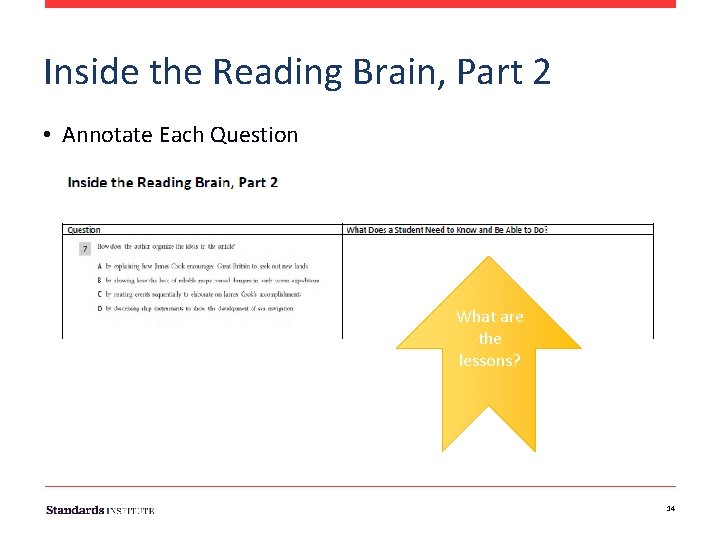
Inside the Reading Brain, Part 2 • Annotate Each Question What are the lessons? 14
How Do Writers Create Structure? 15
Say Something 1. Partner up. 2. Look for the spots in your reading “How Rebecca Skloot Wrote the Immortal Life of Henrietta Lacks” that are marked “Say Something. ” 3. Read to the first “Say Something” marker, then discuss what you have read so far with your partner. You might ask a question, provide a brief summary, or discuss a key point, an interesting idea, or a connection to your teaching or students. 4. Continue the process until you’ve read the whole article. 16
Let’s Play More with This Idea • In your envelope, you have several paragraphs from an essay we looked at briefly yesterday, “Water Is Life. ” • Work with a partner to organize the paragraphs the way you think they will appear in the essay. –Which paragraphs go together? Why? –In what order will the groups of paragraphs flow? Why? –What are the central ideas you’re discovering? What does Barbara Kingsolver mean by “Water Is Life”? 17
Lunch 18
Reviewing Objectives and Agenda • Understand the demands of the Craft and Structure ELA Standards and plan a sequence of instruction aligned to these standards using a complex text. • Understand how conducting a structure analysis (standard 5) of a text helps students better understand a complex text • Apply learning by planning instruction I. III. IV. V. VI. Digging into standards 46 Reading like writers – experiencing this Defining “reading like a writer” Analyzing texts for standards 4– 6 opportunities Lunch Designing instruction 19
Share what you’re thinking –Which paragraphs go together? Why? –In what order will the groups of paragraphs flow? Why? –What are the central ideas you’re discovering? What does Barbara Kingsolver mean by “Water Is Life”? – Capture the central ideas we’re sharing on page X of your notebook. 20
“Water Is Life” • The full essay “Water Is Life, ” by Barbara Kingsolver, is in your notebook. • Read the essay, comparing the way you grouped and ordered the paragraphs to the way Kingsolver did. • When you find a difference between your decisions and hers, jot a few notes about what she did and why you think she did it. What impact do her decisions have on the reader? • When you’re finished, think about how you would describe the structure of this essay overall. Can you create a map of it? 21
Final Step • Think about what you’ve learned about the importance of protecting fresh water from today’s work. • Write a paragraph in which you describe two reasons why it’s important to protect fresh water. Include details from any of the texts you read yesterday that still seem relevant and from today's reading, "Water Is Life. " 22
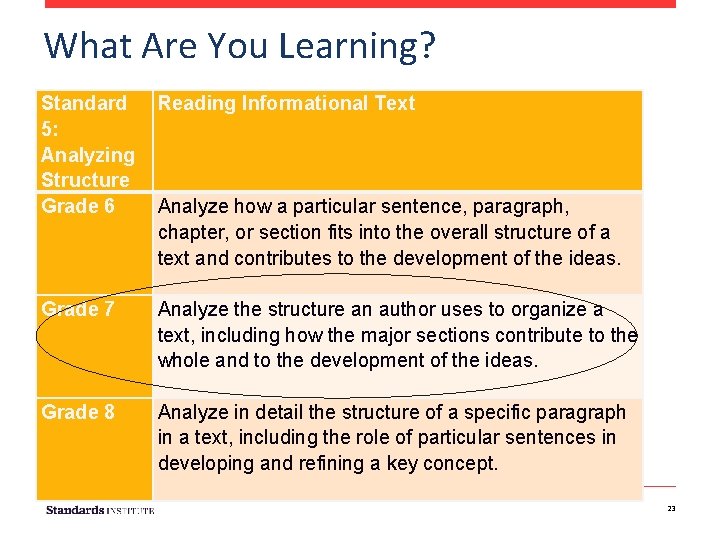
What Are You Learning? Standard 5: Analyzing Structure Grade 6 Reading Informational Text Grade 7 Analyze the structure an author uses to organize a text, including how the major sections contribute to the whole and to the development of the ideas. Grade 8 Analyze in detail the structure of a specific paragraph in a text, including the role of particular sentences in developing and refining a key concept. Analyze how a particular sentence, paragraph, chapter, or section fits into the overall structure of a text and contributes to the development of the ideas. 23
The Complexity of “Water Is Life” • What aspects of “Water is Life” make it complex? • Would the structure analysis we just completed provide most students with an entry point to this text? • What would you do next? 24
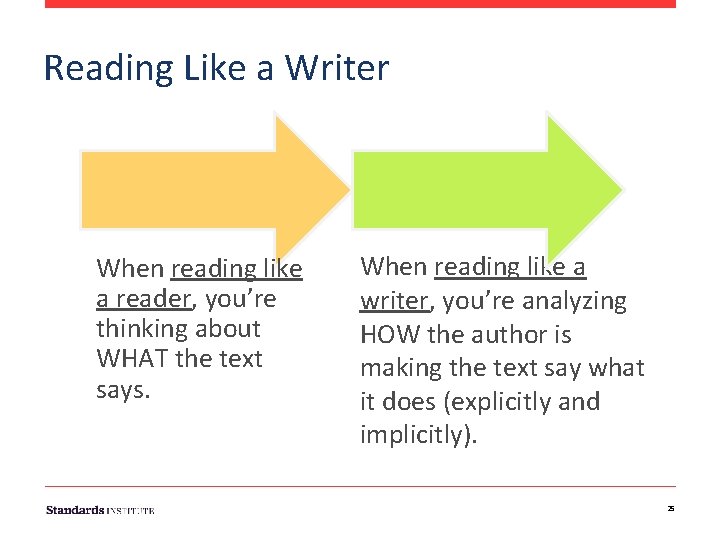
Reading Like a Writer When reading like a reader, you’re thinking about WHAT the text says. When reading like a writer, you’re analyzing HOW the author is making the text say what it does (explicitly and implicitly). 25
Planning Lessons Using Texts Features of texts that help students tackle craft and structure: • Lots of opportunity to encounter and grapple with new academic vocabulary • Interesting and different text structure(s) • Compelling points of view/purposes 26
Look Back Go back to the envelope of texts we sorted into sets yesterday. Which would be the basis for good craft and structure lessons? Choose one or two texts that you’ll write a lesson for this afternoon: • Lots of opportunity to encounter and grapple with new academic vocabulary • Juicy Sentence work opportunity • Interesting and different text structure(s) • Compelling points of view/purposes. Alternative: Consider texts from your existing curriculum or that you’re planning to use in the future (maybe from the text set you built yesterday, if you did that). Which of those might be good for craft and structure lessons? 27
Journal, Last Page in Notebook • What are you learning about the relationship between standards, texts, and strategies or lessons? • Important for tomorrow—what did you learn today about the importance of fresh water and our relationship to it? Capture specific details and quotes from “Water Is Life” that were particularly meaningful or resonant for you. 28
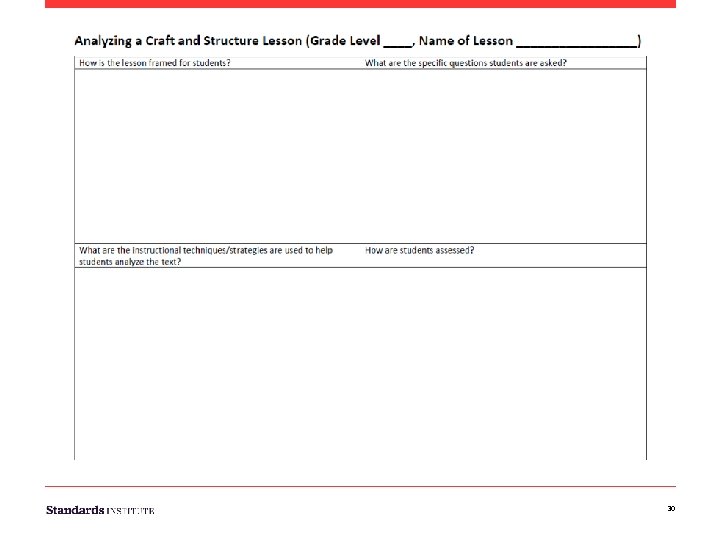
Lessons as Models • One of the ways to use the curriculum posted on the Unbound. ED website is to look at the lessons as models of new ideas and sample text-dependent questions. • We’re going to dive deeply into a couple of craft and structure lessons from the curriculum, looking for techniques and questions you might replicate. 29
30
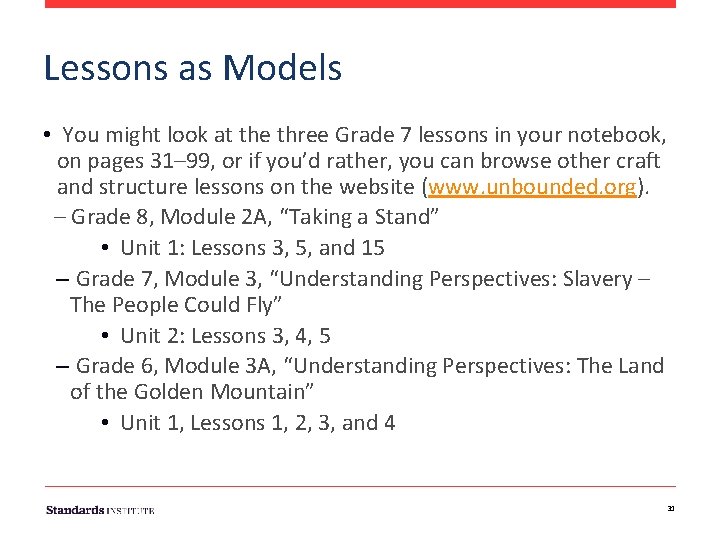
Lessons as Models • You might look at the three Grade 7 lessons in your notebook, on pages 31– 99, or if you’d rather, you can browse other craft and structure lessons on the website (www. unbounded. org). – Grade 8, Module 2 A, “Taking a Stand” • Unit 1: Lessons 3, 5, and 15 – Grade 7, Module 3, “Understanding Perspectives: Slavery – The People Could Fly” • Unit 2: Lessons 3, 4, 5 – Grade 6, Module 3 A, “Understanding Perspectives: The Land of the Golden Mountain” • Unit 1, Lessons 1, 2, 3, and 4 31
Break 32
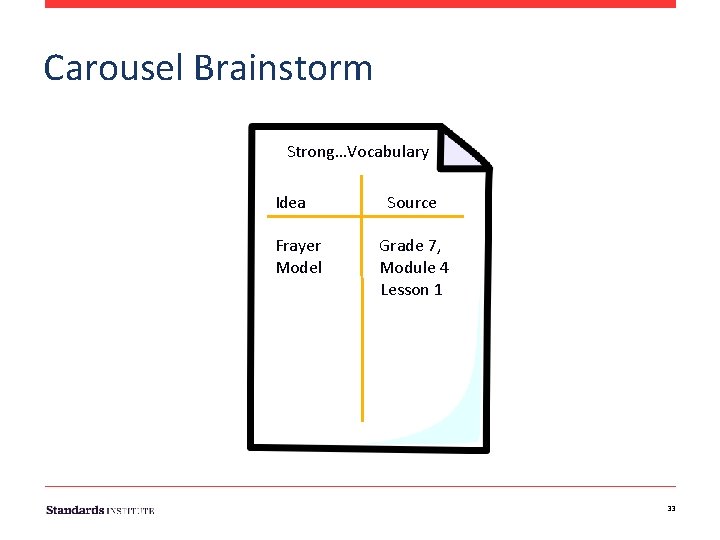
Carousel Brainstorm Strong…Vocabulary Idea Frayer Model Source Grade 7, Module 4 Lesson 1 33
Lesson Planning • The goal for the next hour is to develop a lesson plan or instructional sequence that bring together all that you’ve learned over the past several days: – Based on a complex text that can be used for students to practice standards 4, 5, and/or 6 (perhaps along with other standards). Help your students read like writers! – Incorporates text-dependent questions that support analysis of text (use the posted questions as models if needed) – Incorporates at least one of the instructional techniques you’ve experienced or read about (feel free to read/research more if needed) – Is rigorous, engaging, and scaffolded but requires kids to do the work 34
What’s Coming Together? What is coming together for you? What remains unanswered? On a 3 x 5 card, answer the first question on one side and the second on the other. Please answer in full sentences to avoid confusion. 35
36
Image Credits • Slide 1: Nicholas Lue • Slide 2: Hilton Bonnet Creek • Slide 15: http: //www. amazon. com/Rebecca. Skloot/e/B 002 LUV 0 FG • Slide 36: Unboun. Ed 37
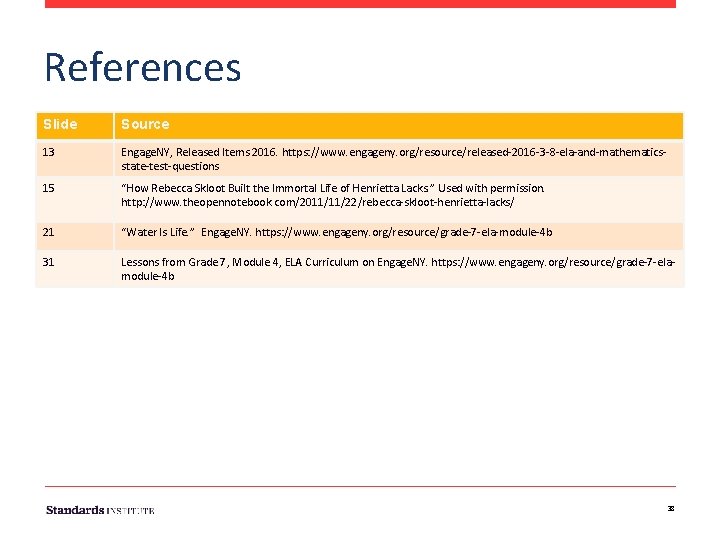
References Slide Source 13 Engage. NY, Released Items 2016. https: //www. engageny. org/resource/released-2016 -3 -8 -ela-and-mathematicsstate-test-questions 15 “How Rebecca Skloot Built the Immortal Life of Henrietta Lacks. ” Used with permission. http: //www. theopennotebook. com/2011/11/22/rebecca-skloot-henrietta-lacks/ 21 “Water Is Life. ” Engage. NY. https: //www. engageny. org/resource/grade-7 -ela-module-4 b 31 Lessons from Grade 7, Module 4, ELA Curriculum on Engage. NY. https: //www. engageny. org/resource/grade-7 -elamodule-4 b 38