
AttachmentRelated Variables Predict Moral Mindset and Moral Action
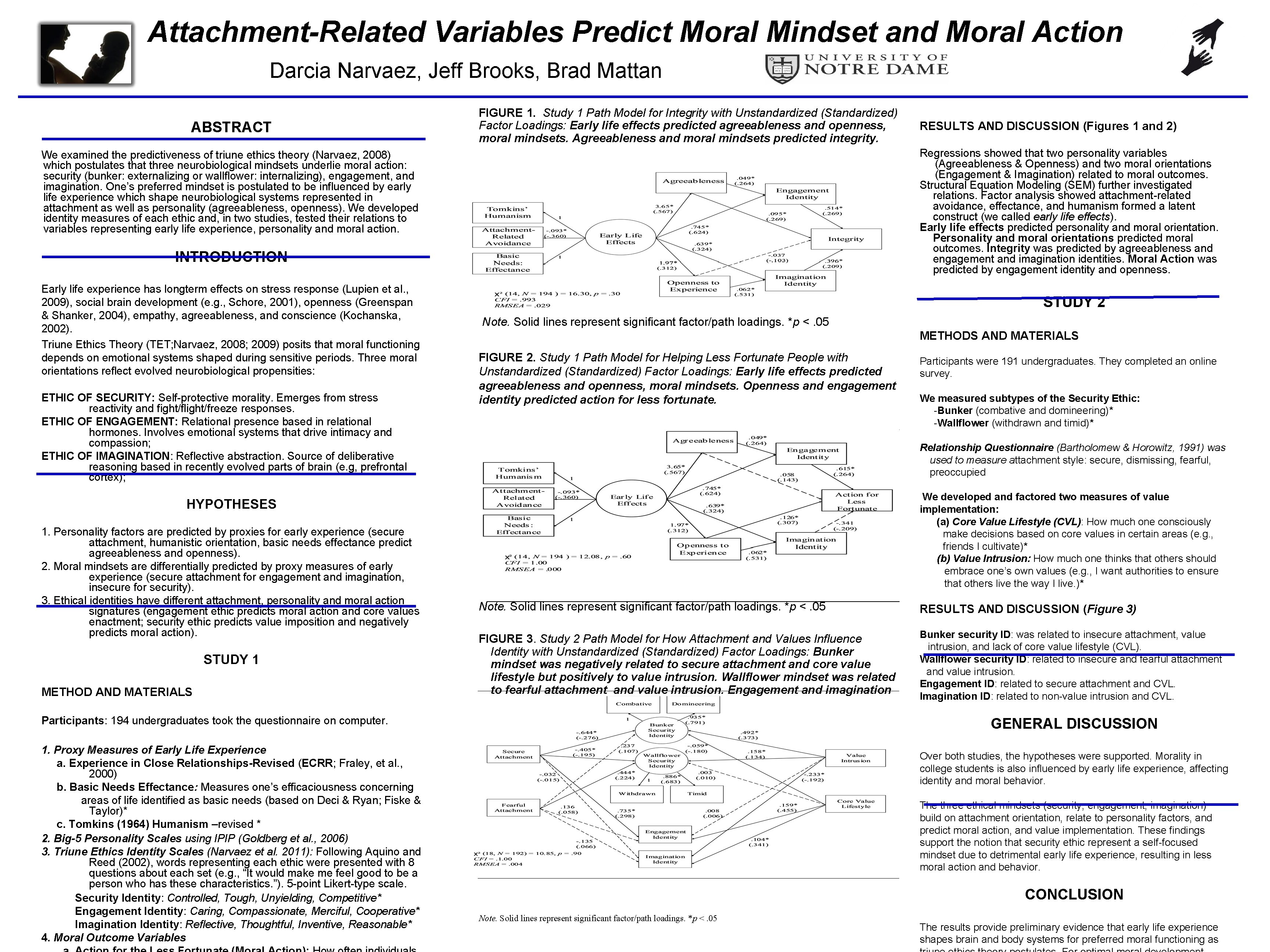
Attachment-Related Variables Predict Moral Mindset and Moral Action Darcia Narvaez, Jeff Brooks, Brad Mattan ABSTRACT FIGURE 1. Study 1 Path Model for Integrity with Unstandardized (Standardized) Factor Loadings: Early life effects predicted agreeableness and openness, moral mindsets. Agreeableness and moral mindsets predicted integrity. Regressions showed that two personality variables (Agreeableness & Openness) and two moral orientations (Engagement & Imagination) related to moral outcomes. Structural Equation Modeling (SEM) further investigated relations. Factor analysis showed attachment-related avoidance, effectance, and humanism formed a latent construct (we called early life effects). Early life effects predicted personality and moral orientation. Personality and moral orientations predicted moral outcomes. Integrity was predicted by agreeableness and engagement and imagination identities. Moral Action was predicted by engagement identity and openness. We examined the predictiveness of triune ethics theory (Narvaez, 2008) which postulates that three neurobiological mindsets underlie moral action: security (bunker: externalizing or wallflower: internalizing), engagement, and imagination. One’s preferred mindset is postulated to be influenced by early life experience which shape neurobiological systems represented in attachment as well as personality (agreeableness, openness). We developed identity measures of each ethic and, in two studies, tested their relations to variables representing early life experience, personality and moral action. INTRODUCTION Early life experience has longterm effects on stress response (Lupien et al. , 2009), social brain development (e. g. , Schore, 2001), openness (Greenspan & Shanker, 2004), empathy, agreeableness, and conscience (Kochanska, 2002). Triune Ethics Theory (TET; Narvaez, 2008; 2009) posits that moral functioning depends on emotional systems shaped during sensitive periods. Three moral orientations reflect evolved neurobiological propensities: ETHIC OF SECURITY: Self-protective morality. Emerges from stress reactivity and fight/flight/freeze responses. ETHIC OF ENGAGEMENT: Relational presence based in relational hormones. Involves emotional systems that drive intimacy and compassion; ETHIC OF IMAGINATION: Reflective abstraction. Source of deliberative reasoning based in recently evolved parts of brain (e. g, prefrontal cortex); STUDY 2 Note. Solid lines represent significant factor/path loadings. *p <. 05 METHODS AND MATERIALS FIGURE 2. Study 1 Path Model for Helping Less Fortunate People with Unstandardized (Standardized) Factor Loadings: Early life effects predicted agreeableness and openness, moral mindsets. Openness and engagement identity predicted action for less fortunate. STUDY 1 METHOD AND MATERIALS We measured subtypes of the Security Ethic: -Bunker (combative and domineering)* -Wallflower (withdrawn and timid)* We developed and factored two measures of value implementation: (a) Core Value Lifestyle (CVL): How much one consciously make decisions based on core values in certain areas (e. g. , friends I cultivate)* (b) Value Intrusion: How much one thinks that others should embrace one’s own values (e. g. , I want authorities to ensure that others live the way I live. )* Note. Solid lines represent significant factor/path loadings. *p <. 05 RESULTS AND DISCUSSION (Figure 3) FIGURE 3. Study 2 Path Model for How Attachment and Values Influence Identity with Unstandardized (Standardized) Factor Loadings: Bunker mindset was negatively related to secure attachment and core value lifestyle but positively to value intrusion. Wallflower mindset was related to fearful attachment and value intrusion. Engagement and imagination mindsets were related to core value lifestyle. Bunker security ID: was related to insecure attachment, value intrusion, and lack of core value lifestyle (CVL). Wallflower security ID: related to insecure and fearful attachment and value intrusion. Engagement ID: related to secure attachment and CVL. Imagination ID: related to non-value intrusion and CVL. Participants: 194 undergraduates took the questionnaire on computer. 1. Proxy Measures of Early Life Experience a. Experience in Close Relationships-Revised (ECRR; Fraley, et al. , 2000) b. Basic Needs Effectance: Measures one’s efficaciousness concerning areas of life identified as basic needs (based on Deci & Ryan; Fiske & Taylor)* c. Tomkins (1964) Humanism –revised * 2. Big-5 Personality Scales using IPIP (Goldberg et al. , 2006) 3. Triune Ethics Identity Scales (Narvaez et al. 2011): Following Aquino and Reed (2002), words representing each ethic were presented with 8 questions about each set (e. g. , “It would make me feel good to be a person who has these characteristics. ”). 5 -point Likert-type scale. Security Identity: Controlled, Tough, Unyielding, Competitive* Engagement Identity: Caring, Compassionate, Merciful, Cooperative* Imagination Identity: Reflective, Thoughtful, Inventive, Reasonable* 4. Moral Outcome Variables Participants were 191 undergraduates. They completed an online survey. Relationship Questionnaire (Bartholomew & Horowitz, 1991) was used to measure attachment style: secure, dismissing, fearful, preoccupied HYPOTHESES 1. Personality factors are predicted by proxies for early experience (secure attachment, humanistic orientation, basic needs effectance predict agreeableness and openness). 2. Moral mindsets are differentially predicted by proxy measures of early experience (secure attachment for engagement and imagination, insecure for security). 3. Ethical identities have different attachment, personality and moral action signatures (engagement ethic predicts moral action and core values enactment; security ethic predicts value imposition and negatively predicts moral action). RESULTS AND DISCUSSION (Figures 1 and 2) GENERAL DISCUSSION Over both studies, the hypotheses were supported. Morality in college students is also influenced by early life experience, affecting identity and moral behavior. The three ethical mindsets (security, engagement, imagination) build on attachment orientation, relate to personality factors, and predict moral action, and value implementation. These findings support the notion that security ethic represent a self-focused mindset due to detrimental early life experience, resulting in less moral action and behavior. CONCLUSION Note. Solid lines represent significant factor/path loadings. *p <. 05 The results provide preliminary evidence that early life experience shapes brain and body systems for preferred moral functioning as
- Slides: 1