
Attachment Dr Anne Shortall Consultant Child and Adolescent

- Slides: 58
Attachment Dr Anne Shortall Consultant Child and Adolescent Psychiatrist Updated 2020 by Dr Meenaka Williams and Brendan Hore
Learning Outcomes To understand different classifications of attachment, conditions that promote healthy attachment and the clinical relevance of failure to develop selective attachments. To understand the relevance of attachment theory to emotional development, affect regulation and relationships across the lifespan Basic understanding of assessment of attachment across the lifespan Awareness of principles of interventions
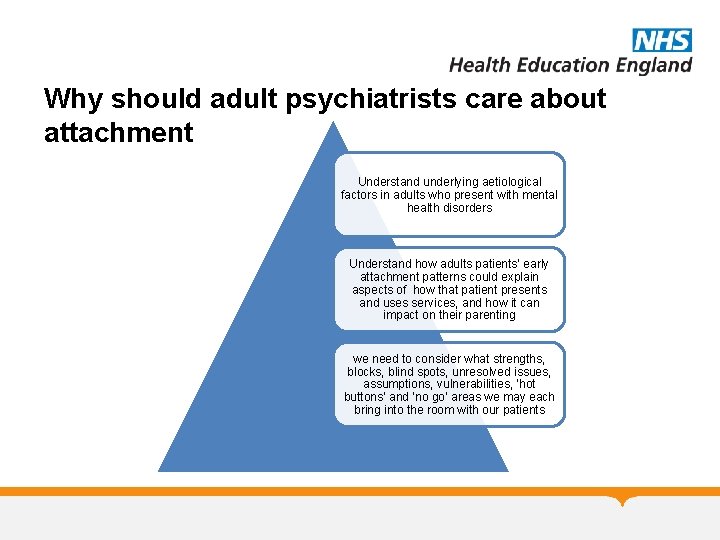
Why should adult psychiatrists care about attachment Understand underlying aetiological factors in adults who present with mental health disorders Understand how adults patients’ early attachment patterns could explain aspects of how that patient presents and uses services, and how it can impact on their parenting we need to consider what strengths, blocks, blind spots, unresolved issues, assumptions, vulnerabilities, ‘hot buttons’ and ‘no go’ areas we may each bring into the room with our patients
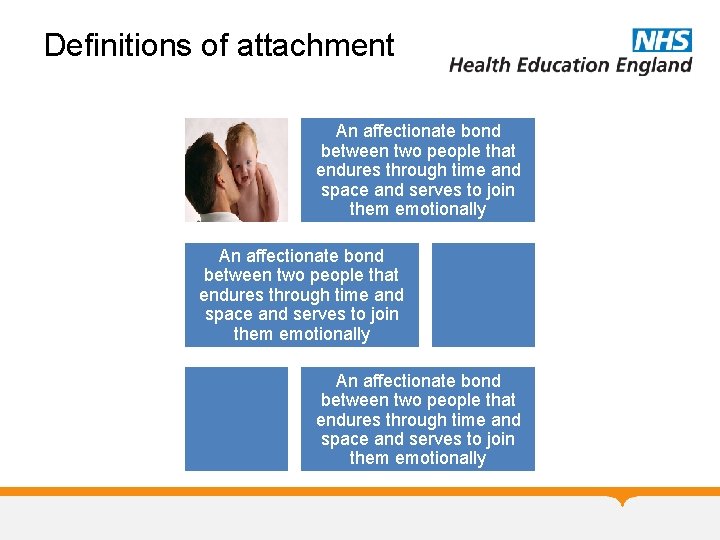
Definitions of attachment An affectionate bond between two people that endures through time and space and serves to join them emotionally
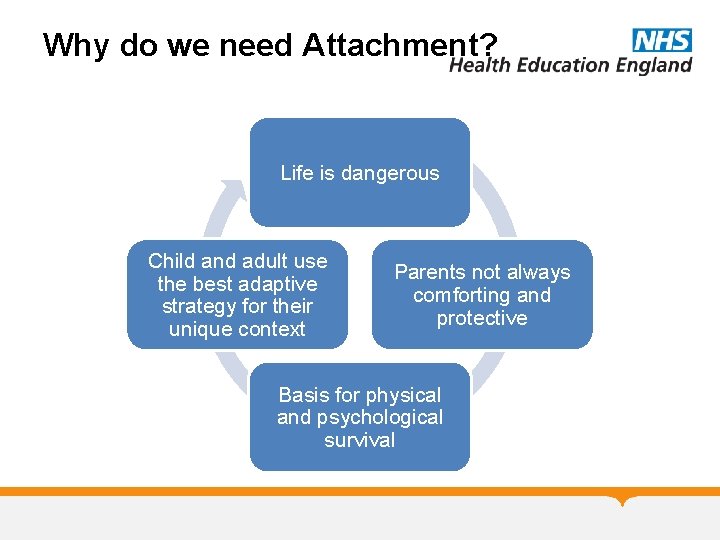
Why do we need Attachment? Life is dangerous Child and adult use the best adaptive strategy for their unique context Parents not always comforting and protective Basis for physical and psychological survival
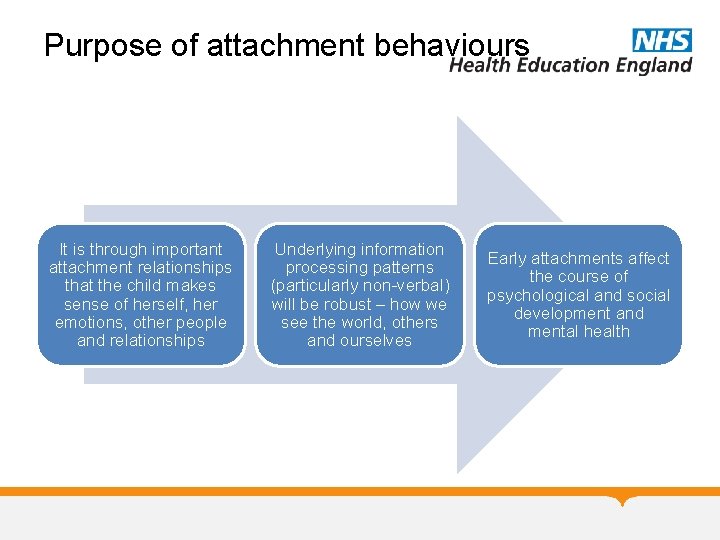
Purpose of attachment behaviours It is through important attachment relationships that the child makes sense of herself, her emotions, other people and relationships Underlying information processing patterns (particularly non-verbal) will be robust – how we see the world, others and ourselves Early attachments affect the course of psychological and social development and mental health
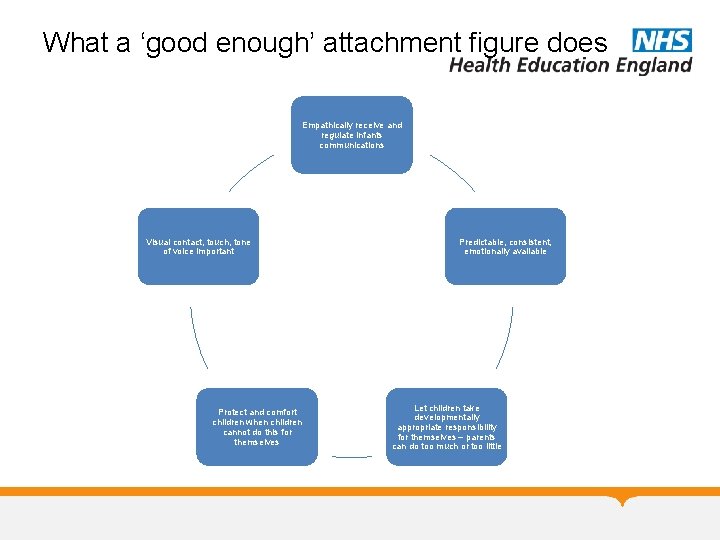
What a ‘good enough’ attachment figure does Empathically receive and regulate infants communications Visual contact, touch, tone of voice important Protect and comfort children when children cannot do this for themselves Predictable, consistent, emotionally available Let children take developmentally appropriate responsibility for themselves – parents can do too much or too little
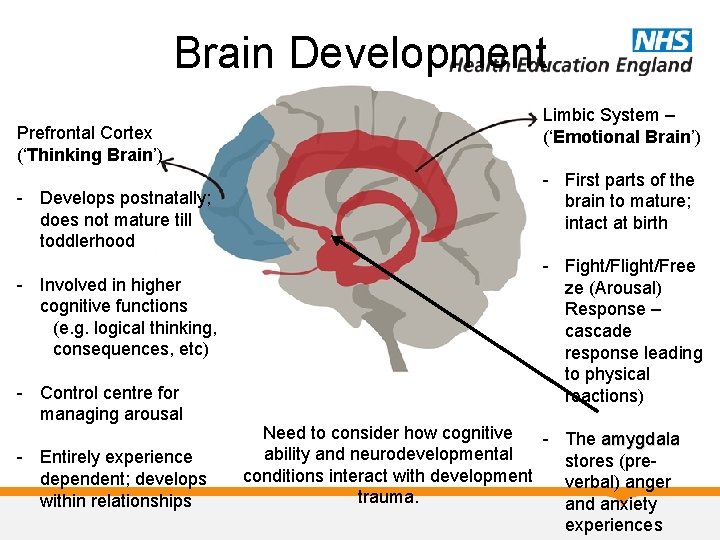
Brain Development Prefrontal Cortex (‘Thinking Brain’) - Develops postnatally; does not mature till toddlerhood - Involved in higher cognitive functions (e. g. logical thinking, consequences, etc) - Control centre for managing arousal - Entirely experience dependent; develops within relationships Limbic System – (‘Emotional Brain’) - First parts of the brain to mature; intact at birth - Fight/Flight/Free ze (Arousal) Response – cascade response leading to physical reactions) Need to consider how cognitive ability and neurodevelopmental conditions interact with development trauma. The amygdala stores (preverbal) anger and anxiety experiences
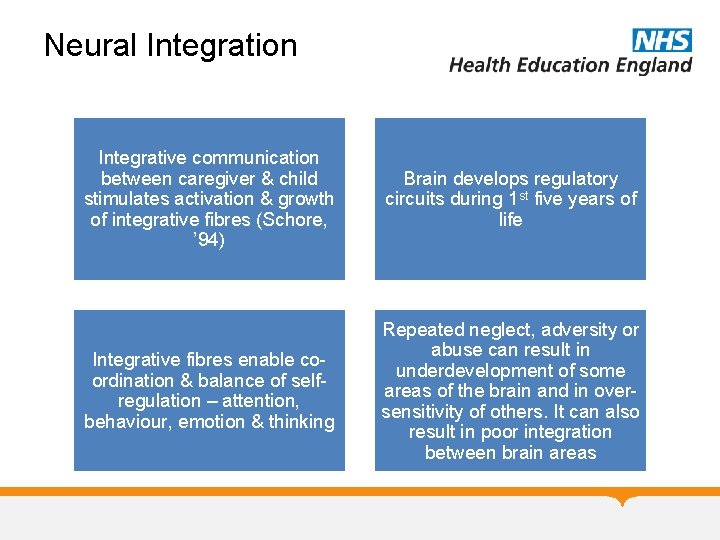
Neural Integration Integrative communication between caregiver & child stimulates activation & growth of integrative fibres (Schore, ’ 94) Brain develops regulatory circuits during 1 st five years of life Integrative fibres enable coordination & balance of selfregulation – attention, behaviour, emotion & thinking Repeated neglect, adversity or abuse can result in underdevelopment of some areas of the brain and in oversensitivity of others. It can also result in poor integration between brain areas
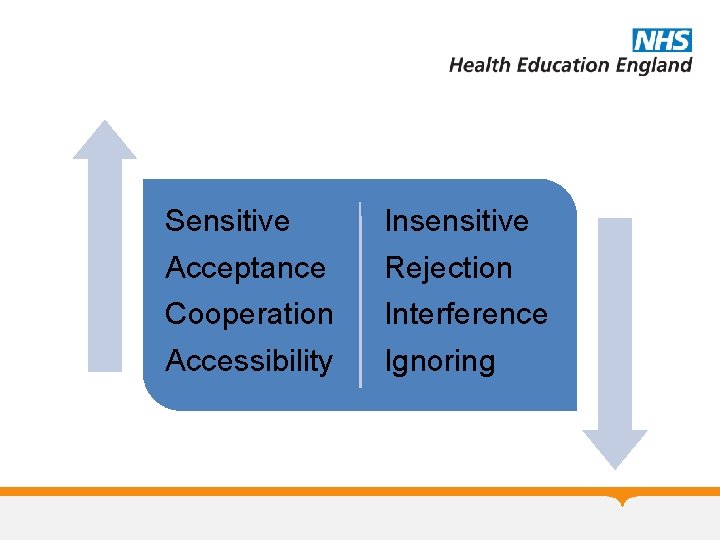
Sensitive Acceptance Cooperation Insensitive Rejection Interference Accessibility Ignoring
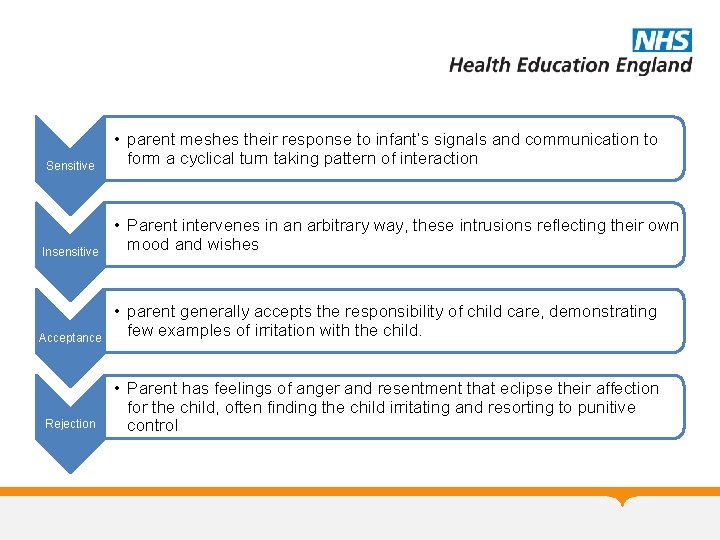
Sensitive • parent meshes their response to infant’s signals and communication to form a cyclical turn taking pattern of interaction Insensitive • Parent intervenes in an arbitrary way, these intrusions reflecting their own mood and wishes Acceptance • parent generally accepts the responsibility of child care, demonstrating few examples of irritation with the child. Rejection • Parent has feelings of anger and resentment that eclipse their affection for the child, often finding the child irritating and resorting to punitive control
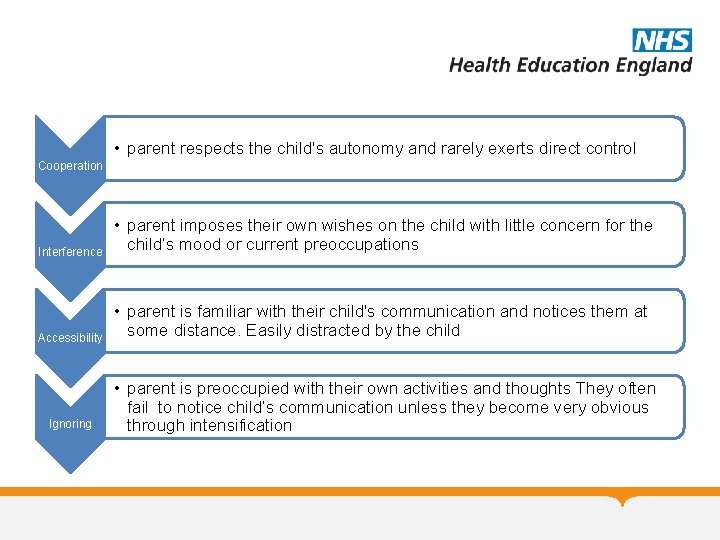
• parent respects the child's autonomy and rarely exerts direct control Cooperation Interference • parent imposes their own wishes on the child with little concern for the child’s mood or current preoccupations Accessibility • parent is familiar with their child's communication and notices them at some distance. Easily distracted by the child Ignoring • parent is preoccupied with their own activities and thoughts They often fail to notice child’s communication unless they become very obvious through intensification
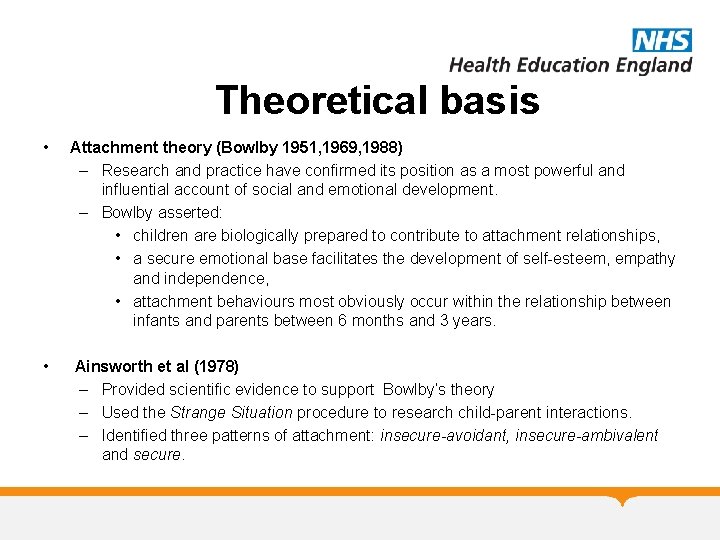
Theoretical basis • Attachment theory (Bowlby 1951, 1969, 1988) – Research and practice have confirmed its position as a most powerful and influential account of social and emotional development. – Bowlby asserted: • children are biologically prepared to contribute to attachment relationships, • a secure emotional base facilitates the development of self-esteem, empathy and independence, • attachment behaviours most obviously occur within the relationship between infants and parents between 6 months and 3 years. • Ainsworth et al (1978) – Provided scientific evidence to support Bowlby’s theory – Used the Strange Situation procedure to research child-parent interactions. – Identified three patterns of attachment: insecure-avoidant, insecure-ambivalent and secure.
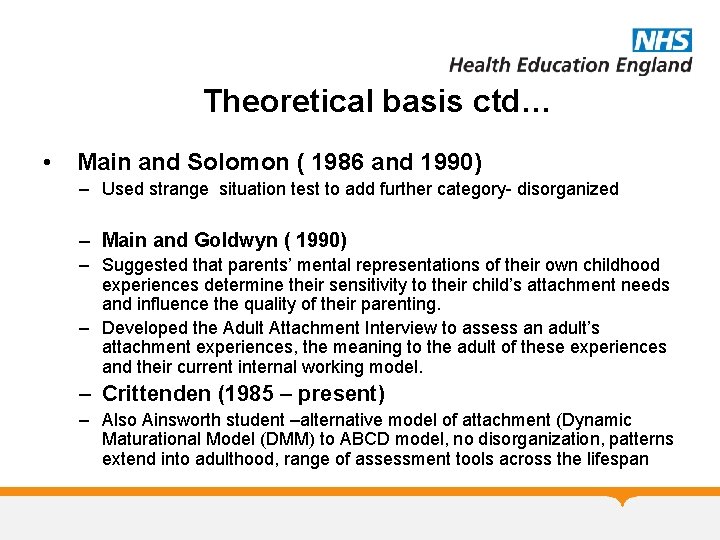
Theoretical basis ctd… • Main and Solomon ( 1986 and 1990) – Used strange situation test to add further category- disorganized – Main and Goldwyn ( 1990) – Suggested that parents’ mental representations of their own childhood experiences determine their sensitivity to their child’s attachment needs and influence the quality of their parenting. – Developed the Adult Attachment Interview to assess an adult’s attachment experiences, the meaning to the adult of these experiences and their current internal working model. – Crittenden (1985 – present) – Also Ainsworth student –alternative model of attachment (Dynamic Maturational Model (DMM) to ABCD model, no disorganization, patterns extend into adulthood, range of assessment tools across the lifespan
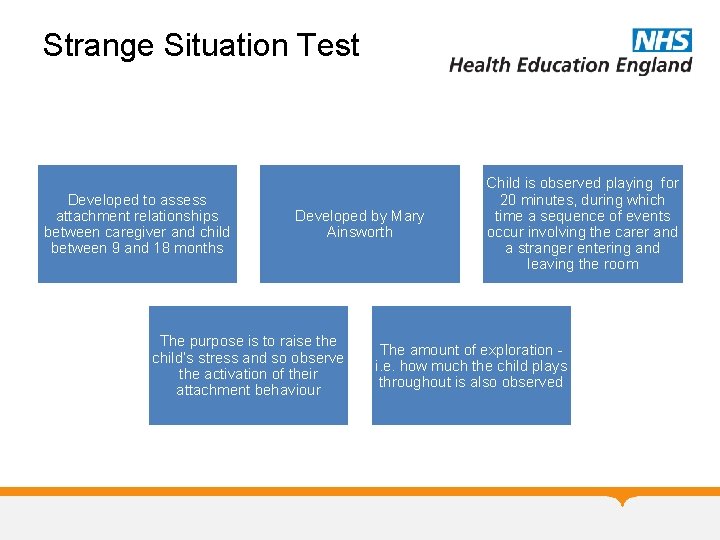
Strange Situation Test Developed to assess attachment relationships between caregiver and child between 9 and 18 months Developed by Mary Ainsworth The purpose is to raise the child’s stress and so observe the activation of their attachment behaviour Child is observed playing for 20 minutes, during which time a sequence of events occur involving the carer and a stranger entering and leaving the room The amount of exploration - i. e. how much the child plays throughout is also observed
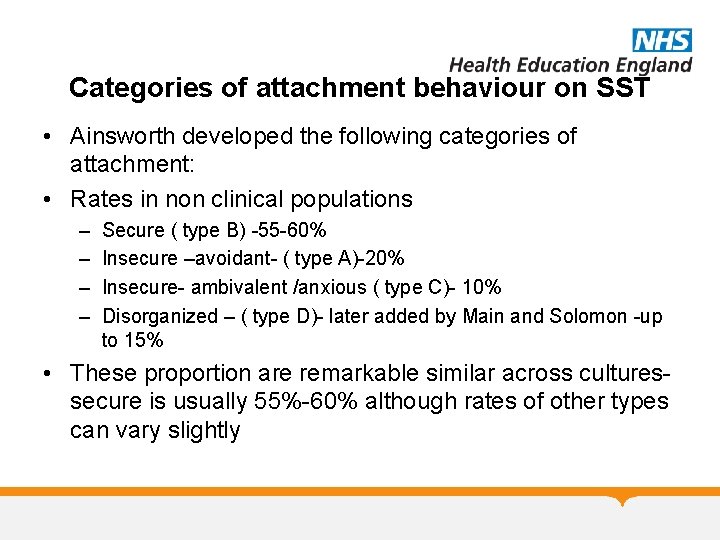
Categories of attachment behaviour on SST • Ainsworth developed the following categories of attachment: • Rates in non clinical populations – – Secure ( type B) -55 -60% Insecure –avoidant- ( type A)-20% Insecure- ambivalent /anxious ( type C)- 10% Disorganized – ( type D)- later added by Main and Solomon -up to 15% • These proportion are remarkable similar across cultures- secure is usually 55%-60% although rates of other types can vary slightly
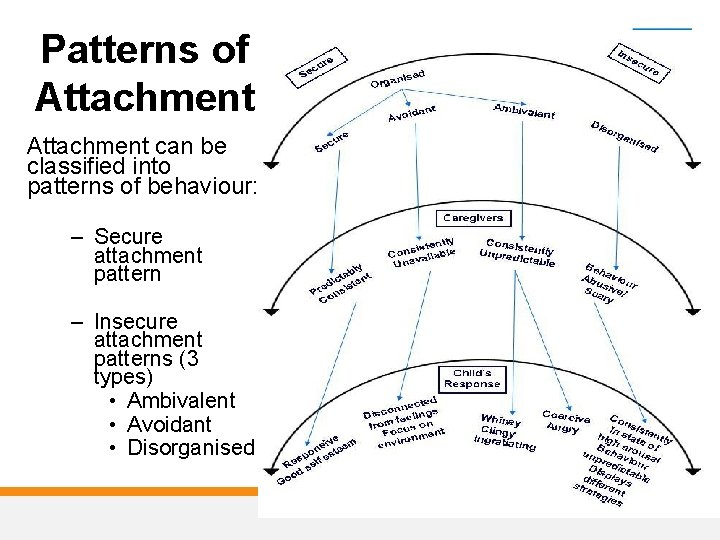
Patterns of Attachment can be classified into patterns of behaviour: – Secure attachment pattern – Insecure attachment patterns (3 types) • Ambivalent • Avoidant • Disorganised
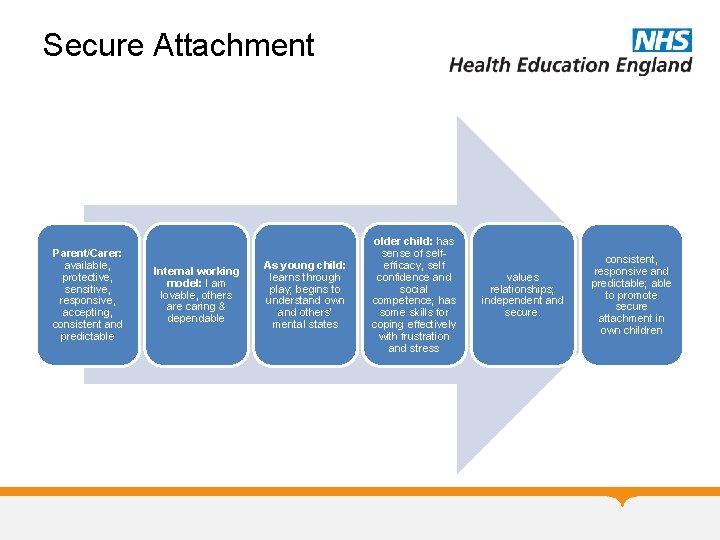
Secure Attachment Parent/Carer: available, protective, sensitive, responsive, accepting, consistent and predictable Internal working model: I am lovable, others are caring & dependable As young child: learns through play; begins to understand own and others’ mental states older child: has sense of selfefficacy, self confidence and social competence; has some skills for coping effectively with frustration and stress values relationships; independent and secure. consistent, responsive and predictable; able to promote secure attachment in own children
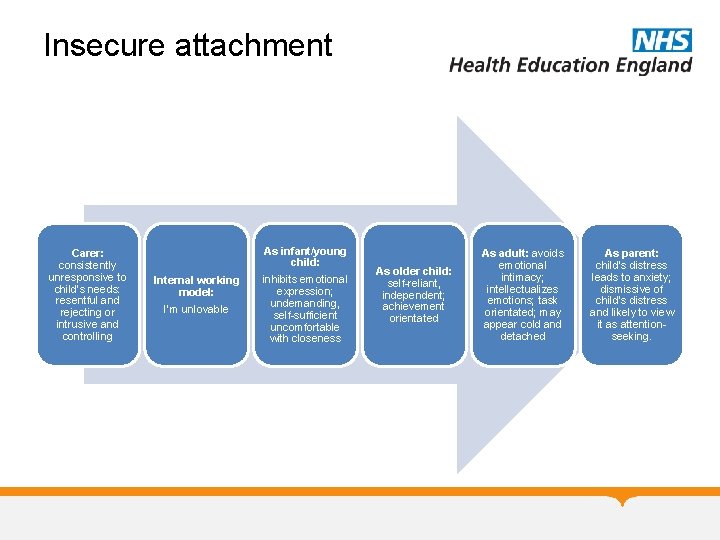
Insecure attachment Carer: consistently unresponsive to child’s needs: resentful and rejecting or intrusive and controlling Internal working model: I’m unlovable As infant/young child: inhibits emotional expression; undemanding, self-sufficient uncomfortable with closeness As older child: self-reliant, independent; achievement orientated As adult: avoids emotional intimacy; intellectualizes emotions; task orientated; may appear cold and detached As parent: child’s distress leads to anxiety; dismissive of child’s distress and likely to view it as attentionseeking.
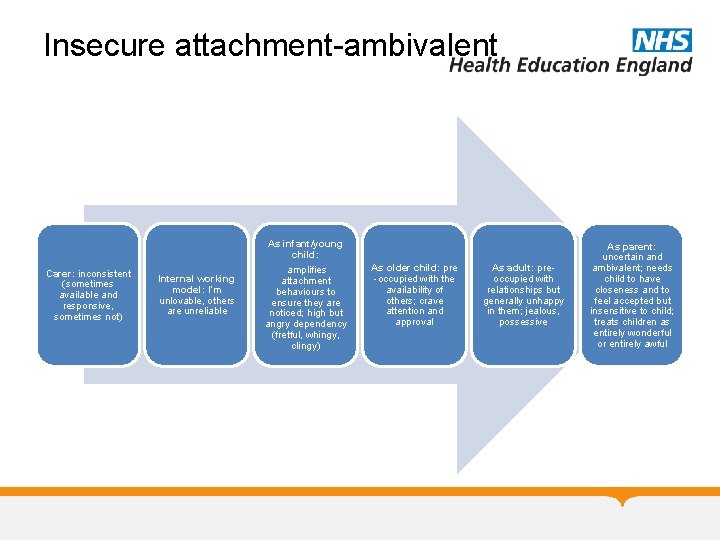
Insecure attachment-ambivalent Carer: inconsistent (sometimes available and responsive, sometimes not) Internal working model: I’m unlovable, others are unreliable As infant/young child: amplifies attachment behaviours to ensure they are noticed; high but angry dependency (fretful, whingy, clingy) As older child: pre -occupied with the availability of others; crave attention and approval As adult: preoccupied with relationships but generally unhappy in them; jealous, possessive As parent: uncertain and ambivalent; needs child to have closeness and to feel accepted but insensitive to child; treats children as entirely wonderful or entirely awful
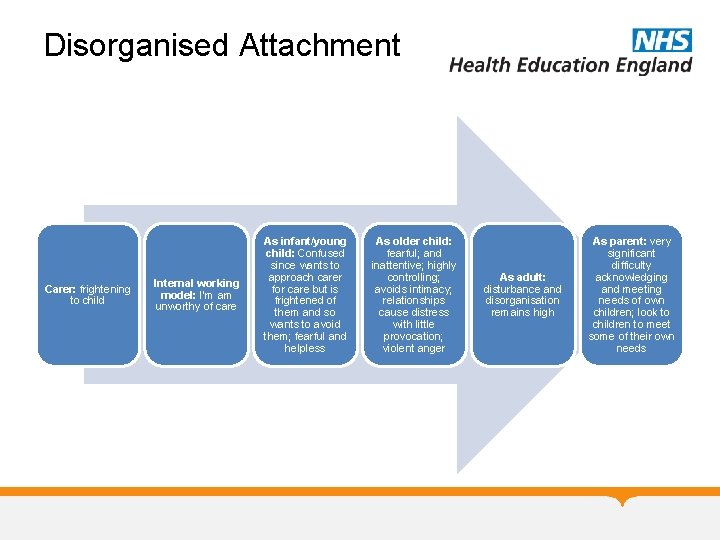
Disorganised Attachment Carer: frightening to child Internal working model: I’m am unworthy of care As infant/young child: Confused since wants to approach carer for care but is frightened of them and so wants to avoid them; fearful and helpless As older child: fearful; and inattentive; highly controlling; avoids intimacy; relationships cause distress with little provocation; violent anger As adult: disturbance and disorganisation remains high As parent: very significant difficulty acknowledging and meeting needs of own children; look to children to meet some of their own needs
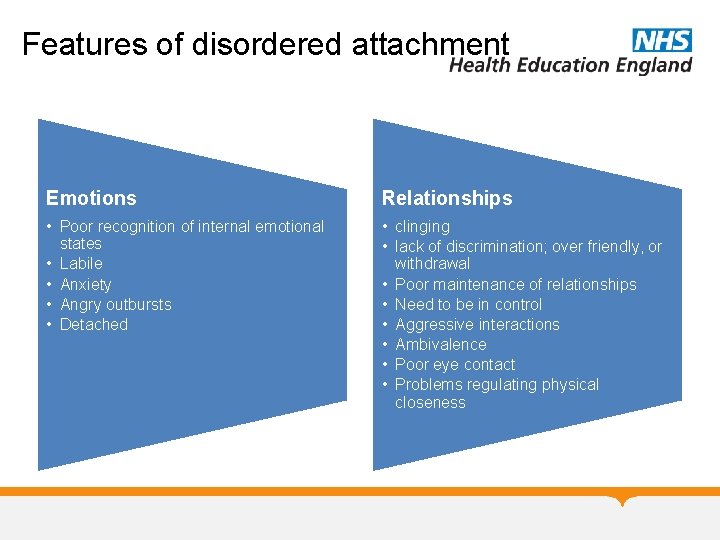
Features of disordered attachment Emotions Relationships • Poor recognition of internal emotional states • Labile • Anxiety • Angry outbursts • Detached • clinging • lack of discrimination; over friendly, or withdrawal • Poor maintenance of relationships • Need to be in control • Aggressive interactions • Ambivalence • Poor eye contact • Problems regulating physical closeness
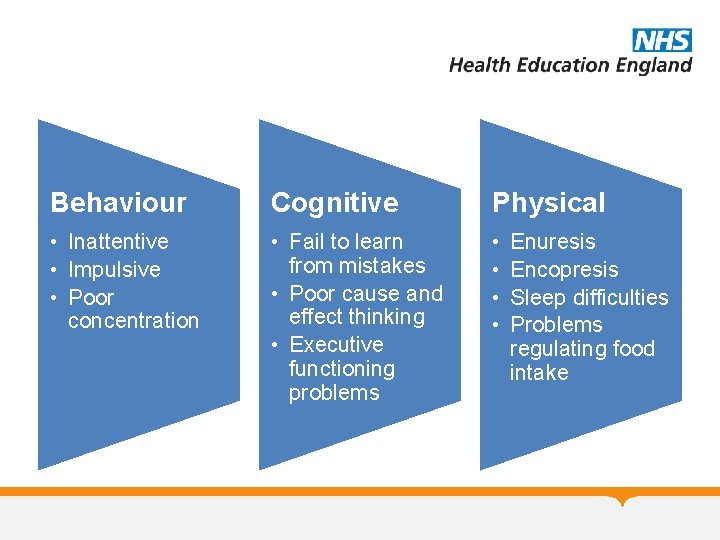
Behaviour Cognitive Physical • Inattentive • Impulsive • Poor concentration • Fail to learn from mistakes • Poor cause and effect thinking • Executive functioning problems • • Enuresis Encopresis Sleep difficulties Problems regulating food intake
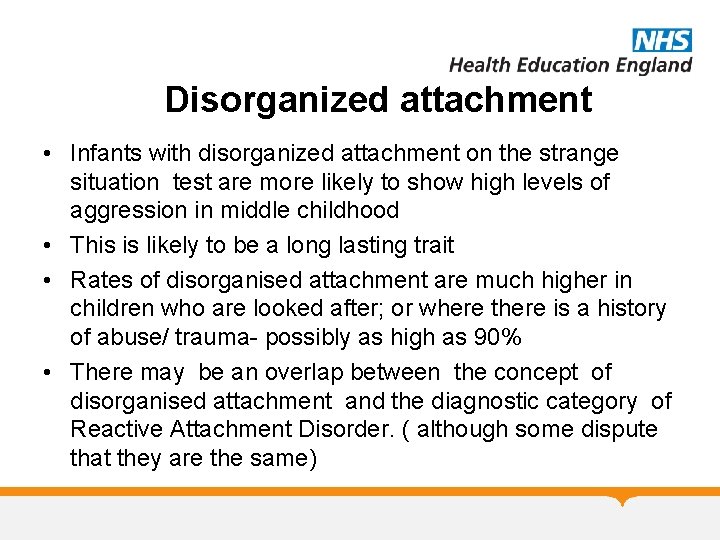
Disorganized attachment • Infants with disorganized attachment on the strange situation test are more likely to show high levels of aggression in middle childhood • This is likely to be a long lasting trait • Rates of disorganised attachment are much higher in children who are looked after; or where there is a history of abuse/ trauma- possibly as high as 90% • There may be an overlap between the concept of disorganised attachment and the diagnostic category of Reactive Attachment Disorder. ( although some dispute that they are the same)
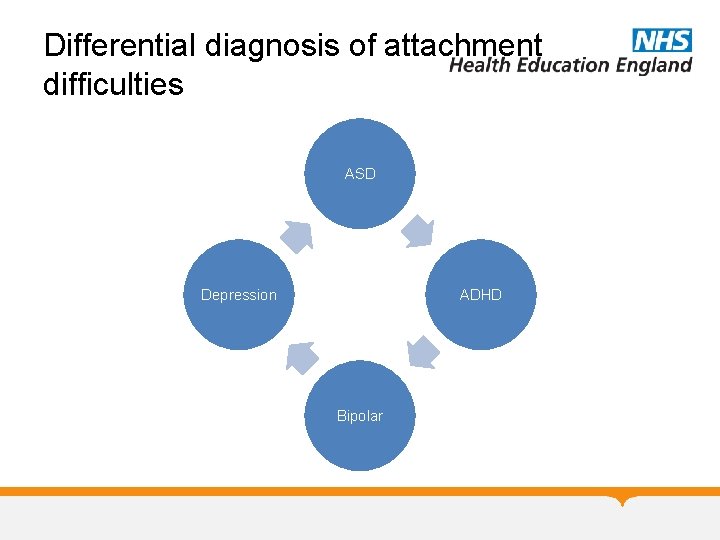
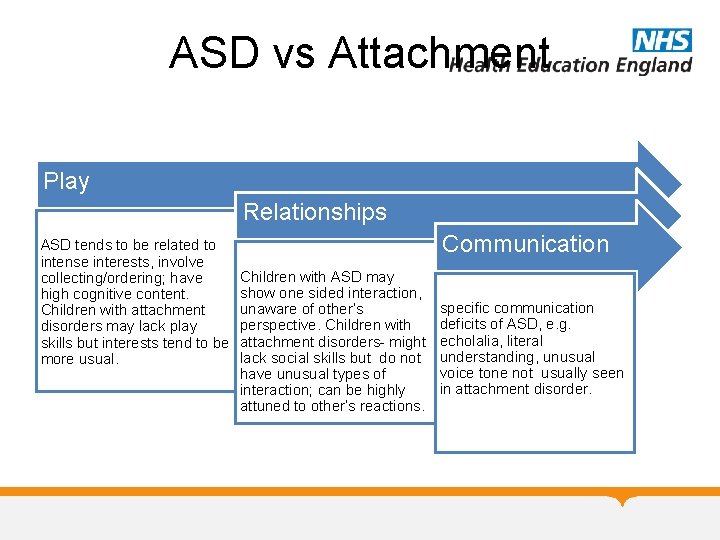
Differential diagnosis of attachment difficulties ASD Depression ADHD Bipolar
ASD vs Attachment Play Relationships ASD tends to be related to intense interests, involve collecting/ordering; have high cognitive content. Children with attachment disorders may lack play skills but interests tend to be more usual. Communication Children with ASD may show one sided interaction, specific communication unaware of other’s deficits of ASD, e. g. perspective. Children with attachment disorders- might echolalia, literal lack social skills but do not understanding, unusual voice tone not usually seen have unusual types of in attachment disorder. interaction; can be highly attuned to other’s reactions.
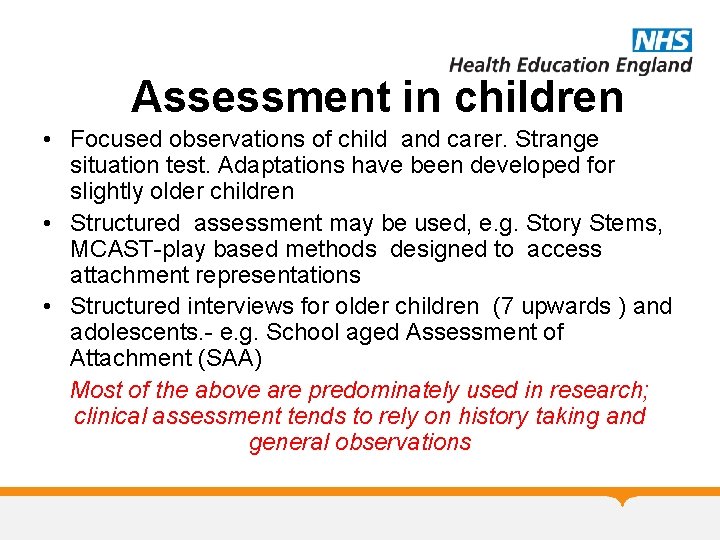
Assessment in children • Focused observations of child and carer. Strange situation test. Adaptations have been developed for slightly older children • Structured assessment may be used, e. g. Story Stems, MCAST-play based methods designed to access attachment representations • Structured interviews for older children (7 upwards ) and adolescents. - e. g. School aged Assessment of Attachment (SAA) Most of the above are predominately used in research; clinical assessment tends to rely on history taking and general observations
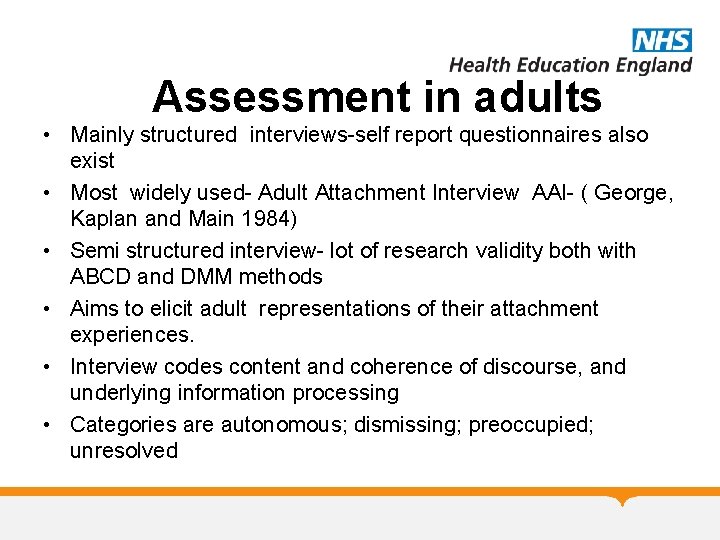
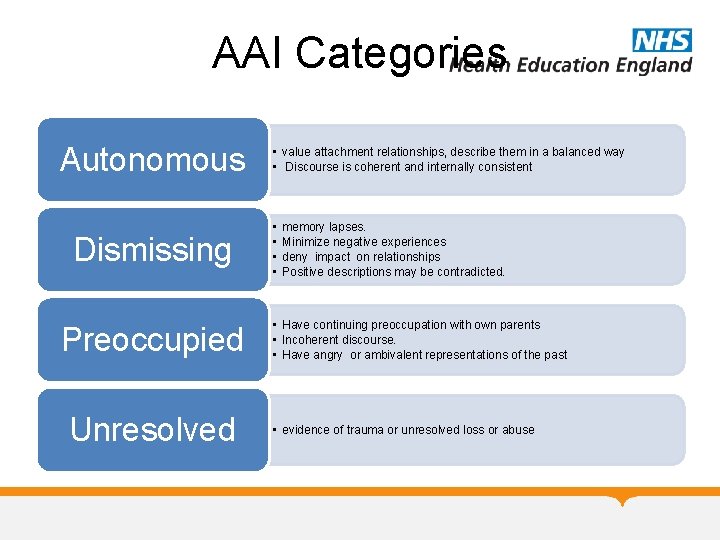
Assessment in adults • Mainly structured interviews-self report questionnaires also exist • Most widely used- Adult Attachment Interview AAI- ( George, Kaplan and Main 1984) • Semi structured interview- lot of research validity both with ABCD and DMM methods • Aims to elicit adult representations of their attachment experiences. • Interview codes content and coherence of discourse, and underlying information processing • Categories are autonomous; dismissing; preoccupied; unresolved
AAI Categories Autonomous Dismissing Preoccupied Unresolved • value attachment relationships, describe them in a balanced way • Discourse is coherent and internally consistent • • memory lapses. Minimize negative experiences deny impact on relationships Positive descriptions may be contradicted. • Have continuing preoccupation with own parents • Incoherent discourse. • Have angry or ambivalent representations of the past • evidence of trauma or unresolved loss or abuse
Therapeutic interventions for children • A range of approaches have been developed. • None are, or attempt to be, a substitute for good quality care at home. They can only be an extra. • All professional attachment interventions emphasize the central importance of carers and largely describe therapeutic work with, and through parents, long-term substitute carers or adoptive families.
Principles of care giving for children with disrupted attachments: Looked after children • • • Information giving Co regulation of emotions Limit setting, discipline with empathy Claiming behaviours Help child build narrative about their experiences Carer coping and self care
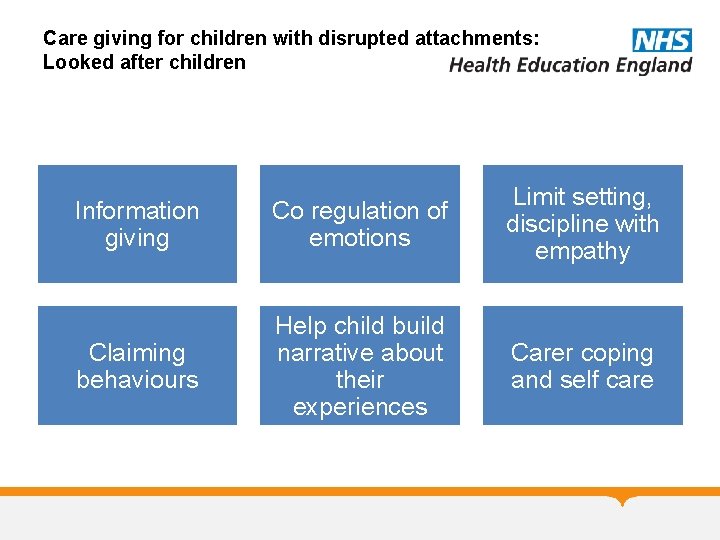
Care giving for children with disrupted attachments: Looked after children Information giving Co regulation of emotions Limit setting, discipline with empathy Claiming behaviours Help child build narrative about their experiences Carer coping and self care
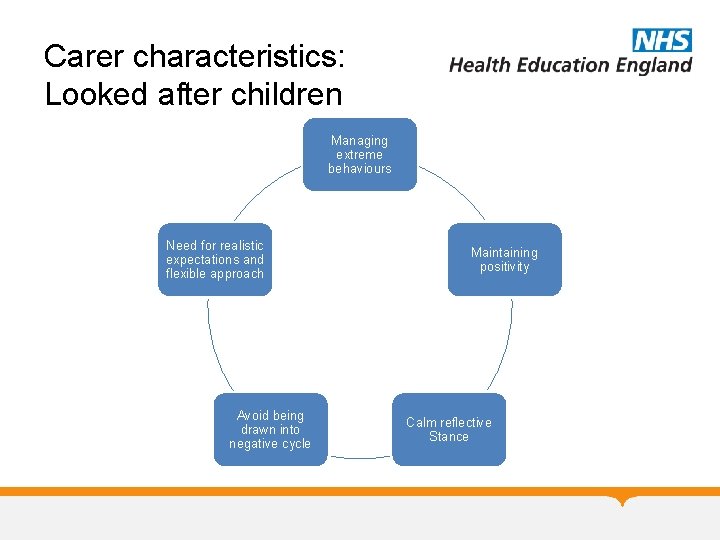
Carer characteristics: Looked after children Managing extreme behaviours Need for realistic expectations and flexible approach Avoid being drawn into negative cycle Maintaining positivity Calm reflective Stance
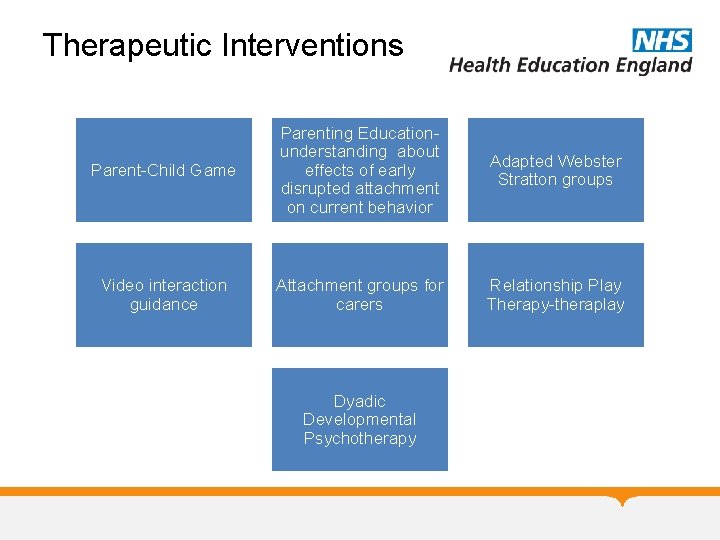
Therapeutic Interventions Parent-Child Game Parenting Educationunderstanding about effects of early disrupted attachment on current behavior Adapted Webster Stratton groups Video interaction guidance Attachment groups for carers Relationship Play Therapy-theraplay Dyadic Developmental Psychotherapy
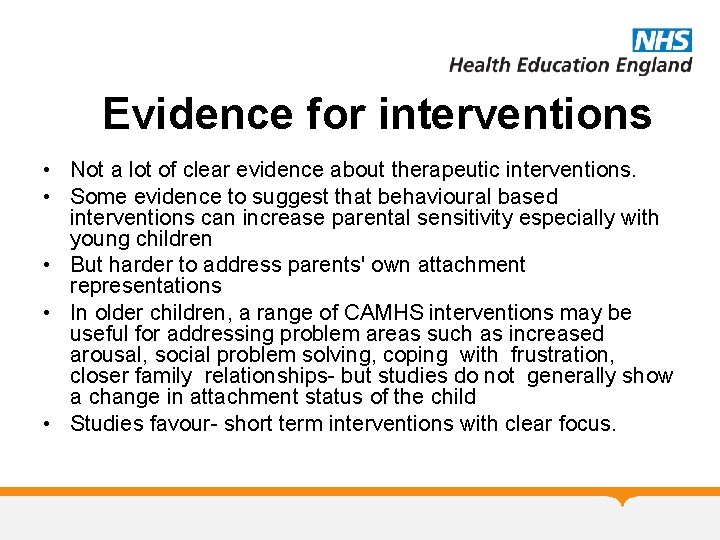
Evidence for interventions • Not a lot of clear evidence about therapeutic interventions. • Some evidence to suggest that behavioural based interventions can increase parental sensitivity especially with young children • But harder to address parents' own attachment representations • In older children, a range of CAMHS interventions may be useful for addressing problem areas such as increased arousal, social problem solving, coping with frustration, closer family relationships- but studies do not generally show a change in attachment status of the child • Studies favour- short term interventions with clear focus.
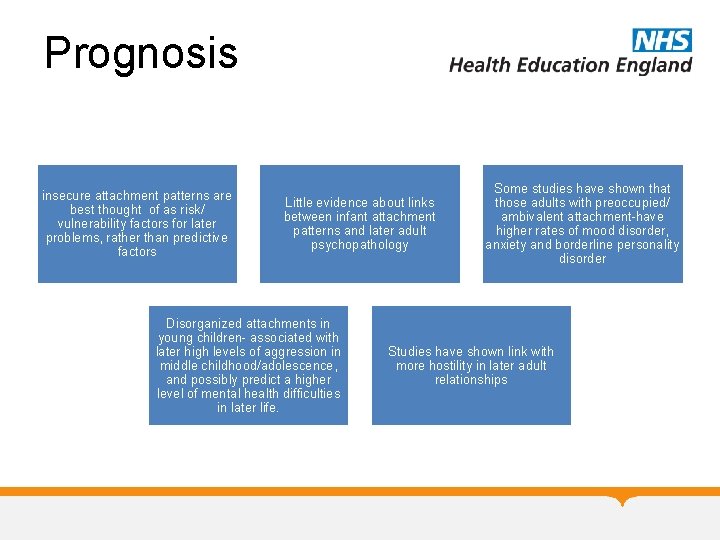
Prognosis insecure attachment patterns are best thought of as risk/ vulnerability factors for later problems, rather than predictive factors Little evidence about links between infant attachment patterns and later adult psychopathology Disorganized attachments in young children- associated with later high levels of aggression in middle childhood/adolescence, and possibly predict a higher level of mental health difficulties in later life. Some studies have shown that those adults with preoccupied/ ambivalent attachment-have higher rates of mood disorder, anxiety and borderline personality disorder Studies have shown link with more hostility in later adult relationships
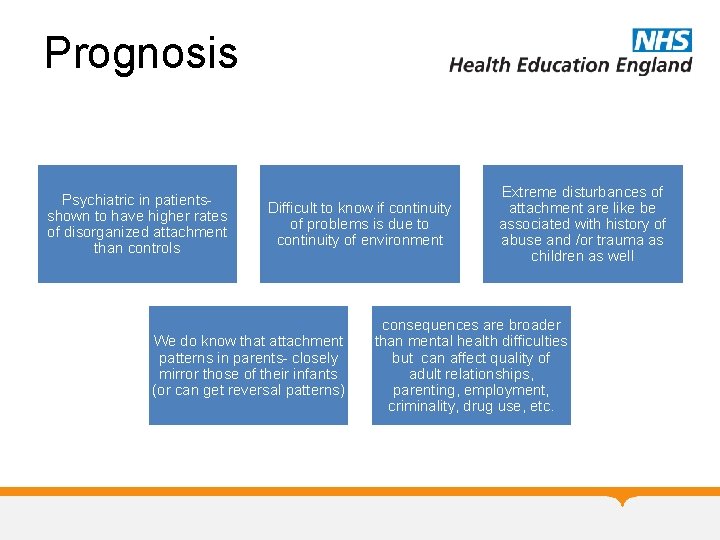
Prognosis Psychiatric in patients- shown to have higher rates of disorganized attachment than controls Difficult to know if continuity of problems is due to continuity of environment We do know that attachment patterns in parents- closely mirror those of their infants (or can get reversal patterns) Extreme disturbances of attachment are like be associated with history of abuse and /or trauma as children as well consequences are broader than mental health difficulties but can affect quality of adult relationships, parenting, employment, criminality, drug use, etc.
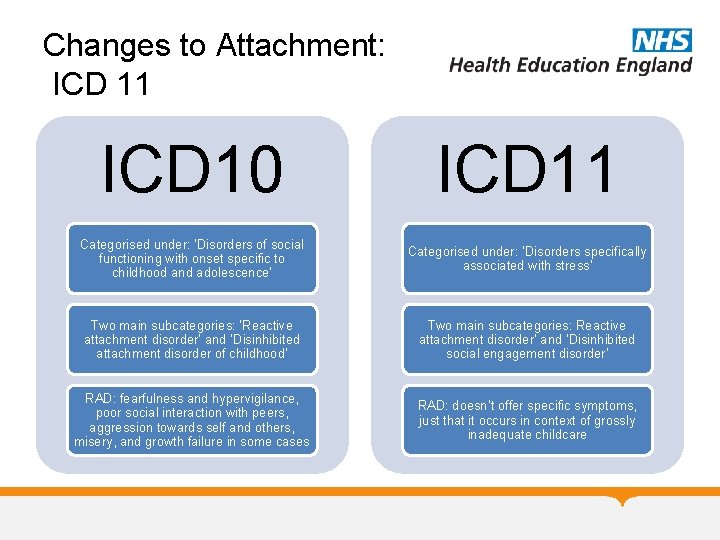
Changes to Attachment: ICD 11 ICD 10 ICD 11 Categorised under: ‘Disorders of social functioning with onset specific to childhood and adolescence’ Categorised under: ‘Disorders specifically associated with stress’ Two main subcategories: ‘Reactive attachment disorder’ and ‘Disinhibited attachment disorder of childhood’ Two main subcategories: Reactive attachment disorder’ and ‘Disinhibited social engagement disorder’ RAD: fearfulness and hypervigilance, poor social interaction with peers, aggression towards self and others, misery, and growth failure in some cases RAD: doesn’t offer specific symptoms, just that it occurs in context of grossly inadequate childcare
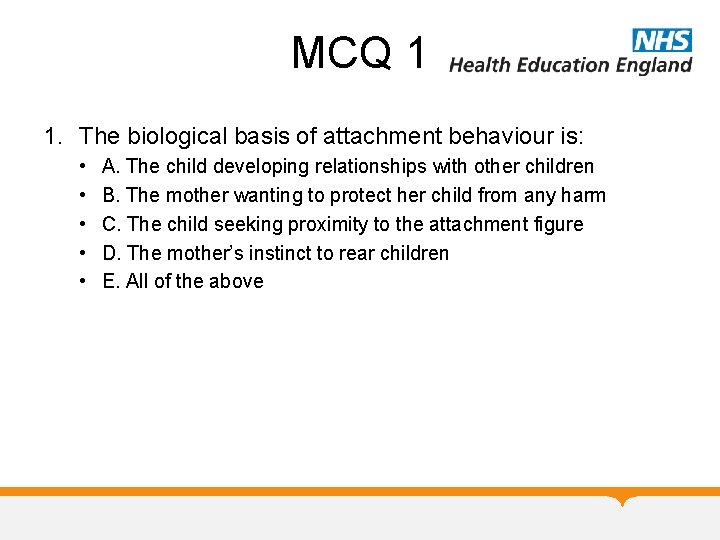
MCQ 1 1. The biological basis of attachment behaviour is: • • • A. The child developing relationships with other children B. The mother wanting to protect her child from any harm C. The child seeking proximity to the attachment figure D. The mother’s instinct to rear children E. All of the above
Answer • E
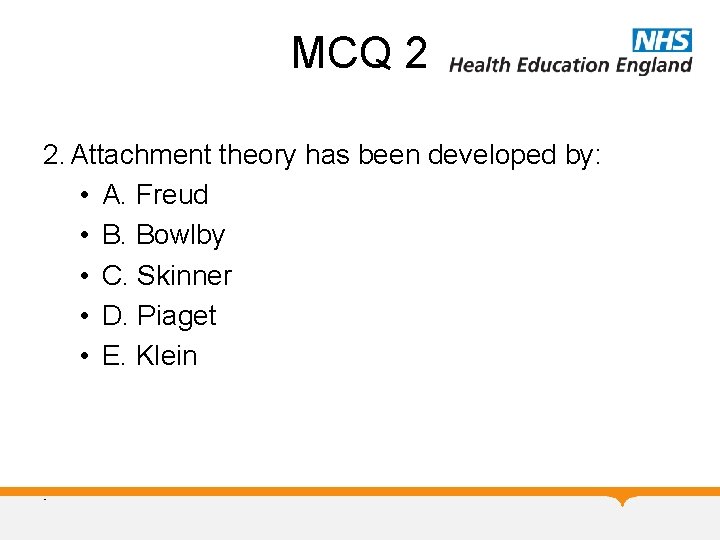
MCQ 2 2. Attachment theory has been developed by: • A. Freud • B. Bowlby • C. Skinner • D. Piaget • E. Klein •
Answer • B
MCQ 3 3. ‘Institutional deprivation” occur in the context of which ICD 11 diagnosis? : • • • A. Generalised anxiety disorder B. Phobic anxiety disorder C. PTSD D. Reactive attachment disorder E. Paranoid personality disorder
Answer • D
MCQ 4 4. Select a feature that does NOT form part of Reactive Attachment Disorder (ICD 11) but points towards Pervasive Developmental Disorders: • A. Abnormal pattern of social responsiveness that improves if child is placed in normal rearing environment • B. Aggressive responses towards their own or other’s distress • C. Restricted, repetitive interests and behaviours • D. Strongly contradictory social responses • E. None of the above
Answer • C
MCQ 5 5. Reactive Attachment Disorder of early infancy and childhood (DSM V) and Reactive Attachment Disorder of (ICD 11) share common diagnostic criteria. Which of the following is NOT a diagnostic feature in ICD 11: • A. Developed before age of 5 years • B. Does not turn to primary caregiver for comfort • C. Does not display security seeking behaviour • D. Does not respond when comfort is offered • E. None of the above
Answer • E
MCQ 6 6. Which of the following features is NOT part of Disinhibited Social engagement Disorder (ICD 11): • • • A. Approaches adults indiscriminately B. Exhibits over familiar behaviour with strangers C. Features develop within first 5 years of life D. Occurs in context of grossly inadequate childcare E. Abnormal speech development including echolalia
Answer • E
MCQ 7 7. Which of the following cognitive age ranges must a child reach to develop an attachment relationship: • A. 2 -5 months • B. 7 -9 months • C. 2 years • D. 5 years • E. 7 years
Answer • B
MCQ 8 8. What is the procedure called that assesses a child’s attachment behaviour: • • • A. Novel Situation Test B. Attachment Assessment Procedure C. Strange Situation Procedure D. Mother - Infant Attachment Battery E. None of the above
Answer • C
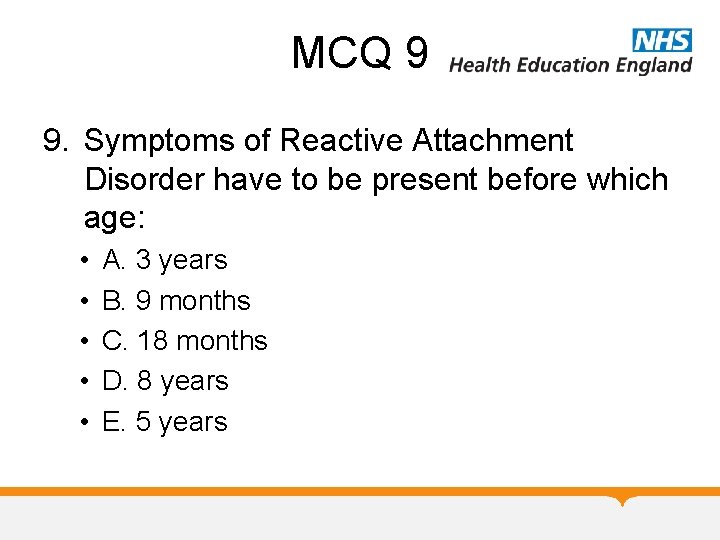
MCQ 9 9. Symptoms of Reactive Attachment Disorder have to be present before which age: • • • A. 3 years B. 9 months C. 18 months D. 8 years E. 5 years
Answer • E
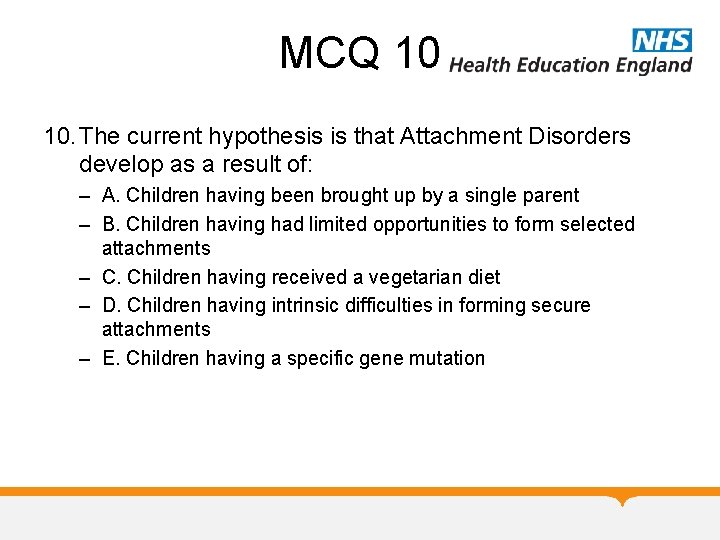
MCQ 10 10. The current hypothesis is that Attachment Disorders develop as a result of: – A. Children having been brought up by a single parent – B. Children having had limited opportunities to form selected attachments – C. Children having received a vegetarian diet – D. Children having intrinsic difficulties in forming secure attachments – E. Children having a specific gene mutation
Answer • B