
ATTACHMENT 2 An Overview of the New ASME


- Slides: 23
ATTACHMENT 2 An Overview of the New ASME Section VIII, Division 2 Pressure Vessel Code API Exploration & Production Standards Conference on Oilfield Equipment and Materials Technical Session 1: Applications of Standards Research San Francisco, CA, June 26, 2007 David A. Osage The Equity Engineering Group, Inc. Shaker Heights, Ohio USA 1
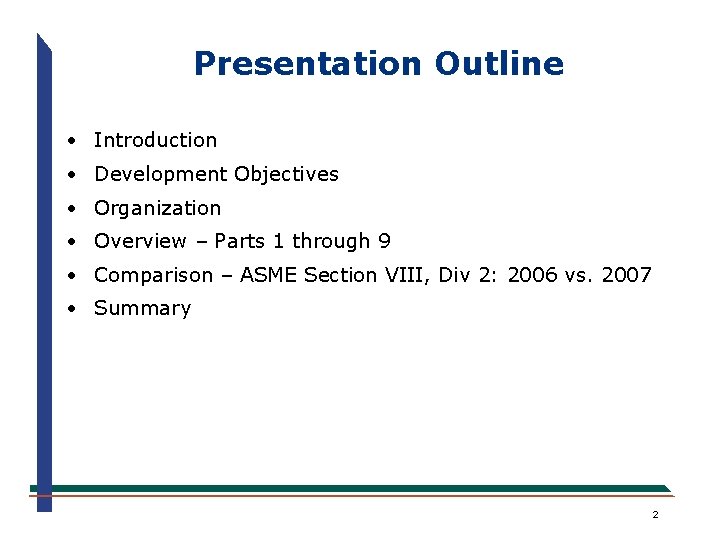
Presentation Outline · Introduction · Development Objectives · Organization · Overview – Parts 1 through 9 · Comparison – ASME Section VIII, Div 2: 2006 vs. 2007 · Summary 2
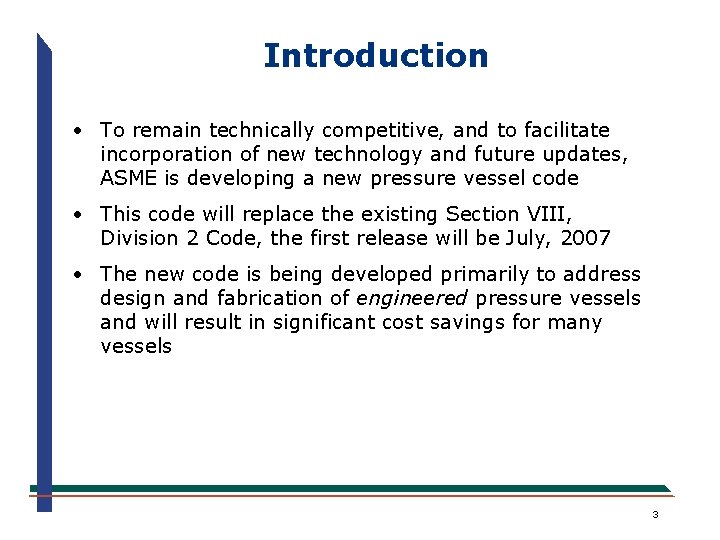
Introduction · To remain technically competitive, and to facilitate incorporation of new technology and future updates, ASME is developing a new pressure vessel code · This code will replace the existing Section VIII, Division 2 Code, the first release will be July, 2007 · The new code is being developed primarily to address design and fabrication of engineered pressure vessels and will result in significant cost savings for many vessels 3
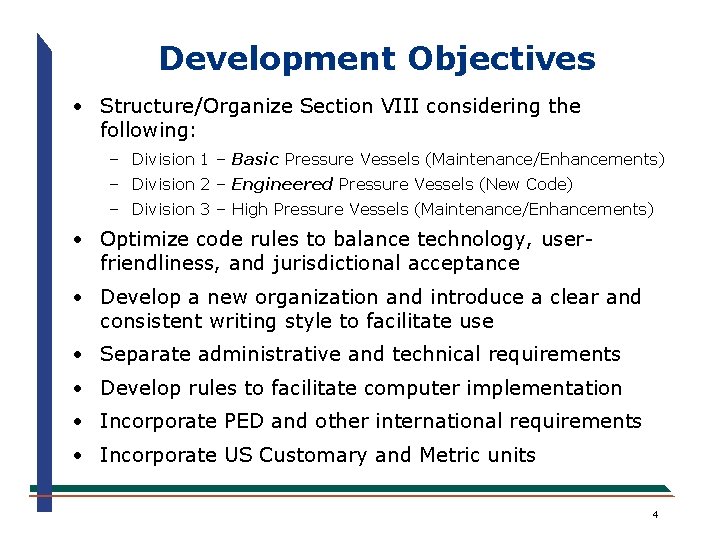
Development Objectives · Structure/Organize Section VIII considering the following: – Division 1 – Basic Pressure Vessels (Maintenance/Enhancements) – Division 2 – Engineered Pressure Vessels (New Code) – Division 3 – High Pressure Vessels (Maintenance/Enhancements) · Optimize code rules to balance technology, userfriendliness, and jurisdictional acceptance · Develop a new organization and introduce a clear and consistent writing style to facilitate use · Separate administrative and technical requirements · Develop rules to facilitate computer implementation · Incorporate PED and other international requirements · Incorporate US Customary and Metric units 4
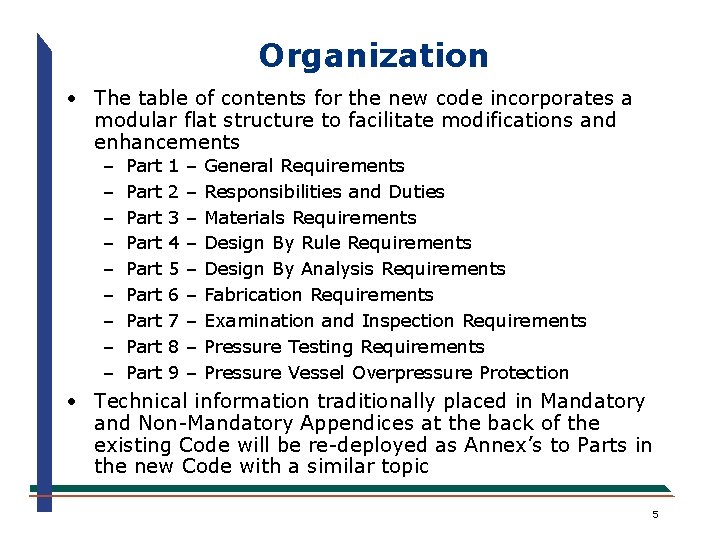
Organization · The table of contents for the new code incorporates a modular flat structure to facilitate modifications and enhancements – – – – – Part Part Part 1 2 3 4 5 6 7 8 9 – – – – – General Requirements Responsibilities and Duties Materials Requirements Design By Rule Requirements Design By Analysis Requirements Fabrication Requirements Examination and Inspection Requirements Pressure Testing Requirements Pressure Vessel Overpressure Protection · Technical information traditionally placed in Mandatory and Non-Mandatory Appendices at the back of the existing Code will be re-deployed as Annex’s to Parts in the new Code with a similar topic 5
Overview Part 1 – General Requirements • Introduction, Organization and Definitions • Scope and Jurisdiction • Pressure Vessels with High Design Pressures • Unfired Steam Boilers • Field Assembly • Referenced Standards • Units of Measure, Metric and US Customary 6
Overview Part 2 – Duties and Responsibilities • User responsibilities • Manufacturers responsibilities • Inspectors duties • Annexes on User Design Specification (UDS) and the Manufacturers Design Report (MDR) • Separation of administrative and technical requirements, administrative requirements placed in Informative Annexes 7
Overview Part 2 – Duties and Responsibilities · UDS and MDR – Registered Professional Engineer (RPE) requirement – RPE certification has been in the Code since the first issuance; however, codes and standards covering similar equipment do not require RPE certification (e. g. ASME Div. 1, ASME B 31. 3, API, European, etc. ) – RPE certification is unique to USA and Canada – Industry questionnaire confirmed that RPE certification of UDS and MDR is a barrier to the use of the existing Div 2 • Alternative to the RPE certification developed Certification of Compliance approach, certification of the UDS and MDR by the individuals in responsible charge of the design and manufacture of the vessel 8
Overview Part 3 – Material Requirements · New allowable stress basis will typically result in higher allowable stresses and lower wall thickness, extent of wall thickness reduction is a function of the YS/TS ratio at the design temperature · Justification for higher allowable stresses and reduced wall thickness – – – Experience obtained from other PV construction codes More stringent material requirements Higher material toughness requirement Better design rules Increased NDE · New material models for strength parameters (i. e. stress -strain curves) and physical properties provided to facilitate design and numerical analysis requirements 9
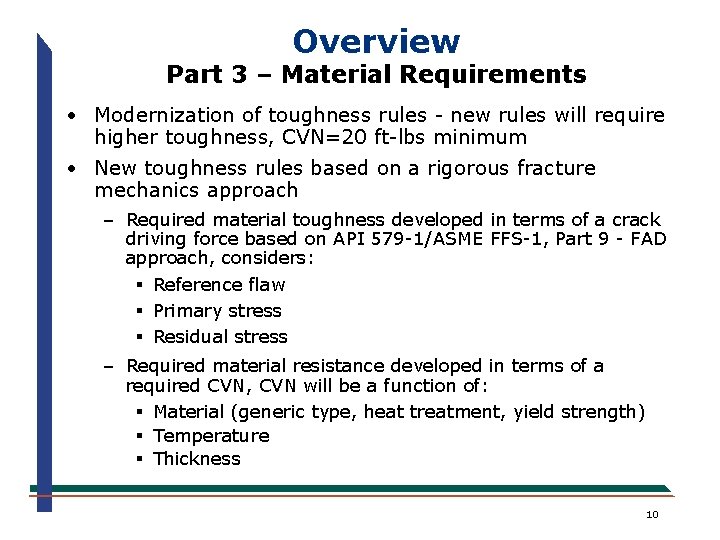
Overview Part 3 – Material Requirements · Modernization of toughness rules - new rules will require higher toughness, CVN=20 ft-lbs minimum · New toughness rules based on a rigorous fracture mechanics approach – Required material toughness developed in terms of a crack driving force based on API 579 -1/ASME FFS-1, Part 9 - FAD approach, considers: § Reference flaw § Primary stress § Residual stress – Required material resistance developed in terms of a required CVN, CVN will be a function of: § Material (generic type, heat treatment, yield strength) § Temperature § Thickness 10
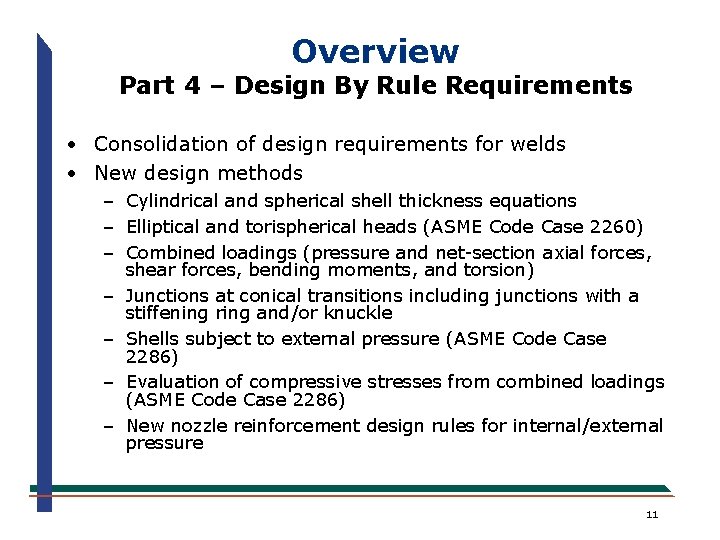
Overview Part 4 – Design By Rule Requirements · Consolidation of design requirements for welds · New design methods – Cylindrical and spherical shell thickness equations – Elliptical and torispherical heads (ASME Code Case 2260) – Combined loadings (pressure and net-section axial forces, shear forces, bending moments, and torsion) – Junctions at conical transitions including junctions with a stiffening ring and/or knuckle – Shells subject to external pressure (ASME Code Case 2286) – Evaluation of compressive stresses from combined loadings (ASME Code Case 2286) – New nozzle reinforcement design rules for internal/external pressure 11
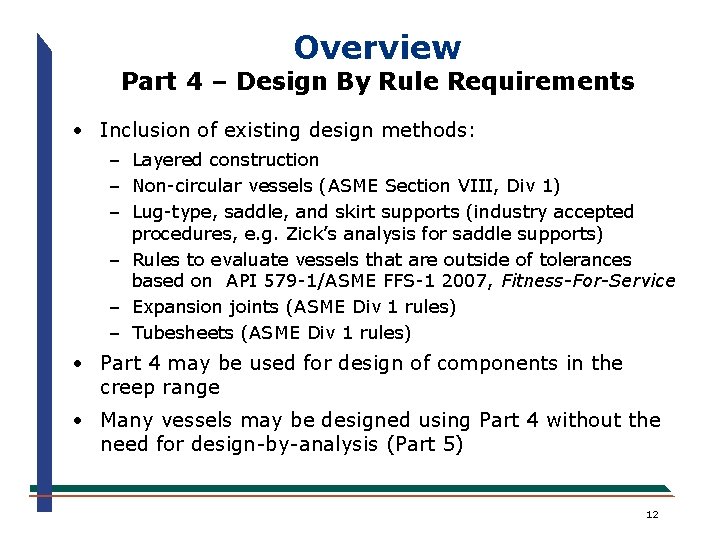
Overview Part 4 – Design By Rule Requirements · Inclusion of existing design methods: – Layered construction – Non-circular vessels (ASME Section VIII, Div 1) – Lug-type, saddle, and skirt supports (industry accepted procedures, e. g. Zick’s analysis for saddle supports) – Rules to evaluate vessels that are outside of tolerances based on API 579 -1/ASME FFS-1 2007, Fitness-For-Service – Expansion joints (ASME Div 1 rules) – Tubesheets (ASME Div 1 rules) · Part 4 may be used for design of components in the creep range · Many vessels may be designed using Part 4 without the need for design-by-analysis (Part 5) 12
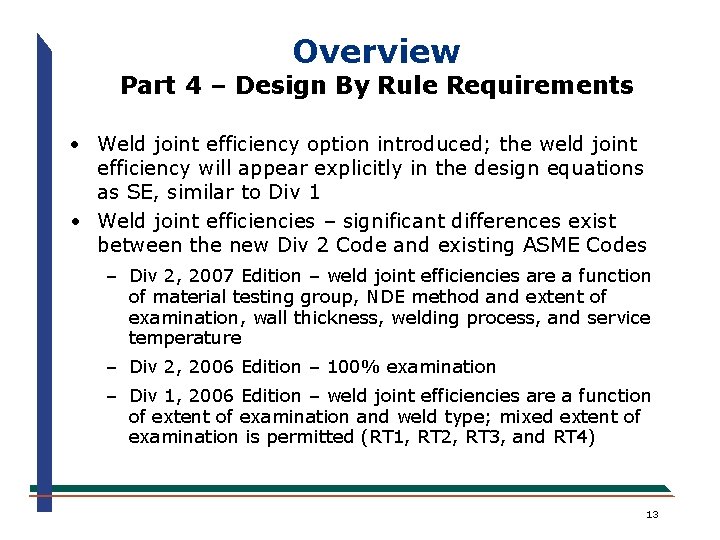
Overview Part 4 – Design By Rule Requirements · Weld joint efficiency option introduced; the weld joint efficiency will appear explicitly in the design equations as SE, similar to Div 1 • Weld joint efficiencies – significant differences exist between the new Div 2 Code and existing ASME Codes – Div 2, 2007 Edition – weld joint efficiencies are a function of material testing group, NDE method and extent of examination, wall thickness, welding process, and service temperature – Div 2, 2006 Edition – 100% examination – Div 1, 2006 Edition – weld joint efficiencies are a function of extent of examination and weld type; mixed extent of examination is permitted (RT 1, RT 2, RT 3, and RT 4) 13
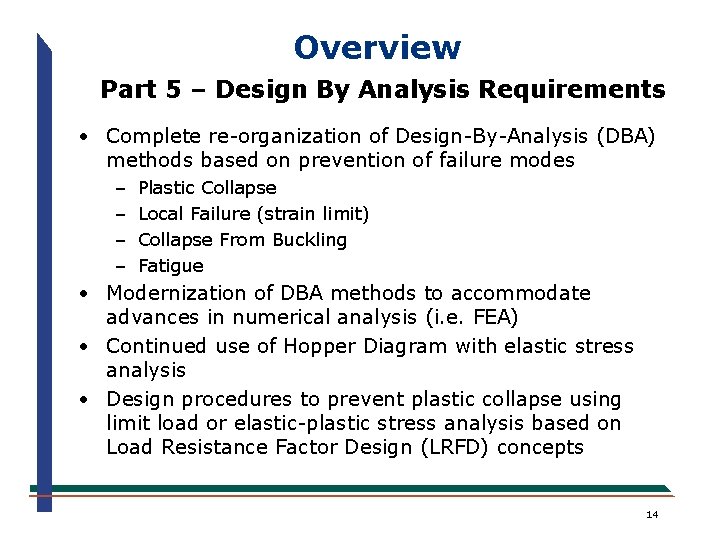
Overview Part 5 – Design By Analysis Requirements · Complete re-organization of Design-By-Analysis (DBA) methods based on prevention of failure modes – – Plastic Collapse Local Failure (strain limit) Collapse From Buckling Fatigue · Modernization of DBA methods to accommodate advances in numerical analysis (i. e. FEA) · Continued use of Hopper Diagram with elastic stress analysis · Design procedures to prevent plastic collapse using limit load or elastic-plastic stress analysis based on Load Resistance Factor Design (LRFD) concepts 14
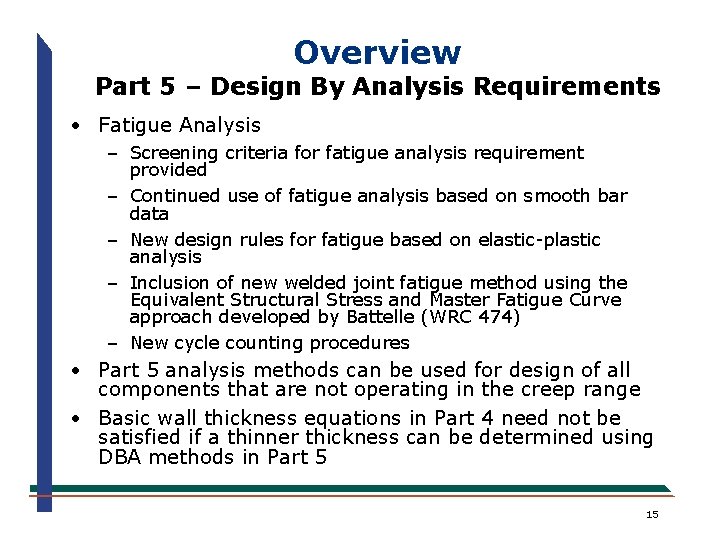
Overview Part 5 – Design By Analysis Requirements · Fatigue Analysis – Screening criteria for fatigue analysis requirement provided – Continued use of fatigue analysis based on smooth bar data – New design rules for fatigue based on elastic-plastic analysis – Inclusion of new welded joint fatigue method using the Equivalent Structural Stress and Master Fatigue Curve approach developed by Battelle (WRC 474) – New cycle counting procedures · Part 5 analysis methods can be used for design of all components that are not operating in the creep range · Basic wall thickness equations in Part 4 need not be satisfied if a thinner thickness can be determined using DBA methods in Part 5 15
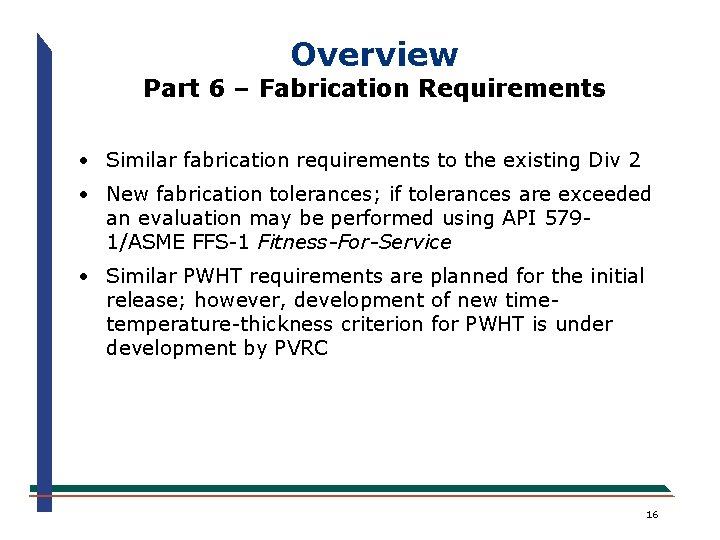
Overview Part 6 – Fabrication Requirements · Similar fabrication requirements to the existing Div 2 · New fabrication tolerances; if tolerances are exceeded an evaluation may be performed using API 5791/ASME FFS-1 Fitness-For-Service · Similar PWHT requirements are planned for the initial release; however, development of new timetemperature-thickness criterion for PWHT is under development by PVRC 16
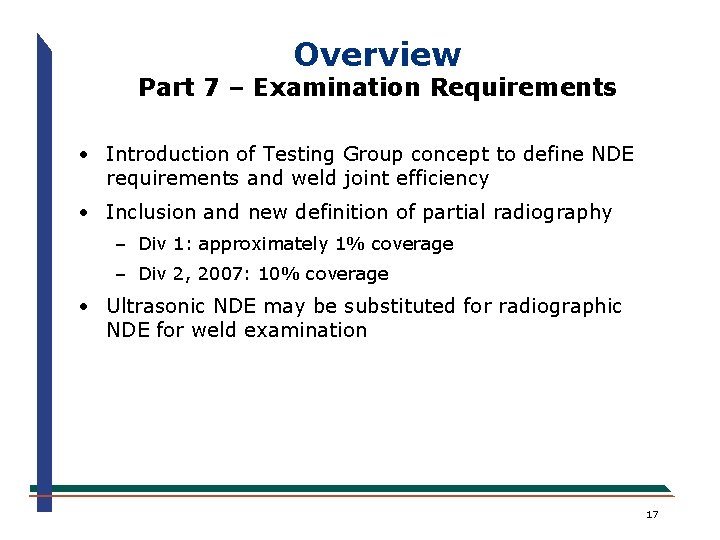
Overview Part 7 – Examination Requirements · Introduction of Testing Group concept to define NDE requirements and weld joint efficiency · Inclusion and new definition of partial radiography – Div 1: approximately 1% coverage – Div 2, 2007: 10% coverage · Ultrasonic NDE may be substituted for radiographic NDE for weld examination 17
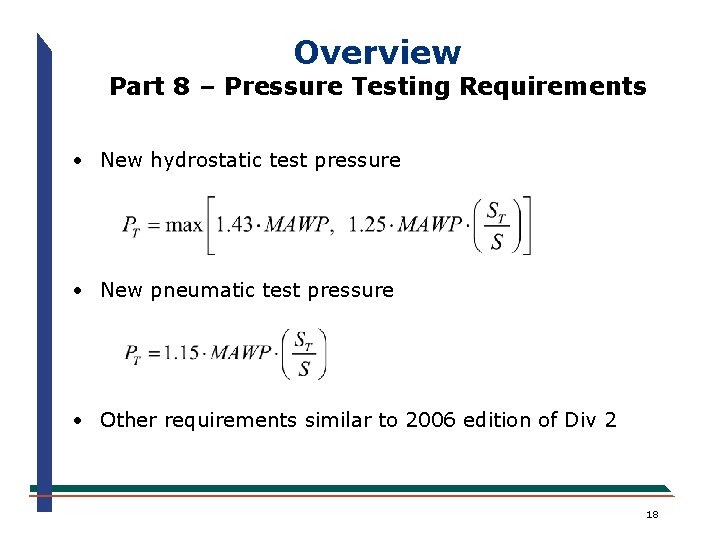
Overview Part 8 – Pressure Testing Requirements · New hydrostatic test pressure · New pneumatic test pressure · Other requirements similar to 2006 edition of Div 2 18
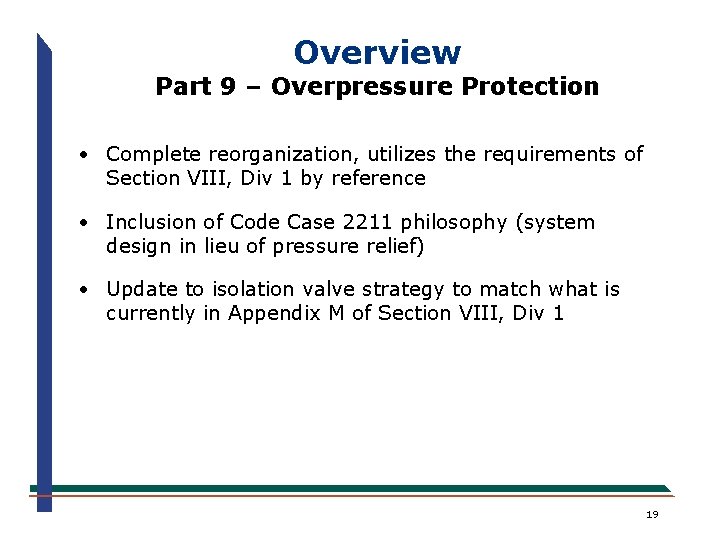
Overview Part 9 – Overpressure Protection · Complete reorganization, utilizes the requirements of Section VIII, Div 1 by reference · Inclusion of Code Case 2211 philosophy (system design in lieu of pressure relief) · Update to isolation valve strategy to match what is currently in Appendix M of Section VIII, Div 1 19
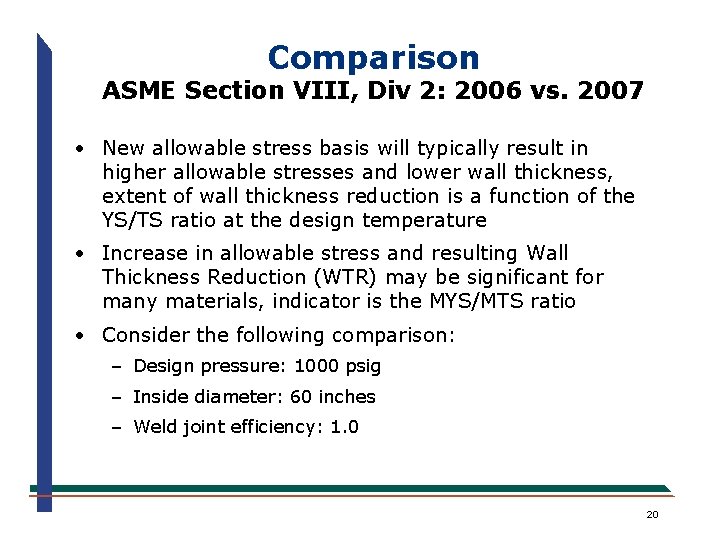
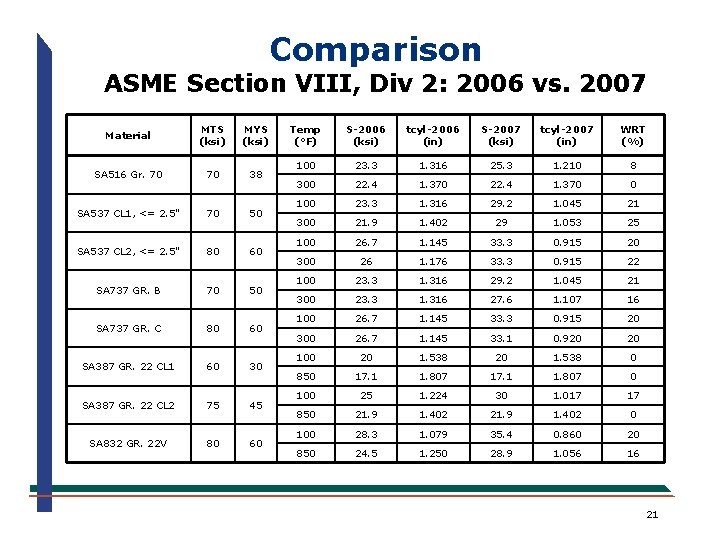
Comparison ASME Section VIII, Div 2: 2006 vs. 2007 · New allowable stress basis will typically result in higher allowable stresses and lower wall thickness, extent of wall thickness reduction is a function of the YS/TS ratio at the design temperature · Increase in allowable stress and resulting Wall Thickness Reduction (WTR) may be significant for many materials, indicator is the MYS/MTS ratio · Consider the following comparison: – Design pressure: 1000 psig – Inside diameter: 60 inches – Weld joint efficiency: 1. 0 20
Comparison ASME Section VIII, Div 2: 2006 vs. 2007 Material MTS (ksi) MYS (ksi) SA 516 Gr. 70 70 38 SA 537 CL 1, <= 2. 5" 70 50 SA 537 CL 2, <= 2. 5" 80 60 SA 737 GR. B 70 50 SA 737 GR. C 80 60 SA 387 GR. 22 CL 1 60 30 SA 387 GR. 22 CL 2 75 45 SA 832 GR. 22 V 80 60 Temp (°F) S-2006 (ksi) tcyl-2006 (in) S-2007 (ksi) tcyl-2007 (in) WRT (%) 100 23. 3 1. 316 25. 3 1. 210 8 300 22. 4 1. 370 0 100 23. 3 1. 316 29. 2 1. 045 21 300 21. 9 1. 402 29 1. 053 25 100 26. 7 1. 145 33. 3 0. 915 20 300 26 1. 176 33. 3 0. 915 22 100 23. 3 1. 316 29. 2 1. 045 21 300 23. 3 1. 316 27. 6 1. 107 16 100 26. 7 1. 145 33. 3 0. 915 20 300 26. 7 1. 145 33. 1 0. 920 20 100 20 1. 538 0 850 17. 1 1. 807 0 100 25 1. 224 30 1. 017 17 850 21. 9 1. 402 0 100 28. 3 1. 079 35. 4 0. 860 20 850 24. 5 1. 250 28. 9 1. 056 16 21
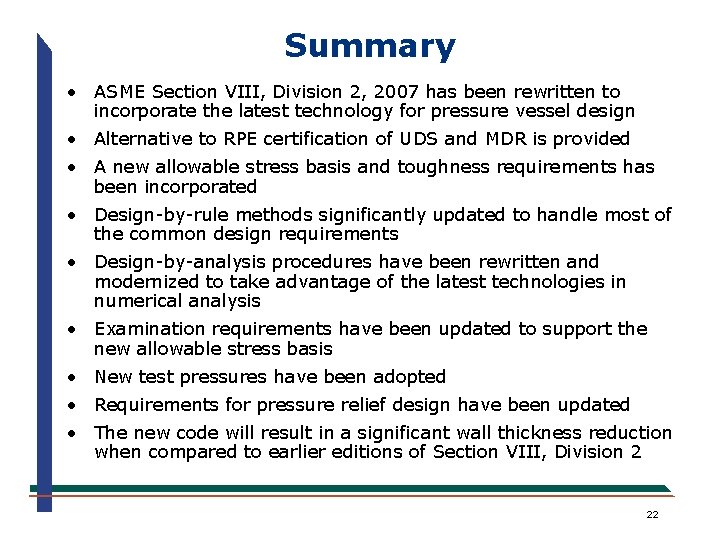
Summary • ASME Section VIII, Division 2, 2007 has been rewritten to incorporate the latest technology for pressure vessel design • Alternative to RPE certification of UDS and MDR is provided • A new allowable stress basis and toughness requirements has been incorporated • Design-by-rule methods significantly updated to handle most of the common design requirements • Design-by-analysis procedures have been rewritten and modernized to take advantage of the latest technologies in numerical analysis • Examination requirements have been updated to support the new allowable stress basis • New test pressures have been adopted • Requirements for pressure relief design have been updated • The new code will result in a significant wall thickness reduction when compared to earlier editions of Section VIII, Division 2 22
20600 Chagrin Blvd. • Suite 1200 Shaker Heights, OH 44122 USA Phone: 216 -283 -9519 • Fax: 216 -283 -6022 www. equityeng. com 23