
Atrial Fibrillation Detection Device ADVISOR MANI MINA CLIENT
Atrial Fibrillation Detection Device ADVISOR: MANI MINA CLIENT: DR. RAKSHAK SARDA CONTACT: BENJAMIN SJULSON GROUP MEMBERS: IAN ABBOTT SETH RICKARD AARON MELCER KEEGAN MUMMA NICHOLAS DUBOIS DONATHAN MORGAN May 1615

What is Atrial Fibrillation? Irregular and often rapid heart rate that can increase the risk of stroke, heart failure and other heart-related complications. Over 33. 5 million people in the world have been diagnosed with Atrial Fibrillation Symptoms include: May 1615 General fatigue Rapid and Irregular Heartbeat Fluttering or “Thumping” in the Chest Dizziness Shortness of Breath Weakness
Intended Users Lower income areas of the world Little to no access to professional medical equipment Largescale use of android based smartphones India is the 3 rd largest smartphone market in the world May 1615 Projected to reach 314 million mobile internet users by 2017 Consumer electronics outnumber commercial medical solutions Intended to be distributed by doctors diagnosing heart problems
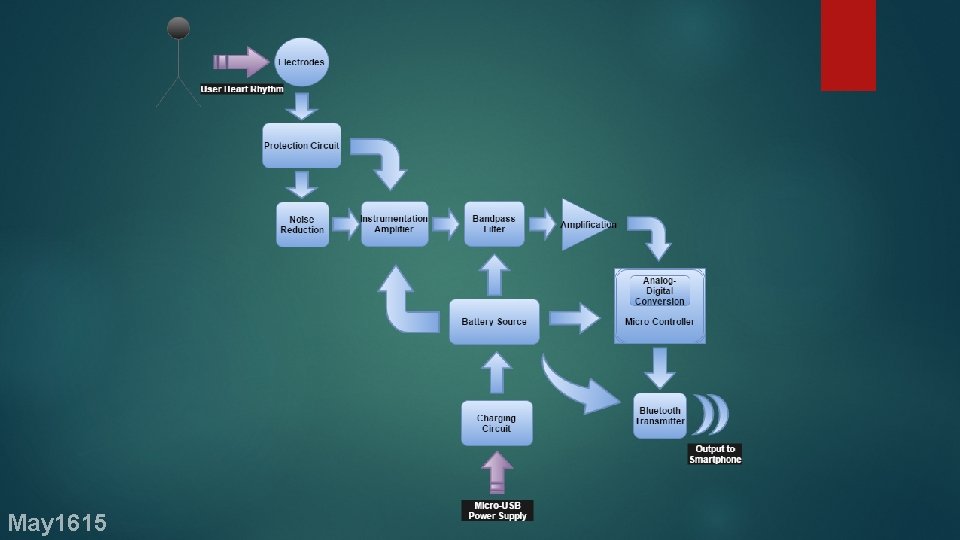
Our Solution Low cost ECG monitor Android companion application Low power MCU Low power Bluetooth connection core Algorithm to detect Atrial Fibrillation May 1615
Functional Requirements Low Power – Can last a day on battery power Rechargeable – Using commonly available charger Safety Circuit – Protect user/circuitry from shock Long Lifespan – Durable components Bluetooth Connection Display ECG Output Detect Atrial Fibrillation May 1615
Nonfunctional Requirements Easily Wearable Light weight Small form factor Low Cost Durable May 1615 Protective enclosure for circuitry Intuitive Simple UI/UX Easily localizable
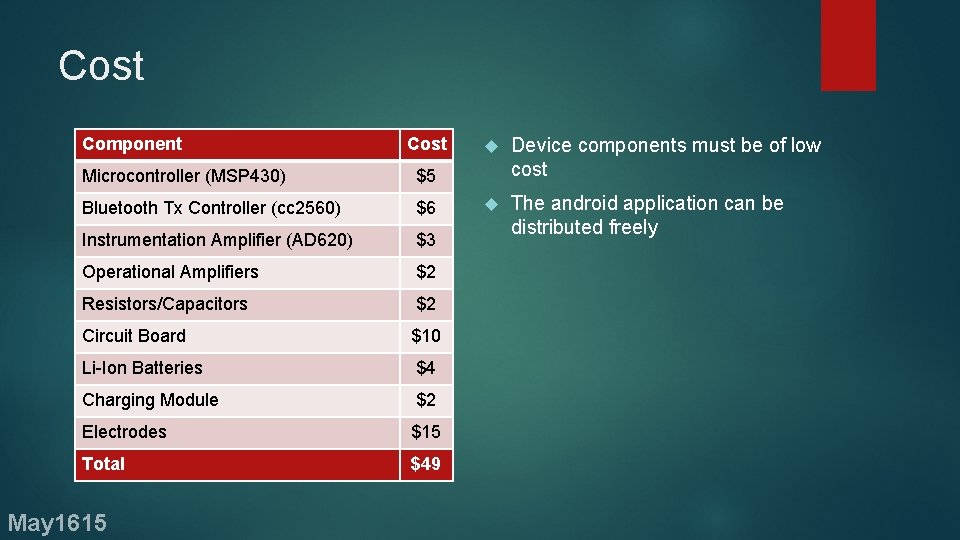
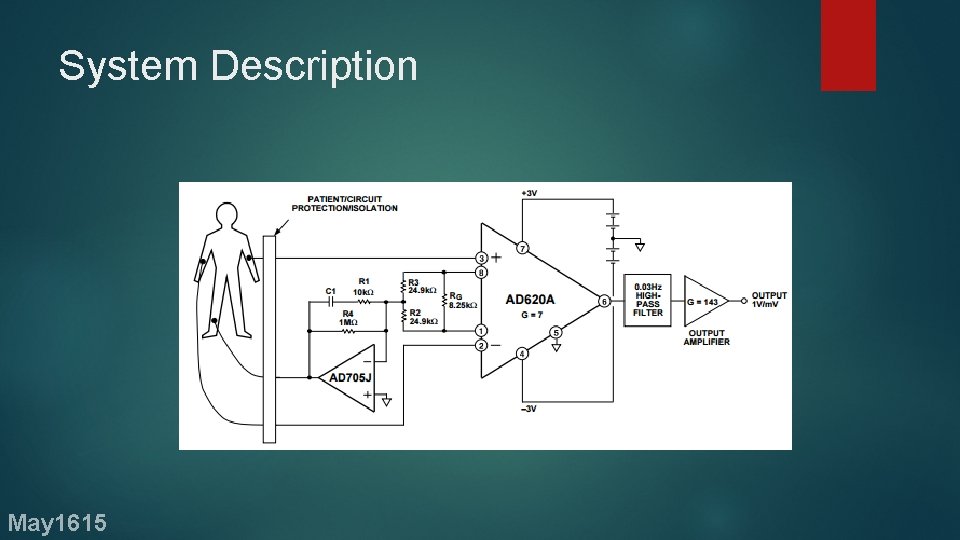
Cost Component Cost Microcontroller (MSP 430) $5 Bluetooth Tx Controller (cc 2560) $6 Instrumentation Amplifier (AD 620) $3 Operational Amplifiers $2 Resistors/Capacitors $2 Circuit Board $10 Li-Ion Batteries $4 Charging Module $2 Electrodes $15 Total $49 May 1615 Device components must be of low cost The android application can be distributed freely
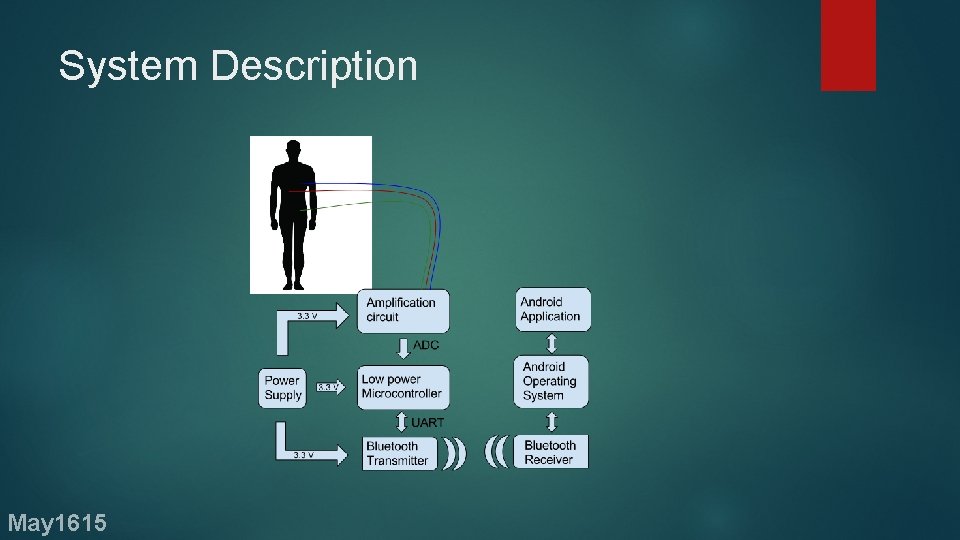
System Description May 1615
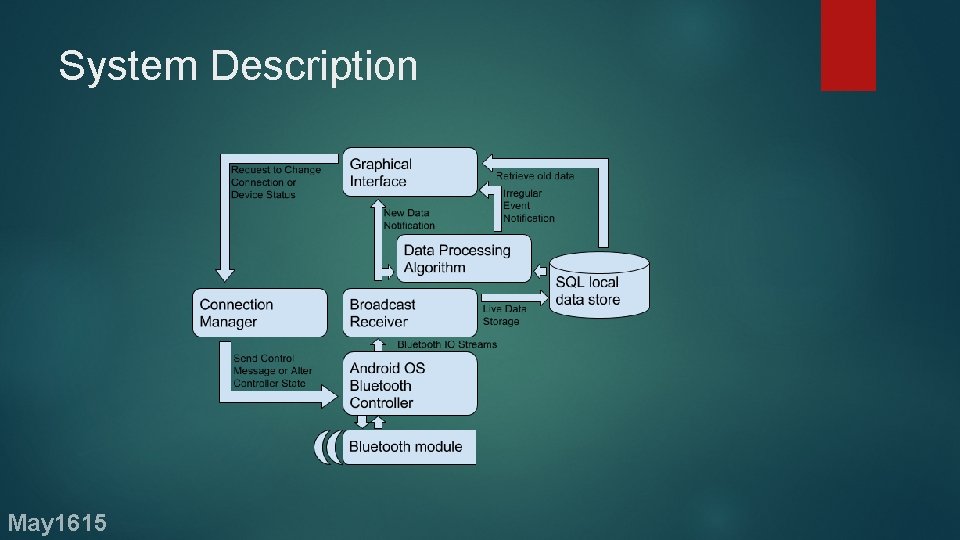
System Description May 1615
May 1615
System Description May 1615
Validation Acceptance Test The physical device will be thoroughly tested by providing a functional equivalent of an Afib Heart Rate signal Software can be tested with j. Unit tests and Android framework testing Bluetooth can be stubbed out to confirm that the application is working Real world testing would begin once the above three testing phases are complete May 1615
Challenges Creating a reliable connection between the amplification circuit and the subject Integrating the amplification circuit with the MCU Integrating the MCU with the Bluetooth controller Establishing a Bluetooth connection between the hardware and the Android application Transmitting the heart waveform efficiently to the application Ensuring testing reflects functionality May 1615
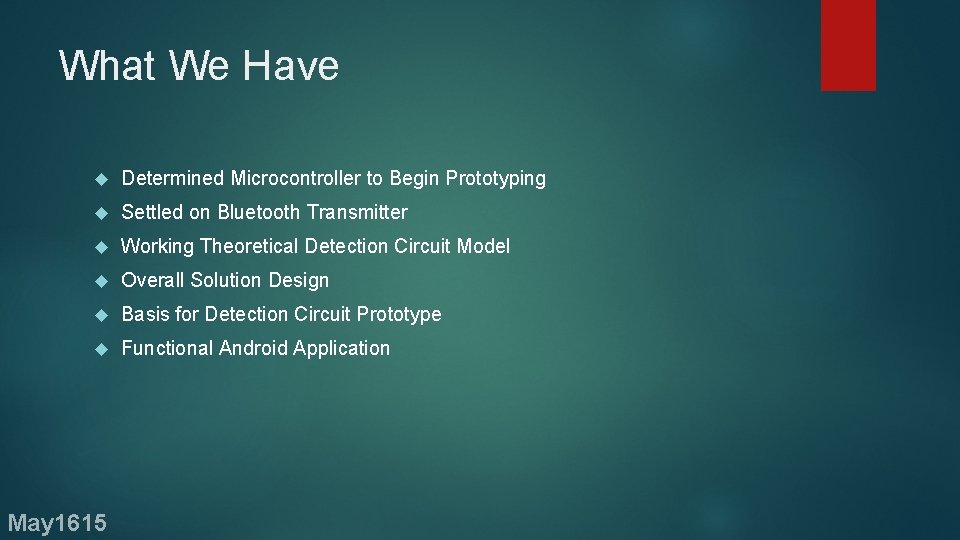
What We Have Determined Microcontroller to Begin Prototyping Settled on Bluetooth Transmitter Working Theoretical Detection Circuit Model Overall Solution Design Basis for Detection Circuit Prototype Functional Android Application May 1615
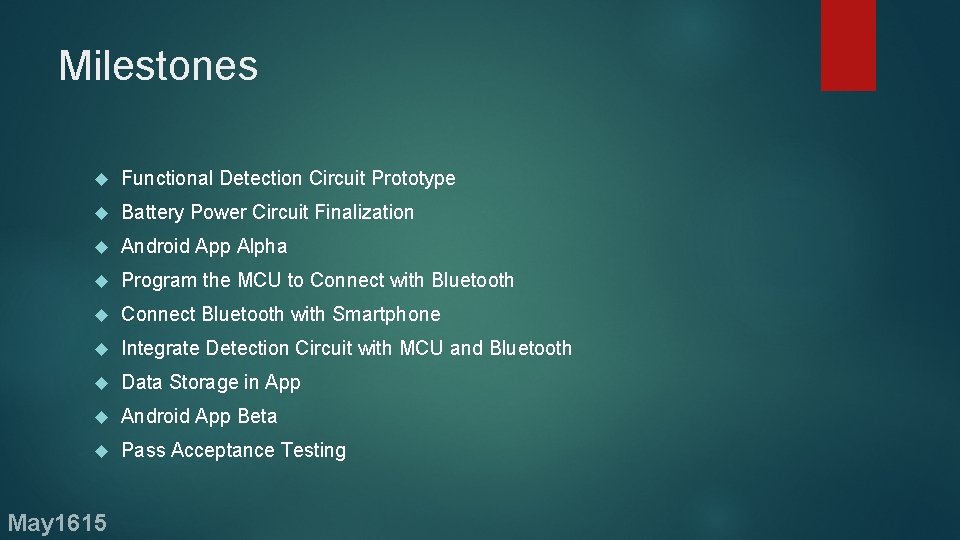
Milestones Functional Detection Circuit Prototype Battery Power Circuit Finalization Android App Alpha Program the MCU to Connect with Bluetooth Connect Bluetooth with Smartphone Integrate Detection Circuit with MCU and Bluetooth Data Storage in App Android App Beta Pass Acceptance Testing May 1615

Questions? May 1615
- Slides: 16