
Atoms Elements The Periodic Table l Matter anything
Atoms, Elements, & The Periodic Table
l Matter – anything that has mass & volume l Element – a substance composed of only 1 kind of atom l Atom – smallest particle of an element atomic structure video clip
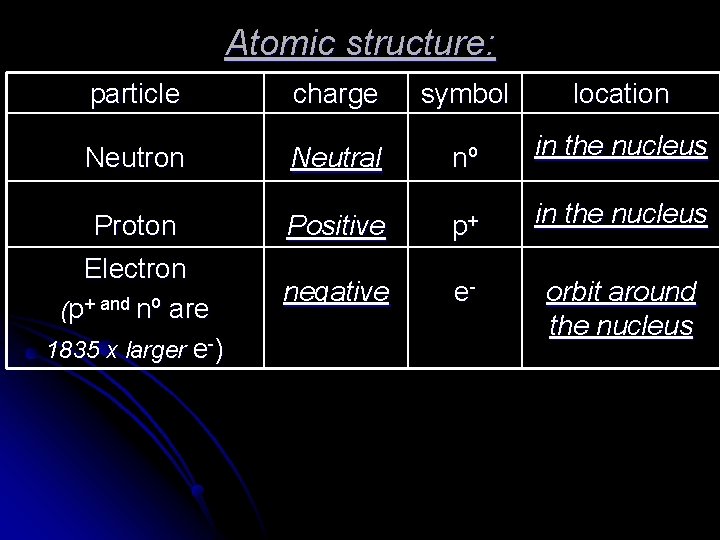
Atomic structure: particle charge symbol location Neutral nº in the nucleus Proton Electron (p+ and nº are 1835 x larger e-) Positive p+ in the nucleus negative e- orbit around the nucleus
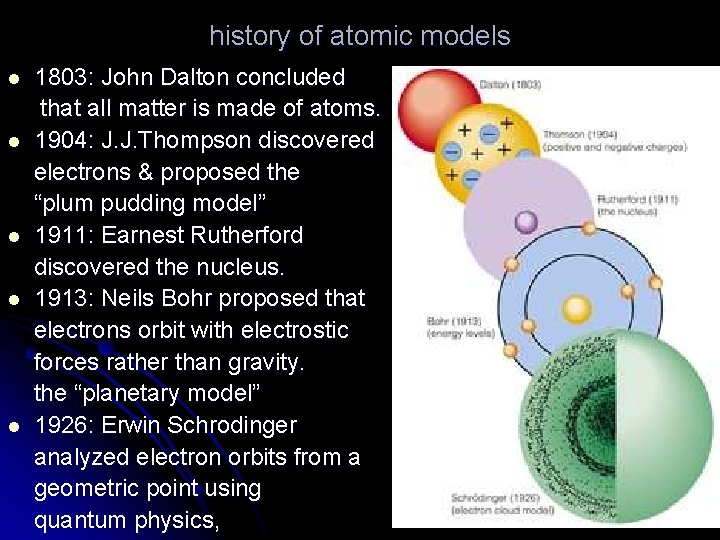
history of atomic models l l l 1803: John Dalton concluded that all matter is made of atoms. 1904: J. J. Thompson discovered electrons & proposed the “plum pudding model” 1911: Earnest Rutherford discovered the nucleus. 1913: Neils Bohr proposed that electrons orbit with electrostic forces rather than gravity. the “planetary model” 1926: Erwin Schrodinger analyzed electron orbits from a geometric point using quantum physics,
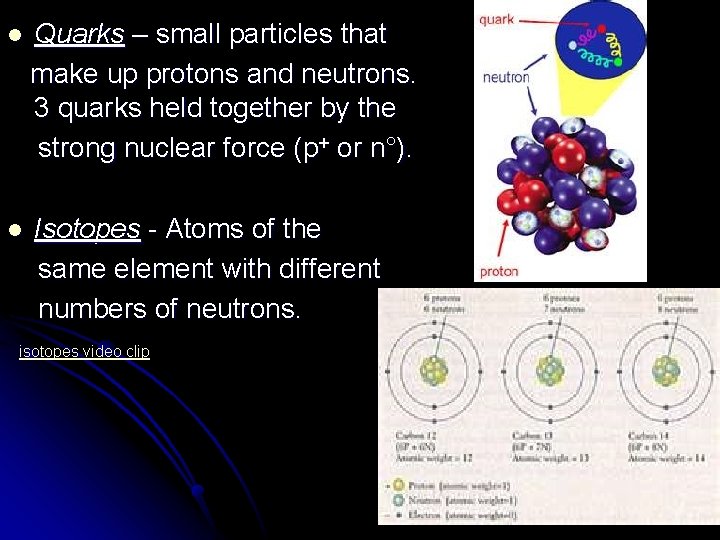
l Quarks – small particles that make up protons and neutrons. 3 quarks held together by the strong nuclear force (p+ or n°). l Isotopes - Atoms of the same element with different numbers of neutrons. isotopes video clip
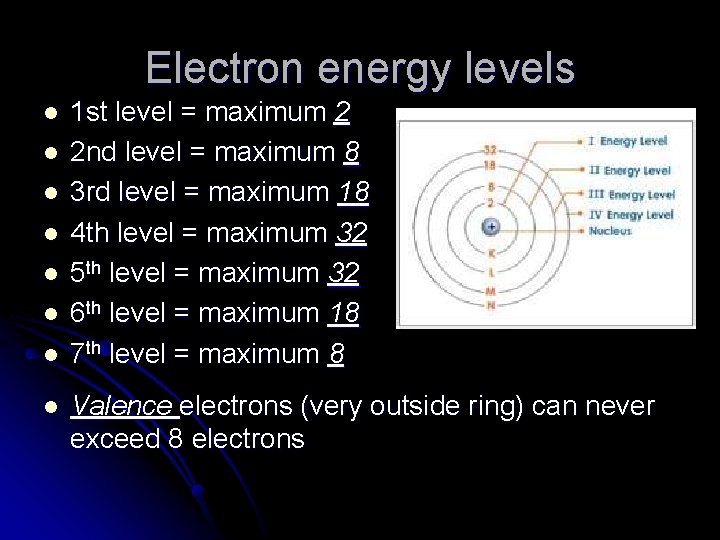
Electron energy levels l l l l 1 st level = maximum 2 2 nd level = maximum 8 3 rd level = maximum 18 4 th level = maximum 32 5 th level = maximum 32 6 th level = maximum 18 7 th level = maximum 8 Valence electrons (very outside ring) can never exceed 8 electrons
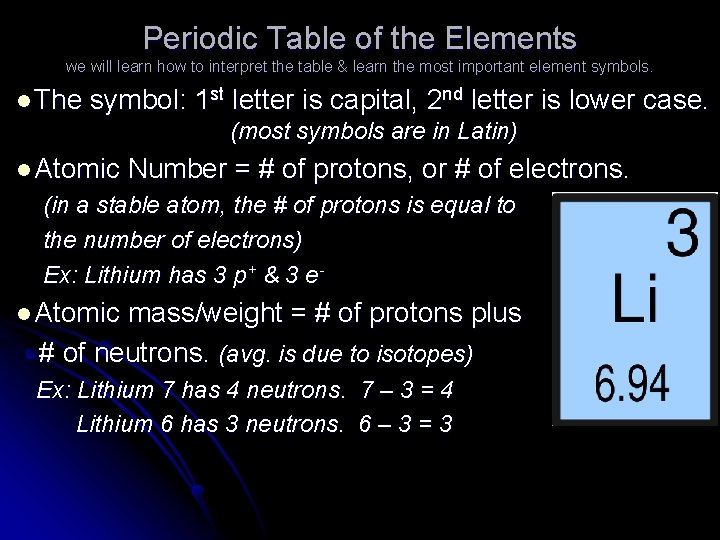
Periodic Table of the Elements we will learn how to interpret the table & learn the most important element symbols. l The symbol: 1 st letter is capital, 2 nd letter is lower case. (most symbols are in Latin) l Atomic Number = # of protons, or # of electrons. (in a stable atom, the # of protons is equal to the number of electrons) Ex: Lithium has 3 p+ & 3 el Atomic mass/weight = # of protons plus # of neutrons. (avg. is due to isotopes) Ex: Lithium 7 has 4 neutrons. 7 – 3 = 4 Lithium 6 has 3 neutrons. 6 – 3 = 3
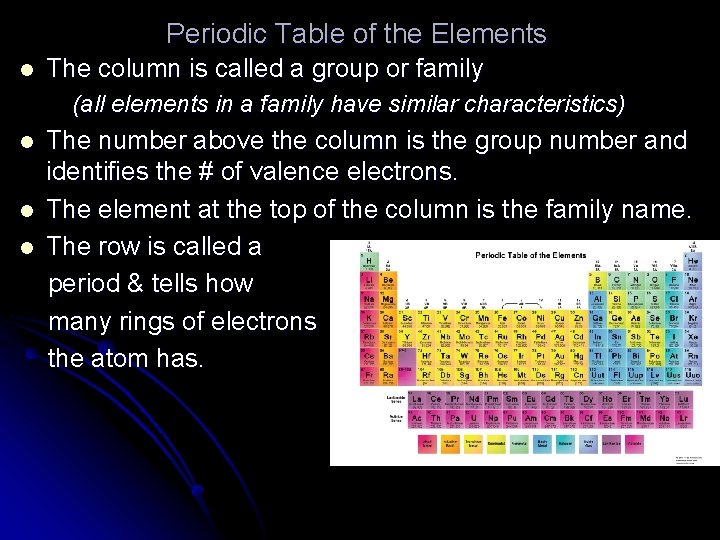
Periodic Table of the Elements l The column is called a group or family (all elements in a family have similar characteristics) l l l The number above the column is the group number and identifies the # of valence electrons. The element at the top of the column is the family name. The row is called a period & tells how many rings of electrons the atom has.
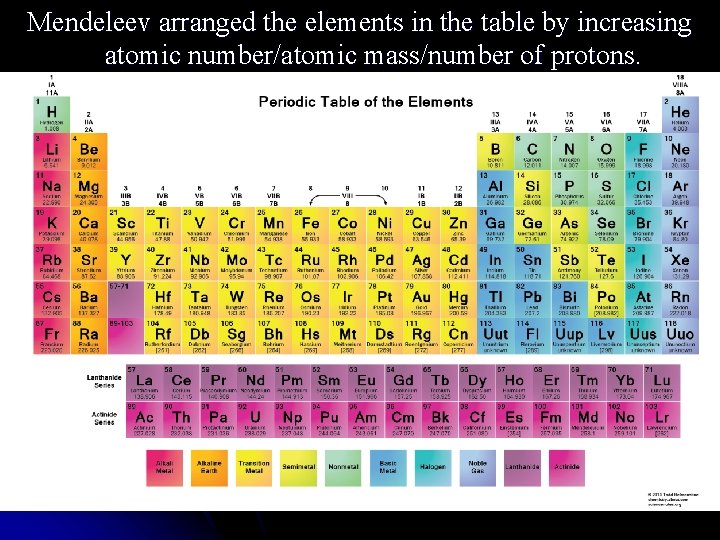
Mendeleev arranged the elements in the table by increasing atomic number/atomic mass/number of protons.
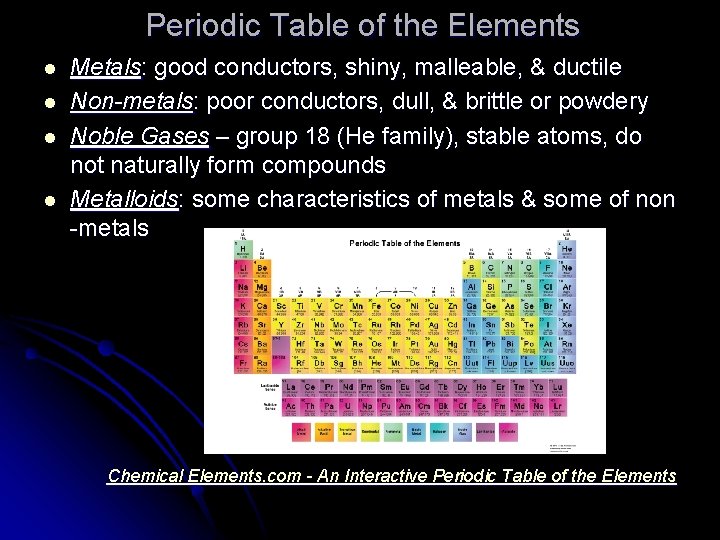
Periodic Table of the Elements l l Metals: good conductors, shiny, malleable, & ductile Non-metals: poor conductors, dull, & brittle or powdery Noble Gases – group 18 (He family), stable atoms, do not naturally form compounds Metalloids: some characteristics of metals & some of non -metals Chemical Elements. com - An Interactive Periodic Table of the Elements
6 most common elements found in living things: 1. 2. 3. 4. 5. 6. Carbon______ Hydrogen_____ Oxygen______ Nitrogen_____ Phosphorous_______ Sulfur The main element in all organic compounds is Carbon_ (more on compounds in our next unit)
- Slides: 11