
Atoms Elements Major Goals of our Atom Elements

- Slides: 32
Atoms & Elements Major Goals of our Atom & Elements Module: 1. Finding the exact location (home) for the electron in an atom 2. Discuss physical and chemical experimental evidence which supports a) electronic structure & b) the periodic trends in the properties of atoms. This powerpoint reviews key topics for atom & elements • Electromagnetic Radiation • Atomic Spectra & Energy Levels • Energy Levels (shells), Sublevel(subshell) & Orbitals • Writing Orbital Diagrams & Electron Configurations • Electron Configurations & the Periodic Table • Periodic Trends of the Elements
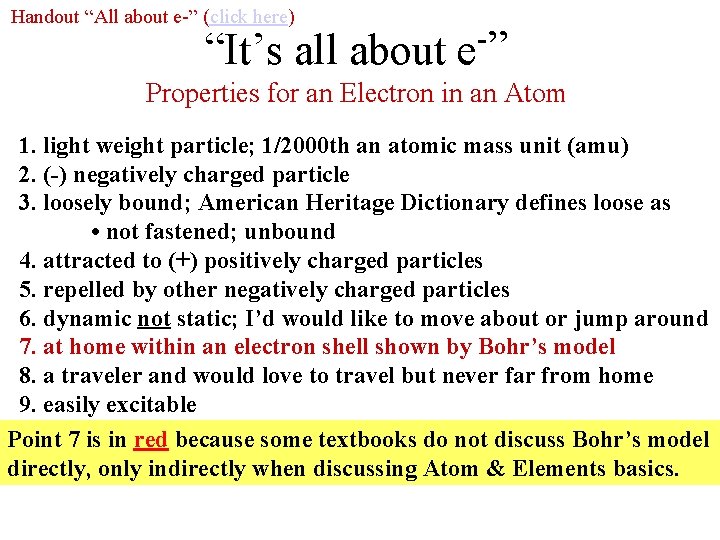
Handout “All about e-” (click here) “It’s all about e-” Properties for an Electron in an Atom 1. light weight particle; 1/2000 th an atomic mass unit (amu) 2. (-) negatively charged particle 3. loosely bound; American Heritage Dictionary defines loose as • not fastened; unbound 4. attracted to (+) positively charged particles 5. repelled by other negatively charged particles 6. dynamic not static; I’d would like to move about or jump around 7. at home within an electron shell shown by Bohr’s model 8. a traveler and would love to travel but never far from home 9. easily excitable Point 7 is in red because some textbooks do not discuss Bohr’s model directly, only indirectly when discussing Atom & Elements basics.
Supplemental packet page 44 Atomic Spectra & Energy Levels Point 7 is in red because some textbooks do not discuss Bohr’s model directly, only indirectly when discussing Atom & Elements basics. The ladder and the concentric circles below are visuals for Bohr’s model. Bohr’s Model Playlist (click here)
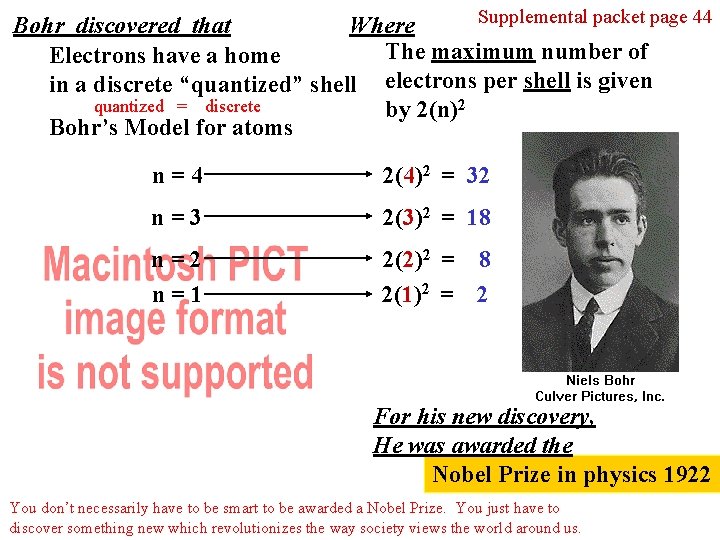
Supplemental packet page 44 Bohr discovered that Where The maximum number of Electrons have a home in a discrete “quantized” shell electrons per shell is given quantized = discrete by 2(n)2 Bohr’s Model for atoms n=4 2(4)2 = 32 n=3 2(3)2 = 18 n=2 n=1 2(2)2 = 8 2(1)2 = 2 For his new discovery, He was awarded the Nobel Prize in physics 1922 You don’t necessarily have to be smart to be awarded a Nobel Prize. You just have to discover something new which revolutionizes the way society views the world around us.
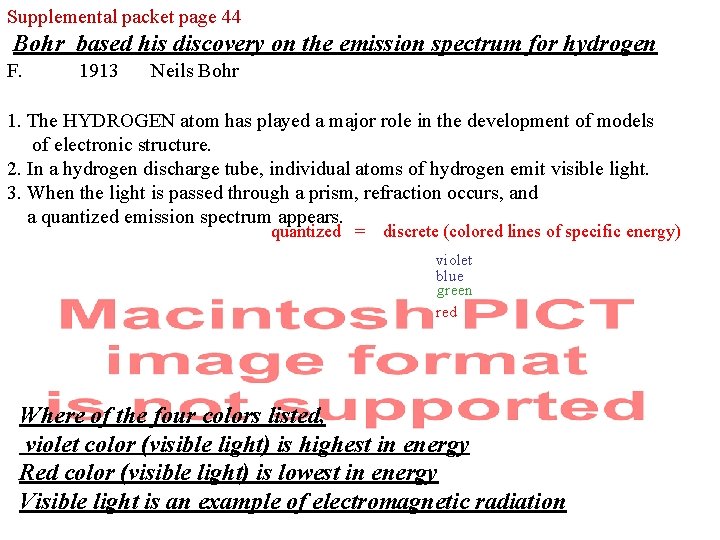
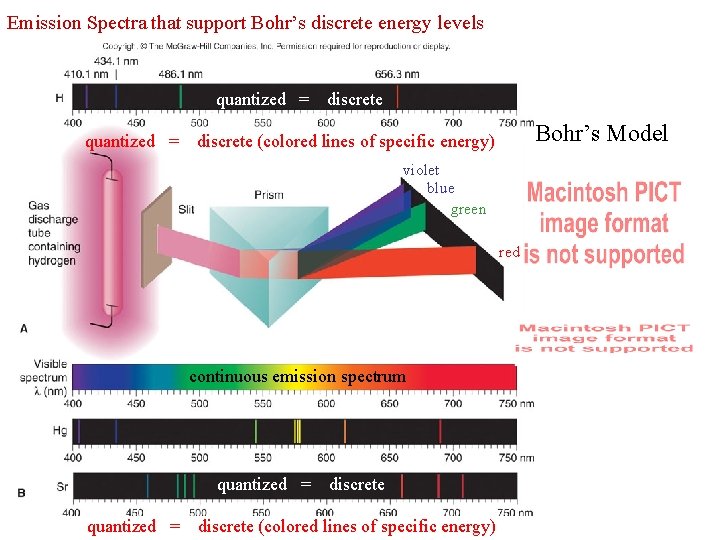
Supplemental packet page 44 Bohr based his discovery on the emission spectrum for hydrogen F. 1913 Neils Bohr 1. The HYDROGEN atom has played a major role in the development of models of electronic structure. 2. In a hydrogen discharge tube, individual atoms of hydrogen emit visible light. 3. When the light is passed through a prism, refraction occurs, and a quantized emission spectrum appears. quantized = discrete (colored lines of specific energy) violet blue green red Where of the four colors listed, violet color (visible light) is highest in energy Red color (visible light) is lowest in energy Visible light is an example of electromagnetic radiation
Emission Spectra that support Bohr’s discrete energy levels quantized = discrete quantized = Bohr’s Model discrete (colored lines of specific energy) violet blue green red continuous emission spectrum quantized = discrete (colored lines of specific energy)
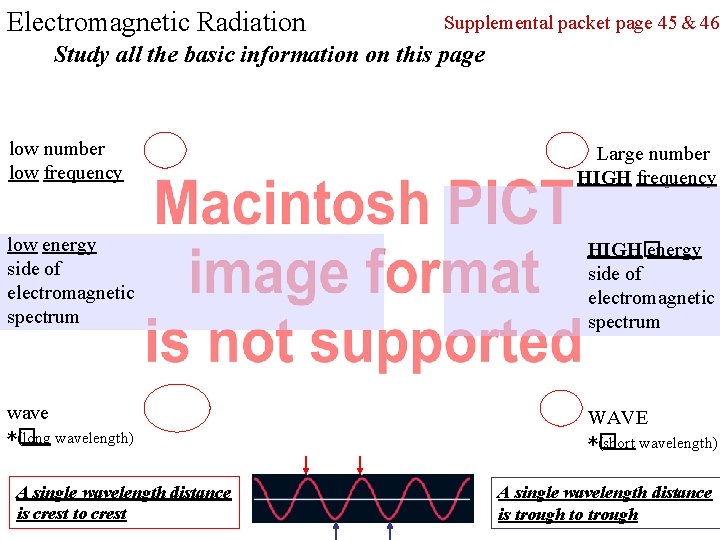
Electromagnetic Radiation Supplemental packet page 45 & 46 Study all the basic information on this page low number low frequency Large number HIGH frequency low energy side of electromagnetic spectrum HIGH� energy side of electromagnetic spectrum wave *� (long wavelength) WAVE *� (short wavelength) A single wavelength distance is crest to crest A single wavelength distance is trough to trough
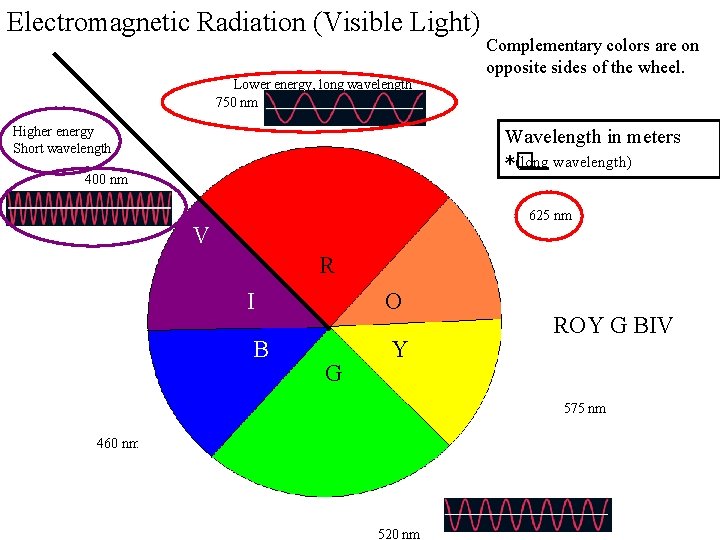
Electromagnetic Radiation (Visible Light) Complementary colors are on opposite sides of the wheel. Lower energy, long wavelength 750 nm Higher energy Short wavelength Wavelength in meters *� (long wavelength) 400 nm 625 nm V R I O B Y G ROY G BIV 575 nm 460 nm 520 nm
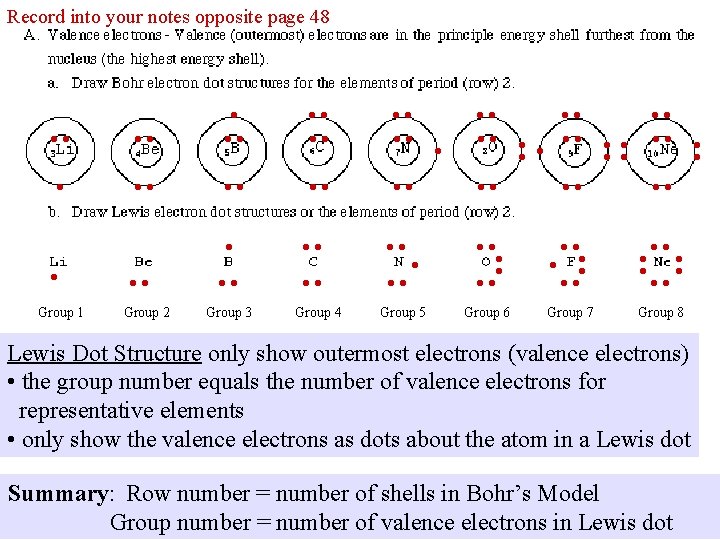
Record into your notes opposite page 48 • • • • • • • • • Group 1 • • Group 2 Group 3 Group 4 • Group 5 • • • • • • • • • • • • • • • Group 6 Group 7 Group 8 Lewis Dot Structure only show outermost electrons (valence electrons) • the group number equals the number of valence electrons for representative elements • only show the valence electrons as dots about the atom in a Lewis dot Summary: Row number = number of shells in Bohr’s Model Group number = number of valence electrons in Lewis dot
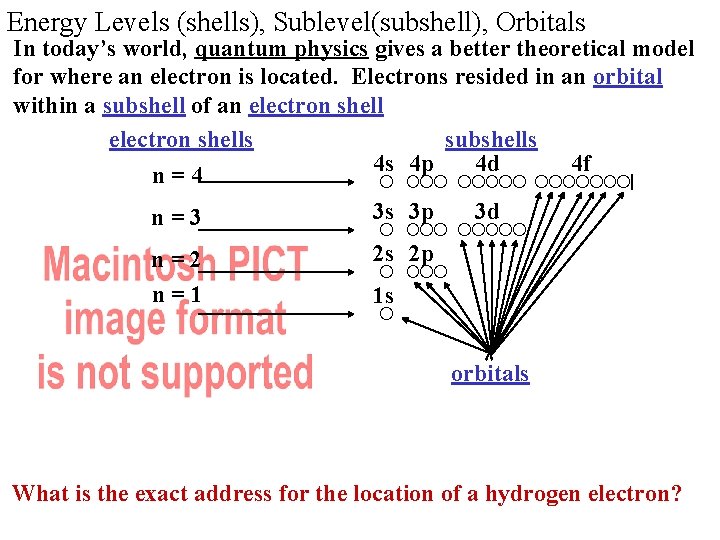
Energy Levels (shells), Sublevel(subshell), Orbitals In today’s world, quantum physics gives a better theoretical model for where an electron is located. Electrons resided in an orbital within a subshell of an electron shells subshells 4 s 4 p 4 d 4 f n=4 n=3 3 s 3 p n=2 n=1 2 s 2 p • 3 d 1 s orbitals What is the exact address for the location of a hydrogen electron?
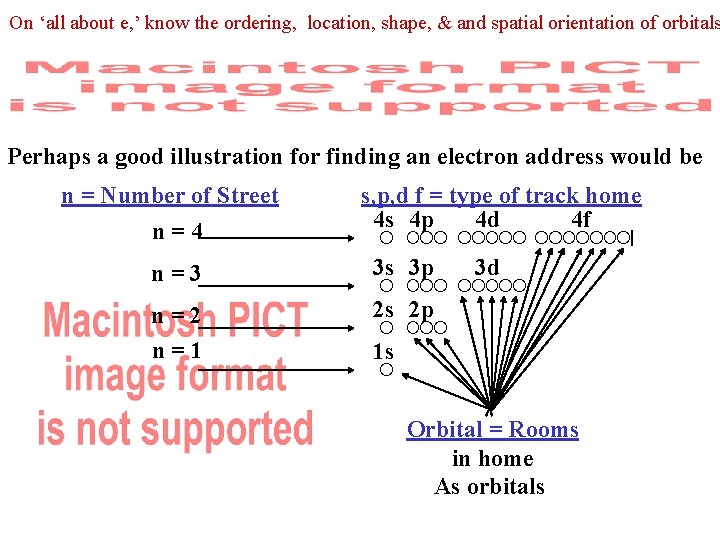
On ‘all about e, ’ know the ordering, location, shape, & and spatial orientation of orbitals Perhaps a good illustration for finding an electron address would be n = Number of Street n=4 s, p, d f = type of track home 4 s 4 p 4 d 4 f n=3 3 s 3 p n=2 n=1 2 s 2 p • 3 d 1 s Orbital = Rooms in home As orbitals
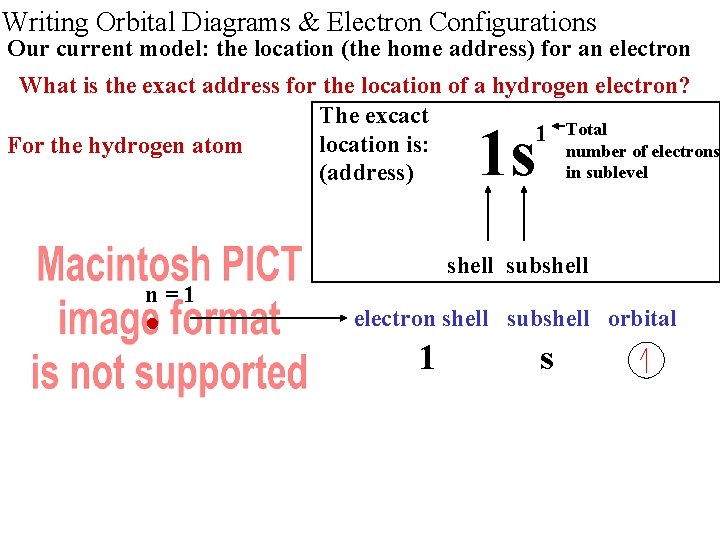
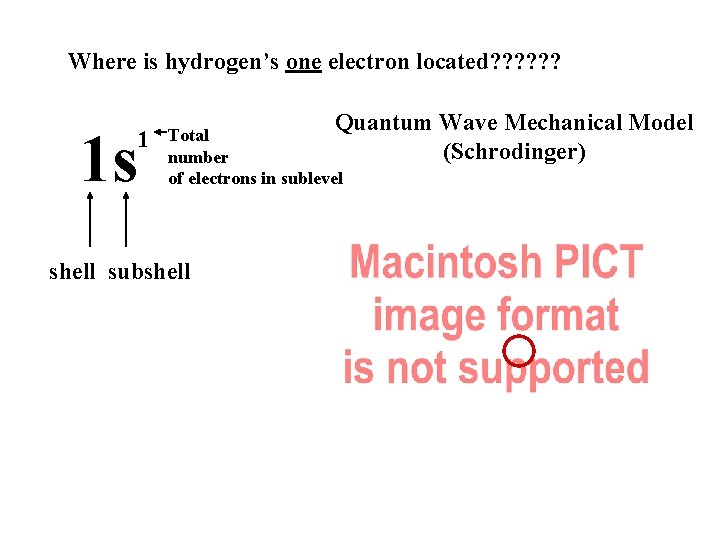
Writing Orbital Diagrams & Electron Configurations Our current model: the location (the home address) for an electron What is the exact address for the location of a hydrogen electron? The excact Total 1 location is: For the hydrogen atom number of electrons in sublevel (address) 1 s shell subshell n=1 • electron shell subshell orbital 1 s
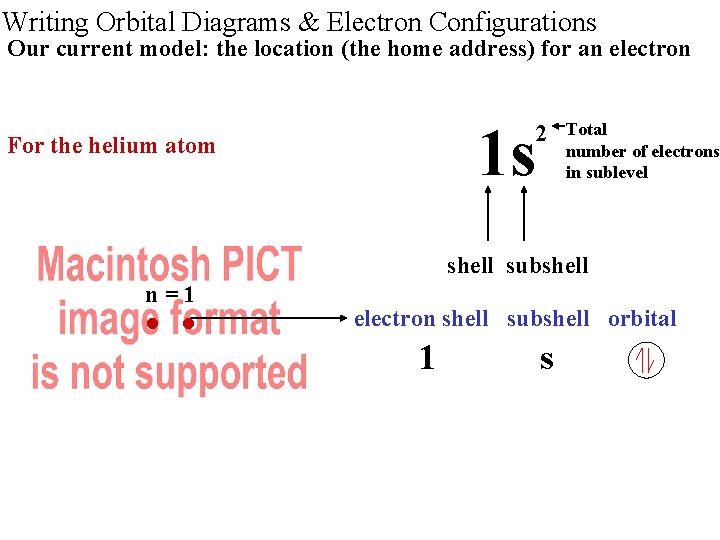
Writing Orbital Diagrams & Electron Configurations Our current model: the location (the home address) for an electron 1 s 2 For the helium atom Total number of electrons in sublevel shell subshell n=1 • • electron shell subshell orbital 1 s
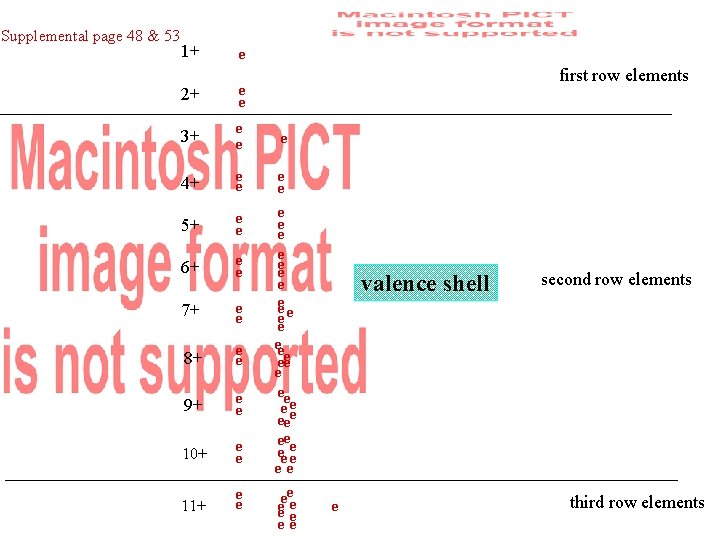
Supplemental page 48 & 53 1+ e 2+ e e 3+ e e 4+ e e 5+ e e 6+ e e 7+ e e 8+ e e 9+ e e 10+ e e 11+ e e first row elements e e ee ee eee e ee ee ee e e ee valence shell e second row elements third row elements
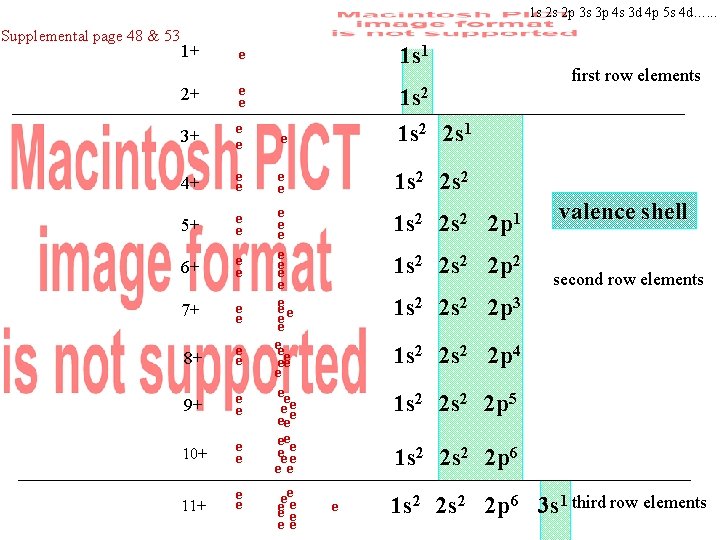
1 s 2 s 2 p 3 s 3 p 4 s 3 d 4 p 5 s 4 d…. . . Supplemental page 48 & 53 1+ e 2+ e e 3+ e e 4+ e e 5+ e e 6+ e e 7+ e e 8+ e e 9+ e e 10+ e e 11+ e e 1 s 1 1 s 2 2 s 1 e e ee ee eee e ee ee ee e e ee first row elements 1 s 2 2 s 2 2 p 1 1 s 2 2 p 2 valence shell second row elements 1 s 2 2 p 3 1 s 2 2 p 4 1 s 2 2 p 5 1 s 2 2 p 6 e 1 s 2 2 p 6 3 s 1 third row elements
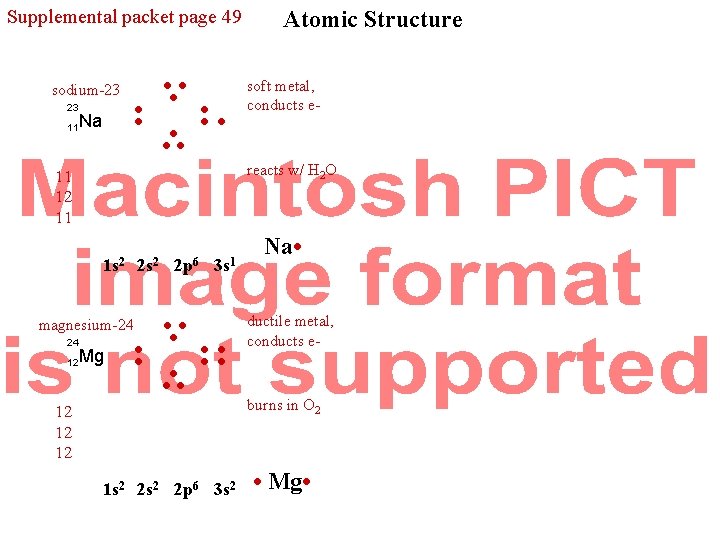
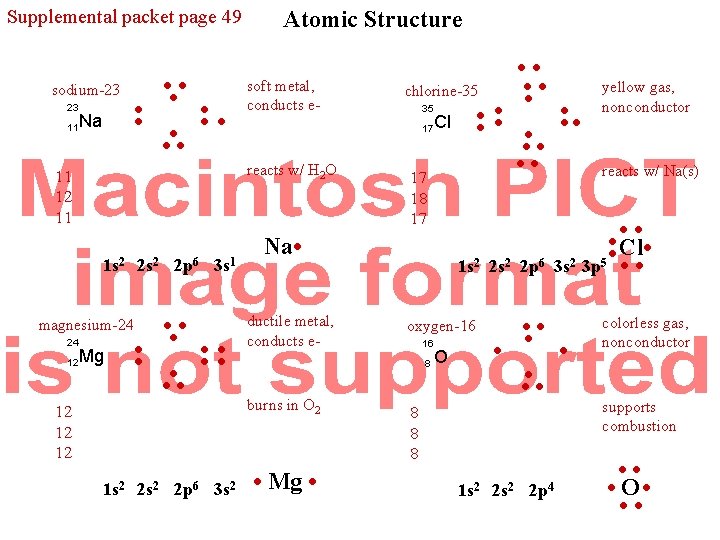
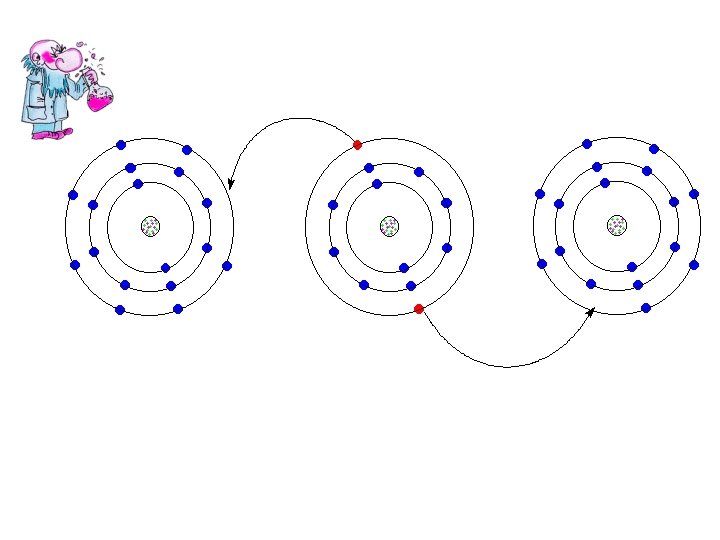
Supplemental packet page 49 sodium-23 23 11 Na • • • • 1 s 2 magnesium-24 12 soft metal, conducts e- reacts w/ H 2 O 11 12 11 24 Atomic Structure Mg 2 s 2 2 p 6 3 s 1 • • • • • • 12 12 12 1 s 2 2 p 6 3 s 2 Na • ductile metal, conducts e- burns in O 2 • Mg •
Supplemental packet page 49 sodium-23 23 11 Na • • • • 1 s 2 magnesium-24 12 soft metal, conducts e- reacts w/ H 2 O 11 12 11 24 Atomic Structure Mg 2 s 2 2 p 6 3 s 1 • • • • • • 12 12 12 1 s 2 2 p 6 3 s 2 • • chlorine-35 • • • 17 Cl • • • • 17 18 17 Na • ductile metal, conducts e- 1 s 2 2 p 6 oxygen-16 16 8 burns in O 2 • Mg • O 1 s 2 2 p 4 reacts w/ Na(s) • • Cl • 3 s 2 3 p 5 • • • 8 8 8 yellow gas, nonconductor colorless gas, nonconductor supports combustion • • • O • • •
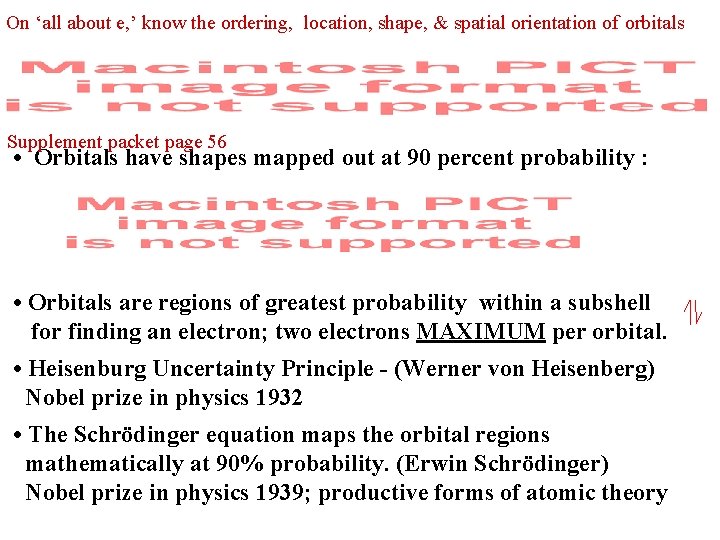
On ‘all about e, ’ know the ordering, location, shape, & spatial orientation of orbitals Supplement packet page 56 • Orbitals have shapes mapped out at 90 percent probability : • Orbitals are regions of greatest probability within a subshell for finding an electron; two electrons MAXIMUM per orbital. • Heisenburg Uncertainty Principle - (Werner von Heisenberg) Nobel prize in physics 1932 • The Schrödinger equation maps the orbital regions mathematically at 90% probability. (Erwin Schrödinger) Nobel prize in physics 1939; productive forms of atomic theory
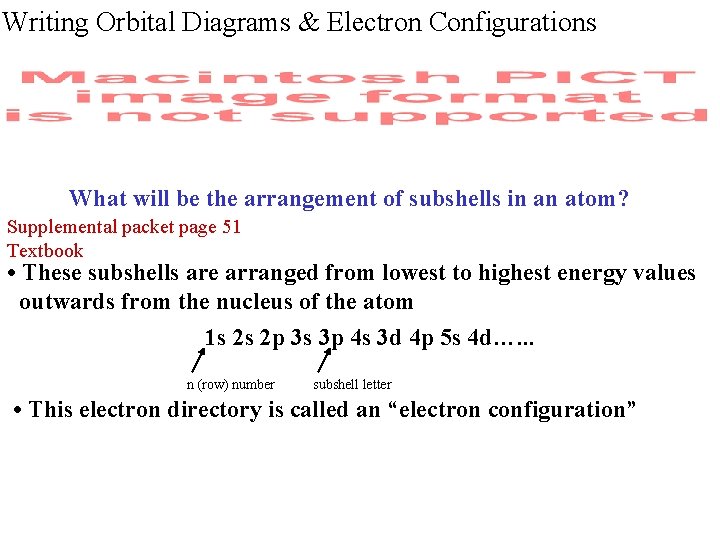
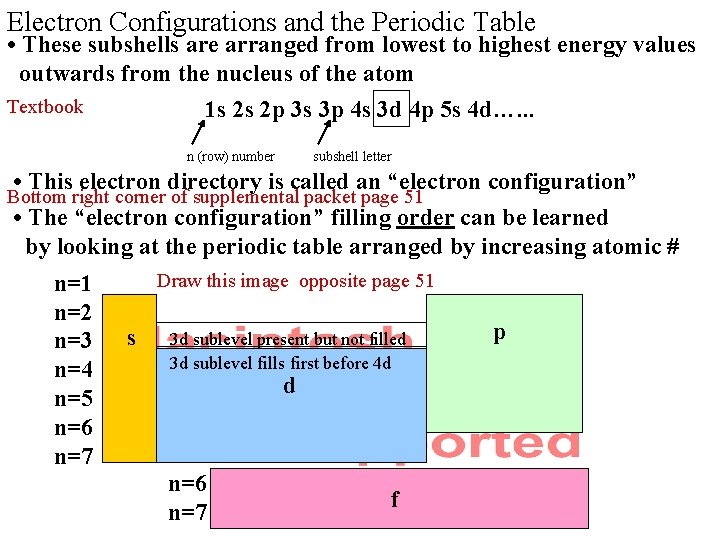
Writing Orbital Diagrams & Electron Configurations What will be the arrangement of subshells in an atom? Supplemental packet page 51 Textbook • These subshells are arranged from lowest to highest energy values outwards from the nucleus of the atom 1 s 2 s 2 p 3 s 3 p 4 s 3 d 4 p 5 s 4 d…. . . n (row) number subshell letter • This electron directory is called an “electron configuration”
Electron Configurations and the Periodic Table • These subshells are arranged from lowest to highest energy values outwards from the nucleus of the atom Textbook 1 s 2 s 2 p 3 s 3 p 4 s 3 d 4 p 5 s 4 d…. . . n (row) number subshell letter • This electron directory is called an “electron configuration” • The “electron configuration” filling order can be learned by looking at the periodic table arranged by increasing atomic # Bottom right corner of supplemental packet page 51 n=2 n=3 n=4 n=5 n=6 n=7 Draw this image opposite page 51 s 3 d sublevel present but not filled 3 d sublevel fills first before 4 d d n=6 n=7 f p
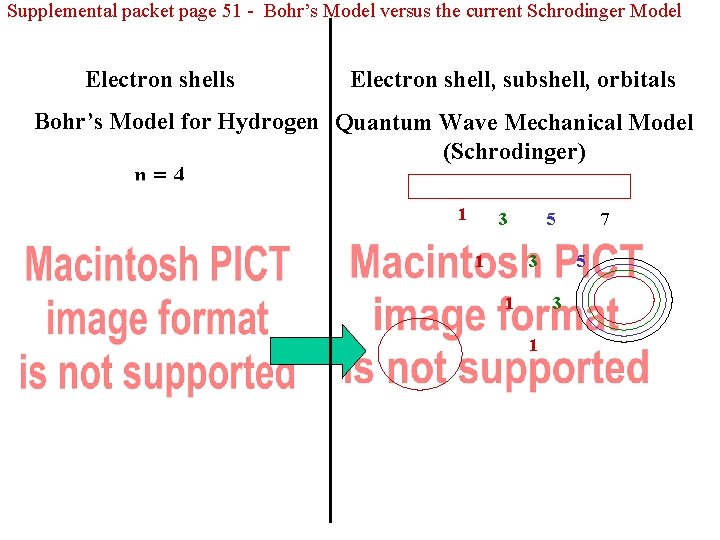
Supplemental packet page 51 - Bohr’s Model versus the current Schrodinger Model Electron shells Electron shell, subshell, orbitals Bohr’s Model for Hydrogen Quantum Wave Mechanical Model (Schrodinger) n=4 n=3 n=2 n=1 1 5 3 1 3 1 7
Where is hydrogen’s one electron located? ? ? 1 s 1 Quantum Wave Mechanical Model (Schrodinger) Total number of electrons in sublevel shell subshell
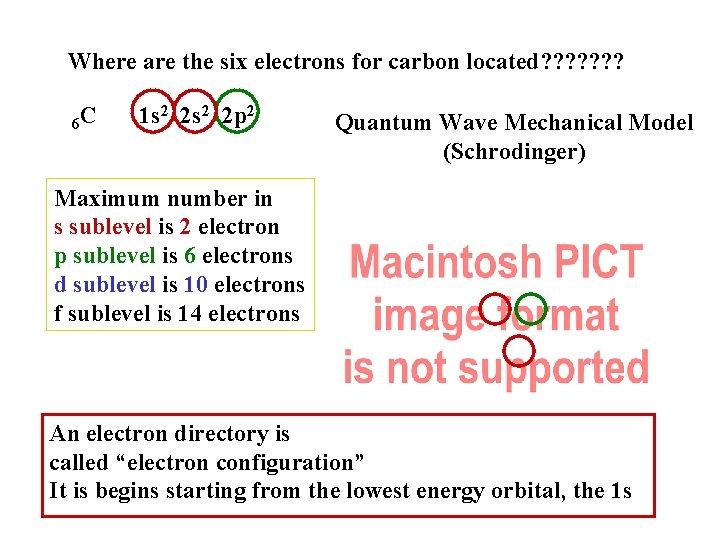
Where are the six electrons for carbon located? ? ? ? 6 C 1 s 2 2 p 2 Quantum Wave Mechanical Model (Schrodinger) Maximum number in s sublevel is 2 electron p sublevel is 6 electrons d sublevel is 10 electrons f sublevel is 14 electrons An electron directory is called “electron configuration” It is begins starting from the lowest energy orbital, the 1 s
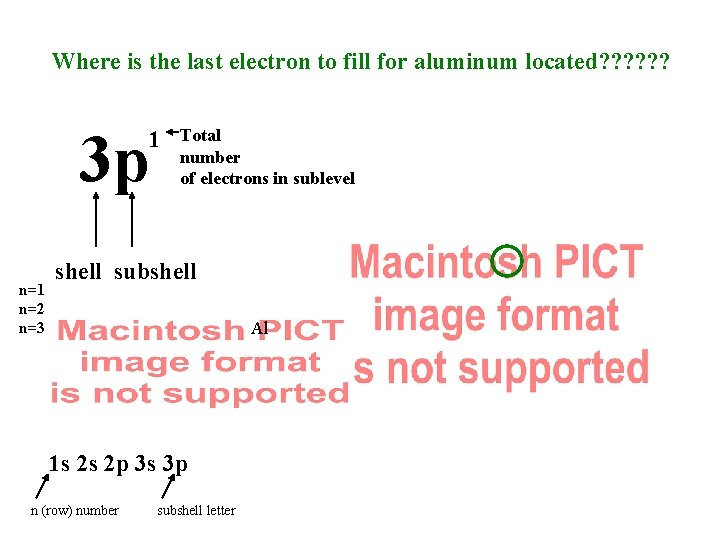
Where is the last electron to fill for aluminum located? ? ? 3 p 1 n=2 n=3 Total number of electrons in sublevel shell subshell Al 1 s 2 s 2 p 3 s 3 p n (row) number subshell letter
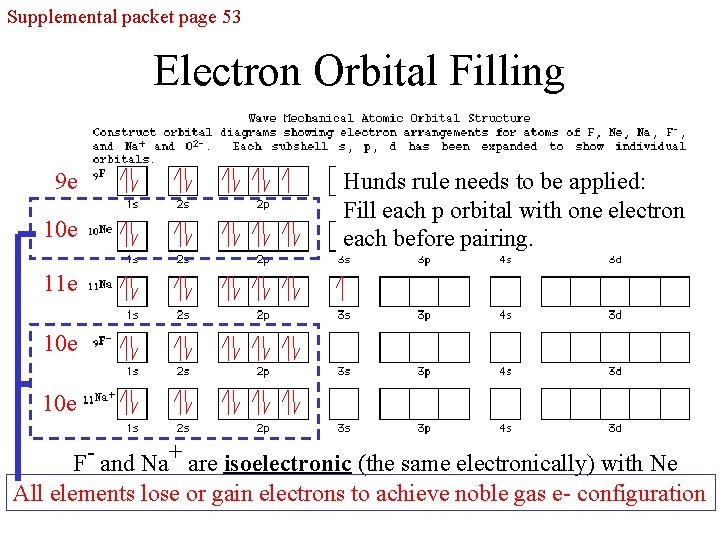
Supplemental packet page 53 Electron Orbital Filling 9 e 10 e Hunds rule needs to be applied: Fill each p orbital with one electron each before pairing. 11 e 10 e F- and Na+ are isoelectronic (the same electronically) with Ne All elements lose or gain electrons to achieve noble gas e- configuration
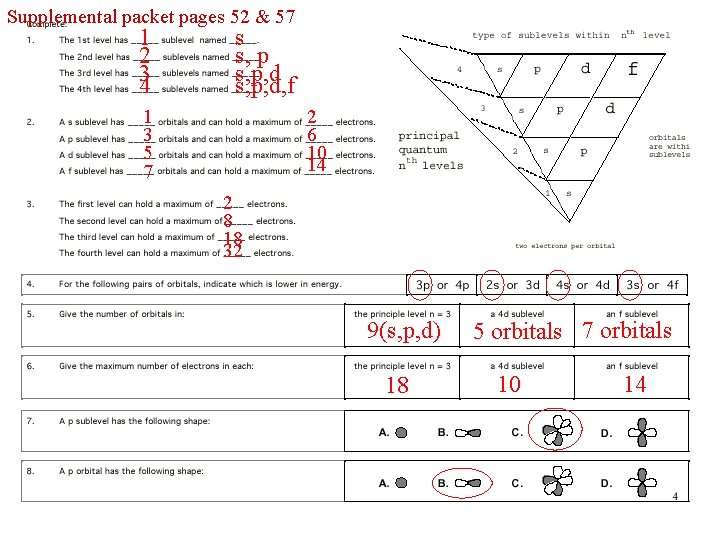
Supplemental packet pages 52 & 57 1 2 34 s s, p, d, f 1 3 5 7 2 6 10 14 2 8 18 32 9(s, p, d) 18 5 orbitals 7 orbitals 10 14
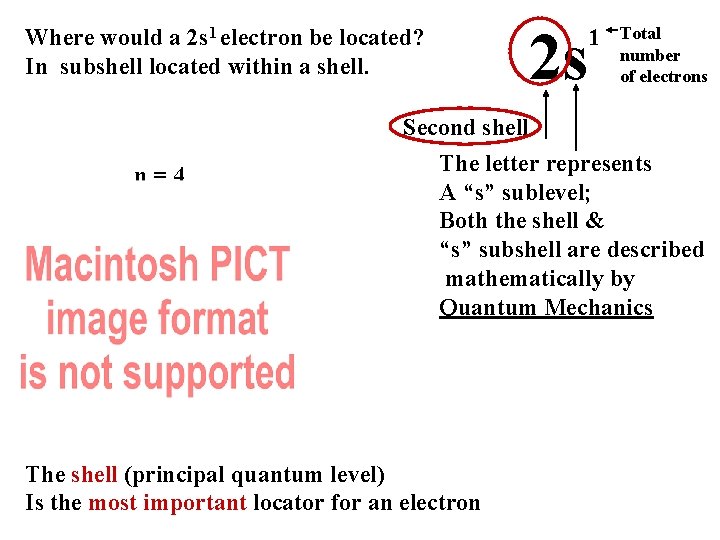
Where would a 2 s 1 electron be located? In subshell located within a shell. n=4 n=3 n=2 n=1 2 s 1 Total number of electrons Second shell The letter represents A “s” sublevel; Both the shell & “s” subshell are described mathematically by Quantum Mechanics The shell (principal quantum level) Is the most important locator for an electron
More on orbital shapes and volumes
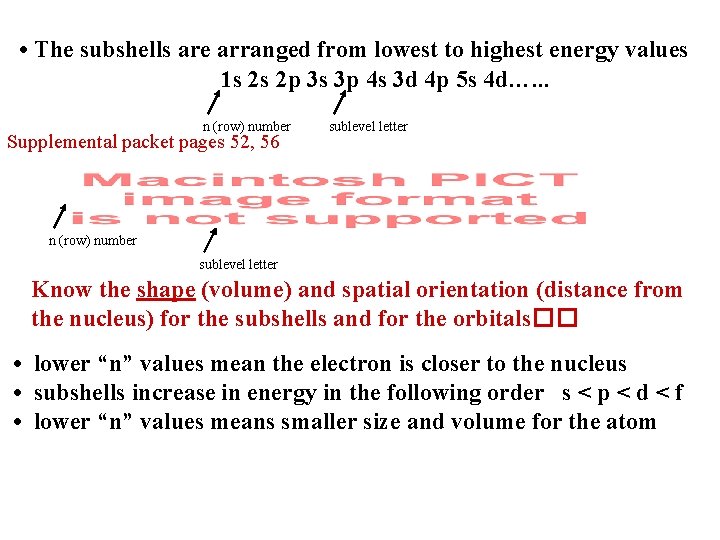
• The subshells are arranged from lowest to highest energy values 1 s 2 s 2 p 3 s 3 p 4 s 3 d 4 p 5 s 4 d…. . . n (row) number Supplemental packet pages 52, 56 sublevel letter n (row) number sublevel letter Know the shape (volume) and spatial orientation (distance from the nucleus) for the subshells and for the orbitals�� • lower “n” values mean the electron is closer to the nucleus • subshells increase in energy in the following order s < p < d < f • lower “n” values means smaller size and volume for the atom