
Atoms Atom the basic unit of matter Atoms

Atoms • Atom: the basic unit of matter. Atoms are electrically neutral because they have equal numbers of protons and electrons. – An atom that loses electrons has a positive charge, an atom that gains electrons has a negative charge (remember, electrons are negative). • Ions: positively and negatively charged atoms. • Composed of: – Protons: Positively charged subatomic particle, found in the nucleus. – Neutrons: Subatomic particle with no charge, found in the nucleus. – Electrons: Negatively charged subatomic particle, found outside of the nucleus. Copyright © 2002 Pearson Education, Inc. , publishing as Pearson Prentice Hall
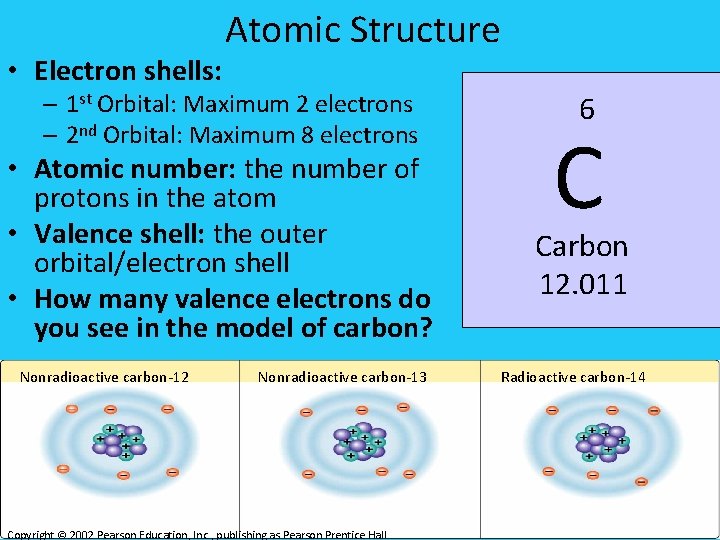
• Electron shells: Atomic Structure – 1 st Orbital: Maximum 2 electrons – 2 nd Orbital: Maximum 8 electrons • Atomic number: the number of protons in the atom • Valence shell: the outer orbital/electron shell • How many valence electrons do you see in the model of carbon? Nonradioactive carbon-12 Nonradioactive carbon-13 Copyright © 2002 Pearson Education, Inc. , publishing as Pearson Prentice Hall 6 C Carbon 12. 011 Radioactive carbon-14

Atomic Models: Lewis Dot, Bohr • Practice: Lewis Dot and Bohr for Li, F, Ne • How many bonds can each atom make? H O Copyright © 2002 Pearson Education, Inc. , publishing as Benjamin Cummings N C
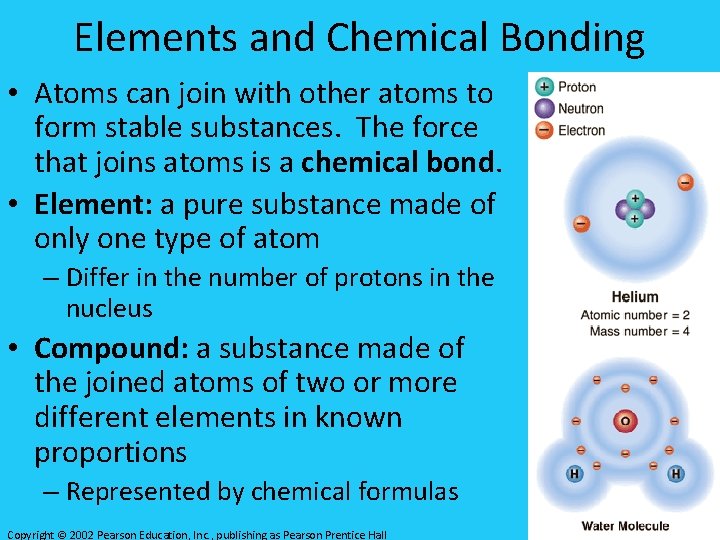
Elements and Chemical Bonding • Atoms can join with other atoms to form stable substances. The force that joins atoms is a chemical bond. • Element: a pure substance made of only one type of atom – Differ in the number of protons in the nucleus • Compound: a substance made of the joined atoms of two or more different elements in known proportions – Represented by chemical formulas Copyright © 2002 Pearson Education, Inc. , publishing as Pearson Prentice Hall
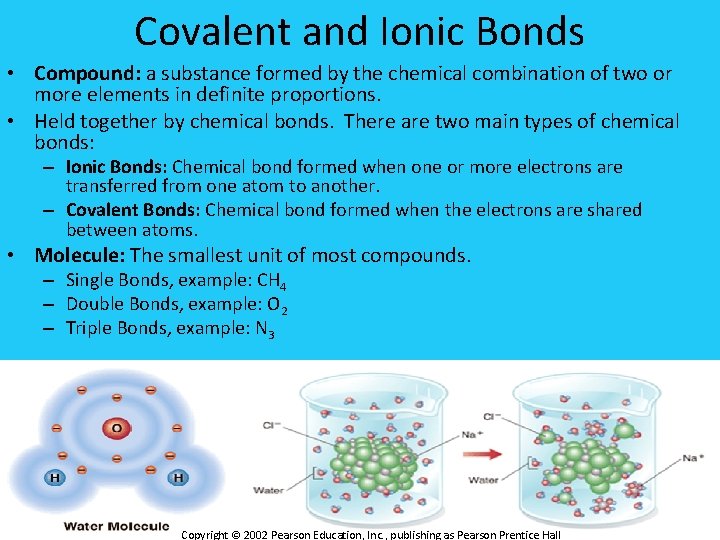
Covalent and Ionic Bonds • Compound: a substance formed by the chemical combination of two or more elements in definite proportions. • Held together by chemical bonds. There are two main types of chemical bonds: – Ionic Bonds: Chemical bond formed when one or more electrons are transferred from one atom to another. – Covalent Bonds: Chemical bond formed when the electrons are shared between atoms. • Molecule: The smallest unit of most compounds. – Single Bonds, example: CH 4 – Double Bonds, example: O 2 – Triple Bonds, example: N 3 Copyright © 2002 Pearson Education, Inc. , publishing as Pearson Prentice Hall
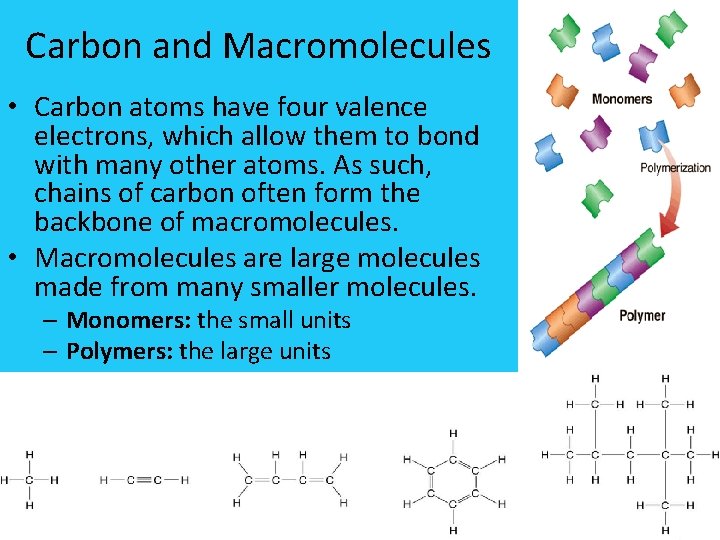
Carbon and Macromolecules • Carbon atoms have four valence electrons, which allow them to bond with many other atoms. As such, chains of carbon often form the backbone of macromolecules. • Macromolecules are large molecules made from many smaller molecules. – Monomers: the small units – Polymers: the large units

Four Classes of Biomolecules 1. Carbohydrates (sugars) • Primarily composed of: Carbon, Hydrogen, Oxygen 2. Lipids (fats) • Primarily composed of: Carbon, Hydrogen, Oxygen 3. Amino Acids (proteins) • Primarily composed of: Carbon, Hydrogen, Oxygen, Nitrogen 4. Nucleic Acids (DNA/RNA) • Carbon, Hydrogen, Oxygen, Nitrogen, Phosphorus
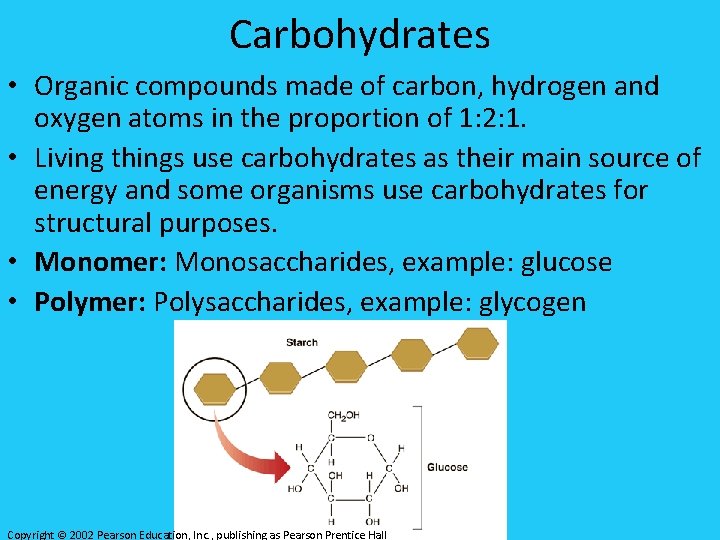
Carbohydrates • Organic compounds made of carbon, hydrogen and oxygen atoms in the proportion of 1: 2: 1. • Living things use carbohydrates as their main source of energy and some organisms use carbohydrates for structural purposes. • Monomer: Monosaccharides, example: glucose • Polymer: Polysaccharides, example: glycogen Copyright © 2002 Pearson Education, Inc. , publishing as Pearson Prentice Hall
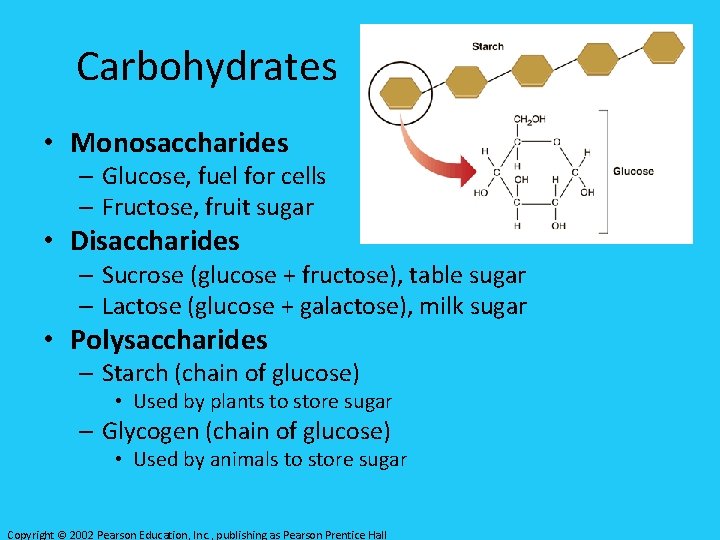
Carbohydrates • Monosaccharides – Glucose, fuel for cells – Fructose, fruit sugar • Disaccharides – Sucrose (glucose + fructose), table sugar – Lactose (glucose + galactose), milk sugar • Polysaccharides – Starch (chain of glucose) • Used by plants to store sugar – Glycogen (chain of glucose) • Used by animals to store sugar Copyright © 2002 Pearson Education, Inc. , publishing as Pearson Prentice Hall
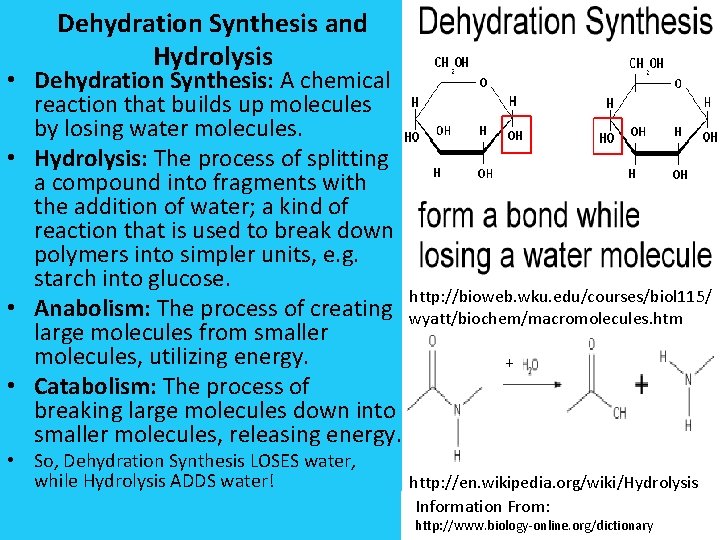
Dehydration Synthesis and Hydrolysis • Dehydration Synthesis: A chemical reaction that builds up molecules by losing water molecules. • Hydrolysis: The process of splitting a compound into fragments with the addition of water; a kind of reaction that is used to break down polymers into simpler units, e. g. starch into glucose. http: //bioweb. wku. edu/courses/biol 115/ • Anabolism: The process of creating wyatt/biochem/macromolecules. htm large molecules from smaller molecules, utilizing energy. + • Catabolism: The process of breaking large molecules down into smaller molecules, releasing energy. • So, Dehydration Synthesis LOSES water, while Hydrolysis ADDS water! http: //en. wikipedia. org/wiki/Hydrolysis Information From: http: //www. biology-online. org/dictionary

Polarity • The polarity of water enables many substances to dissolve in water. • Ionic compounds and polar molecules dissolve best in water, because they are charged like the water. • When ionic compounds are dissolved in water, the ions become surrounded by polar water molecules. Copyright © 2002 Pearson Education, Inc. , publishing as Pearson Prentice Hall
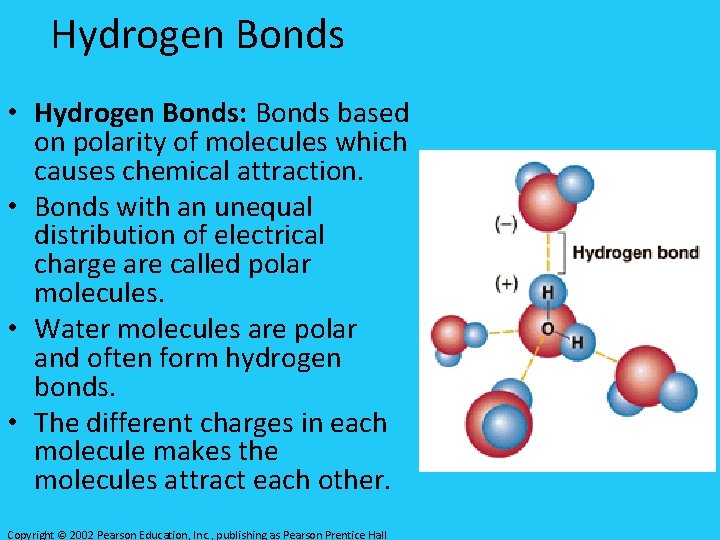
Hydrogen Bonds • Hydrogen Bonds: Bonds based on polarity of molecules which causes chemical attraction. • Bonds with an unequal distribution of electrical charge are called polar molecules. • Water molecules are polar and often form hydrogen bonds. • The different charges in each molecule makes the molecules attract each other. Copyright © 2002 Pearson Education, Inc. , publishing as Pearson Prentice Hall
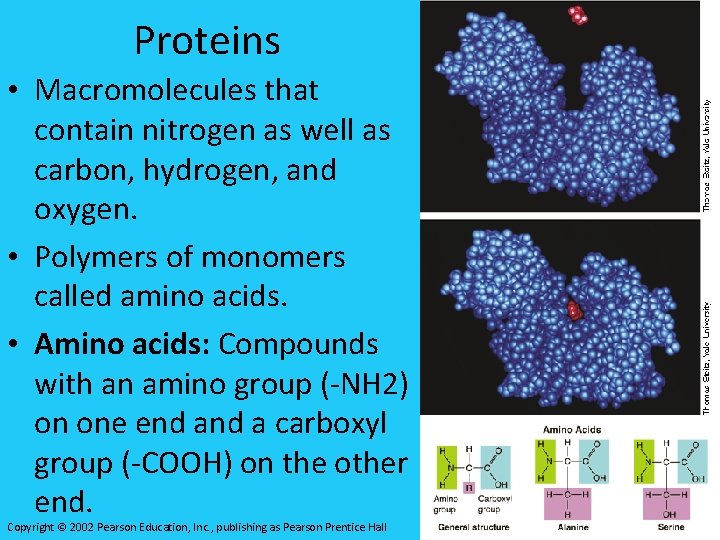
Proteins • Macromolecules that contain nitrogen as well as carbon, hydrogen, and oxygen. • Polymers of monomers called amino acids. • Amino acids: Compounds with an amino group (-NH 2) on one end a carboxyl group (-COOH) on the other end. Copyright © 2002 Pearson Education, Inc. , publishing as Pearson Prentice Hall
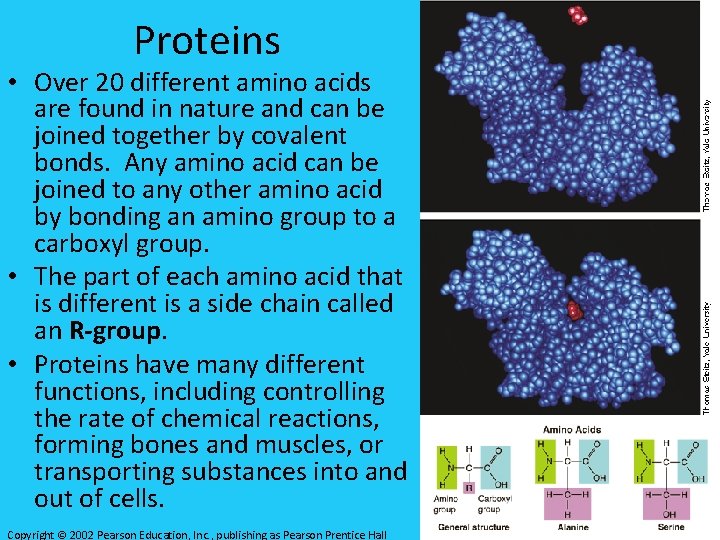
Proteins • Over 20 different amino acids are found in nature and can be joined together by covalent bonds. Any amino acid can be joined to any other amino acid by bonding an amino group to a carboxyl group. • The part of each amino acid that is different is a side chain called an R-group. • Proteins have many different functions, including controlling the rate of chemical reactions, forming bones and muscles, or transporting substances into and out of cells. Copyright © 2002 Pearson Education, Inc. , publishing as Pearson Prentice Hall
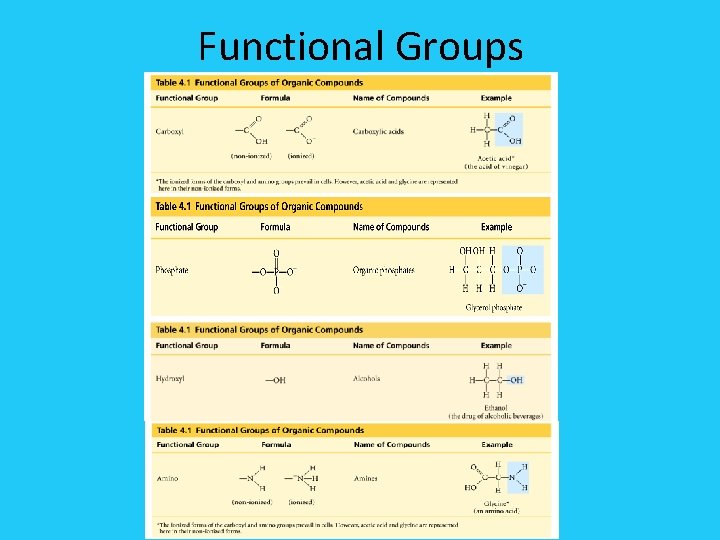
Functional Groups
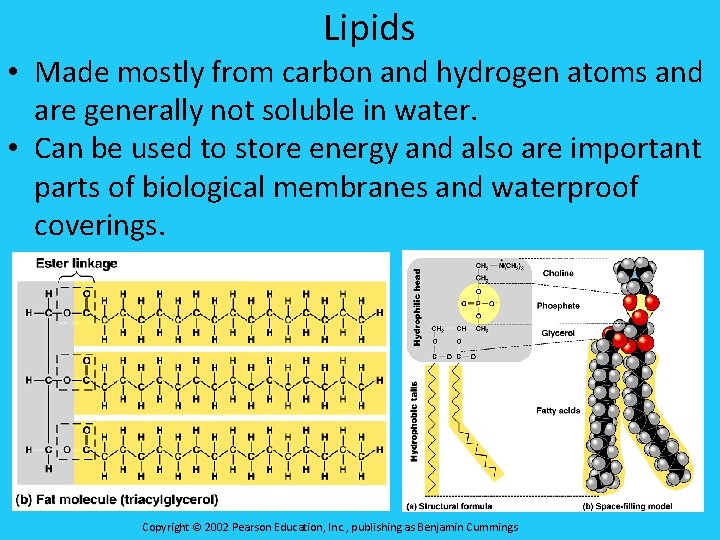
Lipids • Made mostly from carbon and hydrogen atoms and are generally not soluble in water. • Can be used to store energy and also are important parts of biological membranes and waterproof coverings. Copyright © 2002 Pearson Education, Inc. , publishing as Benjamin Cummings
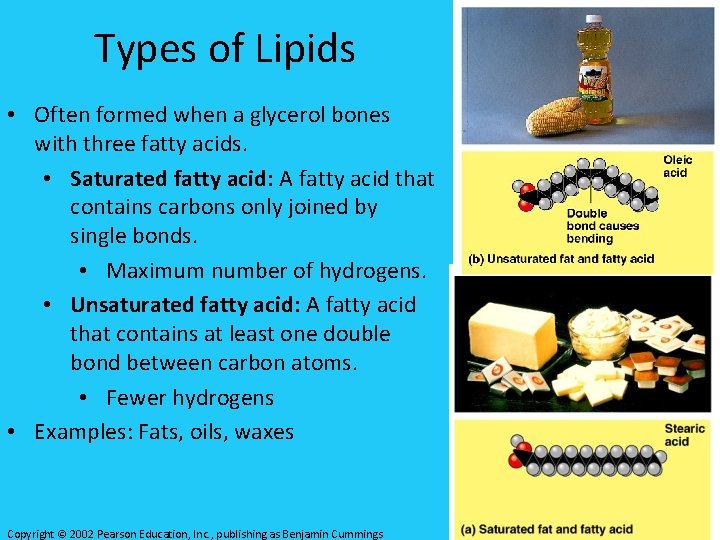
Types of Lipids • Often formed when a glycerol bones with three fatty acids. • Saturated fatty acid: A fatty acid that contains carbons only joined by single bonds. • Maximum number of hydrogens. • Unsaturated fatty acid: A fatty acid that contains at least one double bond between carbon atoms. • Fewer hydrogens • Examples: Fats, oils, waxes Copyright © 2002 Pearson Education, Inc. , publishing as Benjamin Cummings
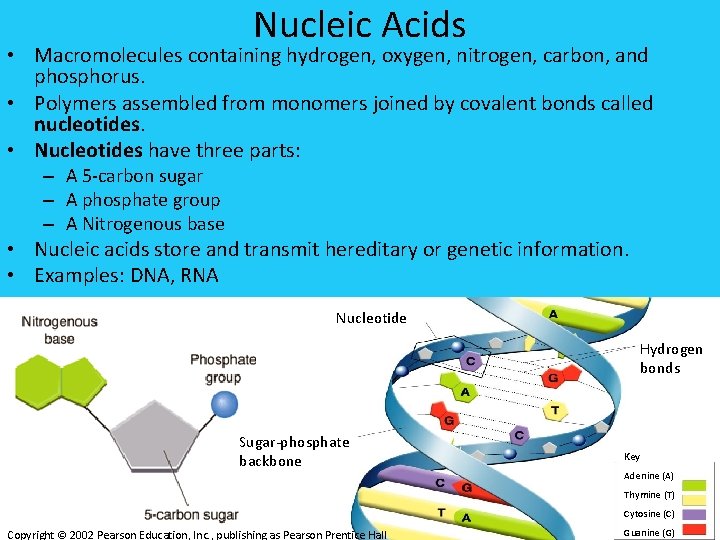
Nucleic Acids • Macromolecules containing hydrogen, oxygen, nitrogen, carbon, and phosphorus. • Polymers assembled from monomers joined by covalent bonds called nucleotides. • Nucleotides have three parts: – A 5 -carbon sugar – A phosphate group – A Nitrogenous base • Nucleic acids store and transmit hereditary or genetic information. • Examples: DNA, RNA Nucleotide Hydrogen bonds Sugar-phosphate backbone Key Adenine (A) Thymine (T) Cytosine (C) Copyright © 2002 Pearson Education, Inc. , publishing as Pearson Prentice Hall Guanine (G)
- Slides: 18