
Atoms and Molecules Atoms are the submicroscopic particles
Atoms and Molecules • Atoms are the submicroscopic particles that constitute the fundamental building blocks of ordinary matter. • Free atoms are rare in nature; instead they bind together in specific geometrical arrangements to form molecules. © 2014 Pearson Education, Inc.
Atoms and Molecules • If we want to understand the substances around us, we must understand the atoms and molecules that compose them—this is the central goal of chemistry. – Chemistry is the science that seeks to understand the behavior of matter by studying the behavior of atoms and molecules. © 2014 Pearson Education, Inc.
The Classification of Matter • Matter is anything that occupies space and has mass. • Your textbook, your desk, your chair, and even your body are all composed of matter. • We can classify matter according to its state (its physical form) and its composition (the basic components that make it up). © 2014 Pearson Education, Inc.
Classification of Matter by Components • The first division in the classification of matter is between a pure substance and a mixture. • A pure substance is made up of only one component and its composition is invariant. © 2014 Pearson Education, Inc.
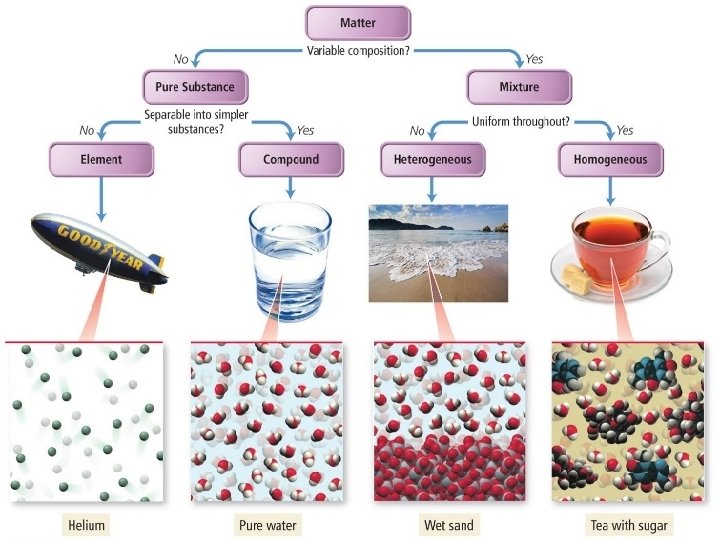
© 2014 Pearson Education, Inc.
Classification of Pure Substances • An element is a substance that cannot be chemically broken down into simpler substances. • Basic building blocks of matter • Composed of single type of atom, like helium • A compound is a substance composed of two or more elements in fixed definite proportions. • Most elements are chemically reactive and combine with other elements to form compounds like water, sugar, etc. © 2014 Pearson Education, Inc.
• Mixture: Two or more components combined in proportions that can vary. Mixtures come in two types: – Homogeneous mixtures: solutions – Heterogeneous mixtures © 2014 Pearson Education, Inc.
Separating Heterogeneous Mixtures • Mixtures are separable because the different components have different physical or chemical properties. • A mixture of sand water can be separated by decanting—carefully pouring off the water into another container. • Filtration is also used to separate heterogenous mixtures. © 2014 Pearson Education, Inc.
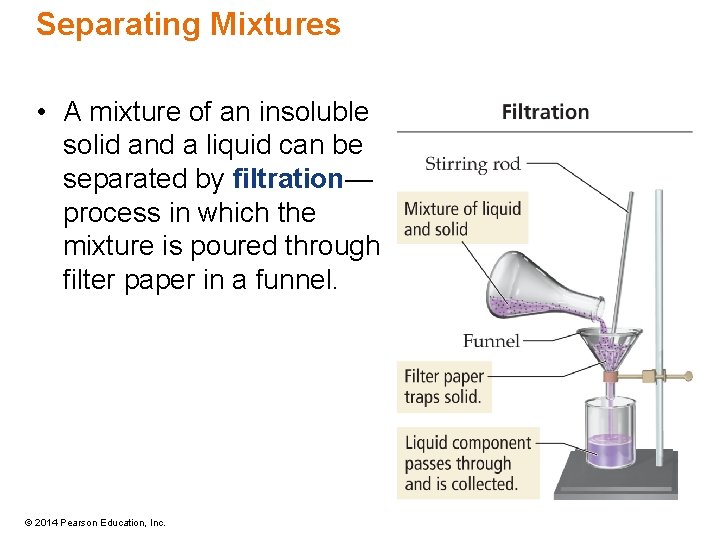
Separating Mixtures • A mixture of an insoluble solid and a liquid can be separated by filtration— process in which the mixture is poured through filter paper in a funnel. © 2014 Pearson Education, Inc.
Separation Homogeneous Mixtures • By distillation • By Thin Layer Chromatography © 2014 Pearson Education, Inc.
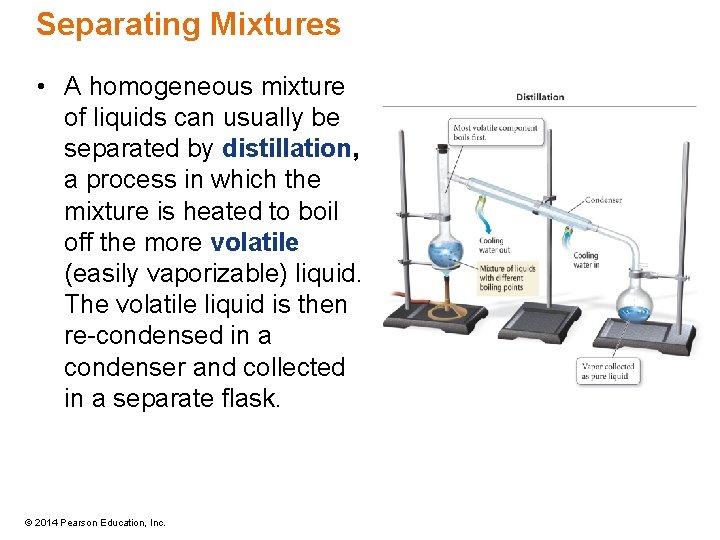
Separating Mixtures • A homogeneous mixture of liquids can usually be separated by distillation, a process in which the mixture is heated to boil off the more volatile (easily vaporizable) liquid. The volatile liquid is then re-condensed in a condenser and collected in a separate flask. © 2014 Pearson Education, Inc.
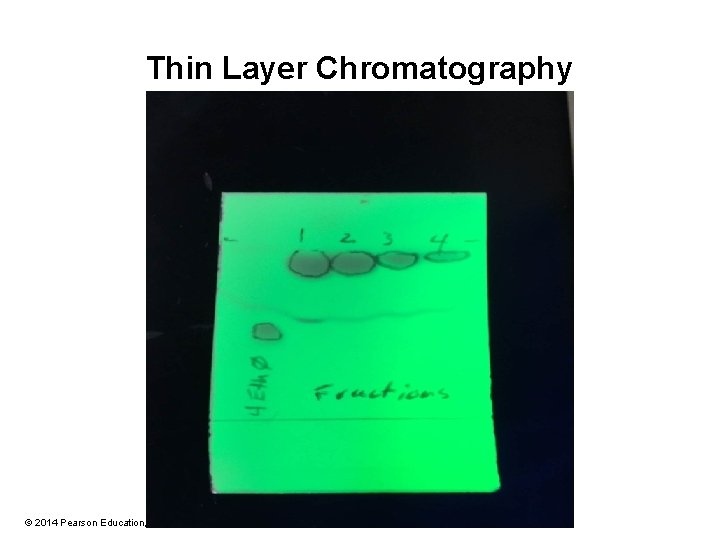
Thin Layer Chromatography © 2014 Pearson Education, Inc.
- Slides: 12