
Atoms and Light n Objectives q q q
Atoms and Light n Objectives q q q Compare the wave and particle models of light Define a "quantum" of energy and explain how it is related to energy change of matter Compare continuous electromagnetic spectra and atomic emission spectra 5. 1 Atoms and Light
History n Remember Rutherford's gold foil experiment q q n All of atom's positive charge and most of its mass are in the nucleus Most of atom's volume occupied by fast-moving electrons surrounding the nucleus Unanswered questions: q q q How are the electons arranged in the electron clouds? Why aren't the electrons pulled into the nucleus? Why do different elements behave differently? 5. 1 Atoms and Light
so. . . Why study Light? n n Analyzing the light that an element emits helps us understand its chemical behavior and. . . Chemical behavior is related to how electrons are arranged in atoms 5. 1 Atoms and Light
Wave Nature of Light n What is electromagnetic radiation? q q n A form of energy Has "wavelike" behavior Examples q q visible light (what we see) microwaves X rays waves that transmit radio and television 5. 1 Atoms and Light
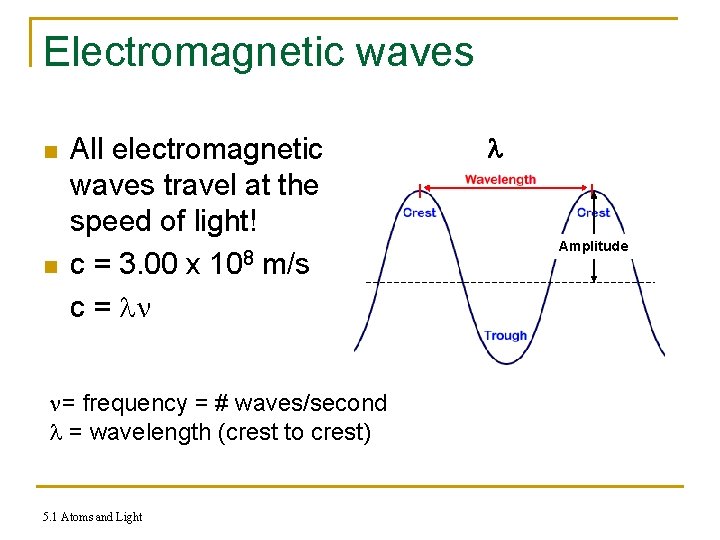
Electromagnetic waves n n All electromagnetic waves travel at the speed of light! c = 3. 00 x 108 m/s c = ln n= frequency = # waves/second l = wavelength (crest to crest) 5. 1 Atoms and Light l Amplitude
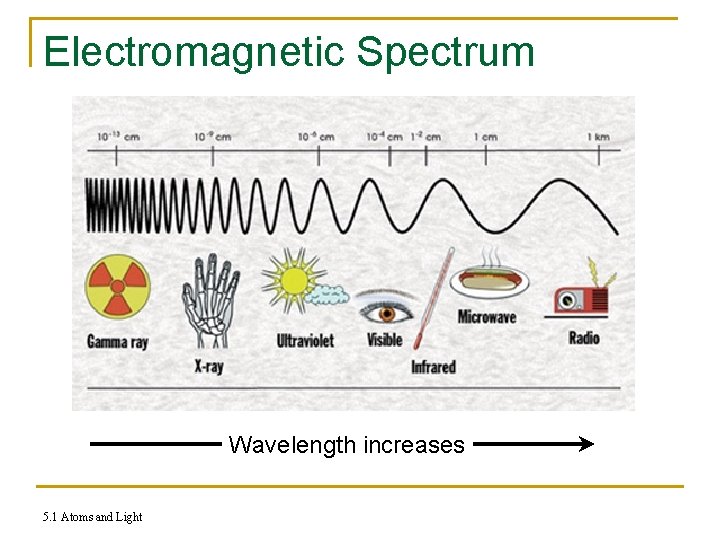
Electromagnetic Spectrum Wavelength increases 5. 1 Atoms and Light
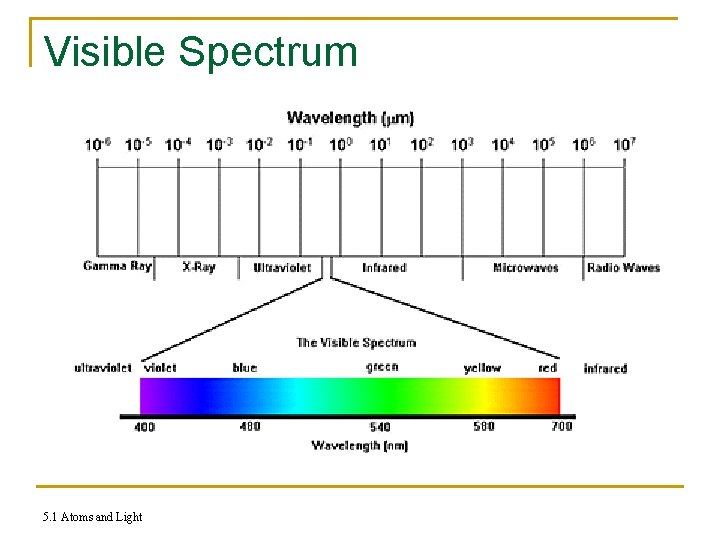
Visible Spectrum 5. 1 Atoms and Light
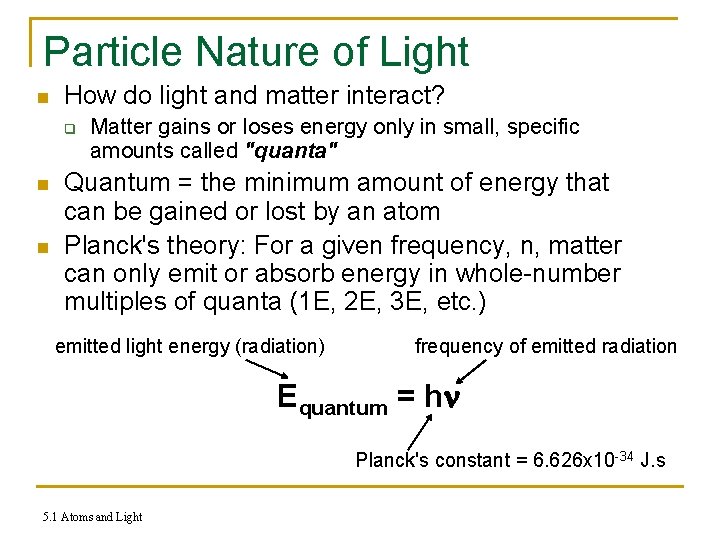
Particle Nature of Light n How do light and matter interact? q n n Matter gains or loses energy only in small, specific amounts called "quanta" Quantum = the minimum amount of energy that can be gained or lost by an atom Planck's theory: For a given frequency, n, matter can only emit or absorb energy in whole-number multiples of quanta (1 E, 2 E, 3 E, etc. ) emitted light energy (radiation) frequency of emitted radiation Equantum = hn Planck's constant = 6. 626 x 10 -34 J. s 5. 1 Atoms and Light
The Photoelectric Effect n n Proposed by Albert Einstein in 1905 Electromagnetic radiation is both wave-like and particle-like A beam of light can be thought of as a stream of tiny bundles of energy, called "photons" A photon is a particle of electromagnetic radiation with no mass, having a quantum of energy Ephoton = Equantum = hn 5. 1 Atoms and Light
Atomic Emission Spectrum n n Atoms emit electromagnetic waves when excited or unstable The set of frequencies of those electromagnetic waves is called the "atomic emission spectrum" of that atom The spectrum is made up of lines of color Each atom has a unique spectrum to see samples of spectra, go to: http: //webmineral. com/help/Flame. Test. shtml 5. 1 Atoms and Light
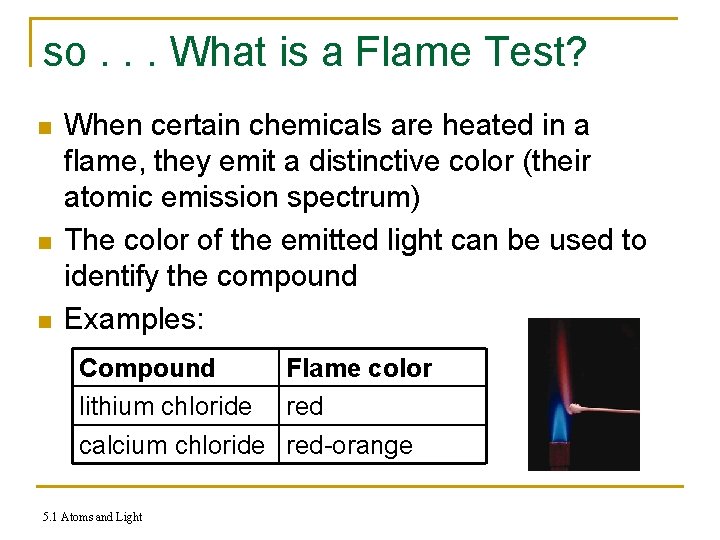
so. . . What is a Flame Test? n n n When certain chemicals are heated in a flame, they emit a distinctive color (their atomic emission spectrum) The color of the emitted light can be used to identify the compound Examples: Compound Flame color lithium chloride red calcium chloride red-orange 5. 1 Atoms and Light
Modeling the Atom n n Revisit movie, "The Atom" Hydrogen's atomic orbitals q n Energy levels, sublevels, and atomic orbitals Extending to other atoms electrons in atoms
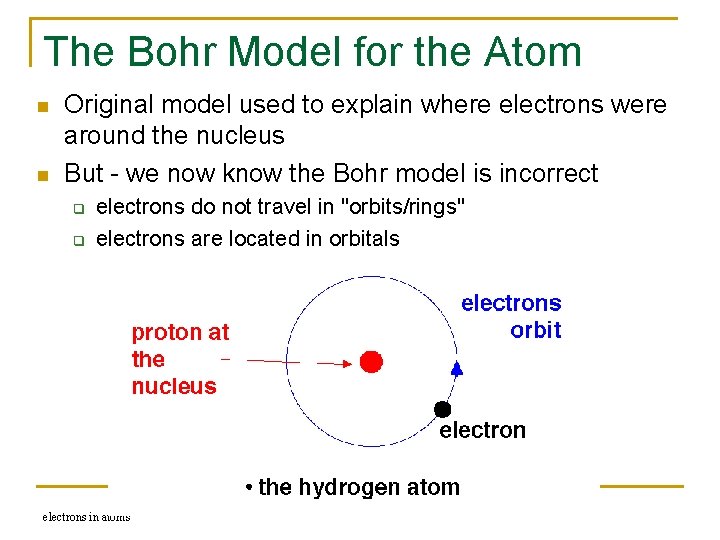
The Bohr Model for the Atom n n Original model used to explain where electrons were around the nucleus But - we now know the Bohr model is incorrect q q electrons do not travel in "orbits/rings" electrons are located in orbitals electrons in atoms
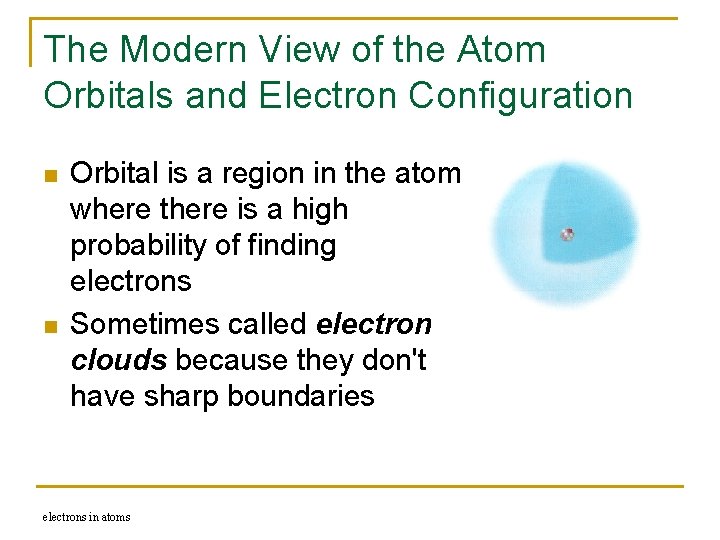
The Modern View of the Atom Orbitals and Electron Configuration n n Orbital is a region in the atom where there is a high probability of finding electrons Sometimes called electron clouds because they don't have sharp boundaries electrons in atoms
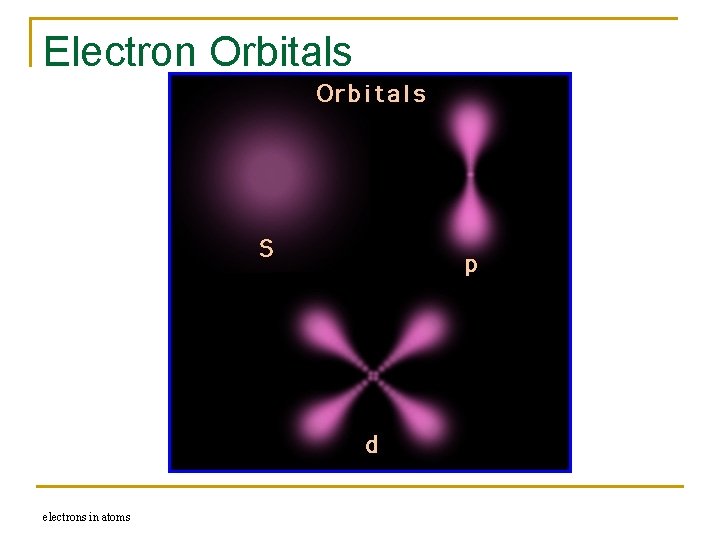
Electron Orbitals electrons in atoms
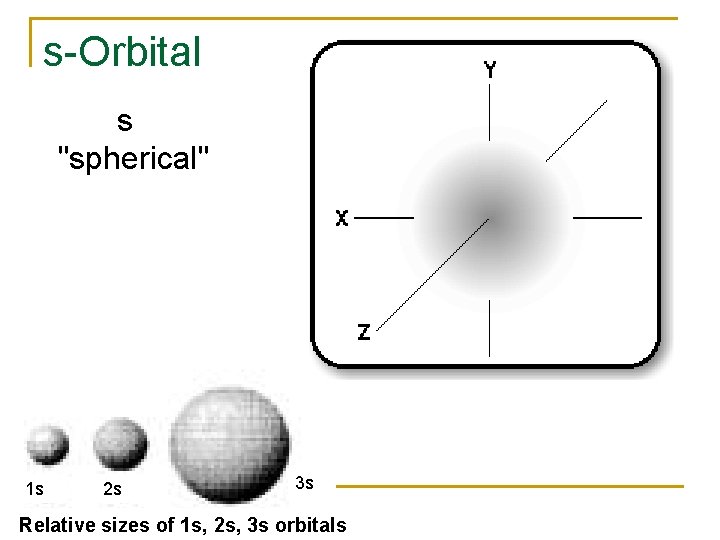
s-Orbital s "spherical" 1 s 2 s electrons in atoms 3 s Relative sizes of 1 s, 2 s, 3 s orbitals
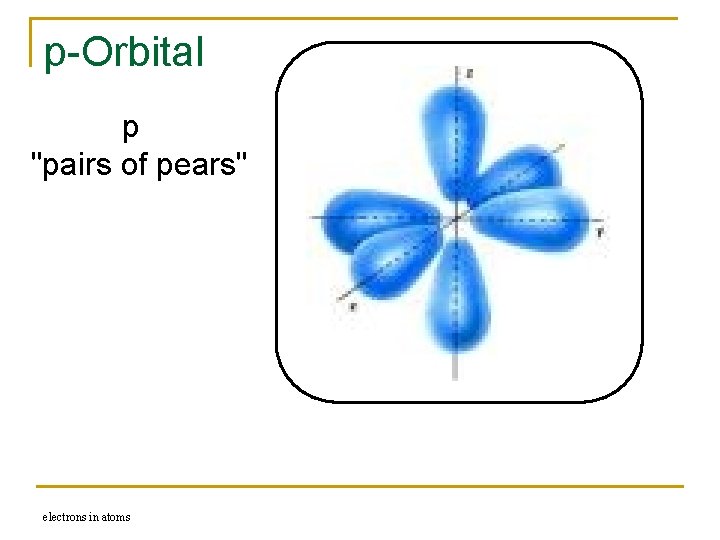
p-Orbital p "pairs of pears" electrons in atoms
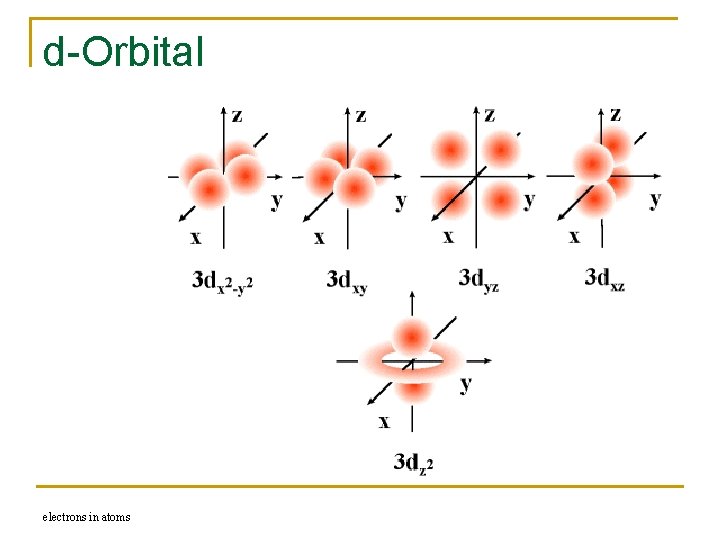
d-Orbital electrons in atoms
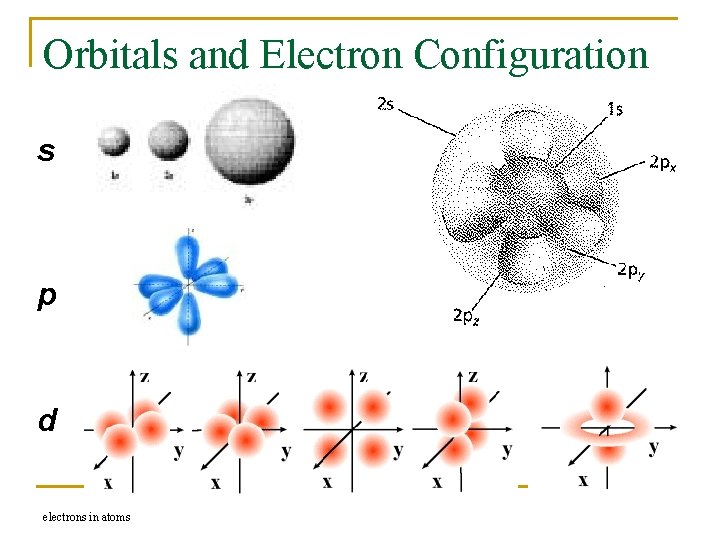
Orbitals and Electron Configuration s p d electrons in atoms

quantum model of a sodium atom Na p+ = 11 e- = 11 n 0 = 12 electrons in atoms
Definitions to Know n Probability q q n Orbital q q n Specific energy levels an electron can be in Ground State q n Specific region where the electron is Not guaranteed to be at any one place but rather a region of high probability Energy State q n Likelihood of an occurrence Likelihood of finding an electron in a specific region within the atom Lowest energy level an electron can be in Excited State q Any level above the ground state electrons in atoms
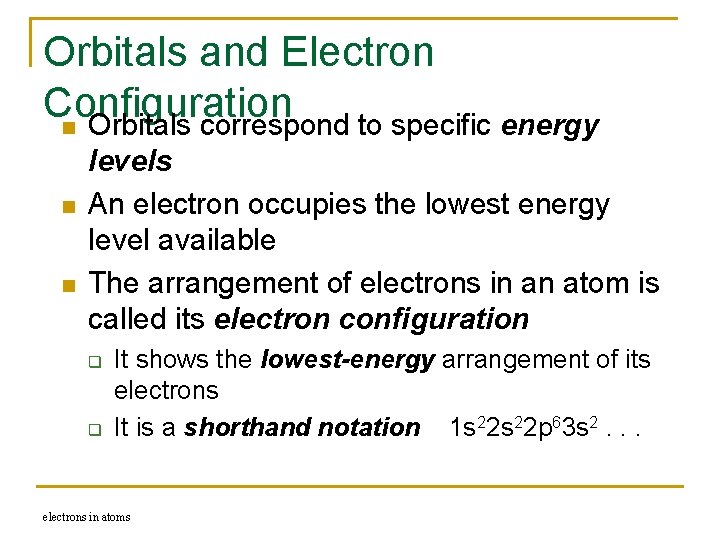
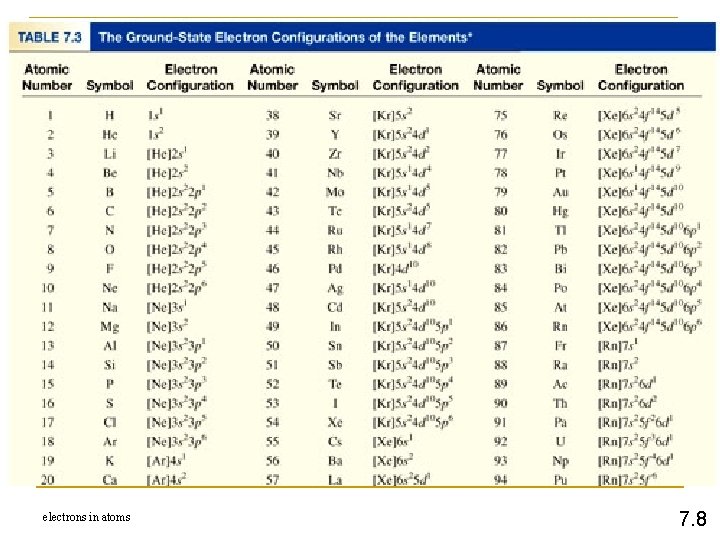
Orbitals and Electron Configuration n Orbitals correspond to specific energy n n levels An electron occupies the lowest energy level available The arrangement of electrons in an atom is called its electron configuration q q It shows the lowest-energy arrangement of its electrons It is a shorthand notation 1 s 22 p 63 s 2. . . electrons in atoms

The Hydrogen Atom - Seven Energy At any given time, depending on its energy state, hydrogen's single Levels n electron exists in a given energy level and a specific orbital Principal level (n) Sublevels (types of orbitals) Number of orbitals in each sublevel Total number of orbitals related to principal level 1 s 1 1 2 s p 1 3 4 3 s p d 1 3 5 9 4 s p d f 1 3 5 7 16 etc. electrons in atoms
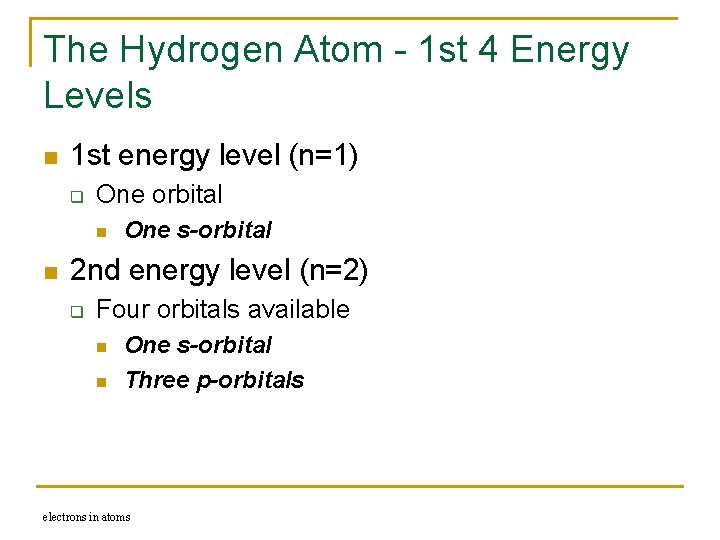
The Hydrogen Atom - 1 st 4 Energy Levels n 1 st energy level (n=1) q One orbital n n One s-orbital 2 nd energy level (n=2) q Four orbitals available n n One s-orbital Three p-orbitals electrons in atoms
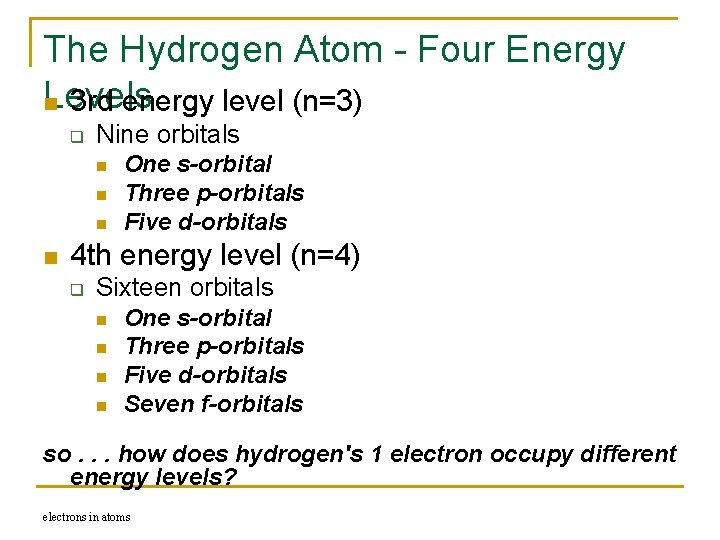
The Hydrogen Atom - Four Energy Levels n 3 rd energy level (n=3) q Nine orbitals n n One s-orbital Three p-orbitals Five d-orbitals 4 th energy level (n=4) q Sixteen orbitals n n One s-orbital Three p-orbitals Five d-orbitals Seven f-orbitals so. . . how does hydrogen's 1 electron occupy different energy levels? electrons in atoms
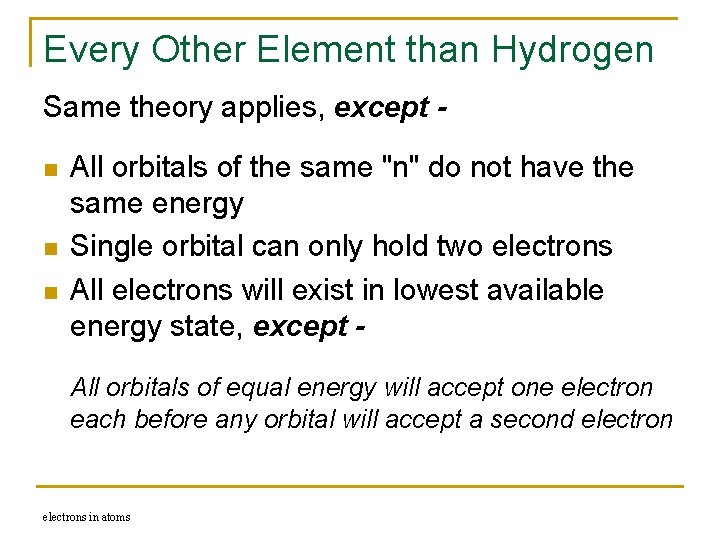
Every Other Element than Hydrogen Same theory applies, except n n n All orbitals of the same "n" do not have the same energy Single orbital can only hold two electrons All electrons will exist in lowest available energy state, except All orbitals of equal energy will accept one electron each before any orbital will accept a second electrons in atoms
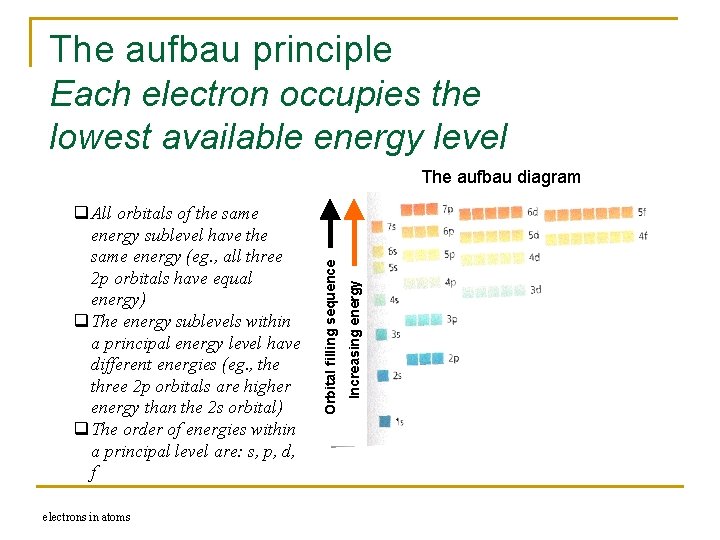
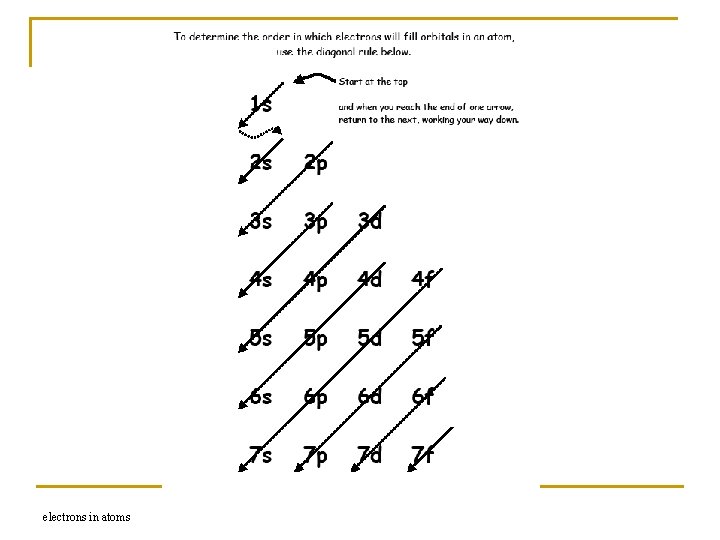
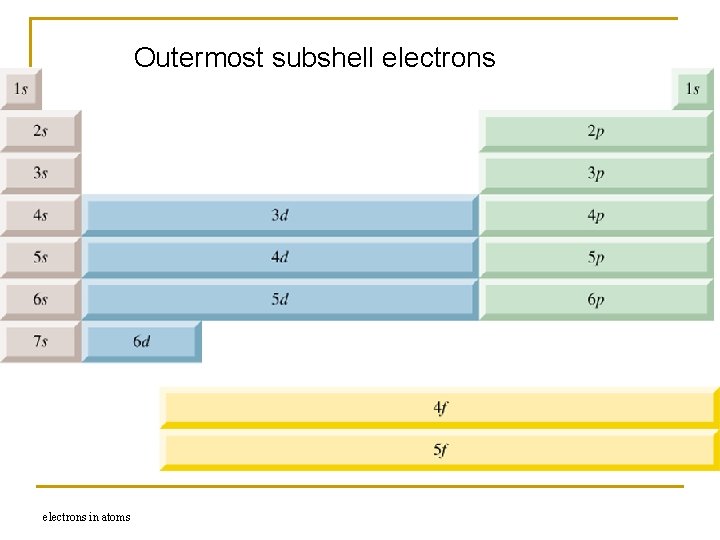
The aufbau principle Each electron occupies the lowest available energy level electrons in atoms Increasing energy q All orbitals of the same energy sublevel have the same energy (eg. , all three 2 p orbitals have equal energy) q The energy sublevels within a principal energy level have different energies (eg. , the three 2 p orbitals are higher energy than the 2 s orbital) q The order of energies within a principal level are: s, p, d, f Orbital filling sequence The aufbau diagram
The Pauli exclusion principle A single orbital can only hold two electrons (with opposite spins) electrons in atoms
Hund's Rule All orbitals of equal energy will accept one electron each before any orbital will accept a second electrons in atoms

Tips for Writing Electron Configurations 1. Remember what each part of the configuration stands for example 1 s 2 (1) = the energy level (s) = the type of orbital (2) = # of electrons in the orbital electrons in atoms
Tips for Writing Electron Configurations 2. Start with the 1 s orbital. Then begin filling the next highest energy orbitals (2 s, 2 p, 3 s, etc. ) until all the electrons are accounted for 3. Put one electron in each orbital of the sublevel first; then go back and pair electrons in each orbital as necessary. electrons in atoms

Let's Practice hydrogen helium lithium beryllium boron carbon nitrogen oxygen fluorine neon 7 p 7 s 6 s 5 p 5 s 5 d 4 d 4 p 3 d 4 s 3 p 3 s 2 p 2 s 1 s electrons in atoms 6 p 6 d 5 f 4 f
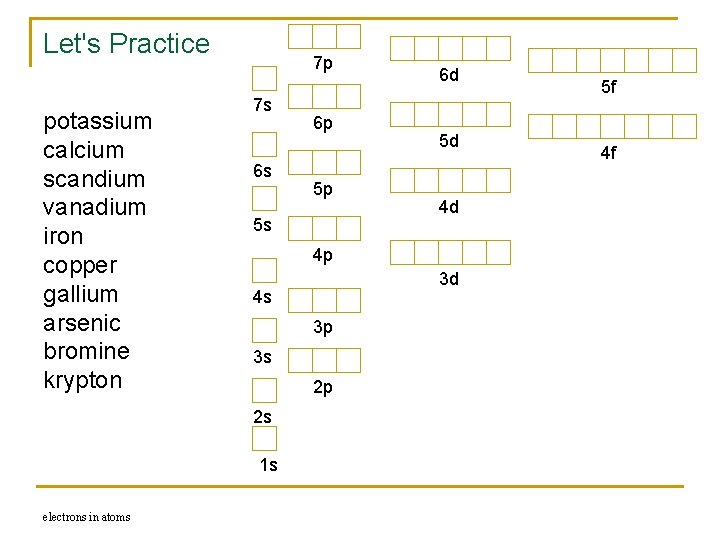
Let's Practice potassium calcium scandium vanadium iron copper gallium arsenic bromine krypton 7 p 7 s 6 s 5 p 5 s 5 d 4 d 4 p 3 d 4 s 3 p 3 s 2 p 2 s 1 s electrons in atoms 6 p 6 d 5 f 4 f
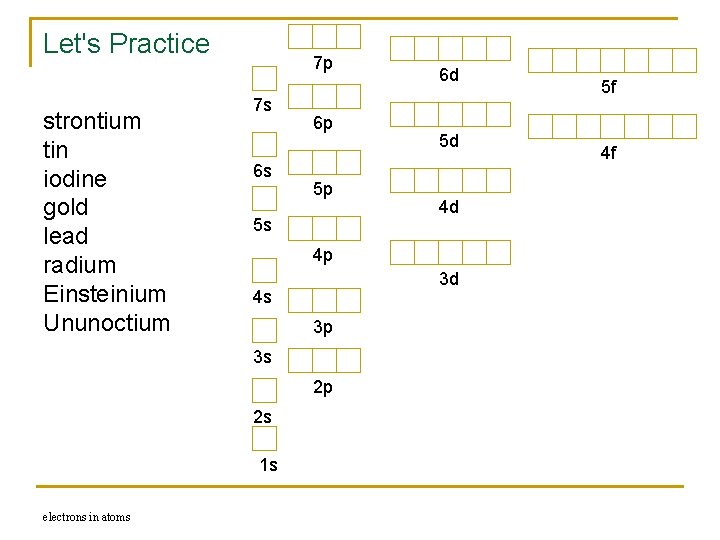
Let's Practice strontium tin iodine gold lead radium Einsteinium Ununoctium 7 p 7 s 6 s 6 p 5 p 5 s 5 d 4 d 4 p 3 d 4 s 3 p 3 s 2 p 2 s 1 s electrons in atoms 6 d 5 f 4 f
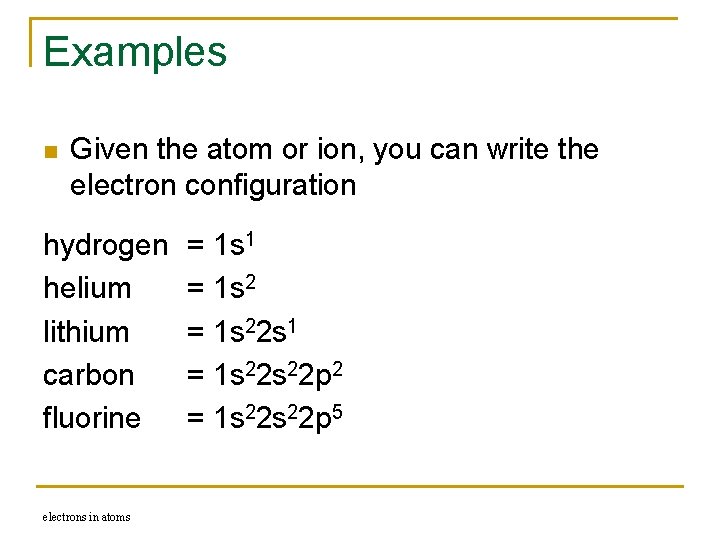
Examples n Given the atom or ion, you can write the electron configuration hydrogen helium lithium carbon fluorine electrons in atoms = 1 s 1 = 1 s 22 s 1 = 1 s 22 p 2 = 1 s 22 p 5

Let's Practice hydrogen lithium boron nitrogen fluorine vanadium zinc arsenic iodine cerium dubnium electrons in atoms hey, let's use the noble gas configuration!
electrons in atoms
Outermost subshell electrons in atoms
electrons in atoms 7. 8
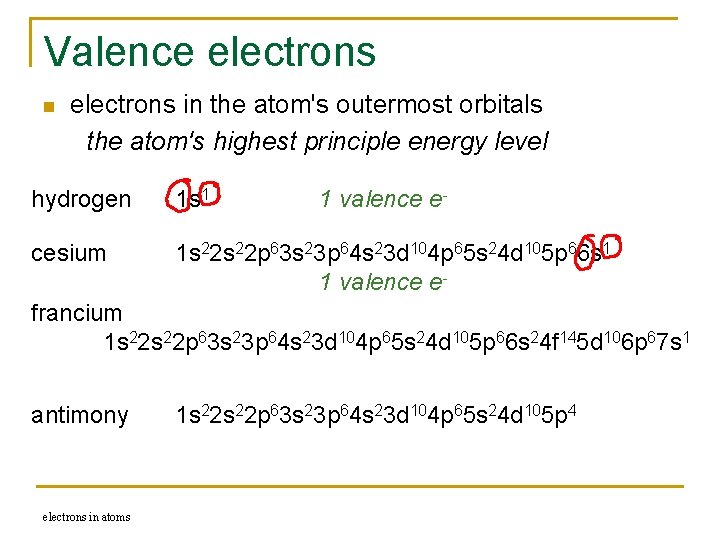
Valence electrons n electrons in the atom's outermost orbitals the atom's highest principle energy level hydrogen 1 s 1 1 valence e- cesium 1 s 22 p 63 s 23 p 64 s 23 d 104 p 65 s 24 d 105 p 66 s 1 1 valence e- francium 1 s 22 p 63 s 23 p 64 s 23 d 104 p 65 s 24 d 105 p 66 s 24 f 145 d 106 p 67 s 1 antimony electrons in atoms 1 s 22 p 63 s 23 p 64 s 23 d 104 p 65 s 24 d 105 p 4
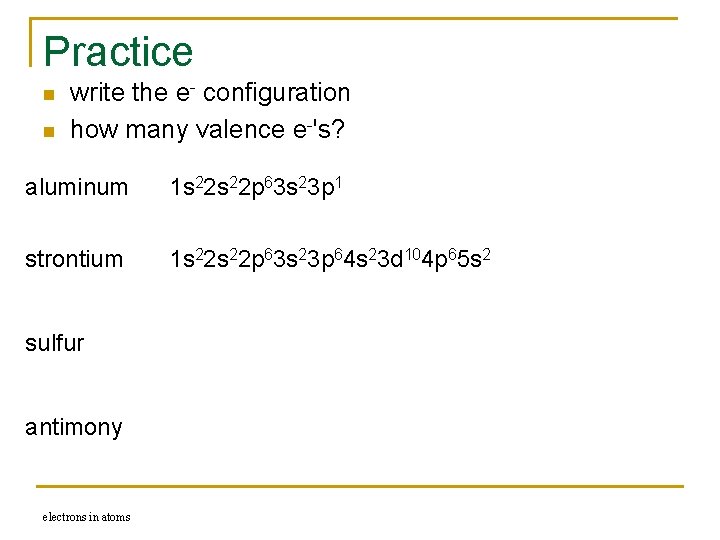
Practice n n write the e- configuration how many valence e-'s? aluminum 1 s 22 p 63 s 23 p 1 strontium 1 s 22 p 63 s 23 p 64 s 23 d 104 p 65 s 2 sulfur antimony electrons in atoms

Paramagnetic unpaired electrons 2 p electrons in atoms Diamagnetic all electrons paired 2 p 7. 8
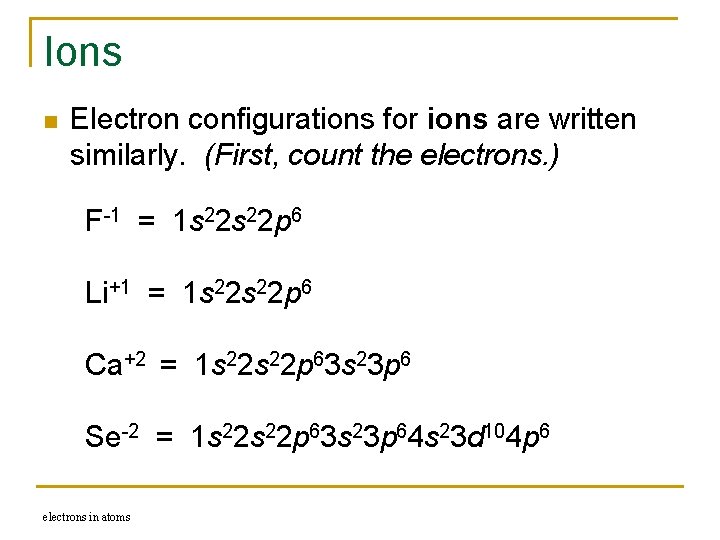
Ions n Electron configurations for ions are written similarly. (First, count the electrons. ) F-1 = 1 s 22 p 6 Li+1 = 1 s 22 p 6 Ca+2 = 1 s 22 p 63 s 23 p 6 Se-2 = 1 s 22 p 63 s 23 p 64 s 23 d 104 p 6 electrons in atoms
- Slides: 43