
Atoms and Energy Objective Learning about atomic models
Atoms and Energy Objective: Learning about atomic models, atomic structure and energy level of electrons. Also, explore the structure and the trends of periodic table. Key concepts: v Atomic Model v Emission Spectrum and energy levels v Periodic table v Atomics Number and Atomic Mass v Isotopes v Trends in Periodic Table
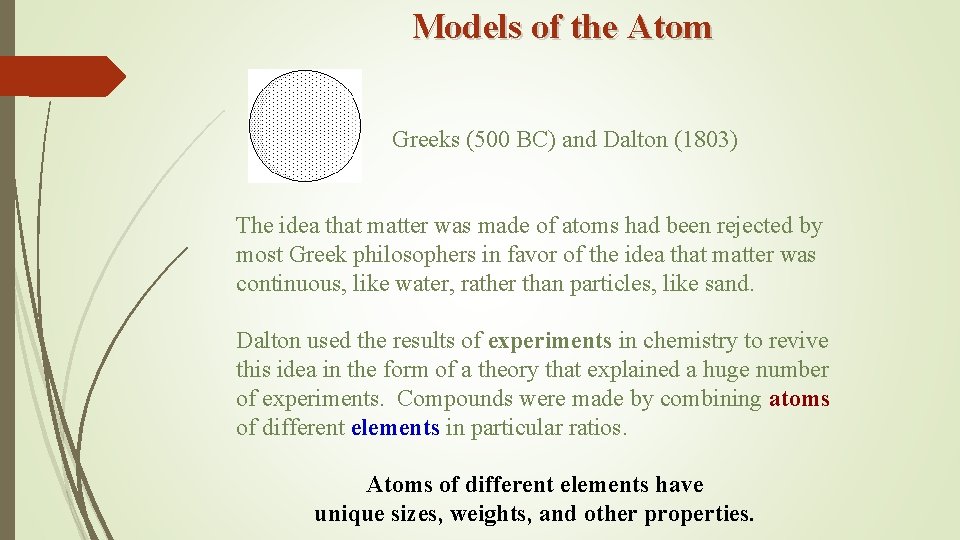
Models of the Atom Greeks (500 BC) and Dalton (1803) The idea that matter was made of atoms had been rejected by most Greek philosophers in favor of the idea that matter was continuous, like water, rather than particles, like sand. Dalton used the results of experiments in chemistry to revive this idea in the form of a theory that explained a huge number of experiments. Compounds were made by combining atoms of different elements in particular ratios. Atoms of different elements have unique sizes, weights, and other properties.
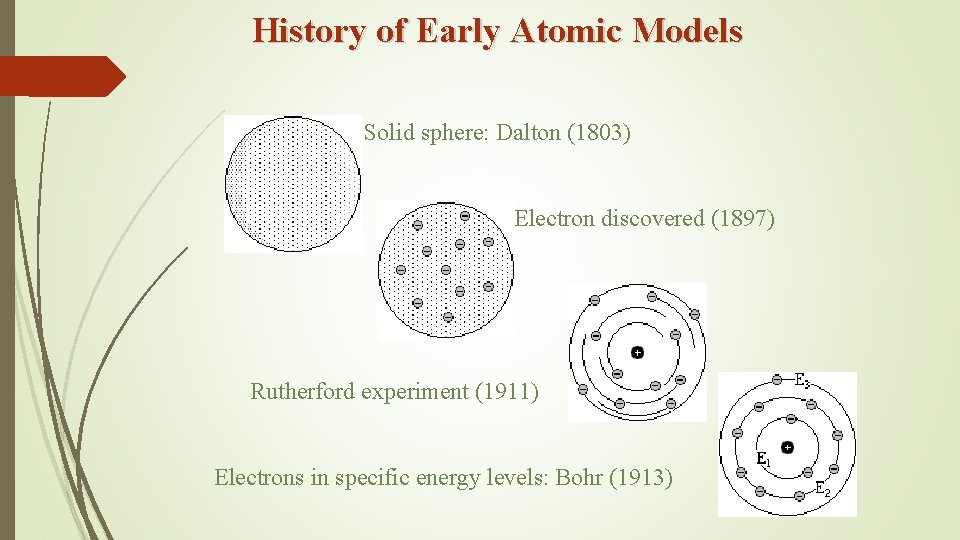
History of Early Atomic Models Solid sphere: Dalton (1803) Electron discovered (1897) Rutherford experiment (1911) Electrons in specific energy levels: Bohr (1913)
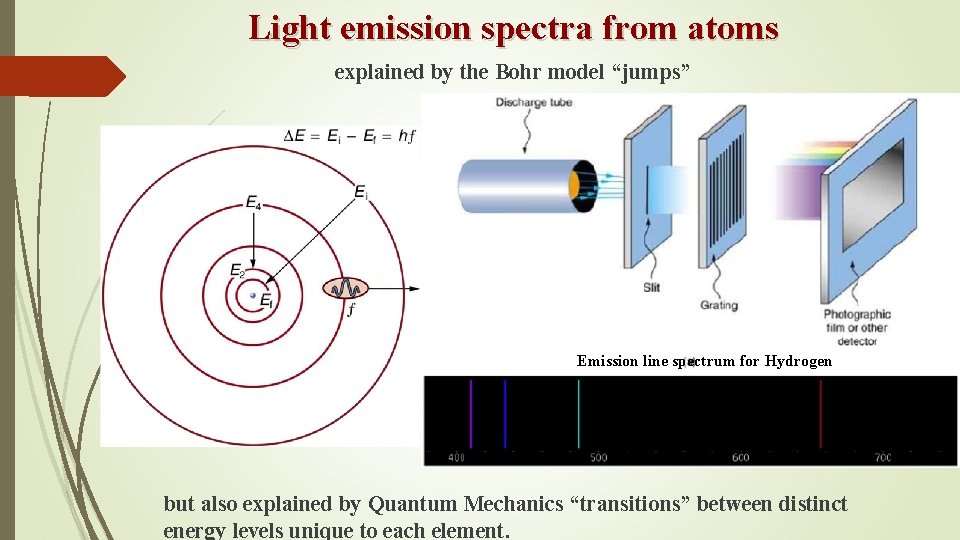
Light emission spectra from atoms explained by the Bohr model “jumps” Emission line spectrum for Hydrogen but also explained by Quantum Mechanics “transitions” between distinct energy levels unique to each element.
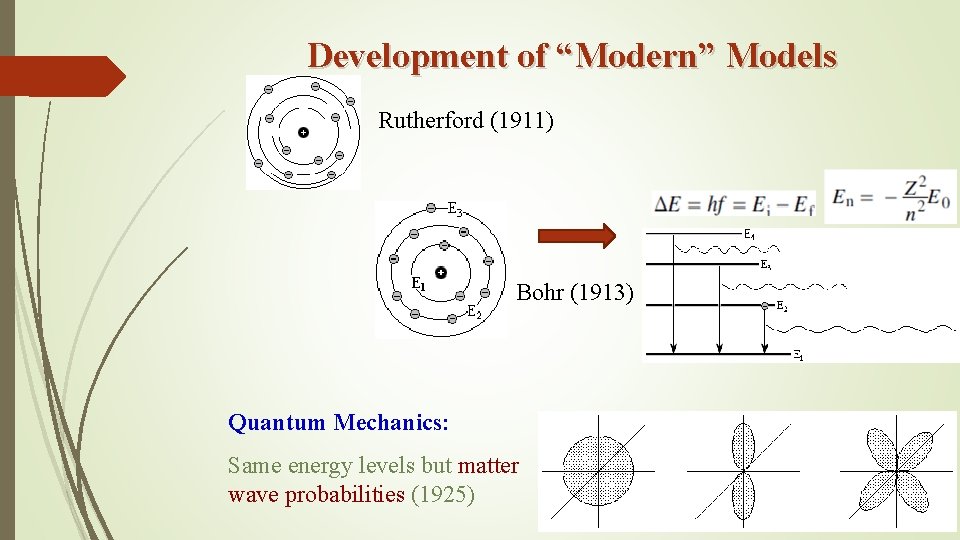
Development of “Modern” Models Rutherford (1911) Bohr (1913) Quantum Mechanics: Same energy levels but matter wave probabilities (1925)
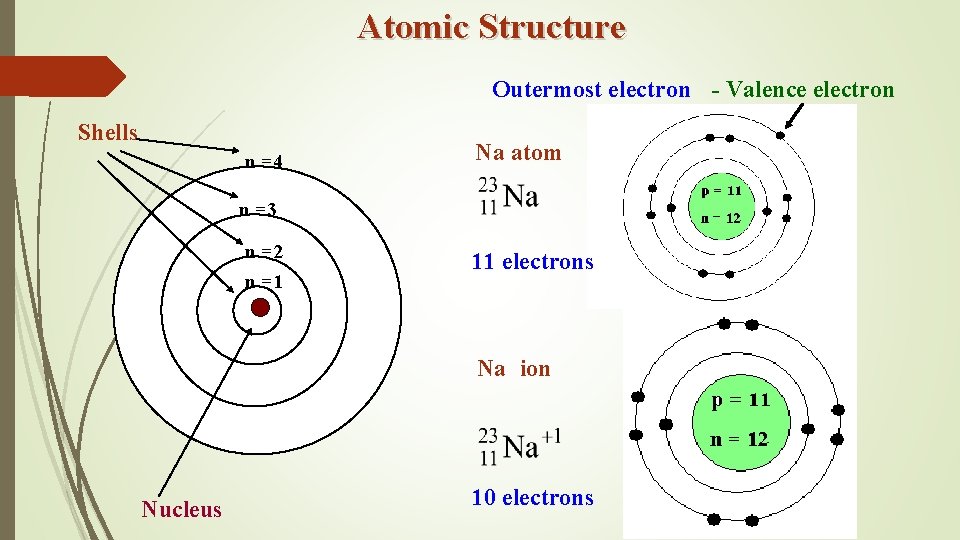
Atomic Structure Outermost electron - Valence electron Shells n =4 Na atom n =3 n =2 n =1 11 electrons Na ion Nucleus 10 electrons
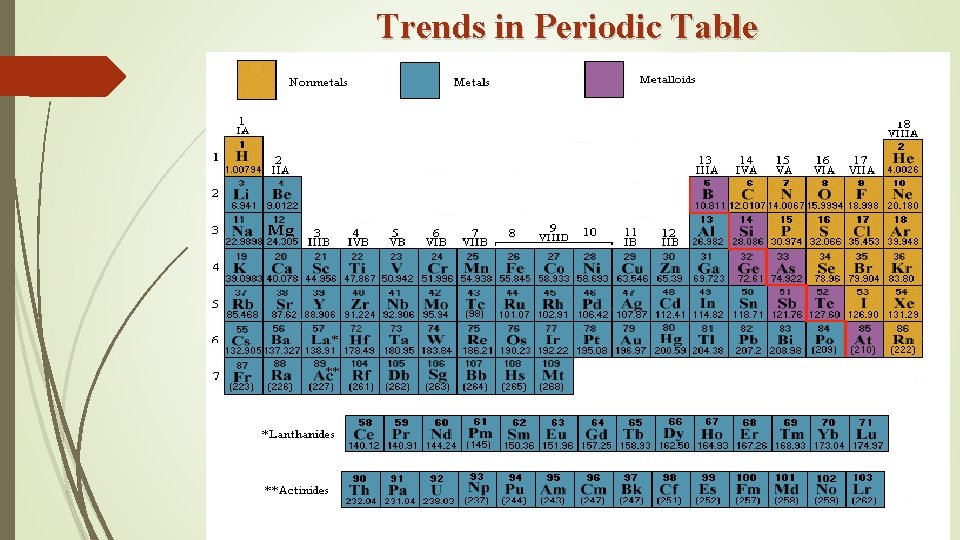
Structure of the Periodic Table The original arrangement of the Periodic Table came from organizing elements by their properties, which repeated in a regular pattern with a particular period (frequency). Elements in the same column (group or family) have very similar chemical properties (see the next slide). Elements in the same row show a smooth trend in properties as you move from one side to the other. We now understand this to be a result of the organization of electron energy levels given by quantum mechanics.

Structure of the Periodic Table Electrons fill distinct energy “shells” and each row corresponds to the filling of a shell. All of chemistry can be understood starting from this basic concept of atomic physics.

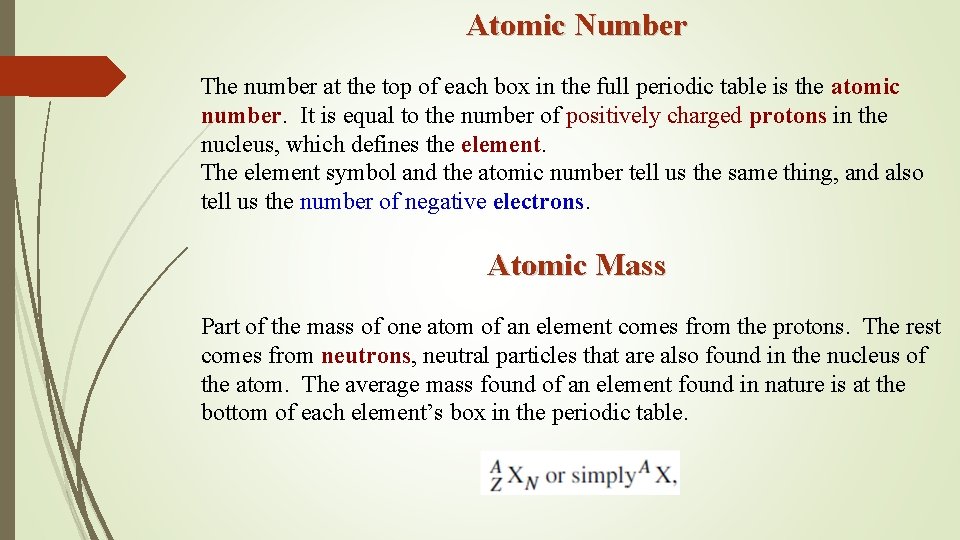
Atomic Number The number at the top of each box in the full periodic table is the atomic number. It is equal to the number of positively charged protons in the nucleus, which defines the element. The element symbol and the atomic number tell us the same thing, and also tell us the number of negative electrons. Atomic Mass Part of the mass of one atom of an element comes from the protons. The rest comes from neutrons, neutral particles that are also found in the nucleus of the atom. The average mass found of an element found in nature is at the bottom of each element’s box in the periodic table.
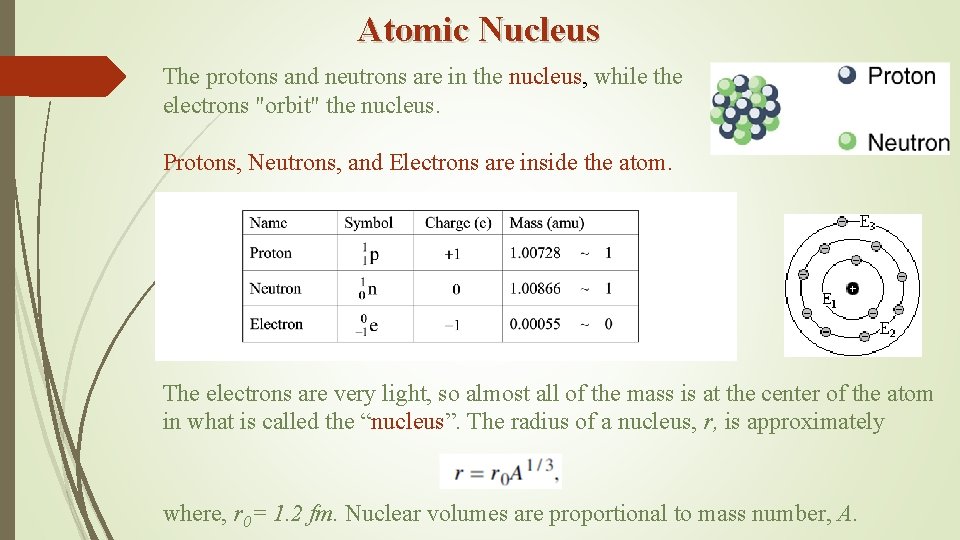
Atomic Nucleus The protons and neutrons are in the nucleus, while the electrons "orbit" the nucleus. Protons, Neutrons, and Electrons are inside the atom. The electrons are very light, so almost all of the mass is at the center of the atom in what is called the “nucleus”. The radius of a nucleus, r, is approximately where, r 0= 1. 2 fm. Nuclear volumes are proportional to mass number, A.
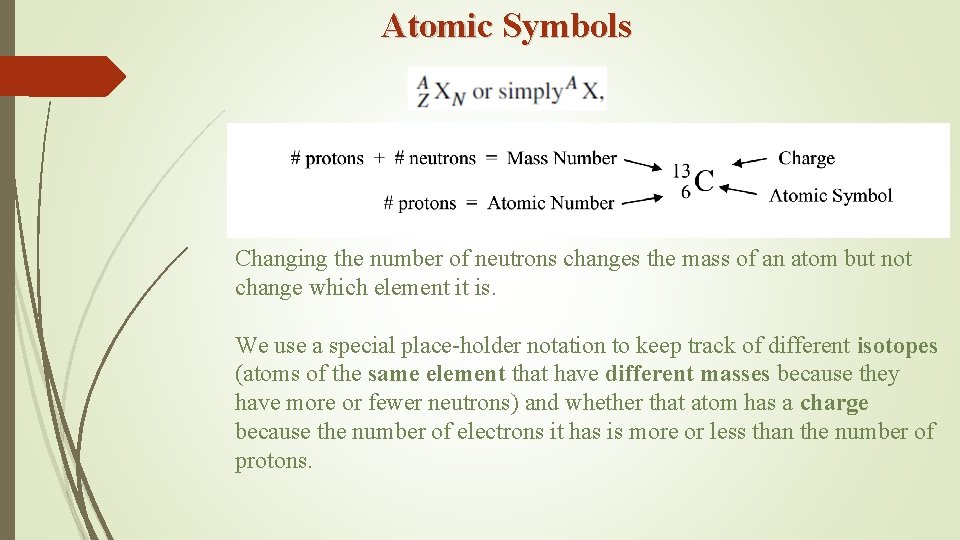
Atomic Symbols Changing the number of neutrons changes the mass of an atom but not change which element it is. We use a special place-holder notation to keep track of different isotopes (atoms of the same element that have different masses because they have more or fewer neutrons) and whether that atom has a charge because the number of electrons it has is more or less than the number of protons.
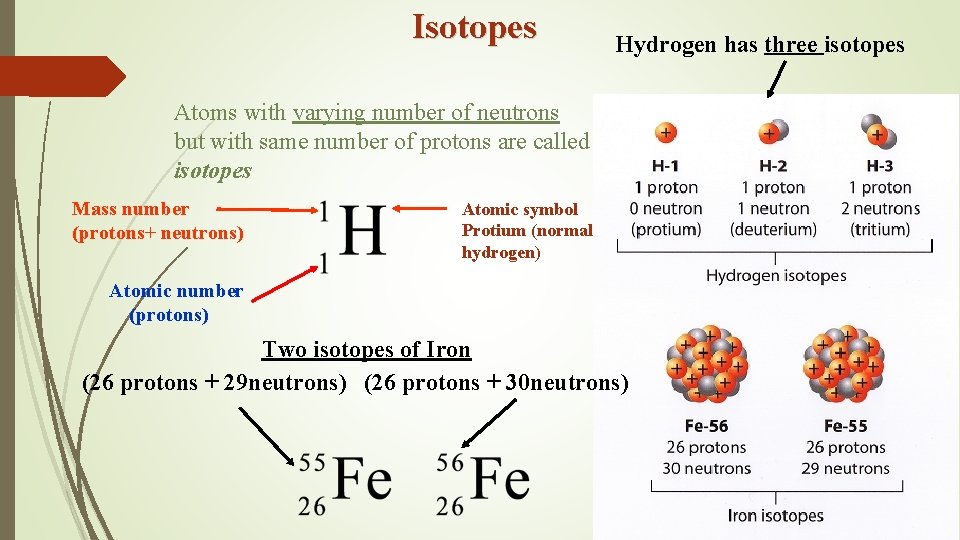
Isotopes Hydrogen has three isotopes Atoms with varying number of neutrons but with same number of protons are called isotopes Mass number (protons+ neutrons) Atomic symbol Protium (normal hydrogen) Atomic number (protons) Two isotopes of Iron (26 protons + 29 neutrons) (26 protons + 30 neutrons)
Examples
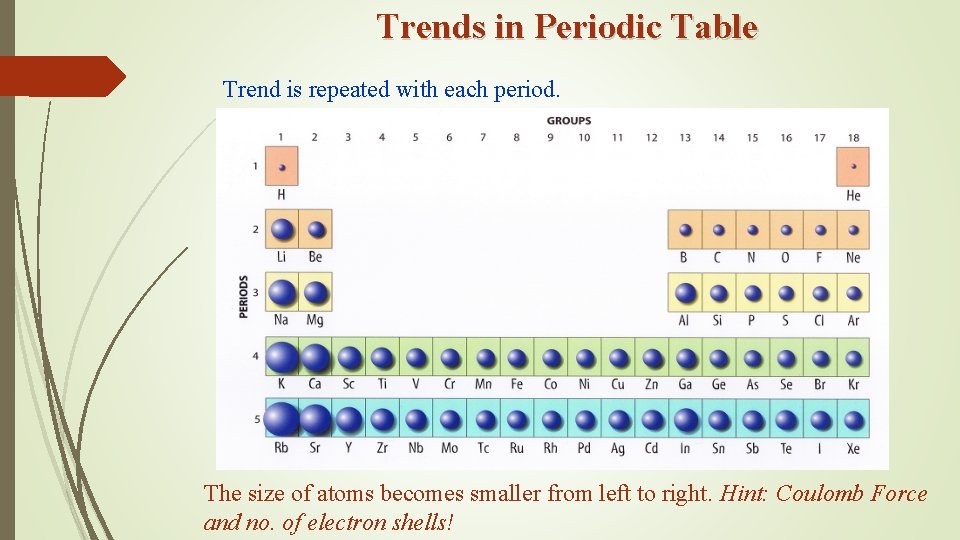
Trends in Periodic Table Trend is repeated with each period. The size of atoms becomes smaller from left to right. Hint: Coulomb Force and no. of electron shells!
Trends in Periodic Table
- Slides: 16