
Atomiclayer CVD ALCVD or ALD Deposits successive layers
- Slides: 7
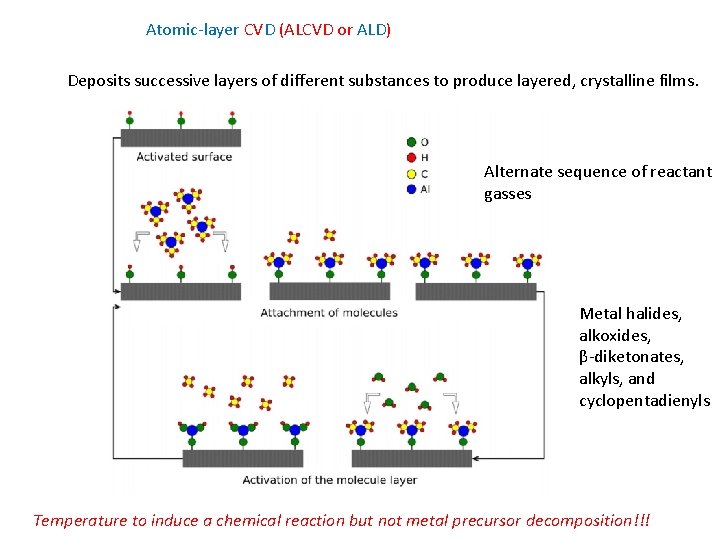
Atomic-layer CVD (ALCVD or ALD) Deposits successive layers of different substances to produce layered, crystalline films. Alternate sequence of reactant gasses Metal halides, alkoxides, β-diketonates, alkyls, and cyclopentadienyls Temperature to induce a chemical reaction but not metal precursor decomposition!!!
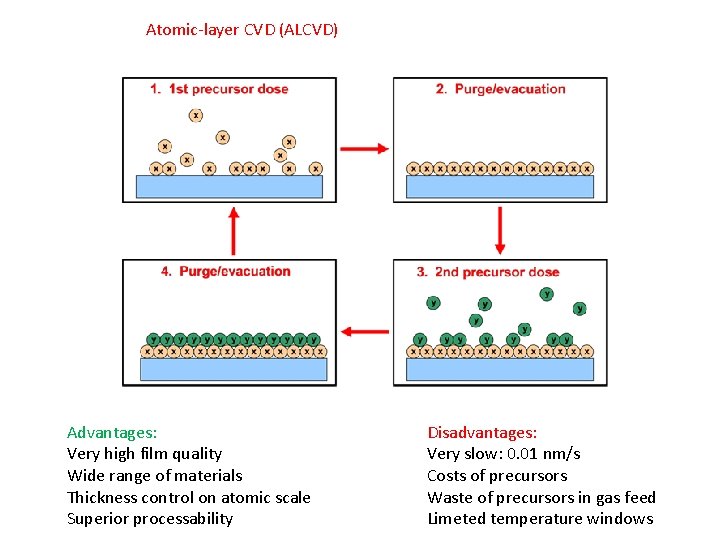
Atomic-layer CVD (ALCVD) Advantages: Very high film quality Wide range of materials Thickness control on atomic scale Superior processability Disadvantages: Very slow: 0. 01 nm/s Costs of precursors Waste of precursors in gas feed Limeted temperature windows
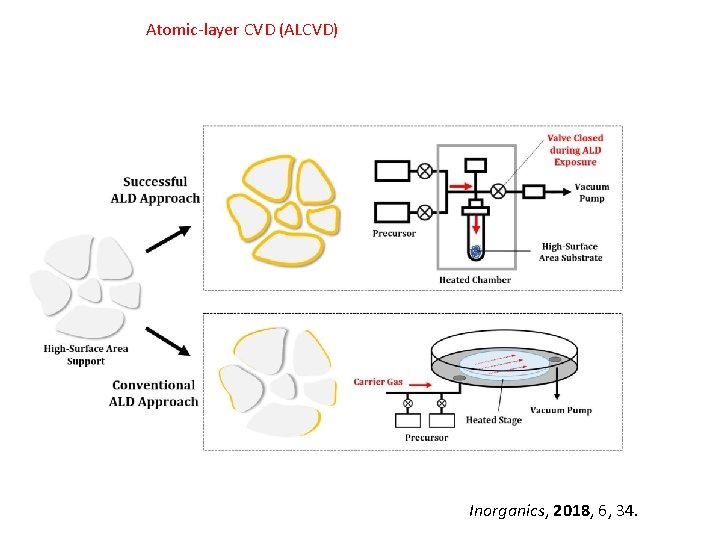
Atomic-layer CVD (ALCVD) Inorganics, 2018, 6, 34.
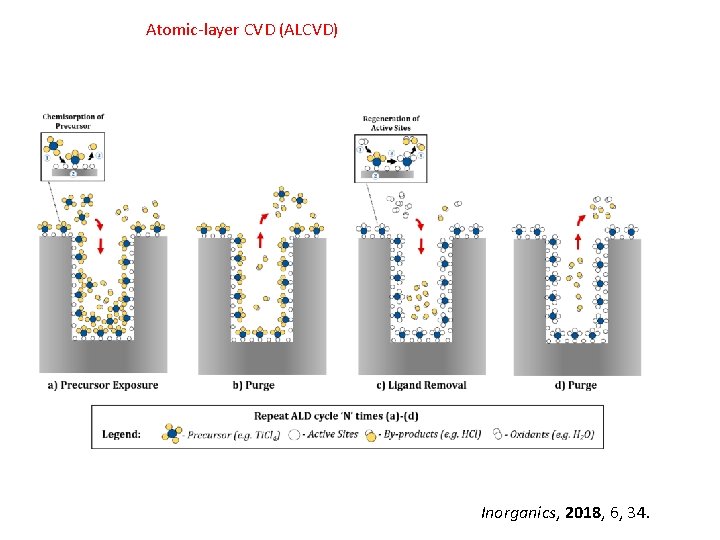
Atomic-layer CVD (ALCVD) Inorganics, 2018, 6, 34.
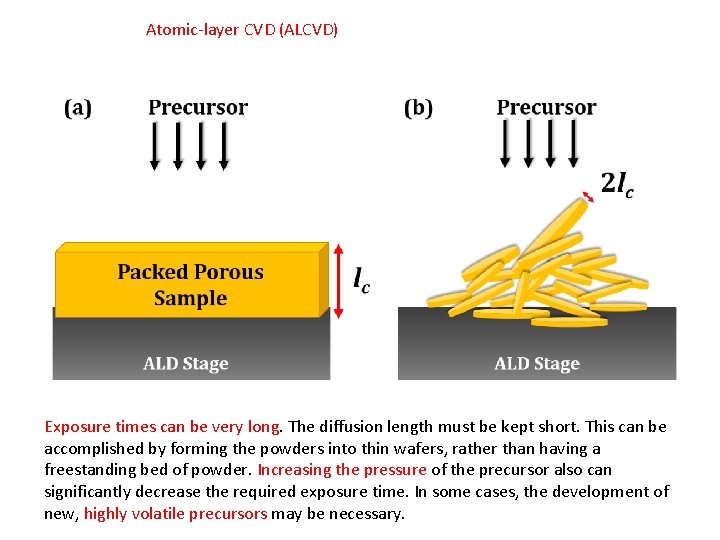
Atomic-layer CVD (ALCVD) Exposure times can be very long. The diffusion length must be kept short. This can be accomplished by forming the powders into thin wafers, rather than having a freestanding bed of powder. Increasing the pressure of the precursor also can significantly decrease the required exposure time. In some cases, the development of new, highly volatile precursors may be necessary.
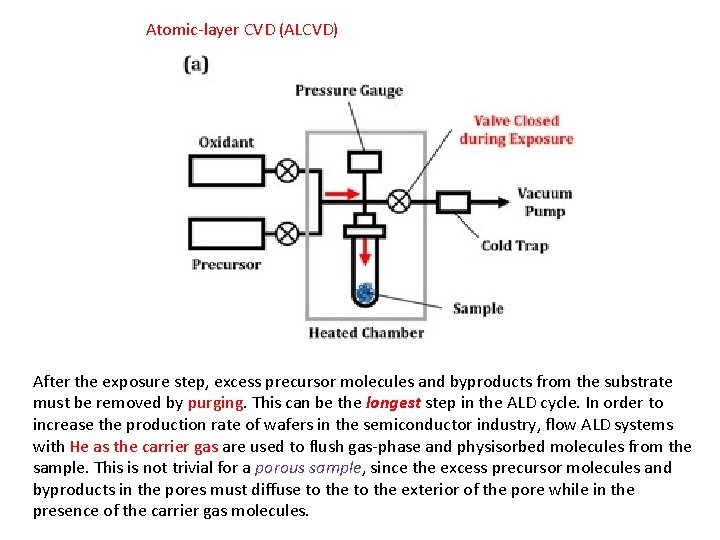
Atomic-layer CVD (ALCVD) After the exposure step, excess precursor molecules and byproducts from the substrate must be removed by purging. This can be the longest step in the ALD cycle. In order to increase the production rate of wafers in the semiconductor industry, flow ALD systems with He as the carrier gas are used to flush gas-phase and physisorbed molecules from the sample. This is not trivial for a porous sample, since the excess precursor molecules and byproducts in the pores must diffuse to the exterior of the pore while in the presence of the carrier gas molecules.
Atomic-layer CVD (ALCVD) Obviously, when the purging step is incomplete, physisorbed precursor molecules may remain within the pore. Introducing the next reactant will lead to the reaction of these condensed species. (1) the formation of non-uniform films; (2) the formation of porous films; (3) the production of films that are much thicker than would be expected for ALD. The reaction of condensed films has been invoked as an explanation for the thick porous films formed by ALD procedures in SOFC electrodes.