
Atomic Vibrations in Solids phonons Goal understanding the
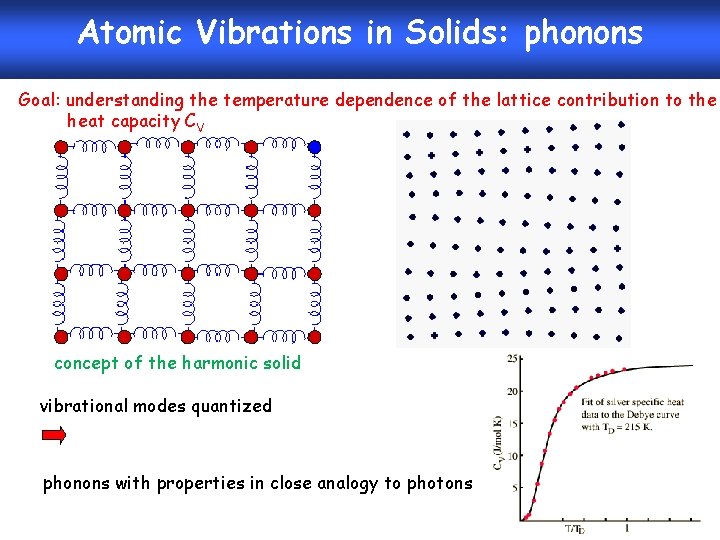
Atomic Vibrations in Solids: phonons Goal: understanding the temperature dependence of the lattice contribution to the heat capacity CV concept of the harmonic solid Photons* and Planck’s black body radiation law vibrational modes quantized phonons with properties in close analogy to photons
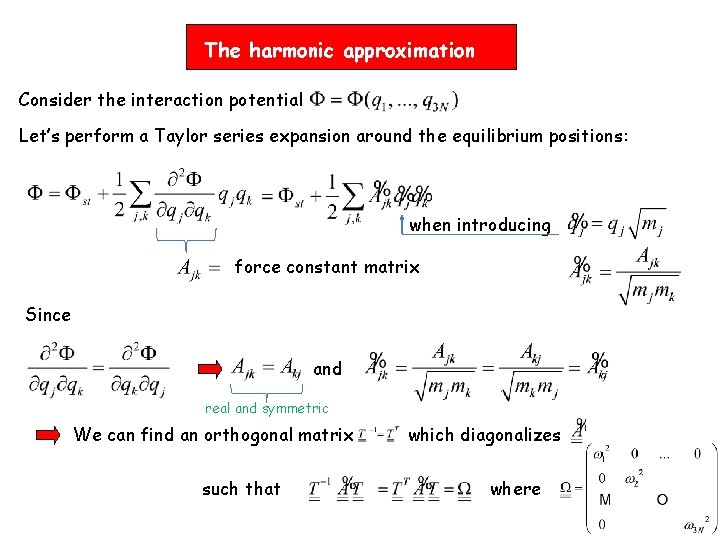
The harmonic approximation Consider the interaction potential Let’s perform a Taylor series expansion around the equilibrium positions: when introducing force constant matrix Since and real and symmetric We can find an orthogonal matrix such that which diagonalizes where
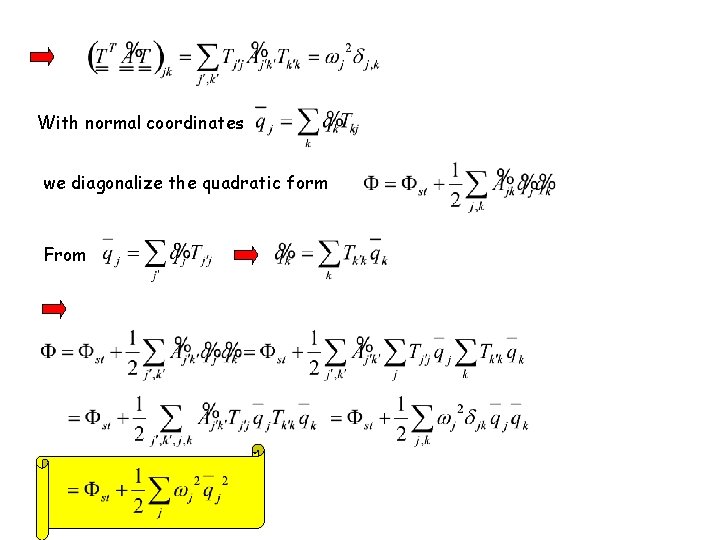
With normal coordinates we diagonalize the quadratic form From
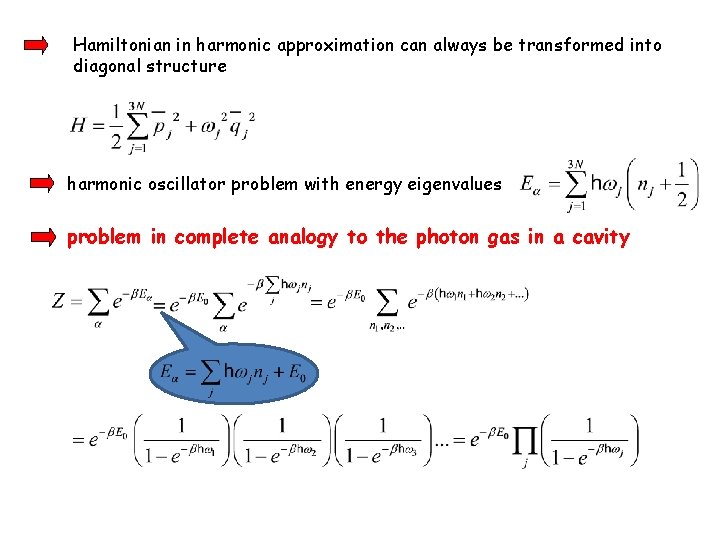
Hamiltonian in harmonic approximation can always be transformed into diagonal structure harmonic oscillator problem with energy eigenvalues problem in complete analogy to the photon gas in a cavity
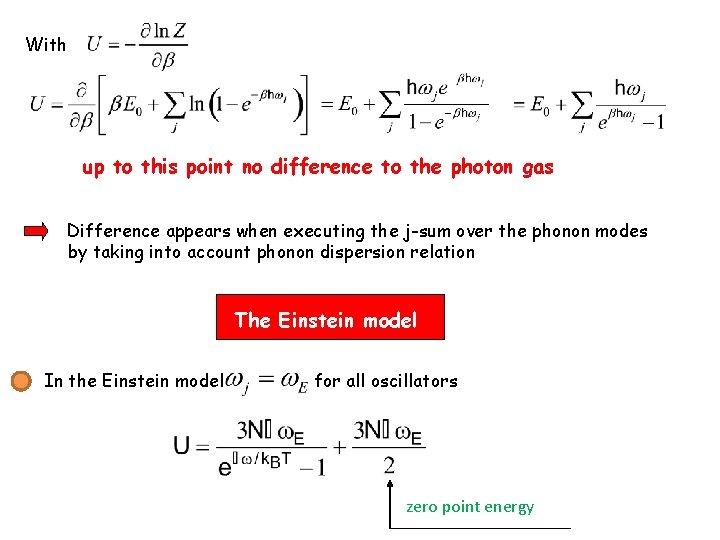
With up to this point no difference to the photon gas Difference appears when executing the j-sum over the phonon modes by taking into account phonon dispersion relation The Einstein model In the Einstein model for all oscillators zero point energy
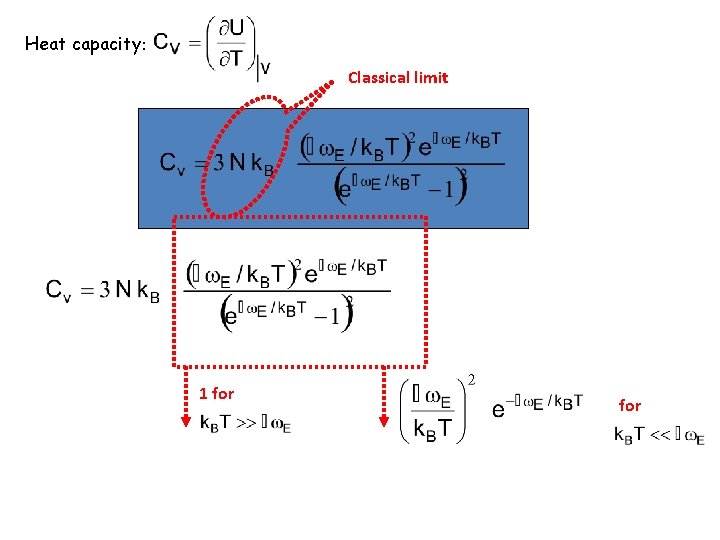
Heat capacity: Classical limit 1 for

• good news: Einstein model explains decrease of Cv for T->0 • bad news: Experiments show for T->0 Assumption that all modes have the same frequency refinement unrealistic
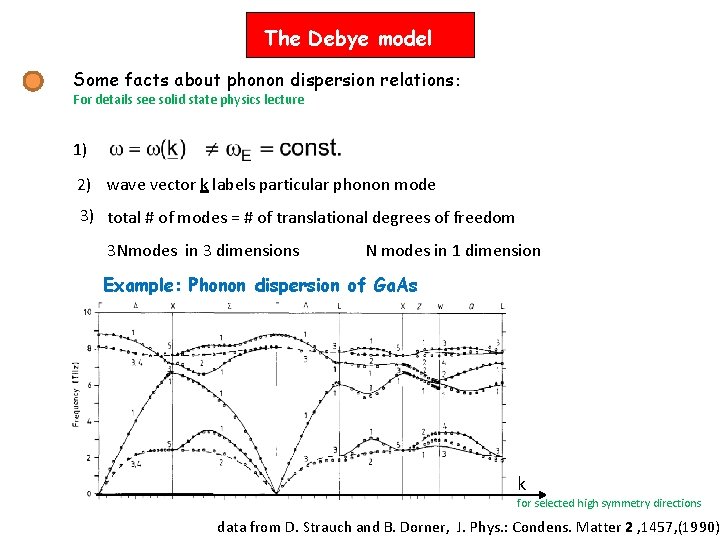
The Debye model Some facts about phonon dispersion relations: For details see solid state physics lecture 1) 2) wave vector k labels particular phonon mode 3) total # of modes = # of translational degrees of freedom 3 Nmodes in 3 dimensions N modes in 1 dimension Example: Phonon dispersion of Ga. As k for selected high symmetry directions data from D. Strauch and B. Dorner, J. Phys. : Condens. Matter 2 , 1457, (1990)
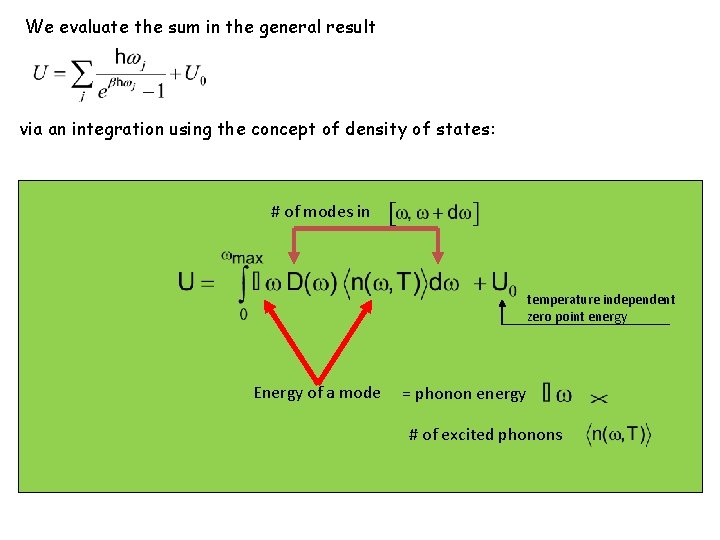
We evaluate the sum in the general result via an integration using the concept of density of states: # of modes in temperature independent zero point energy Energy of a mode = phonon energy # of excited phonons
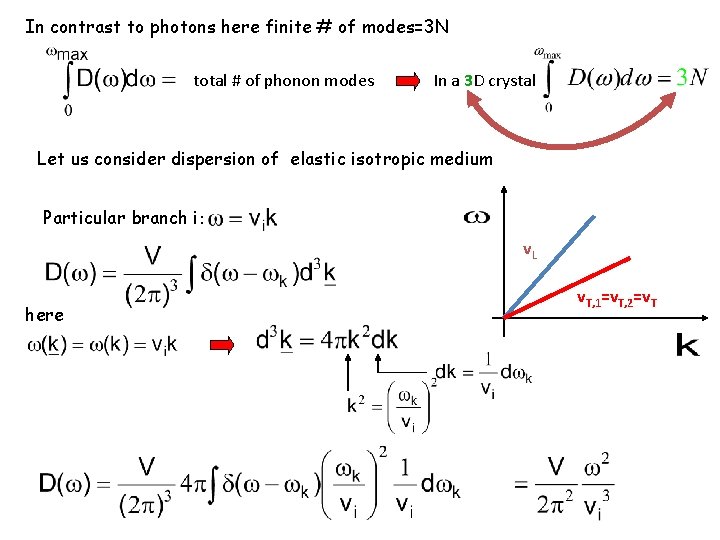
In contrast to photons here finite # of modes=3 N total # of phonon modes In a 3 D crystal Let us consider dispersion of elastic isotropic medium Particular branch i: v. L here v. T, 1=v. T, 2=v. T
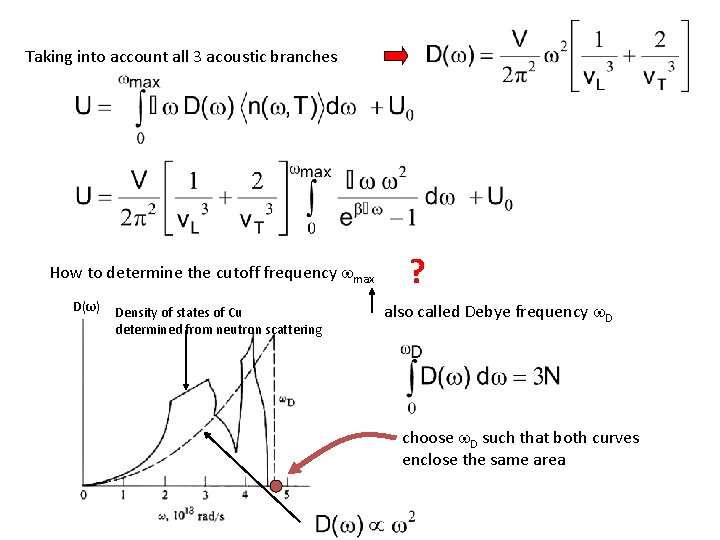
Taking into account all 3 acoustic branches How to determine the cutoff frequency max D(ω) Density of states of Cu determined from neutron scattering ? also called Debye frequency D choose D such that both curves enclose the same area

with æ ¶U ö Cv =ç ÷ è ¶T ø v Let’s define the Debye temperature Substitution: energy temperature
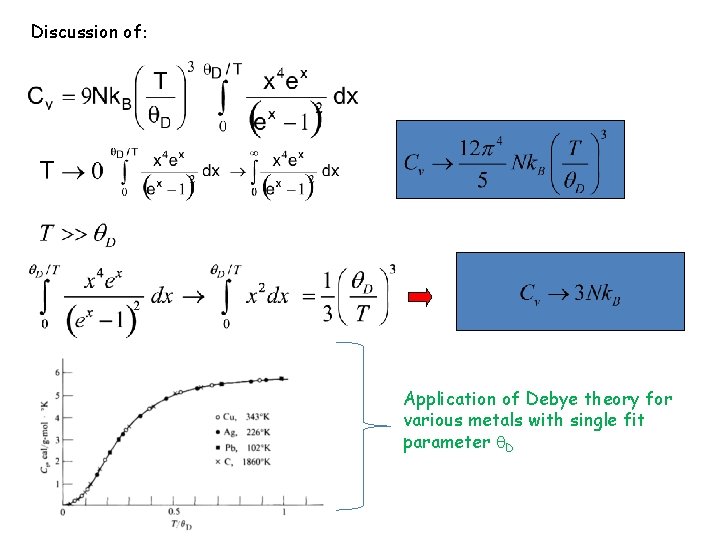
Discussion of: Application of Debye theory for various metals with single fit parameter D
- Slides: 13