
ATOMIC THEORY The Atom From Philosophical Idea to

- Slides: 10
ATOMIC THEORY
The Atom: From Philosophical Idea to Scientific Theory � Democritus was one of first to propose the idea of a basic particle of matter (400 B. C. ) � Called it the atom (means indivisible in Greek). � Aristotle lived after Democritus (300 B. C. ), but believed in all matter being continuous. � Aristotle’s view was accepted until the late 1700 s. � No solid evidence existed to support Aristotle’s views.
Foundations of Atomic Theory � As technology improved, so did scientific theories. � In the 1790 s, improvements in balances enabled scientists to accurately measure masses of substances they were studying. This led to three new laws: ○ The law of conservation of mass. ○ The law of definite proportions. ○ The law of multiple proportions.
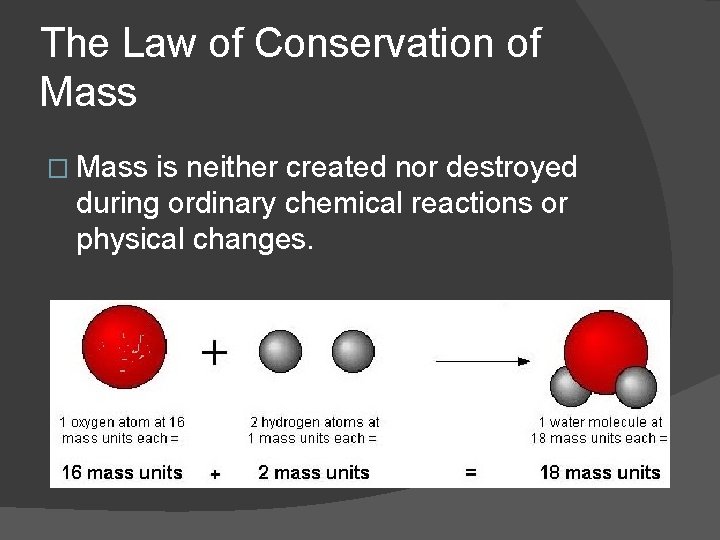
The Law of Conservation of Mass � Mass is neither created nor destroyed during ordinary chemical reactions or physical changes.
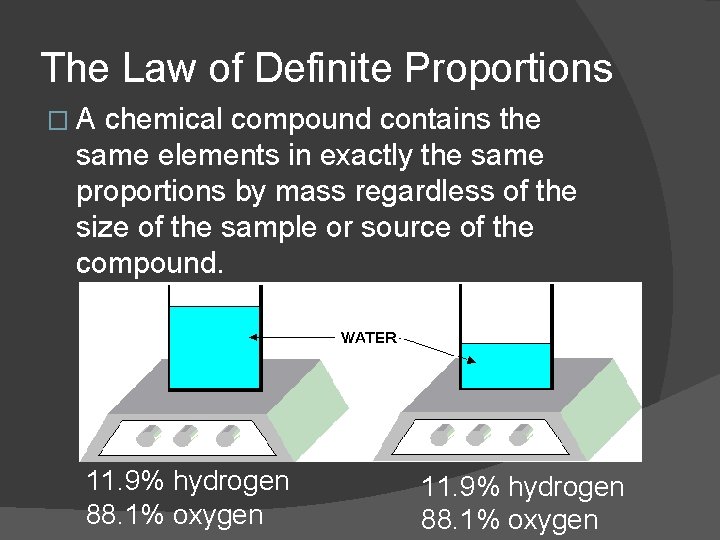
The Law of Definite Proportions �A chemical compound contains the same elements in exactly the same proportions by mass regardless of the size of the sample or source of the compound. 11. 9% hydrogen 88. 1% oxygen
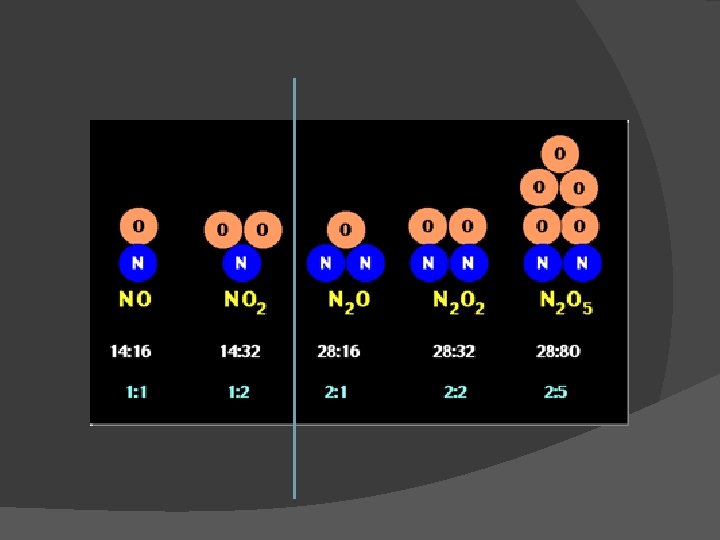
The Law of Multiple Proportions � If two or more different compounds are composed of the same two elements, then the ratio of the masses of the second element combined with a certain mass of the first element is always a ratio of small whole numbers.
Dalton’s Atomic Theory � In 1808, John Dalton proposed an explanation for the laws. � All matter is made up of small particles (atoms). � Every element has atoms that are unique for that element and identical. � Atoms cannot be subdivided, created, or destroyed. � Atoms of different elements combine in simple whole-number ratios to form chemical compounds. � In chemical reactions, atoms are combined, separated, or rearranged.
Modern Atomic Theory � Changes to Dalton’s Theory �Atoms ARE divisible (nuclear reactions). �Atoms of a given element CAN have different masses (isotopes).
Putting it all together… � Why were Dalton’s ideas accepted and not Aristotle or Democritus’? � What laws did Dalton explain using his theory?