
ATOMIC THEORY Students will learn about the atomic

ATOMIC THEORY Students will learn about the atomic theory and how the history of important scientific experiments led to creating the modern atomic theory.
TYPE OF GAS HYDROGEN AIR NEON IODINE KRYPTON COLORS OBSERVED LINES OBSERVED

1897 – J. J. THOMSON DISCOVERS ELECTRON! • Thomson discovered the electron through the his experiments on the properties of cathode rays. • First called the electron “corpuscles” and concluded that they were an atom’s “building blocks” (Wikipedia 2011) • Created the “Plum Pudding model” to depict the atom with electrons. Picture credit: http: //en. wikipedia. org/wiki/J. _Thomson Picture credit: http: //en. wikipedia. org/wiki/Plum_pudding_model
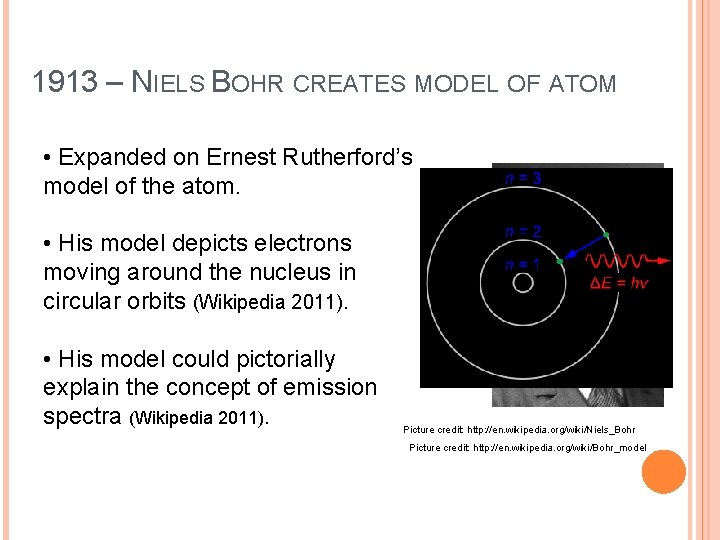
1913 – NIELS BOHR CREATES MODEL OF ATOM • Expanded on Ernest Rutherford’s model of the atom. • His model depicts electrons moving around the nucleus in circular orbits (Wikipedia 2011). • His model could pictorially explain the concept of emission spectra (Wikipedia 2011). Picture credit: http: //en. wikipedia. org/wiki/Niels_Bohr Picture credit: http: //en. wikipedia. org/wiki/Bohr_model
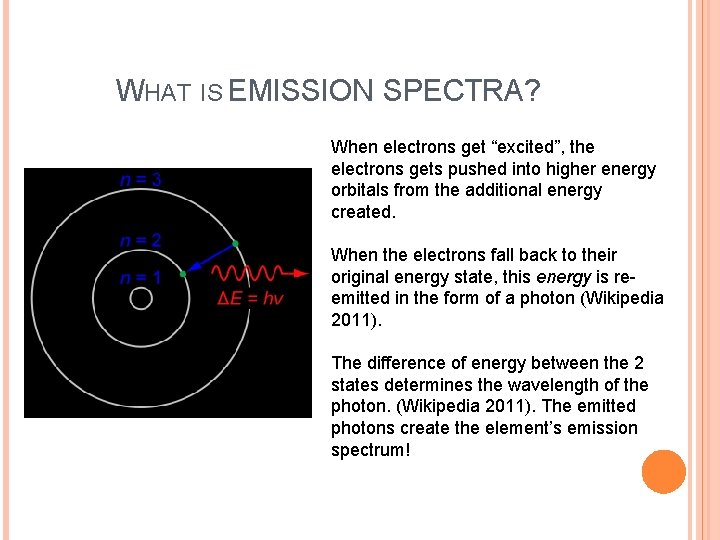
WHAT IS EMISSION SPECTRA? When electrons get “excited”, the electrons gets pushed into higher energy orbitals from the additional energy created. When the electrons fall back to their original energy state, this energy is reemitted in the form of a photon (Wikipedia 2011). The difference of energy between the 2 states determines the wavelength of the photon. (Wikipedia 2011). The emitted photons create the element’s emission spectrum!
MODERN ATOMIC THEORY Bohr’s model of the atom can only be correctly applied to 1 -electron elements, such as hydrogen, and does not fully explain larger elements. Other mathematical research during his time led scientists to believe that electrons move around the nucleus in a “cloud” of probability instead of “orbiting” with a set path. The Heisenberg Uncertainty Principle was one of the key insights to this notion - one cannot accurately measure both the position and momentum of a particle simultaneously (Wikipedia 2011).
HOMEWORK!!! Prepare a time line in Power. Point, a short movie, or a web page with hot links that illustrates the history of the atom from Democritus to present day. • At least 10 scientists’ work must be represented. • There must be at least 5 events / scientists that occurred after the year 1950. • At least one of the scientists must be a woman • Each event should be documented with: - a date (if it occurred after 1700), - a Primary Scientist that conducted the work, - a brief explanation of the experiment, - a brief explanation of the findings or results.
WORKS CITED Wikipedia 2011, J. J. Thomson, viewed 6 September 2011, <http: //en. wikipedia. org/wiki/J. _Thomson>. Wikipedia 2011, Niels Bohr, viewed 6 September 2011, < http: //en. wikipedia. org/wiki/Niels_Bohr>. Wikipedia 2011, Emission Specrtrum, viewed 6 September 2011, <http: //en. wikipedia. org/wiki/Emission_spectrum>.
- Slides: 8