
Atomic Theory learning activities Observation vs Inference Triangles
Atomic Theory: learning activities • Observation vs. Inference • Triangles to Squares = Model/Theory Activity • Black Boxes – Mystery Box Activity – Hypotheses & Theory • History of Atomic Structure – Explain to a classmate and to one other outside of class. Must Initial. • Notes not used with outside person.
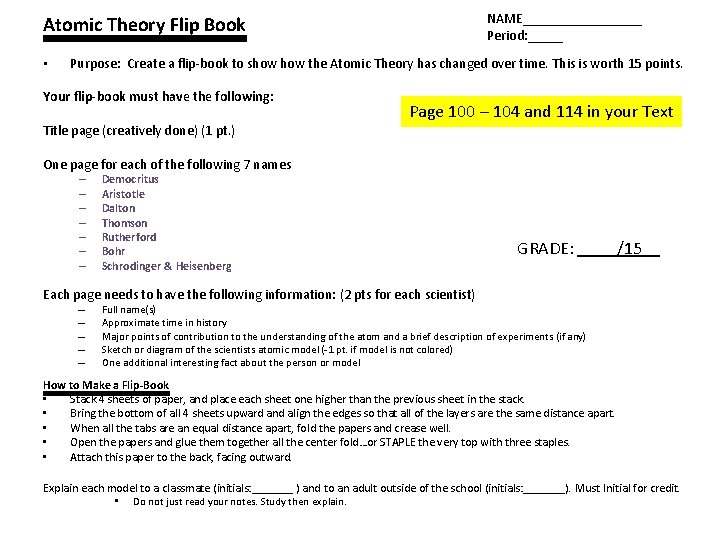
NAME_________ Period: _____ Atomic Theory Flip Book • Purpose: Create a flip-book to show the Atomic Theory has changed over time. This is worth 15 points. Your flip-book must have the following: Title page (creatively done) (1 pt. ) Page 100 – 104 and 114 in your Text One page for each of the following 7 names – – – – Democritus Aristotle Dalton Thomson Rutherford Bohr Schrodinger & Heisenberg GRADE: ___ /15__ Each page needs to have the following information: (2 pts for each scientist) – – – Full name(s) Approximate time in history Major points of contribution to the understanding of the atom and a brief description of experiments (if any) Sketch or diagram of the scientists atomic model (-1 pt. if model is not colored) One additional interesting fact about the person or model How to Make a Flip-Book • Stack 4 sheets of paper, and place each sheet one higher than the previous sheet in the stack. • Bring the bottom of all 4 sheets upward and align the edges so that all of the layers are the same distance apart. • When all the tabs are an equal distance apart, fold the papers and crease well. • Open the papers and glue them together all the center fold…or STAPLE the very top with three staples. • Attach this paper to the back, facing outward. Explain each model to a classmate (initials: _______ ) and to an adult outside of the school (initials: _______). Must Initial for credit. • Do not just read your notes. Study then explain.

Triangles into Squares
Smart. Starter • Exam I Reflection • 1. What did you do to prepare for your exam? What worked? What did you do that didn’t help? • 2. What will you do different during this new unit to prepare better for your next exam?
Mystery BOX • Station for each box. • White board for each box & Marker • Draw what you think it looks like inside the box. – Evidence? • Switch stations. – Add with a different color but do not erase • Might need a 2 nd drawing • Add your evidence.
Which of these things in the natural world are most like the mystery box? 1. 2. 3. 4. 5. 6. 7. 8. 9. Making a map of Yosemite National Park Making a map of the Earth's interior Exploring the surface of the Moon. Exploring the surface of Venus. Studying a cancer cell. Learning the structure of an atom. Finding out how DNA works. Learning what causes a new disease. How do we remember things?
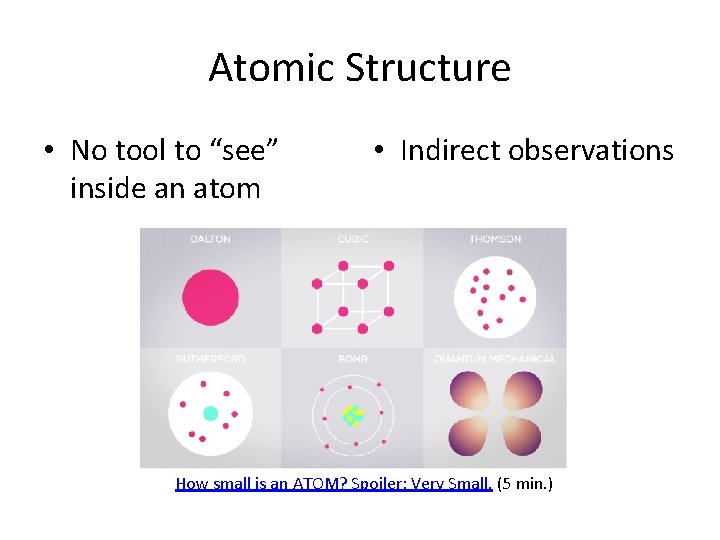
Atomic Structure • No tool to “see” inside an atom • Indirect observations How small is an ATOM? Spoiler: Very Small. (5 min. )
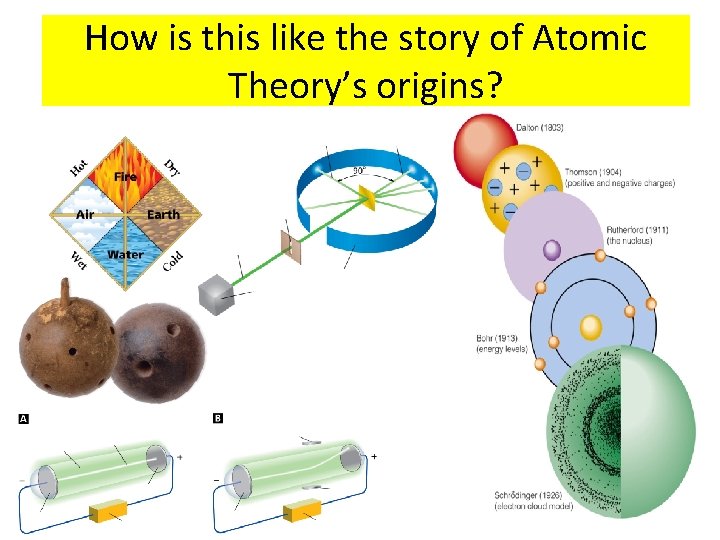
How is this like the story of Atomic Theory’s origins?
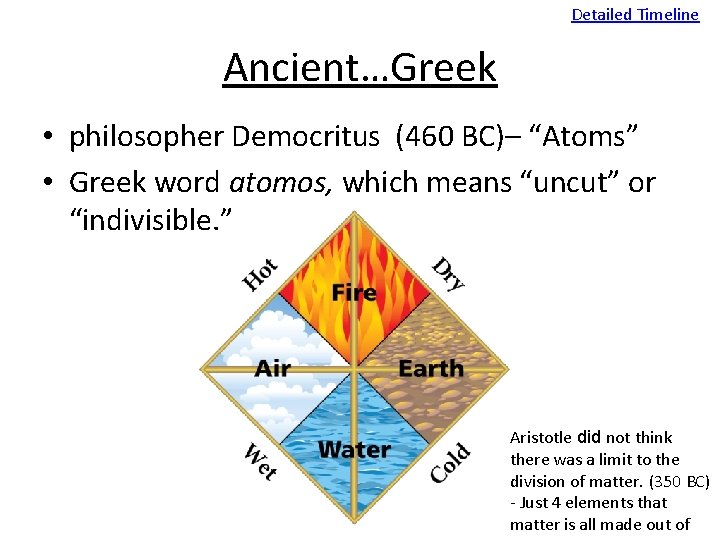
Detailed Timeline Ancient…Greek • philosopher Democritus (460 BC)– “Atoms” • Greek word atomos, which means “uncut” or “indivisible. ” Aristotle did not think there was a limit to the division of matter. (350 BC) - Just 4 elements that matter is all made out of
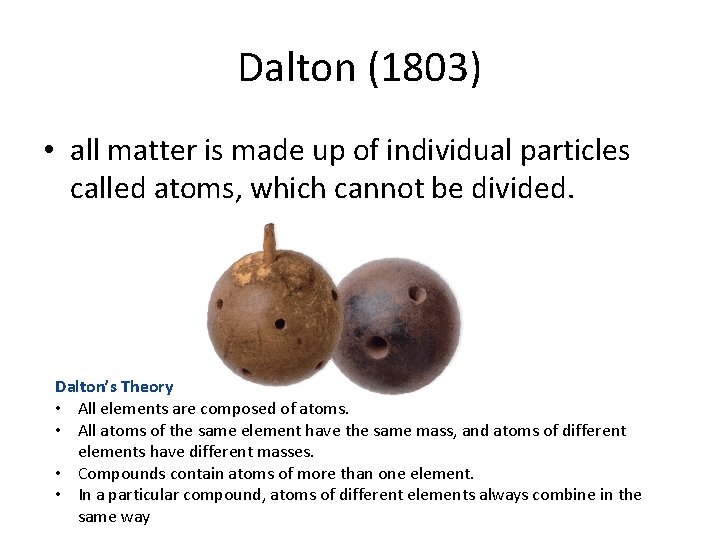
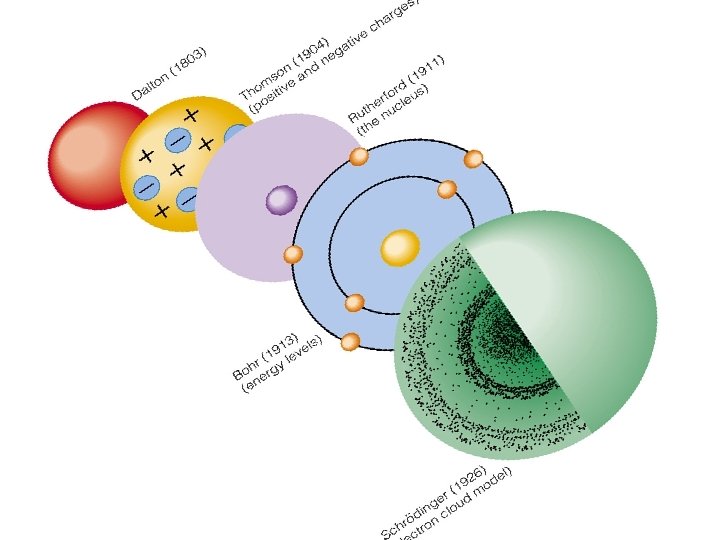
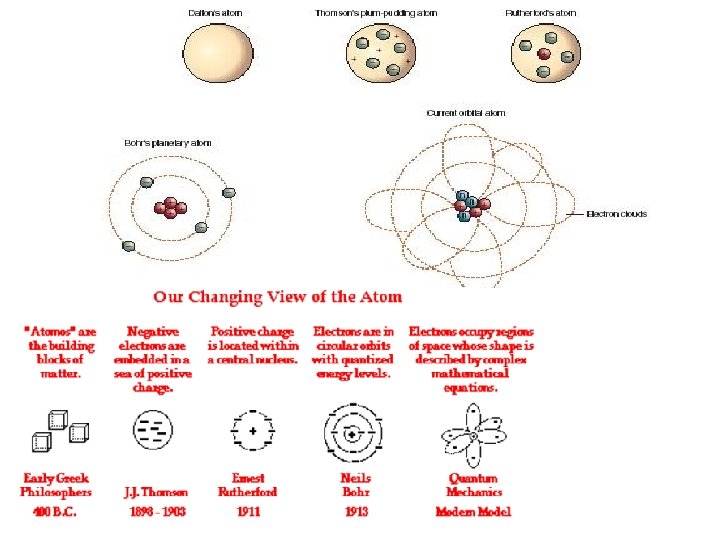
Dalton (1803) • all matter is made up of individual particles called atoms, which cannot be divided. Dalton’s Theory • All elements are composed of atoms. • All atoms of the same element have the same mass, and atoms of different elements have different masses. • Compounds contain atoms of more than one element. • In a particular compound, atoms of different elements always combine in the same way
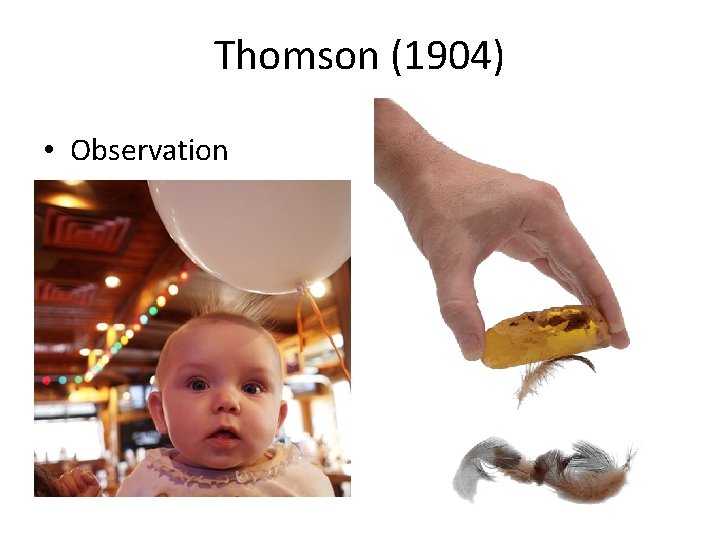
Thomson (1904) • Observation
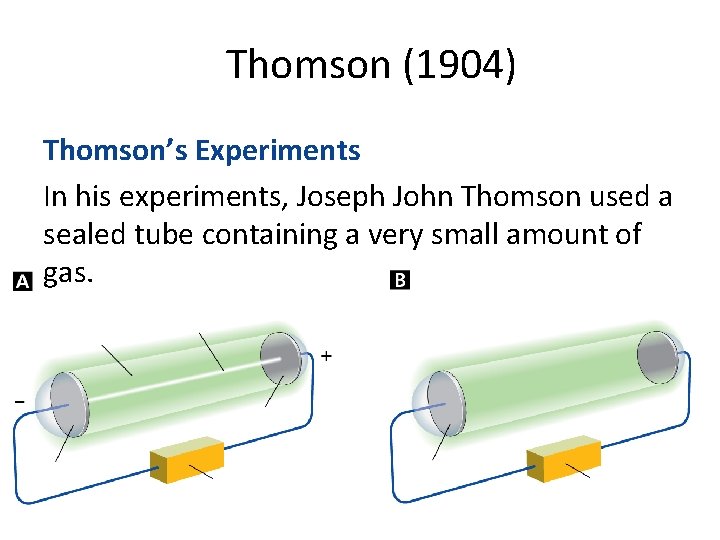
Thomson (1904) Thomson’s Experiments In his experiments, Joseph John Thomson used a sealed tube containing a very small amount of gas.
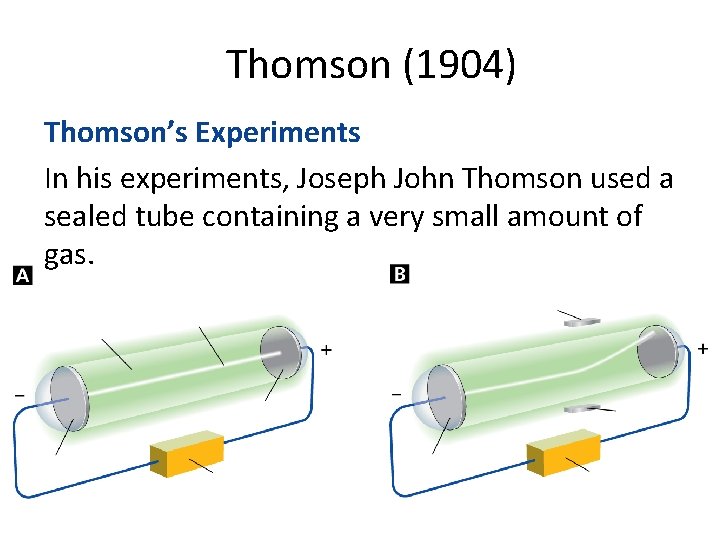
Thomson (1904) Thomson’s Experiments In his experiments, Joseph John Thomson used a sealed tube containing a very small amount of gas.
Evidence for Subatomic Particles • Thomson hypothesized that the beam was a stream of charged particles that interacted with the air in the tube and caused the air to glow. • Thomson observed that the beam was repelled by the negatively charged plate and attracted by the positively charged plate. • the particles had about 1/2000 the mass of a hydrogen atom, the lightest atom.
Thomson revised Dalton’s model to account for these subatomic particles. • “plum pudding” model
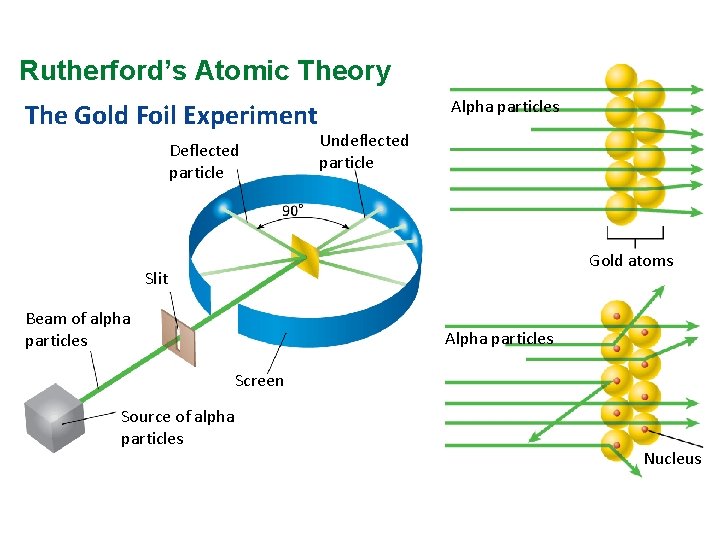
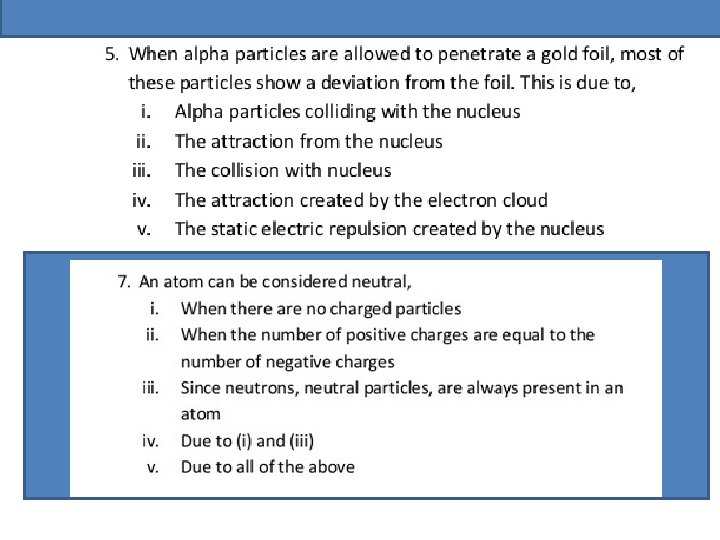
Rutherford’s Atomic Theory The Gold Foil Experiment Deflected particle Alpha particles Undeflected particle Gold atoms Slit Beam of alpha particles Alpha particles Screen Source of alpha particles Nucleus
Discovery of the Nucleus • Thomson’s model did not explain all of the evidence from Rutherford's experiment… • …So Rutherford proposed a new model. • The nucleus of the atom is a dense, positively charged mass located in the center of the atom.
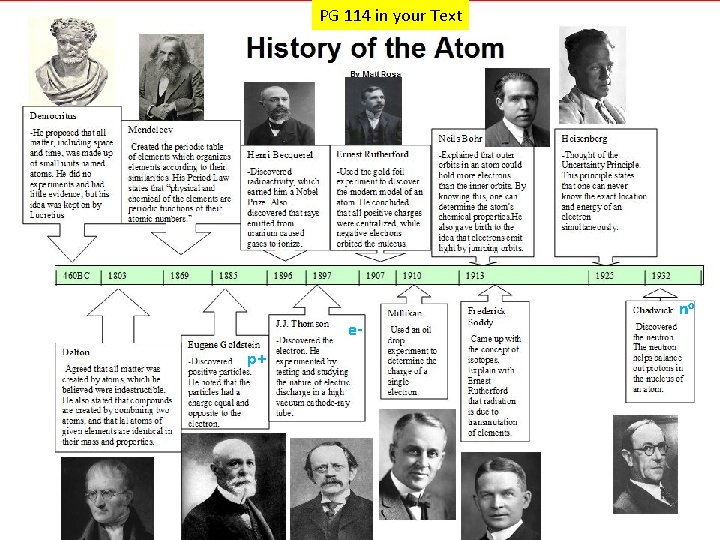
PG 114 in your Text ep+ no
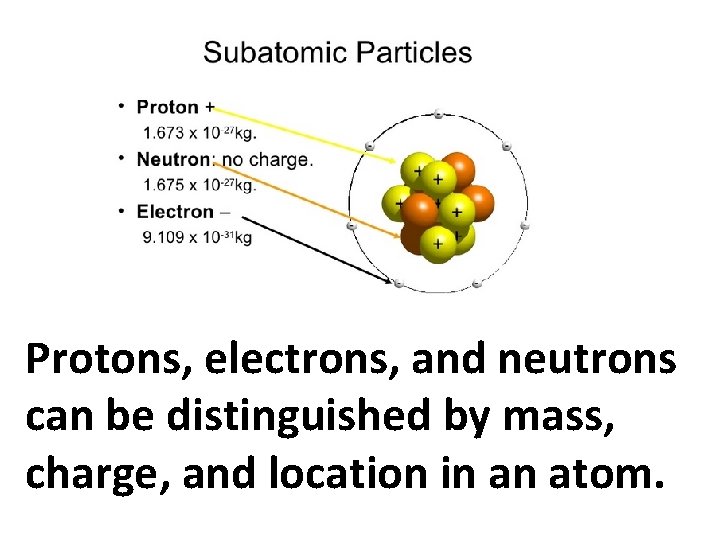
Protons, electrons, and neutrons can be distinguished by mass, charge, and location in an atom.
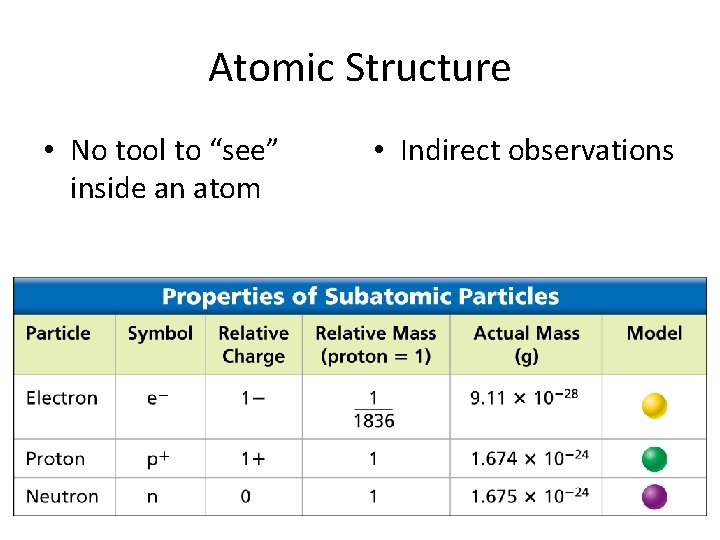
Atomic Structure • No tool to “see” inside an atom • Indirect observations
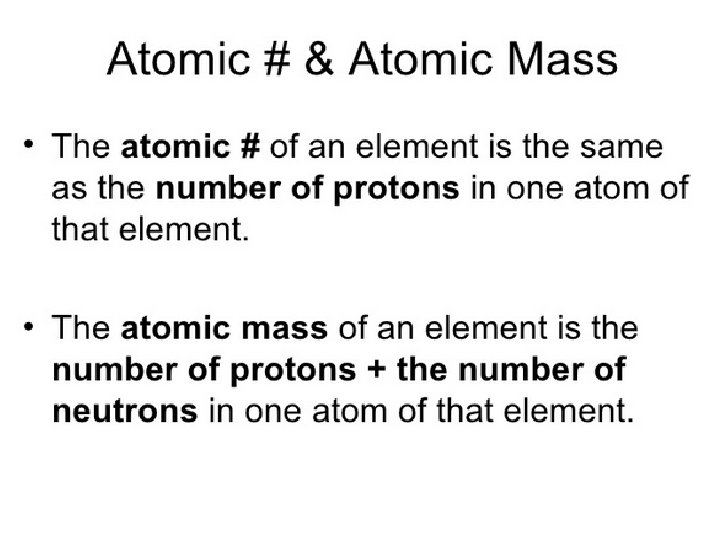
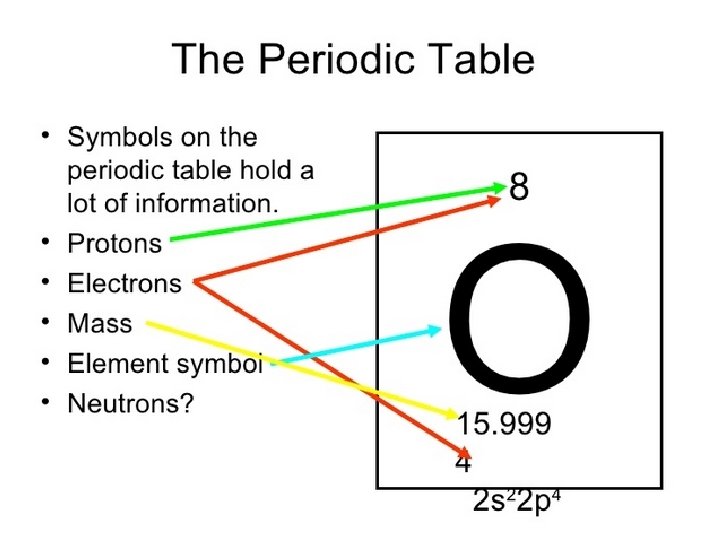

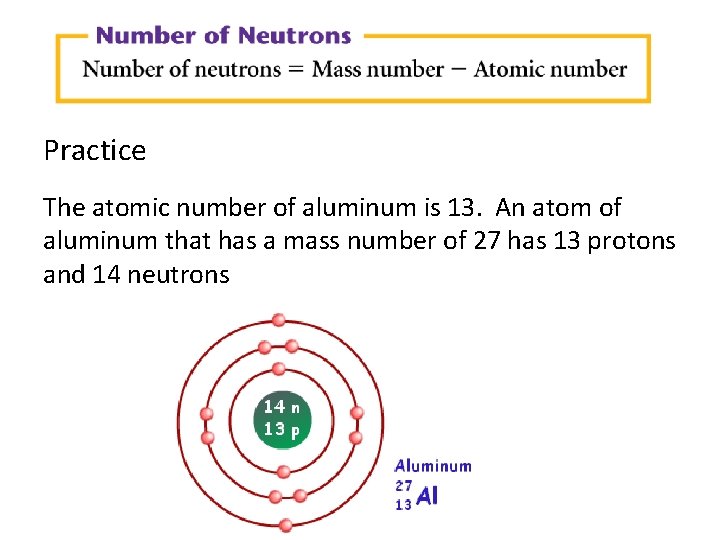
Practice The atomic number of aluminum is 13. An atom of aluminum that has a mass number of 27 has 13 protons and 14 neutrons
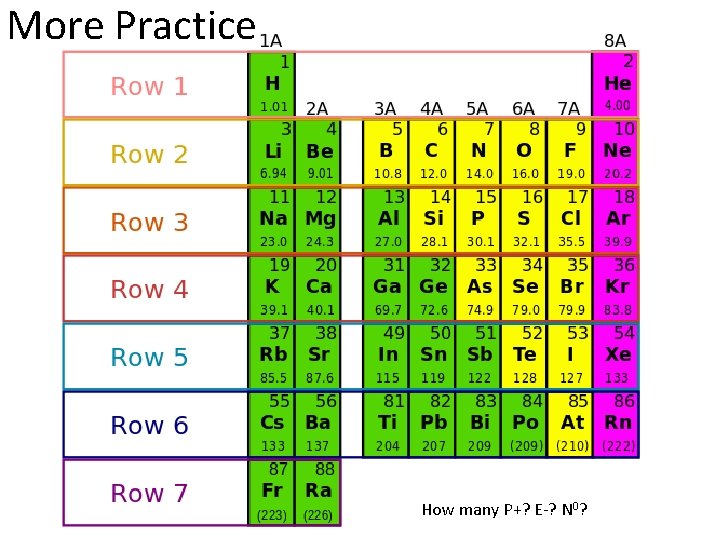
More Practice How many P+? E-? N 0?
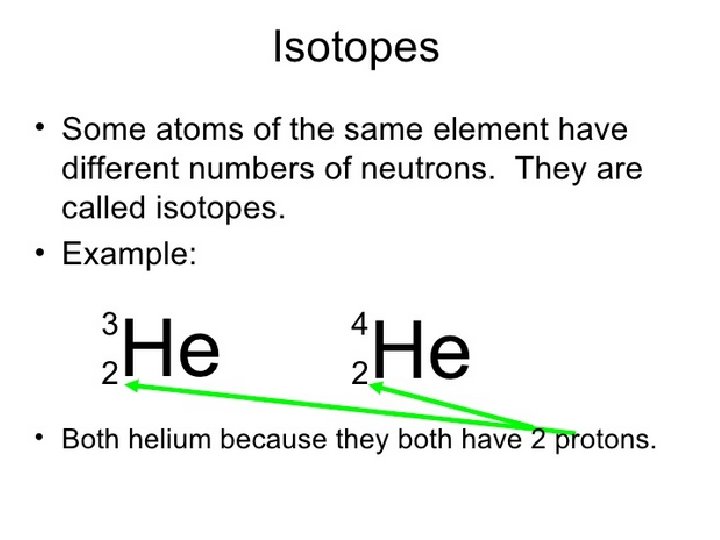
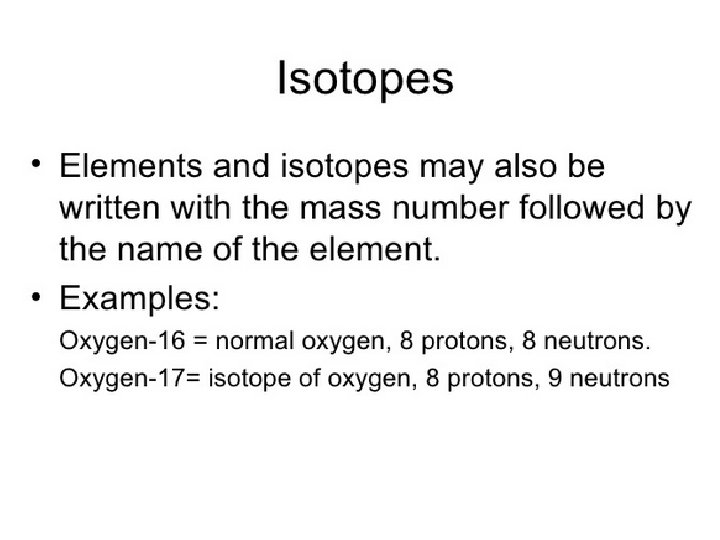
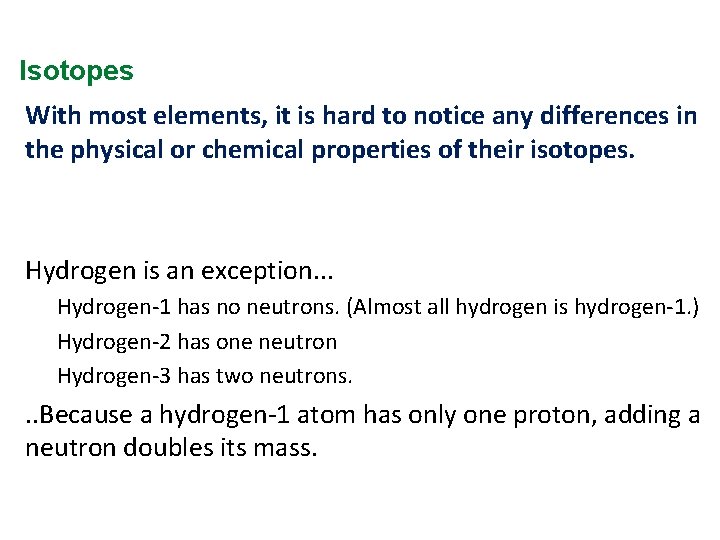
Isotopes With most elements, it is hard to notice any differences in the physical or chemical properties of their isotopes. Hydrogen is an exception. . . Hydrogen-1 has no neutrons. (Almost all hydrogen is hydrogen-1. ) Hydrogen-2 has one neutron Hydrogen-3 has two neutrons. . . Because a hydrogen-1 atom has only one proton, adding a neutron doubles its mass.
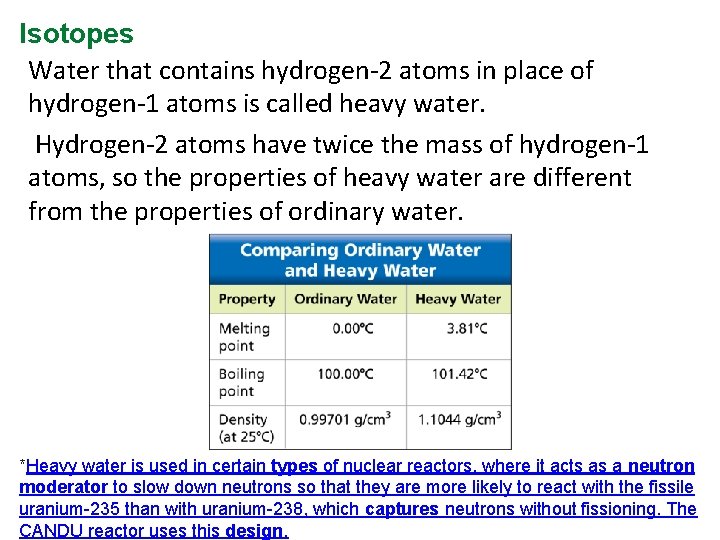
Isotopes Water that contains hydrogen-2 atoms in place of hydrogen-1 atoms is called heavy water. Hydrogen-2 atoms have twice the mass of hydrogen-1 atoms, so the properties of heavy water are different from the properties of ordinary water. *Heavy water is used in certain types of nuclear reactors, where it acts as a neutron moderator to slow down neutrons so that they are more likely to react with the fissile uranium-235 than with uranium-238, which captures neutrons without fissioning. The CANDU reactor uses this design.
Beanium Isotopes…. • Groups of 3 • 2 groups per scale • Use your calculators only after you have set up the problem. • LAB RULES 1. Cover up…. N/A 2. KNOW WHAT YOU ARE DOING BEFORE YOU DO IT! 3. Don’t act Stupid.
4. 3 Modern Atomic Theory • Bohr’s Model • Electron Cloud Model • Ground State VS Excited States Electron Configuration This Is Not What An Atom Looks Like…SCISCHOW – 5 minutes
Bohr’s Model of the Atom What can happen to electrons when atoms gain or lose energy?
Bohr’s Model of the Atom Bohr’s model focused on the electrons and their arrangement. In Bohr’s model, electrons move with constant speed in fixed orbits around the nucleus, like planets around a sun. Each electron in an atom has a specific amount of energy.
Bohr’s Model of the Atom Energy Levels When an atom gains or loses energy, the energy of an electron can change. • The possible energies that electrons in an atom can have are called energy levels. • An electron cannot exist between energy levels.
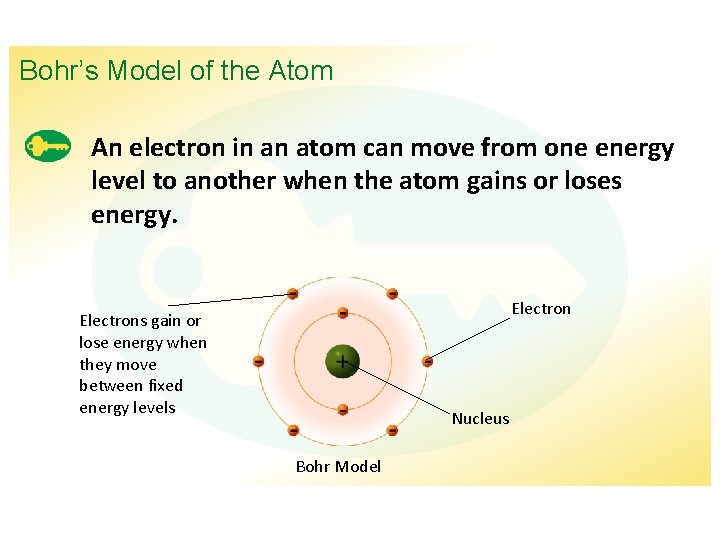
Bohr’s Model of the Atom An electron in an atom can move from one energy level to another when the atom gains or loses energy. Electrons gain or lose energy when they move between fixed energy levels Nucleus Bohr Model
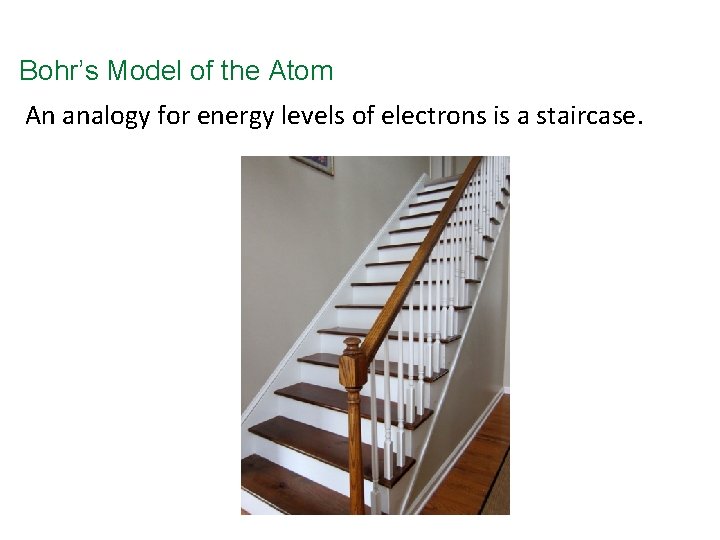
Bohr’s Model of the Atom An analogy for energy levels of electrons is a staircase.
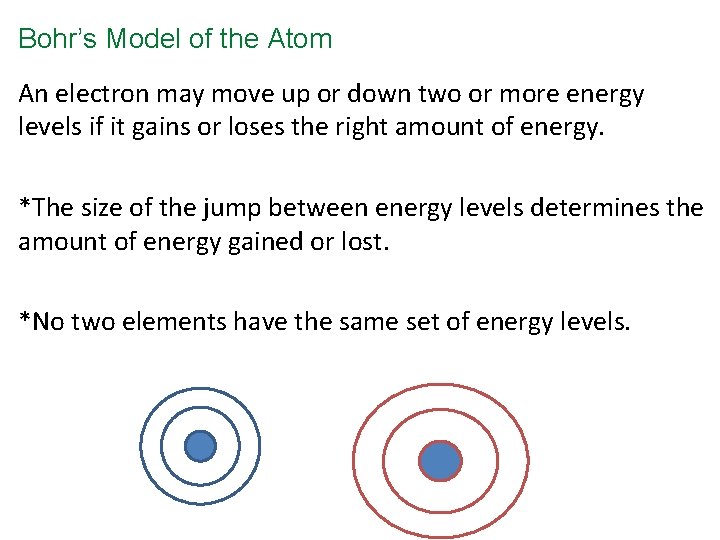
Bohr’s Model of the Atom An electron may move up or down two or more energy levels if it gains or loses the right amount of energy. *The size of the jump between energy levels determines the amount of energy gained or lost. *No two elements have the same set of energy levels.
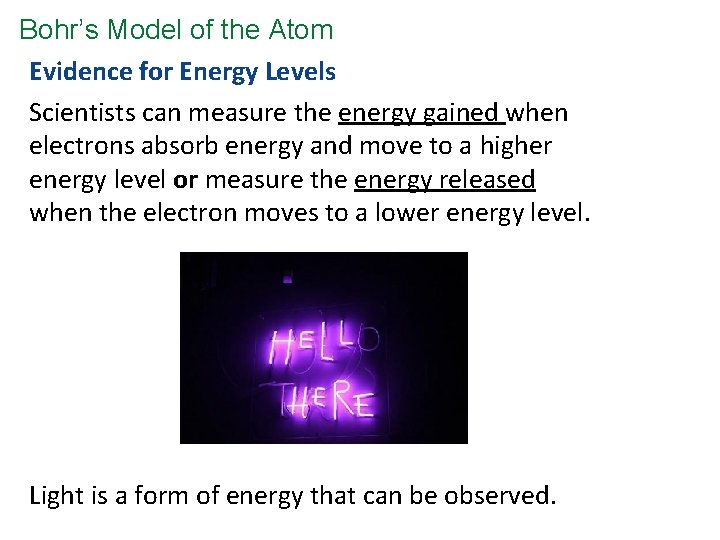
Bohr’s Model of the Atom Evidence for Energy Levels Scientists can measure the energy gained when electrons absorb energy and move to a higher energy level or measure the energy released when the electron moves to a lower energy level. Light is a form of energy that can be observed.
Electron Cloud Model What model do scientists use to describe how electrons behave in atoms? An electron cloud is a visual model of the most likely locations for electrons in an atom. Scientists use the electron cloud model to describe the possible locations of electrons around the nucleus. Study Time with The ELECTRON: Crash Course Chemistry #5
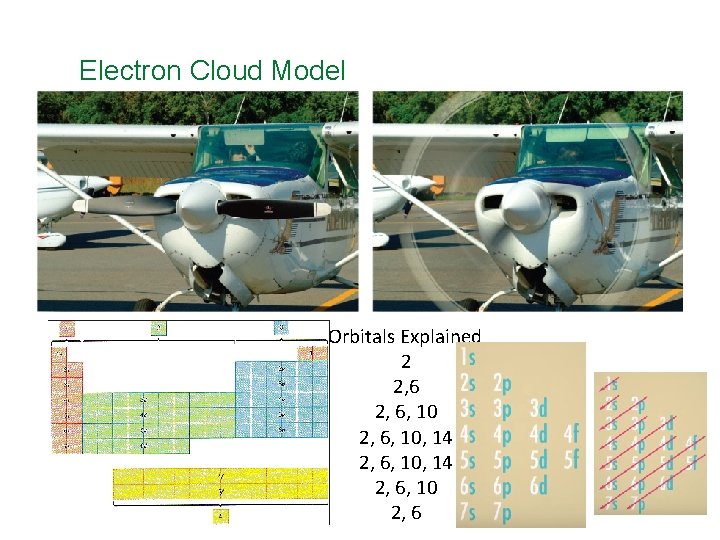
Electron Cloud Model Orbitals Explained 2 2, 6, 10, 14 2, 6, 10 2, 6
Bohr’s Electron Cloud Model Today, scientists use probability when trying to predict the locations and motions of electrons in atoms. An electron cloud is a visual model of the most likely locations for electrons in an atom.
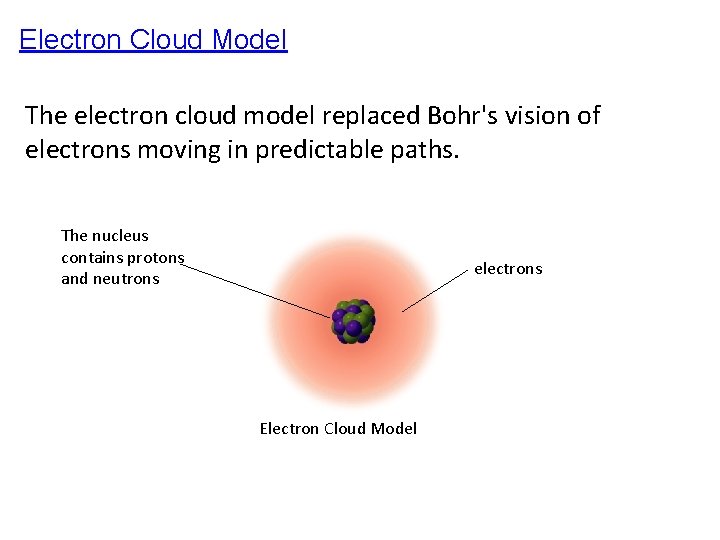
Electron Cloud Model The electron cloud model replaced Bohr's vision of electrons moving in predictable paths. The nucleus contains protons and neutrons electrons Electron Cloud Model
Electron Cloud Model What model do scientists use to describe how electrons behave in atoms? An orbital is a region of space around the nucleus where an electron is likely to be found. The electron cloud represents all the orbitals in an atom. An electron cloud is a good approximation of how electrons behave in their orbitals.
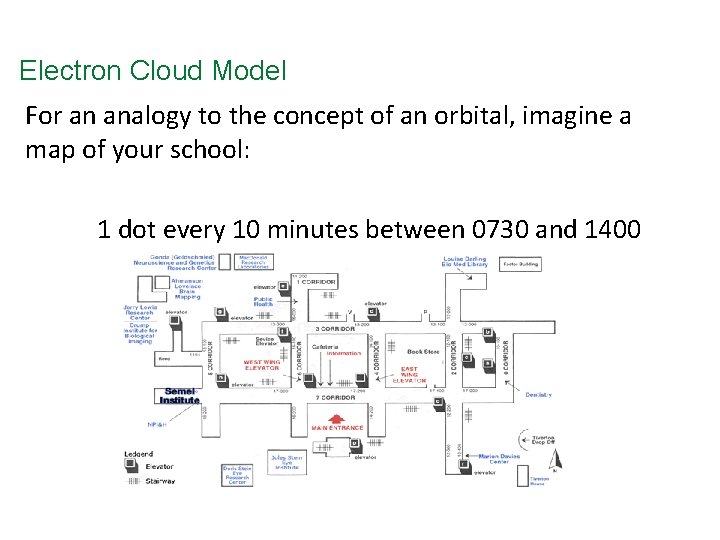
Electron Cloud Model For an analogy to the concept of an orbital, imagine a map of your school: 1 dot every 10 minutes between 0730 and 1400
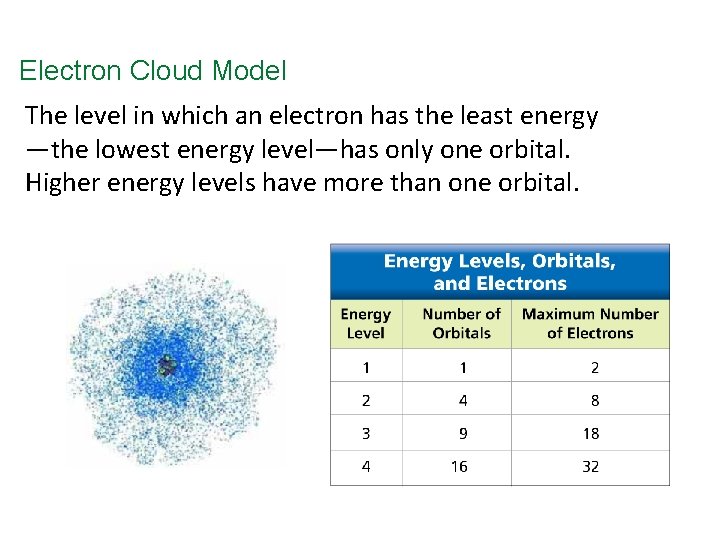
Electron Cloud Model The level in which an electron has the least energy —the lowest energy level—has only one orbital. Higher energy levels have more than one orbital.
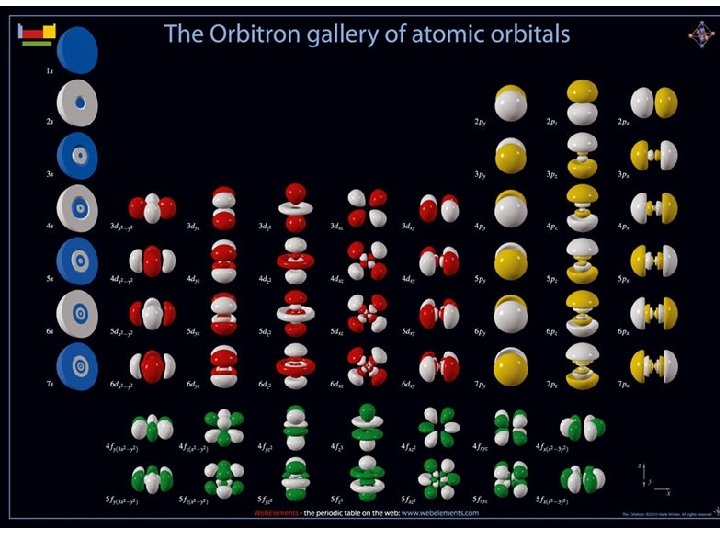
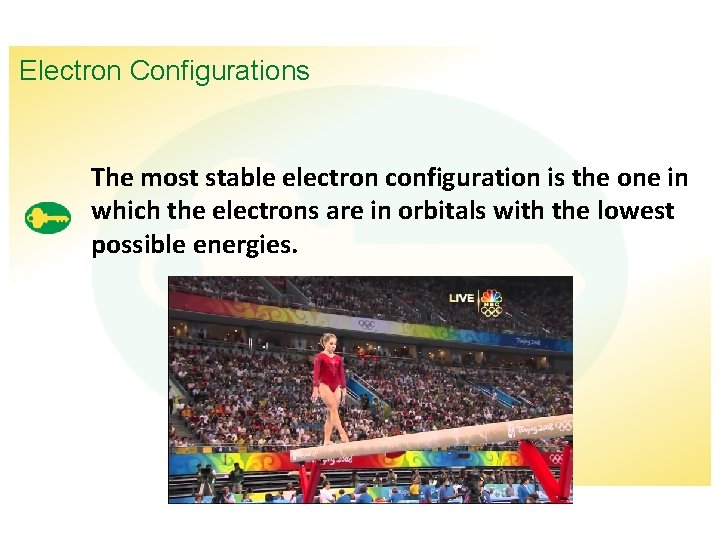
Electron Configurations The most stable electron configuration is the one in which the electrons are in orbitals with the lowest possible energies.
Extra Credit Reading Chapter 9, The Mighty Atom in A Short History of Nearly Everything by Bill Bryson Due by email attachment by 3 PM on Sunday, February 27 It must be in a word-processing format I can open and edit. These formats include. doc, . docx, . txt, . wps, . rtf, . xml, among others. (Check with me if you don’t have one of these. If you use i. Work Pages, please save as export. rtf or. xml. ) Your summary must have enough substance to convince me that you read it. If two papers are identical, both get half credit, etc. (Sort of like the conservation of momentum in physics. . . )
Study Help Videos • The History of Atomic Chemistry: Crash Course Chemistry #37 (9: 41 min. ) Just how small is an ATOM? (5. 5 min. ) STEEL TO THE ATOMIC LEVEL (3. 5 min. ) How big is an ATOM? Can you see it? What Does An Atom REALLY Look Like? Only the first 1. 5 minutes are useful…then it gets lost in Quantum Mechanics
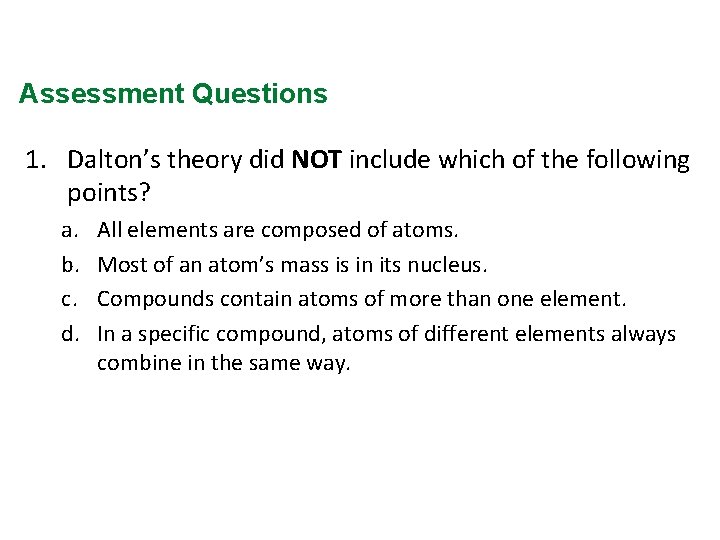
Assessment Questions 1. Dalton’s theory did NOT include which of the following points? a. b. c. d. All elements are composed of atoms. Most of an atom’s mass is in its nucleus. Compounds contain atoms of more than one element. In a specific compound, atoms of different elements always combine in the same way.
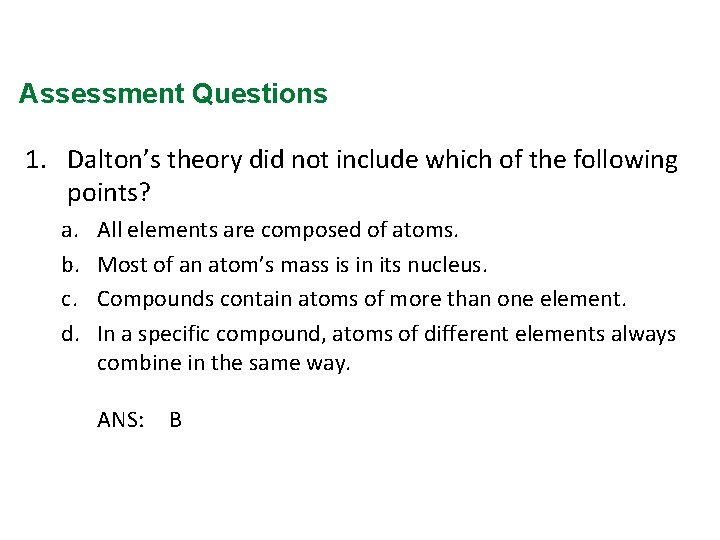
Assessment Questions 1. Dalton’s theory did not include which of the following points? a. b. c. d. All elements are composed of atoms. Most of an atom’s mass is in its nucleus. Compounds contain atoms of more than one element. In a specific compound, atoms of different elements always combine in the same way. ANS: B
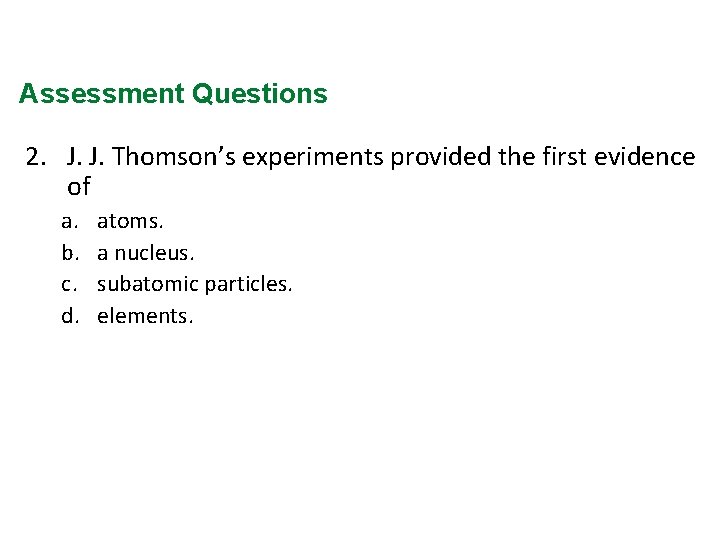
Assessment Questions 2. J. J. Thomson’s experiments provided the first evidence of a. b. c. d. atoms. a nucleus. subatomic particles. elements.
Assessment Questions 2. J. J. Thomson’s experiments provided the first evidence of a. b. c. d. atoms. a nucleus. subatomic particles. elements. ANS: C
Assessment Questions 1. The concept of an atom as a small particle of matter that cannot be divided was proposed by the ancient Greek philosopher, Democritus. True False
Assessment Questions 1. The concept of an atom as a small particle of matter that cannot be divided was proposed by the ancient Greek philosopher, Democritus. True False ANS: T

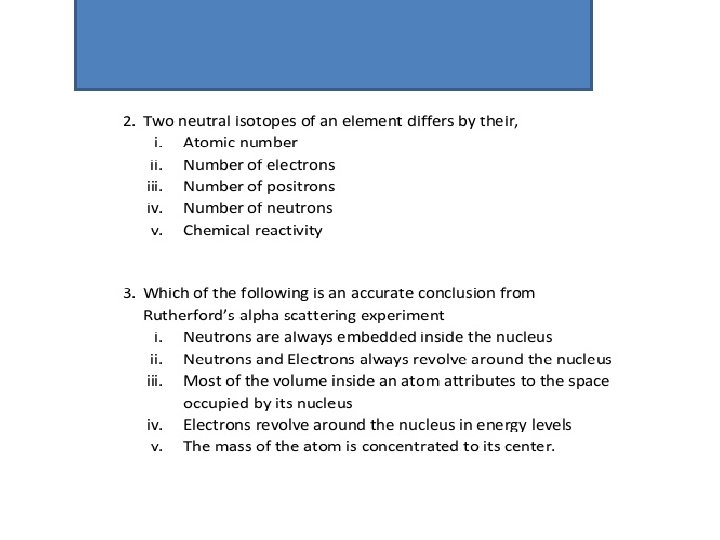
Assessment Questions 1. In which way do isotopes of an element differ? a. b. c. d. number of electrons in the atom number of protons in the atom number of neutrons in the atom net charge of the atom
Assessment Questions 1. In which way do isotopes of an element differ? a. b. c. d. number of electrons in the atom number of protons in the atom number of neutrons in the atom net charge of the atom ANS: C
Assessment Questions 1. Of the three subatomic particles that form the atom, the one with the smallest mass is the neutron. True False
Assessment Questions 1. Of the three subatomic particles that form the atom, the one with the smallest mass is the neutron. True False ANS: F, electron
Assessment Questions 1. According to Bohr’s model of the atom, which of the following can happen when an atom gains energy? a. b. c. d. An atom returns to its ground state. A neutron can be changed into a proton. A proton can move to a higher energy level. An electron can move to a higher energy level.
Assessment Questions 1. According to Bohr’s model of the atom, which of the following can happen when an atom gains energy? a. b. c. d. An atom returns to its ground state. A neutron can be changed into a proton. A proton can move to a higher energy level. An electron can move to a higher energy level. ANS: D
Assessment Questions 2. How does the modern atomic theory describe the location of electrons in an atom? a. Electrons move randomly in space around the nucleus. b. Electrons can be described as a cloud based on probable locations. c. Electrons orbit the nucleus in the same way that planets orbit the sun. d. Electrons move in a spiral pattern if increasing distance from the nucleus.
Assessment Questions 2. How does the modern atomic theory describe the location of electrons in an atom? a. Electrons move randomly in space around the nucleus. b. Electrons can be described as a cloud based on probable locations. c. Electrons orbit the nucleus in the same way that planets orbit the sun. d. Electrons move in a spiral pattern if increasing distance from the nucleus. ANS: B
Assessment Questions 3. What is meant when an atom is said to be in its ground state? a. b. c. d. There is no net charge on the atom. The number of protons equals the number of neutrons. The atom’s electrons all have the lowest possible energies. It is the isotope with the least number of neutrons.
Assessment Questions 3. What is meant when an atom is said to be in its ground state? a. b. c. d. There is no net charge on the atom. The number of protons equals the number of neutrons. The atom’s electrons all have the lowest possible energies. It is the isotope with the least number of neutrons. ANS: C
- Slides: 70