
Atomic Theory http videos howstuffworks comdiscovery29430 assignmentdiscoveryoriginoftheatomtheoryvideo htm
- Slides: 5
Atomic Theory http: //videos. howstuffworks. com/discovery/29430 -assignmentdiscovery-origin-of-the-atom-theory-video. htm • Model • A familiar idea used to explain unfamiliar facts observed in nature • Theory • An explanation of observable facts and phenomena • To remain valid, models and theories must: • Explain all known facts • Enable scientist to make correct predictions Episode 301
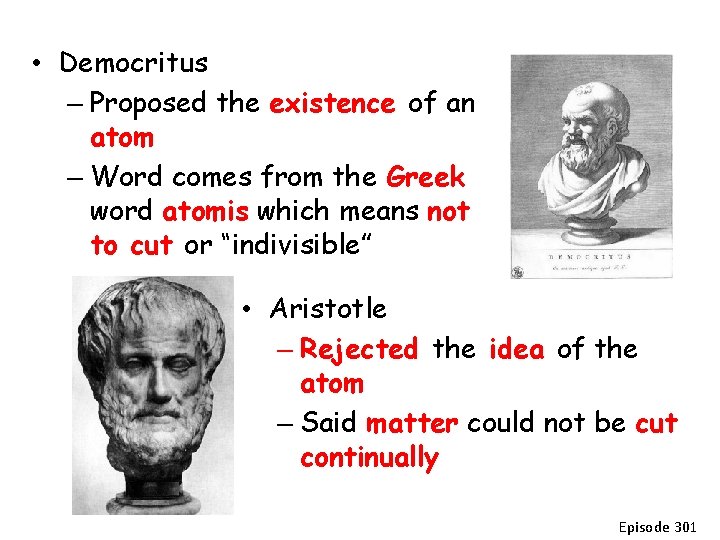
• Democritus – Proposed the existence of an atom – Word comes from the Greek word atomis which means not to cut or “indivisible” • Aristotle – Rejected the idea of the atom – Said matter could not be cut continually Episode 301
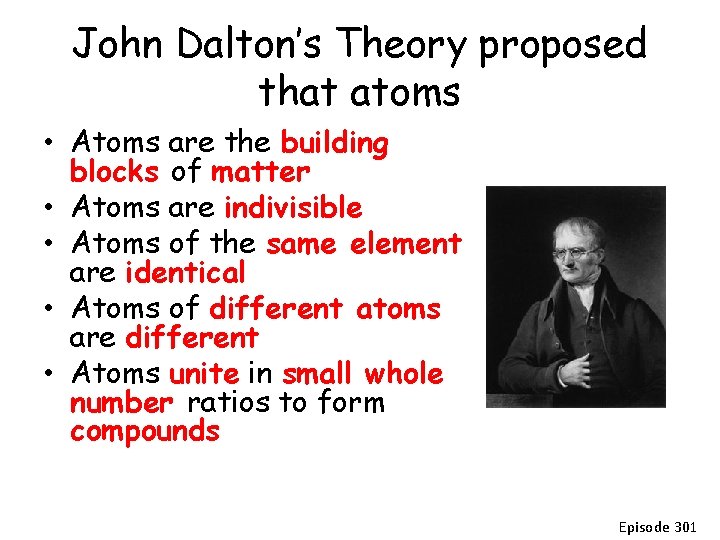
John Dalton’s Theory proposed that atoms • Atoms are the building blocks of matter • Atoms are indivisible • Atoms of the same element are identical • Atoms of different atoms are different • Atoms unite in small whole number ratios to form compounds Episode 301
J. J. Thomson • Credited with discovery of electron: a blow to Dalton’s indivisible atom http: //videos. howstuffworks. com/science-channel/29292 -100 -greatest-discoveriesthe-cathode-ray-tube-video. htm – Cathode Ray – negatively charged stream of particles (electrons) • Proposed the plum pudding model of the atom: negatively charged electrons embedded in a ball of positive charge Episode 301
Ernest Rutherford’s Gold-foil Experiment http: //www. youtube. com/watch? v=XBq. Hkraf 8 i. E • • Aimed alpha particles at gold foil Most passed through A few particle were deflected Some particles were even bounced back • Conclusions to Rutherford’s experiment • Most of the atom is empty space • Dense positively charged nucleus • Planetary model Episode 301