
Atomic Theory 1 Democritus to the Planetary Model
- Slides: 18
Atomic Theory 1 Democritus to the Planetary Model
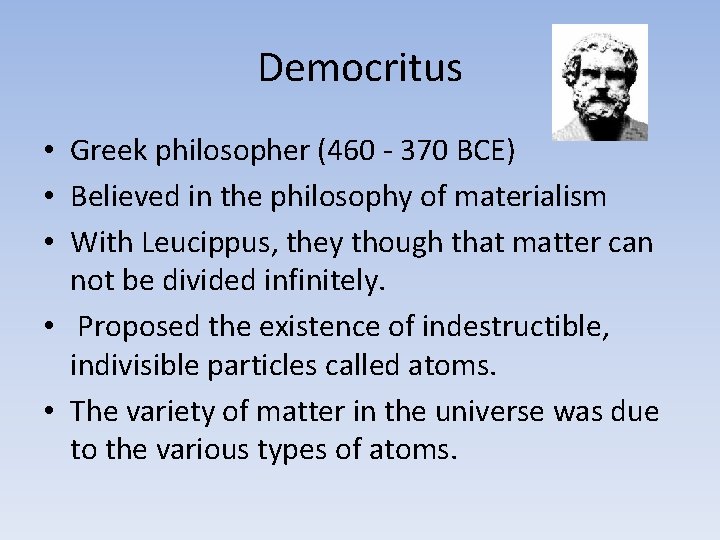
Democritus • Greek philosopher (460 - 370 BCE) • Believed in the philosophy of materialism • With Leucippus, they though that matter can not be divided infinitely. • Proposed the existence of indestructible, indivisible particles called atoms. • The variety of matter in the universe was due to the various types of atoms.
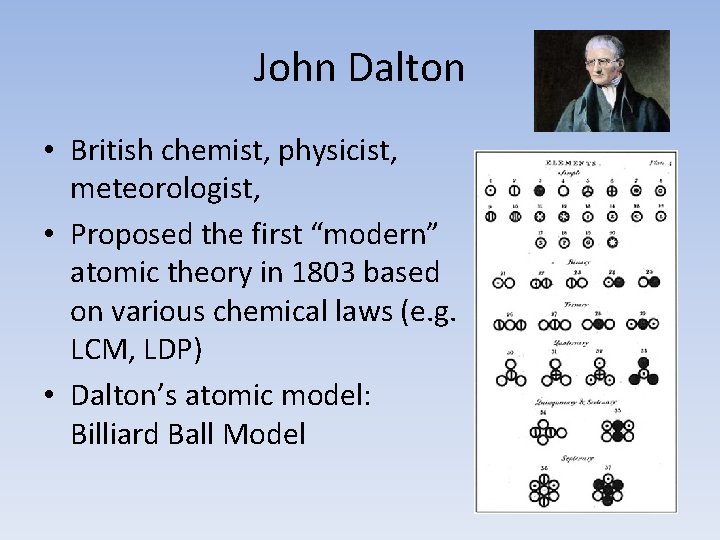
John Dalton • British chemist, physicist, meteorologist, • Proposed the first “modern” atomic theory in 1803 based on various chemical laws (e. g. LCM, LDP) • Dalton’s atomic model: Billiard Ball Model
5 Points of Dalton’s Atomic Theory: 1. All matter is made of tiny indivisible particles called atoms. 2. Atoms cannot be created or destroyed. 3. All atoms of a particular element are identical. 4. Compounds are formed through the combination of elements. 5. Chemical reactions involve atoms recombining to form new substances.
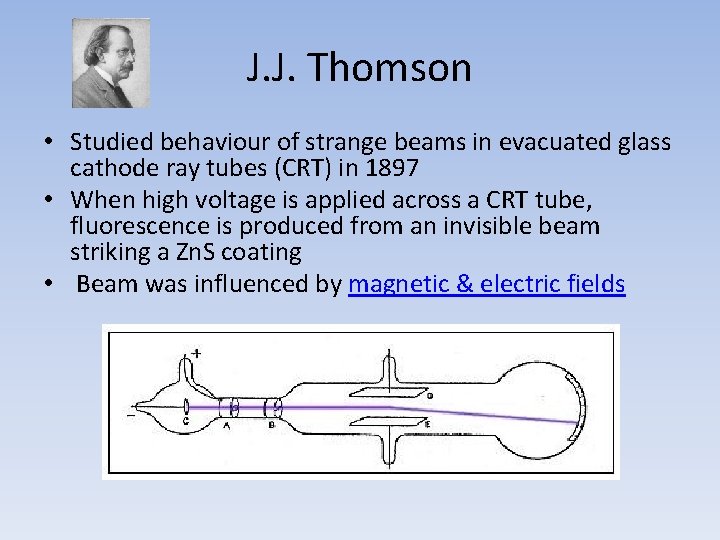
J. J. Thomson • Studied behaviour of strange beams in evacuated glass cathode ray tubes (CRT) in 1897 • When high voltage is applied across a CRT tube, fluorescence is produced from an invisible beam striking a Zn. S coating • Beam was influenced by magnetic & electric fields
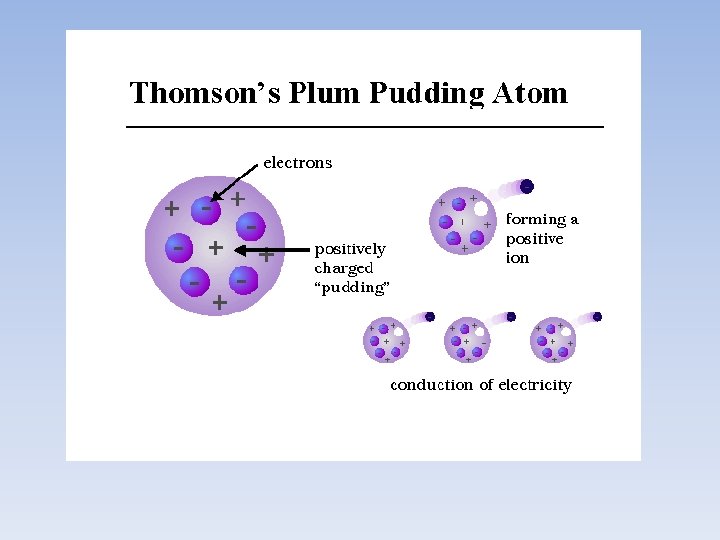
• Using the charge to mass ratio, he concluded that cathode rays consist of tiny “particles” • These charged particles were much smaller than the tiniest atom and came from within the atoms of the metal electrode • These “subatomic” particles were called electrons and led to the Plum Pudding Model e- e- e-
Plum Pudding….
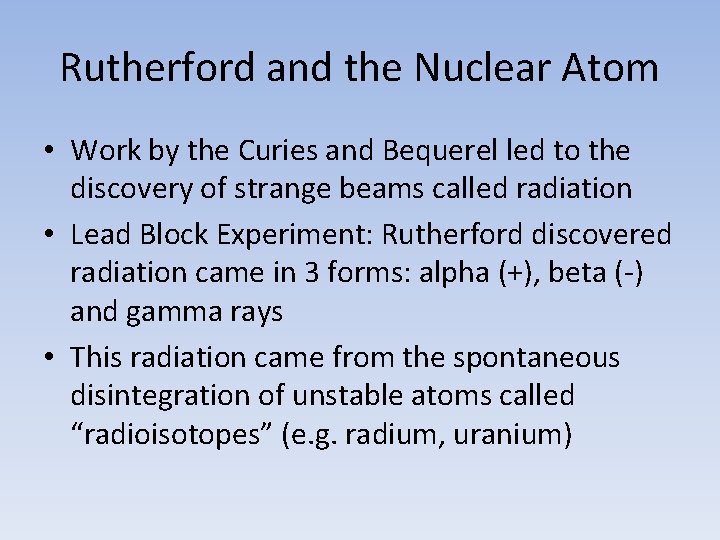
Rutherford and the Nuclear Atom • Work by the Curies and Bequerel led to the discovery of strange beams called radiation • Lead Block Experiment: Rutherford discovered radiation came in 3 forms: alpha (+), beta (-) and gamma rays • This radiation came from the spontaneous disintegration of unstable atoms called “radioisotopes” (e. g. radium, uranium)
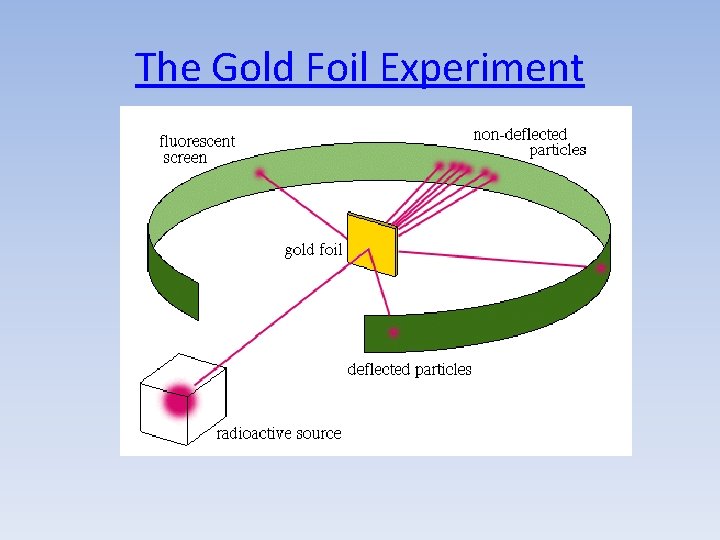
Gold Foil Experiment (1909) • Rutherford proposed that a beam of alpha particles (He 2+ ions) should have enough energy to pass through a thin gold foil and be detected on a Zn. S screed behind the foil • The experiment initially seemed work, confirming Thomson’s Plum Pudding Model of the atom with a diffuse positive sphere
The Gold Foil Experiment
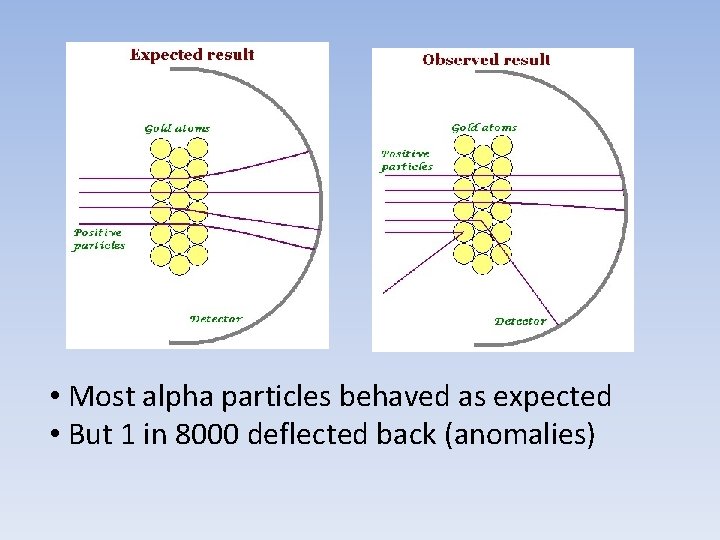
• Most alpha particles behaved as expected • But 1 in 8000 deflected back (anomalies)
Rutherford’s Conclusions 1. The positive charge is not distributed evenly but is in a very dense positive core. 2. Most of the atom is simply empty space occupied by tiny electrons. Rutherford proposed a new model called the Planetary Model due to its resemblance to our solar system.
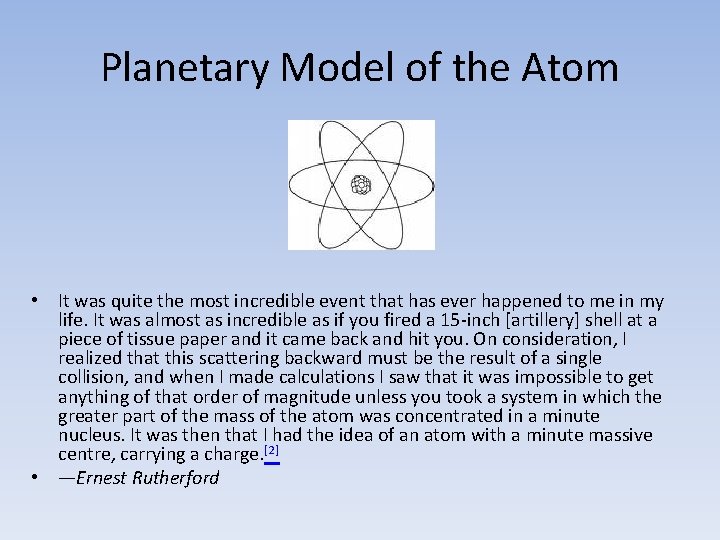
Planetary Model of the Atom • It was quite the most incredible event that has ever happened to me in my life. It was almost as incredible as if you fired a 15 -inch [artillery] shell at a piece of tissue paper and it came back and hit you. On consideration, I realized that this scattering backward must be the result of a single collision, and when I made calculations I saw that it was impossible to get anything of that order of magnitude unless you took a system in which the greater part of the mass of the atom was concentrated in a minute nucleus. It was then that I had the idea of an atom with a minute massive centre, carrying a charge. [2] • —Ernest Rutherford
The Proton (1919) • Rutherford’s nucleus was extremely tiny – only 1/10, 000 th the diameter of the entire atom! • Later, Rutherford proved that other atoms contain hydrogen nuclei • He concluded this is the simplest positively charged particle and named it the proton
The Mass Problem • Protons seemed to account for most of the mass of the atom • But evidence showed that atoms had only half the positive charge that was expected if the nucleus was composed only of protons • The answer to the problem came from another radioactive beam….
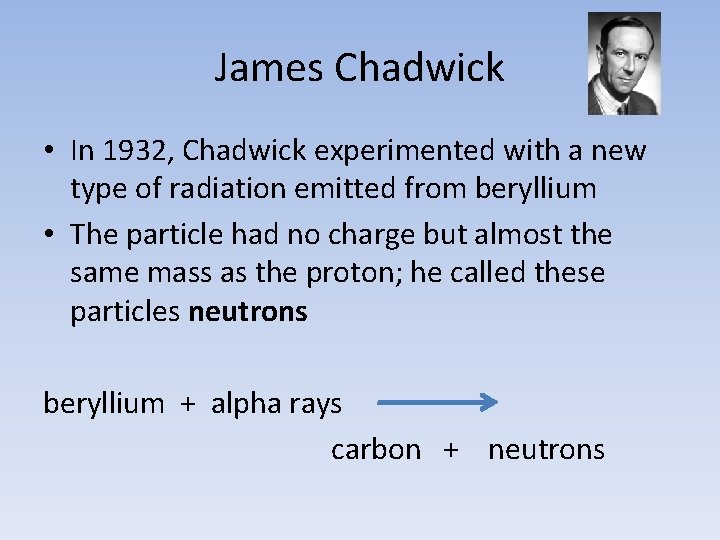
James Chadwick • In 1932, Chadwick experimented with a new type of radiation emitted from beryllium • The particle had no charge but almost the same mass as the proton; he called these particles neutrons beryllium + alpha rays carbon + neutrons
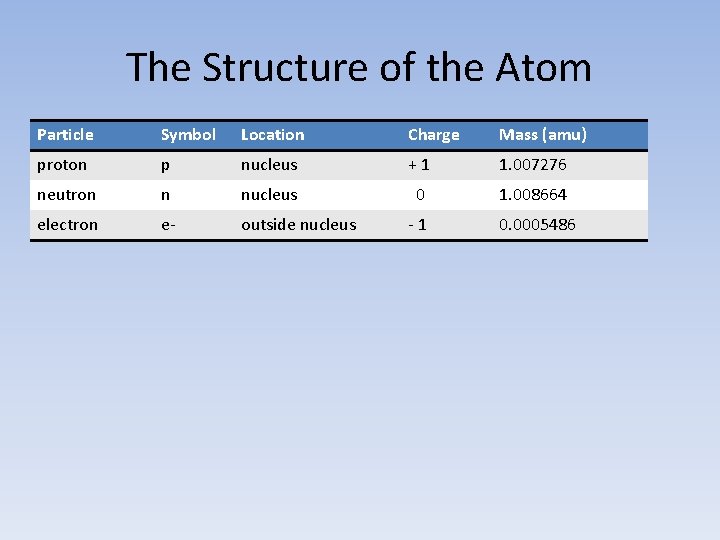
The Structure of the Atom Particle Symbol Location Charge Mass (amu) proton p nucleus +1 1. 007276 neutron n nucleus 0 1. 008664 electron e- outside nucleus -1 0. 0005486