
Atomic Structure www labinitio com What is an
Atomic Structure www. lab-initio. com
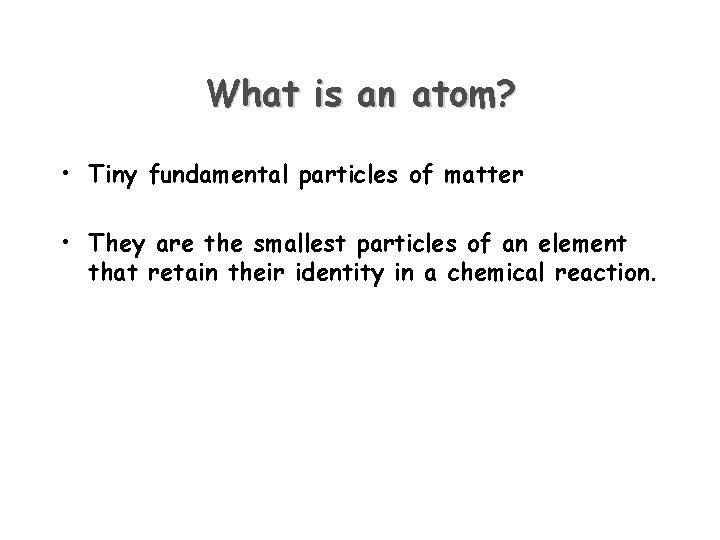
What is an atom? • Tiny fundamental particles of matter • They are the smallest particles of an element that retain their identity in a chemical reaction.

Early Models of the Atom • Greek philosopher Democritus (460 B. C. – 370 B. C. ) – Believed atoms were indivisible and indestructible – His ideas could not explain chemical behavior and were not supported by a scientific approaches • John Dalton (1766 – 1844) – Built on Democritus’s ideas and studied ratios in which elements combined – Used scientific research and formulated a theory
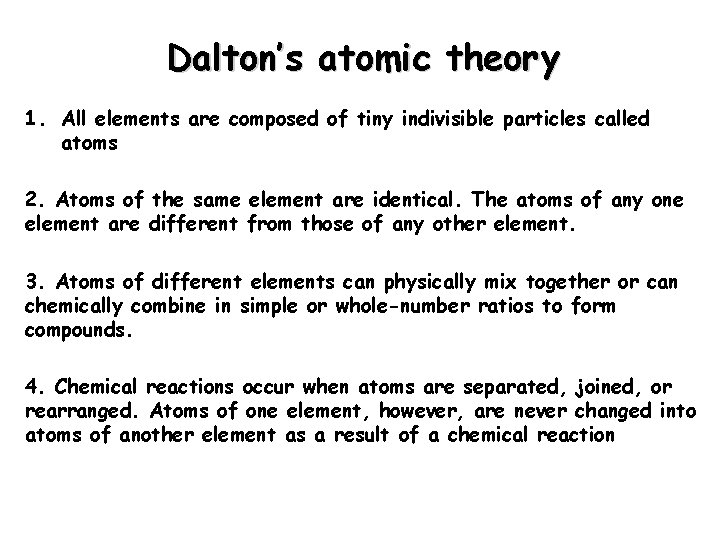
Dalton’s atomic theory 1. All elements are composed of tiny indivisible particles called atoms 2. Atoms of the same element are identical. The atoms of any one element are different from those of any other element. 3. Atoms of different elements can physically mix together or can chemically combine in simple or whole-number ratios to form compounds. 4. Chemical reactions occur when atoms are separated, joined, or rearranged. Atoms of one element, however, are never changed into atoms of another element as a result of a chemical reaction
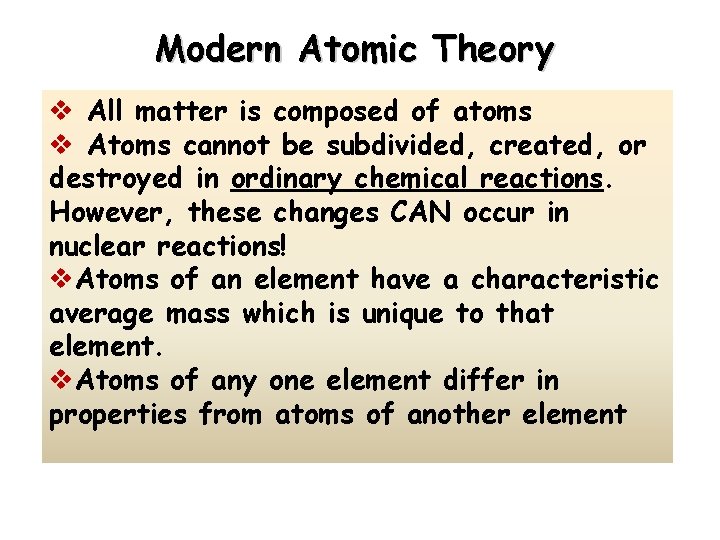
Modern Atomic Theory v All matter is composed of atoms v Atoms cannot be subdivided, created, or destroyed in ordinary chemical reactions. However, these changes CAN occur in nuclear reactions! v. Atoms of an element have a characteristic average mass which is unique to that element. v. Atoms of any one element differ in properties from atoms of another element
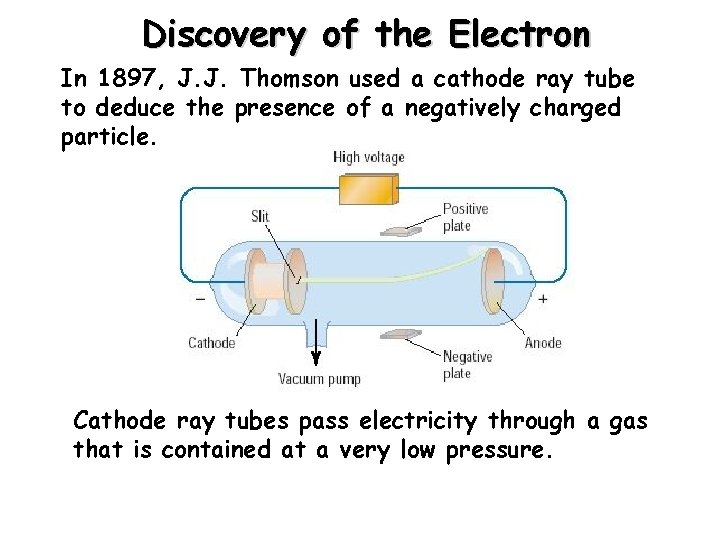
Discovery of the Electron In 1897, J. J. Thomson used a cathode ray tube to deduce the presence of a negatively charged particle. Cathode ray tubes pass electricity through a gas that is contained at a very low pressure.
Conclusions from the Study of the Electron q Cathode rays have identical properties regardless of the element used to produce them. All elements must contain identically charged electrons. q. Atoms are neutral, so there must be positive particles in the atom to balance the negative charge of the electrons q Electrons have so little mass that atoms must contain other particles that account for most of the mass
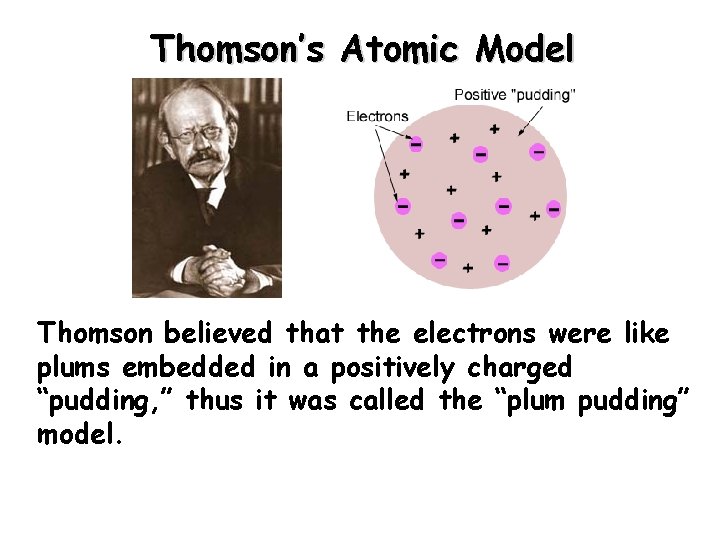
Thomson’s Atomic Model Thomson believed that the electrons were like plums embedded in a positively charged “pudding, ” thus it was called the “plum pudding” model.
The Discovery of more Subatomic Particles • In 1886, Eugen Goldstein observed a cathoderay tube and found rays traveling opposite of the cathode rays – He concluded they must be positive – We call these positive particles Protons • In 1932, physicist James Chadwick confirmed another subatomic particle – They had no charge but had a mass similar to protons – We call these neutral particles Neutrons
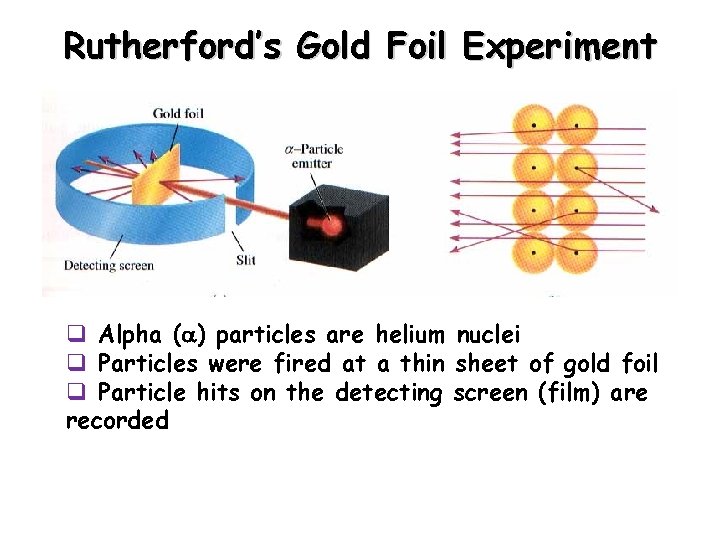
Rutherford’s Gold Foil Experiment q Alpha ( ) particles are helium nuclei q Particles were fired at a thin sheet of gold foil q Particle hits on the detecting screen (film) are recorded
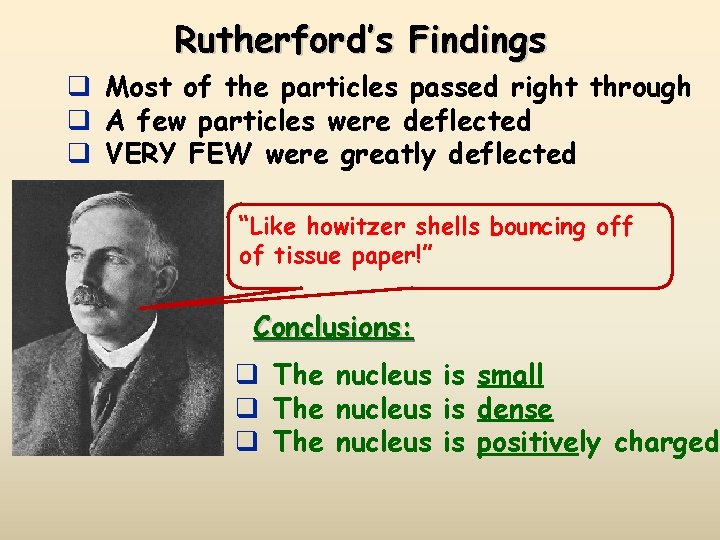
Rutherford’s Findings q Most of the particles passed right through q A few particles were deflected q VERY FEW were greatly deflected “Like howitzer shells bouncing off of tissue paper!” Conclusions: q The nucleus is small q The nucleus is dense q The nucleus is positively charged
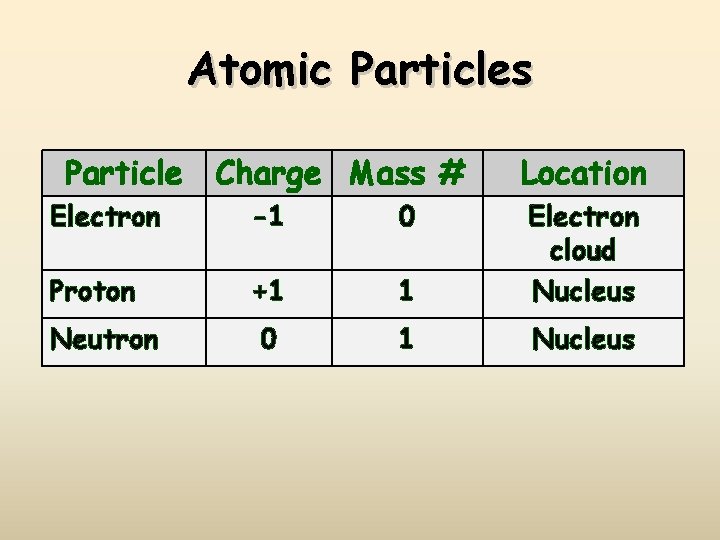
Atomic Particles Particle Charge Mass # Location Electron -1 0 Proton +1 1 Electron cloud Nucleus 0 1 Nucleus Neutron
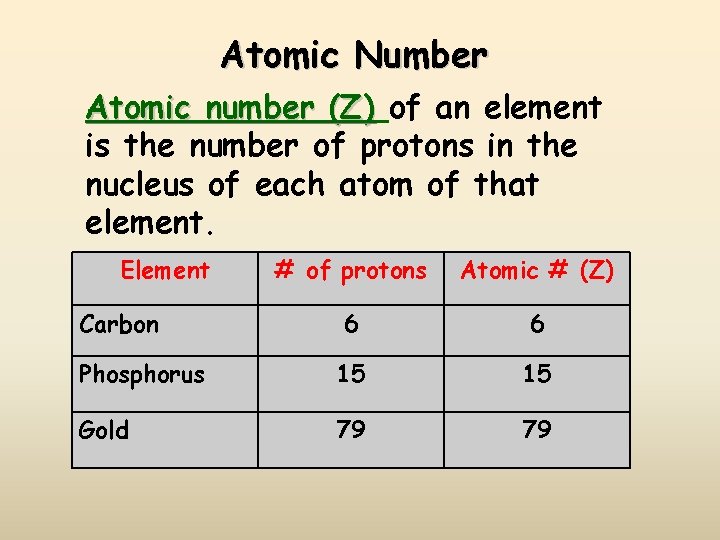
Atomic Number Atomic number (Z) of an element is the number of protons in the nucleus of each atom of that element. Element # of protons Atomic # (Z) 6 6 Phosphorus 15 15 Gold 79 79 Carbon
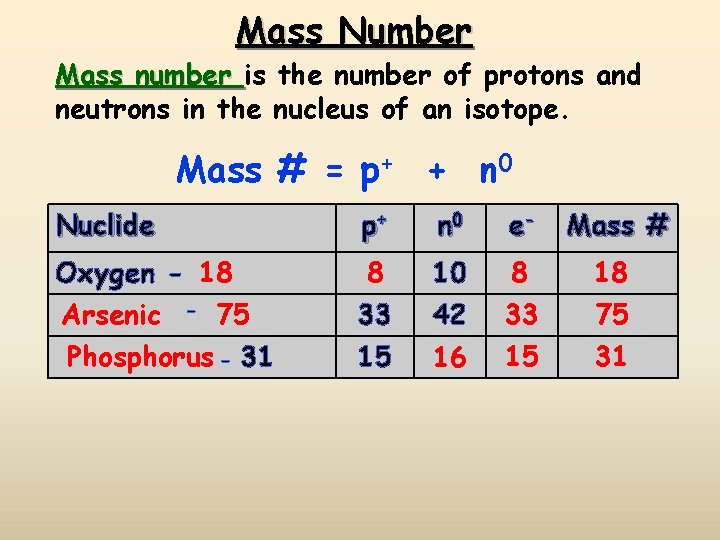
Mass Number Mass number is the number of protons and neutrons in the nucleus of an isotope. Mass # = p+ + n 0 Nuclide p+ n 0 e- Mass # Oxygen - 18 8 33 10 42 8 18 15 16 33 15 75 31 Arsenic - 75 Phosphorus - 31
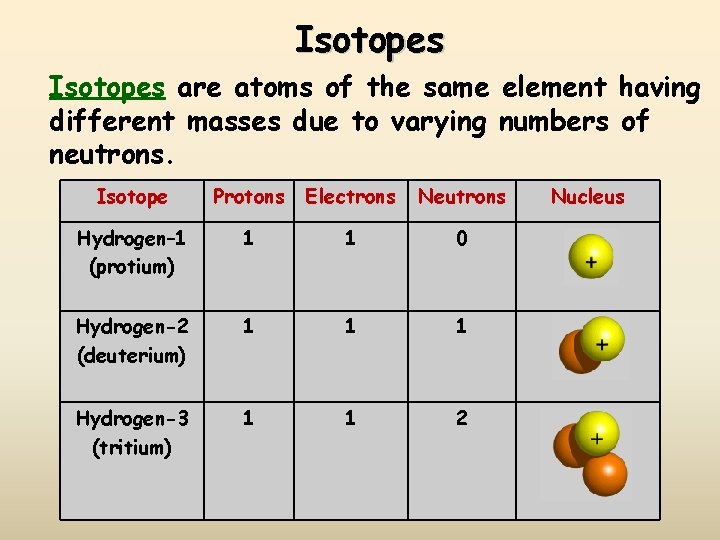
Isotopes are atoms of the same element having different masses due to varying numbers of neutrons. Isotope Protons Electrons Neutrons Hydrogen– 1 (protium) 1 1 0 Hydrogen-2 (deuterium) 1 1 1 Hydrogen-3 (tritium) 1 1 2 Nucleus
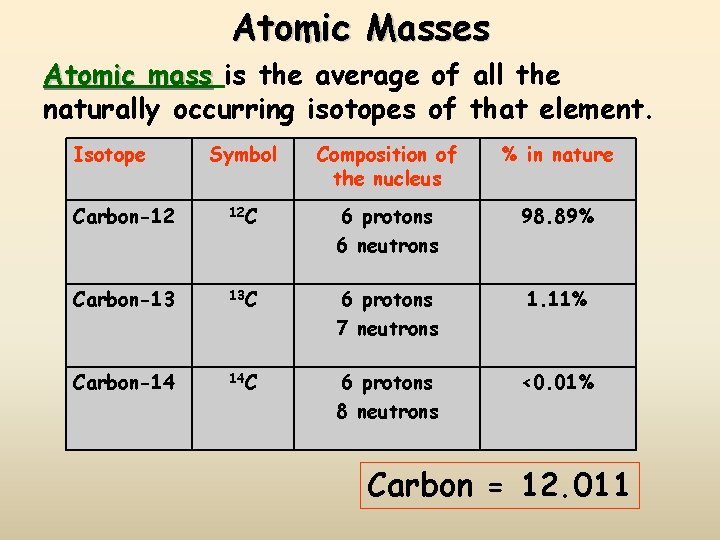
Atomic Masses Atomic mass is the average of all the naturally occurring isotopes of that element. Isotope Symbol Composition of the nucleus % in nature Carbon-12 12 C 6 protons 6 neutrons 98. 89% Carbon-13 13 C 6 protons 7 neutrons 1. 11% Carbon-14 14 C 6 protons 8 neutrons <0. 01% Carbon = 12. 011
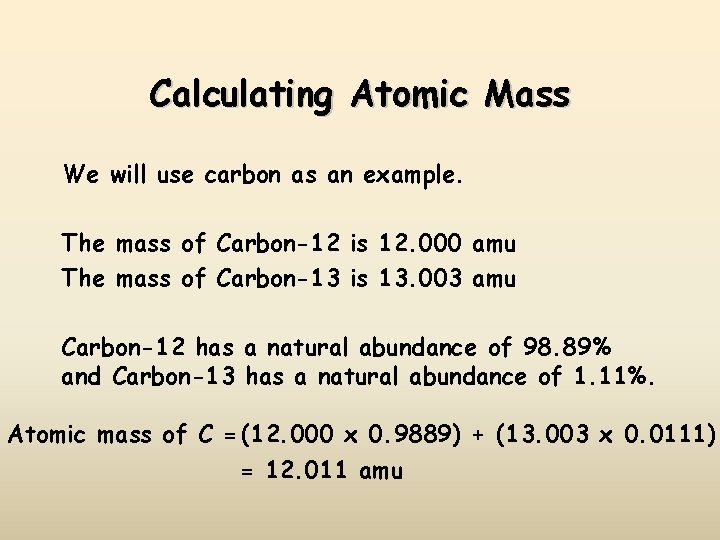
Calculating Atomic Mass We will use carbon as an example. The mass of Carbon-12 is 12. 000 amu The mass of Carbon-13 is 13. 003 amu Carbon-12 has a natural abundance of 98. 89% and Carbon-13 has a natural abundance of 1. 11%. Atomic mass of C = (12. 000 x 0. 9889) + (13. 003 x 0. 0111) = 12. 011 amu
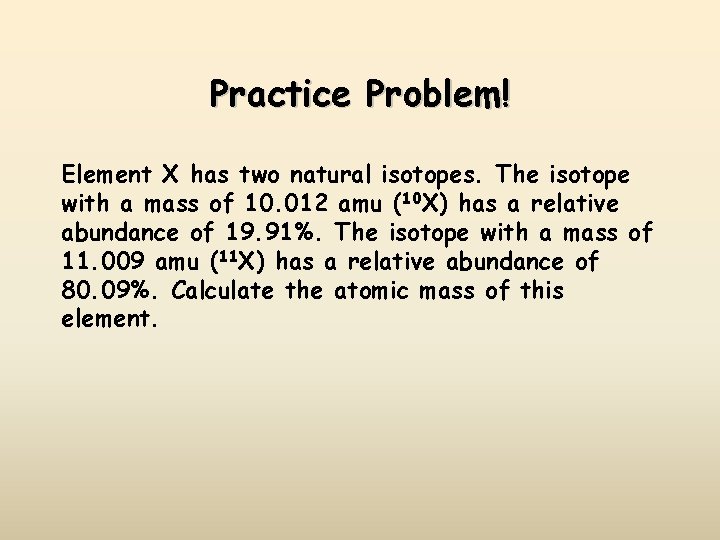
Practice Problem! Element X has two natural isotopes. The isotope with a mass of 10. 012 amu (10 X) has a relative abundance of 19. 91%. The isotope with a mass of 11. 009 amu (11 X) has a relative abundance of 80. 09%. Calculate the atomic mass of this element.
- Slides: 18