
Atomic Structure the Periodic Table Basic Definitions smallest
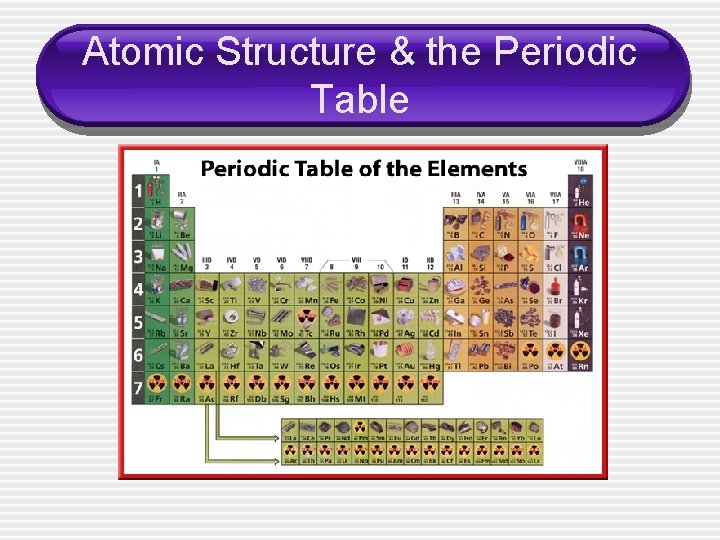
Atomic Structure & the Periodic Table
Basic Definitions • ______ – smallest unit of an • element that retains the properties of that element Atoms are made up of several subatomic particles called __________, and _____
Protons, Neutrons, & Electrons • Protons – have a _____charge and are • • • found in the _____ of the atom Neutrons – have _____charge and are also found in the _____of an atom Electrons – have a _____charge and are found _____ of the nucleus Nucleus – made up of _____and _____, has an overall _____ charge
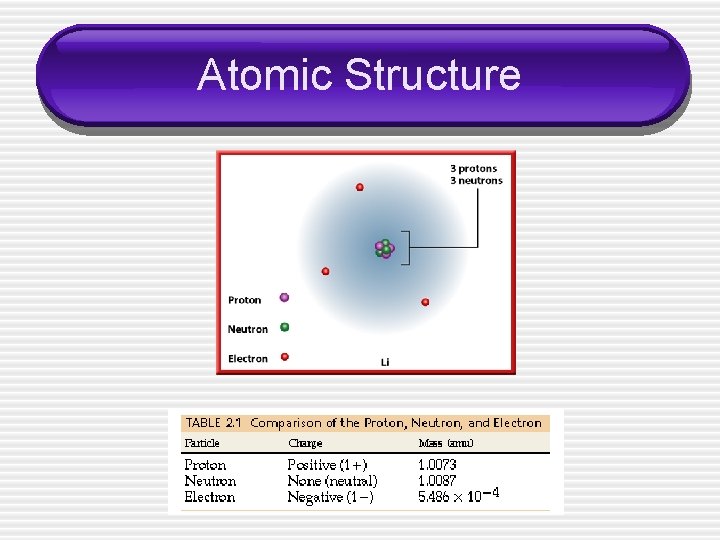
Atomic Structure
Atomic Numbers • The atomic number of an element is the number of _____in the nucleus of an atom of that element. • It is the number of protons that determines the identity of an element. • The number of _____ for an element CANNOT be changed.
Atomic Numbers • Because atoms have no overall charge, the number of _____must equal the number of _____. • So, the atomic number of an element also tells the number of _____ in a _____atom. • The number of _____ can be changed when determining the charge of an _____.
Masses • The sum of the _____ and _____ in the nucleus is the mass number. • _____ of an element have different mass numbers because they have different numbers of neutrons.
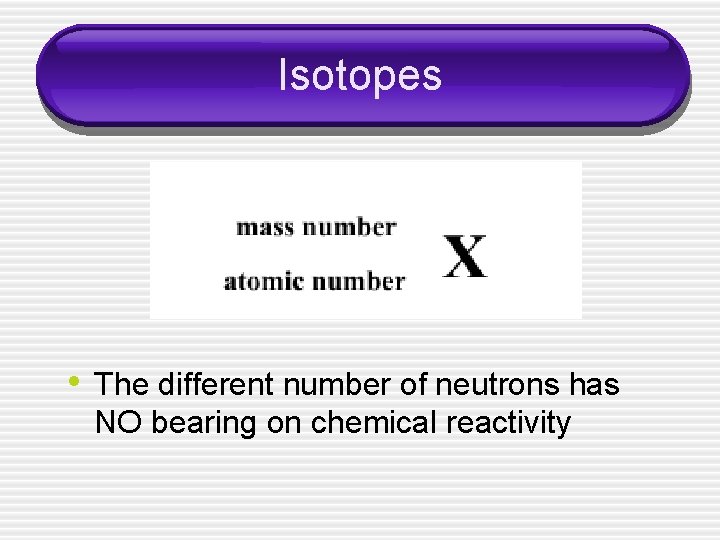
Isotopes • The different number of neutrons has NO bearing on chemical reactivity
Writing the Names of Isotopes • When writing the name of an isotope, you will write the name of the element – the mass number
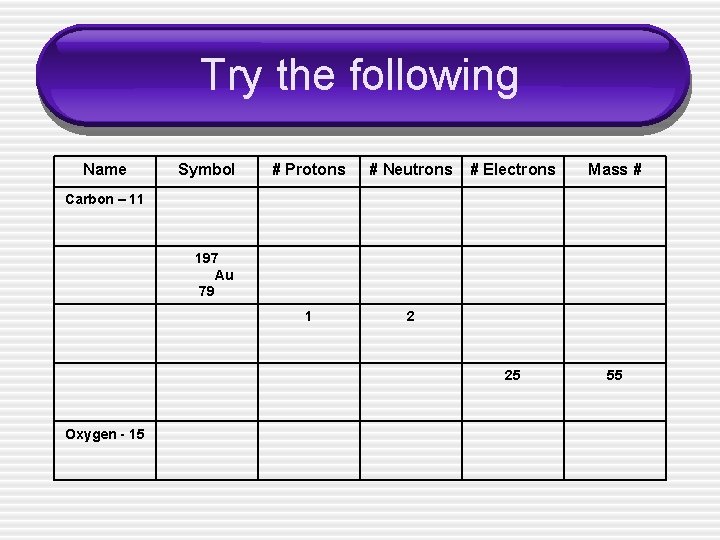
Try the following Name Symbol # Protons # Neutrons 1 2 # Electrons Mass # 25 55 Carbon – 11 197 Au 79 Oxygen - 15
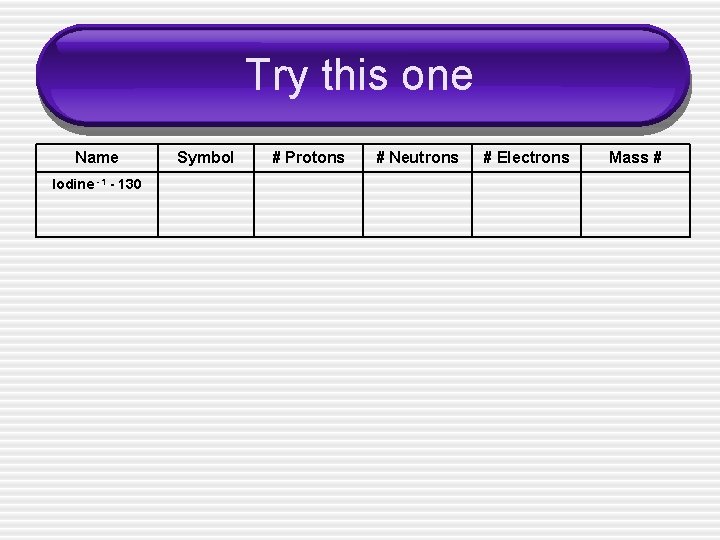
Try this one Name Iodine -1 - 130 Symbol # Protons # Neutrons # Electrons Mass #
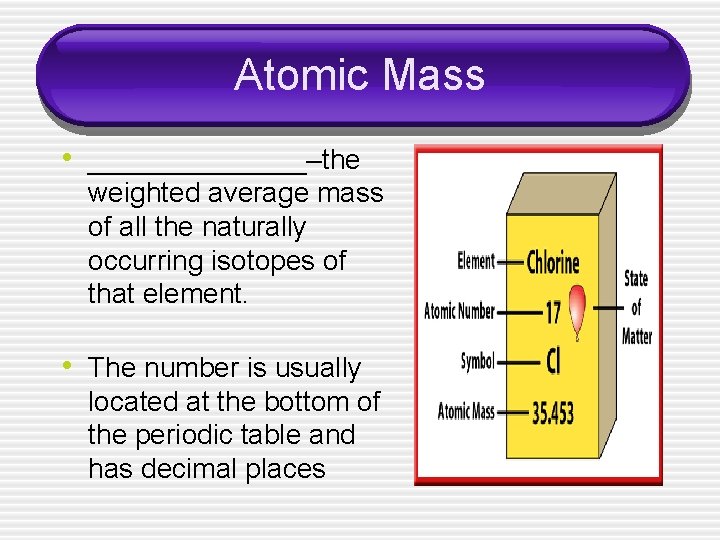
Atomic Mass • _______–the weighted average mass of all the naturally occurring isotopes of that element. • The number is usually located at the bottom of the periodic table and has decimal places
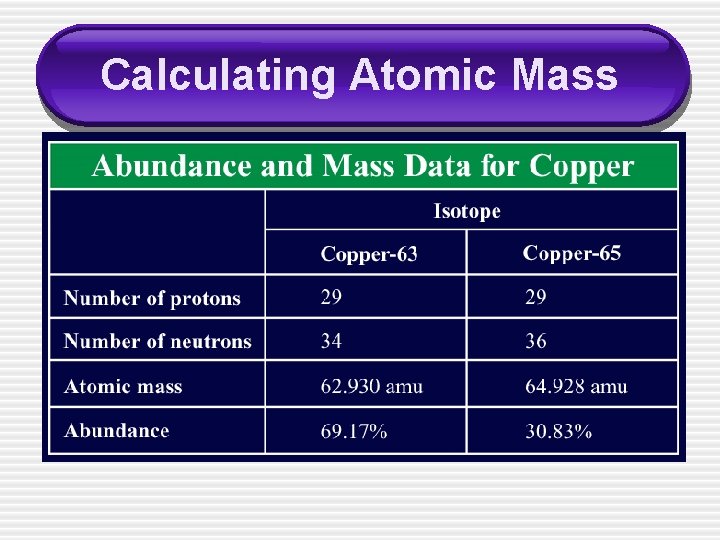
Calculating Atomic Mass
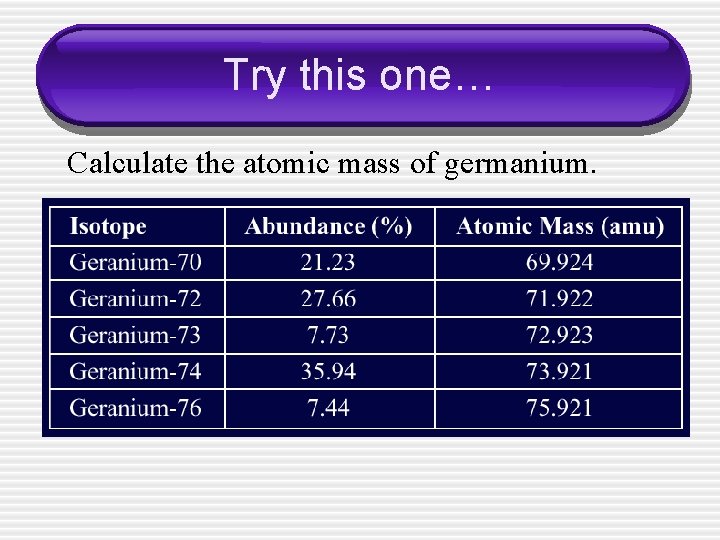
Try this one… Calculate the atomic mass of germanium.
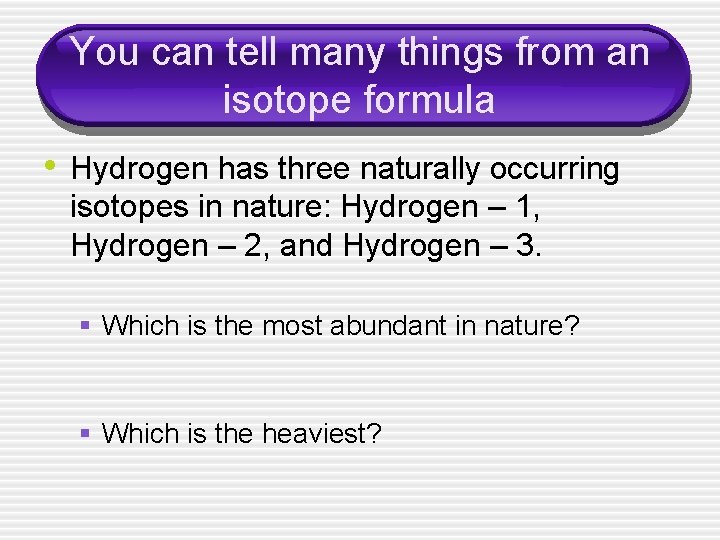
You can tell many things from an isotope formula • Hydrogen has three naturally occurring isotopes in nature: Hydrogen – 1, Hydrogen – 2, and Hydrogen – 3. § Which is the most abundant in nature? § Which is the heaviest?
Periodic Table • Periodic Table – arrangement of elements in order of increasing _____ with elements having similar properties in vertical columns § __________– horizontal rows
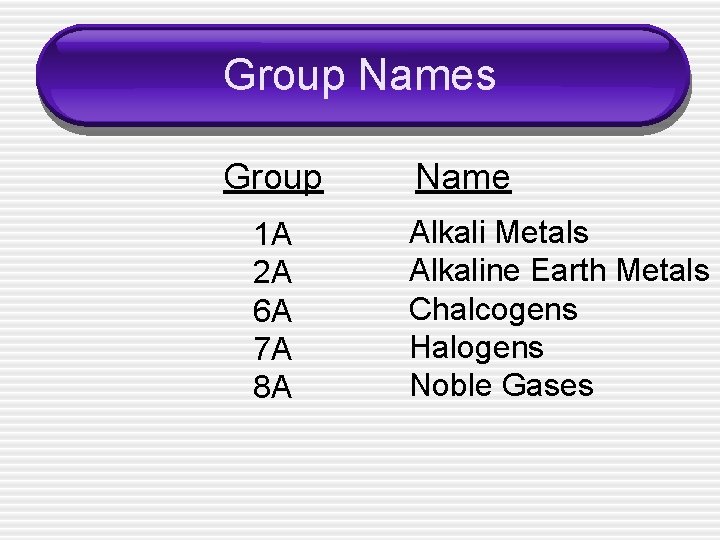
Group Names Group 1 A 2 A 6 A 7 A 8 A Name Alkali Metals Alkaline Earth Metals Chalcogens Halogens Noble Gases
Groups • The group tell you the number of ________ that the element has • Valence electrons are electrons in the _____ shell of the atom
Characteristics • Elements in the same group exhibit similar chemical characteristics due to the fact that they all have the same number of ___________. • The most stable number of valence electrons is _____ • This is called an _____
Charges • Every element wants 8 valence electrons to become stable. They will gain or lose valence electrons to form an octet
Physical States and Classes of the Elements • The majority of the elements are _____ • . They occupy the entire _____side • and center of the periodic table. _____ occupy the upper-right-hand corner. • _____ are located along the boundary between metals and nonmetals.
Metals • Metals are elements that have _____, _____heat and electricity, and usually bend without breaking. • All metals except _____are solids at room temperature.
Transition Metals • The elements in Groups 3 through 12 of the periodic table are called the ______ elements. • All transition elements are ______. • Many transition metals can have more than one charge
Inner Transition Metals • Atomic numbers 58 -71 and 90 -103, are known as ______ transition metals • These elements are separated from the main table because putting them in their proper position would make the table very wide.
Non Metals • Most nonmetals don’t conduct electricity, are much poorer conductors of heat than metals, and are _____ when solid. • Many are _____ at room temperature • Those that are solids lack the luster of metals.
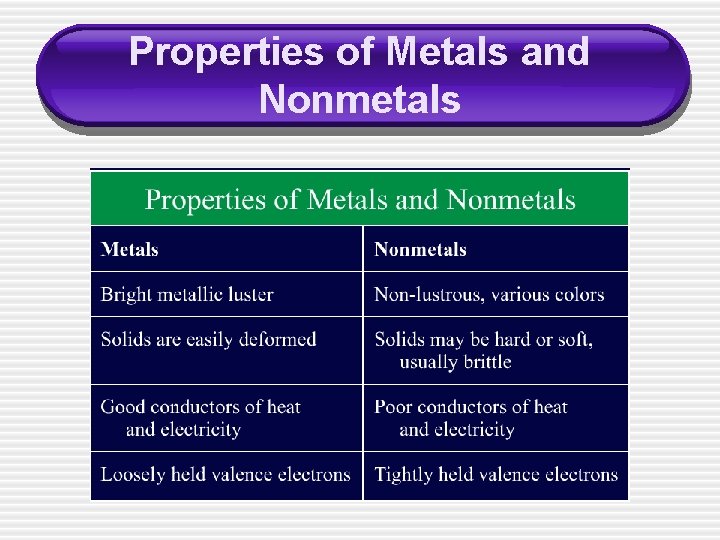
Properties of Metals and Nonmetals
Metalloids • Metalloids have some chemical and physical properties of metals and other properties of nonmetals. • In the periodic table, the metalloids lie along the border between metals and nonmetals.
- Slides: 27