
Atomic Structure Pupils will be able to Describe
Atomic Structure Pupils will be able to: • Describe the structure of an atom • Describe the types of sub-atomic particles • Define relative atomic mass and relative atomic number 2/22/2021
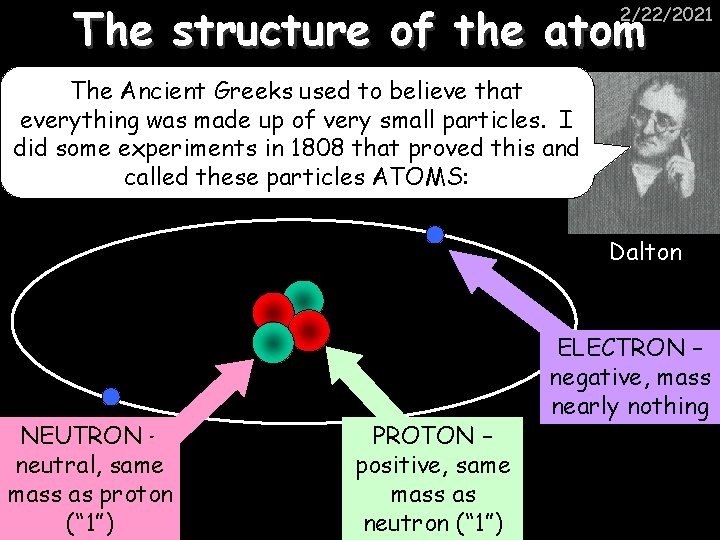
The structure of the atom 2/22/2021 The Ancient Greeks used to believe that everything was made up of very small particles. I did some experiments in 1808 that proved this and called these particles ATOMS: Dalton NEUTRON – neutral, same mass as proton (“ 1”) PROTON – positive, same mass as neutron (“ 1”) ELECTRON – negative, mass nearly nothing
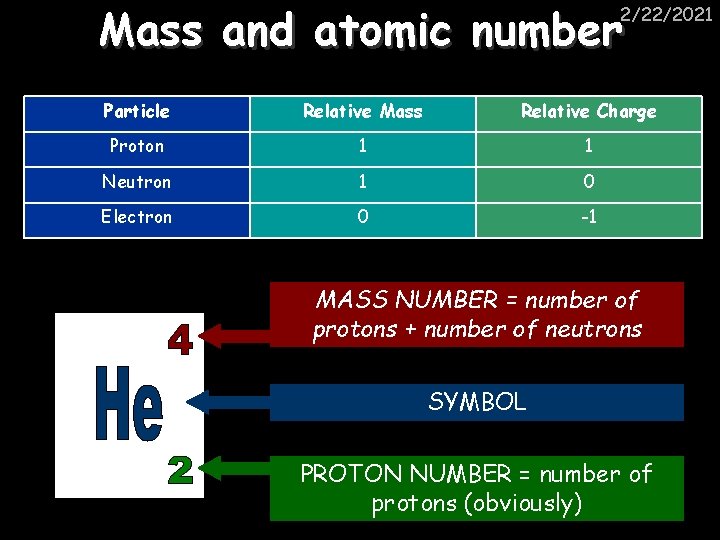
Mass and atomic number 2/22/2021 Particle Relative Mass Relative Charge Proton 1 1 Neutron 1 0 Electron 0 -1 MASS NUMBER = number of protons + number of neutrons SYMBOL PROTON NUMBER = number of protons (obviously)
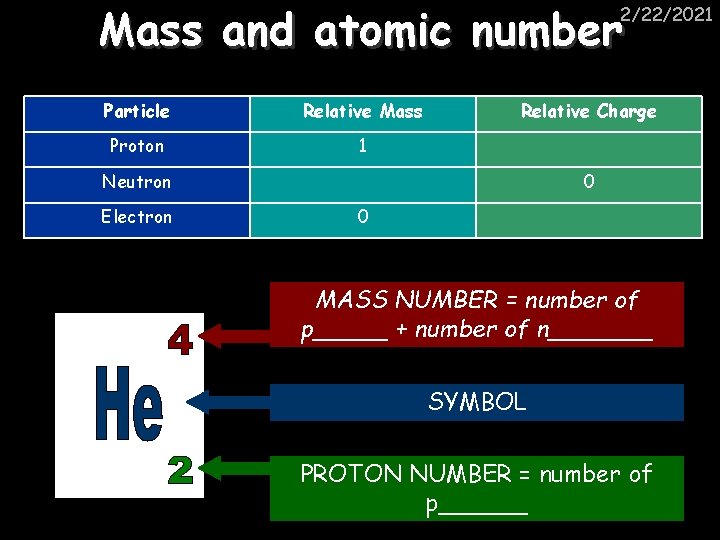
Mass and atomic number 2/22/2021 Particle Relative Mass Proton 1 Relative Charge Neutron Electron 0 0 MASS NUMBER = number of p_____ + number of n_______ SYMBOL PROTON NUMBER = number of p______
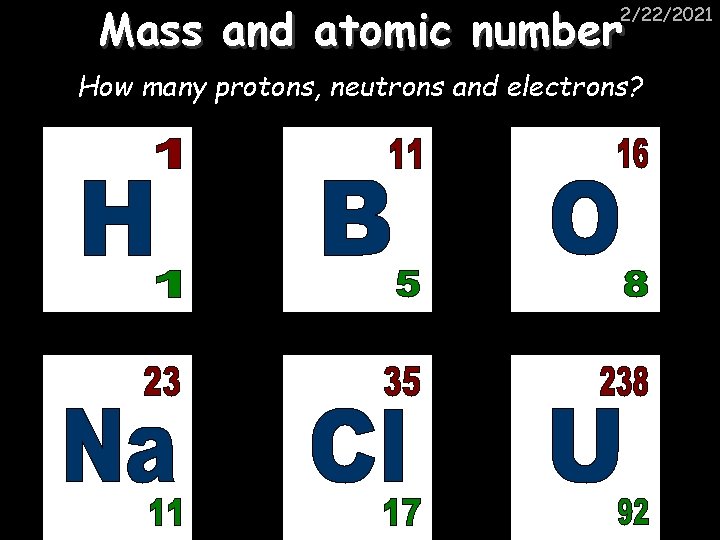
Mass and atomic number 2/22/2021 How many protons, neutrons and electrons?
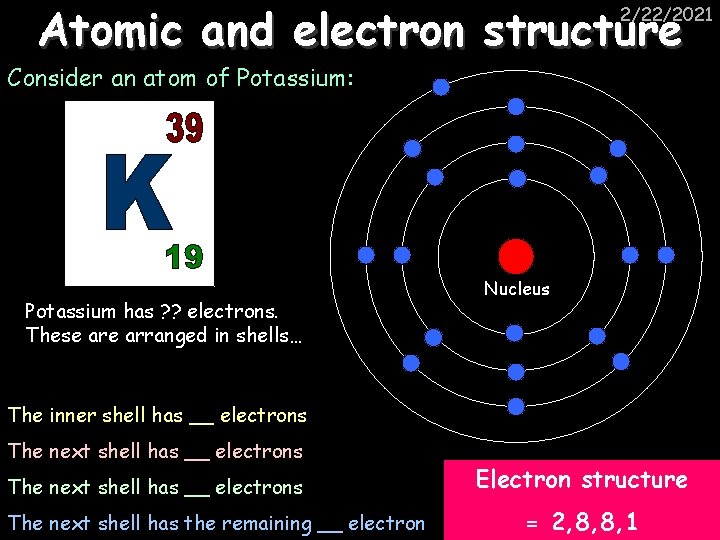
Atomic and electron structure 2/22/2021 Consider an atom of Potassium: Potassium has ? ? electrons. These arranged in shells… Nucleus The inner shell has __ electrons The next shell has the remaining __ electron Electron structure = 2, 8, 8, 1

Try this… 2/22/2021 Consider an atom of Boron: 1. How many protons, neutrons and electrons does it have? 2. Draw an atomic structure diagram for an atom of Boron. 3. Write out the electronic structure. The inner shell has __ electrons The second shell has __ electrons
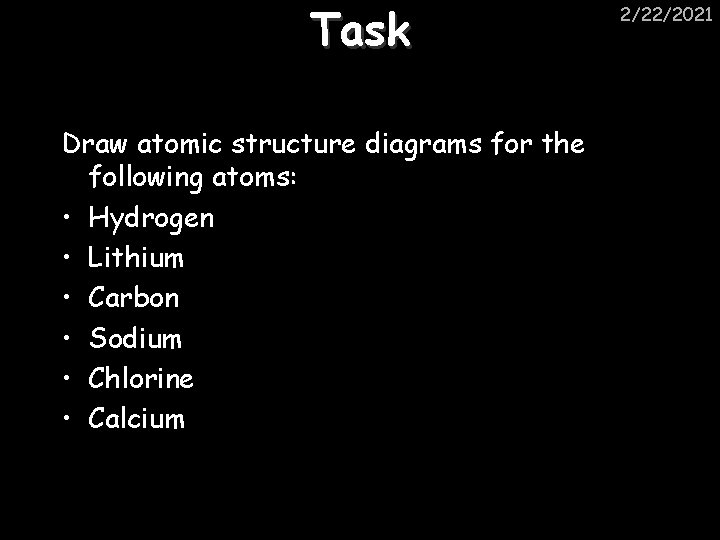
Task Draw atomic structure diagrams for the following atoms: • Hydrogen • Lithium • Carbon • Sodium • Chlorine • Calcium 2/22/2021
Lesson Outcomes 2/22/2021 Pupils will be able to • define the term ‘isotope’ • Use the periodic table to work out the numbers of protons, neutrons and electrons in specific isotopes • Draw atomic structure diagrams to illustrate electron arrangement in specific isotopes
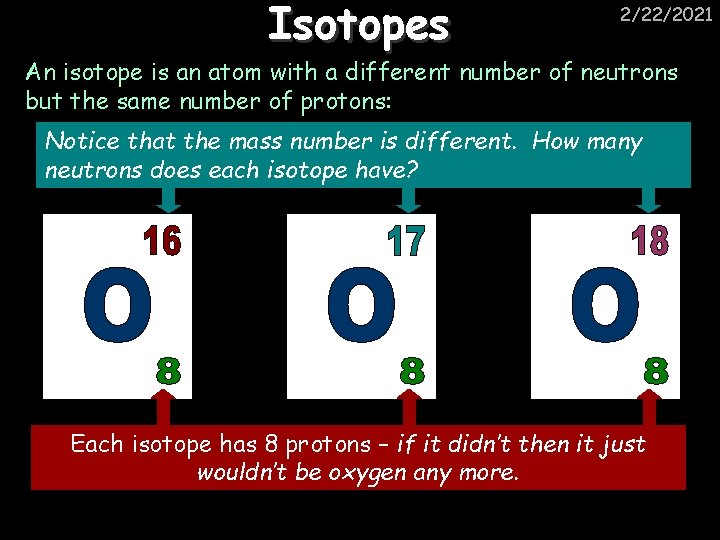
Isotopes 2/22/2021 An isotope is an atom with a different number of neutrons but the same number of protons: Notice that the mass number is different. How many neutrons does each isotope have? Each isotope has 8 protons – if it didn’t then it just wouldn’t be oxygen any more.
Hydrogen Isotopes 2/22/2021
Isotopes 2/22/2021
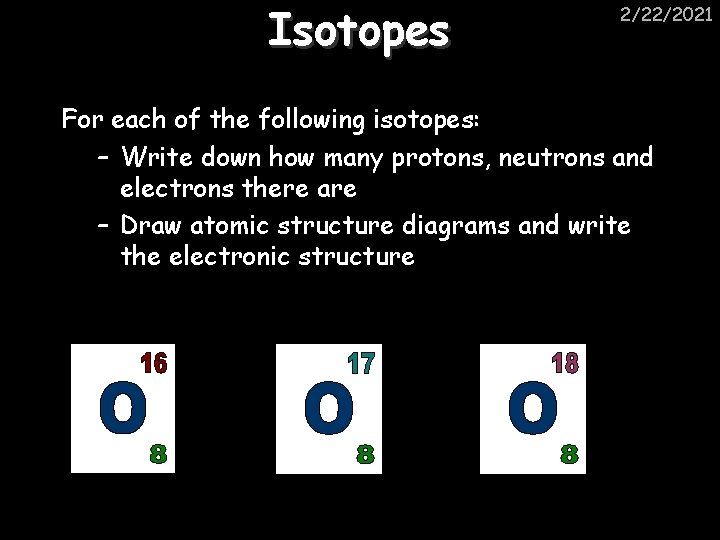
Isotopes 2/22/2021 For each of the following isotopes: – Write down how many protons, neutrons and electrons there are – Draw atomic structure diagrams and write the electronic structure
Lesson Outcomes 2/22/2021 Pupils will be able to: • Describe the relationship between group number and number of electrons in an atoms outer shell • Describe the relationship between period and number of shells or energy levels
Lesson Outcomes 2/22/2021 Pupils will be able to: • Identify the alkali metals on the periodic table • Identify how many electrons the alkali metals have in their outer shell • List the alkali metals in order of reactivity • Describe the reaction between the alkali metals and water • Explain the pattern of reactivity
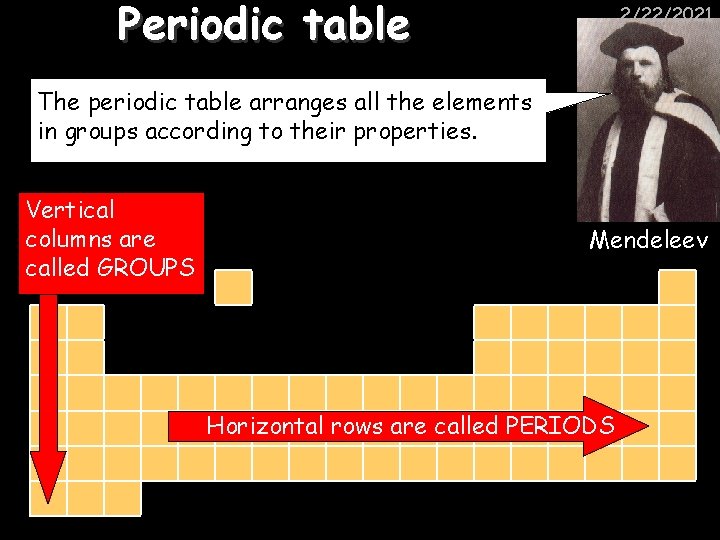
Periodic table 2/22/2021 The periodic table arranges all the elements in groups according to their properties. Vertical columns are called GROUPS Mendeleev Horizontal rows are called PERIODS
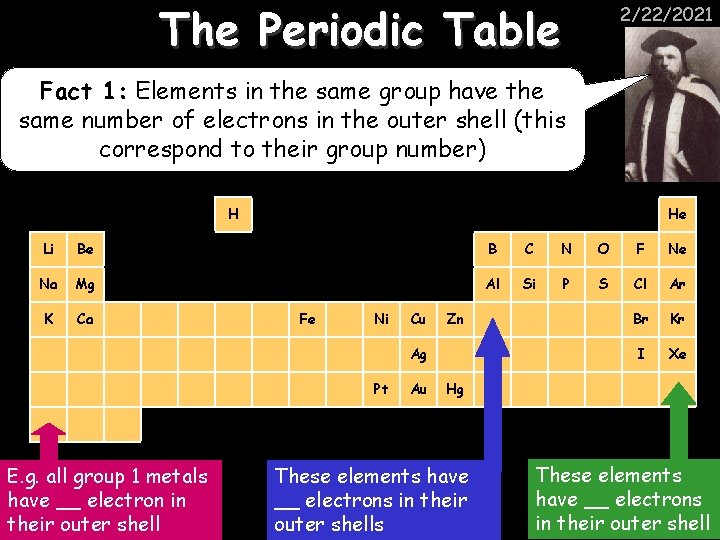
The Periodic Table 2/22/2021 Fact 1: Elements in the same group have the same number of electrons in the outer shell (this correspond to their group number) H He Li Be B C N O F Ne Na Mg Al Si P S Cl Ar K Ca Br Kr I Xe Fe Ni Cu Zn Ag Pt E. g. all group 1 metals have __ electron in their outer shell Au Hg These elements have __ electrons in their outer shells These elements have __ electrons in their outer shell
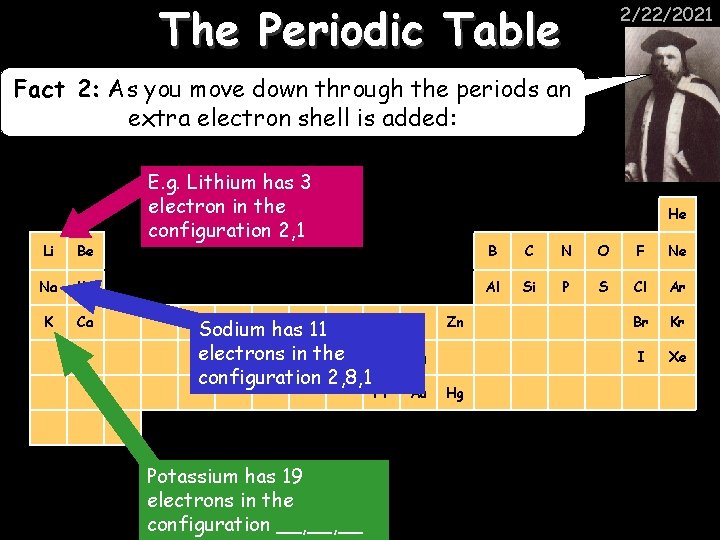
The Periodic Table 2/22/2021 Fact 2: As you move down through the periods an extra electron shell is added: Li Be Na Mg K Ca E. g. Lithium has 3 electron Hin the configuration 2, 1 He Ni Sodium has. Fe 11 electrons in the configuration 2, 8, 1 Pt Potassium has 19 electrons in the configuration __, __ Cu Zn Ag Au Hg B C N O F Ne Al Si P S Cl Ar Br Kr I Xe
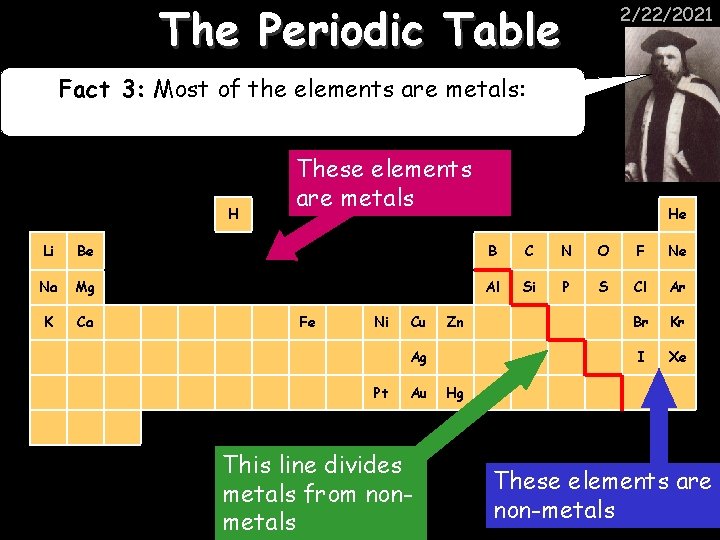
The Periodic Table 2/22/2021 Fact 3: Most of the elements are metals: H These elements are metals He Li Be B C N O F Ne Na Mg Al Si P S Cl Ar K Ca Br Kr I Xe Fe Ni Cu Zn Ag Pt Au This line divides metals from nonmetals Hg These elements are non-metals
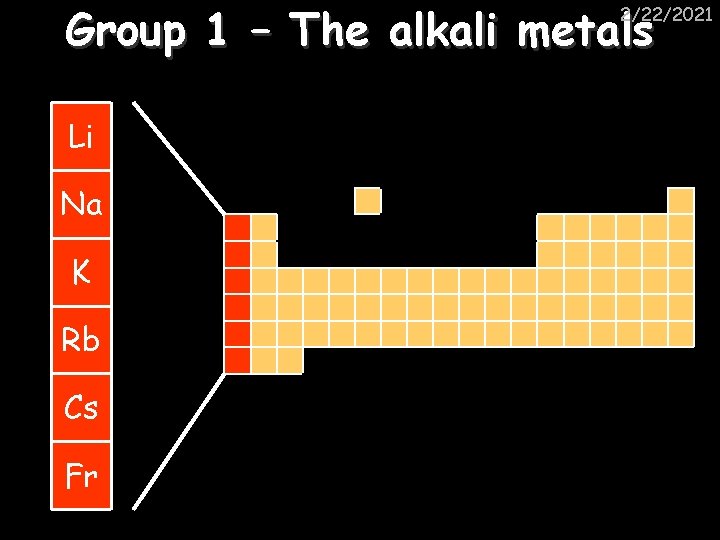
Group 1 – The alkali metals 2/22/2021 Li Na K Rb Cs Fr
Assignment 2/22/2021 Write a couple of sentences to explain: • What group the alkali metals are in • How many electrons they have in their outer shell • Each time you descend the group an extra electron shell is added. That means that the lower down the group an atom is, the further away their outer electron shell is from the nucleus.
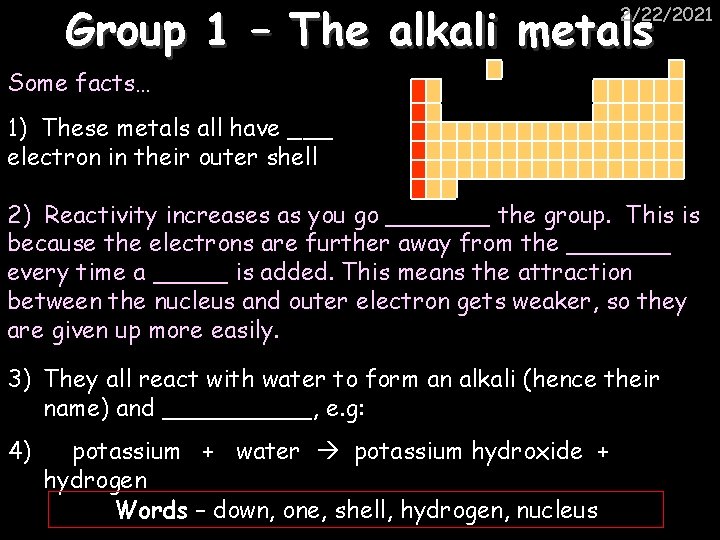
Group 1 – The alkali metals 2/22/2021 Some facts… 1) These metals all have ___ electron in their outer shell 2) Reactivity increases as you go _______ the group. This is because the electrons are further away from the _______ every time a _____ is added. This means the attraction between the nucleus and outer electron gets weaker, so they are given up more easily. 3) They all react with water to form an alkali (hence their name) and _____, e. g: 4) potassium + water potassium hydroxide + hydrogen Words – down, one, shell, hydrogen, nucleus
Lesson Outcomes 2/22/2021 Pupils will be able to: • Identify the halogens on the periodic table • Identify how many electrons the halogens have in their outer shell • List the halogens in order of reactivity • Describe displacement reactions between the halogens • Explain the pattern of reactivity
2/22/2021 Write a few sentences to describe your observations of the alkali metals with water: • Did reactivity increase as you went up or down the group? • What happened to the colour of the indicator in the water? What does this mean? Explain the pattern of reactivity. Think about, and include in your answer: • Number of electrons in outer shell • Distance of outer electron shell from nucleus • Force of attraction between positively charged protons in the nucleus and negatively charged electrons in outer shell
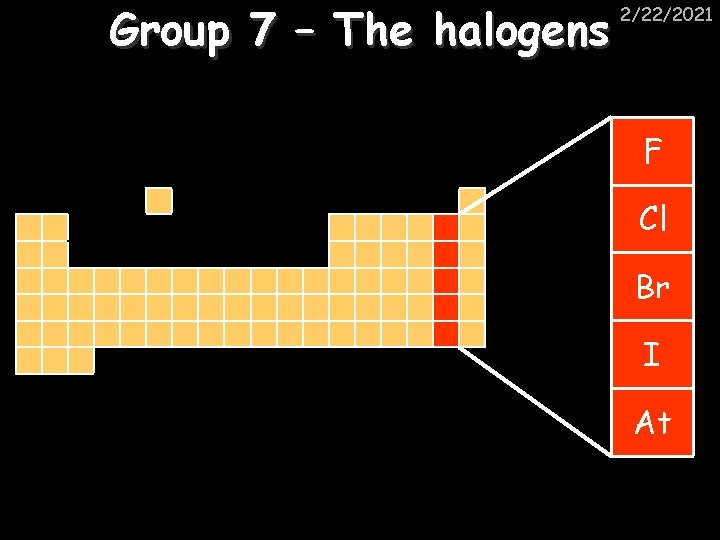
Group 7 – The halogens 2/22/2021 F Cl Br I At
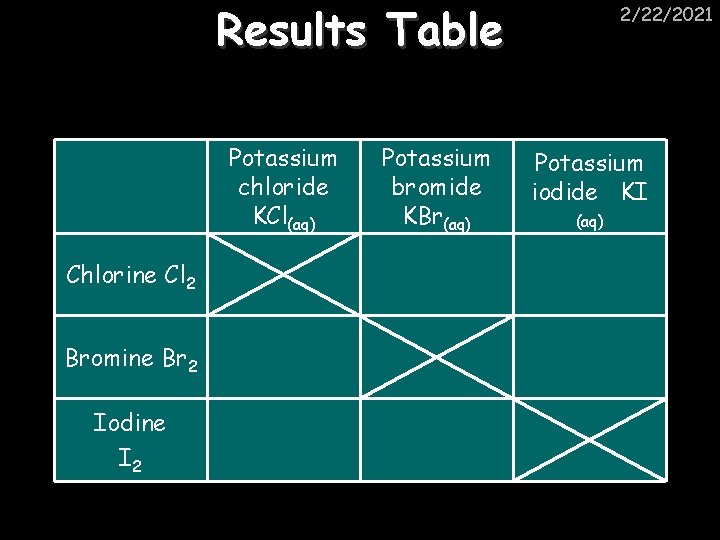
Results Table Potassium chloride KCl(aq) Chlorine Cl 2 Bromine Br 2 Iodine I 2 Potassium bromide KBr(aq) 2/22/2021 Potassium iodide KI (aq)
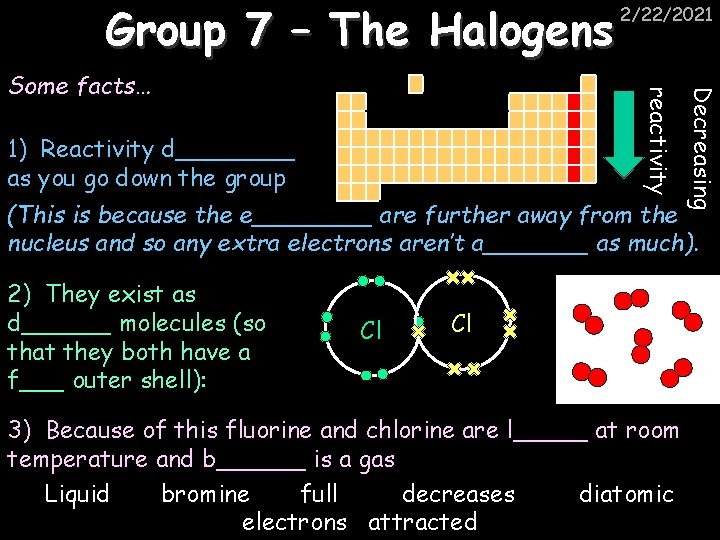
Group 7 – The Halogens 1) Reactivity d____ as you go down the group Decreasing reactivity Some facts… 2/22/2021 (This is because the e____ are further away from the nucleus and so any extra electrons aren’t a_______ as much). 2) They exist as d______ molecules (so that they both have a f___ outer shell): Cl Cl 3) Because of this fluorine and chlorine are l_____ at room temperature and b______ is a gas Liquid bromine full decreases diatomic electrons attracted
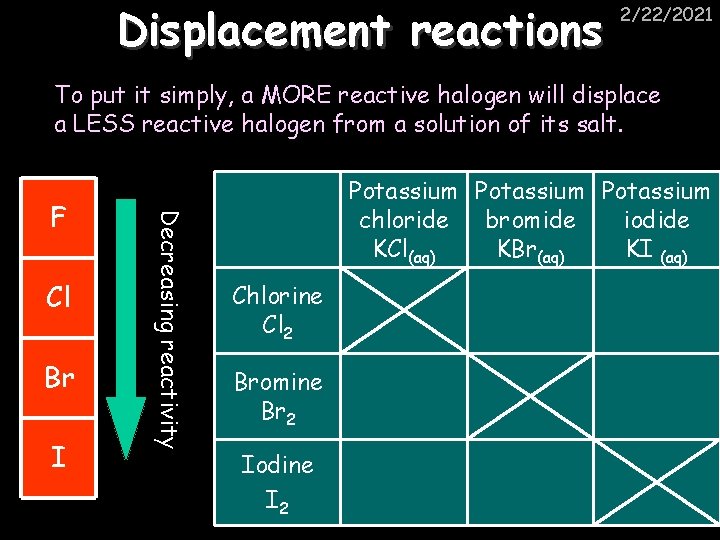
Displacement reactions 2/22/2021 To put it simply, a MORE reactive halogen will displace a LESS reactive halogen from a solution of its salt. Cl Br I Decreasing reactivity F Potassium chloride bromide iodide KCl(aq) KBr(aq) KI (aq) Chlorine Cl 2 Bromine Br 2 Iodine I 2
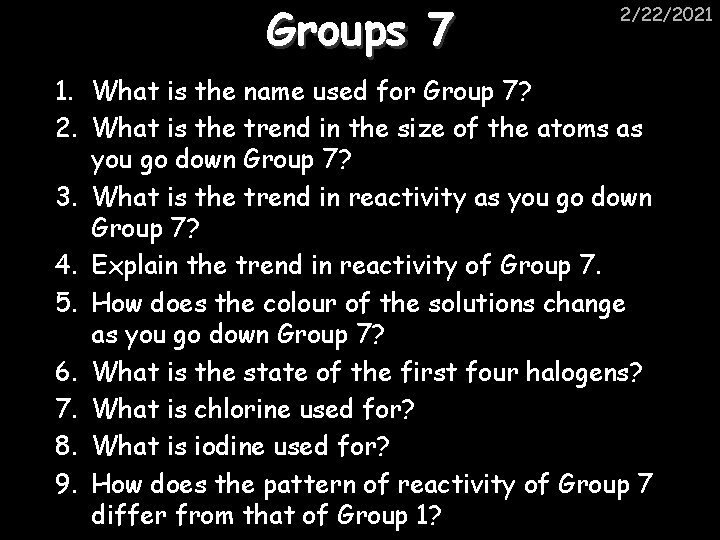
Groups 7 2/22/2021 1. What is the name used for Group 7? 2. What is the trend in the size of the atoms as you go down Group 7? 3. What is the trend in reactivity as you go down Group 7? 4. Explain the trend in reactivity of Group 7. 5. How does the colour of the solutions change as you go down Group 7? 6. What is the state of the first four halogens? 7. What is chlorine used for? 8. What is iodine used for? 9. How does the pattern of reactivity of Group 7 differ from that of Group 1?
Group 7 2/22/2021 Use ‘displacement theory’ to explain the pattern of reactivity in the halogens
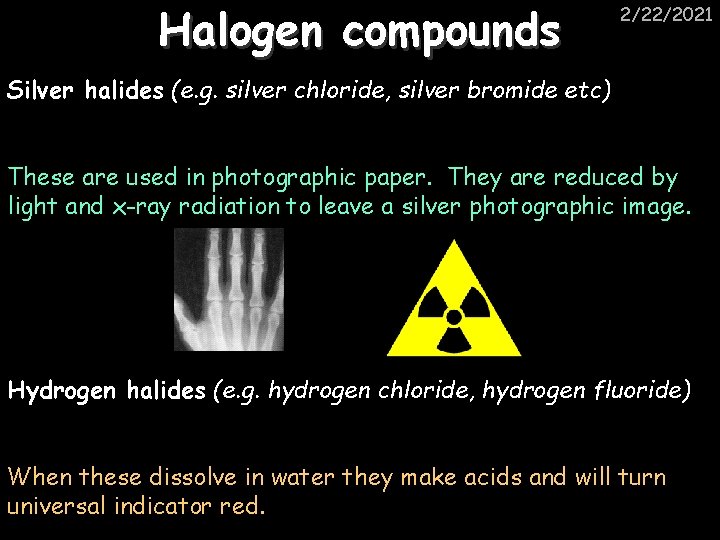
Halogen compounds 2/22/2021 Silver halides (e. g. silver chloride, silver bromide etc) These are used in photographic paper. They are reduced by light and x-ray radiation to leave a silver photographic image. Hydrogen halides (e. g. hydrogen chloride, hydrogen fluoride) When these dissolve in water they make acids and will turn universal indicator red.
- Slides: 31