
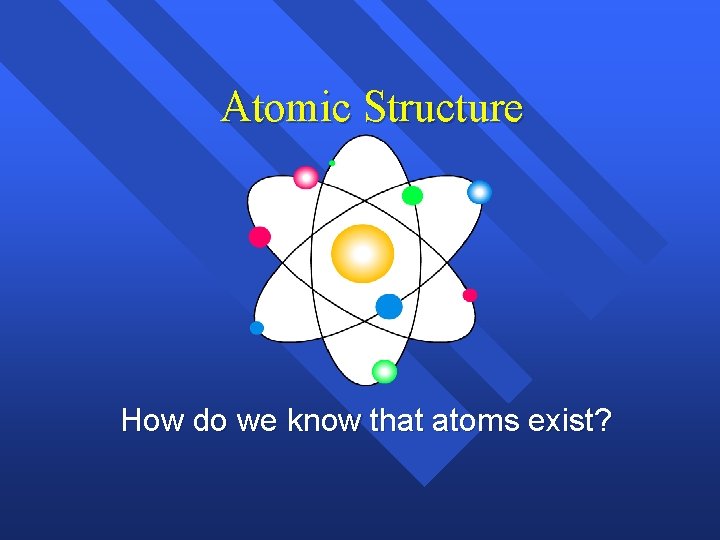
Atomic Structure How do we know that atoms
- Slides: 67
Atomic Structure How do we know that atoms exist?
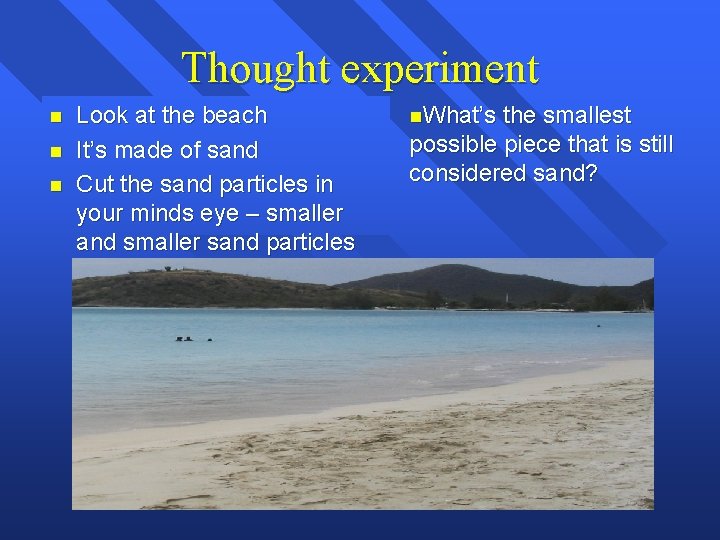
Thought experiment n n n Look at the beach It’s made of sand Cut the sand particles in your minds eye – smaller and smaller sand particles n. What’s the smallest possible piece that is still considered sand?
History of the atom Not the history of the atom, but the idea of the atom. n Original idea came from Ancient Greece (400 B. C. ) n Democritus and Leucippus- Greek philosophers. n Pondered the fundamental nature of matter. n Matter is made up of indivisible particles n Atomos – indivisible, not to be cut n
Another Greek Aristotle - Famous philosopher n All substances are made of 4 elements n Fire - Hot n Air - light n Earth - cool, heavy n Water - wet n Blend these in different proportions to get all substances n All matter is continuous n
Who Was Right? Neither view was supported by experimentation. n Greeks settled disagreements by debate. n Aristotle was a better debater - He won. n His ideas carried through middle ages. n
Foundations of Atomic Theory Late 1700’s – most chemists accepted the modern definition of an element as a substance that cannot be broken down further by ordinary chemical means. n Elements combine to form compounds whose properties are different from the elements that form them. n Great controversy over whether elements always combine in the same ratio when forming a particular compound. n
Foundations of Atomic Theory Significant improvements to the available technologies n Led to a more quantitative study of elements, compounds, and chemical reactions n Led to the discovery of several basic laws n
Law of Conservation of Mass n Mass is neither created nor destroyed during ordinary chemical reactions or physical changes.
Law of Definite Proportions Regardless of where or how a pure chemical compound is prepared, it is composed of a fixed proportion of. elements. n It is a ratio by mass. n All salt crystals, Na. Cl, regardless of sample size contains exactly 39. 34% sodium and 60. 66% chlorine. n
Foundations of Atomic Theory In 1808 - John Dalton- England. n Teacher- proposed an explanation for these laws. n n Dalton’s Atomic Theory 1) All atoms are composed of extremely small particles called atoms.
Dalton’s Atomic Theory 2) Atoms of a given element are identical in size, mass, and other properties; atoms of different elements differ in size, mass, and other properties. 3) Atoms cannot be subdivided, created, or destroyed. 4) Atoms of different elements combine in simple whole-number ratios to form chemical compounds. 5) In chemical reactions, atoms are combined, separated, or rearranged.
Where Dalton Was Wrong Atoms are divisible into even smaller particles! n A given element can have atoms with different masses! n Atomic theory is an ever evolving concept improving as technology improves. n Unchanged for 200 years: matter is composed of atoms, atoms of one element differ in properties from atoms of another element. n
The Structure of the Atom Late 1800’s scientific advances allowed for a deeper exploration into the nature of matter. n Atoms are composed of several basic types of smaller particles. n The number and arrangement of these particles within an atom determines that atom’s chemical properties. n
The Structure of the Atom An atom is the smallest particle of an element that retains the chemical properties of that element. n All atoms are composed of two regions: – Nucleus: very small dense region located in the center of the atom. » Made up of at least one positive particle, proton, and usually one or more neutral particles called neutrons. n
The Structure of the Atom Surrounding the nucleus is a large region occupied by negatively charged particles called electrons. n This region is called the electron cloud. n Protons, Neutrons, and Electrons are referred to as subatomic particles. n
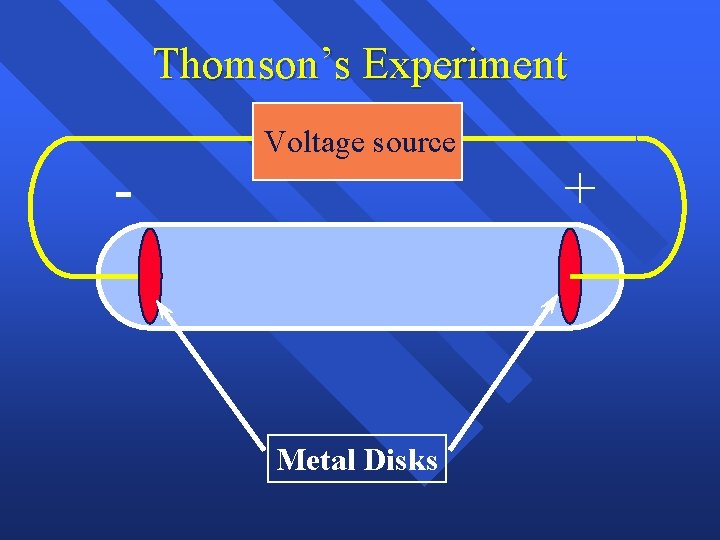
Discoveries J. J. Thomson - English physicist. 1897 n Investigated relationship between electricity and matter. n Made a piece of equipment called a cathode ray tube. n It is a vacuum tube - all the air has been pumped out. n A limited amount of other gases are put in n
Thomson’s Experiment - Voltage source Metal Disks +
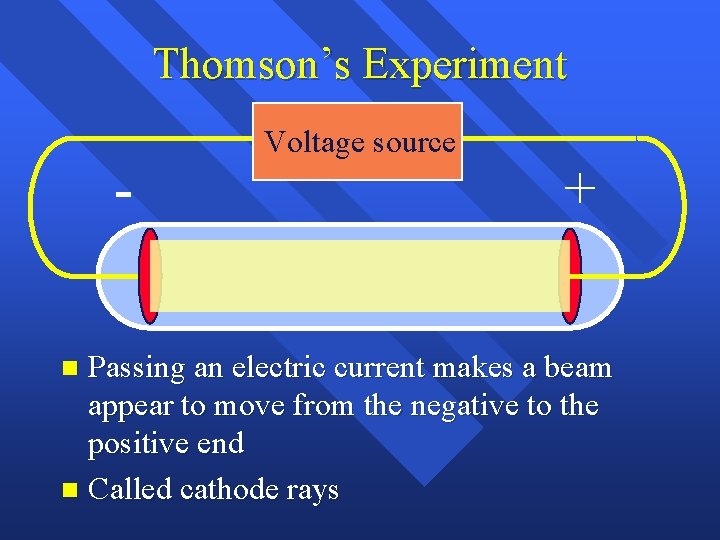
Thomson’s Experiment - Voltage source + Passing an electric current makes a beam appear to move from the negative to the positive end n Called cathode rays n
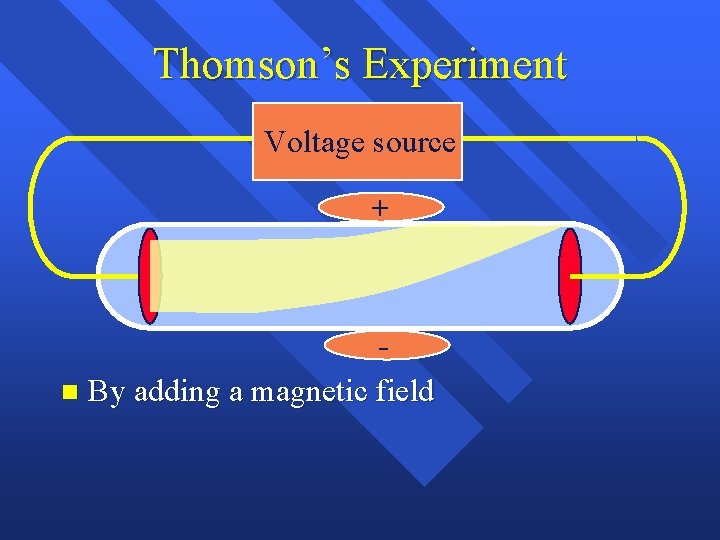
Thomson’s Experiment Voltage source + n By adding a magnetic field
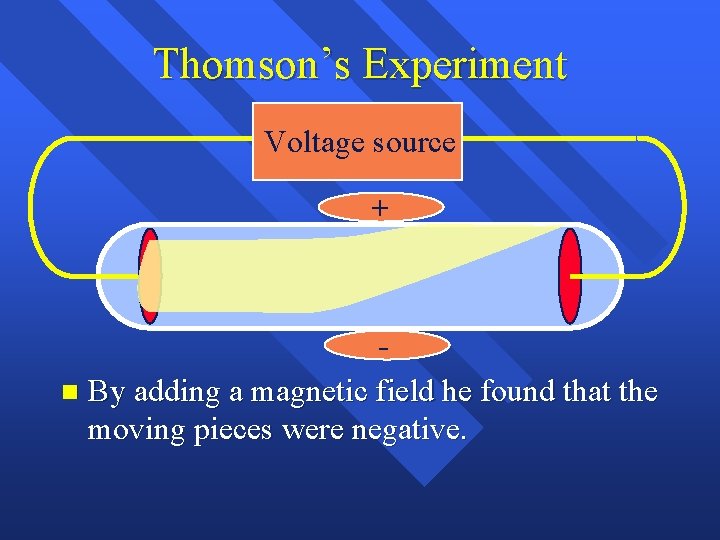
Thomson’s Experiment Voltage source + n By adding a magnetic field he found that the moving pieces were negative.
Thomson’s Experiment Used many different metals and gases n Beam was always the same n By the amount it bent he could find the ratio of charge to mass n He found the ratio was the same with every material n He concluded that the rays were composed of identical negatively charged particles. n
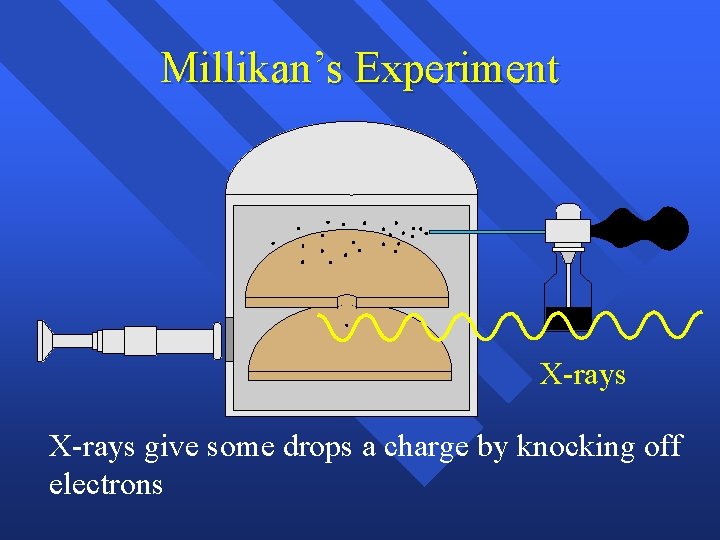
Millikan’s Experiment 1909 Robert Millikan measured the charge of an electron. n Scientists used this information and the charge-to-mass ratio to determine the mass of an electron. n
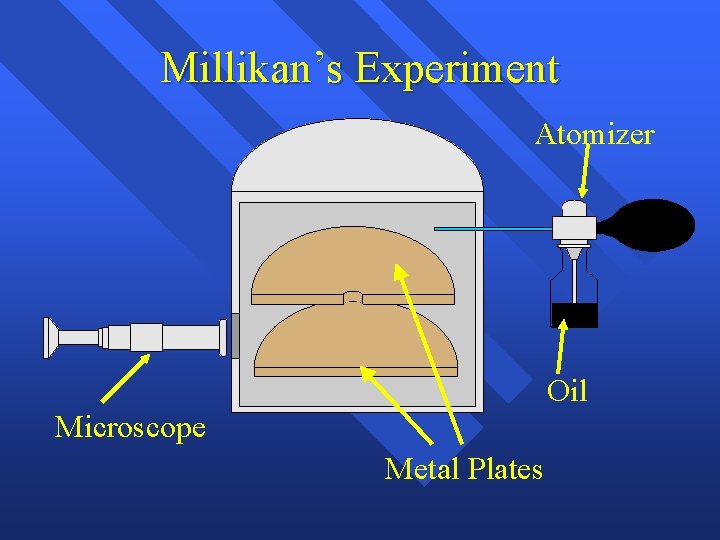
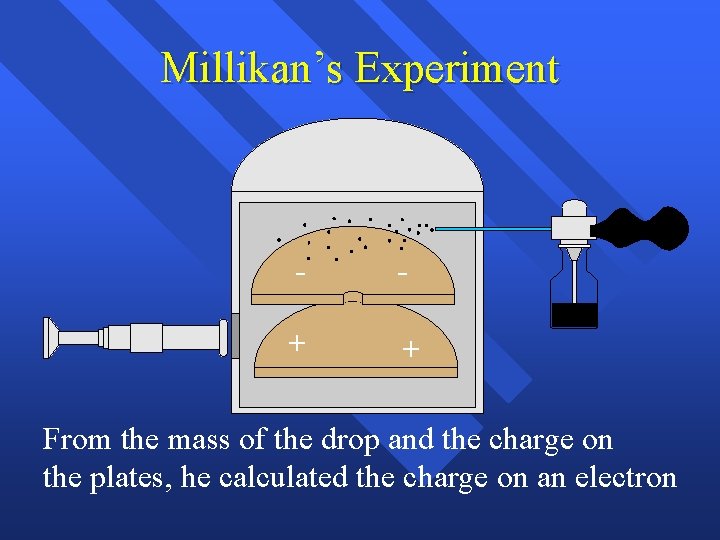
Millikan’s Experiment Atomizer + Oil Microscope Metal Plates
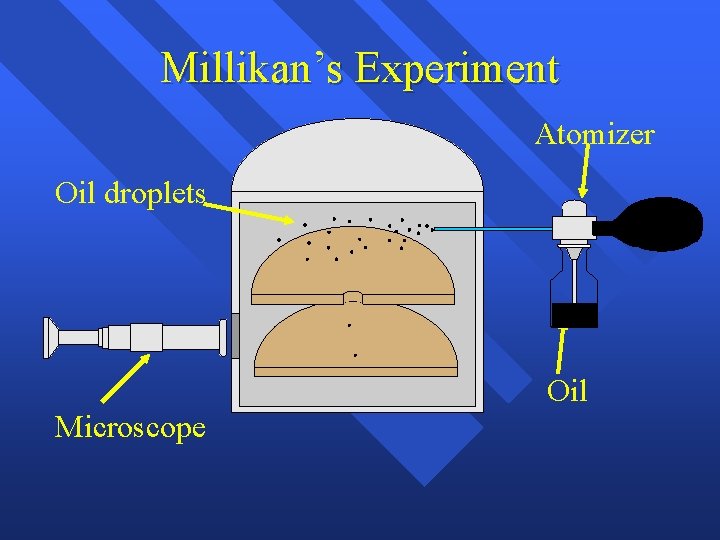
Millikan’s Experiment Atomizer Oil droplets + Oil Microscope
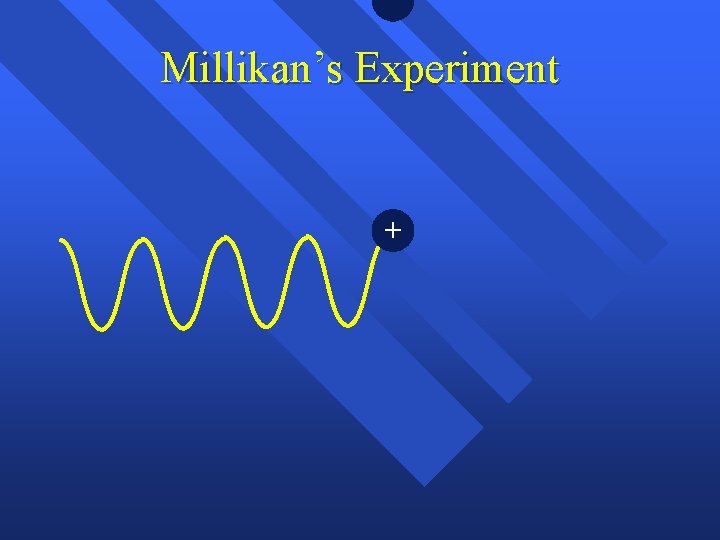
Millikan’s Experiment X-rays give some drops a charge by knocking off electrons
Millikan’s Experiment +-
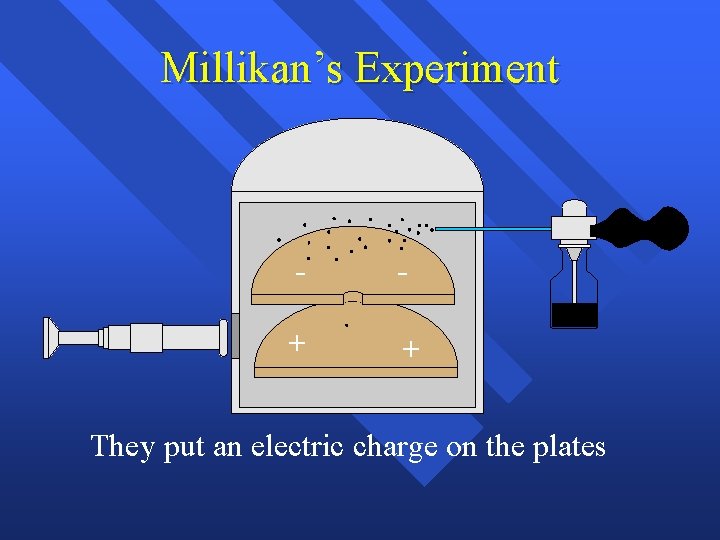
Millikan’s Experiment - - + + They put an electric charge on the plates
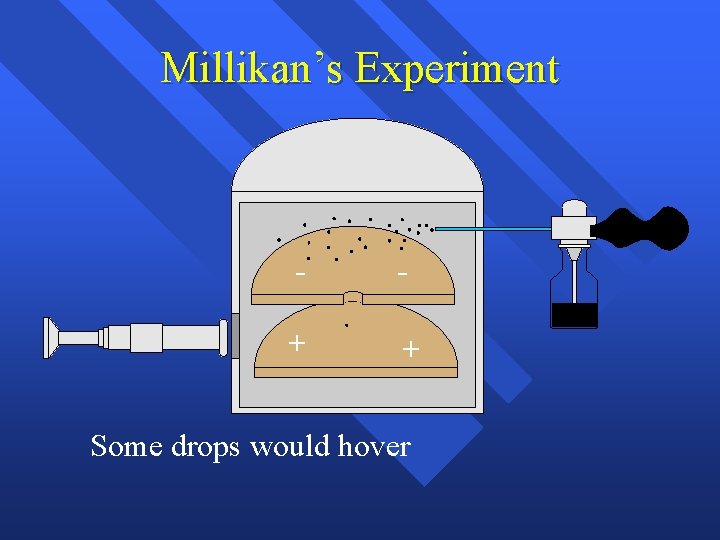
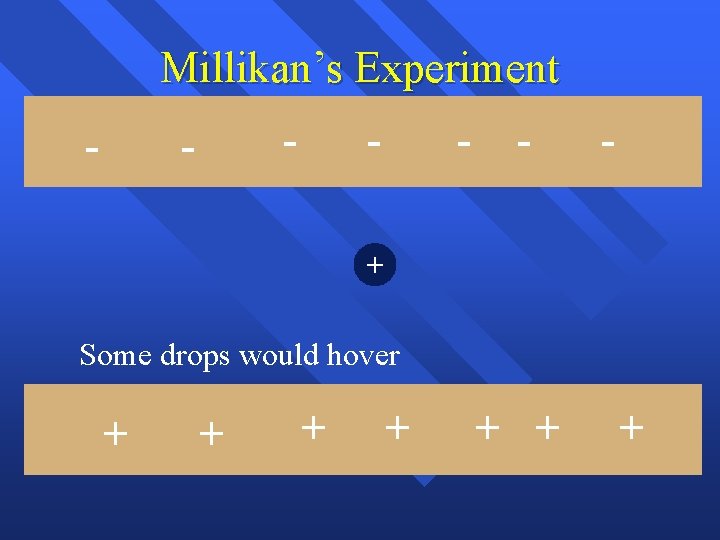
Millikan’s Experiment - - + + Some drops would hover
Millikan’s Experiment - - - - + Some drops would hover + + + +
Millikan’s Experiment - - + + From the mass of the drop and the charge on the plates, he calculated the charge on an electron
Inferences About Atomic Structure Atoms are electrically neutral, therefore, they must contain a positive charge to balance the negative electrons. n Electrons have so much less mass than atoms, atoms must contain other particles that account for most of the atoms mass. n
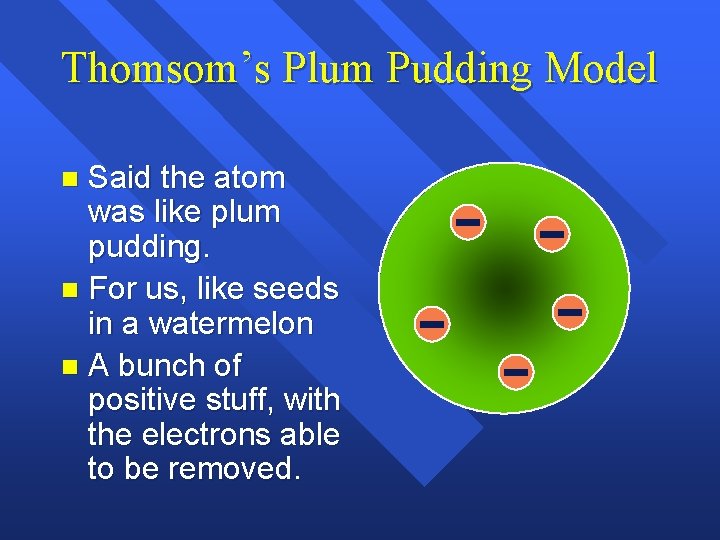
Thomsom’s Plum Pudding Model Said the atom was like plum pudding. n For us, like seeds in a watermelon n A bunch of positive stuff, with the electrons able to be removed. n
Rutherford’s Experiment Ernest Rutherford English physicist. (1911) – Hans Geiger and Ernest Marsden n Believed the plum pudding model of the atom was correct. n Set out to prove it! n
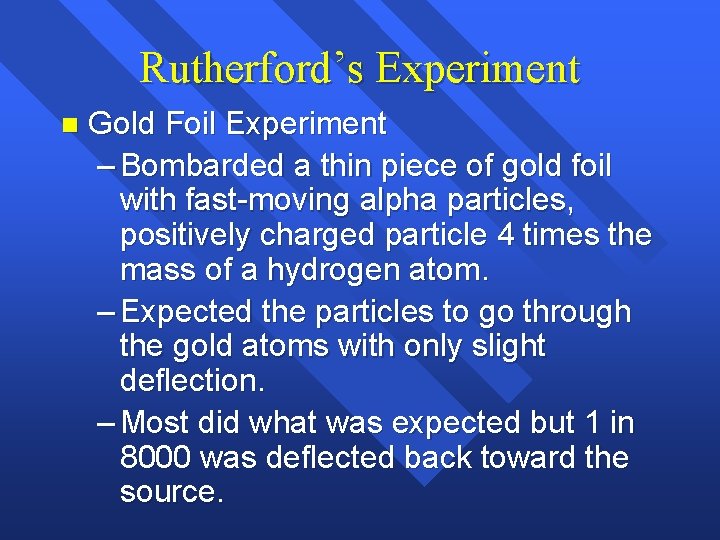
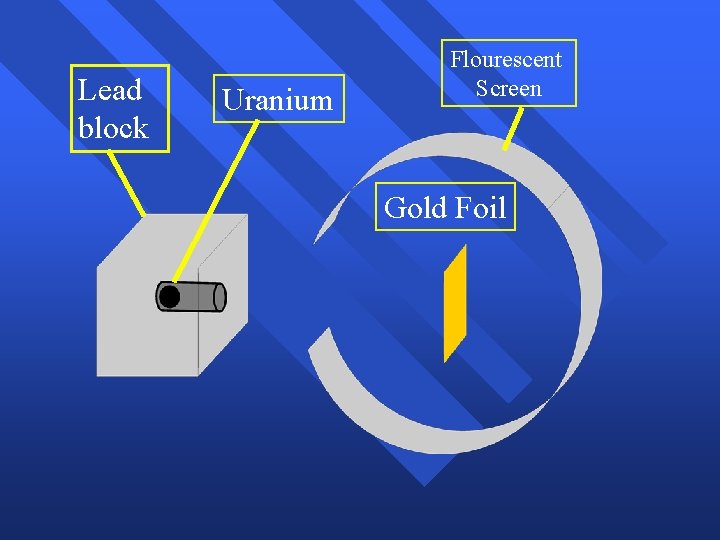
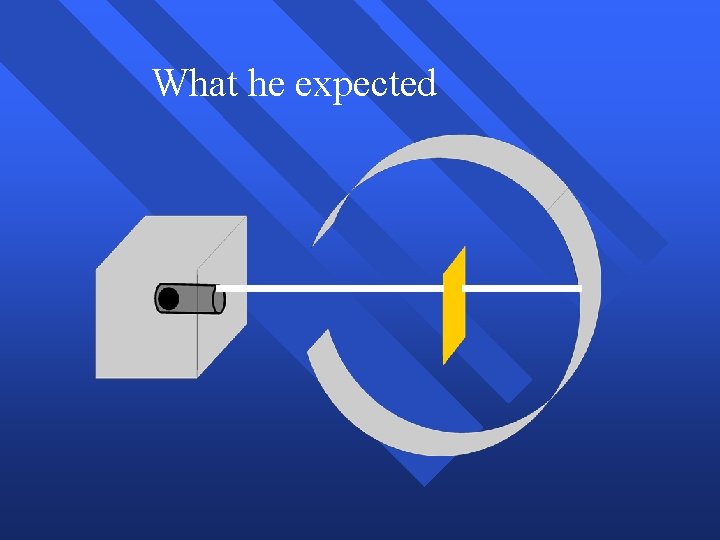
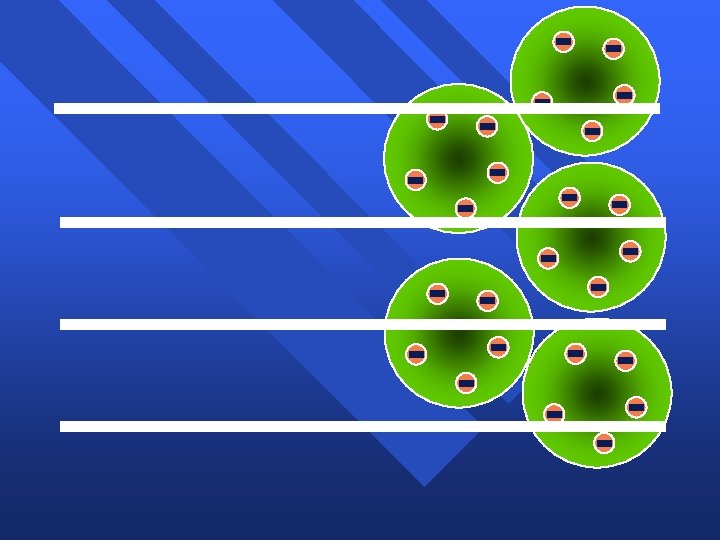
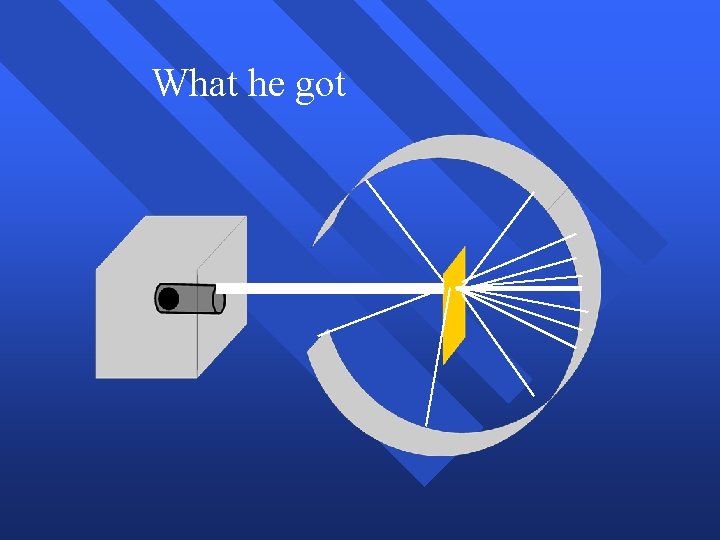
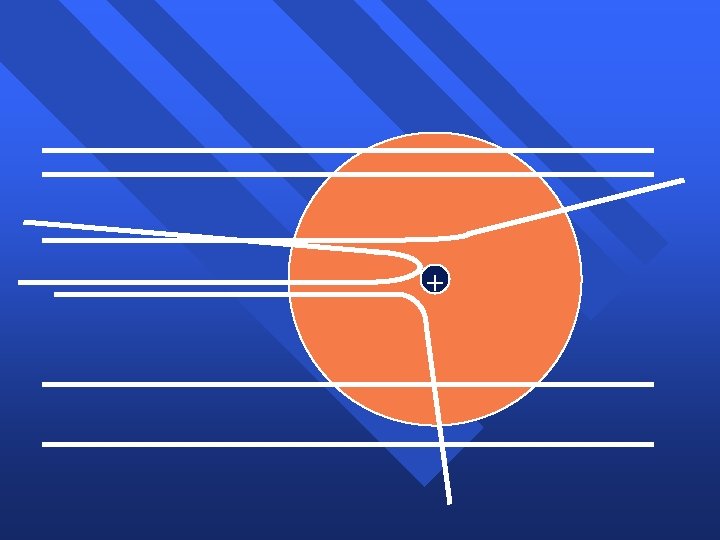
Rutherford’s Experiment n Gold Foil Experiment – Bombarded a thin piece of gold foil with fast-moving alpha particles, positively charged particle 4 times the mass of a hydrogen atom. – Expected the particles to go through the gold atoms with only slight deflection. – Most did what was expected but 1 in 8000 was deflected back toward the source.
Lead block Uranium Flourescent Screen Gold Foil
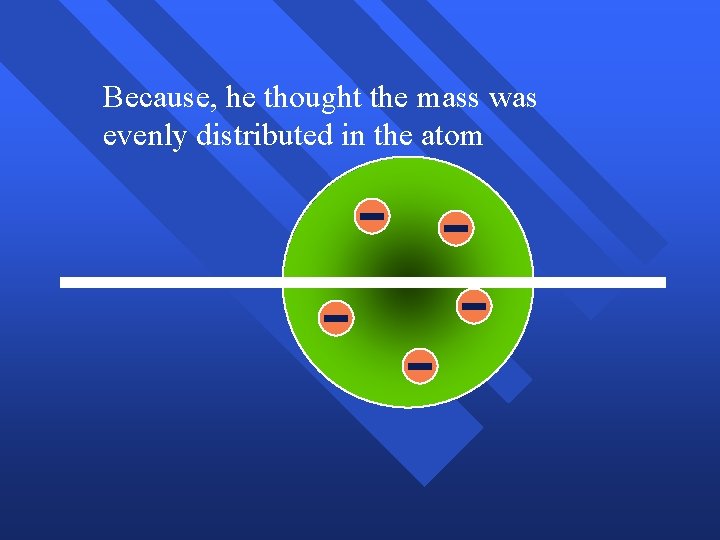
What he expected
Because, he thought the mass was evenly distributed in the atom
What he got
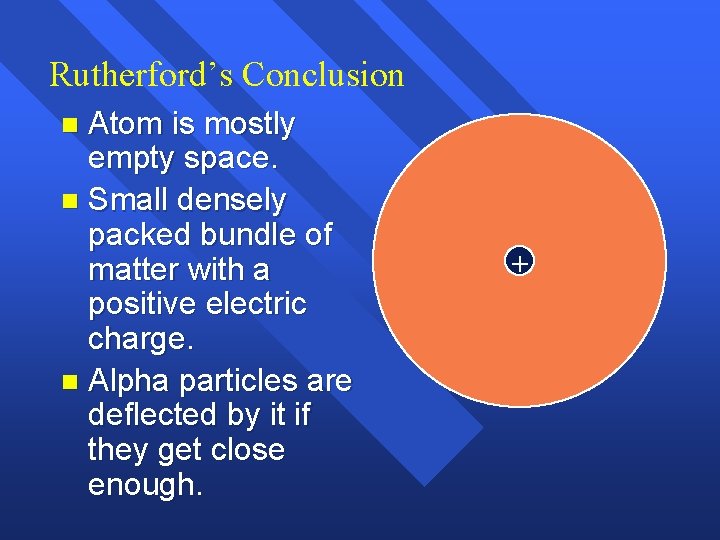
Rutherford’s Conclusion When the alpha particles hit a florescent screen, it glows. n The deflected particles experienced a powerful force within the atom. n He figured this force occupied a very small space because most of the particles went through. n
Rutherford’s Conclusion Atom is mostly empty space. n Small densely packed bundle of matter with a positive electric charge. n Alpha particles are deflected by it if they get close enough. n +
What We Know So Far Except for the simplest hydrogen atom, all nuclei are composed of two kinds of particles – positive Protons – neutral Neutrons n Atoms are electrically neutral, they contain the same number of protons and electrons. n
What We Know So Far n The nuclei of atoms of different elements differ in their number of protons and therefore in the amount of positive charge. n The number of protons determines the atoms identity.
What We Don’t Know Yet n Where are the electrons?
Forces In The Nucleus n Like charges repel each other – Except in the nucleus » When like charges are extremely close togethere is a strong attraction between them. » More than 100 protons can exist together to help form a nucleus. n These short range forces hold the nuclear particles together, they are called nuclear forces.
Subatomic Particles Proton - positively charged pieces 1836 times heavier than the electron. n Neutron - no charge but the slightly larger than the mass of a proton. n Electron – negatively charged pieces ~1/1837 times the mass of the hydrogen atom. n Where are the pieces? n
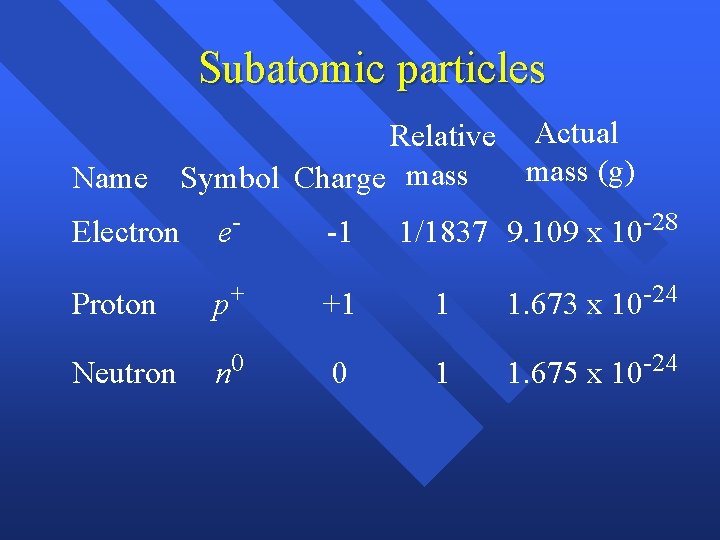
Subatomic particles Relative Actual mass (g) Name Symbol Charge mass Electron e- -1 1/1837 9. 109 x 10 -28 Proton p+ +1 1 1. 673 x 10 -24 Neutron n 0 0 1 1. 675 x 10 -24
Structure of the Atom There are two regions. n The nucleus. n With protons and neutrons. n Positive charge. n Almost all the mass. n Electron cloud- most of the volume of an atom. n The region where the electron can be found. n
Size of an atom Atoms are small. n Measured in picometers, 10 -12 meters. n Hydrogen atom, 32 pm radius. n Nucleus tiny compared to atom. n IF the atom was the size of a stadium, the nucleus would be the size of a marble. n Radius of the nucleus is near 10 -15 m. n Density near 1014 g/cm 3. n
Counting the Pieces Atomic Number = number of protons n # of protons determines kind of atom. n the same as the number of electrons in the neutral atom. n Mass Number = the number of protons + neutrons. n All the things with mass. n NOT on the periodic table n
Isotopes Dalton was wrong. n Atoms of the same element can have different numbers of neutrons. n different mass numbers. n called isotopes. n
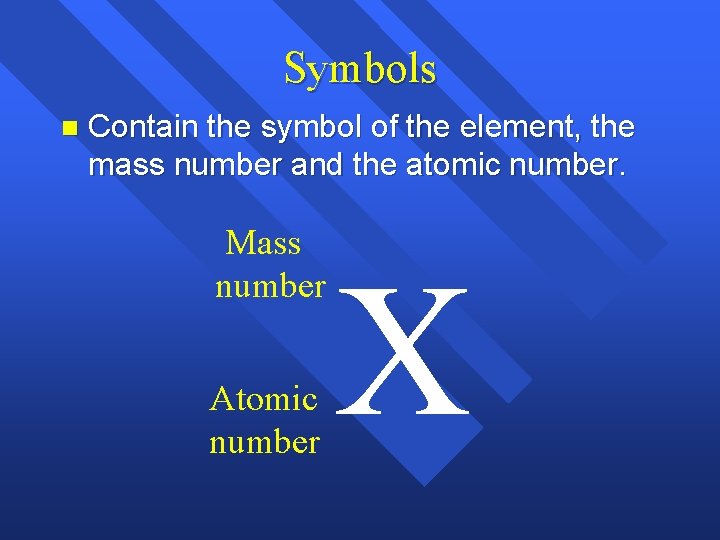
Symbols n Contain the symbol of the element, the mass number and the atomic number.
Symbols n Contain the symbol of the element, the mass number and the atomic number. Mass number Atomic number X
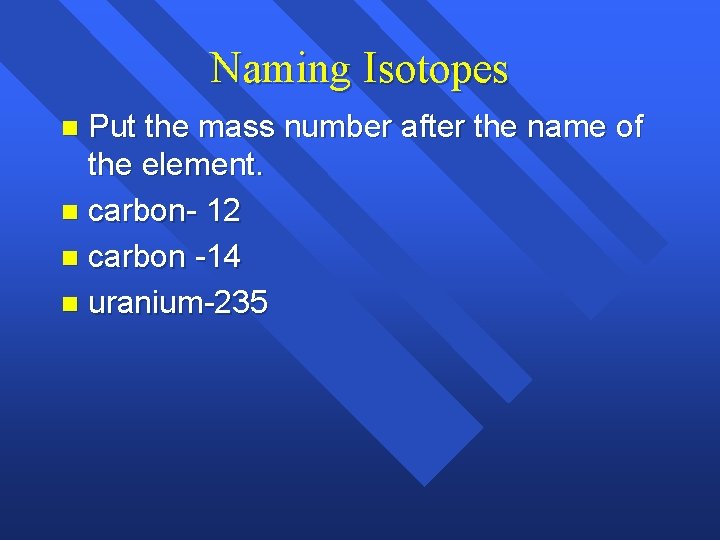
Naming Isotopes Put the mass number after the name of the element. n carbon- 12 n carbon -14 n uranium-235 n
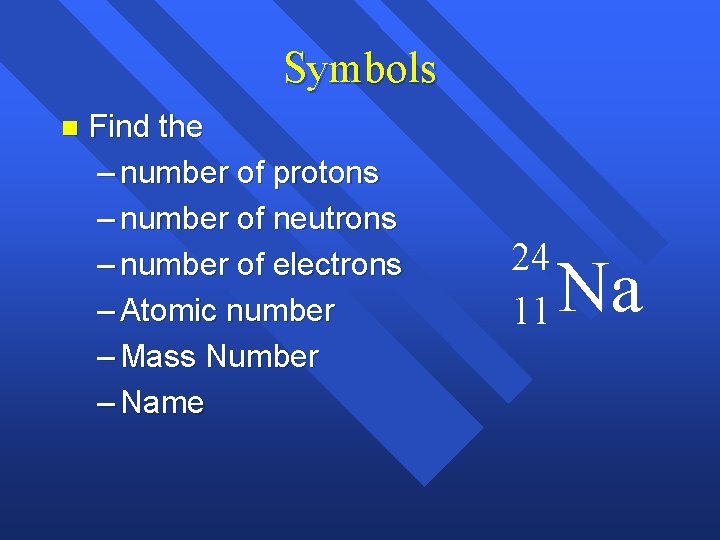
Symbols n Find the – number of protons – number of neutrons – number of electrons – Atomic number – Mass Number – Name 24 11 Na
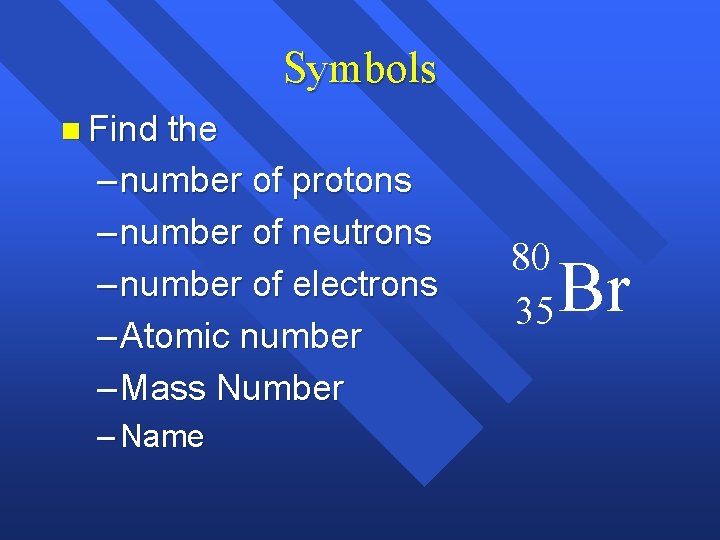
Symbols n Find the – number of protons – number of neutrons – number of electrons – Atomic number – Mass Number – Name 80 35 Br
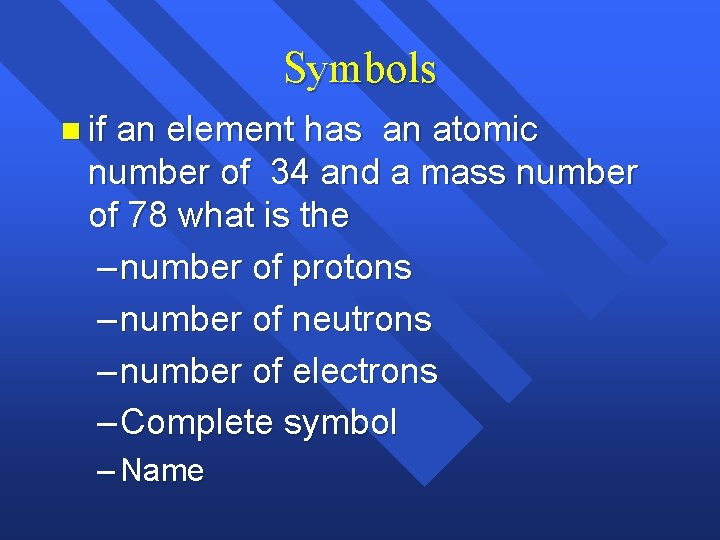
Symbols n if an element has an atomic number of 34 and a mass number of 78 what is the – number of protons – number of neutrons – number of electrons – Complete symbol – Name
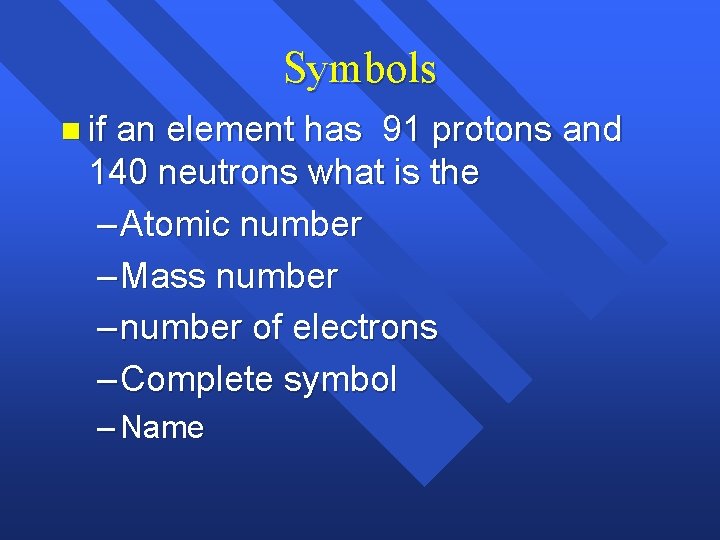
Symbols n if an element has 91 protons and 140 neutrons what is the – Atomic number – Mass number – number of electrons – Complete symbol – Name
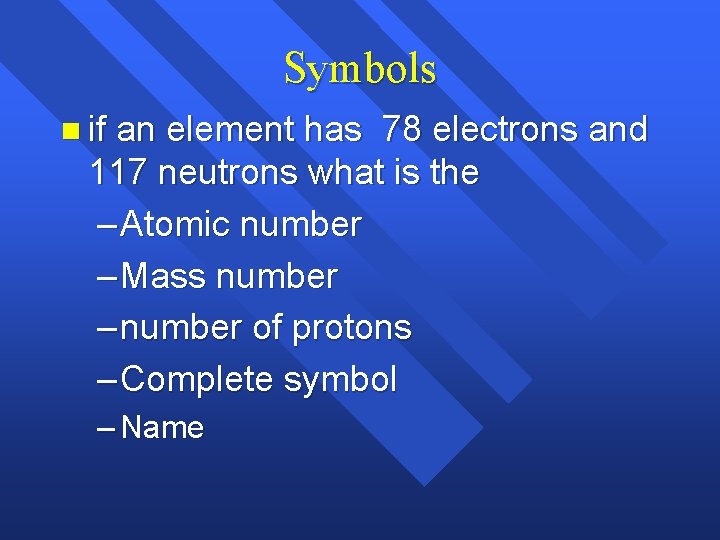
Symbols n if an element has 78 electrons and 117 neutrons what is the – Atomic number – Mass number – number of protons – Complete symbol – Name
Atomic Mass How heavy is an atom of oxygen? n There are different kinds of oxygen atoms. n More concerned with average atomic mass. n Based on abundance of each element in nature. n Don’t use grams because the numbers would be too small. n
Measuring Atomic Mass Unit is the Atomic Mass Unit (amu) n One twelfth the mass of a carbon-12 atom. n 6 p+ and 6 n 0 n Each isotope has its own atomic mass n we get the average using percent abundance. n
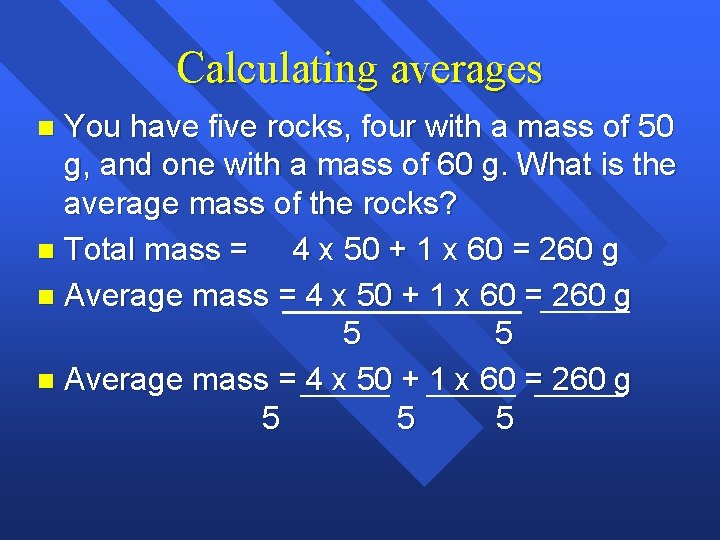
Calculating averages You have five rocks, four with a mass of 50 g, and one with a mass of 60 g. What is the average mass of the rocks? n Total mass = 4 x 50 + 1 x 60 = 260 g n Average mass = 4 x 50 + 1 x 60 = 260 g 5 5 5 n
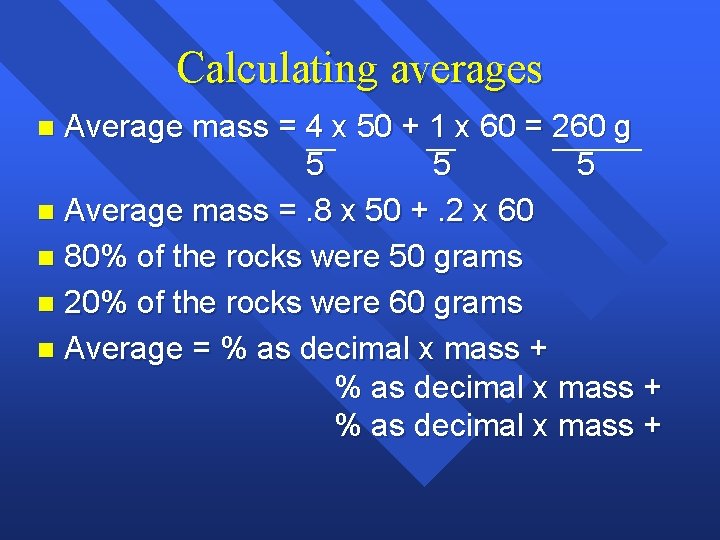
Calculating averages Average mass = 4 x 50 + 1 x 60 = 260 g 5 5 5 n Average mass =. 8 x 50 +. 2 x 60 n 80% of the rocks were 50 grams n 20% of the rocks were 60 grams n Average = % as decimal x mass + n
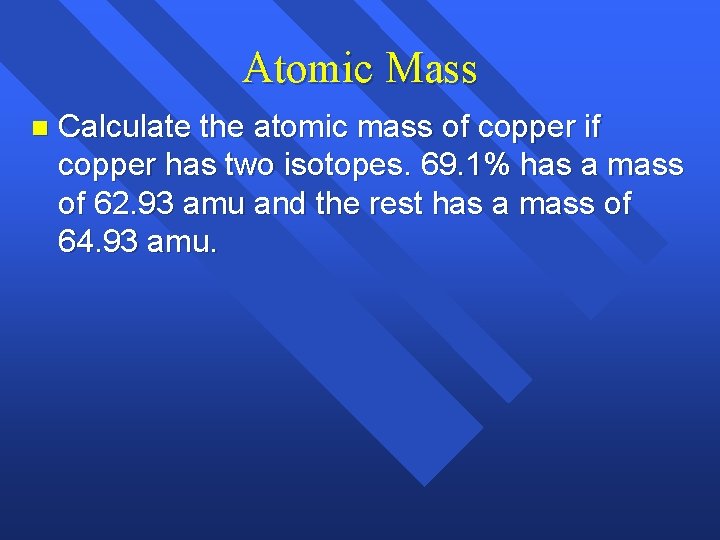
Atomic Mass n Calculate the atomic mass of copper if copper has two isotopes. 69. 1% has a mass of 62. 93 amu and the rest has a mass of 64. 93 amu.
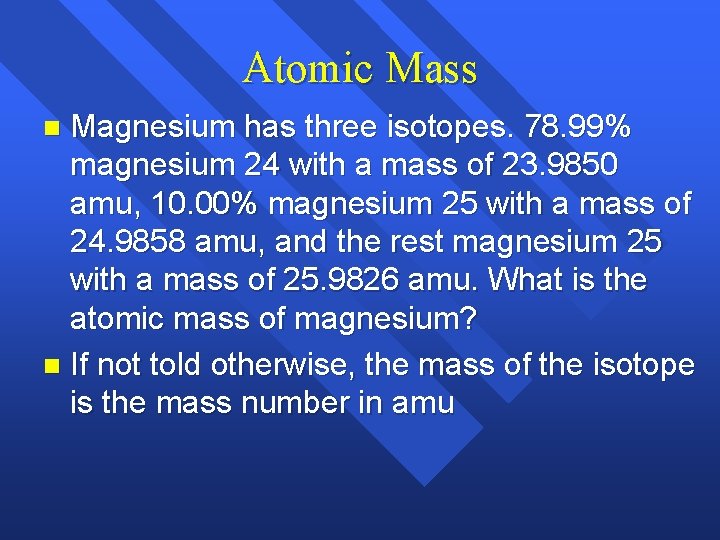
Atomic Mass Magnesium has three isotopes. 78. 99% magnesium 24 with a mass of 23. 9850 amu, 10. 00% magnesium 25 with a mass of 24. 9858 amu, and the rest magnesium 25 with a mass of 25. 9826 amu. What is the atomic mass of magnesium? n If not told otherwise, the mass of the isotope is the mass number in amu n
Atomic Mass Is not a whole number because it is an average. n are the decimal numbers on the periodic table. n