
Atomic Structure History Chem Objective 2 bd Atom
Atomic Structure History Chem: Objective 2 b-d
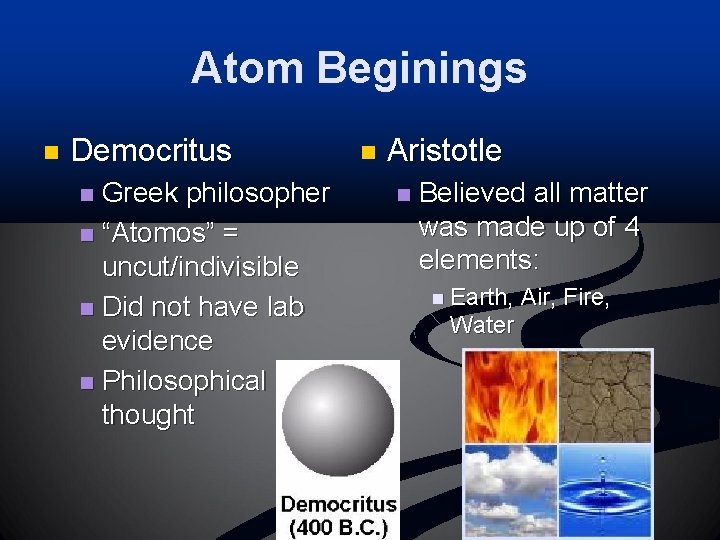
Atom Beginings n Democritus Greek philosopher n “Atomos” = uncut/indivisible n Did not have lab evidence n Philosophical thought n n Aristotle n Believed all matter was made up of 4 elements: n Earth, Water Air, Fire,
Origin of the term “Atom” n Greek roots: a- : not n -tomos: cutting n Idea that matter may be subdivided only to the size of an elemental particle, the atom, origniated in ancient Greece n Thank you, Democritus. n
The Atomic Theory n John Dalton n Ground work for the atomic model – experimental, lab based evidence to back his findings n n By relating atoms to the measureable property of mass, Dalton turned Democritus’ ideas into scientific theories Dalton proposed an explanation of matter based on these 3 laws: n n n Conservation of Mass Definite Proportions Multiple Proportions
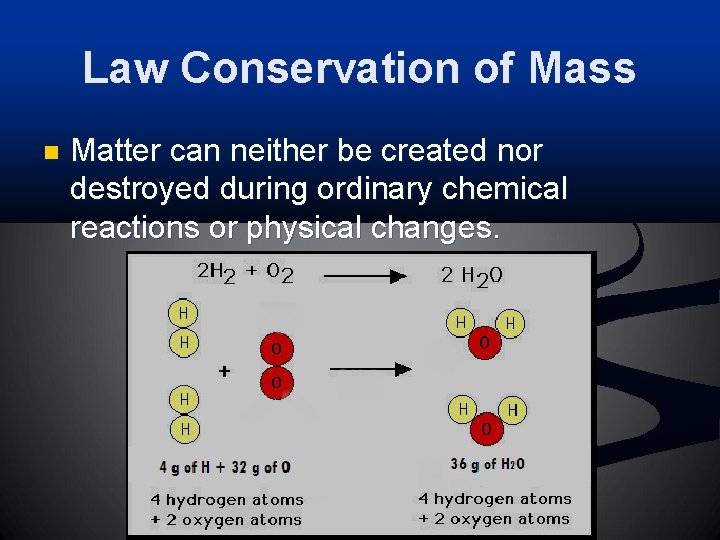
Law Conservation of Mass n Matter can neither be created nor destroyed during ordinary chemical reactions or physical changes.

Law of Definite Proportions n A chemical compound contains the same elements in exactly the same proportions by mass regardless of the size of the sample or the source of the compound. Ex: (Table Salt) Na. Cl n Example 1: table salt, sodium chloride, always consists of 39. 34% sodium by mass and 60. 66% chlorine by mass. n Example 2: (Water) H 2 O – Always consists of 11% hydrogen and 89% oxygen.

Law of Multiple Proportions n If two or more different compounds are composed of the same two elements, then the ratio of the masses of the second element combined with a certain mass of the first element is always a ratio of small whole numbers.
Dalton’s Atomic Theory 1. 2. 3. 4. 5. All matter is composed of extremely small particles called atoms. Atoms of given element are identical in size, mass, and other properties Atoms cannot be subdivided, created, or destroyed Atoms of different elements combine in simple whole-number ratios to form chemical compounds In chemical reactions, atoms are combined, separated, or rearranged.
Dalton’s Theory Modified Theories are always up for modifications, alterations, etc. n Not all aspects of Dalton’s atomic theory over time have been supported. n 1) we know atoms are divisible n 2) we know a given element may have different masses (isotopes) n
The Structure of the Atom: the smallest particle of an element that retains the chemical properties of that element. n Consists of 2 Regions: n Nucleus: very small, located at the center, made up of at least one proton, and usually one ore more neutron. n Electron Cloud: occupied by electrons. n
Cathode Rays and Electrons n 1800’s – experiments performed running electric current through various gases at low temperatures. (Gases at atmospheric pressure do not conduct electricity well. )
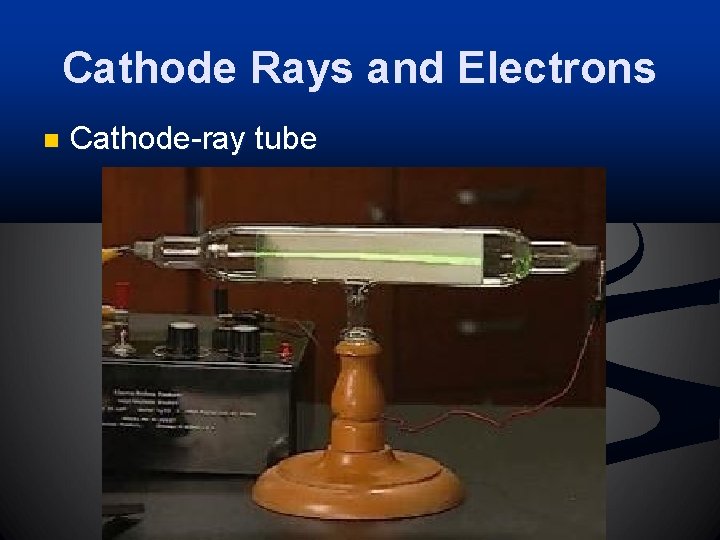
Cathode Rays and Electrons n Cathode-ray tube
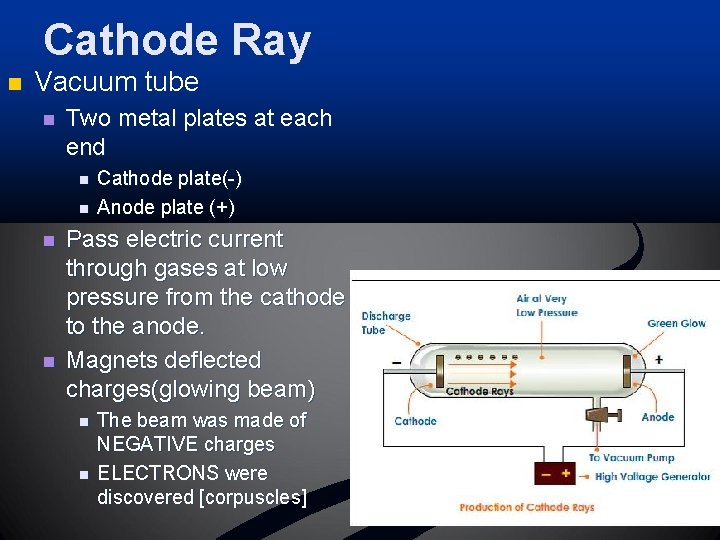
Cathode Ray n Vacuum tube n Two metal plates at each end n n Cathode plate(-) Anode plate (+) Pass electric current through gases at low pressure from the cathode to the anode. Magnets deflected charges(glowing beam) n n The beam was made of NEGATIVE charges ELECTRONS were discovered [corpuscles]
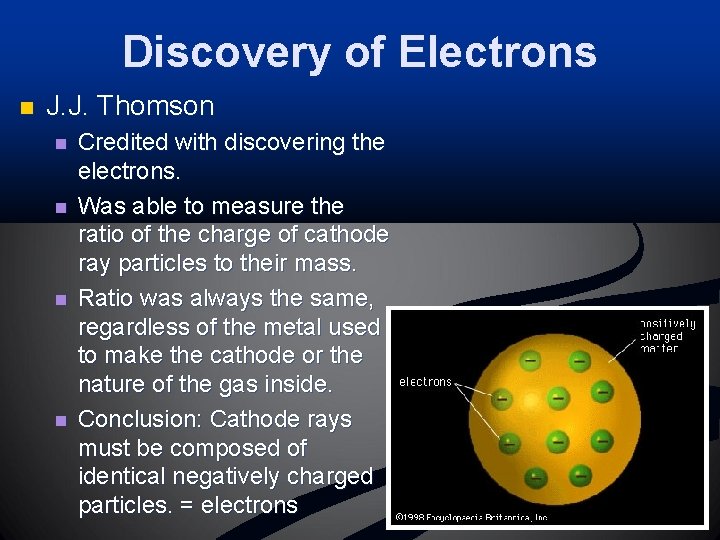
Discovery of Electrons n J. J. Thomson n n Credited with discovering the electrons. Was able to measure the ratio of the charge of cathode ray particles to their mass. Ratio was always the same, regardless of the metal used to make the cathode or the nature of the gas inside. Conclusion: Cathode rays must be composed of identical negatively charged particles. = electrons
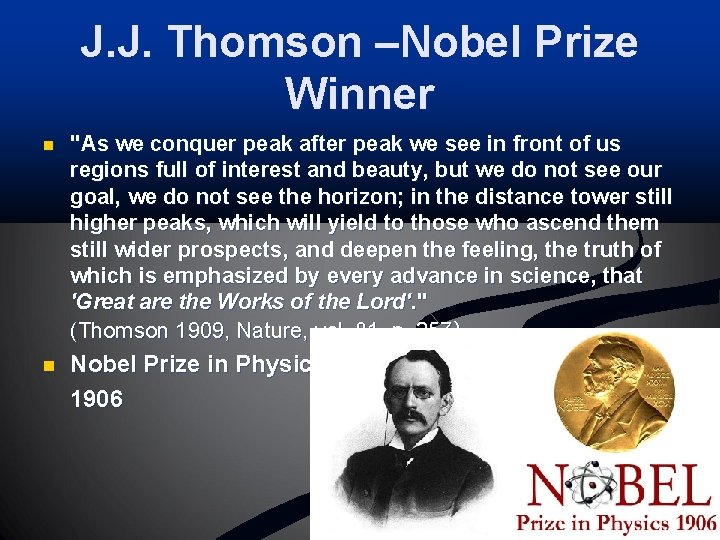
J. J. Thomson –Nobel Prize Winner n "As we conquer peak after peak we see in front of us regions full of interest and beauty, but we do not see our goal, we do not see the horizon; in the distance tower still higher peaks, which will yield to those who ascend them still wider prospects, and deepen the feeling, the truth of which is emphasized by every advance in science, that 'Great are the Works of the Lord'. " (Thomson 1909, Nature, vol. 81, p. 257). n Nobel Prize in Physics 1906
Robert A. Millikan Found quantity of charge carried by electron and calculated mass of the electron n Electron carries ONE negative charge unit n Electrons mass is 1/1840 the mass of a Hydrogen atom/ (proton) /AMU n
Eugen Goldstein Observed a cathode ray tube contained particles traveling opposite direction of cathode rays. n These particles were protons. n These protons had a mass 1840 times larger than the electrons. n
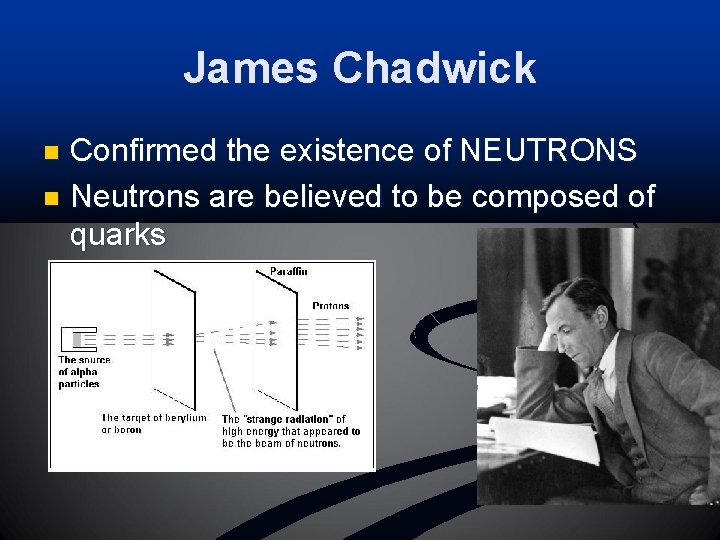
James Chadwick Confirmed the existence of NEUTRONS n Neutrons are believed to be composed of quarks n
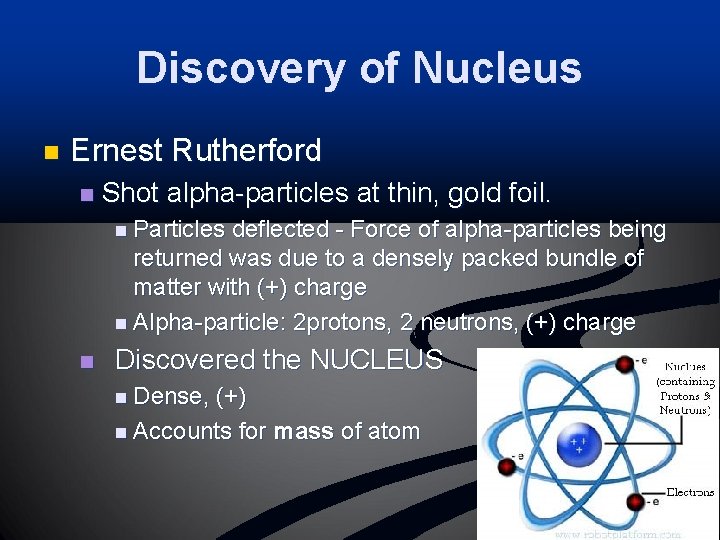
Discovery of Nucleus n Ernest Rutherford n Shot alpha-particles at thin, gold foil. n Particles deflected - Force of alpha-particles being returned was due to a densely packed bundle of matter with (+) charge n Alpha-particle: 2 protons, 2 neutrons, (+) charge n Discovered the NUCLEUS n Dense, (+) n Accounts for mass of atom
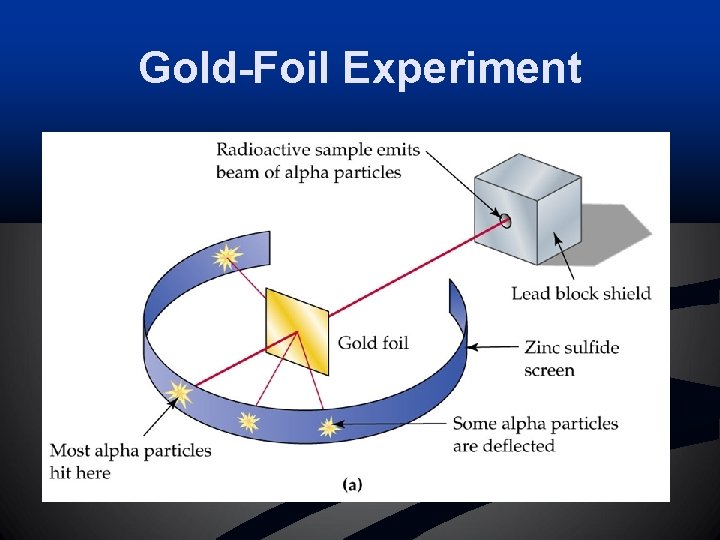
Gold-Foil Experiment
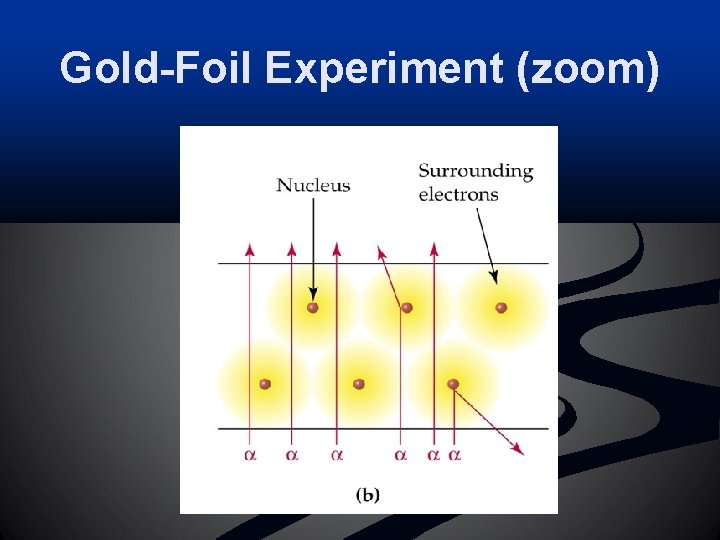
Gold-Foil Experiment (zoom)
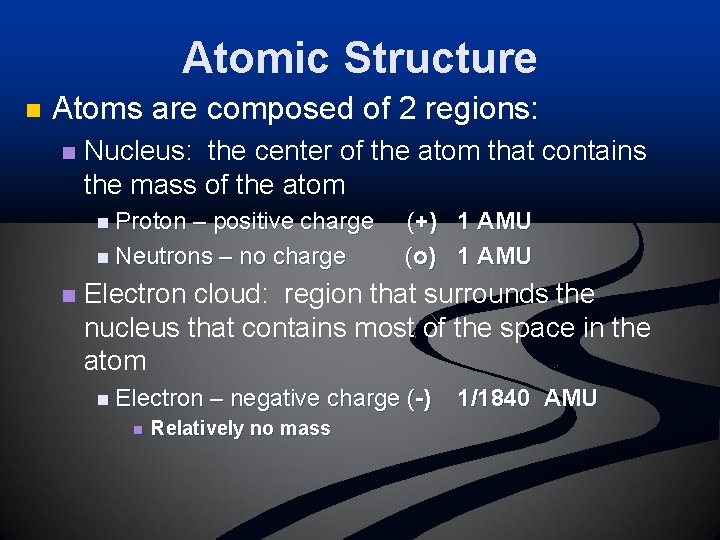
Atomic Structure n Atoms are composed of 2 regions: n Nucleus: the center of the atom that contains the mass of the atom n Proton – positive charge n Neutrons – no charge n (+) 1 AMU (o) 1 AMU Electron cloud: region that surrounds the nucleus that contains most of the space in the atom n Electron n – negative charge (-) Relatively no mass 1/1840 AMU
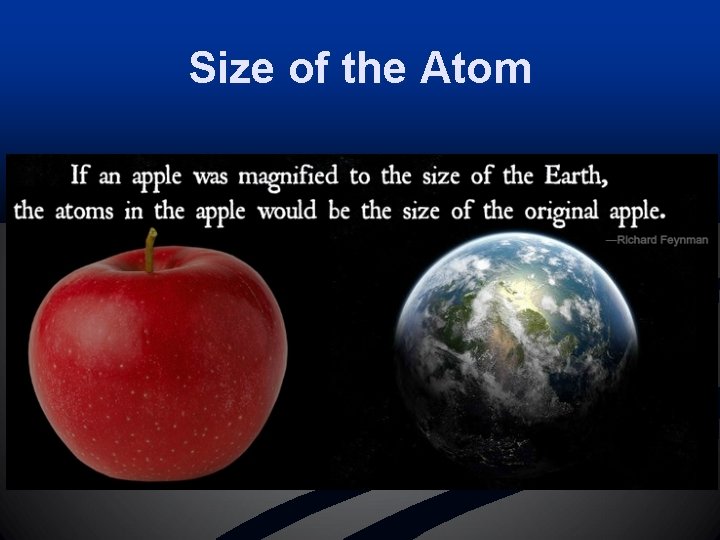
Size of the Atom
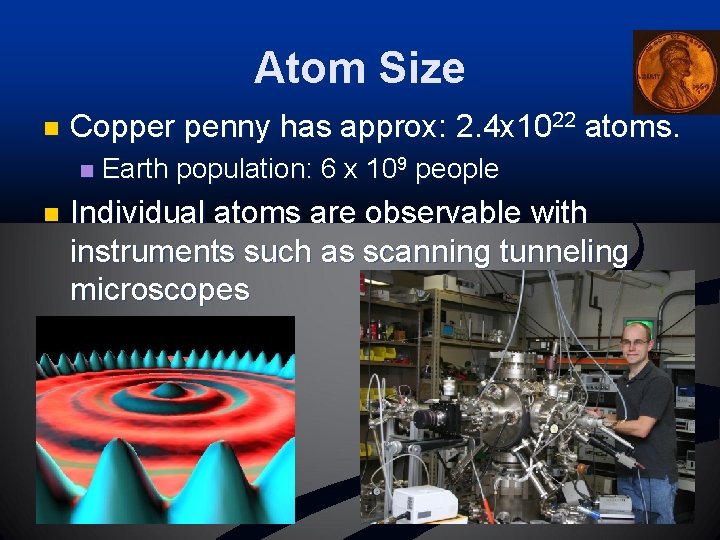
Atom Size n Copper penny has approx: 2. 4 x 10²² atoms. n n Earth population: 6 x 10⁹ people Individual atoms are observable with instruments such as scanning tunneling microscopes
Subatomic Particles n Protons: Determine IDENTITY of atom n Neutrons: Determine MASS of atom n Electrons: Determine CHARGE of atom
Atomic Number n n The number of PROTONS an atom contains Each type of atom contains a specific number of protons Ex: 8 protons always indicates Oxygen The “atom’s number”
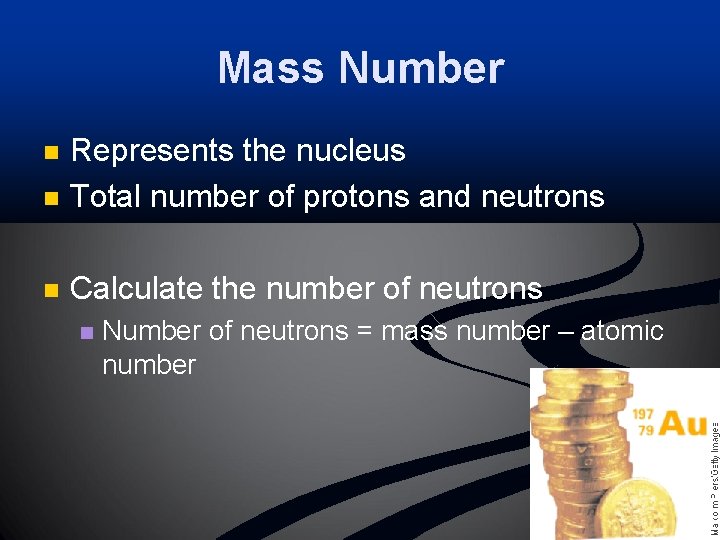
Mass Number n Represents the nucleus Total number of protons and neutrons n Calculate the number of neutrons n n Number of neutrons = mass number – atomic number
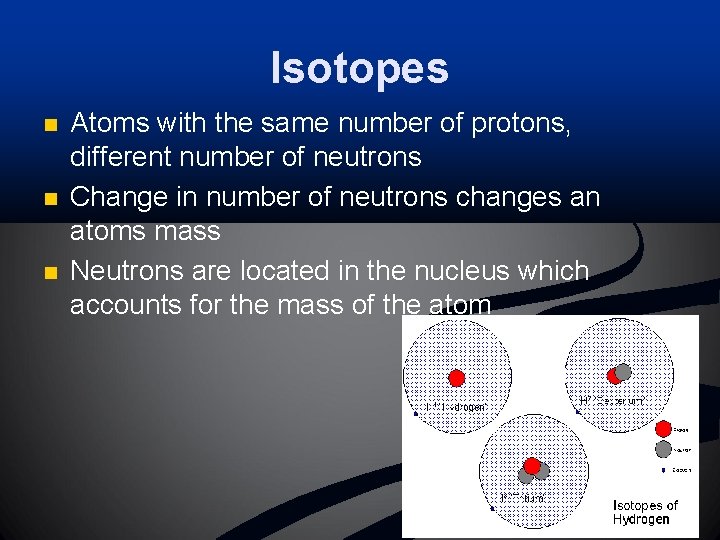
Isotopes n n n Atoms with the same number of protons, different number of neutrons Change in number of neutrons changes an atoms mass Neutrons are located in the nucleus which accounts for the mass of the atom
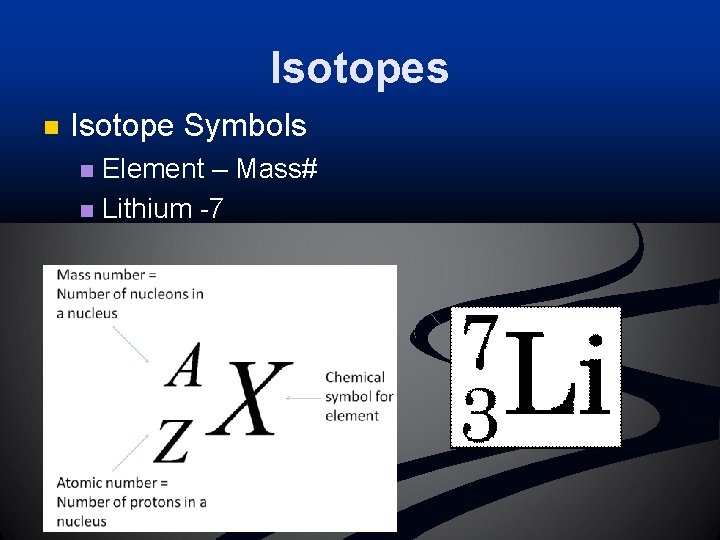
Isotopes n Isotope Symbols Element – Mass# n Lithium -7 n
Isotopes n n n Most elements occur as a mixture of two or more isotopes One isotope naturally occurs more than others Example: Chlorine – 35 and Chlorine – 37 n Chlorine – 35 occurs 75% n Chlorine – 37 occurs 25% n n Chlorine – 35 is the most abundant
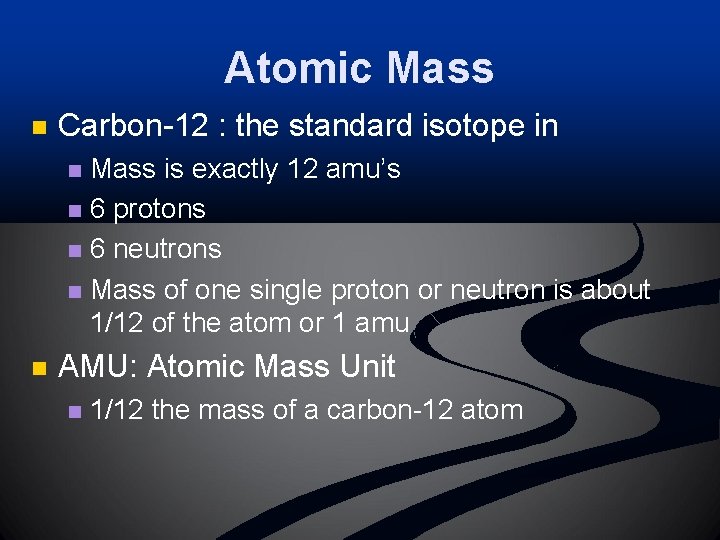
Atomic Mass n Carbon-12 : the standard isotope in Mass is exactly 12 amu’s n 6 protons n 6 neutrons n Mass of one single proton or neutron is about 1/12 of the atom or 1 amu n n AMU: Atomic Mass Unit n 1/12 the mass of a carbon-12 atom
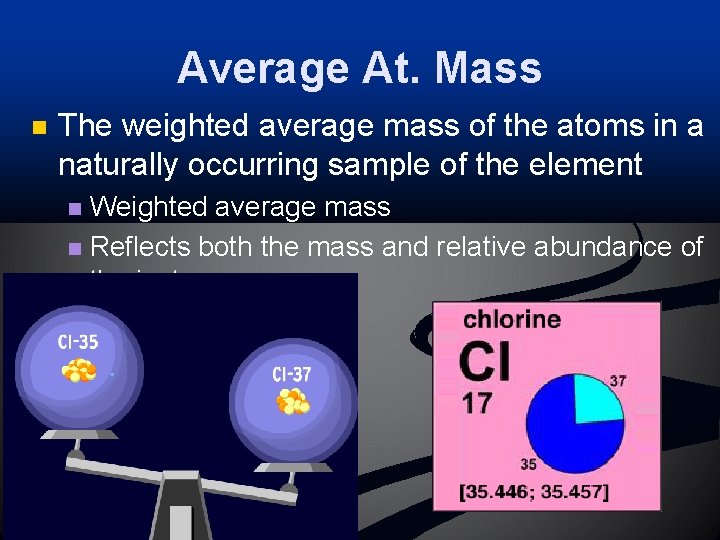
Average At. Mass n The weighted average mass of the atoms in a naturally occurring sample of the element Weighted average mass n Reflects both the mass and relative abundance of the isotopes n
Calculating Atomic Mass n n The element copper has naturally occurring isotopes with mass numbers of 63 and 65. The relative abundance and atomic masses are 69. 2% for mass of 62. 93 amu, and 30. 8% for mass of 64. 93. Calculate the average atomic mass of copper. Calculate the atomic mass of bromine. The two isotopes of bromine have atomic masses and relative abundance of 78. 92 amu (50. 69%) and 80. 92 amu (49. 31%).
Ions n Atoms that hold a charge due to gaining or losing electrons n Cation: positively charged ion n Lost n electrons Anion: negatively charged ion n Gained n electrons Electrons determine the charge of the atom
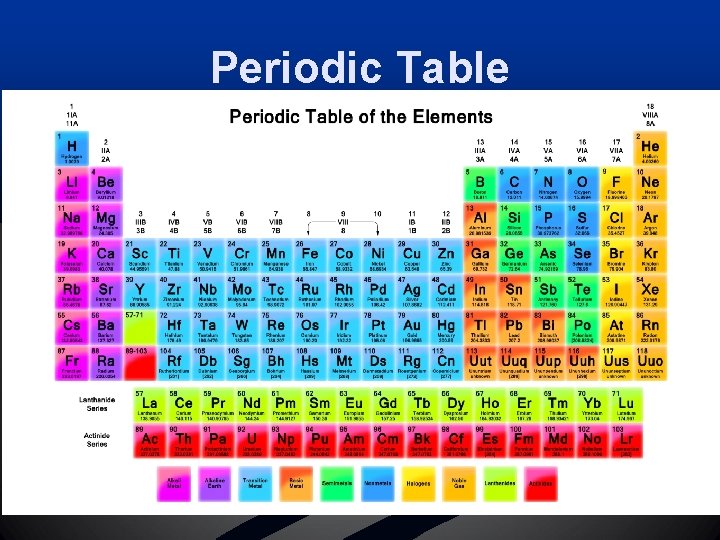
Periodic Table n n Arrangement of elements in which the elements are separated into groups based on a set of repeating properties. Allows you to compare properties of one element (or group of elements) to another element (or group of elements). Period: Horizontal ROW Group: Vertical COLUMN
Electron Orbital/Configuratio n Chemistry/Physical Science
Atomic Model n All models are proposed theories Bohrs n Quantum model n n There is no exact model n Scientist’s experiments Dalton n Rutherford n Thomson n
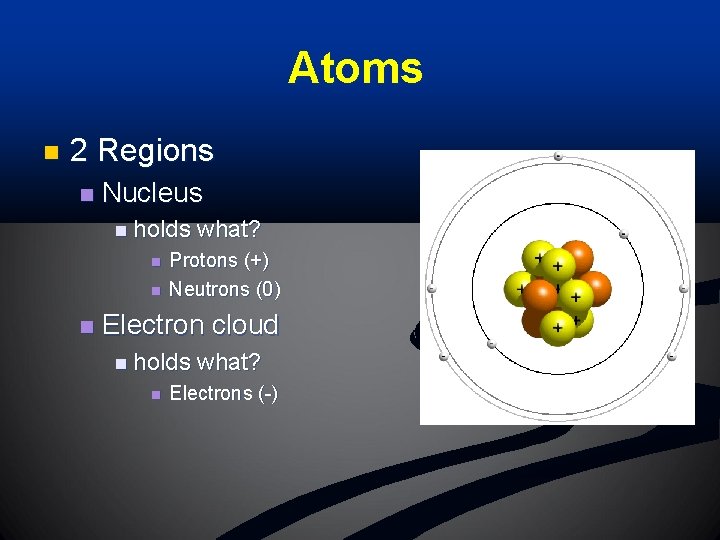
Atoms n 2 Regions n Nucleus n holds n n n what? Protons (+) Neutrons (0) Electron cloud n holds n what? Electrons (-)
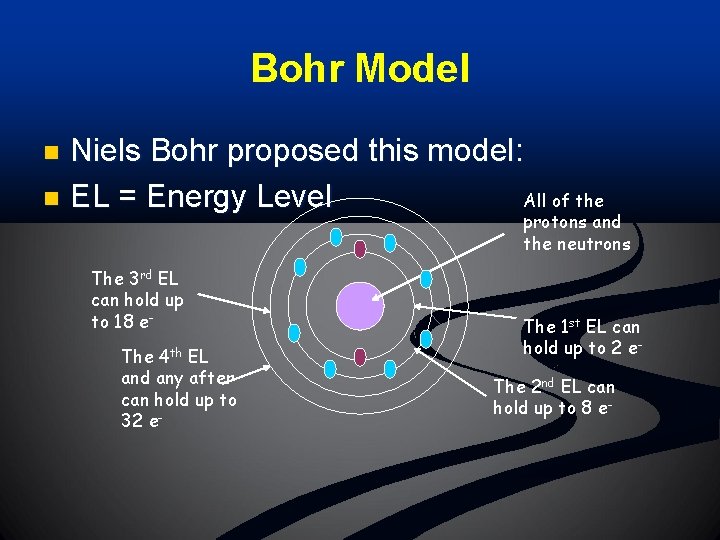
Bohr Model Niels Bohr proposed this model: All of the n EL = Energy Level n protons and the neutrons The 3 rd EL can hold up to 18 e. The 4 th EL and any after can hold up to 32 e- The 1 st EL can hold up to 2 e. The 2 nd EL can hold up to 8 e-
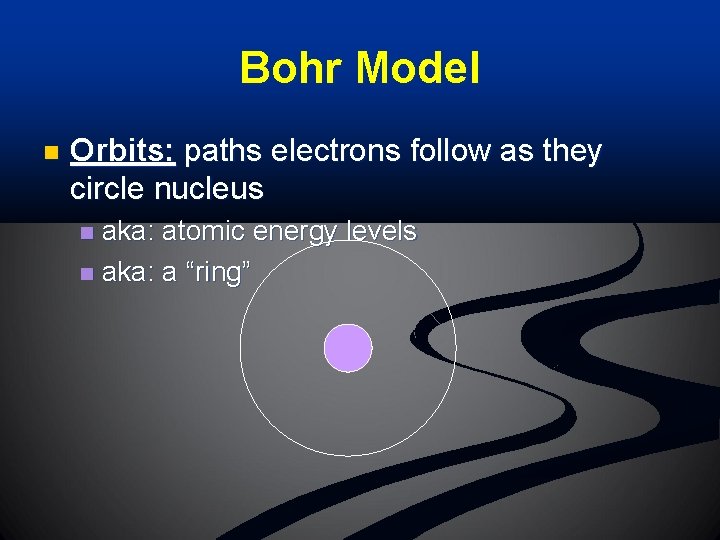
Bohr Model n Orbits: paths electrons follow as they circle nucleus aka: atomic energy levels n aka: a “ring” n
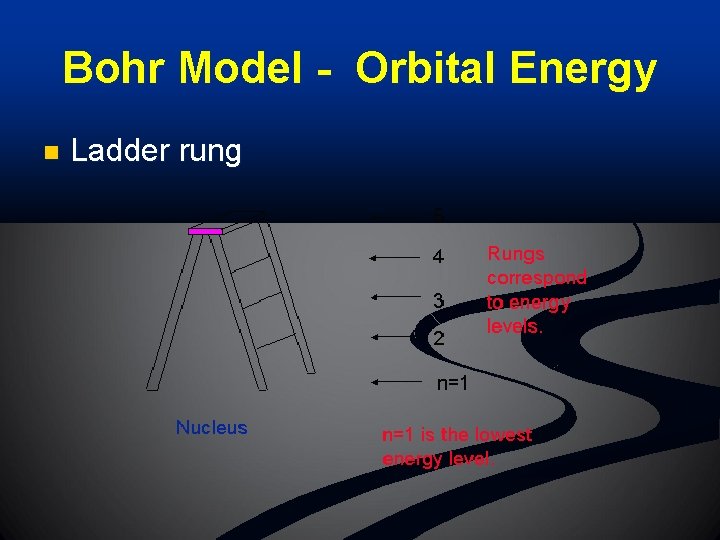
Bohr Model - Orbital Energy n Ladder rung
Bohr Model - Orbital Energy n The higher the person on a ladder rung, the more unstable he/she is. n The higher the energy level, the more unstable the electron is, and more likely to react. n The lower the energy level, the more stable the electron is, and less likely to react.
Quantum Model n Erwin Schrödinger: Used mathematical equations to develop a clearer atomic model n Inside of Bohr’s orbits(energy levels), reside multiple orbitals n n Orbitals: 3 D region around nucleus that indicates probable locations of an electron n Have definite/fixed energy n Closer to nucleus = lower energy (Ground State) n Further from nucleus = higher energy (Excited State)
Quantum Model n Principal quantum # (Energy Level): n n n AKA: Principal Energy Level Symbol = “n” Indicates the main energy level occupied by an electron n As n increases, electron energy and distance from nucleus also increase Total # of orbitals existing in a given energy level = n 2 EL 1 = 1 orbitals, EL 2 = 4 orbitals, EL 3 = 9 orbitals
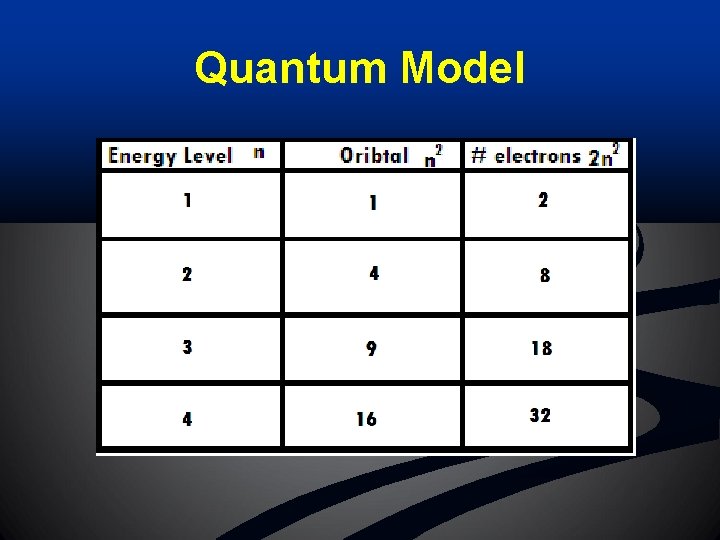
Quantum Model
Quantum Model n Angular momentum quantum #: n Symbol = “l” n These n Indicates shape of main energy level n (s, n are the SUBLEVELS p, f, d…) Each orbital holds 2 electrons n s-holds 2, px-holds 2, py-holds 2, pz-holds 2
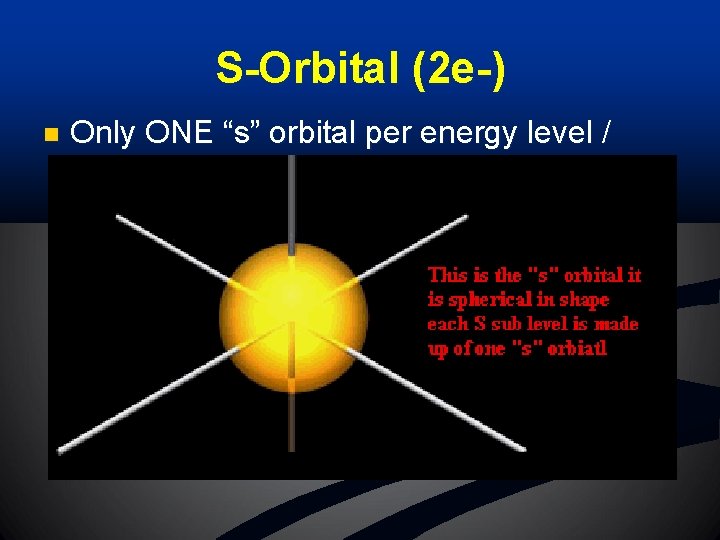
S-Orbital (2 e-) n Only ONE “s” orbital per energy level / Spherical shaped
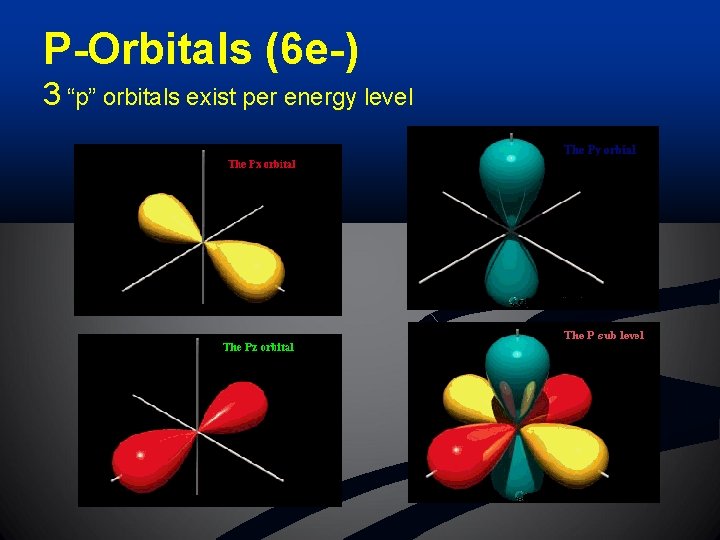
P-Orbitals (6 e-) 3 “p” orbitals exist per energy level
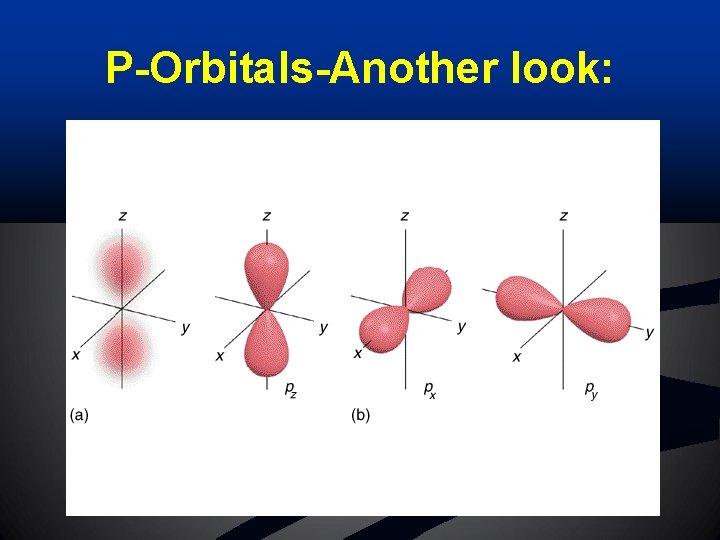
P-Orbitals-Another look:
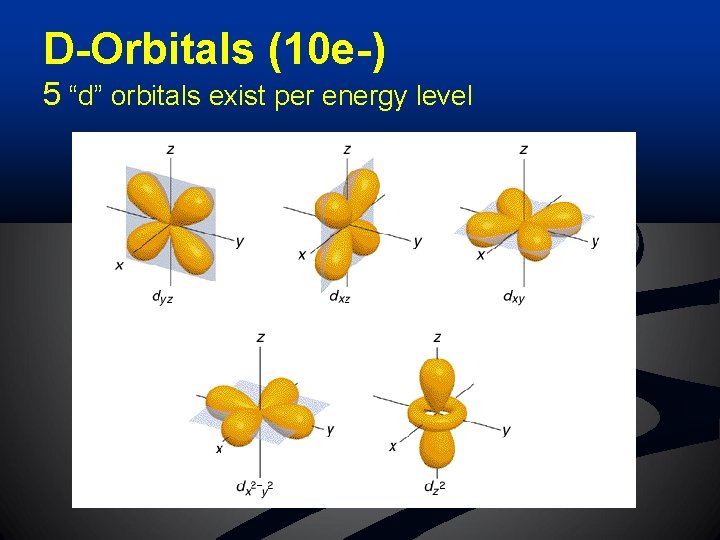
D-Orbitals (10 e-) 5 “d” orbitals exist per energy level
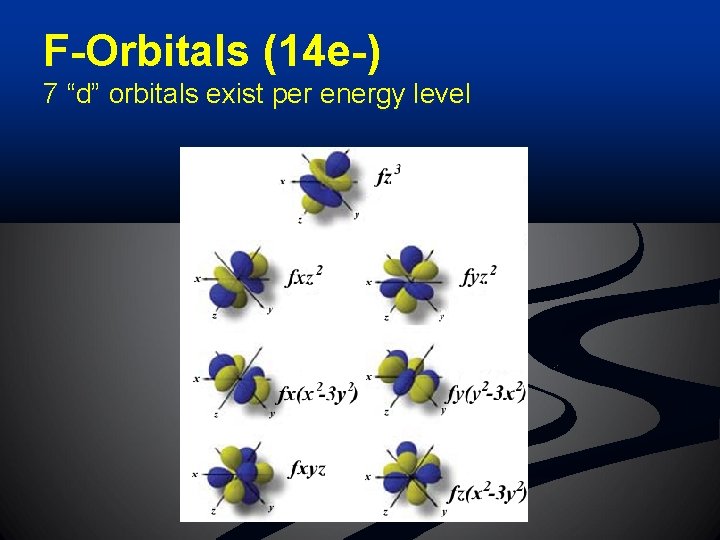
F-Orbitals (14 e-) 7 “d” orbitals exist per energy level
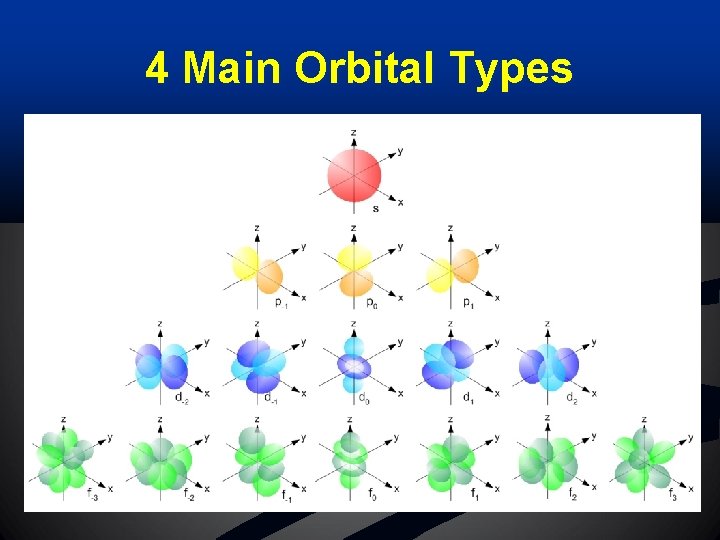
4 Main Orbital Types
Bellwork n Draw the 4 main types of orbitals (s, p, d, f) and explain how many electrons they can hold per oribtal type.
Aufbau Principle States: e- occupies the lowest energy level that can receive it. n 1 s=lowest energy level n 2 s=next lowest n 2 p… and so on n
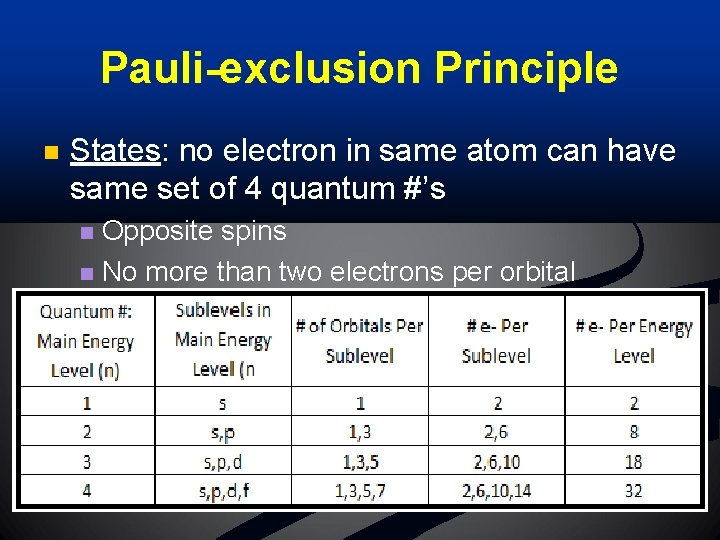
Pauli-exclusion Principle n States: no electron in same atom can have same set of 4 quantum #’s Opposite spins n No more than two electrons per orbital n
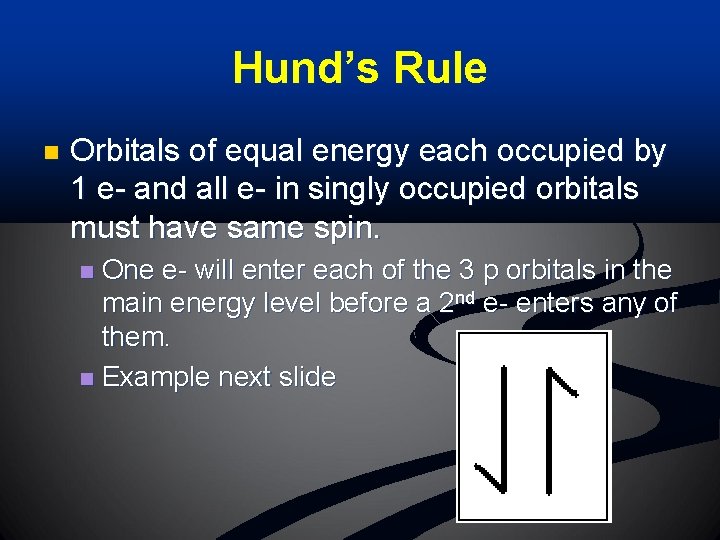
Hund’s Rule n Orbitals of equal energy each occupied by 1 e- and all e- in singly occupied orbitals must have same spin. One e- will enter each of the 3 p orbitals in the main energy level before a 2 nd e- enters any of them. n Example next slide n
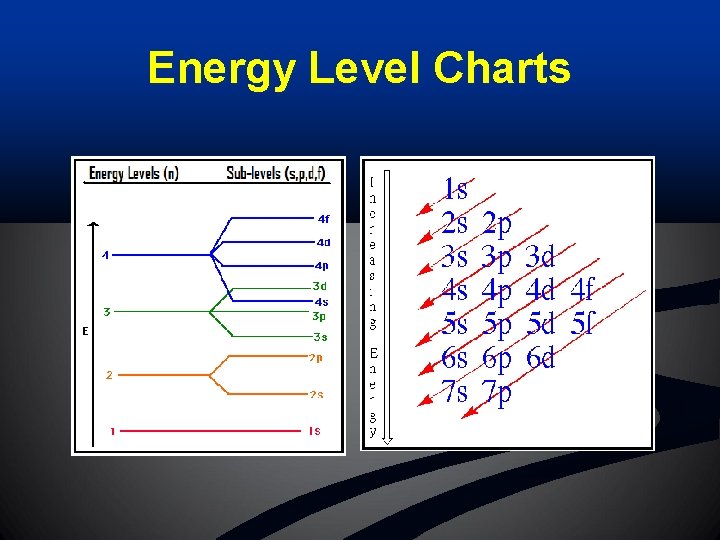
Energy Level Charts
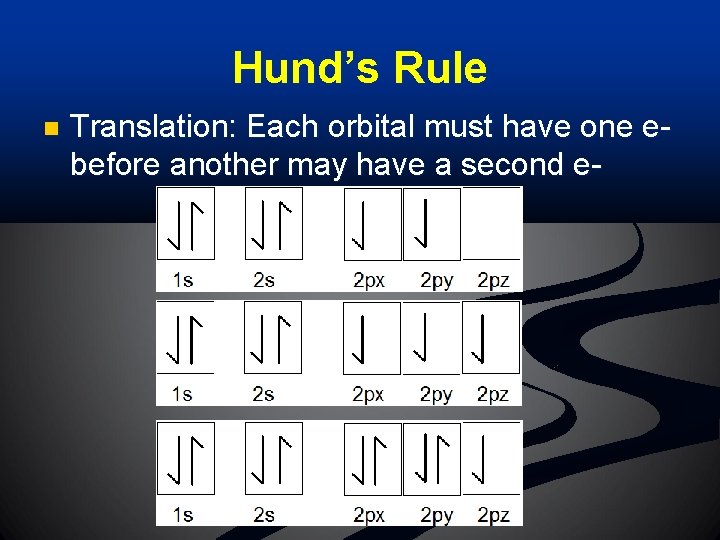
Hund’s Rule n Translation: Each orbital must have one ebefore another may have a second e-
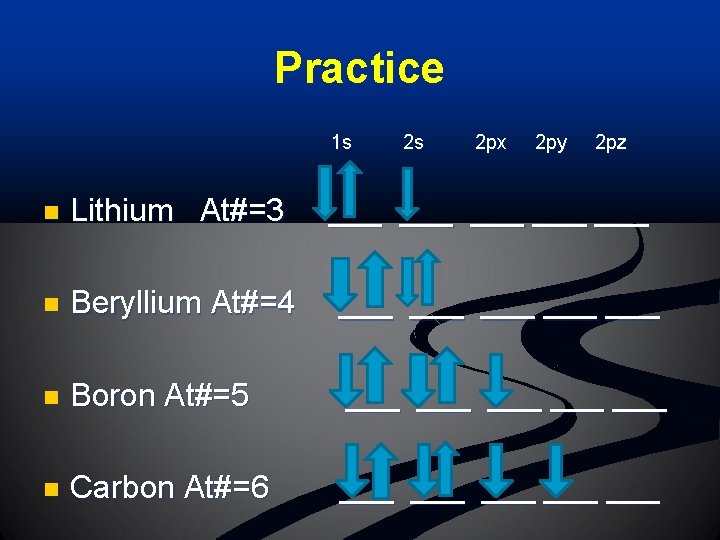
Practice 1 s 2 s 2 px 2 py 2 pz n Lithium At#=3 ___ ___ ___ n Beryllium At#=4 ___ ___ ___ n Boron At#=5 ___ ___ ___ n Carbon At#=6 ___ ___ ___
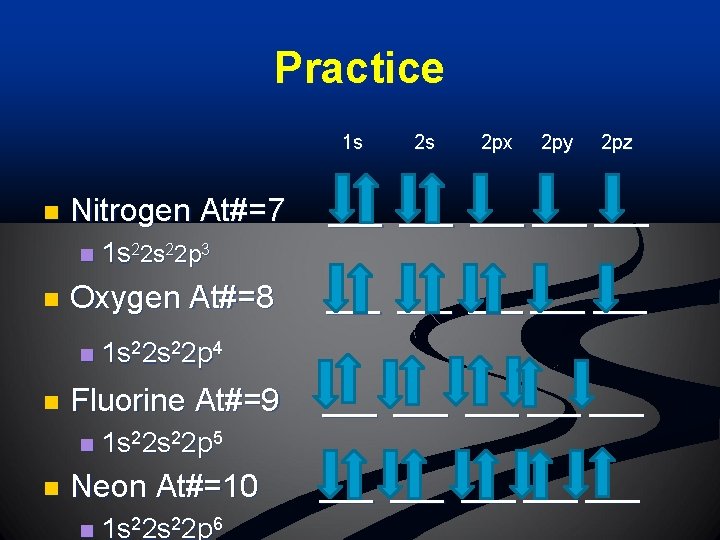
Practice 1 s n Nitrogen At#=7 n n 2 pz ___ ___ ___ ___ 1 s 22 p 5 Neon At#=10 n 2 py 1 s 22 p 4 Fluorine At#=9 n 2 px 1 s 22 p 3 Oxygen At#=8 n 2 s 1 s 22 p 6 ___ ___ ___
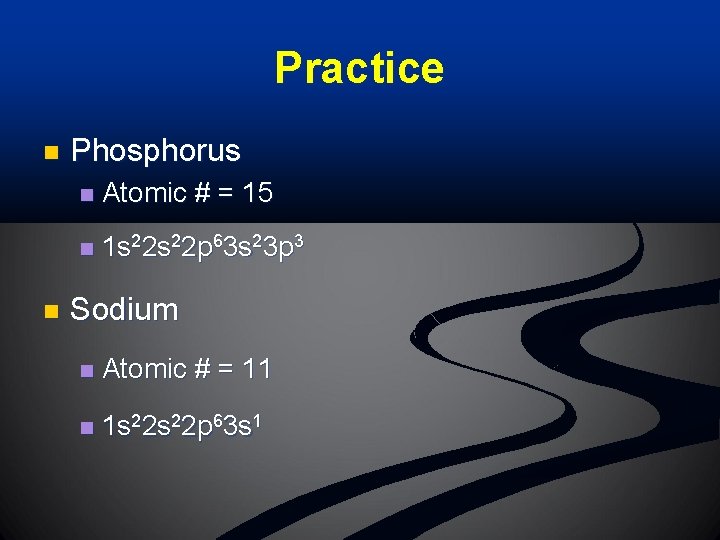
Practice n n Phosphorus n Atomic # = 15 n 1 s 22 p 63 s 23 p 3 Sodium n Atomic # = 11 n 1 s 22 p 63 s 1
Animation n http: //www. quimica 3 d. com/VIDEOS/ORBI TALS/en-18. html
Quantum Mechanical Model The Physics
Quantum Mechanics n http: //ed. ted. com/lessons/particles-andwaves-the-central-mystery-of-quantummechanics-chad-orzel
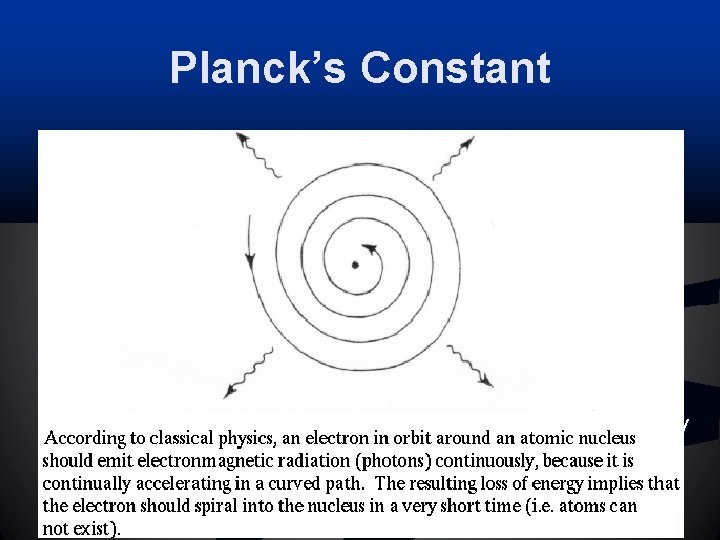
Planck’s Constant n Classical physics: n n Electrons orbit around the atomic nucleus continuously – flawed model Planck assumed energy can only be transferred in small units (quanta) Quanta (h): a small, discrete unit of energy; not divisible n Quantum leap: Electrons jump from one energy level to another n n Transitions of electrons from one orbit to another is done in discrete quanta
Light and the Quantum Model Light… particle or wave? n Quantum Mechanical Model of the atom grew out of the study of light n Light exists as electromagnetic waves n n Photons behave like particles
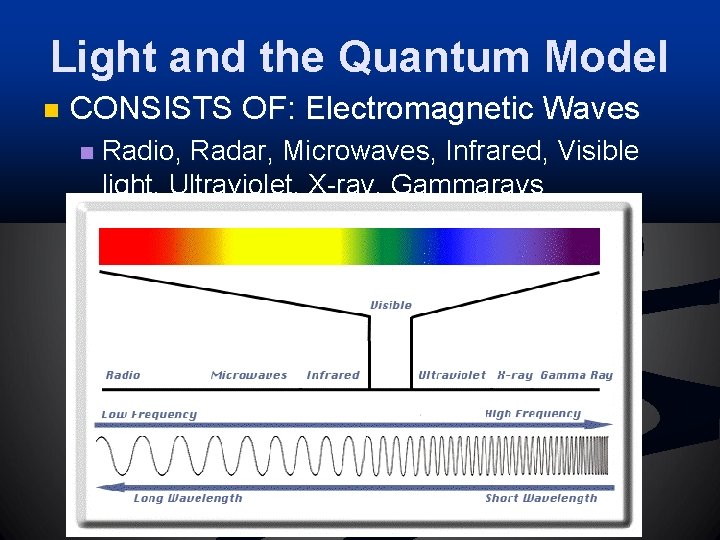
Light and the Quantum Model n CONSISTS OF: Electromagnetic Waves n Radio, Radar, Microwaves, Infrared, Visible light, Ultraviolet, X-ray, Gammarays
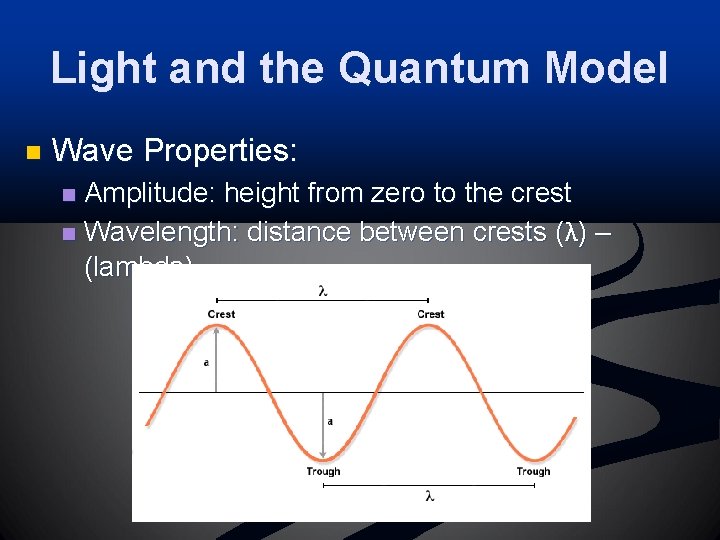
Light and the Quantum Model n Wave Properties: Amplitude: height from zero to the crest n Wavelength: distance between crests (λ) – (lambda) n
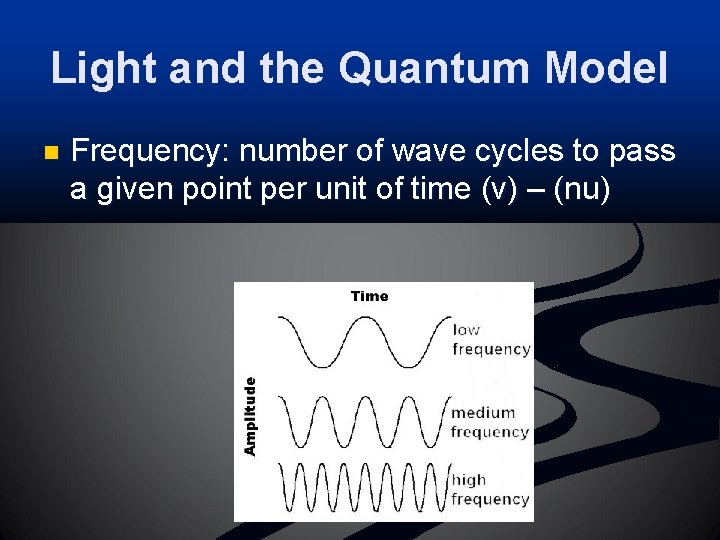
Light and the Quantum Model n Frequency: number of wave cycles to pass a given point per unit of time (v) – (nu)
Light and the Quantum Model Hertz: SI unit of cycles per second (Hz) (s 1 -) n The light constant ~ C= λv n Wavelength(λ) & Frequency(v) – inversely proportional n n IN VACUUM: All electromagnetic waves travel at 2. 998 x 108 m/s
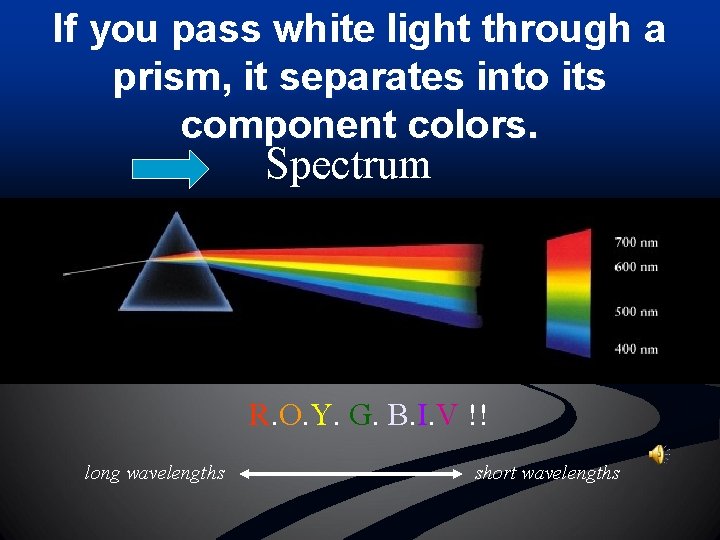
If you pass white light through a prism, it separates into its component colors. Spectrum R. O. Y. G. B. I. V !! long wavelengths short wavelengths
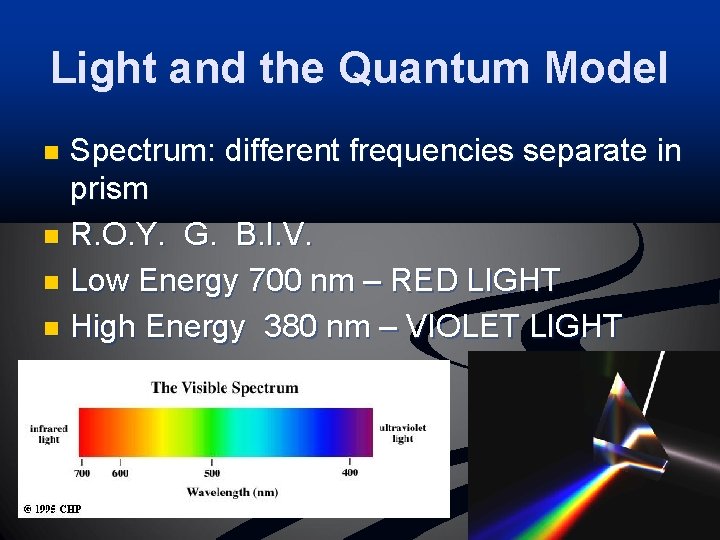
Light and the Quantum Model Spectrum: different frequencies separate in prism n R. O. Y. G. B. I. V. n Low Energy 700 nm – RED LIGHT n High Energy 380 nm – VIOLET LIGHT n
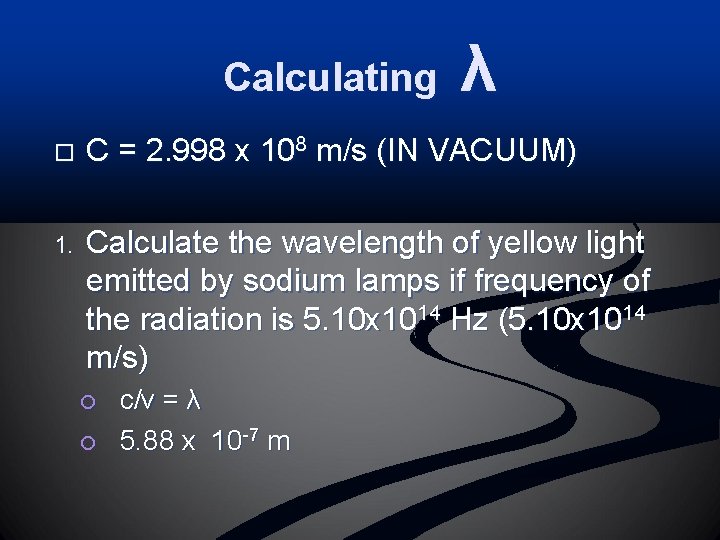
Calculating λ C = 2. 998 x 108 m/s (IN VACUUM) 1. Calculate the wavelength of yellow light emitted by sodium lamps if frequency of the radiation is 5. 10 x 1014 Hz (5. 10 x 1014 m/s) c/v = λ 5. 88 x 10 -7 m
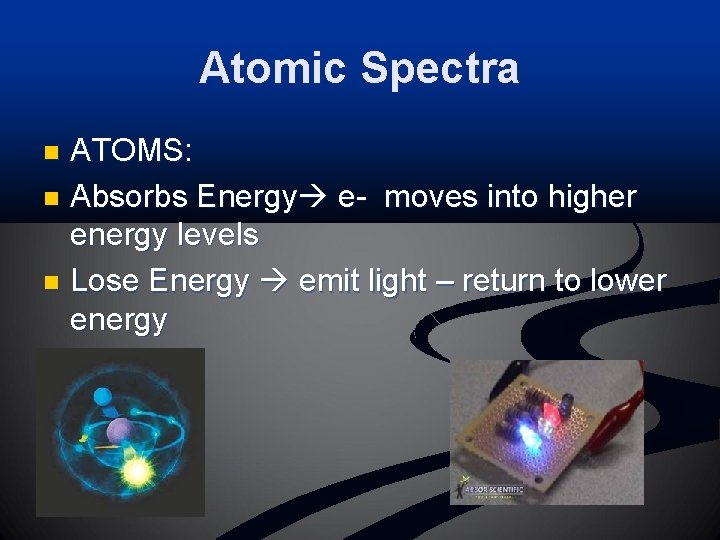
Atomic Spectra ATOMS: n Absorbs Energy e- moves into higher energy levels n Lose Energy emit light – return to lower energy n
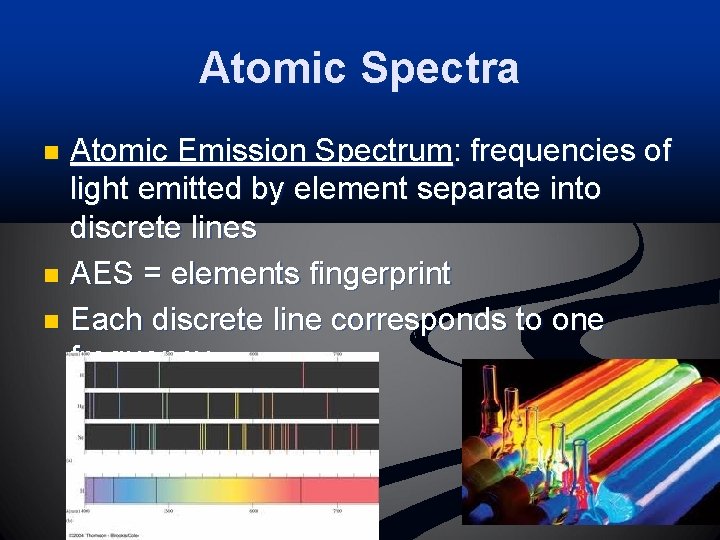
Atomic Spectra Atomic Emission Spectrum: frequencies of light emitted by element separate into discrete lines n AES = elements fingerprint n Each discrete line corresponds to one frequency n
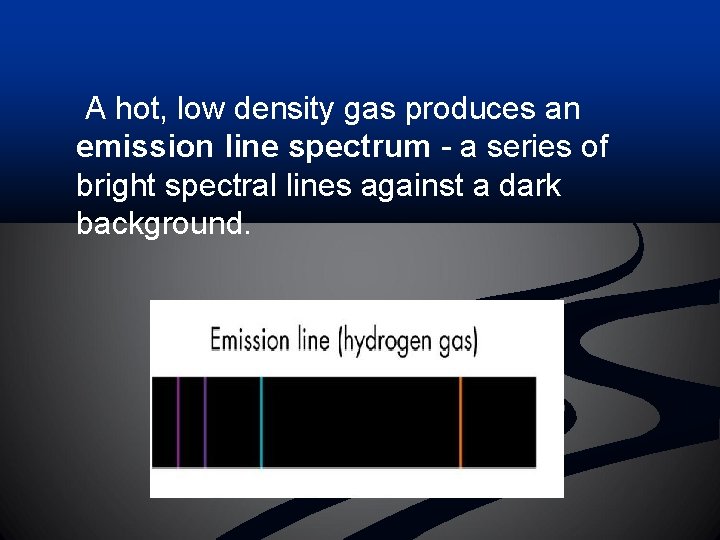
A hot, low density gas produces an emission line spectrum - a series of bright spectral lines against a dark background.
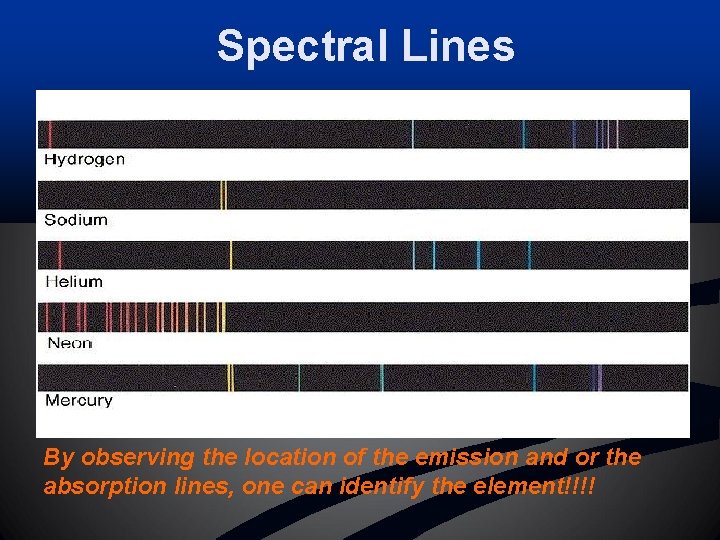
Spectral Lines By observing the location of the emission and or the absorption lines, one can identify the element!!!!
Planck’s Constant – sixty symbols n https: //youtu. be/Tz 2 D 1 aahd 5 A n Check out the mercury lamp emissions
Atomic Spectra Ground State: e- at lowest energy (n=1) n Excitation: e- moves to higher energy (n=2, 3, 4…) n Quantum of Energy (Planck’s constant) n n n Photon (aka: light) – emitted – energy lost Photon has frequency directly proportional to the energy change(photon emission) of the e -
Double Slit Experiment n https: //youtu. be/Iuv 6 h. Y 6 zsd 0? list=PL 6 CA 4 DF 6 E 8955 DD 61
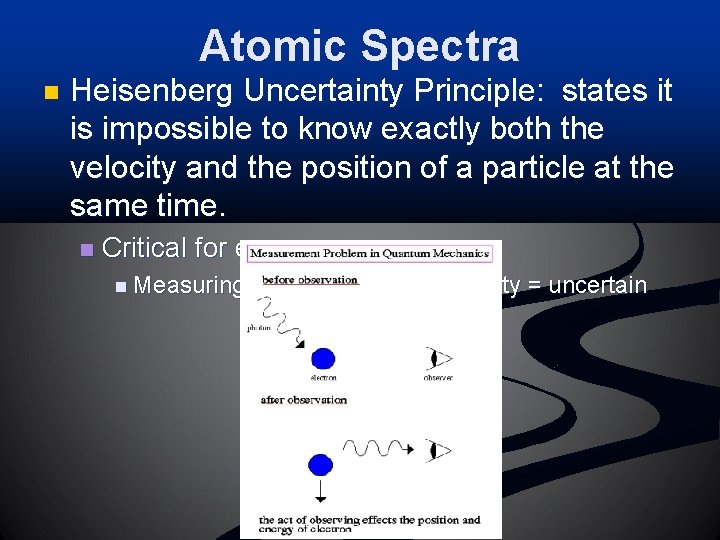
Atomic Spectra n Heisenberg Uncertainty Principle: states it is impossible to know exactly both the velocity and the position of a particle at the same time. n Critical for en Measuring an e- changes its velocity = uncertain
Electromagnetic Spectrum LAB Chapter 5.
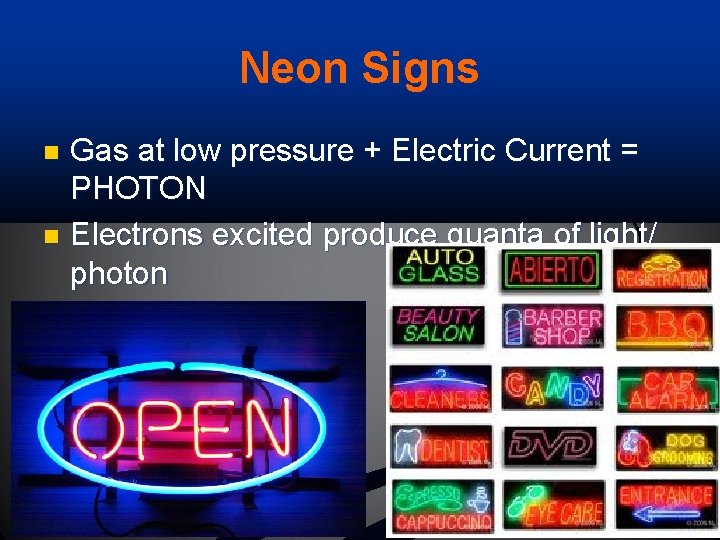
Neon Signs Gas at low pressure + Electric Current = PHOTON n Electrons excited produce quanta of light/ photon n
Atomic Spectra n When atoms absorb energy, electrons move into higher energy levels. n n What is one way atoms might absorb energy? These e- then lose energy by emitting (giving off/releasing) light when they return to lower energy levels.
Atomic Spectra Each group needs to grab colored pencils/crayon/markers. n The next slide is a diagram. n Draw the diagram. Display difference of colors and wavelengths. Indicate high and low energies. n
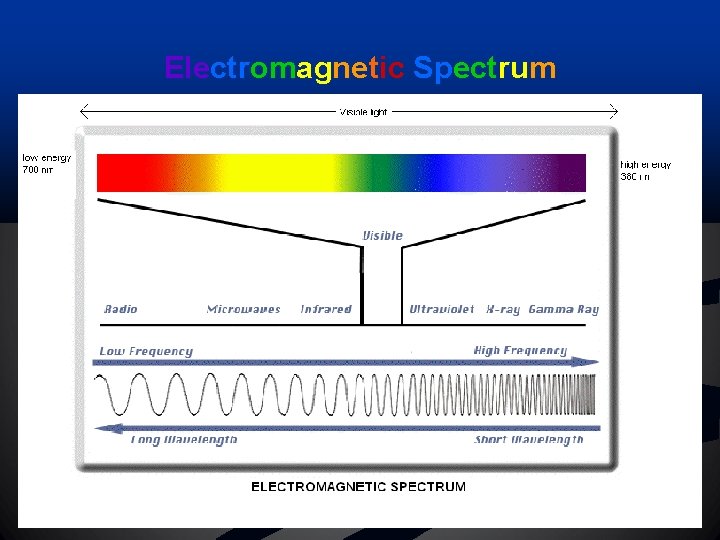
Electromagnetic Spectrum
Pre-Lab Pre-lab: n Wavelength and frequency of light are inversely proportional to each other. As wavelength of light increases, frequency decreases.
Pre-Lab Questions Pre-lab Questions: 1. What does inversely proportional mean? 2. Which color of light would you expect to have the largest wavelength/smallest wavelength? 3. Which color of light would you expect to have the highest energy/lowest energy?
During Lab: n Record the color of the flame of each chemical used. Be descriptive. n Create data table. n Write procedures and results. (paragraph form)
Post Lab Questions: 1. What causes color change in the flame? 2. Why are colors different from element to element? 3. Which element/ion used in lab has the highest energy/lowest energy?
- Slides: 91