
Atomic structure and the periodic table Knowledge Organiser
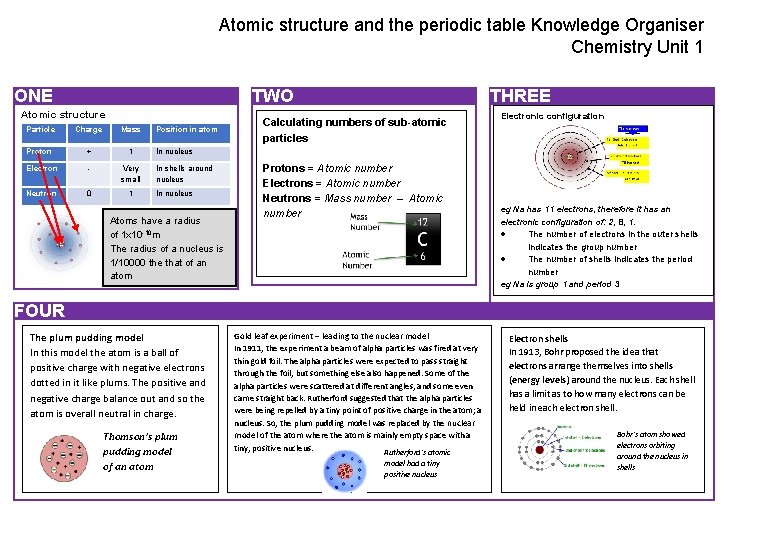
Atomic structure and the periodic table Knowledge Organiser Chemistry Unit 1 ONE TWO Atomic structure Particle Charge Mass Proton + 1 Electron - Very small Neutron 0 1 Position in atom THREE Calculating numbers of sub-atomic particles Electronic configuration In nucleus In shells around nucleus In nucleus Atoms have a radius of 1 x 10 -10 m The radius of a nucleus is 1/10000 the that of an atom Protons = Atomic number Electrons = Atomic number Neutrons = Mass number – Atomic number eg Na has 11 electrons, therefore it has an electronic configuration of: 2, 8, 1. The number of electrons in the outer shells indicates the group number The number of shells indicates the period number eg Na is group 1 and period 3 A FOUR The plum pudding model In this model the atom is a ball of positive charge with negative electrons dotted in it like plums. The positive and negative charge balance out and so the atom is overall neutral in charge. Thomson’s plum pudding model of an atom Gold leaf experiment – leading to the nuclear model In 1911, the experiment a beam of alpha particles was fired at very thin gold foil. The alpha particles were expected to pass straight through the foil, but something else also happened. Some of the alpha particles were scattered at different angles, and some even came straight back. Rutherford suggested that the alpha particles were being repelled by a tiny point of positive charge in the atom; a nucleus. So, the plum pudding model was replaced by the nuclear model of the atom where the atom is mainly empty space with a tiny, positive nucleus. Rutherford’s atomic model had a tiny positive nucleus Electron shells In 1913, Bohr proposed the idea that electrons arrange themselves into shells (energy levels) around the nucleus. Each shell has a limit as to how many electrons can be held in each electron shell. Bohr’s atom showed electrons orbiting around the nucleus in shells
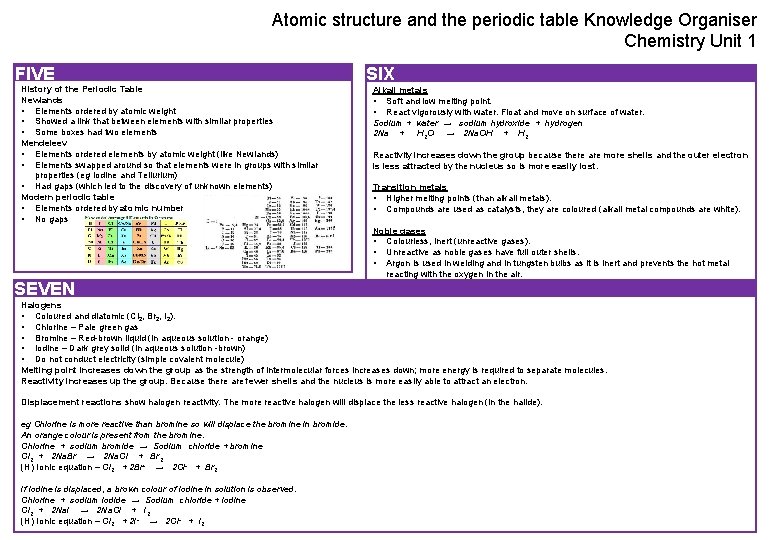
Atomic structure and the periodic table Knowledge Organiser Chemistry Unit 1 FIVE History of the Periodic Table Newlands • Elements ordered by atomic weight • Showed a link that between elements with similar properties • Some boxes had two elements Mendeleev • Elements ordered elements by atomic weight (like Newlands) • Elements swapped around so that elements were in groups with similar properties (eg Iodine and Tellurium) • Had gaps (which led to the discovery of unknown elements) Modern periodic table • Elements ordered by atomic number • No gaps SEVEN SIX Alkali metals • Soft and low melting point. • React vigorously with water. Float and move on surface of water. Sodium + water → sodium hydroxide + hydrogen 2 Na + H 2 O → 2 Na. OH + H 2 Reactivity increases down the group because there are more shells and the outer electron is less attracted by the nucleus so is more easily lost. Transition metals • Higher melting points (than alkali metals). • Compounds are used as catalysts, they are coloured (alkali metal compounds are white). Noble gases • Colourless, inert (unreactive gases). • Unreactive as noble gases have full outer shells. • Argon is used in welding and in tungsten bulbs as it is inert and prevents the hot metal reacting with the oxygen in the air. Halogens • Coloured and diatomic (Cl 2, Br 2, I 2). • Chlorine – Pale green gas • Bromine – Red-brown liquid (in aqueous solution - orange) • Iodine – Dark grey solid (in aqueous solution -brown) • Do not conduct electricity (simple covalent molecule) Melting point increases down the group as the strength of intermolecular forces increases down; more energy is required to separate molecules. Reactivity increases up the group. Because there are fewer shells and the nucleus is more easily able to attract an electron. Displacement reactions show halogen reactivity. The more reactive halogen will displace the less reactive halogen (in the halide). eg Chlorine is more reactive than bromine so will displace the bromine in bromide. An orange colour is present from the bromine. Chlorine + sodium bromide → Sodium chloride + bromine Cl 2 + 2 Na. Br → 2 Na. Cl + Br 2 (H) Ionic equation – Cl 2 + 2 Br- → 2 Cl- + Br 2 If iodine is displaced, a brown colour of iodine in solution is observed. Chlorine + sodium iodide → Sodium chloride + iodine Cl 2 + 2 Na. I → 2 Na. Cl + I 2 (H) Ionic equation – Cl 2 + 2 I- → 2 Cl- + I 2
- Slides: 2