
Atomic Spectra Visible light is one type of
Atomic Spectra
Visible light is one type of electromagnetic radiation. Other types are x-rays, microwaves and radio waves. All electromagnetic radiation (ER) consists of energy propagated by means of electrical and magnetic fields that alternately increase and decrease in intensity as they travel through space. This is the classical wave model but it cannot explain observations on the atomic scale where energy behaves as if it consists of particles.
The Wave Nature of Light The wave properties of ER are described by two interdependant variables Frequency ( ) is the number of cycles the wave undergoes per second and is expressed in units of s-1 Wavelength ( ) is the distance between any point on a wave and the corresponding point on the next wave. Expressed in units of lengtth.
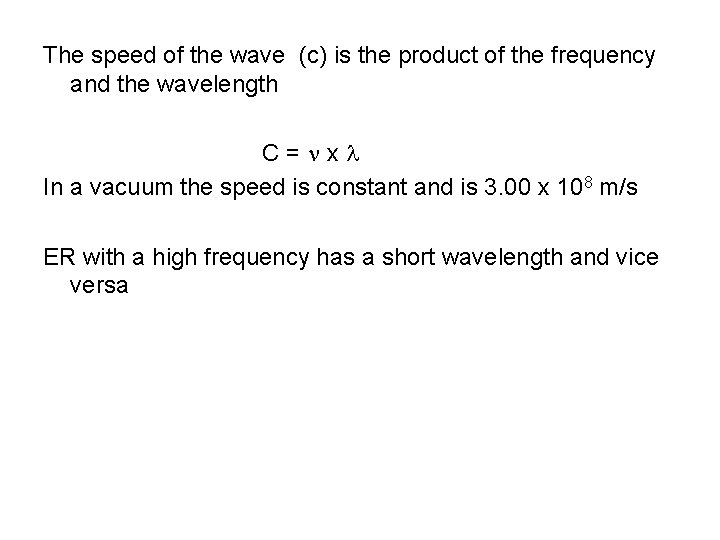
The speed of the wave (c) is the product of the frequency and the wavelength C= x In a vacuum the speed is constant and is 3. 00 x 108 m/s ER with a high frequency has a short wavelength and vice versa

The Electromagnetic Spectrum Gamma rays have very short wavelengths and high frequency Radio waves have long wavelengths and low frequency
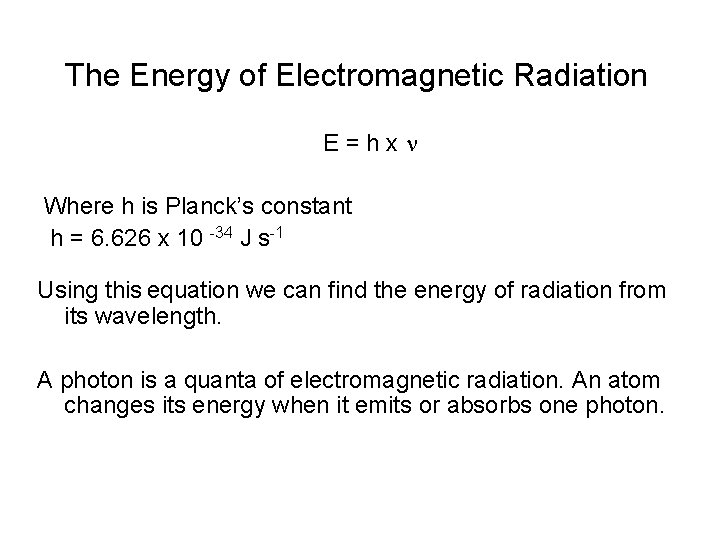
The Energy of Electromagnetic Radiation E=hx Where h is Planck’s constant h = 6. 626 x 10 -34 J s-1 Using this equation we can find the energy of radiation from its wavelength. A photon is a quanta of electromagnetic radiation. An atom changes its energy when it emits or absorbs one photon.
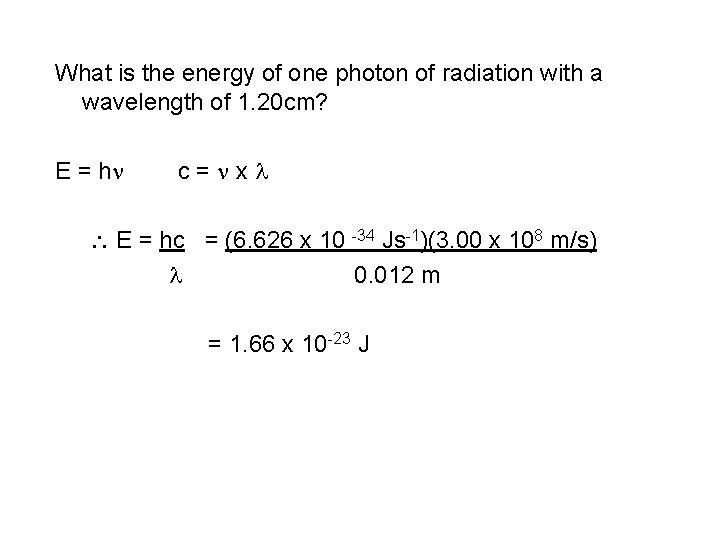
What is the energy of one photon of radiation with a wavelength of 1. 20 cm? E = h c= x E = hc = (6. 626 x 10 -34 Js-1)(3. 00 x 108 m/s) 0. 012 m = 1. 66 x 10 -23 J
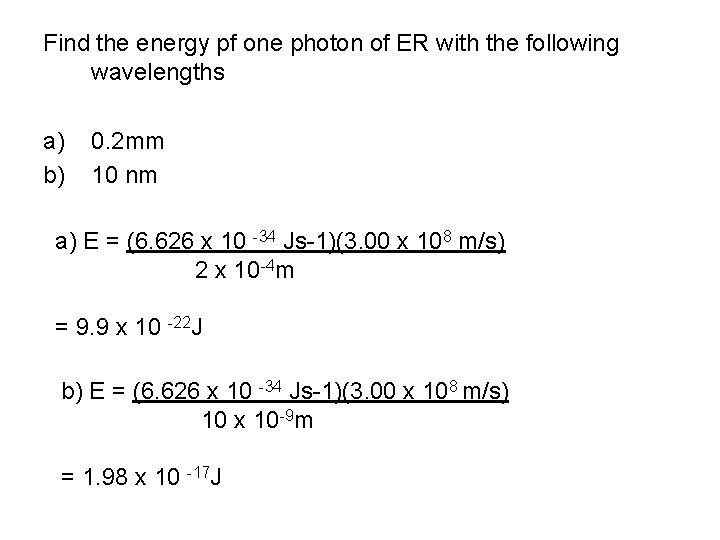
Find the energy pf one photon of ER with the following wavelengths a) b) 0. 2 mm 10 nm a) E = (6. 626 x 10 -34 Js-1)(3. 00 x 108 m/s) 2 x 10 -4 m = 9. 9 x 10 -22 J b) E = (6. 626 x 10 -34 Js-1)(3. 00 x 108 m/s) 10 x 10 -9 m = 1. 98 x 10 -17 J
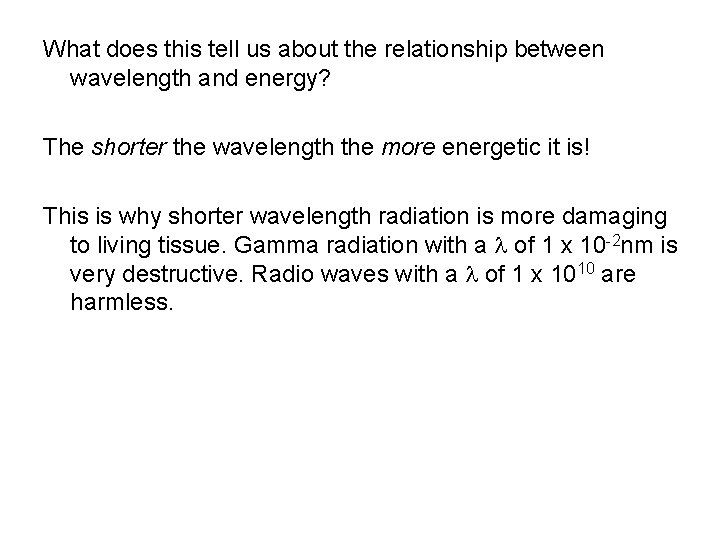
What does this tell us about the relationship between wavelength and energy? The shorter the wavelength the more energetic it is! This is why shorter wavelength radiation is more damaging to living tissue. Gamma radiation with a of 1 x 10 -2 nm is very destructive. Radio waves with a of 1 x 10¹⁰ are harmless.
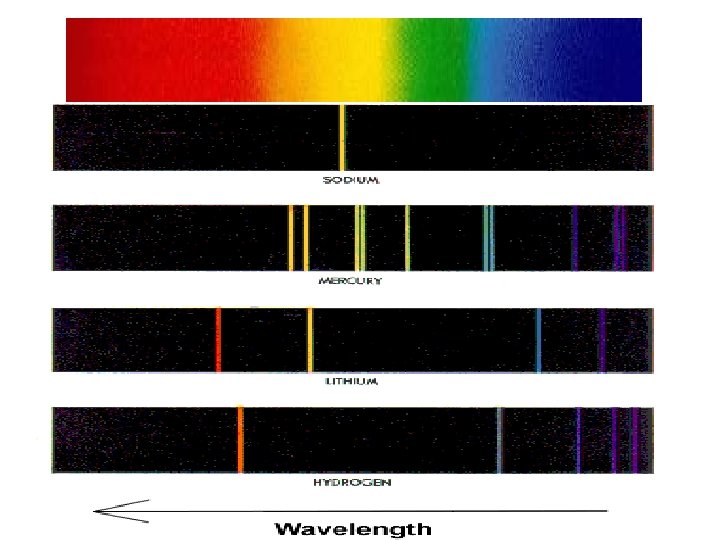
When atoms have been excited (given extra energy) they give out the light and other forms of ER energy. Excitation may be brought about in different ways. One way is to heat the substance in a bunsen flame, another to pass an electric discharge through the vapour. When this light is observed through a spectroscope each element will be seen producing a pattern of lines. Part of the spectrum of hydrogen is shown on the next slide.

Continuous spectrum and line spectrum of hydrogen
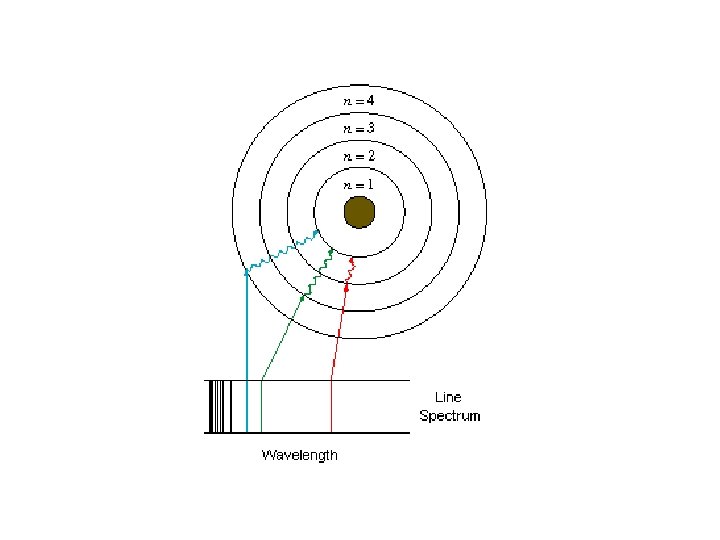
Further, Bohr said electrons give or take energy only when they change their energy levels. If they move up, they take energy (say from light), and if they move down, they release energy. This energy itself is released in discrete packets called photons.
- Slides: 14