
Atomic Processes in the Extreme States of Matter




- Slides: 64
Atomic Processes in the Extreme States of Matter Applications to X-ray free electron lasers generated plasmas Hyun-Kyung Chung International Atomic Energy Agency Nuclear Data Section, Atomic and Molecular Data Unit October 4, 2016 KAIST
OUTLINE • Introduction to High Energy Density Physics – Extreme States of Matter • High Energy Density Laboratory Physics – Laboratory Production of Extreme States of Matter • Atomic Processes in the Extreme States of Matter • Plasmas Generated by X-Ray Free Electron Lasers
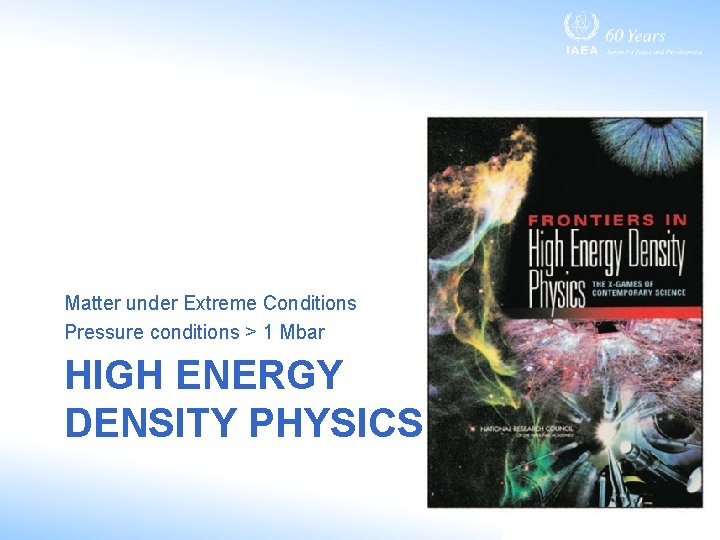
Matter under Extreme Conditions Pressure conditions > 1 Mbar HIGH ENERGY DENSITY PHYSICS
Precursors to HEDP • First half 20 th Century: Stellar structure – Eddington, Chandrasekhar, Schwarzschild, among others • Mid-20 th Century: Nuclear weapons – Oppenheimer, Sakharov, Teller, Bethe, Fermi, others • Compressible metals! – Zel’dovich and Raizer 1966 • Physics of Shock Waves and High Temperature Phenomena • Post Mid-20 th Century (1960 -1980): Inertial fusion origins – Nuckolls, Basov, Emmett, others • HEDP started already as a discipline from about 1979 – Complex quantitative physics experiments became feasible – The first user facility program (NLUF at Omega) began in 1979
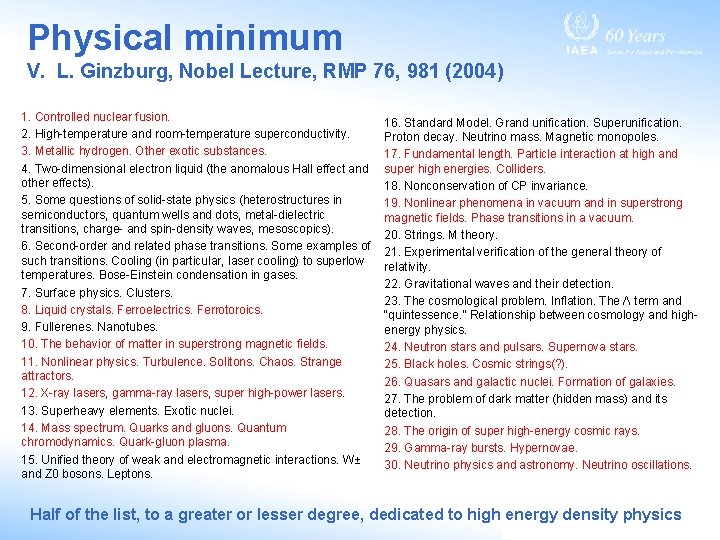
Physical minimum V. L. Ginzburg, Nobel Lecture, RMP 76, 981 (2004) 1. Controlled nuclear fusion. 2. High-temperature and room-temperature superconductivity. 3. Metallic hydrogen. Other exotic substances. 4. Two-dimensional electron liquid (the anomalous Hall effect and other effects). 5. Some questions of solid-state physics (heterostructures in semiconductors, quantum wells and dots, metal-dielectric transitions, charge- and spin-density waves, mesoscopics). 6. Second-order and related phase transitions. Some examples of such transitions. Cooling (in particular, laser cooling) to superlow temperatures. Bose-Einstein condensation in gases. 7. Surface physics. Clusters. 8. Liquid crystals. Ferroelectrics. Ferrotoroics. 9. Fullerenes. Nanotubes. 10. The behavior of matter in superstrong magnetic fields. 11. Nonlinear physics. Turbulence. Solitons. Chaos. Strange attractors. 12. X-ray lasers, gamma-ray lasers, super high-power lasers. 13. Superheavy elements. Exotic nuclei. 14. Mass spectrum. Quarks and gluons. Quantum chromodynamics. Quark-gluon plasma. 15. Unified theory of weak and electromagnetic interactions. W± and Z 0 bosons. Leptons. 16. Standard Model. Grand unification. Superunification. Proton decay. Neutrino mass. Magnetic monopoles. 17. Fundamental length. Particle interaction at high and super high energies. Colliders. 18. Nonconservation of CP invariance. 19. Nonlinear phenomena in vacuum and in superstrong magnetic fields. Phase transitions in a vacuum. 20. Strings. M theory. 21. Experimental verification of the general theory of relativity. 22. Gravitational waves and their detection. 23. The cosmological problem. Inflation. The Λ term and “quintessence. ” Relationship between cosmology and highenergy physics. 24. Neutron stars and pulsars. Supernova stars. 25. Black holes. Cosmic strings(? ). 26. Quasars and galactic nuclei. Formation of galaxies. 27. The problem of dark matter (hidden mass) and its detection. 28. The origin of super high-energy cosmic rays. 29. Gamma-ray bursts. Hypernovae. 30. Neutrino physics and astronomy. Neutrino oscillations. Half of the list, to a greater or lesser degree, dedicated to high energy density physics
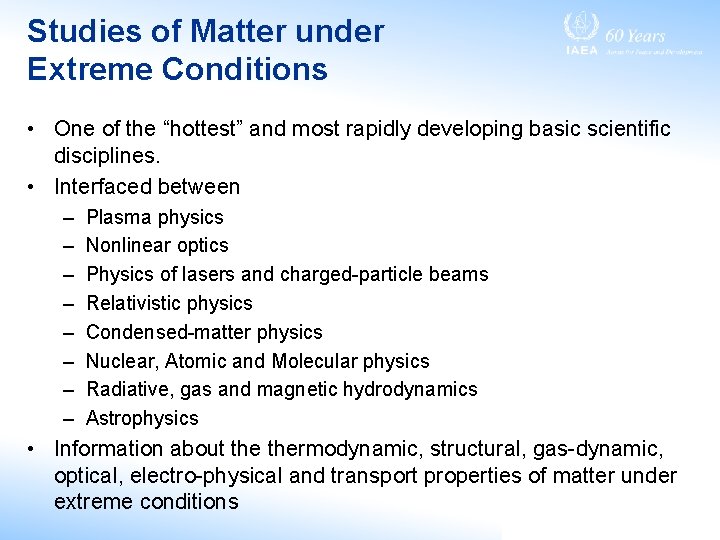
Studies of Matter under Extreme Conditions • One of the “hottest” and most rapidly developing basic scientific disciplines. • Interfaced between – – – – Plasma physics Nonlinear optics Physics of lasers and charged-particle beams Relativistic physics Condensed-matter physics Nuclear, Atomic and Molecular physics Radiative, gas and magnetic hydrodynamics Astrophysics • Information about thermodynamic, structural, gas-dynamic, optical, electro-physical and transport properties of matter under extreme conditions
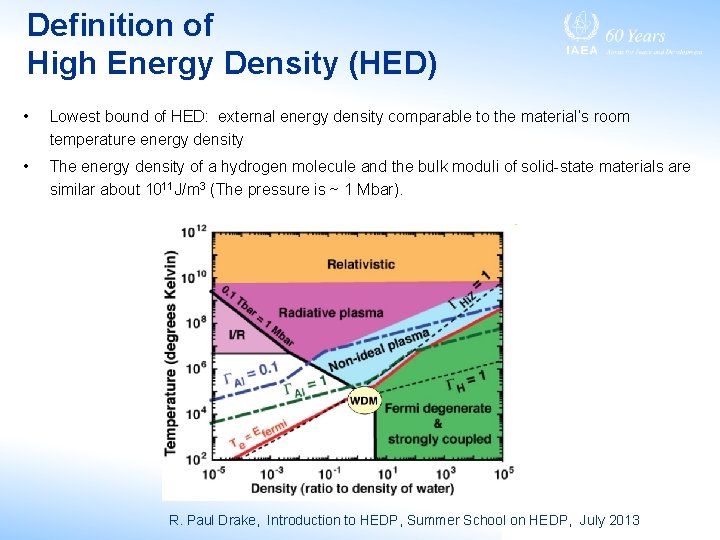
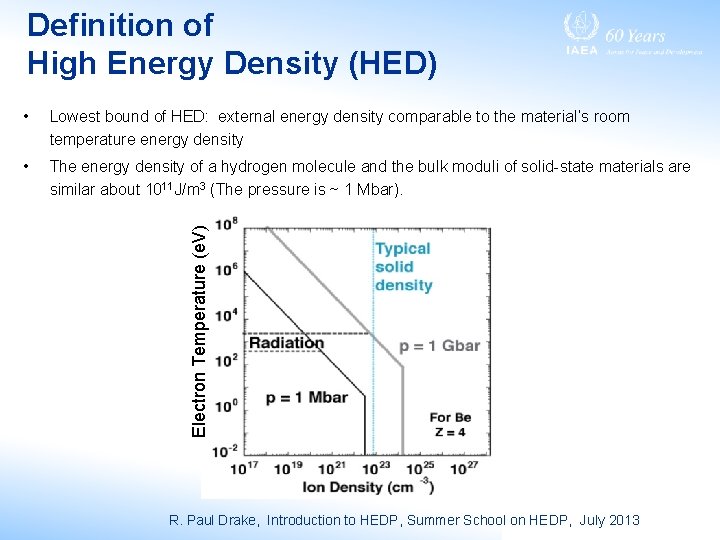
Definition of High Energy Density (HED) • Lowest bound of HED: external energy density comparable to the material’s room temperature energy density • The energy density of a hydrogen molecule and the bulk moduli of solid-state materials are similar about 1011 J/m 3 (The pressure is ~ 1 Mbar). R. Paul Drake, Introduction to HEDP, Summer School on HEDP, July 2013
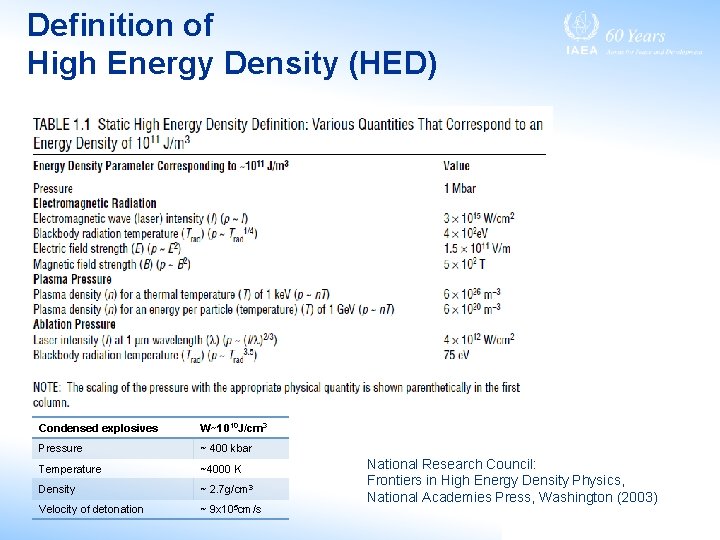
Definition of High Energy Density (HED) Condensed explosives W~1010 J/cm 3 Pressure ~ 400 kbar Temperature ~4000 K Density ~ 2. 7 g/cm 3 Velocity of detonation ~ 9 x 105 cm/s National Research Council: Frontiers in High Energy Density Physics, National Academies Press, Washington (2003)
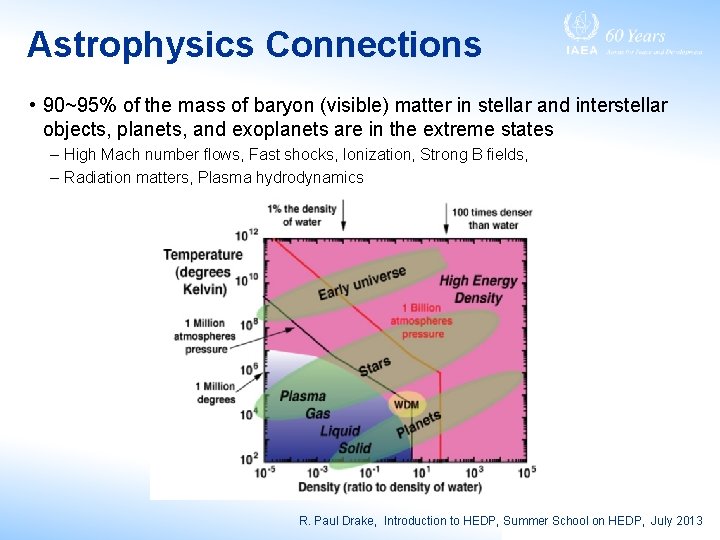
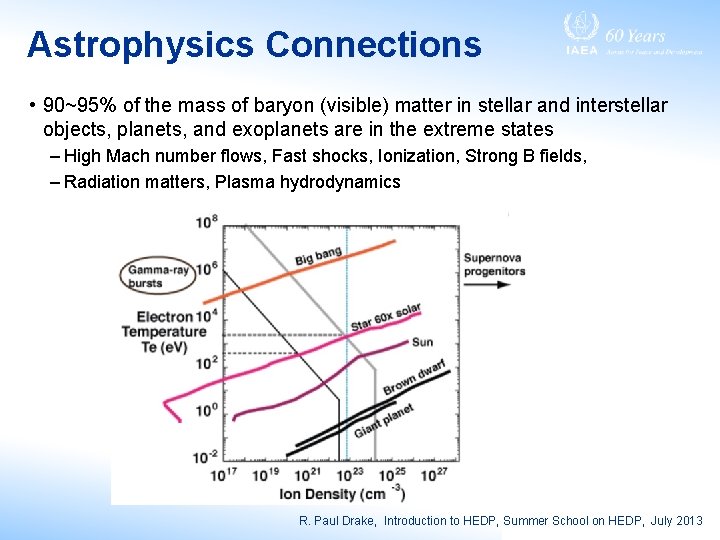
Astrophysics Connections • 90~95% of the mass of baryon (visible) matter in stellar and interstellar objects, planets, and exoplanets are in the extreme states – High Mach number flows, Fast shocks, Ionization, Strong B fields, – Radiation matters, Plasma hydrodynamics R. Paul Drake, Introduction to HEDP, Summer School on HEDP, July 2013
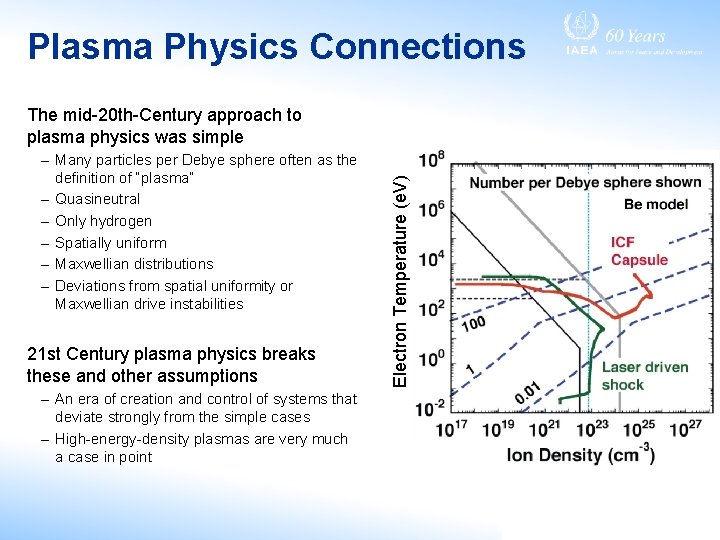
Plasma Physics Connections – Many particles per Debye sphere often as the definition of “plasma” – Quasineutral – Only hydrogen – Spatially uniform – Maxwellian distributions – Deviations from spatial uniformity or Maxwellian drive instabilities 21 st Century plasma physics breaks these and other assumptions – An era of creation and control of systems that deviate strongly from the simple cases – High-energy-density plasmas are very much a case in point Electron Temperature (e. V) The mid-20 th-Century approach to plasma physics was simple
HIGH ENERGY DENSITY LABORATORY PHYSICS
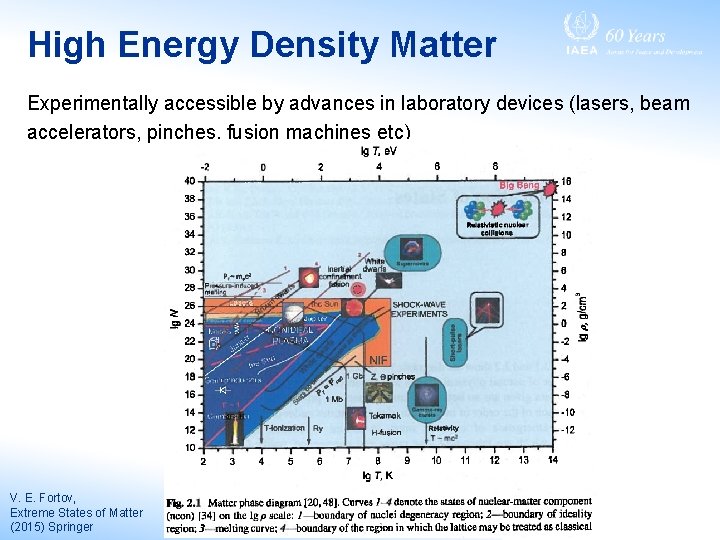
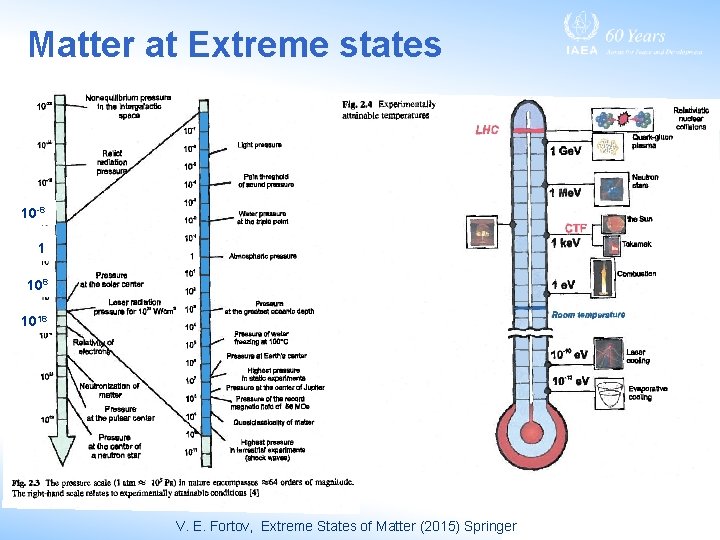
High Energy Density Matter Experimentally accessible by advances in laboratory devices (lasers, beam accelerators, pinches, fusion machines etc) V. E. Fortov, Extreme States of Matter (2015) Springer
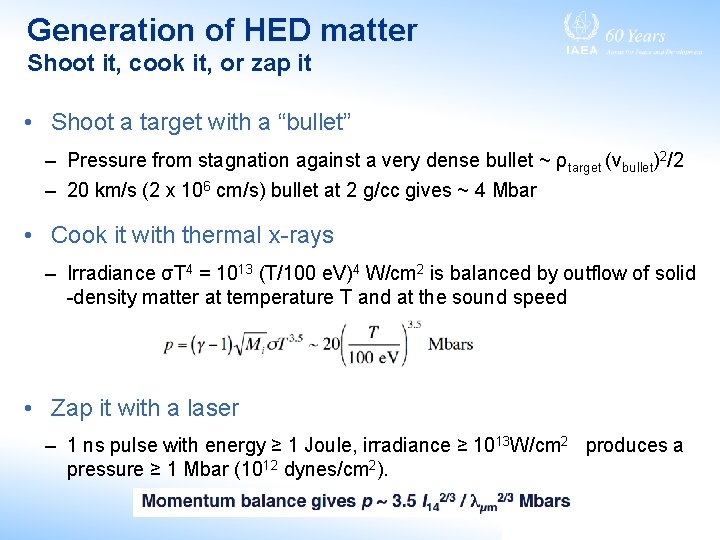
Generation of HED matter Shoot it, cook it, or zap it • Shoot a target with a “bullet” – Pressure from stagnation against a very dense bullet ~ ρtarget (vbullet)2/2 – 20 km/s (2 x 106 cm/s) bullet at 2 g/cc gives ~ 4 Mbar • Cook it with thermal x-rays – Irradiance σT 4 = 1013 (T/100 e. V)4 W/cm 2 is balanced by outflow of solid -density matter at temperature T and at the sound speed • Zap it with a laser – 1 ns pulse with energy ≥ 1 Joule, irradiance ≥ 1013 W/cm 2 produces a pressure ≥ 1 Mbar (1012 dynes/cm 2).
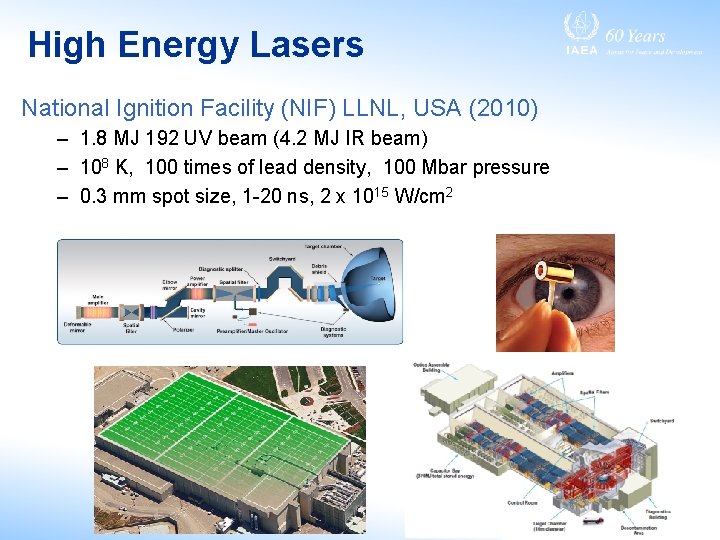
High Energy Lasers National Ignition Facility (NIF) LLNL, USA (2010) – 1. 8 MJ 192 UV beam (4. 2 MJ IR beam) – 108 K, 100 times of lead density, 100 Mbar pressure – 0. 3 mm spot size, 1 -20 ns, 2 x 10¹⁵ W/cm 2
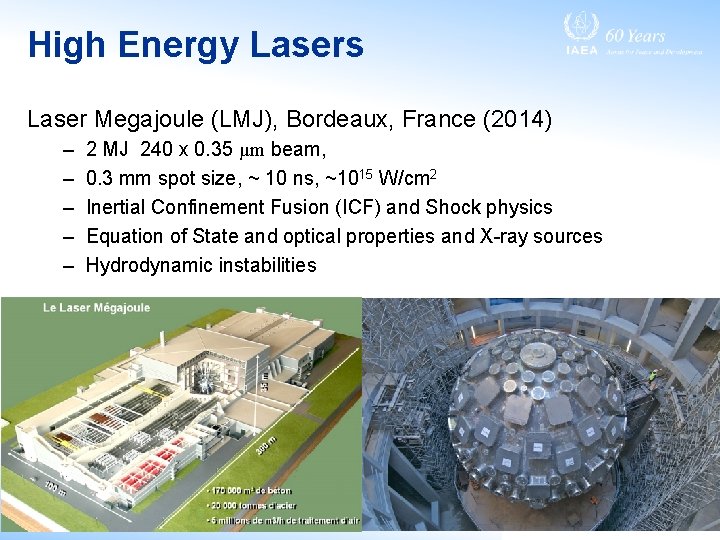
High Energy Lasers Laser Megajoule (LMJ), Bordeaux, France (2014) – – – 2 MJ 240 x 0. 35 μm beam, 0. 3 mm spot size, ~ 10 ns, ~1015 W/cm 2 Inertial Confinement Fusion (ICF) and Shock physics Equation of State and optical properties and X-ray sources Hydrodynamic instabilities
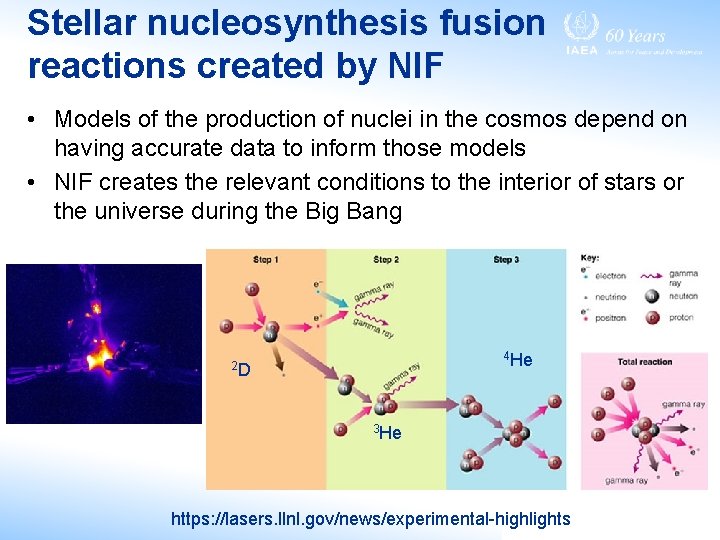
Stellar nucleosynthesis fusion reactions created by NIF • Models of the production of nuclei in the cosmos depend on having accurate data to inform those models • NIF creates the relevant conditions to the interior of stars or the universe during the Big Bang 4 He 2 D 3 He https: //lasers. llnl. gov/news/experimental-highlights
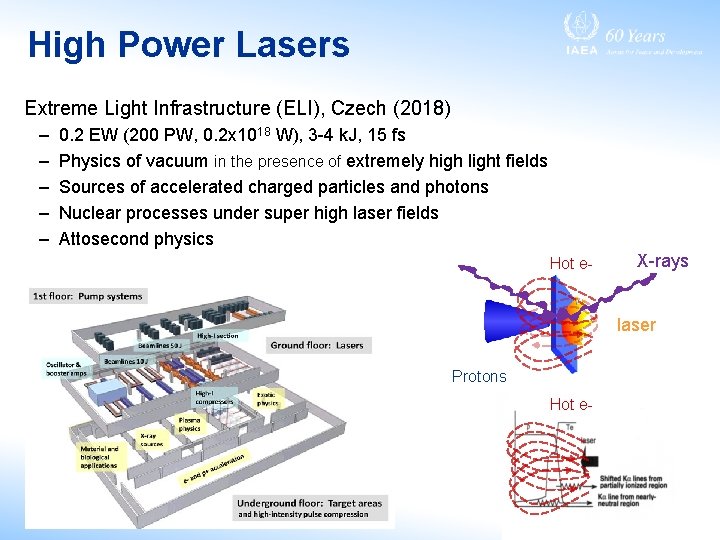
High Power Lasers Extreme Light Infrastructure (ELI), Czech (2018) – – – 0. 2 EW (200 PW, 0. 2 x 10¹⁸ W), 3 -4 k. J, 15 fs Physics of vacuum in the presence of extremely high light fields Sources of accelerated charged particles and photons Nuclear processes under super high laser fields Attosecond physics Hot e- X-rays laser Protons Hot e-
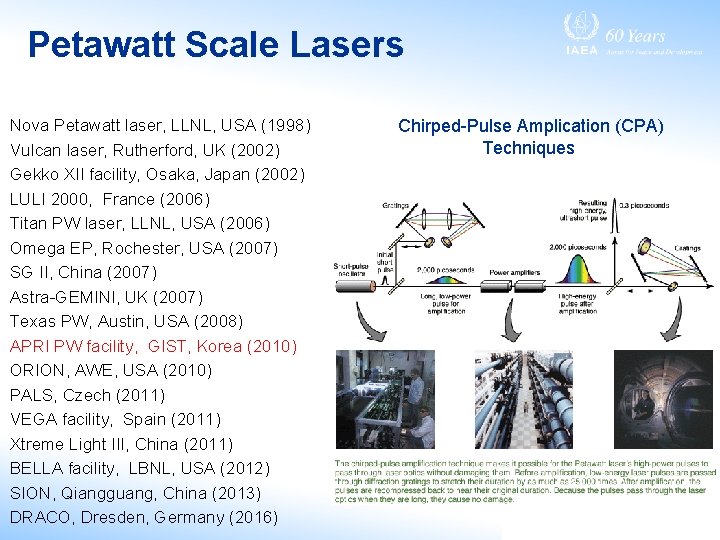
Petawatt Scale Lasers Nova Petawatt laser, LLNL, USA (1998) Vulcan laser, Rutherford, UK (2002) Gekko XII facility, Osaka, Japan (2002) LULI 2000, France (2006) Titan PW laser, LLNL, USA (2006) Omega EP, Rochester, USA (2007) SG II, China (2007) Astra-GEMINI, UK (2007) Texas PW, Austin, USA (2008) APRI PW facility, GIST, Korea (2010) ORION, AWE, USA (2010) PALS, Czech (2011) VEGA facility, Spain (2011) Xtreme Light III, China (2011) BELLA facility, LBNL, USA (2012) SION, Qiangguang, China (2013) DRACO, Dresden, Germany (2016) Chirped-Pulse Amplication (CPA) Techniques
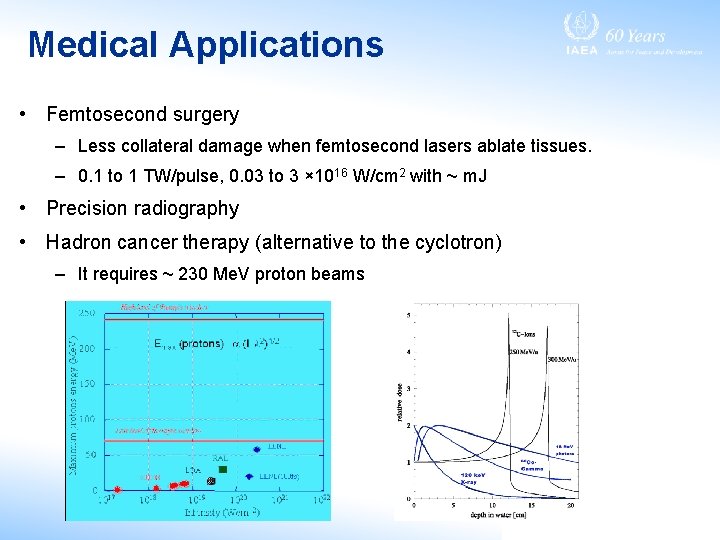
Medical Applications • Femtosecond surgery – Less collateral damage when femtosecond lasers ablate tissues. – 0. 1 to 1 TW/pulse, 0. 03 to 3 × 10¹⁶ W/cm 2 with ~ m. J • Precision radiography • Hadron cancer therapy (alternative to the cyclotron) – It requires ~ 230 Me. V proton beams
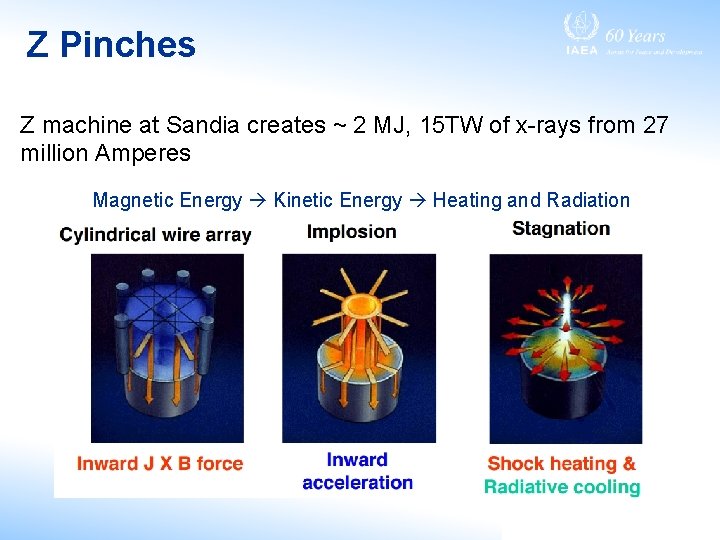
Z Pinches Z machine at Sandia creates ~ 2 MJ, 15 TW of x-rays from 27 million Amperes Magnetic Energy Kinetic Energy Heating and Radiation
Physics with Z Pinches 1. Properties of matter in extreme conditions (“traditional” laboratory astrophysics): – X-ray driven: opacity, photoionized plasmas, atomic physics of HED plasmas – Magnetically driven: EOS via isentropic compression or flyer plates 2. Dynamical HEDP experiments (both magnetically and x-ray driven): – High Mach number flows (jets, shocks, turbulence etc) – MHD systems – Radiation-hydrodynamics (radiative shocks)
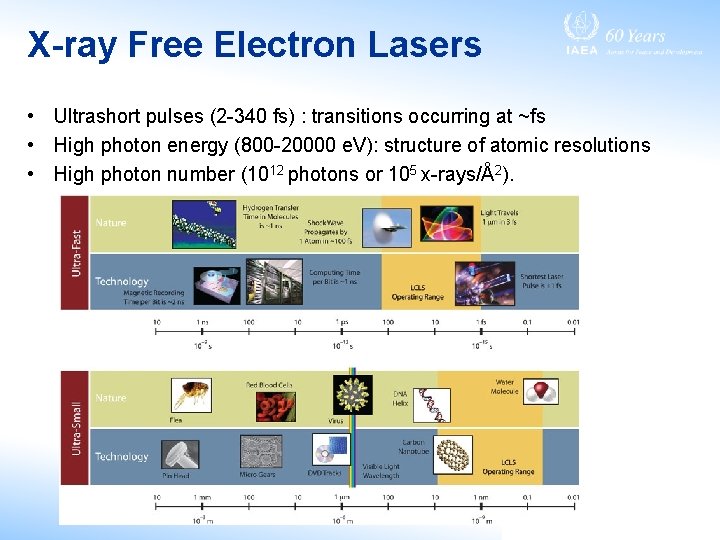
X-ray Free Electron Lasers • Ultrashort pulses (2 -340 fs) : transitions occurring at ~fs • High photon energy (800 -20000 e. V): structure of atomic resolutions • High photon number (1012 photons or 105 x-rays/Å2).
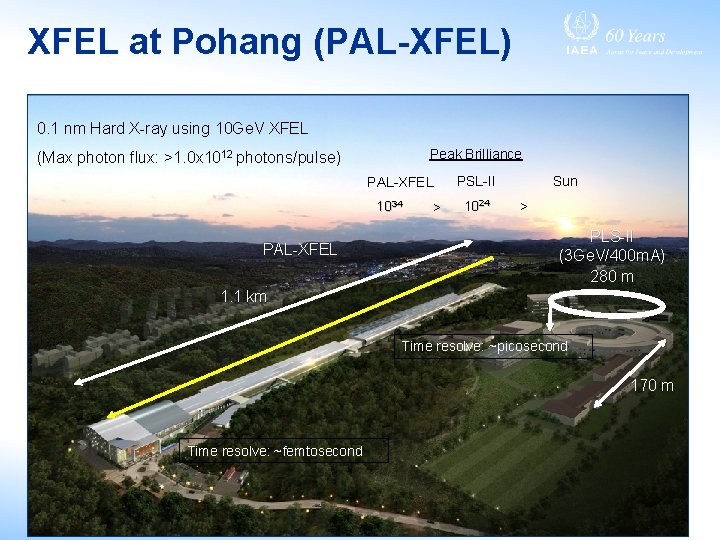
XFEL at Pohang (PAL-XFEL) 0. 1 nm Hard X-ray using 10 Ge. V XFEL Peak Brilliance (Max photon flux: >1. 0 x 1012 photons/pulse) PAL-XFEL 1034 PAL-XFEL > Sun PSL-II 1024 > PLS-II (3 Ge. V/400 m. A) 280 m 1. 1 km Time resolve: ~picosecond 170 m Time resolve: ~femtosecond
ATOMIC PROCESSES IN EXTREME STATES OF MATTER
HEDP Theory • Most phenomena can be grasped using a single fluid – with radiation, – perhaps multiple temperatures, – perhaps heat transport, viscosity, other forces • A multiple fluid (electron, ion, perhaps radiation or other ion) approach is needed at “low” density • Magnetic fields sometimes matter • Working with particle distributions (Boltzmann equation and variants) is important when strong waves are present at “low”density • A single particle or a PIC (particle-in-cell) approach is needed for the relativistic regime and may help when there are strong waves
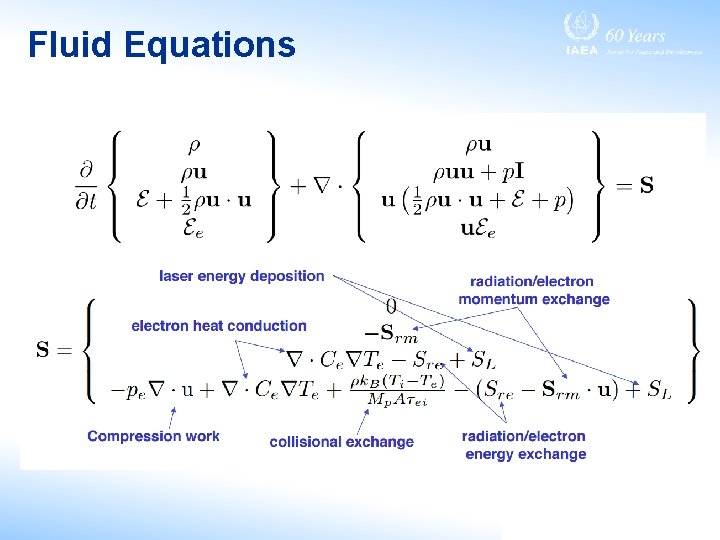
Fluid Equations
Equation of State (EOS) • Non-ideal, strongly coupled states • Need to know how the density of a material varies with pressure • EOS results are often shown as the pressure and density produced by a shock wave. • Generally atomic states are assumed in the local thermodynamic equilibrium (LTE). – A plasma state is a function of local plasma conditions (Ne, Te) – Atomic level population distribution and charge state distribution is a simple function of plasma conditions • Boltzmann and Saha equilibrium equations
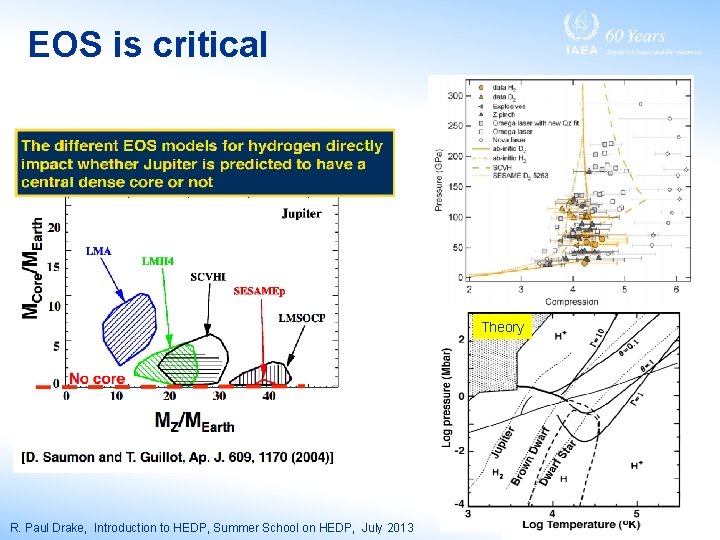
EOS is critical Theory R. Paul Drake, Introduction to HEDP, Summer School on HEDP, July 2013
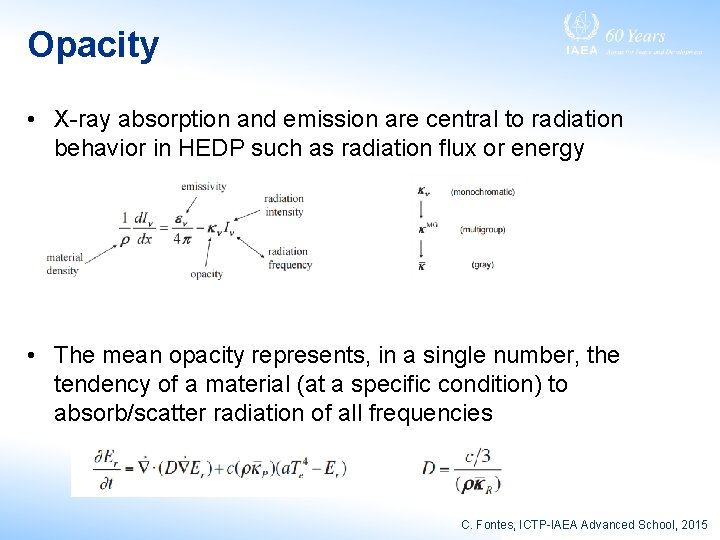
Opacity • X-ray absorption and emission are central to radiation behavior in HEDP such as radiation flux or energy • The mean opacity represents, in a single number, the tendency of a material (at a specific condition) to absorb/scatter radiation of all frequencies C. Fontes, ICTP-IAEA Advanced School, 2015
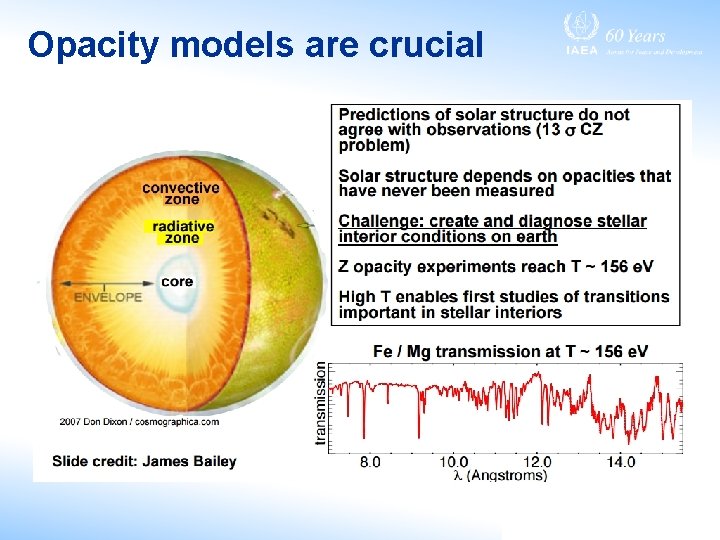
Opacity models are crucial
Non-Local Thermodynamic Equilibrium (Non-LTE) Kinetics • Both equation of state and opacity calculations require information on atomic state or level population distribution. • Calculations are often carried out with the LTE assumptions. However, this often leads to erroneous results of hydrodynamics calculations. • Most laboratory plasmas are not in the LTE state due to a finite size of plasmas (escaping radiation), finite densities, and finite time scales. • Collisional and radiative (CR) processes in plasmas should be considered to determine the atomic state.
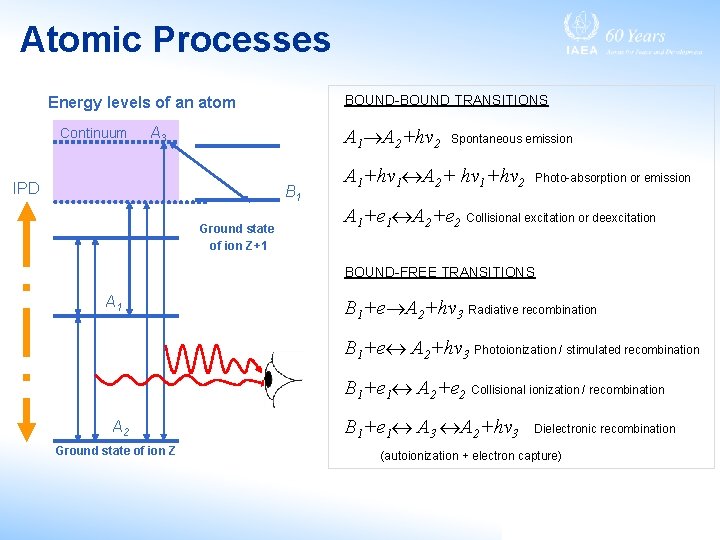
Atomic Processes BOUND-BOUND TRANSITIONS Energy levels of an atom Continuum A 1 A 2+hv 2 A 3 IPD B 1 Ground state of ion Z+1 Spontaneous emission A 1+hv 1 A 2+ hv 1+hv 2 Photo-absorption or emission A 1+e 1 A 2+e 2 Collisional excitation or deexcitation BOUND-FREE TRANSITIONS A 1 B 1+e A 2+hv 3 Radiative recombination B 1+e A 2+hv 3 Photoionization / stimulated recombination B 1+e 1 A 2+e 2 Collisional ionization / recombination A 2 Ground state of ion Z B 1+e 1 A 3 A 2+hv 3 Dielectronic recombination (autoionization + electron capture)
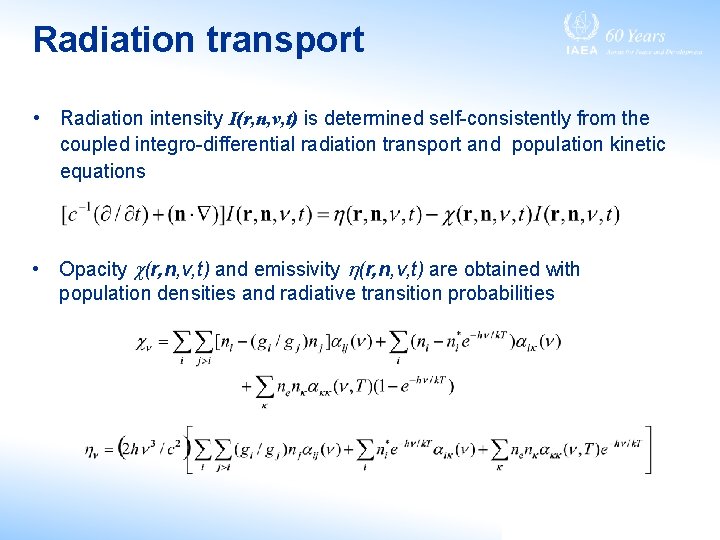
Radiation transport • Radiation intensity I(r, n, v, t) is determined self-consistently from the coupled integro-differential radiation transport and population kinetic equations • Opacity (r, n, v, t) and emissivity (r, n, v, t) are obtained with population densities and radiative transition probabilities
PLASMAS GENERATED BY X-RAY FREE ELECTRON LASERS
L. Young et al. Nature 466, 45 (2010) Femtosecond electronic response of atoms to ultra-intense x-rays XFEL DRIVEN IONIZATION PROCESSES IN GAS JET PLASMA
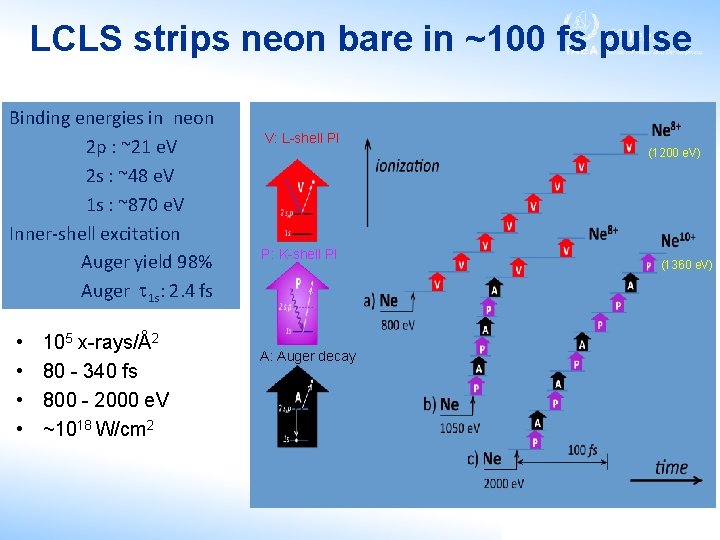
LCLS strips neon bare in ~100 fs pulse Binding energies in neon 2 p : ~21 e. V 2 s : ~48 e. V 1 s : ~870 e. V Inner-shell excitation Auger yield 98% Auger 1 s: 2. 4 fs • • 105 x-rays/Å2 80 - 340 fs 800 - 2000 e. V ~1018 W/cm 2 V: L-shell PI (1200 e. V) P: K-shell PI A: Auger decay (1360 e. V)
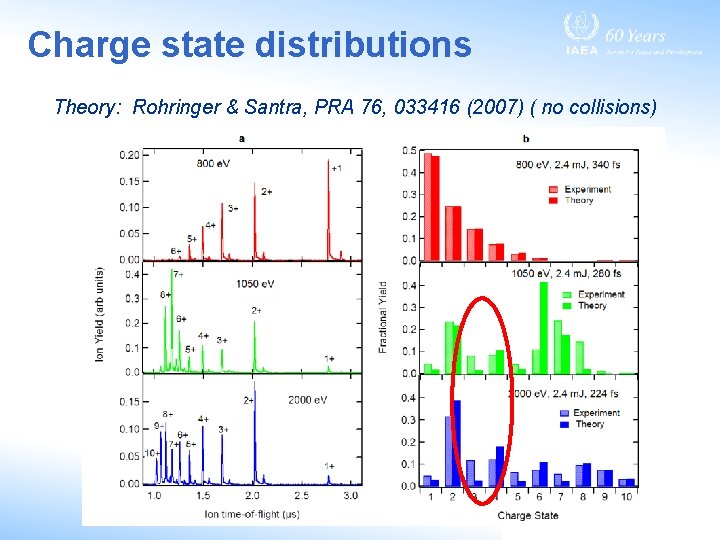
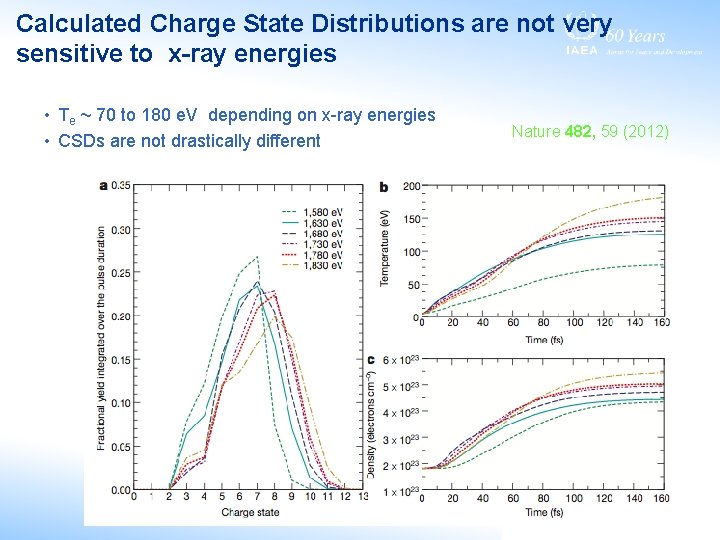
Charge state distributions Theory: Rohringer & Santra, PRA 76, 033416 (2007) ( no collisions)
S. Vinko, Nature 482, 59 (2012) Creation and diagnosis of solid-density hot-dense matter with an XFEL Ciricosta, PRL, 109, 065002 (2012) Direct Measurements of the IPD in a Dense Plasma XFEL DRIVEN IONIZATION PROCESSES IN SOLID TARGET
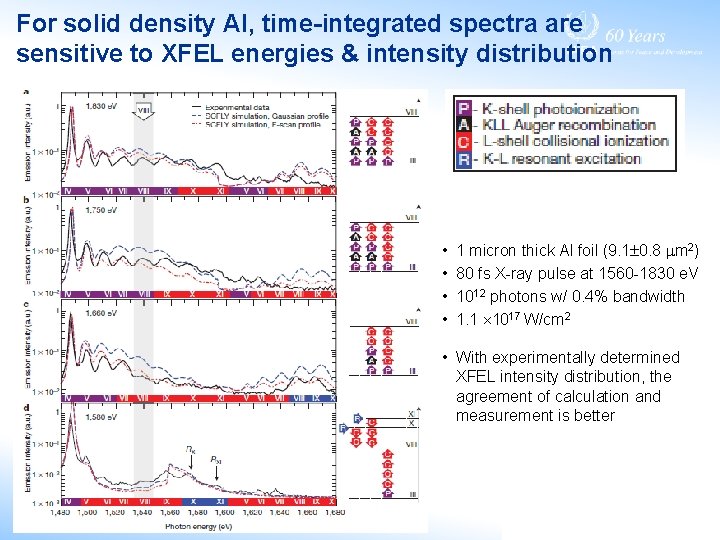
For solid density Al, time-integrated spectra are sensitive to XFEL energies & intensity distribution • • 1 micron thick Al foil (9. 1 0. 8 m 2) 80 fs X-ray pulse at 1560 -1830 e. V 1012 photons w/ 0. 4% bandwidth 1. 1 1017 W/cm 2 • With experimentally determined XFEL intensity distribution, the agreement of calculation and measurement is better
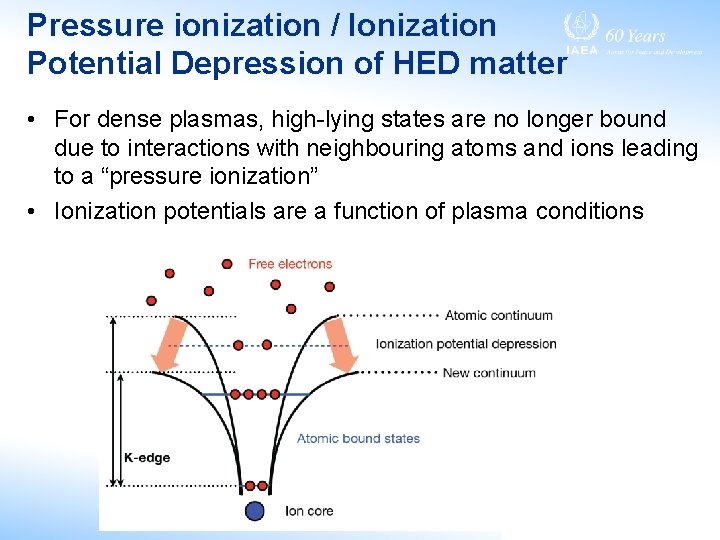
Pressure ionization / Ionization Potential Depression of HED matter • For dense plasmas, high-lying states are no longer bound due to interactions with neighbouring atoms and ions leading to a “pressure ionization” • Ionization potentials are a function of plasma conditions
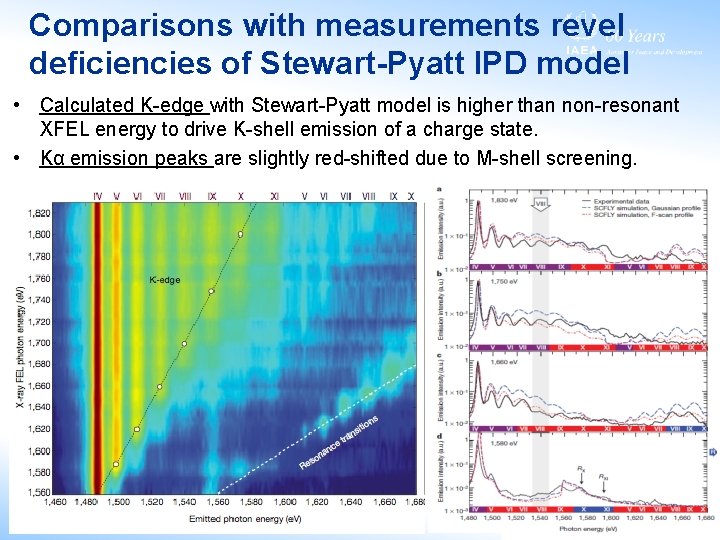
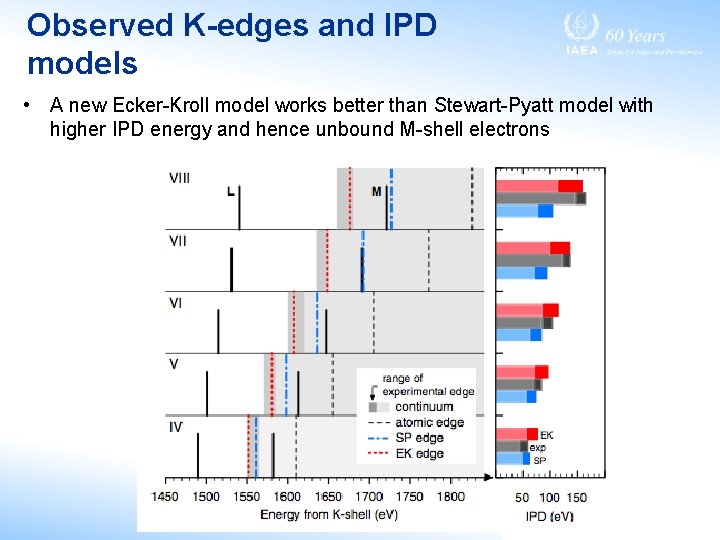
Comparisons with measurements revel deficiencies of Stewart-Pyatt IPD model • Calculated K-edge with Stewart-Pyatt model is higher than non-resonant XFEL energy to drive K-shell emission of a charge state. • Kα emission peaks are slightly red-shifted due to M-shell screening.
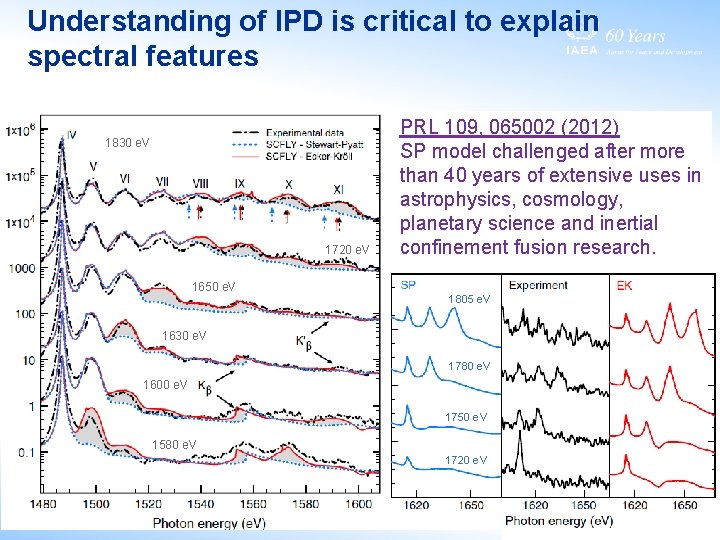
Understanding of IPD is critical to explain spectral features 1830 e. V 1720 e. V 1650 e. V PRL 109, 065002 (2012) SP model challenged after more than 40 years of extensive uses in astrophysics, cosmology, planetary science and inertial confinement fusion research. 1805 e. V 1630 e. V 1780 e. V 1600 e. V 1750 e. V 1580 e. V 1720 e. V
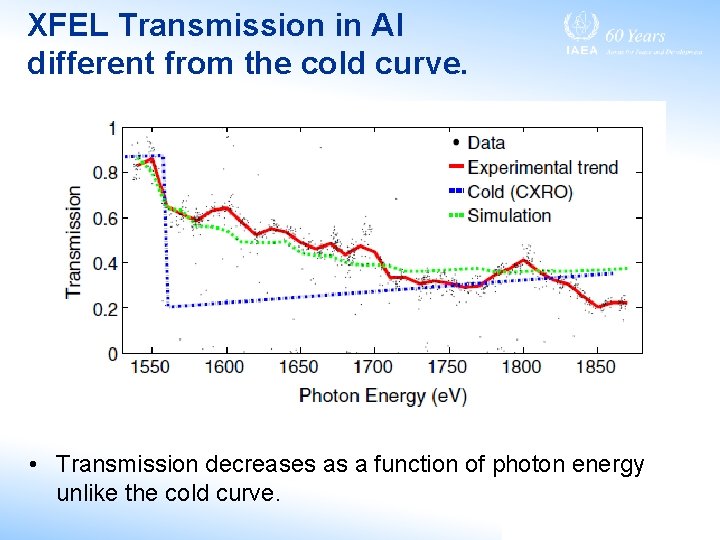
Rackstraw, PRL, 114, 015003 (2015) Saturable Absorption of an XFEL Heated Solid-Density Al Plasma SATURABLE ABSORPTION OF XFEL HEATED SOLID PLASMA
XFEL Transmission in Al different from the cold curve. • Transmission decreases as a function of photon energy unlike the cold curve.
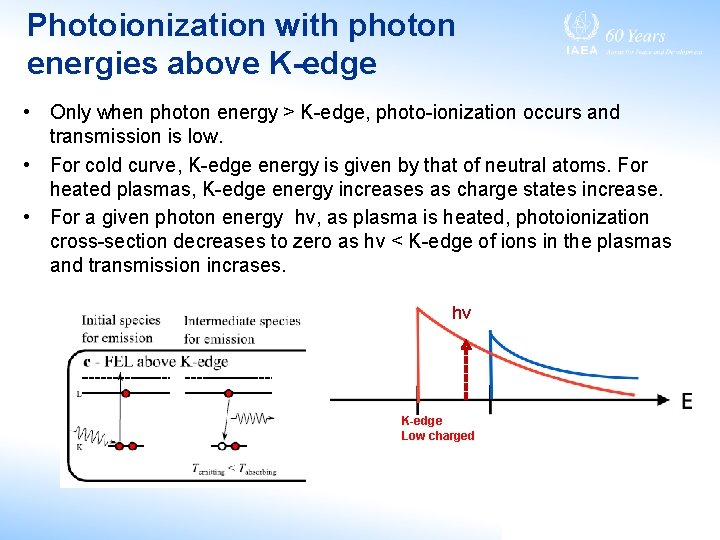
Photoionization with photon energies above K-edge • Only when photon energy > K-edge, photo-ionization occurs and transmission is low. • For cold curve, K-edge energy is given by that of neutral atoms. For heated plasmas, K-edge energy increases as charge states increase. • For a given photon energy hν, as plasma is heated, photoionization cross-section decreases to zero as hν < K-edge of ions in the plasmas and transmission incrases. hv K-edge Low charged K-edge High charged ions
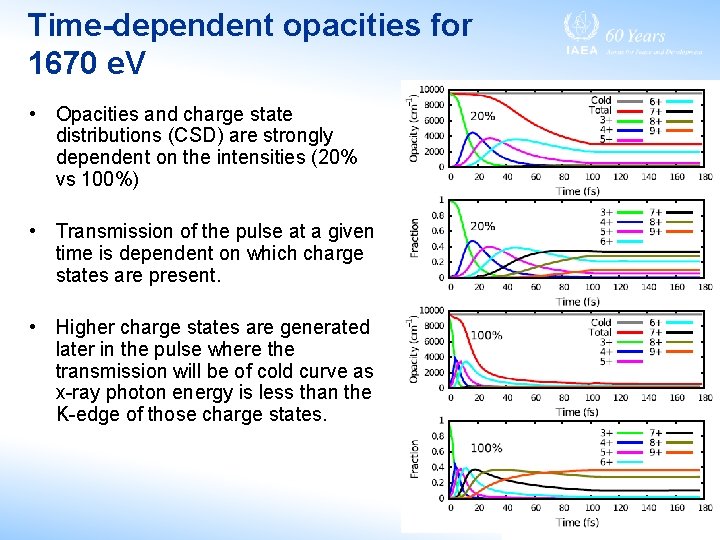
Time-dependent opacities for 1670 e. V • Opacities and charge state distributions (CSD) are strongly dependent on the intensities (20% vs 100%) • Transmission of the pulse at a given time is dependent on which charge states are present. • Higher charge states are generated later in the pulse where the transmission will be of cold curve as x-ray photon energy is less than the K-edge of those charge states.
FLYCHK code: http: //nlte. nist. gov/FLY • A time-dependent collisional-radiative model to provide charge state distributions and spectral intensities • Applications – – – Long-pulse laser produced plasmas Short-pulse laser produced plasmas XFEL laser produced plasmas Electron beam produced plasmas Time-dependent plasmas Tokamak plasmas • More than 750 registered users • Cited by ~ 300 times since 2005
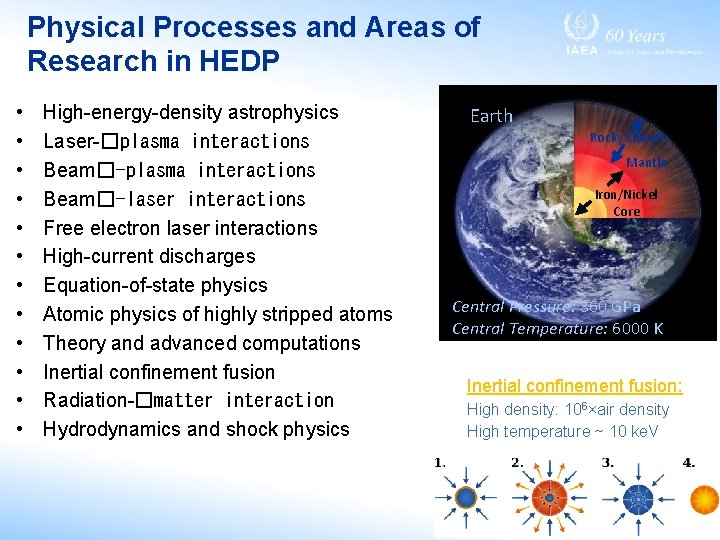
Physical Processes and Areas of Research in HEDP • • • High-energy-density astrophysics Laser-�plasma interactions Beam�-laser interactions Free electron laser interactions High-current discharges Equation-of-state physics Atomic physics of highly stripped atoms Theory and advanced computations Inertial confinement fusion Radiation-�matter interaction Hydrodynamics and shock physics Earth Rocky Silicate Mantle Iron/Nickel Core Central Pressure: 360 GPa Central Temperature: 6000 K Inertial confinement fusion: High density: 106×air density High temperature ~ 10 ke. V
Thank you!
EXTRA SLIDES
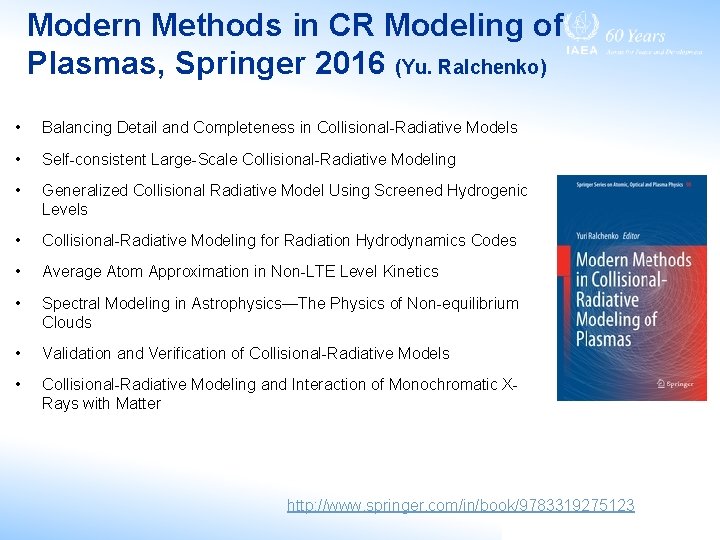
Modern Methods in CR Modeling of Plasmas, Springer 2016 (Yu. Ralchenko) • Balancing Detail and Completeness in Collisional-Radiative Models • Self-consistent Large-Scale Collisional-Radiative Modeling • Generalized Collisional Radiative Model Using Screened Hydrogenic Levels • Collisional-Radiative Modeling for Radiation Hydrodynamics Codes • Average Atom Approximation in Non-LTE Level Kinetics • Spectral Modeling in Astrophysics—The Physics of Non-equilibrium Clouds • Validation and Verification of Collisional-Radiative Models • Collisional-Radiative Modeling and Interaction of Monochromatic XRays with Matter http: //www. springer. com/in/book/9783319275123
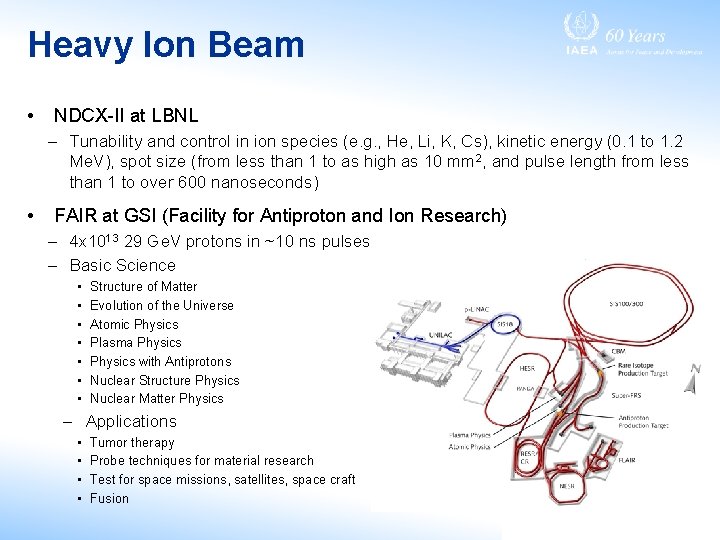
Heavy Ion Beam • NDCX-II at LBNL – Tunability and control in ion species (e. g. , He, Li, K, Cs), kinetic energy (0. 1 to 1. 2 Me. V), spot size (from less than 1 to as high as 10 mm 2, and pulse length from less than 1 to over 600 nanoseconds) • FAIR at GSI (Facility for Antiproton and Ion Research) – 4 x 10¹³ 29 Ge. V protons in ~10 ns pulses – Basic Science • • Structure of Matter Evolution of the Universe Atomic Physics Plasma Physics with Antiprotons Nuclear Structure Physics Nuclear Matter Physics – Applications • • Tumor therapy Probe techniques for material research Test for space missions, satellites, space craft Fusion
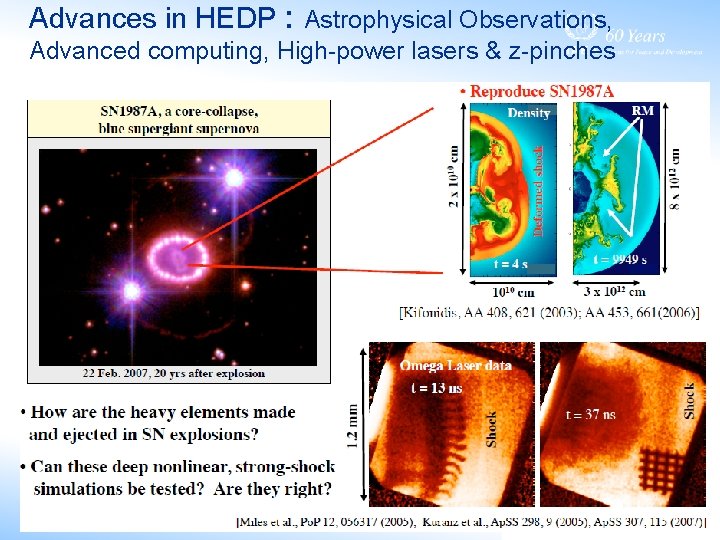
Advances in HEDP : Astrophysical Observations, Advanced computing, High-power lasers & z-pinches
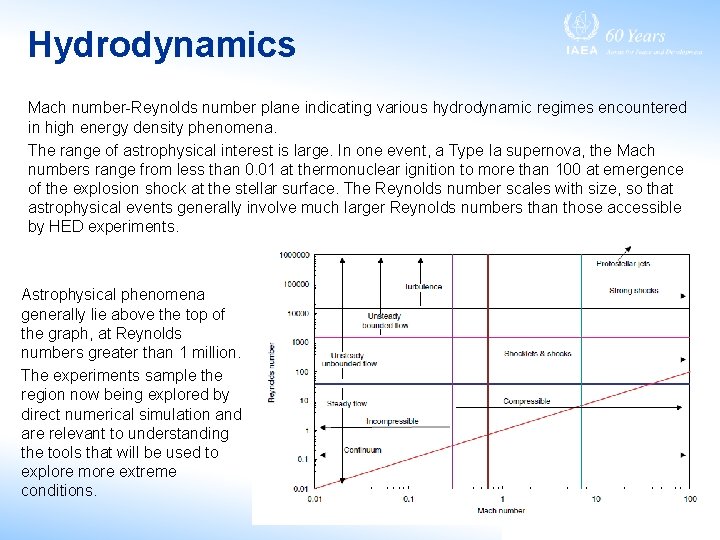
Hydrodynamics Mach number-Reynolds number plane indicating various hydrodynamic regimes encountered in high energy density phenomena. The range of astrophysical interest is large. In one event, a Type Ia supernova, the Mach numbers range from less than 0. 01 at thermonuclear ignition to more than 100 at emergence of the explosion shock at the stellar surface. The Reynolds number scales with size, so that astrophysical events generally involve much larger Reynolds numbers than those accessible by HED experiments. Astrophysical phenomena generally lie above the top of the graph, at Reynolds numbers greater than 1 million. The experiments sample the region now being explored by direct numerical simulation and are relevant to understanding the tools that will be used to explore more extreme conditions.
Matter at Extreme states 10 -8 1 108 1018 V. E. Fortov, Extreme States of Matter (2015) Springer
Astrophysics Connections • 90~95% of the mass of baryon (visible) matter in stellar and interstellar objects, planets, and exoplanets are in the extreme states – High Mach number flows, Fast shocks, Ionization, Strong B fields, – Radiation matters, Plasma hydrodynamics R. Paul Drake, Introduction to HEDP, Summer School on HEDP, July 2013
Definition of High Energy Density (HED) Lowest bound of HED: external energy density comparable to the material’s room temperature energy density • The energy density of a hydrogen molecule and the bulk moduli of solid-state materials are similar about 1011 J/m 3 (The pressure is ~ 1 Mbar). Electron Temperature (e. V) • R. Paul Drake, Introduction to HEDP, Summer School on HEDP, July 2013
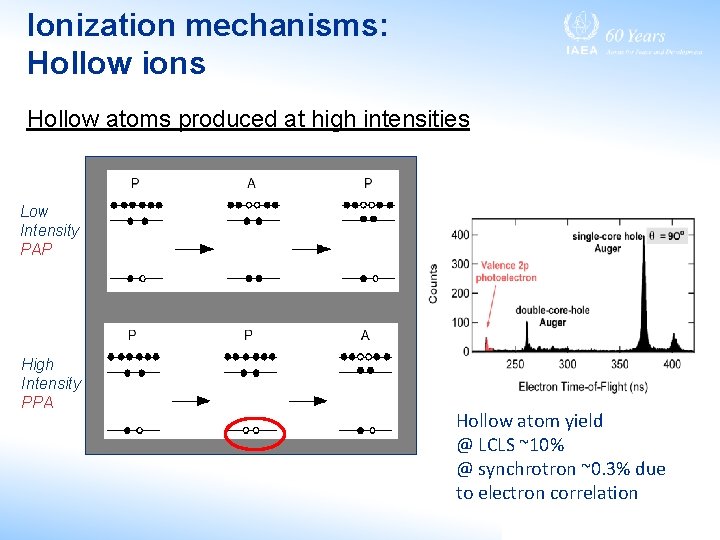
Ionization mechanisms: Hollow ions Hollow atoms produced at high intensities Low Intensity PAP High Intensity PPA Hollow atom yield @ LCLS ~10% @ synchrotron ~0. 3% due to electron correlation
Calculated Charge State Distributions are not very sensitive to x-ray energies • Te ~ 70 to 180 e. V depending on x-ray energies • CSDs are not drastically different Nature 482, 59 (2012)
Observed K-edges and IPD models • A new Ecker-Kroll model works better than Stewart-Pyatt model with higher IPD energy and hence unbound M-shell electrons
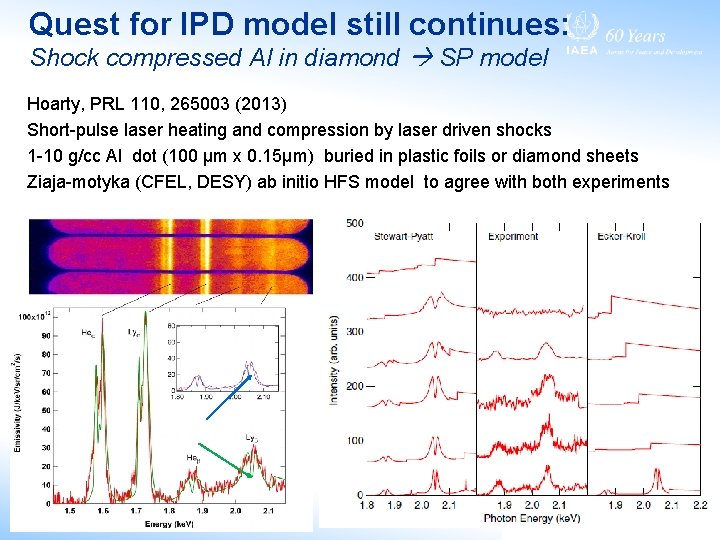
Quest for IPD model still continues: Shock compressed Al in diamond SP model Hoarty, PRL 110, 265003 (2013) Short-pulse laser heating and compression by laser driven shocks 1 -10 g/cc Al dot (100 μm x 0. 15μm) buried in plastic foils or diamond sheets Ziaja-motyka (CFEL, DESY) ab initio HFS model to agree with both experiments 9 g/cc 5. 5 g/cc 4 g/cc FLYCHK 2. 5 g/cc 1. 2 g/cc
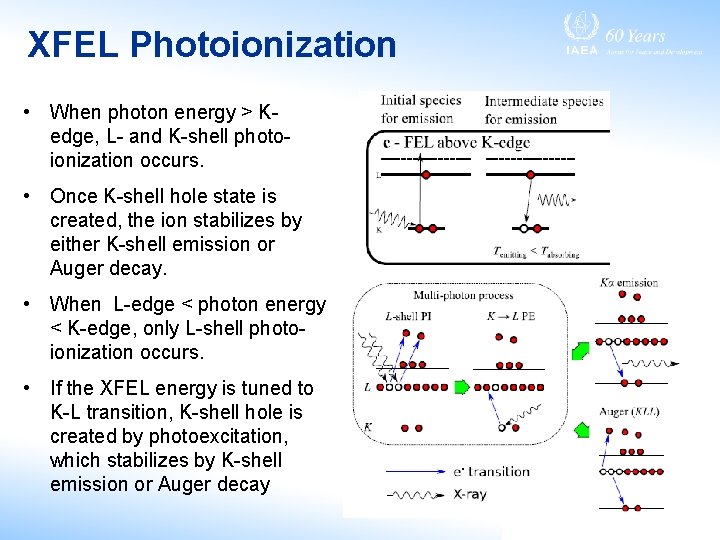
XFEL Photoionization • When photon energy > Kedge, L- and K-shell photoionization occurs. • Once K-shell hole state is created, the ion stabilizes by either K-shell emission or Auger decay. • When L-edge < photon energy < K-edge, only L-shell photoionization occurs. • If the XFEL energy is tuned to K-L transition, K-shell hole is created by photoexcitation, which stabilizes by K-shell emission or Auger decay K-edge High charged ions
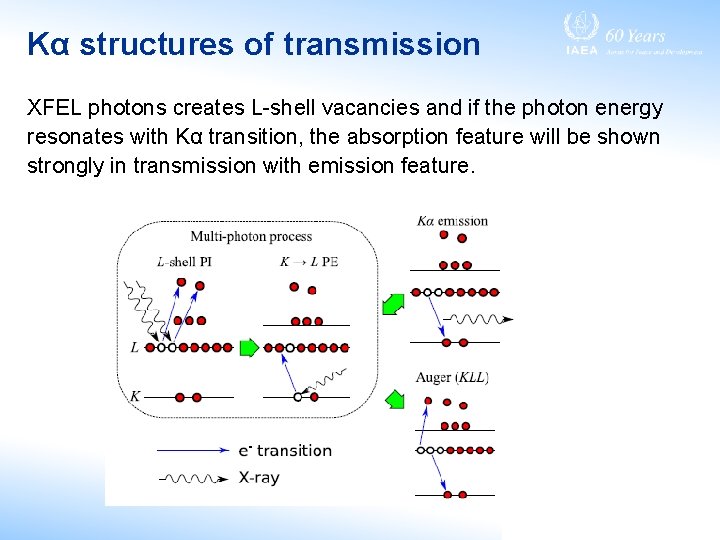
Kα structures of transmission XFEL photons creates L-shell vacancies and if the photon energy resonates with Kα transition, the absorption feature will be shown strongly in transmission with emission feature.
Issues of XFEL modeling by NLTE model v Complex Absorption mechanism v Completeness of relevant configuration sets and transitions v IPD (Ionization Potential Depression) v Non-thermal electron energy distribution v Initial lattice effects and Fermi-Dirac distribution v Multi-photon absorption