
Atomic Operations in Hardware Previously we introduced multicore

- Slides: 18
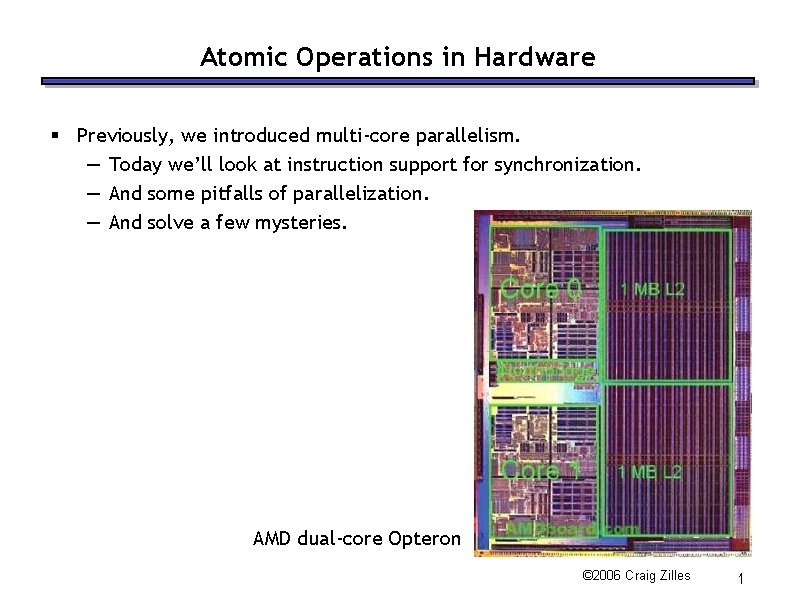
Atomic Operations in Hardware § Previously, we introduced multi-core parallelism. — Today we’ll look at instruction support for synchronization. — And some pitfalls of parallelization. — And solve a few mysteries. AMD dual-core Opteron © 2006 Craig Zilles 1
A simple piece of code unsigned counter = 0; void *do_stuff(void * arg) { for (int i = 0 ; i < 20000 ; ++ i) { counter ++; adds one to counter } return arg; } How long does this program take? How can we make it faster? 2
A simple piece of code unsigned counter = 0; void *do_stuff(void * arg) { for (int i = 0 ; i < 20000 ; ++ i) { counter ++; adds one to counter } return arg; } How long does this program take? Time for 20000 iterations How can we make it faster? Run iterations in parallel 3
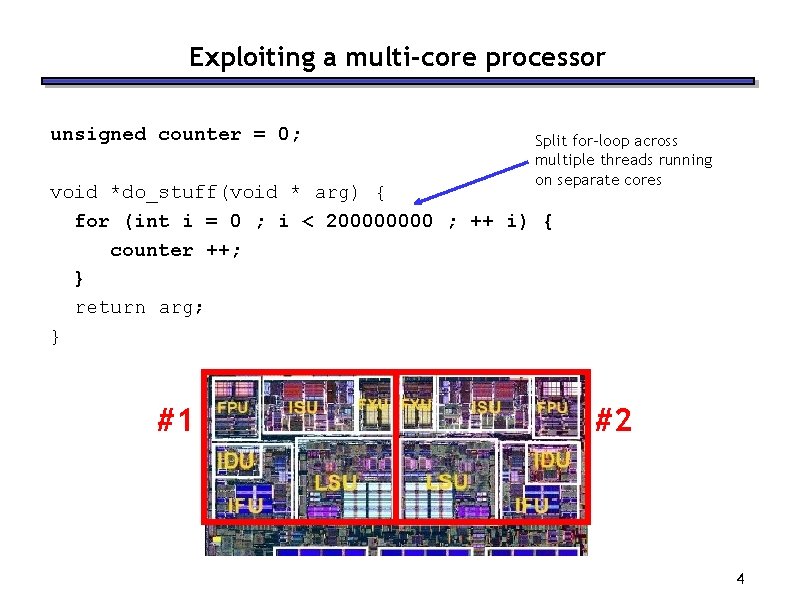
Exploiting a multi-core processor unsigned counter = 0; Split for-loop across multiple threads running on separate cores void *do_stuff(void * arg) { for (int i = 0 ; i < 20000 ; ++ i) { counter ++; } return arg; } #1 #2 4
How much faster? 5
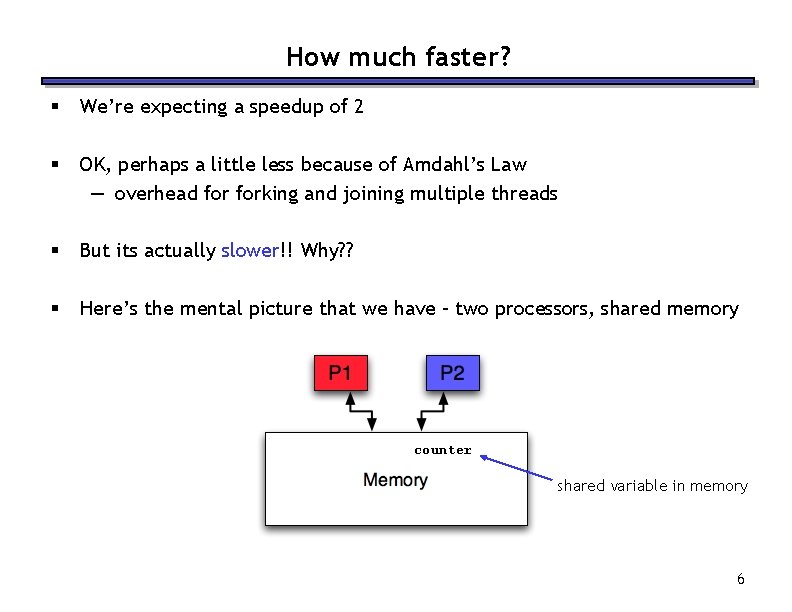
How much faster? § We’re expecting a speedup of 2 § OK, perhaps a little less because of Amdahl’s Law — overhead forking and joining multiple threads § But its actually slower!! Why? ? § Here’s the mental picture that we have – two processors, shared memory counter shared variable in memory 6
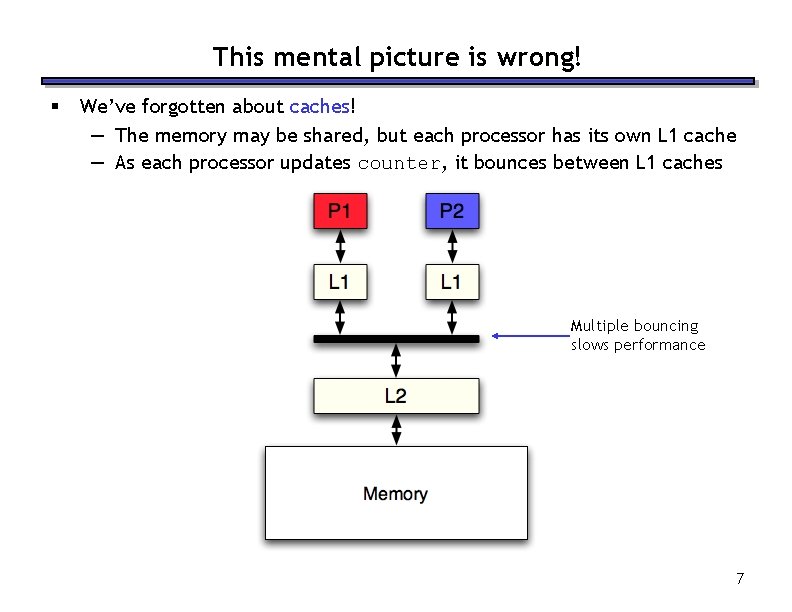
This mental picture is wrong! § We’ve forgotten about caches! — The memory may be shared, but each processor has its own L 1 cache — As each processor updates counter, it bounces between L 1 caches Multiple bouncing slows performance 7
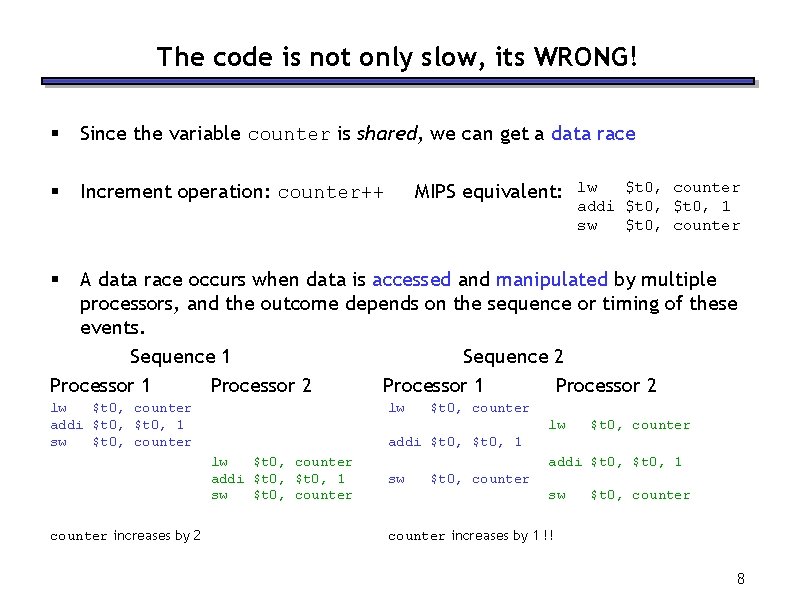
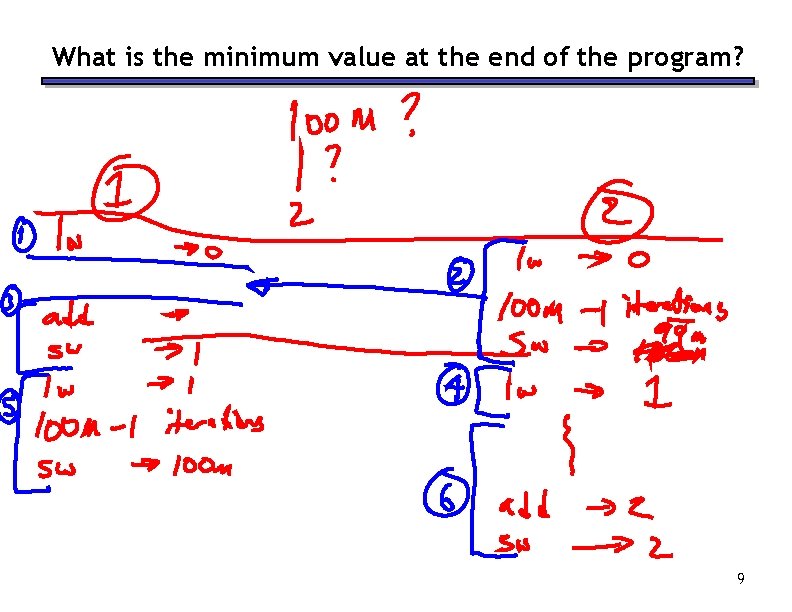
The code is not only slow, its WRONG! § Since the variable counter is shared, we can get a data race § Increment operation: counter++ MIPS equivalent: lw $t 0, counter addi $t 0, 1 sw $t 0, counter A data race occurs when data is accessed and manipulated by multiple processors, and the outcome depends on the sequence or timing of these events. Sequence 1 Sequence 2 Processor 1 Processor 2 § lw $t 0, counter addi $t 0, 1 sw $t 0, counter lw lw $t 0, counter addi $t 0, 1 sw $t 0, counter increases by 2 $t 0, counter addi $t 0, 1 sw $t 0, counter increases by 1 !! 8
What is the minimum value at the end of the program? 9
Atomic operations § You can show that if the sequence is particularly nasty, the final value of counter may be as little as 2, instead of 20000. § To fix this, we must do the load-add-store in a single step — We call this an atomic operation — We’re saying: “Do this, and don’t get interrupted while doing this. ” § “Atomic” in this context means “all or nothing” — either we succeed in completing the operation with no interruptions or we fail to even begin the operation (because someone else was doing an atomic operation) — We really mean “atomic” AND “isolated” from other threads. § x 86 provides a “lock” prefix that tells the hardware: “don’t let anyone read/write the value until I’m done with it” — Not the default case (because it is slow!) 10
What if we want to generalize beyond increments? § § The lock prefix only works for individual x 86 instructions. What if we want to execute an arbitrary region of code without interference? — Consider a red-black tree used by multiple threads. 11
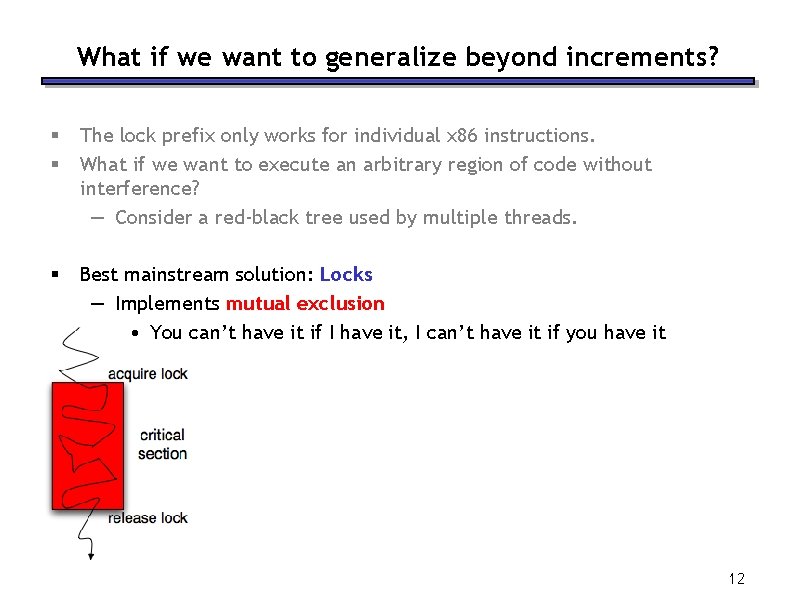
What if we want to generalize beyond increments? § § The lock prefix only works for individual x 86 instructions. What if we want to execute an arbitrary region of code without interference? — Consider a red-black tree used by multiple threads. § Best mainstream solution: Locks — Implements mutual exclusion • You can’t have it if I have it, I can’t have it if you have it 12
What if we want to generalize beyond increments? § § The lock prefix only works for individual x 86 instructions. What if we want to execute an arbitrary region of code without interference? — Consider a red-black tree used by multiple threads. § Best mainstream solution: Locks — Implement “mutual exclusion” • You can’t have it if I have, I can’t have it if you have it when lock = 0, set lock = 1, continue lock = 0 13
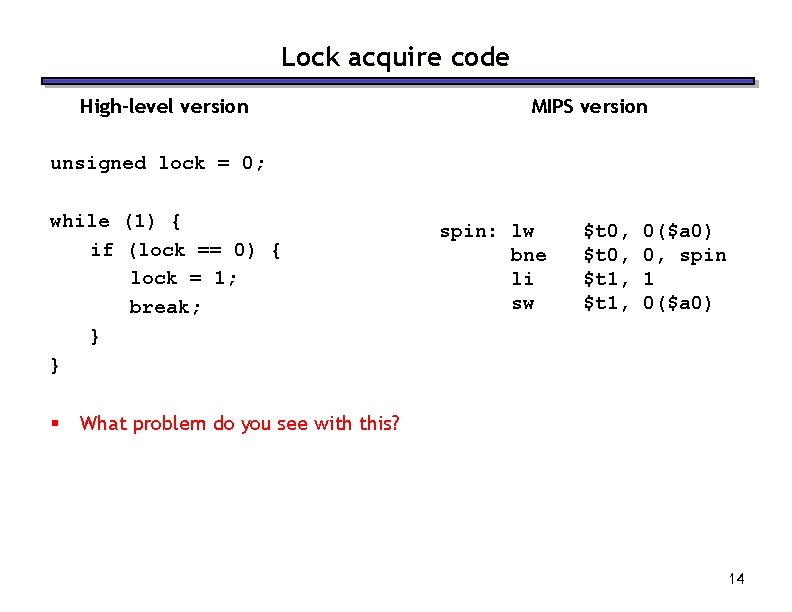
Lock acquire code High-level version MIPS version unsigned lock = 0; while (1) { if (lock == 0) { lock = 1; break; } } § spin: lw bne li sw $t 0, $t 1, 0($a 0) 0, spin 1 0($a 0) What problem do you see with this? 14
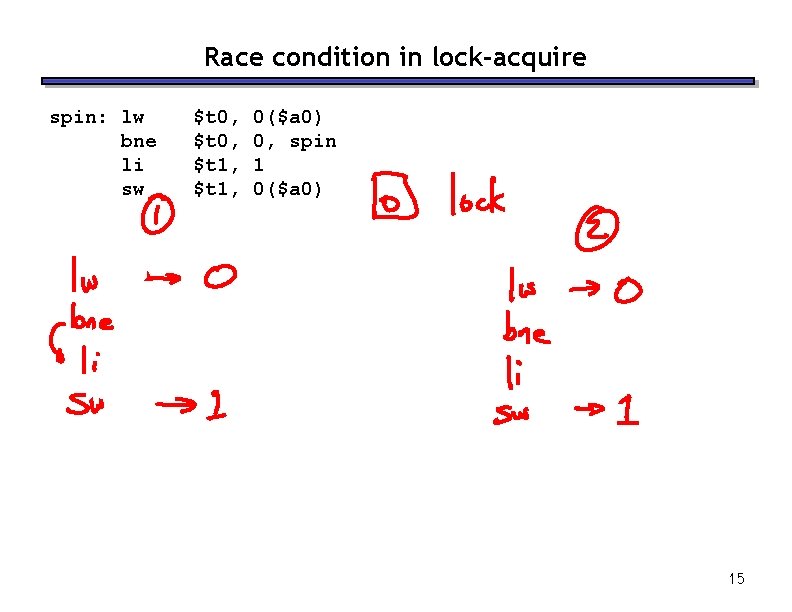
Race condition in lock-acquire spin: lw bne li sw $t 0, $t 1, 0($a 0) 0, spin 1 0($a 0) 15
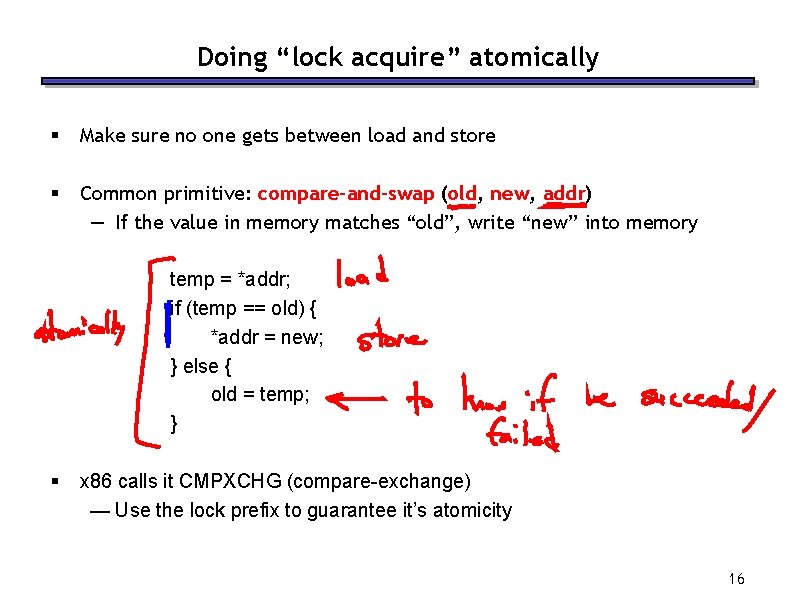
Doing “lock acquire” atomically § Make sure no one gets between load and store § Common primitive: compare-and-swap (old, new, addr) — If the value in memory matches “old”, write “new” into memory temp = *addr; if (temp == old) { *addr = new; } else { old = temp; } § x 86 calls it CMPXCHG (compare-exchange) — Use the lock prefix to guarantee it’s atomicity 16
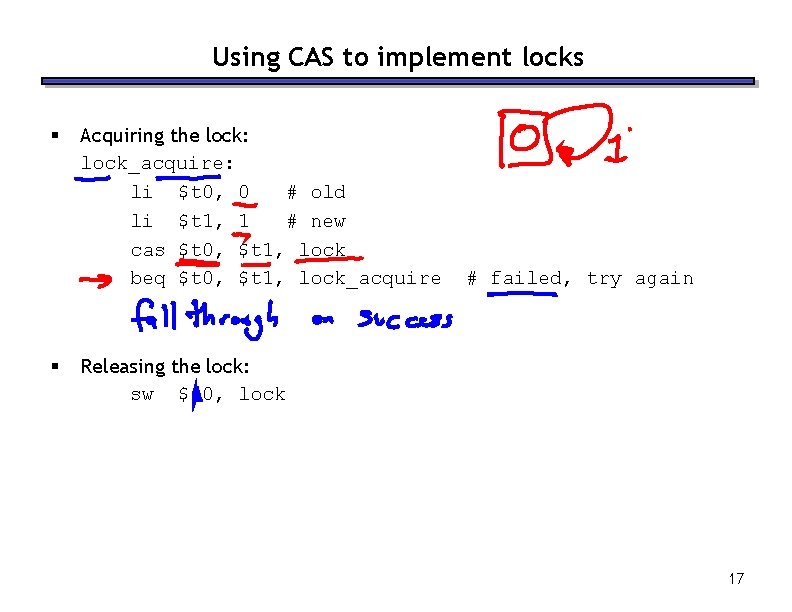
Using CAS to implement locks § § Acquiring the lock: lock_acquire: li $t 0, 0 # old li $t 1, 1 # new cas $t 0, $t 1, lock beq $t 0, $t 1, lock_acquire # failed, try again Releasing the lock: sw $t 0, lock 17
Conclusions § § When parallel threads access the same data, potential for data races — Even true on uniprocessors due to context switching We can prevent data races by enforcing mutual exclusion — Allowing only one thread to access the data at a time — For the duration of a critical section Mutual exclusion can be enforced by locks — Programmer allocates a variable to “protect” shared data — Program must perform: 0 1 transition before data access — 1 0 transition after Locks can be implemented with atomic operations — (hardware instructions that enforce mutual exclusion on 1 data item) — compare-and-swap • If address holds “old”, replace with “new” 18