
Atomic Models Democritus to the Modern Model Overview


- Slides: 18
Atomic Models Democritus to the Modern Model
Overview: Atomic Models Throughout History • Democritus (~400 BC) • Dalton (1800) • Thomson (1897) • Rutherford (1908) • Bohr (1913) • Wave Model-often called the “Electron. Cloud Model” or the Modern Model
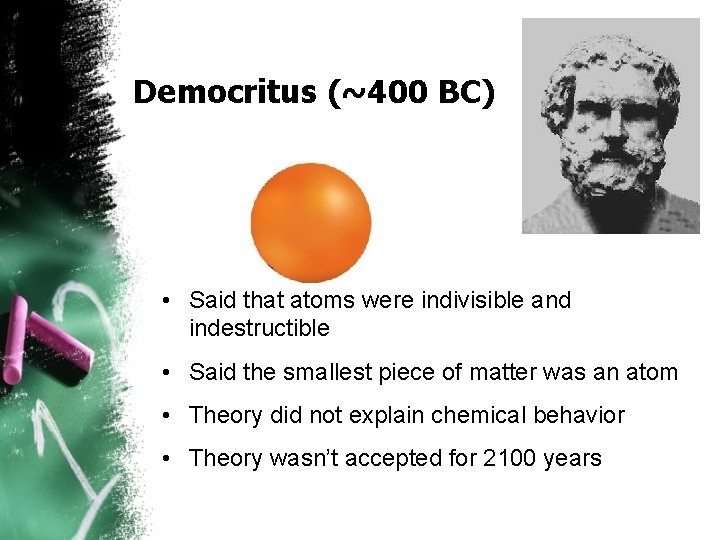
Democritus (~400 BC) • Said that atoms were indivisible and indestructible • Said the smallest piece of matter was an atom • Theory did not explain chemical behavior • Theory wasn’t accepted for 2100 years
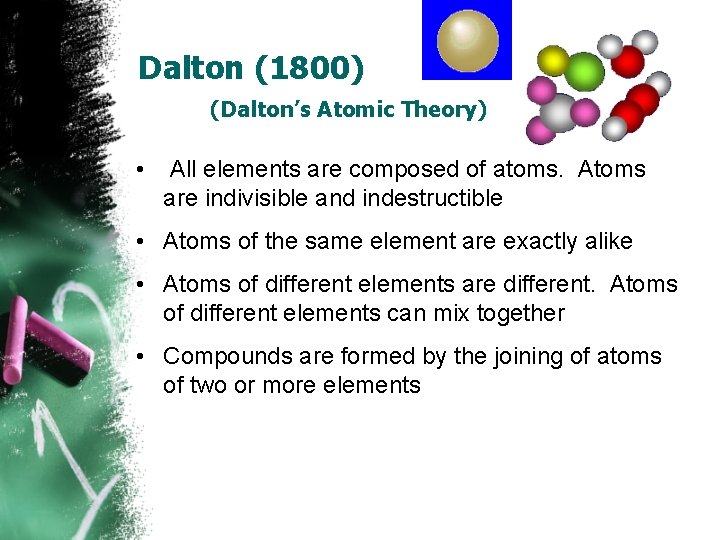
Dalton (1800) (Dalton’s Atomic Theory) • All elements are composed of atoms. Atoms are indivisible and indestructible • Atoms of the same element are exactly alike • Atoms of different elements are different. Atoms of different elements can mix together • Compounds are formed by the joining of atoms of two or more elements
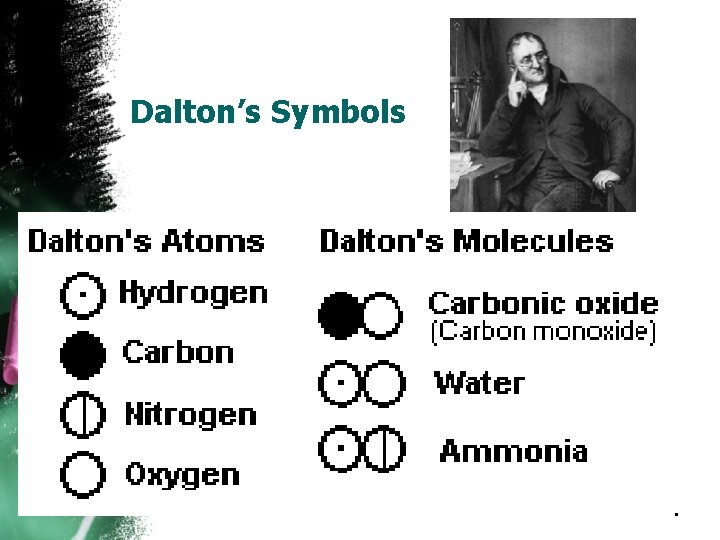
Dalton’s Symbols
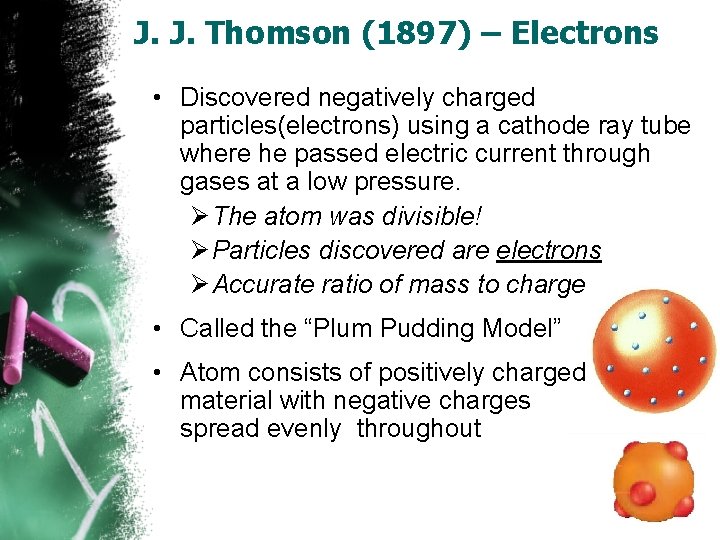
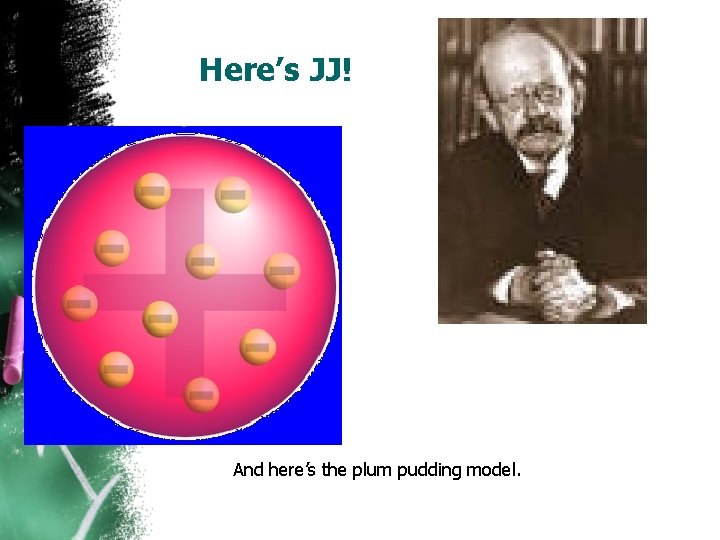
J. J. Thomson (1897) – Electrons • Discovered negatively charged particles(electrons) using a cathode ray tube where he passed electric current through gases at a low pressure. Ø The atom was divisible! Ø Particles discovered are electrons Ø Accurate ratio of mass to charge • Called the “Plum Pudding Model” • Atom consists of positively charged material with negative charges spread evenly throughout
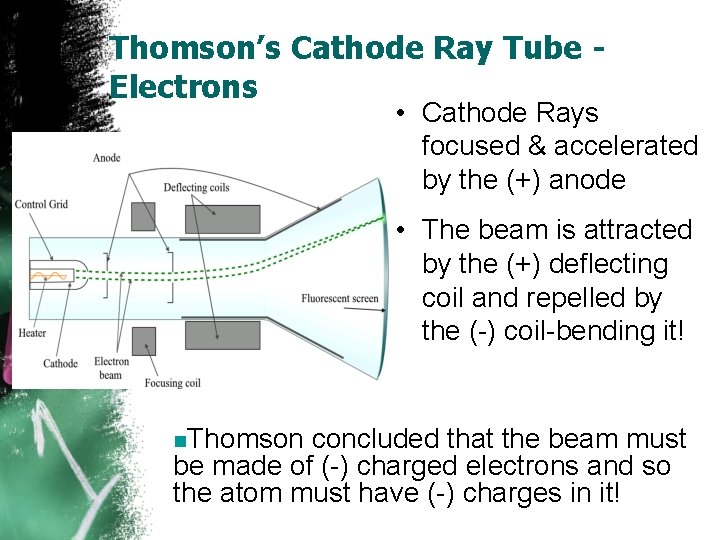
Thomson’s Cathode Ray Tube Electrons • Cathode Rays focused & accelerated by the (+) anode • The beam is attracted by the (+) deflecting coil and repelled by the (-) coil-bending it! n. Thomson concluded that the beam must be made of (-) charged electrons and so the atom must have (-) charges in it!
Here’s JJ! And here’s the plum pudding model.
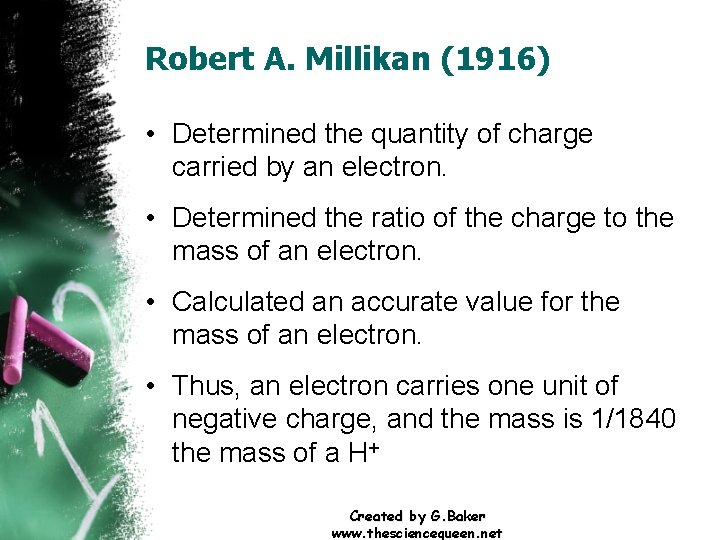
Robert A. Millikan (1916) • Determined the quantity of charge carried by an electron. • Determined the ratio of the charge to the mass of an electron. • Calculated an accurate value for the mass of an electron. • Thus, an electron carries one unit of negative charge, and the mass is 1/1840 the mass of a H+ Created by G. Baker www. thesciencequeen. net
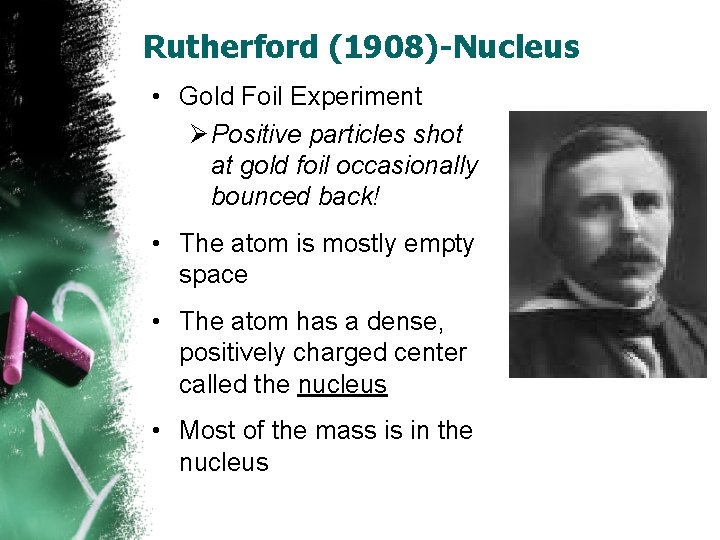
Rutherford (1908)-Nucleus • Gold Foil Experiment Ø Positive particles shot at gold foil occasionally bounced back! • The atom is mostly empty space • The atom has a dense, positively charged center called the nucleus • Most of the mass is in the nucleus
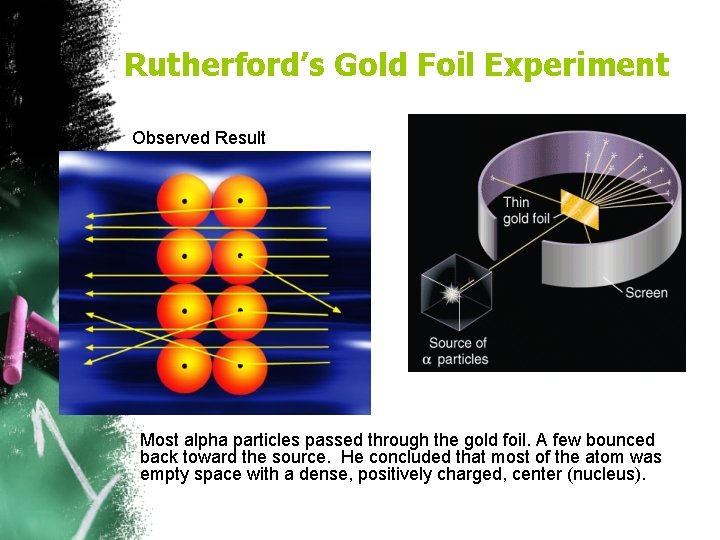
Rutherford’s Gold Foil Experiment Observed Result Most alpha particles passed through the gold foil. A few bounced back toward the source. He concluded that most of the atom was empty space with a dense, positively charged, center (nucleus).
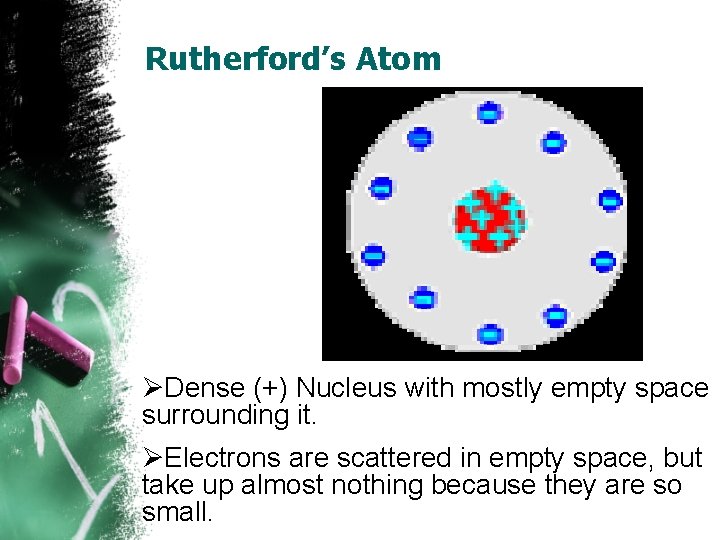
Rutherford’s Atom ØDense (+) Nucleus with mostly empty space surrounding it. ØElectrons are scattered in empty space, but take up almost nothing because they are so small.
James Chadwick - Neutron • Confirmed the existence of the neutron. Ø No charge Ø Mass approximately equal to the proton
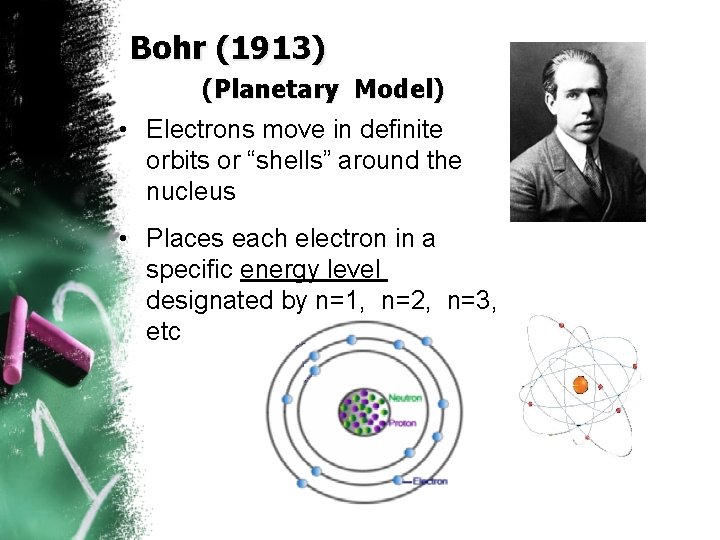
Bohr (1913) (Planetary Model) • Electrons move in definite orbits or “shells” around the nucleus • Places each electron in a specific energy level designated by n=1, n=2, n=3, etc
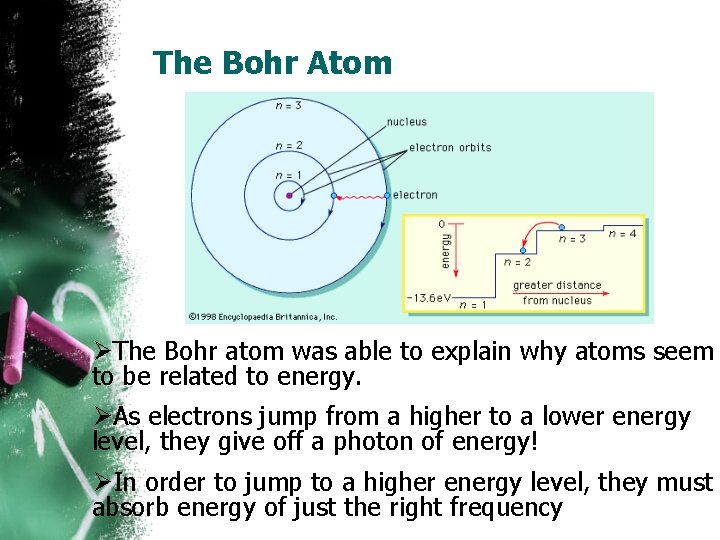
The Bohr Atom ØThe Bohr atom was able to explain why atoms seem to be related to energy. ØAs electrons jump from a higher to a lower energy level, they give off a photon of energy! ØIn order to jump to a higher energy level, they must absorb energy of just the right frequency
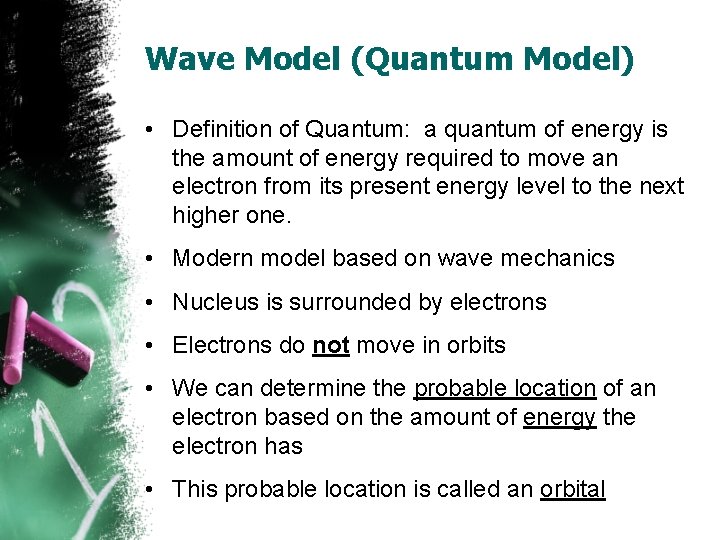
Wave Model (Quantum Model) • Definition of Quantum: a quantum of energy is the amount of energy required to move an electron from its present energy level to the next higher one. • Modern model based on wave mechanics • Nucleus is surrounded by electrons • Electrons do not move in orbits • We can determine the probable location of an electron based on the amount of energy the electron has • This probable location is called an orbital
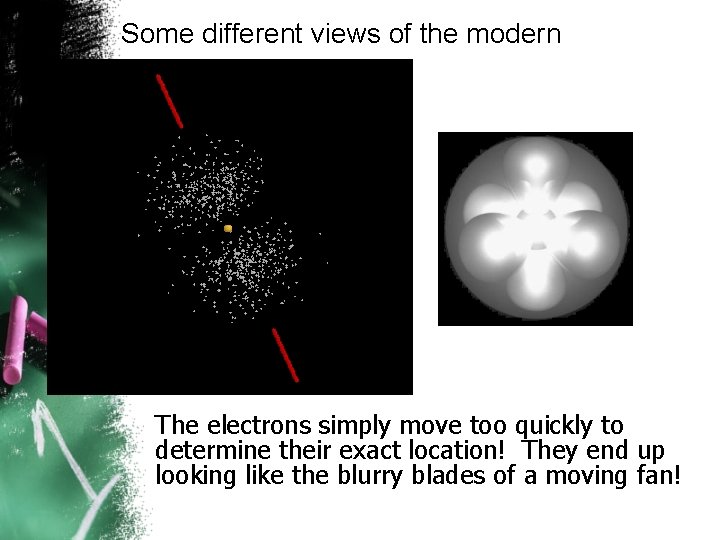
Some different views of the modern model The electrons simply move too quickly to determine their exact location! They end up looking like the blurry blades of a moving fan!