
Atomic Layer Deposition How to Protect Our Cultural
- Slides: 1
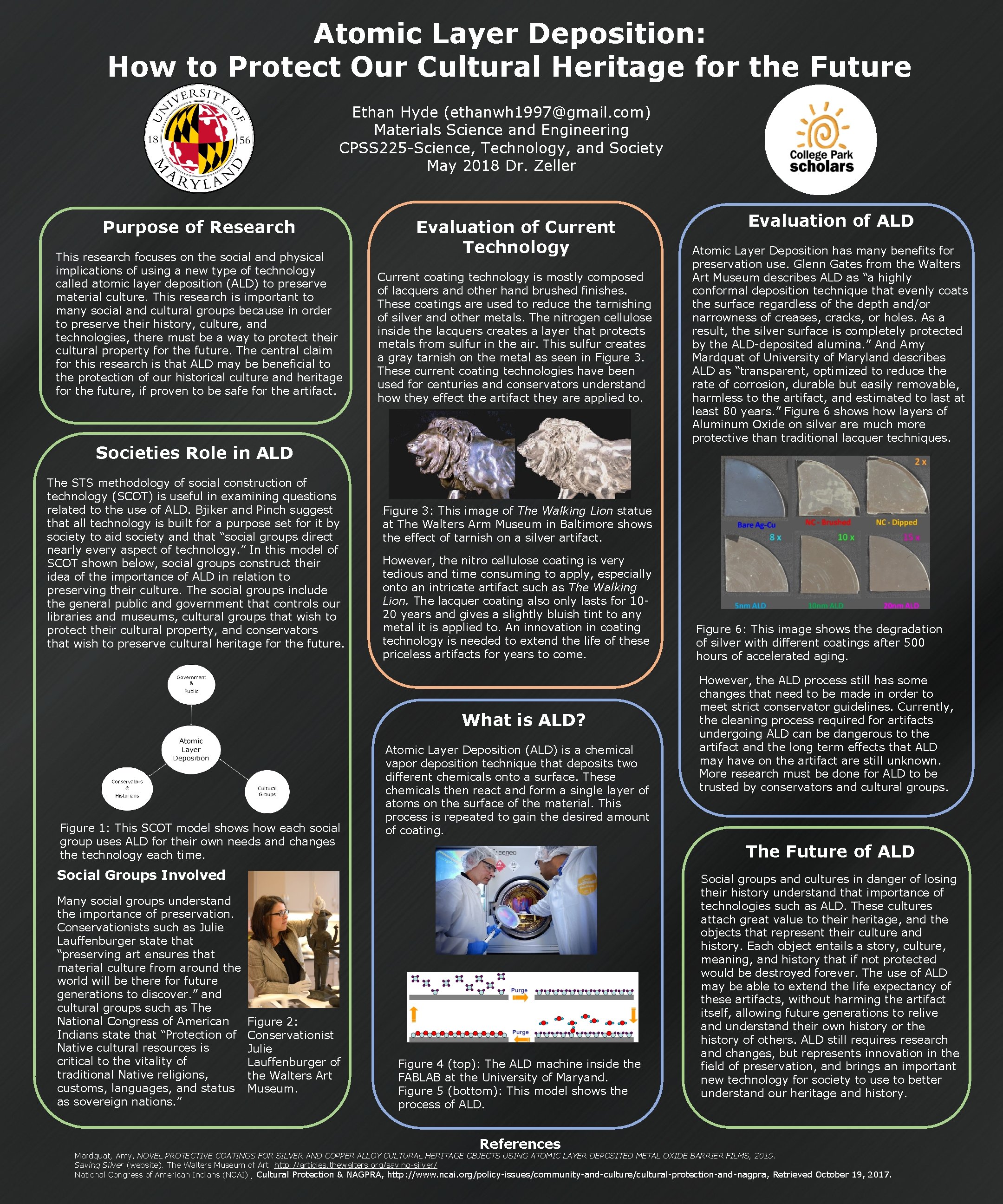
Atomic Layer Deposition: How to Protect Our Cultural Heritage for the Future Ethan Hyde (ethanwh 1997@gmail. com) Materials Science and Engineering CPSS 225 -Science, Technology, and Society May 2018 Dr. Zeller Purpose of Research This research focuses on the social and physical implications of using a new type of technology called atomic layer deposition (ALD) to preserve material culture. This research is important to many social and cultural groups because in order to preserve their history, culture, and technologies, there must be a way to protect their cultural property for the future. The central claim for this research is that ALD may be beneficial to the protection of our historical culture and heritage for the future, if proven to be safe for the artifact. Evaluation of Current Technology Current coating technology is mostly composed of lacquers and other hand brushed finishes. These coatings are used to reduce the tarnishing of silver and other metals. The nitrogen cellulose inside the lacquers creates a layer that protects metals from sulfur in the air. This sulfur creates a gray tarnish on the metal as seen in Figure 3. These current coating technologies have been used for centuries and conservators understand how they effect the artifact they are applied to. Societies Role in ALD The STS methodology of social construction of technology (SCOT) is useful in examining questions related to the use of ALD. Bjiker and Pinch suggest that all technology is built for a purpose set for it by society to aid society and that “social groups direct nearly every aspect of technology. ” In this model of SCOT shown below, social groups construct their idea of the importance of ALD in relation to preserving their culture. The social groups include the general public and government that controls our libraries and museums, cultural groups that wish to protect their cultural property, and conservators that wish to preserve cultural heritage for the future. Figure 3: This image of The Walking Lion statue at The Walters Arm Museum in Baltimore shows the effect of tarnish on a silver artifact. However, the nitro cellulose coating is very tedious and time consuming to apply, especially onto an intricate artifact such as The Walking Lion. The lacquer coating also only lasts for 1020 years and gives a slightly bluish tint to any metal it is applied to. An innovation in coating technology is needed to extend the life of these priceless artifacts for years to come. Atomic Layer Deposition (ALD) is a chemical vapor deposition technique that deposits two different chemicals onto a surface. These chemicals then react and form a single layer of atoms on the surface of the material. This process is repeated to gain the desired amount of coating. Figure 2: Conservationist Julie Lauffenburger of the Walters Art Museum. Figure 6: This image shows the degradation of silver with different coatings after 500 hours of accelerated aging. However, the ALD process still has some changes that need to be made in order to meet strict conservator guidelines. Currently, the cleaning process required for artifacts undergoing ALD can be dangerous to the artifact and the long term effects that ALD may have on the artifact are still unknown. More research must be done for ALD to be trusted by conservators and cultural groups. The Future of ALD Social Groups Involved Many social groups understand the importance of preservation. Conservationists such as Julie Lauffenburger state that “preserving art ensures that material culture from around the world will be there for future generations to discover. ” and cultural groups such as The National Congress of American Indians state that “Protection of Native cultural resources is critical to the vitality of traditional Native religions, customs, languages, and status as sovereign nations. ” Atomic Layer Deposition has many benefits for preservation use. Glenn Gates from the Walters Art Museum describes ALD as “a highly conformal deposition technique that evenly coats the surface regardless of the depth and/or narrowness of creases, cracks, or holes. As a result, the silver surface is completely protected by the ALD-deposited alumina. ” And Amy Mardquat of University of Maryland describes ALD as “transparent, optimized to reduce the rate of corrosion, durable but easily removable, harmless to the artifact, and estimated to last at least 80 years. ” Figure 6 shows how layers of Aluminum Oxide on silver are much more protective than traditional lacquer techniques. 4 What is ALD? Figure 1: This SCOT model shows how each social group uses ALD for their own needs and changes the technology each time. Evaluation of ALD Figure 4 (top): The ALD machine inside the FABLAB at the University of Maryand. Figure 5 (bottom): This model shows the process of ALD. References Social groups and cultures in danger of losing their history understand that importance of technologies such as ALD. These cultures attach great value to their heritage, and the objects that represent their culture and history. Each object entails a story, culture, meaning, and history that if not protected would be destroyed forever. The use of ALD may be able to extend the life expectancy of these artifacts, without harming the artifact itself, allowing future generations to relive and understand their own history or the history of others. ALD still requires research and changes, but represents innovation in the field of preservation, and brings an important new technology for society to use to better understand our heritage and history. Mardquat, Amy, NOVEL PROTECTIVE COATINGS FOR SILVER AND COPPER ALLOY CULTURAL HERITAGE OBJECTS USING ATOMIC LAYER DEPOSITED METAL OXIDE BARRIER FILMS, 2015. Saving Silver (website). The Walters Museum of Art. http: //articles. thewalters. org/saving-silver/ National Congress of American Indians (NCAI) , Cultural Protection & NAGPRA, http: //www. ncai. org/policy-issues/community-and-culture/cultural-protection-and-nagpra, Retrieved October 19, 2017.