
Atomic Instructions Hakim Weatherspoon CS 3410 Spring 2011
![Condition variables Use [Hoare] a condition variable to wait for a condition to become](https://slidetodoc.com/presentation_image/b704dba3af8a0f0a8d715de457adf090/image-28.jpg "Condition variables Use [Hoare] a condition variable to wait for a condition to become")
- Slides: 34
Atomic Instructions Hakim Weatherspoon CS 3410, Spring 2011 Computer Science Cornell University P&H Chapter 2. 11
Announcements PA 4 due next, Friday, May 13 th • Work in pairs • Will not be able to use slip days • Need to schedule time for presentation May 16, 17, or 18 • Signup today after class (in front) 2
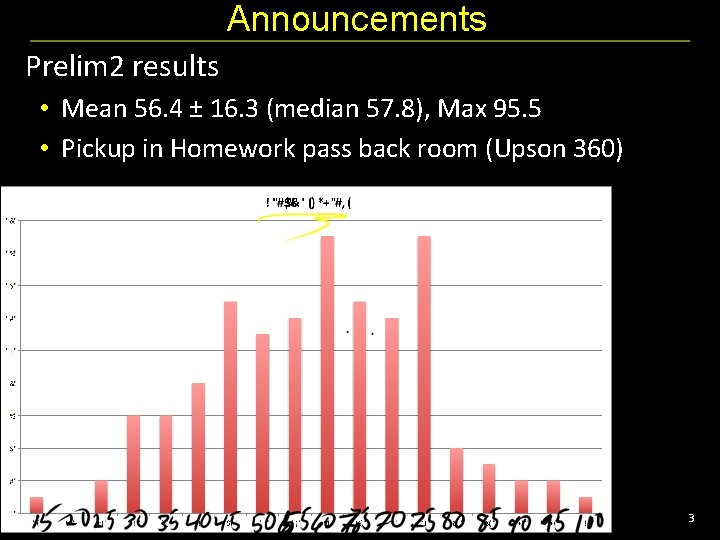
Announcements Prelim 2 results • Mean 56. 4 ± 16. 3 (median 57. 8), Max 95. 5 • Pickup in Homework pass back room (Upson 360) 3
Goals for Today Finish Synchronization • Threads and processes • Critical sections, race conditions, and mutexes • Atomic Instructions • • • HW support for synchronization Using sync primitives to build concurrency-safe data structures Cache coherency causes problems Locks + barriers Language level synchronization 4
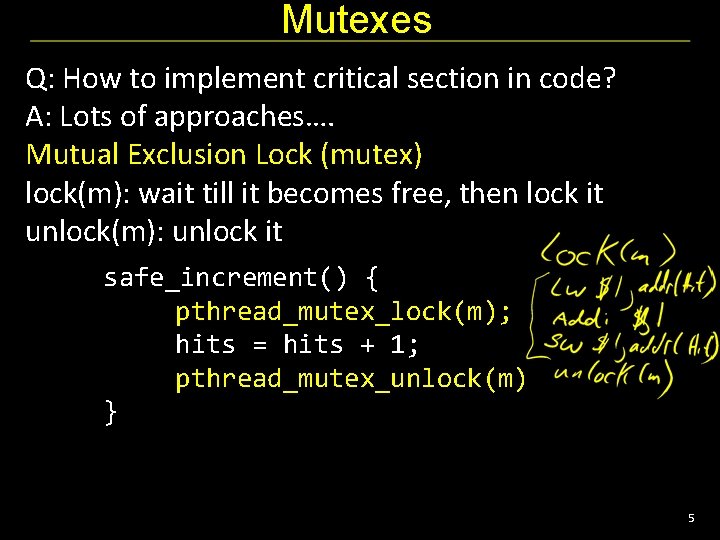
Mutexes Q: How to implement critical section in code? A: Lots of approaches…. Mutual Exclusion Lock (mutex) lock(m): wait till it becomes free, then lock it unlock(m): unlock it safe_increment() { pthread_mutex_lock(m); hits = hits + 1; pthread_mutex_unlock(m) } 5
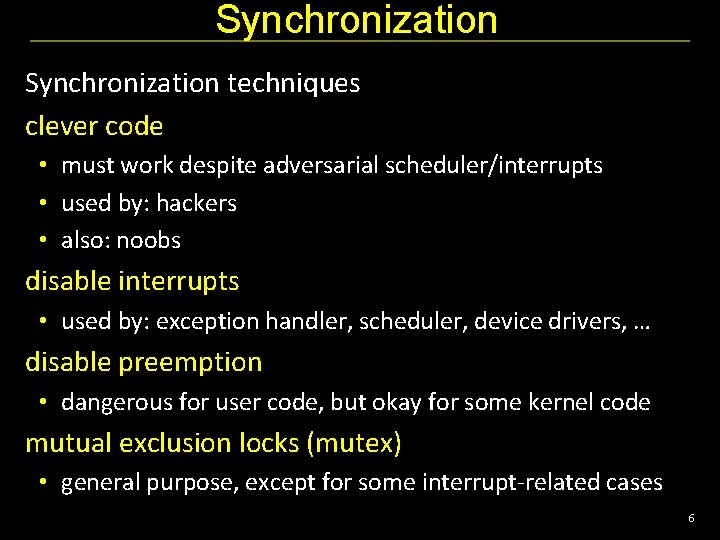
Synchronization techniques clever code • must work despite adversarial scheduler/interrupts • used by: hackers • also: noobs disable interrupts • used by: exception handler, scheduler, device drivers, … disable preemption • dangerous for user code, but okay for some kernel code mutual exclusion locks (mutex) • general purpose, except for some interrupt-related cases 6
Hardware Support for Synchronization 7
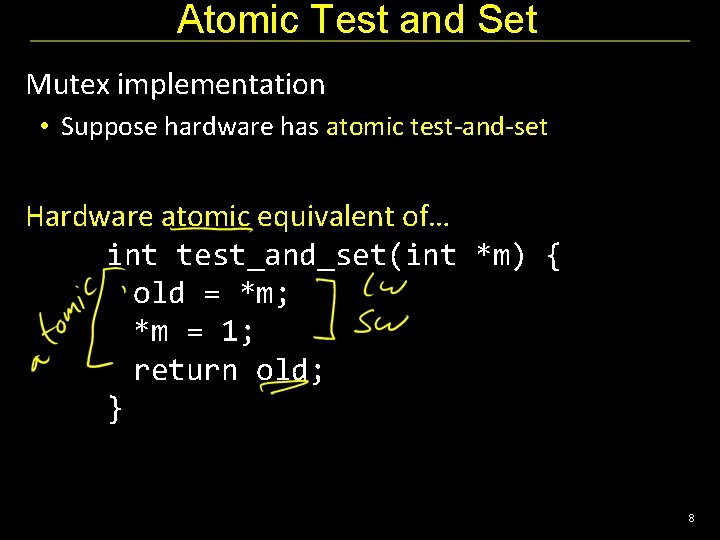
Atomic Test and Set Mutex implementation • Suppose hardware has atomic test-and-set Hardware atomic equivalent of… int test_and_set(int *m) { old = *m; *m = 1; return old; } 8
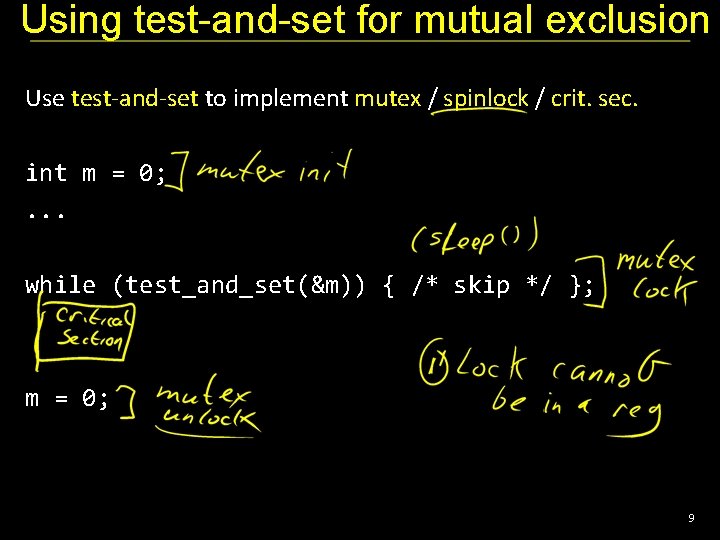
Using test-and-set for mutual exclusion Use test-and-set to implement mutex / spinlock / crit. sec. int m = 0; . . . while (test_and_set(&m)) { /* skip */ }; m = 0; 9
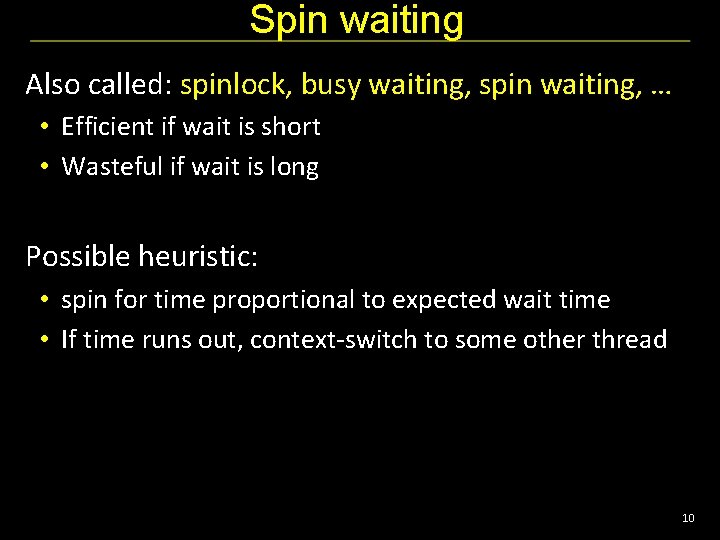
Spin waiting Also called: spinlock, busy waiting, spin waiting, … • Efficient if wait is short • Wasteful if wait is long Possible heuristic: • spin for time proportional to expected wait time • If time runs out, context-switch to some other thread 10
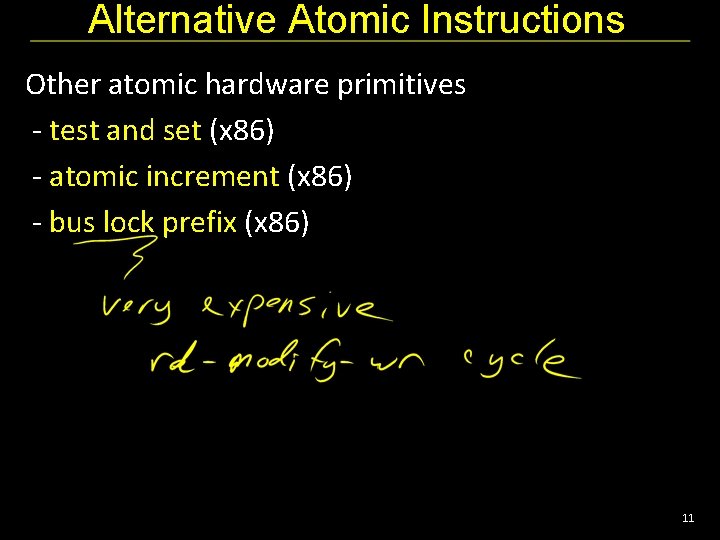
Alternative Atomic Instructions Other atomic hardware primitives - test and set (x 86) - atomic increment (x 86) - bus lock prefix (x 86) 11
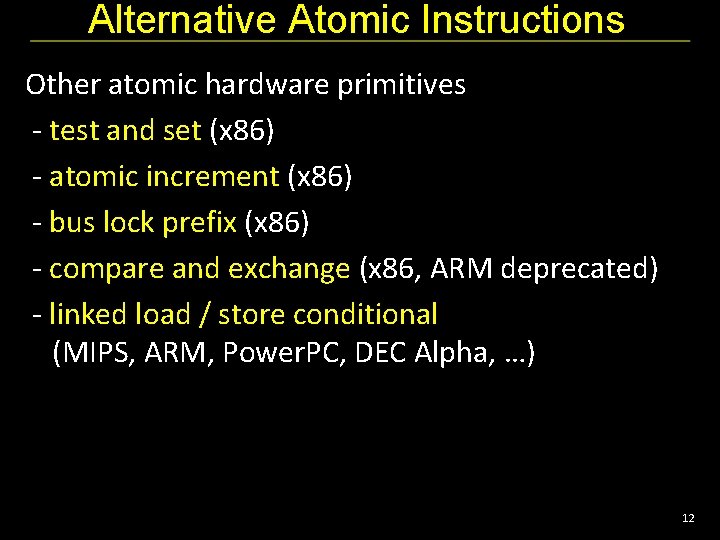
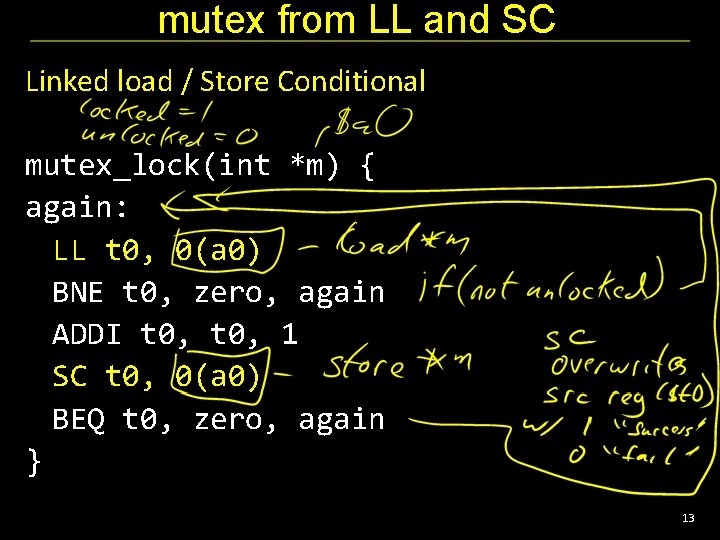
Alternative Atomic Instructions Other atomic hardware primitives - test and set (x 86) - atomic increment (x 86) - bus lock prefix (x 86) - compare and exchange (x 86, ARM deprecated) - linked load / store conditional (MIPS, ARM, Power. PC, DEC Alpha, …) 12
mutex from LL and SC Linked load / Store Conditional mutex_lock(int *m) { again: LL t 0, 0(a 0) BNE t 0, zero, again ADDI t 0, 1 SC t 0, 0(a 0) BEQ t 0, zero, again } 13
Using synchronization primitives to build concurrency-safe datastructures 14
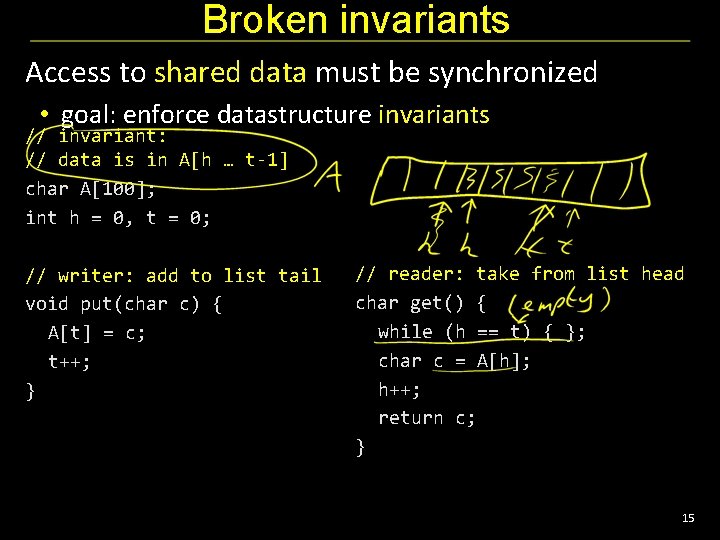
Broken invariants Access to shared data must be synchronized • goal: enforce datastructure invariants // invariant: // data is in A[h … t-1] char A[100]; int h = 0, t = 0; // writer: add to list tail void put(char c) { A[t] = c; t++; } // reader: take from list head char get() { while (h == t) { }; char c = A[h]; h++; return c; } 15
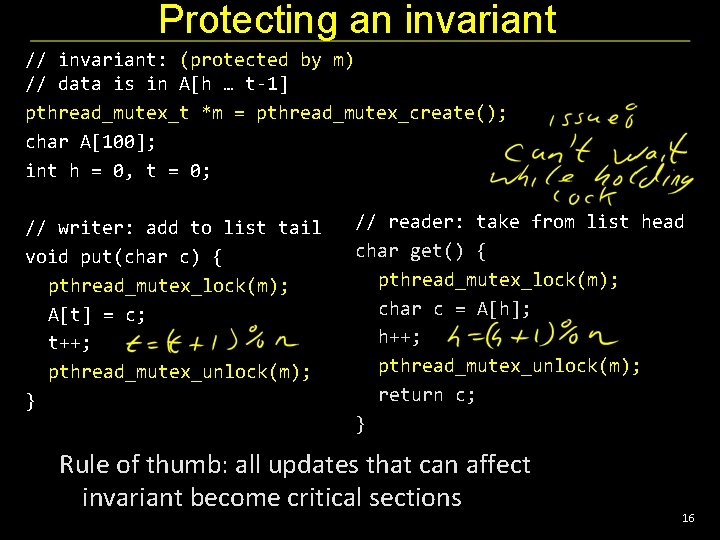
Protecting an invariant // invariant: (protected by m) // data is in A[h … t-1] pthread_mutex_t *m = pthread_mutex_create(); char A[100]; int h = 0, t = 0; // writer: add to list tail void put(char c) { pthread_mutex_lock(m); A[t] = c; t++; pthread_mutex_unlock(m); } // reader: take from list head char get() { pthread_mutex_lock(m); char c = A[h]; h++; pthread_mutex_unlock(m); return c; } Rule of thumb: all updates that can affect invariant become critical sections 16
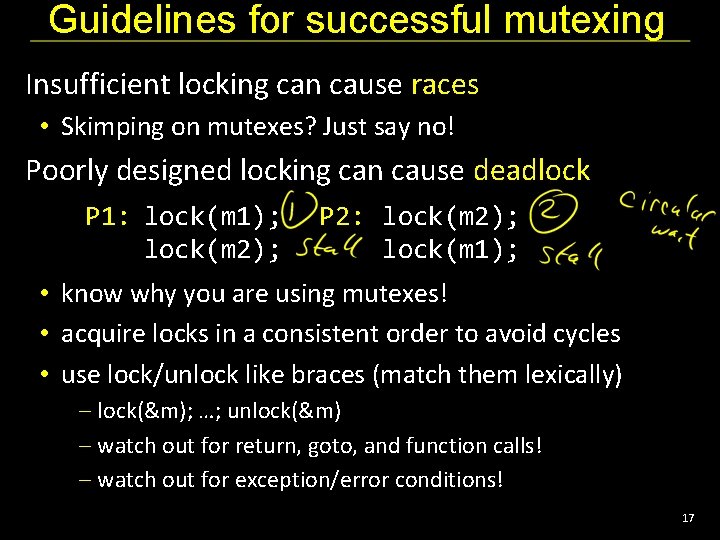
Guidelines for successful mutexing Insufficient locking can cause races • Skimping on mutexes? Just say no! Poorly designed locking can cause deadlock P 1: lock(m 1); lock(m 2); P 2: lock(m 2); lock(m 1); • know why you are using mutexes! • acquire locks in a consistent order to avoid cycles • use lock/unlock like braces (match them lexically) – lock(&m); …; unlock(&m) – watch out for return, goto, and function calls! – watch out for exception/error conditions! 17
Cache Coherency causes yet more trouble 18
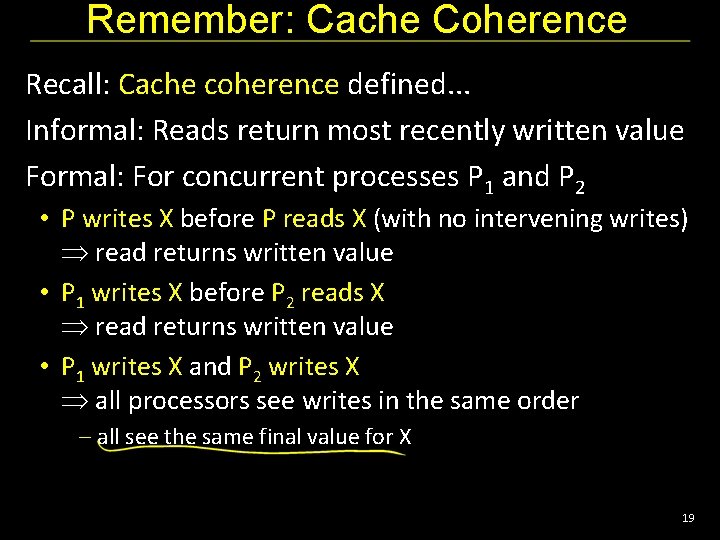
Remember: Cache Coherence Recall: Cache coherence defined. . . Informal: Reads return most recently written value Formal: For concurrent processes P 1 and P 2 • P writes X before P reads X (with no intervening writes) read returns written value • P 1 writes X before P 2 reads X read returns written value • P 1 writes X and P 2 writes X all processors see writes in the same order – all see the same final value for X 19
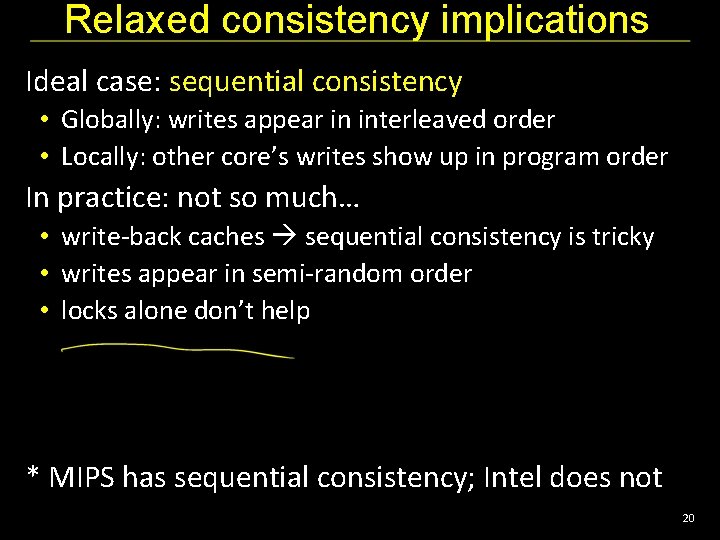
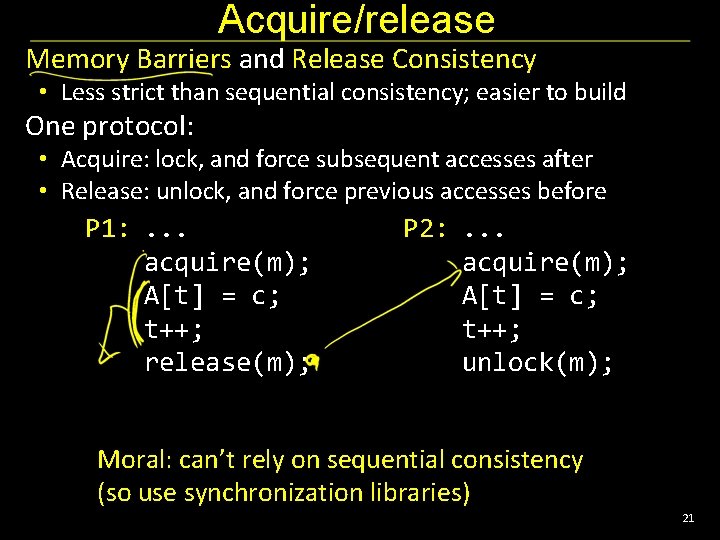
Relaxed consistency implications Ideal case: sequential consistency • Globally: writes appear in interleaved order • Locally: other core’s writes show up in program order In practice: not so much… • write-back caches sequential consistency is tricky • writes appear in semi-random order • locks alone don’t help * MIPS has sequential consistency; Intel does not 20
Acquire/release Memory Barriers and Release Consistency • Less strict than sequential consistency; easier to build One protocol: • Acquire: lock, and force subsequent accesses after • Release: unlock, and force previous accesses before P 1: . . . acquire(m); A[t] = c; t++; release(m); P 2: . . . acquire(m); A[t] = c; t++; unlock(m); Moral: can’t rely on sequential consistency (so use synchronization libraries) 21
Are Locks + Barriers enough? 22
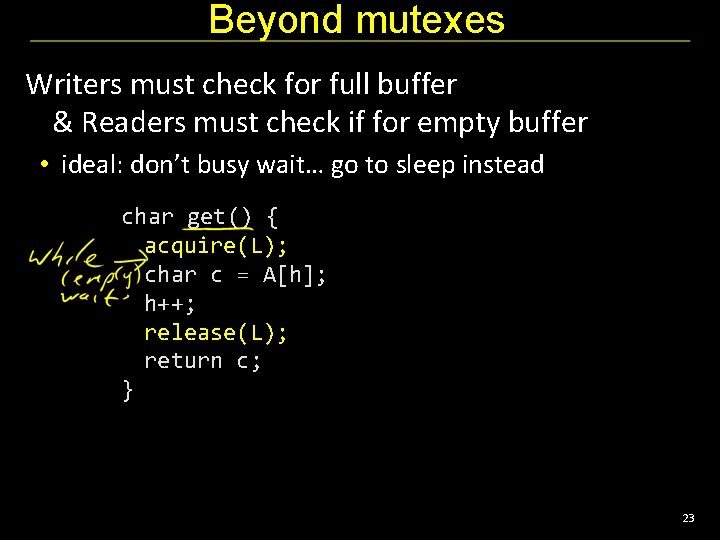
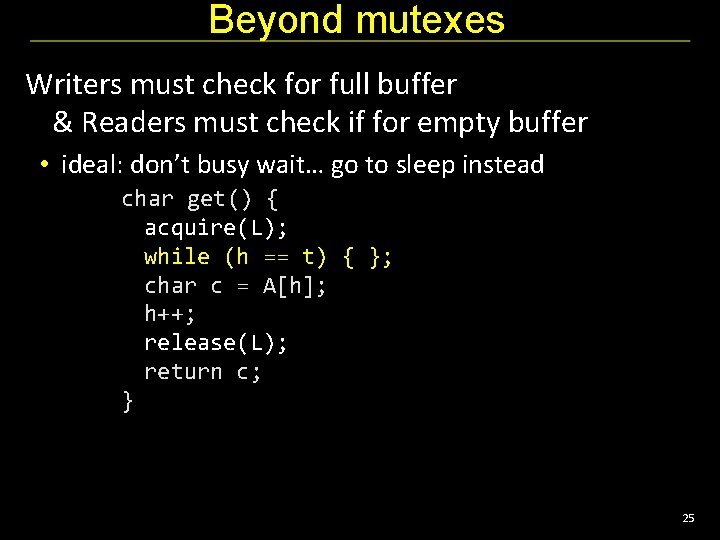
Beyond mutexes Writers must check for full buffer & Readers must check if for empty buffer • ideal: don’t busy wait… go to sleep instead char get() { acquire(L); char c = A[h]; h++; release(L); return c; } 23
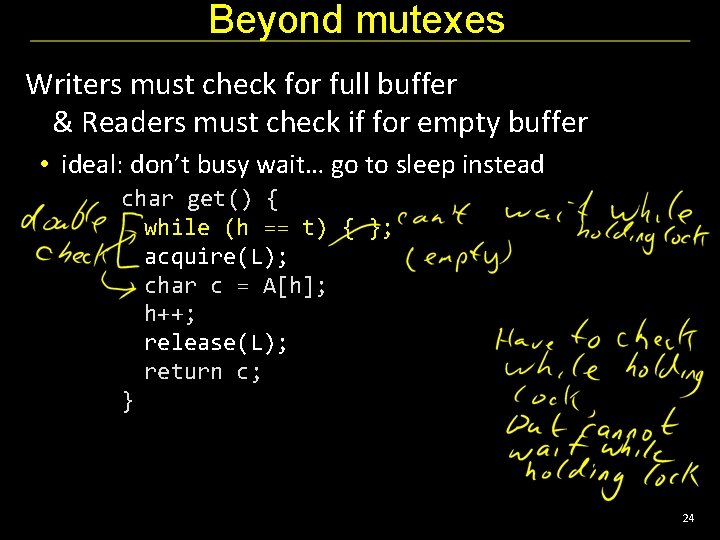
Beyond mutexes Writers must check for full buffer & Readers must check if for empty buffer • ideal: don’t busy wait… go to sleep instead char get() { t) { }; acquire(L); while (h == f) { }; acquire(L); char c c = = A[h]; h++; release(L); return c; c; } } 24
Beyond mutexes Writers must check for full buffer & Readers must check if for empty buffer • ideal: don’t busy wait… go to sleep instead char get() { acquire(L); while (h == t) { }; char c c = = A[h]; h++; release(L); return c; c; } } 25
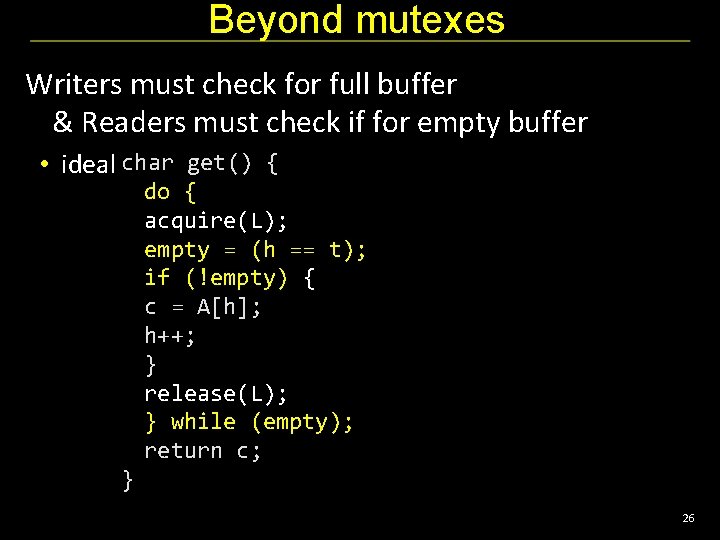
Beyond mutexes Writers must check for full buffer & Readers must check if for empty buffer { • ideal: char don’tget() busy wait… go to sleep instead do {get() { char get() { f) { }; acquire(L); while (h == acquire(L); empty while = acquire(L); (h(h ==== f)t); { }; char c if (!empty) { char c = = A[h]; h++; c = A[h]; h++; release(L); return } return c; c; } } release(L); } while (empty); return c; } 26
Language-level Synchronization 27
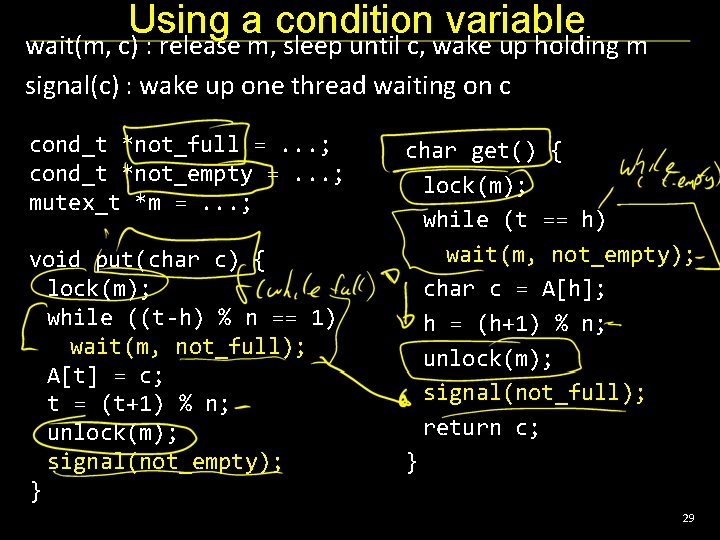
Condition variables Use [Hoare] a condition variable to wait for a condition to become true (without holding lock!) wait(m, c) : • atomically release m and sleep, waiting for condition c • wake up holding m sometime after c was signaled signal(c) : wake up one thread waiting on c broadcast(c) : wake up all threads waiting on c POSIX (e. g. , Linux): pthread_cond_wait, pthread_cond_signal, pthread_cond_broadcast 28
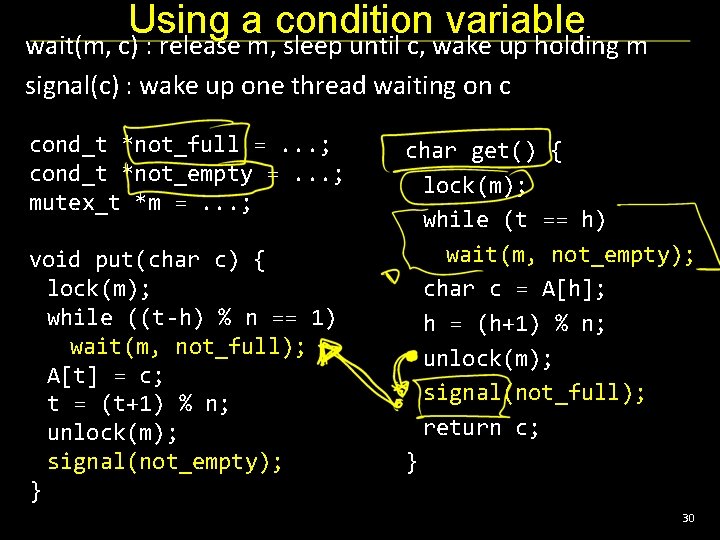
Using a condition variable wait(m, c) : release m, sleep until c, wake up holding m signal(c) : wake up one thread waiting on c cond_t *not_full =. . . ; cond_t *not_empty =. . . ; mutex_t *m =. . . ; void put(char c) { lock(m); while ((t-h) % n == 1) wait(m, not_full); A[t] = c; t = (t+1) % n; unlock(m); signal(not_empty); } char get() { lock(m); while (t == h) wait(m, not_empty); char c = A[h]; h = (h+1) % n; unlock(m); signal(not_full); return c; } 29
Using a condition variable wait(m, c) : release m, sleep until c, wake up holding m signal(c) : wake up one thread waiting on c cond_t *not_full =. . . ; cond_t *not_empty =. . . ; mutex_t *m =. . . ; void put(char c) { lock(m); while ((t-h) % n == 1) wait(m, not_full); A[t] = c; t = (t+1) % n; unlock(m); signal(not_empty); } char get() { lock(m); while (t == h) wait(m, not_empty); char c = A[h]; h = (h+1) % n; unlock(m); signal(not_full); return c; } 30
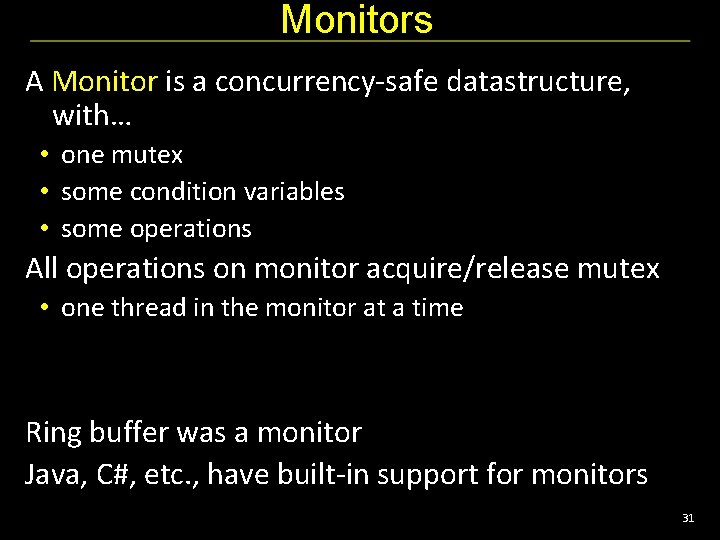
Monitors A Monitor is a concurrency-safe datastructure, with… • one mutex • some condition variables • some operations All operations on monitor acquire/release mutex • one thread in the monitor at a time Ring buffer was a monitor Java, C#, etc. , have built-in support for monitors 31
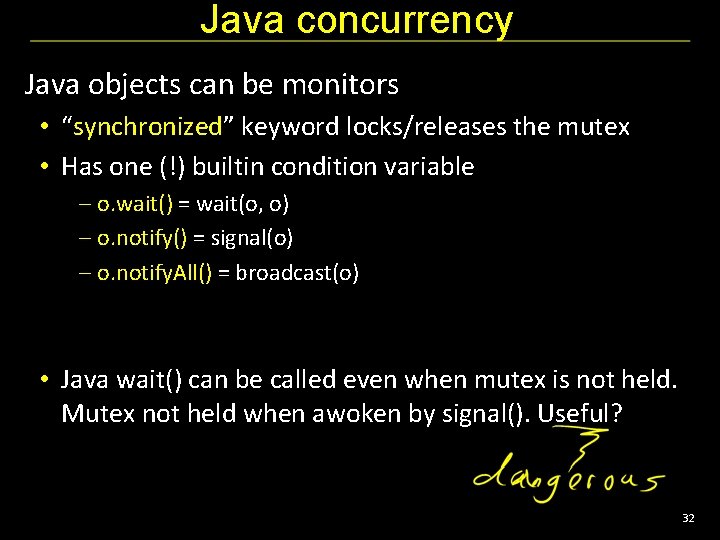
Java concurrency Java objects can be monitors • “synchronized” keyword locks/releases the mutex • Has one (!) builtin condition variable – o. wait() = wait(o, o) – o. notify() = signal(o) – o. notify. All() = broadcast(o) • Java wait() can be called even when mutex is not held. Mutex not held when awoken by signal(). Useful? 32
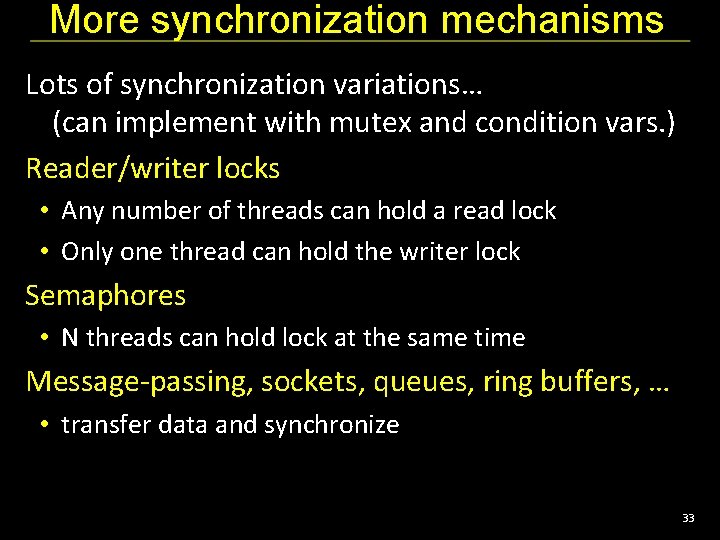
More synchronization mechanisms Lots of synchronization variations… (can implement with mutex and condition vars. ) Reader/writer locks • Any number of threads can hold a read lock • Only one thread can hold the writer lock Semaphores • N threads can hold lock at the same time Message-passing, sockets, queues, ring buffers, … • transfer data and synchronize 33
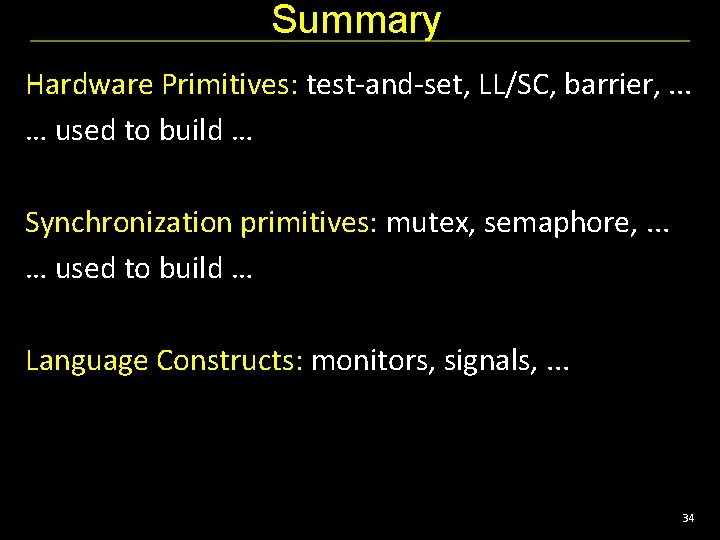
Summary Hardware Primitives: test-and-set, LL/SC, barrier, . . . … used to build … Synchronization primitives: mutex, semaphore, . . . … used to build … Language Constructs: monitors, signals, . . . 34