
ATOMIC ENERGY EDUCATION SOCIETY SUBJECT GEOGRAPHY STREAM ARTS
ATOMIC ENERGY EDUCATION SOCIETY SUBJECT – GEOGRAPHY STREAM – ARTS CLASS -12 CHAPTER-02 THE WORLD POPULATION MODULE-02/02 Prepared By: Mr. S. SADHUKHAN (PGT-SS) AECS-2, JADUGUDA
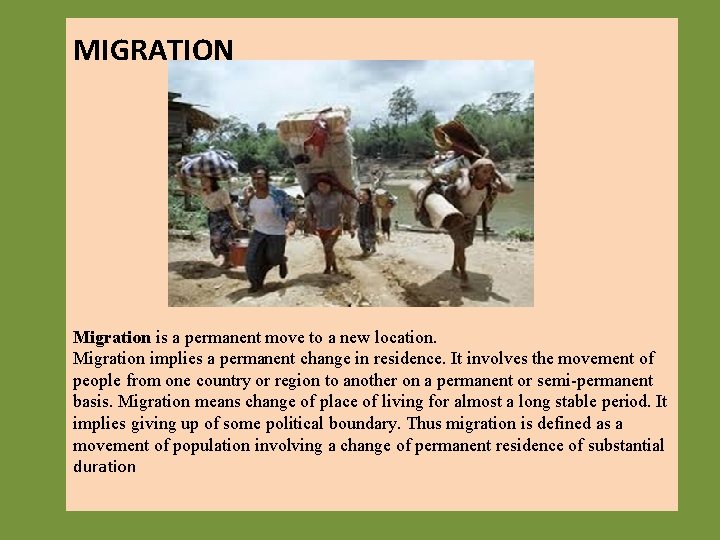
MIGRATION Migration is a permanent move to a new location. Migration implies a permanent change in residence. It involves the movement of people from one country or region to another on a permanent or semi-permanent basis. Migration means change of place of living for almost a long stable period. It implies giving up of some political boundary. Thus migration is defined as a movement of population involving a change of permanent residence of substantial duration
NATURE OF MIGRATION • • i. iii. iv. Inter-continental migration International migration Interstate migration Internal migration Rural to Urban to rural Rural to rural Interurban • Temporary • Periodic or seasonal migration
Determinants of Migration Push Factors are those that operate in areas of outmigration and compel the people to move to other areas. The Push factors make the place of origin seem less attractive for reasons like unemployment, poor living conditions, political turmoil, unpleasant climate, natural disasters, epidemics and socio-economic backwardness. Pull factors are those that operate in areas of immigration and attract the people to these areas. The Pull factors make the place of destination seem more attractive than the place of origin for reasons like better job opportunities and living conditions, peace and stability, security of life and property and pleasant climate
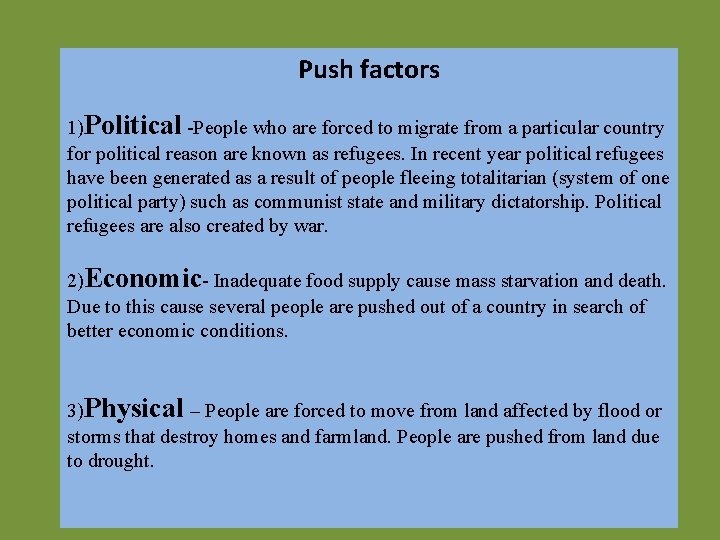
Push factors 1)Political -People who are forced to migrate from a particular country for political reason are known as refugees. In recent year political refugees have been generated as a result of people fleeing totalitarian (system of one political party) such as communist state and military dictatorship. Political refugees are also created by war. 2)Economic- Inadequate food supply cause mass starvation and death. Due to this cause several people are pushed out of a country in search of better economic conditions. 3)Physical – People are forced to move from land affected by flood or storms that destroy homes and farmland. People are pushed from land due to drought.
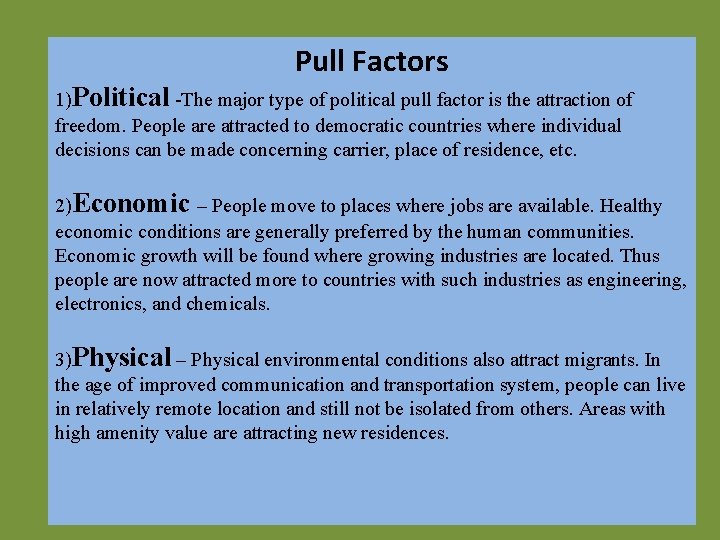
Pull Factors 1)Political -The major type of political pull factor is the attraction of freedom. People are attracted to democratic countries where individual decisions can be made concerning carrier, place of residence, etc. 2)Economic – People move to places where jobs are available. Healthy economic conditions are generally preferred by the human communities. Economic growth will be found where growing industries are located. Thus people are now attracted more to countries with such industries as engineering, electronics, and chemicals. 3)Physical – Physical environmental conditions also attract migrants. In the age of improved communication and transportation system, people can live in relatively remote location and still not be isolated from others. Areas with high amenity value are attracting new residences.
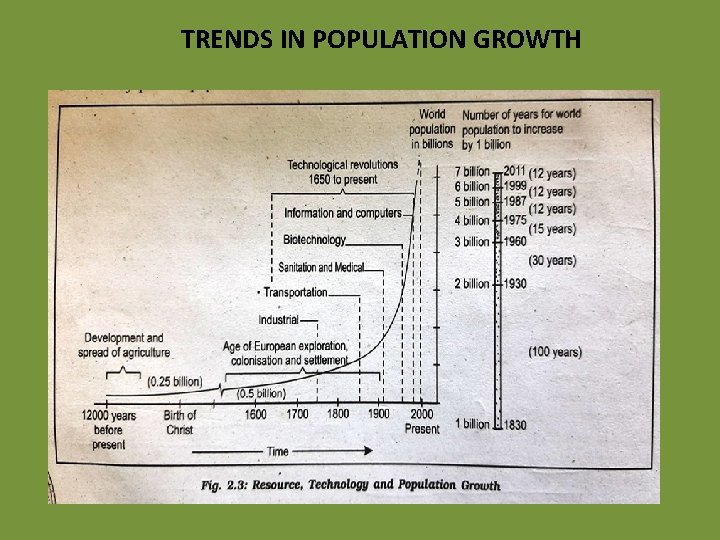
TRENDS IN POPULATION GROWTH
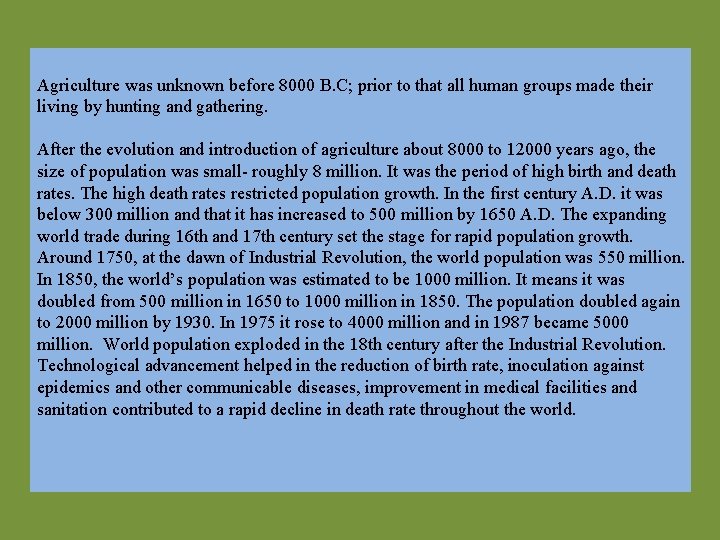
Agriculture was unknown before 8000 B. C; prior to that all human groups made their living by hunting and gathering. After the evolution and introduction of agriculture about 8000 to 12000 years ago, the size of population was small- roughly 8 million. It was the period of high birth and death rates. The high death rates restricted population growth. In the first century A. D. it was below 300 million and that it has increased to 500 million by 1650 A. D. The expanding world trade during 16 th and 17 th century set the stage for rapid population growth. Around 1750, at the dawn of Industrial Revolution, the world population was 550 million. In 1850, the world’s population was estimated to be 1000 million. It means it was doubled from 500 million in 1650 to 1000 million in 1850. The population doubled again to 2000 million by 1930. In 1975 it rose to 4000 million and in 1987 became 5000 million. World population exploded in the 18 th century after the Industrial Revolution. Technological advancement helped in the reduction of birth rate, inoculation against epidemics and other communicable diseases, improvement in medical facilities and sanitation contributed to a rapid decline in death rate throughout the world.
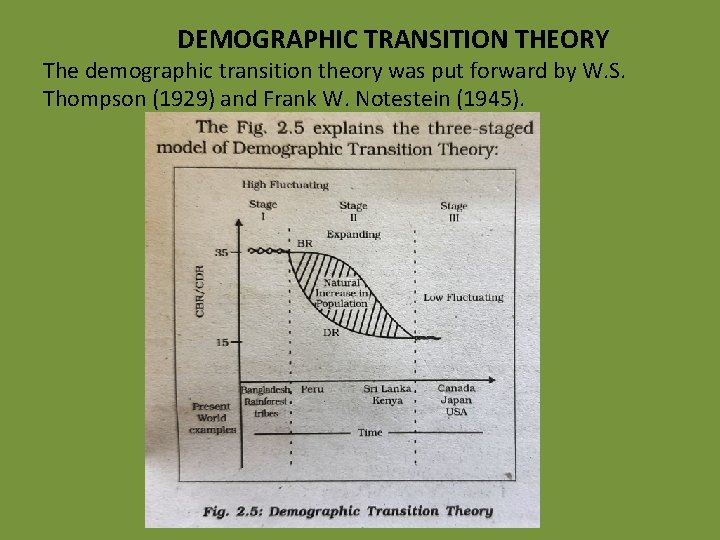
DEMOGRAPHIC TRANSITION THEORY The demographic transition theory was put forward by W. S. Thompson (1929) and Frank W. Notestein (1945).
Stage I -High and fluctuating birth and death rates, and slow population growth Stage II -High birth rates and declining death rates and rapid population growth Stage III -Declining birth rates and low death rates, and declining rate of population growth Stage IV -Low birth and death rates, and slow population growth Stage V -Birth and death rates approximately equal, which in time will result in zero population growth
The First stage has high fertility and high mortality because people reproduce more to compensate for the deaths due to epidemics and variable food supply. The population growth is slow and most of the people are engaged in agriculture. Life expectancy is low; people are mostly illiterate and have low levels of technology. Two hundred years ago all the countries of the world were in this stage.
In the Second stage fertility remains high in the beginning but it declines with time. This is accompanied by reduced mortality rate. Improvement in sanitation and health conditions lead to decline in mortality. Life expectancy starts improving. The processes of industrialization, urbanization and modernization become prominent. The countries like India, Pakistan, Bangladesh, Nepal and Indonesia belong to the late second stage where the fertility rates have started declining gradually and there is tremendous growth of population.
In the Last stage, both fertility and mortality decline. The population is either stable or grows slowly. The population becomes urbanized, literate and has high technical knowhow and controls the family. Anglo-America, West European countries, Australia, New Zealand, South Africa and Japan have reached this stage of demographic transition
POPULATION CONTROL MEASURES Family planning is the spacing or preventing the birth of children. It is helpful in limiting population growth and improving women’s health. Propaganda, free availability of contraceptives and tax disincentives for large families are some of the measures to help population control.

THANK YOU
- Slides: 15