
Atomic Emission Spectra What is lights fingerprint Click




- Slides: 19
Atomic Emission Spectra What is light’s fingerprint? Click here to begin! www. leffellabs. com
Each element gives off a characteristic color of light when burned. For a long time, scientists tried to explain the behavior of light by assuming that light consists of particles. By the early 1900 s, however, there was enough evidence to convince scientists that light consists of waves. Click to Continue
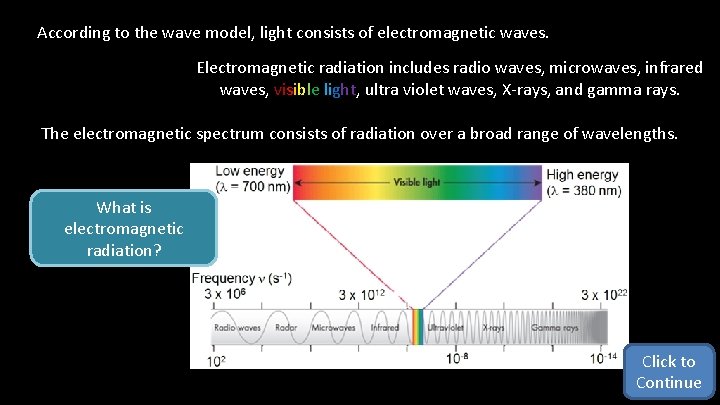
According to the wave model, light consists of electromagnetic waves. Electromagnetic radiation includes radio waves, microwaves, infrared waves, visible light, ultra violet waves, X-rays, and gamma rays. The electromagnetic spectrum consists of radiation over a broad range of wavelengths. What is electromagnetic radiation? Click to Continue
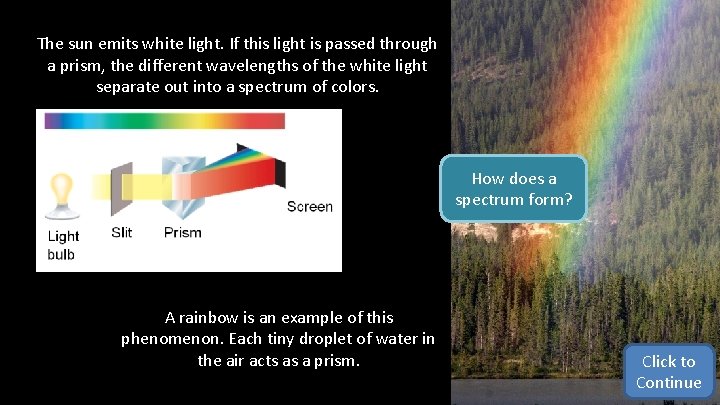
The sun emits white light. If this light is passed through a prism, the different wavelengths of the white light separate out into a spectrum of colors. How does a spectrum form? A rainbow is an example of this phenomenon. Each tiny droplet of water in the air acts as a prism. Click to Continue
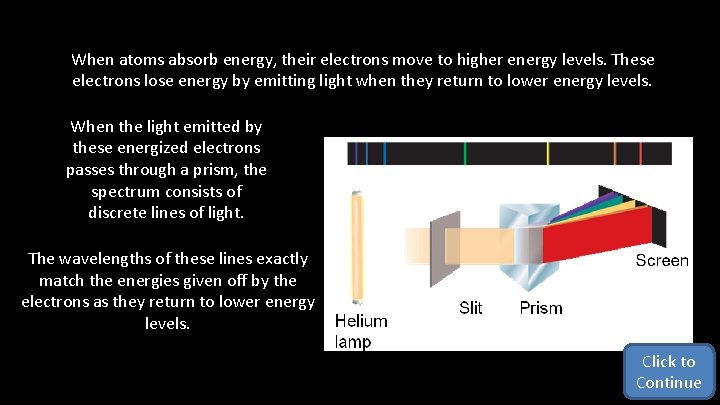
When atoms absorb energy, their electrons move to higher energy levels. These electrons lose energy by emitting light when they return to lower energy levels. When the light emitted by these energized electrons passes through a prism, the spectrum consists of discrete lines of light. The wavelengths of these lines exactly match the energies given off by the electrons as they return to lower energy levels. Click to Continue
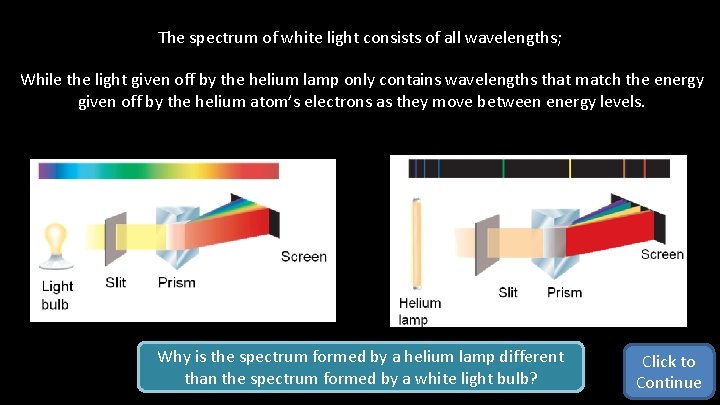
The spectrum of white light consists of all wavelengths; While the light given off by the helium lamp only contains wavelengths that match the energy given off by the helium atom’s electrons as they move between energy levels. Why is the spectrum formed by a helium lamp different than the spectrum formed by a white light bulb? Click to Continue
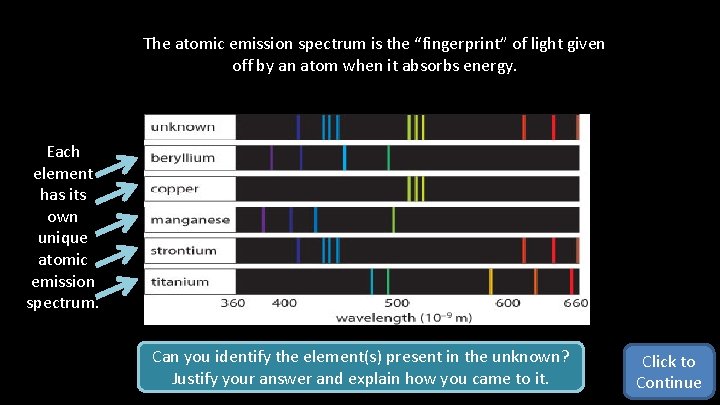
The atomic emission spectrum is the “fingerprint” of light given off by an atom when it absorbs energy. Each element has its own unique atomic emission spectrum. Can you identify the element(s) present in the unknown? Justify your answer and explain how you came to it. Click to Continue
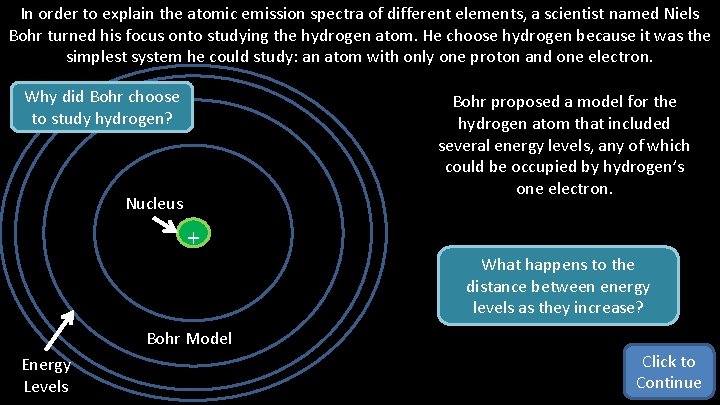
In order to explain the atomic emission spectra of different elements, a scientist named Niels Bohr turned his focus onto studying the hydrogen atom. He choose hydrogen because it was the simplest system he could study: an atom with only one proton and one electron. Why did Bohr choose to study hydrogen? Bohr proposed a model for the hydrogen atom that included several energy levels, any of which could be occupied by hydrogen’s one electron. Nucleus + What happens to the distance between energy levels as they increase? Bohr Model Energy Levels Click to Continue
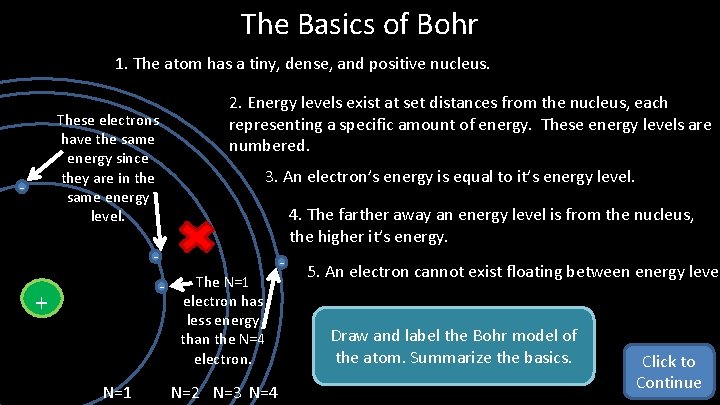
The Basics of Bohr 1. The atom has a tiny, dense, and positive nucleus. 2. Energy levels exist at set distances from the nucleus, each representing a specific amount of energy. These energy levels are numbered. These electrons have the same energy since they are in the same energy level. - - N=1 4. The farther away an energy level is from the nucleus, the higher it’s energy. - - + 3. An electron’s energy is equal to it’s energy level. The N=1 electron has less energy than the N=4 electron. N=2 N=3 N=4 - 5. An electron cannot exist floating between energy level Draw and label the Bohr model of the atom. Summarize the basics. Click to Continue
The lowest energy is called the ground state. + - - Because it has the least amount of energy, the ground state is the most stable. Click on the electron in the ground state.
Wrong! • Remember: the ground state is the least energetic state that the electron can have. Click here to try again.
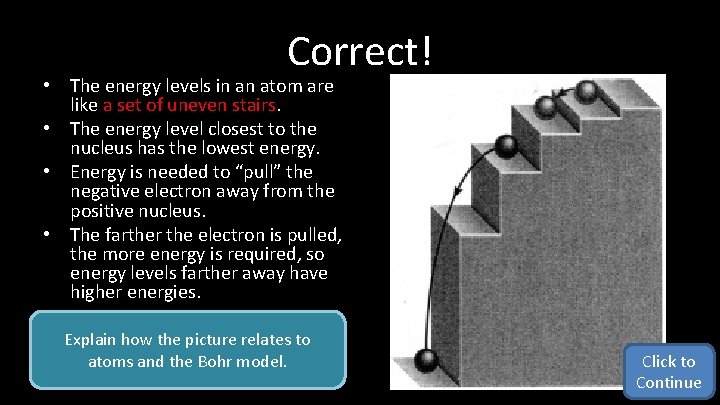
Correct! • The energy levels in an atom are like a set of uneven stairs. • The energy level closest to the nucleus has the lowest energy. • Energy is needed to “pull” the negative electron away from the positive nucleus. • The farther the electron is pulled, the more energy is required, so energy levels farther away have higher energies. Explain how the picture relates to atoms and the Bohr model. Click to Continue
When an atom absorbs energy, its electrons will “jump up” in energy level. This is called the excited state. An electron in the ground state, orbiting the nucleus. The electron absorbs energy. - - + And “jumps up” to a higher energy level. Compare the ground state and the excited state. The electron is now in an excited state. Click to Continue
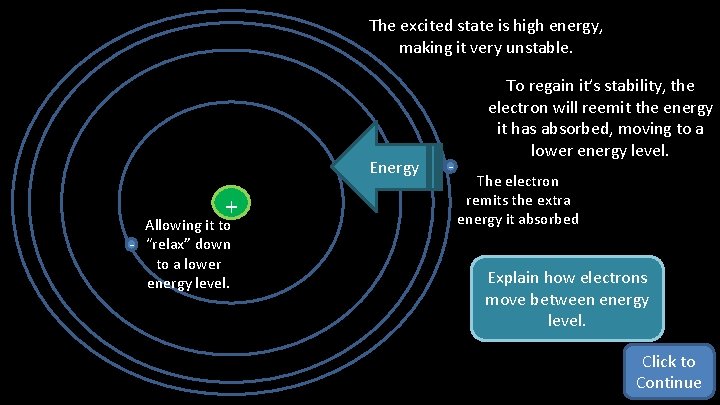
The excited state is high energy, making it very unstable. Energy + Allowing it to - “relax” down to a lower energy level. - To regain it’s stability, the electron will reemit the energy it has absorbed, moving to a lower energy level. The electron remits the extra energy it absorbed Explain how electrons move between energy level. Click to Continue
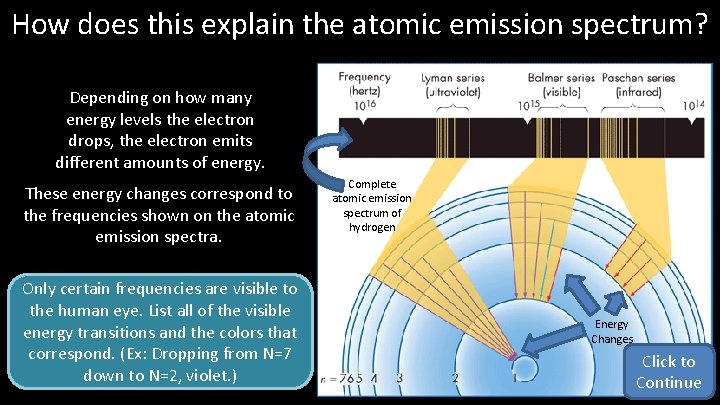
How does this explain the atomic emission spectrum? Depending on how many energy levels the electron drops, the electron emits different amounts of energy. These energy changes correspond to the frequencies shown on the atomic emission spectra. Only certain frequencies are visible to the human eye. List all of the visible energy transitions and the colors that correspond. (Ex: Dropping from N=7 down to N=2, violet. ) Complete atomic emission spectrum of hydrogen Energy Changes Click to Continue
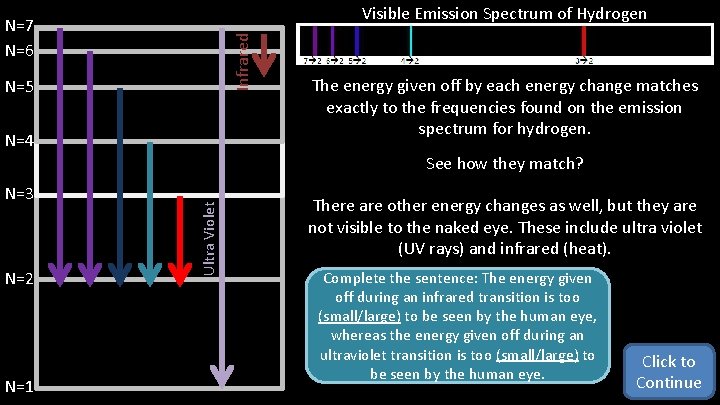
Visible Emission Spectrum of Hydrogen Infrared N=7 N=6 N=5 N=4 The energy given off by each energy change matches exactly to the frequencies found on the emission spectrum for hydrogen. N=3 N=2 N=1 Ultra Violet See how they match? There are other energy changes as well, but they are not visible to the naked eye. These include ultra violet (UV rays) and infrared (heat). Complete the sentence: The energy given off during an infrared transition is too (small/large) to be seen by the human eye, whereas the energy given off during an ultraviolet transition is too (small/large) to be seen by the human eye. Click to Continue
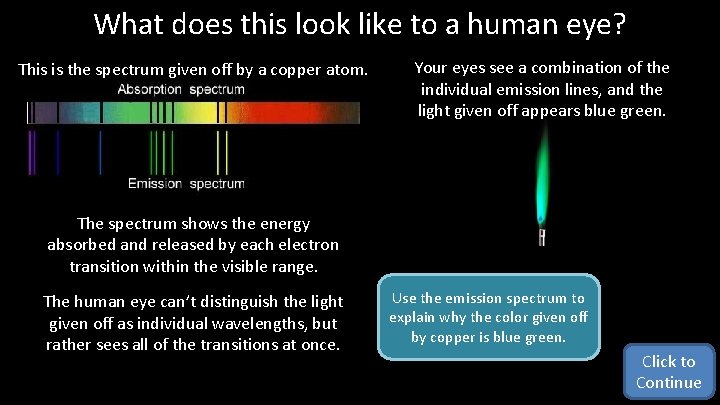
What does this look like to a human eye? This is the spectrum given off by a copper atom. Your eyes see a combination of the individual emission lines, and the light given off appears blue green. The spectrum shows the energy absorbed and released by each electron transition within the visible range. The human eye can’t distinguish the light given off as individual wavelengths, but rather sees all of the transitions at once. Use the emission spectrum to explain why the color given off by copper is blue green. Click to Continue
What is a flame test? In a flame test, an element is burned in the flame of a Bunsen burner. The flame supplies energy to the electrons of the atoms, causing them to jump up in energy level to an excited state. As the electrons relax back down to the ground state, that energy is emitted as photons. Some of these transitions are visible to the human eye, giving off unique colors for each element. First, you will observe the color of the flame for several metal cations. Then, you will be given two unknowns; you must identify them by comparing the color of their flames to the ones your have already observed. What is a flame test? Explain. Click to Continue
Flame Test Pre-Lab • You will complete a flame test lab in school. • Watch the video. • Using the video, write a procedure (Step by step, numbered; spare no details!), and materials needed for the lab. Extra help: TEXT Page 142