
ATOMIC EMISSION SPECTRA AND QUANTUM MECHANICAL MODEL Waves
- Slides: 10
ATOMIC EMISSION SPECTRA AND QUANTUM MECHANICAL MODEL
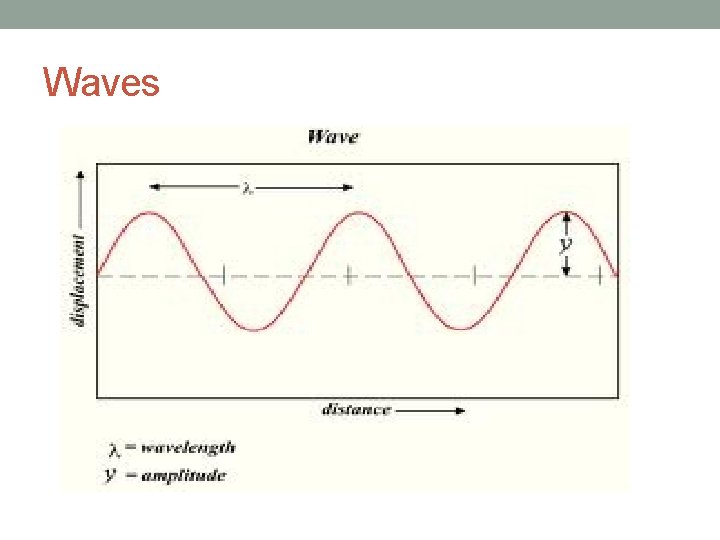
Waves
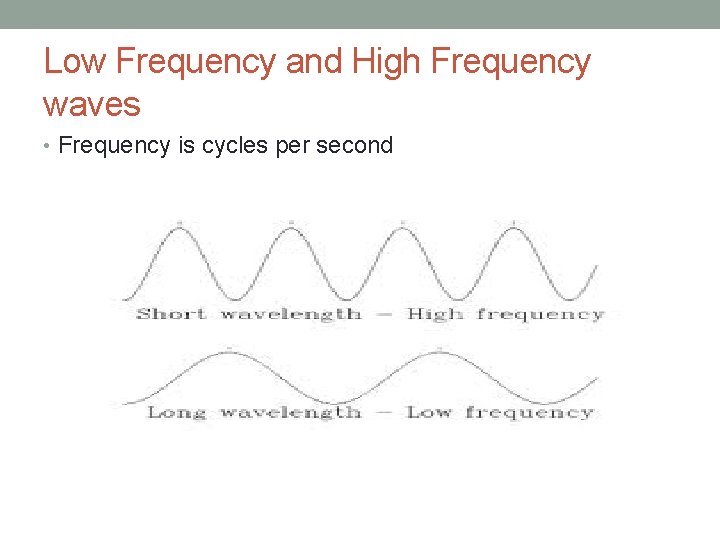
Low Frequency and High Frequency waves • Frequency is cycles per second
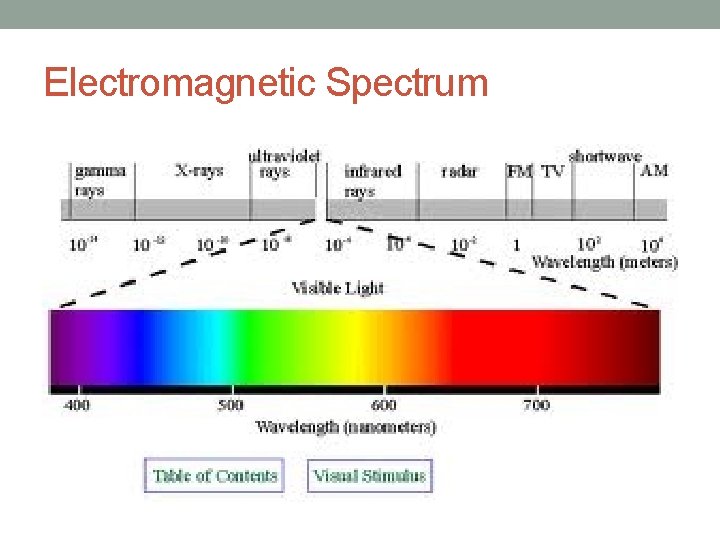
Electromagnetic Spectrum
Atomic Emission Spectra • Pattern formed when light passes through a prism or diffraction grating to separate it into different frequencies of light it contains • Atomic emission spectra is caused by atoms absorbing energy and the electrons move to the higher energy level. • When the energy goes back down to their lower energy level, it emits a light
Ground State/Excited State • Ground state: electrons at its lowest energy possible • Example: Sodium’s outer electron is in the s orbital • Excited state: electrons going to its higher energy • Example: Sodium outer electron going to the s orbital to p (p orbital is higher energy than s)
How are frequencies of light emitted by an atom in relation to changes of electron energy? • The electrons are moving from a higher energy to a lower (excited state to ground state) • http: //www. youtube. com/watch? v=8 M 72 p. X 5 wly. E
Classical vs. Quantum Mechanics • Classical mechanics deals with larger objects (humans, cars, baseball, marbles • In quantum mechanics, matter moves like waves and it pertains to much smaller matter, such as light particles, atoms
Heisenberg Uncertainty Principle • It is impossible to know both the location and the speed of an electron at the same time
Famous scientist in quantum • Max Planck: energy changes in small units known as quanta (Energy= Planck’s constant x frequency) E=hv • Planck’s constant is 6. 626 x 10 -34 Js • Albert Einstein: used Planck’s theory to explain the photoelectric effect • Photoelectric effect: light can be described as quanta and behaves like particles • Louis de Broglie: explains that all matter moves like waves