
Atomic calculation using DFT Solving the Schrodingerlike equation


- Slides: 23
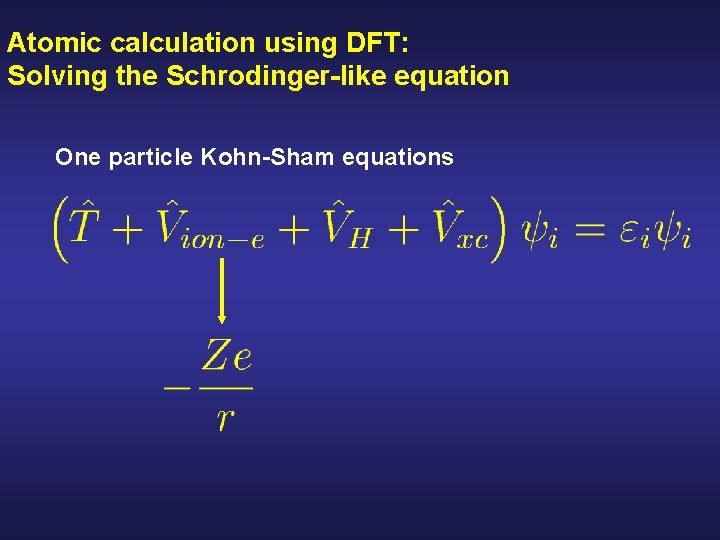
Atomic calculation using DFT: Solving the Schrodinger-like equation One particle Kohn-Sham equations
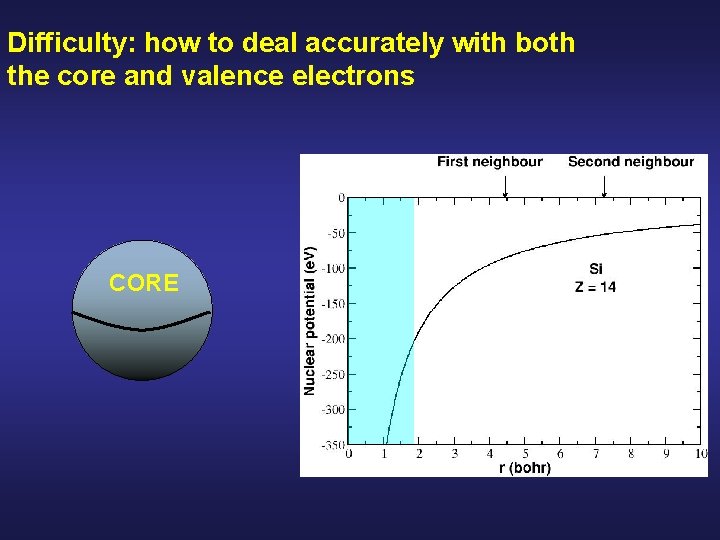
Difficulty: how to deal accurately with both the core and valence electrons CORE
Difficulty: how to deal accurately with both the core and valence electrons VALENCE CORE
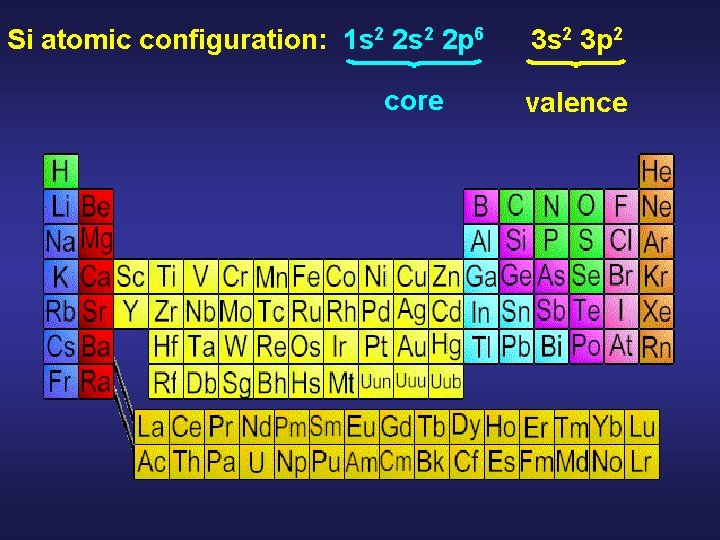
Si atomic configuration: 1 s 2 2 p 6 core 3 s 2 3 p 2 valence
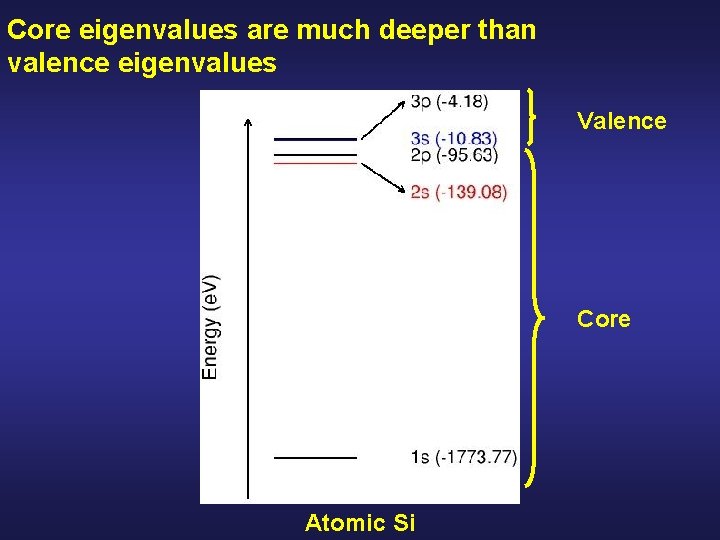
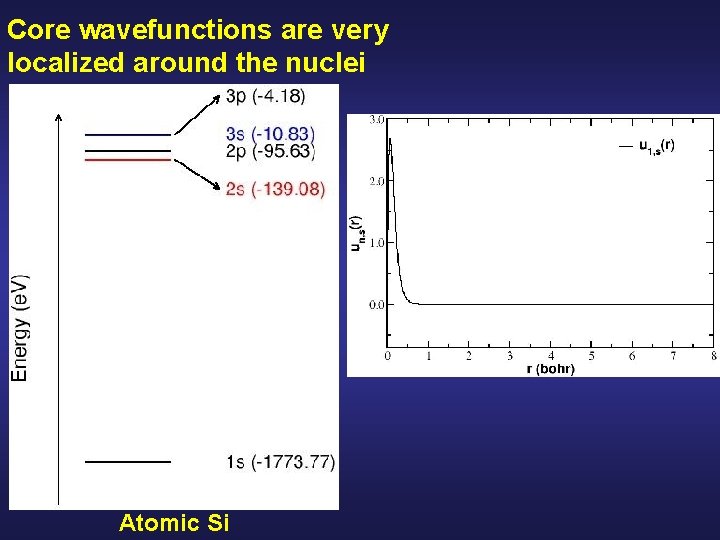
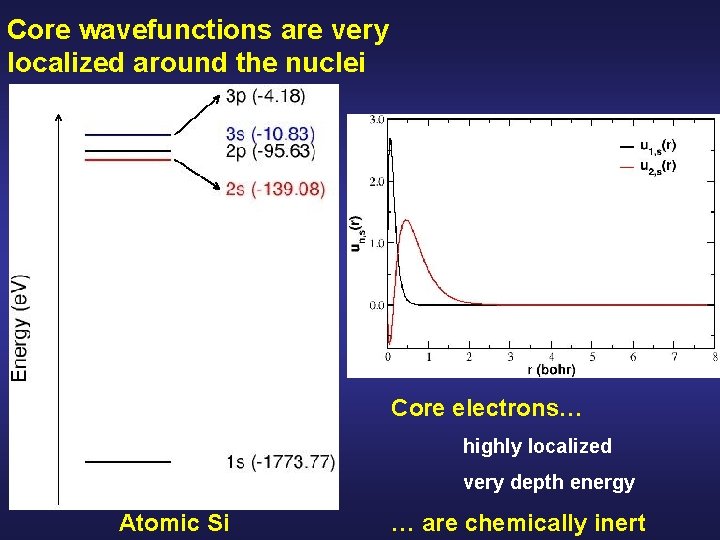
Core eigenvalues are much deeper than valence eigenvalues Valence Core Atomic Si
Core wavefunctions are very localized around the nuclei Atomic Si
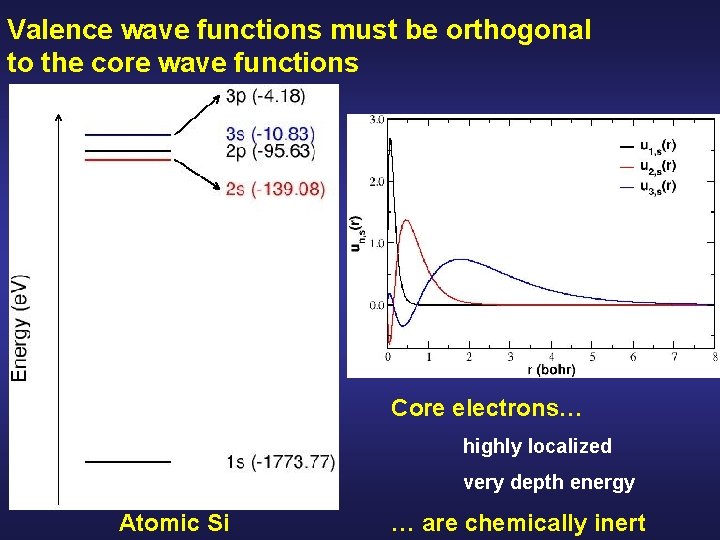
Core wavefunctions are very localized around the nuclei Core electrons… highly localized very depth energy Atomic Si … are chemically inert
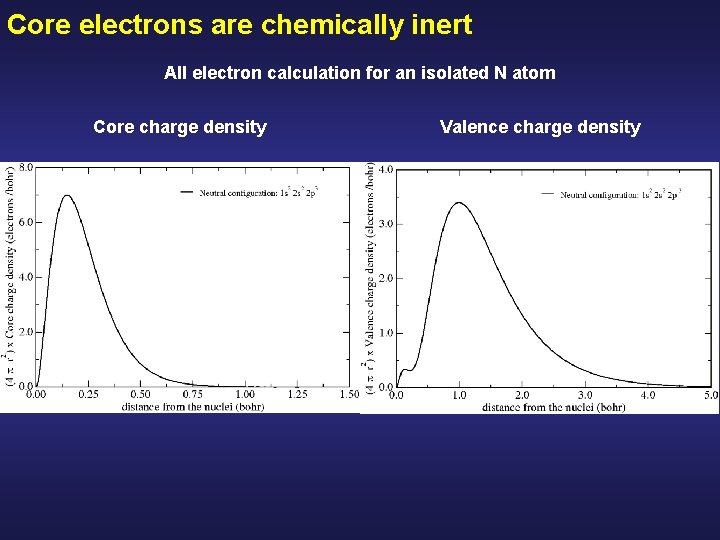
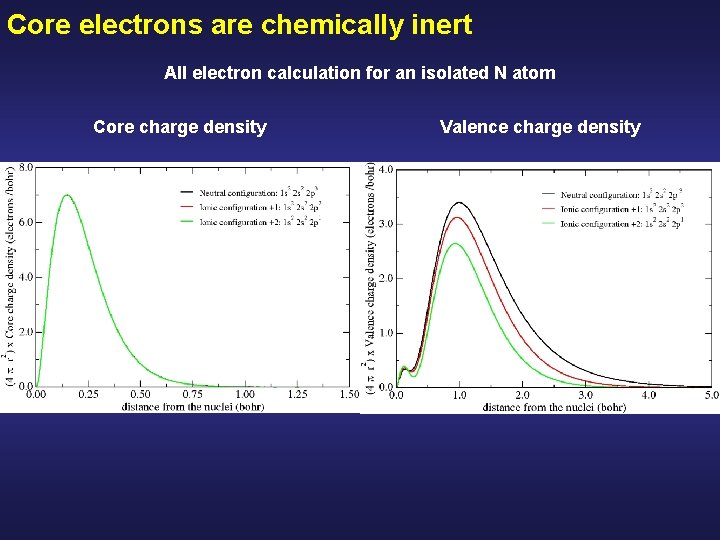
Core electrons are chemically inert All electron calculation for an isolated N atom Core charge density Valence charge density
Core electrons are chemically inert All electron calculation for an isolated N atom Core charge density Valence charge density
Core electrons are chemically inert All electron calculation for an isolated N atom Core charge density Valence charge density
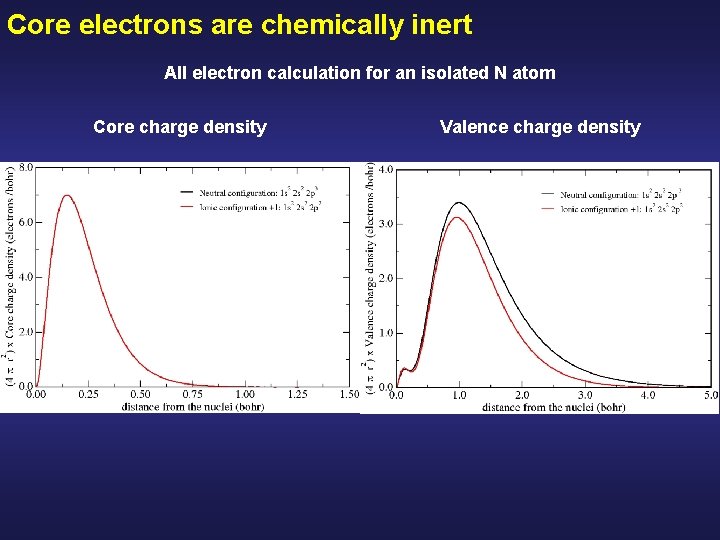
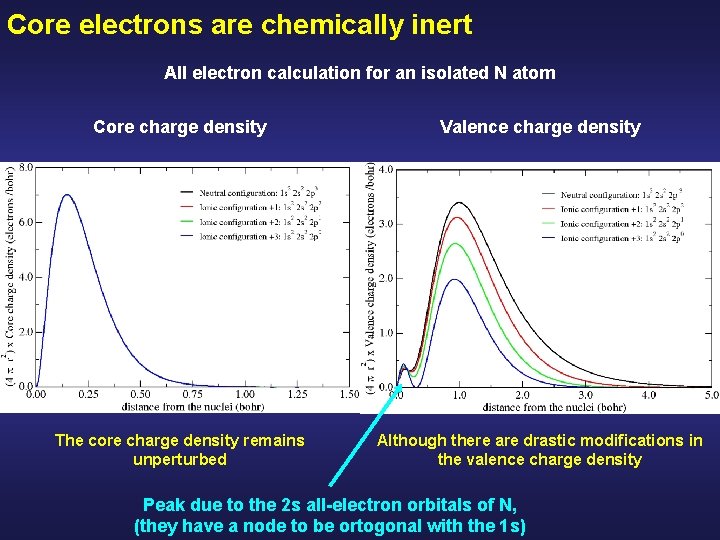
Core electrons are chemically inert All electron calculation for an isolated N atom Core charge density Valence charge density The core charge density remains unperturbed Although there are drastic modifications in the valence charge density Peak due to the 2 s all-electron orbitals of N, (they have a node to be ortogonal with the 1 s)
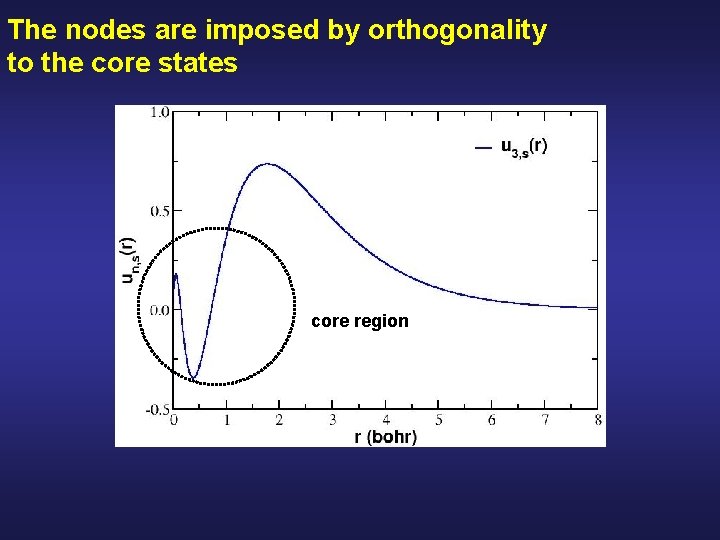
Valence wave functions must be orthogonal to the core wave functions Core electrons… highly localized very depth energy Atomic Si … are chemically inert
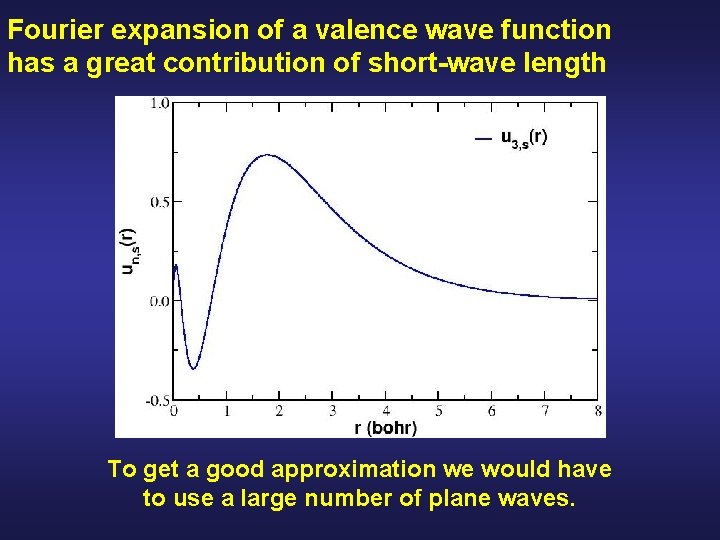
Fourier expansion of a valence wave function has a great contribution of short-wave length To get a good approximation we would have to use a large number of plane waves.
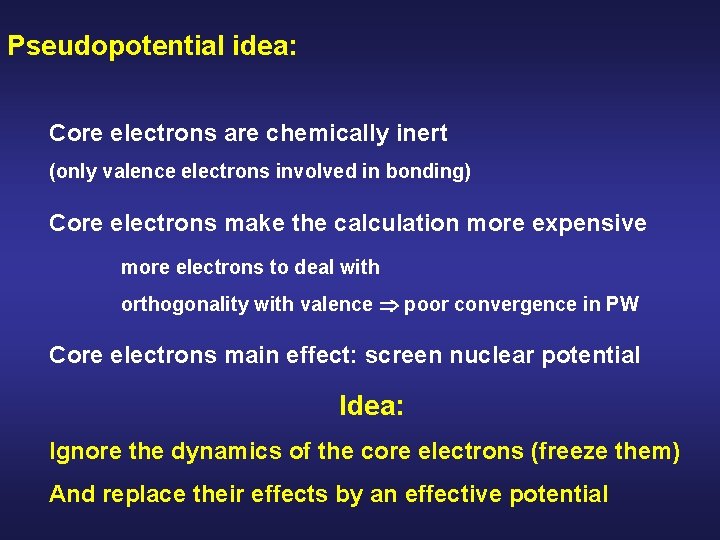
Pseudopotential idea: Core electrons are chemically inert (only valence electrons involved in bonding) Core electrons make the calculation more expensive more electrons to deal with orthogonality with valence poor convergence in PW Core electrons main effect: screen nuclear potential Idea: Ignore the dynamics of the core electrons (freeze them) And replace their effects by an effective potential
The nodes are imposed by orthogonality to the core states core region
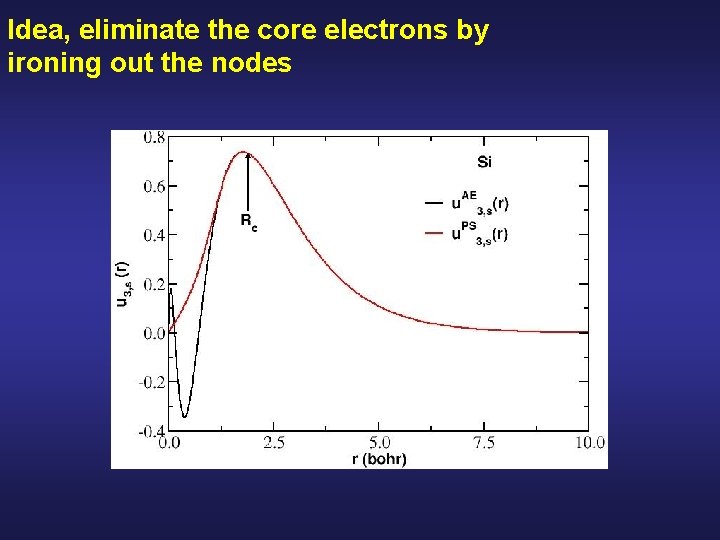
Idea, eliminate the core electrons by ironing out the nodes
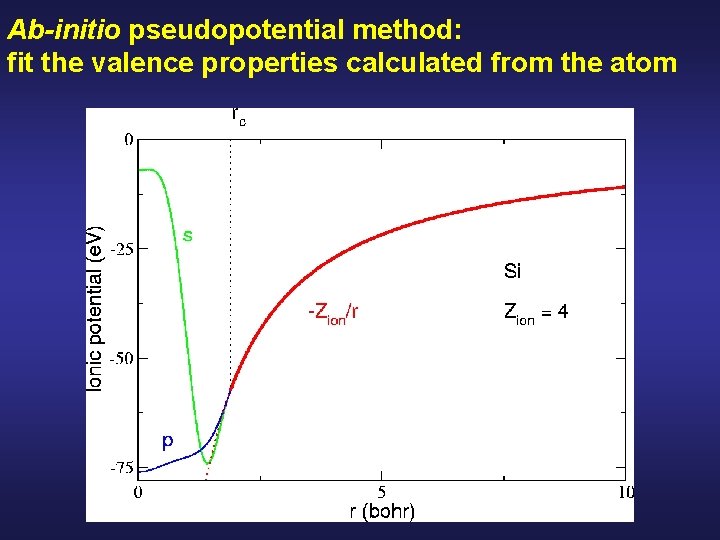
Ab-initio pseudopotential method: fit the valence properties calculated from the atom
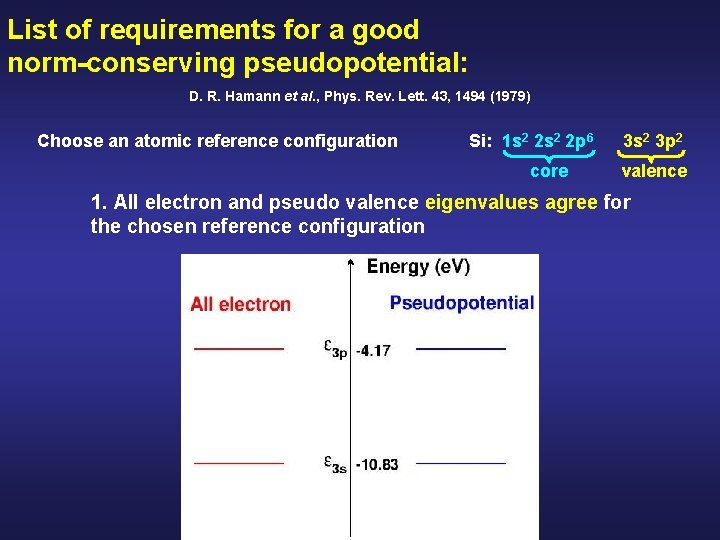
List of requirements for a good norm-conserving pseudopotential: D. R. Hamann et al. , Phys. Rev. Lett. 43, 1494 (1979) Choose an atomic reference configuration Si: 1 s 2 2 p 6 core 3 s 2 3 p 2 valence 1. All electron and pseudo valence eigenvalues agree for the chosen reference configuration
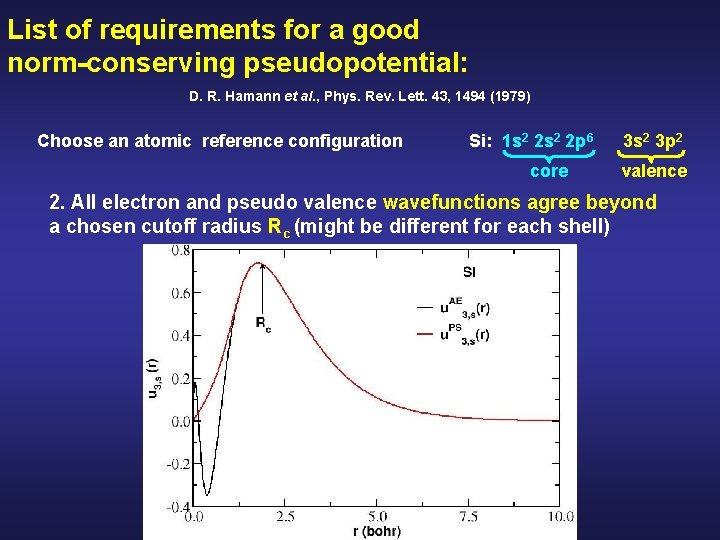
List of requirements for a good norm-conserving pseudopotential: D. R. Hamann et al. , Phys. Rev. Lett. 43, 1494 (1979) Choose an atomic reference configuration Si: 1 s 2 2 p 6 core 3 s 2 3 p 2 valence 2. All electron and pseudo valence wavefunctions agree beyond a chosen cutoff radius Rc (might be different for each shell)
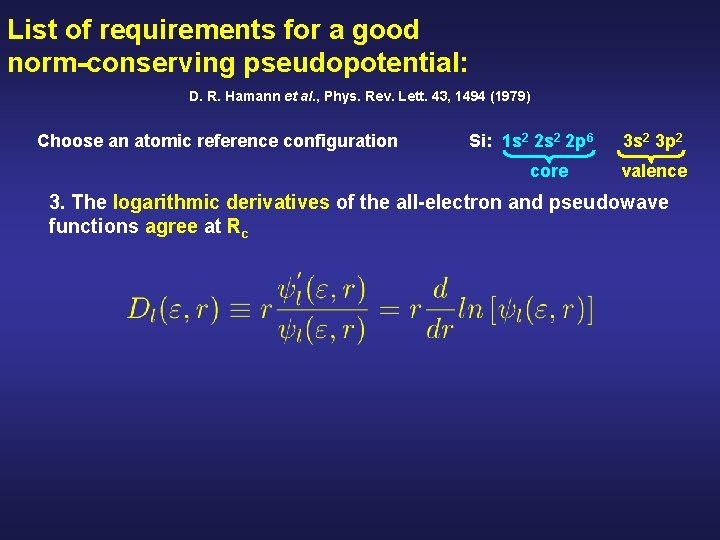
List of requirements for a good norm-conserving pseudopotential: D. R. Hamann et al. , Phys. Rev. Lett. 43, 1494 (1979) Choose an atomic reference configuration Si: 1 s 2 2 p 6 core 3 s 2 3 p 2 valence 3. The logarithmic derivatives of the all-electron and pseudowave functions agree at Rc
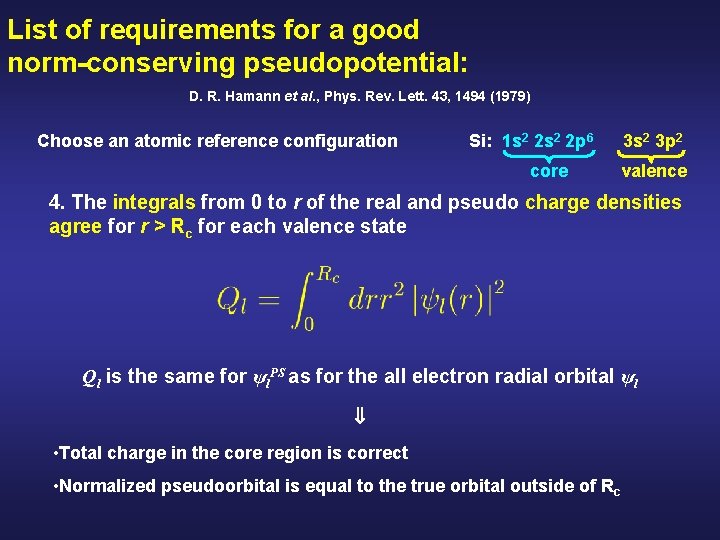
List of requirements for a good norm-conserving pseudopotential: D. R. Hamann et al. , Phys. Rev. Lett. 43, 1494 (1979) Choose an atomic reference configuration Si: 1 s 2 2 p 6 core 3 s 2 3 p 2 valence 4. The integrals from 0 to r of the real and pseudo charge densities agree for r > Rc for each valence state Ql is the same for ψl. PS as for the all electron radial orbital ψl • Total charge in the core region is correct • Normalized pseudoorbital is equal to the true orbital outside of R c
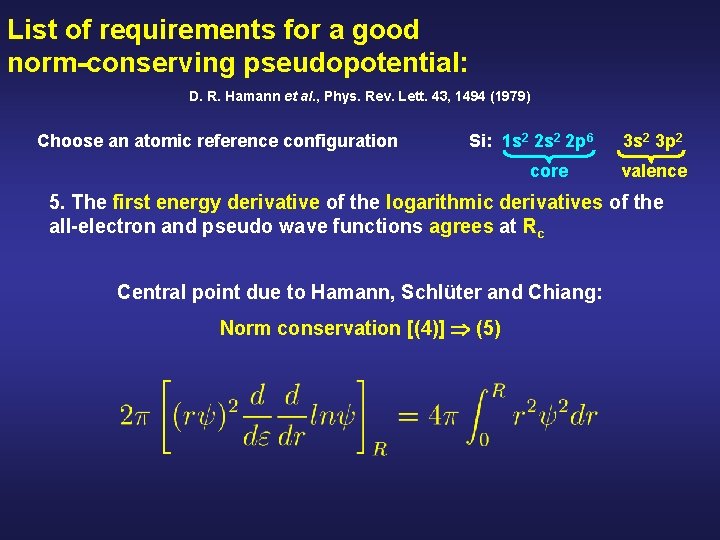
List of requirements for a good norm-conserving pseudopotential: D. R. Hamann et al. , Phys. Rev. Lett. 43, 1494 (1979) Choose an atomic reference configuration Si: 1 s 2 2 p 6 core 3 s 2 3 p 2 valence 5. The first energy derivative of the logarithmic derivatives of the all-electron and pseudo wave functions agrees at Rc Central point due to Hamann, Schlüter and Chiang: Norm conservation [(4)] (5)
Equality of AE and PS energy derivatives of the logarithmic derivatives essential for transferability Atomic Si Bulk Si If condition 5 is satisfied, the change in the eigenvalues to linear order in the change in the potential is reproduced