
Atomic Beam Source for the n EDMSNS Experiment

Atomic Beam Source for the n. EDM@SNS Experiment Mark Broering for MIT ABS team on behalf of n. EDM@SNS Les Houches n. EDM 2021 Conference February 18 th, 2021
Outline • Background • Overall goal of the experiment • How the atomic beam source, as part of the 3 He services, helps to achieve this • Polarized 3 He experimental requirements • Atomic beam source apparatus • Needle nozzle configuration • Simulations • Measurements • Microchannel (MC) plate nozzle configuration • Simulations • Measurements 2
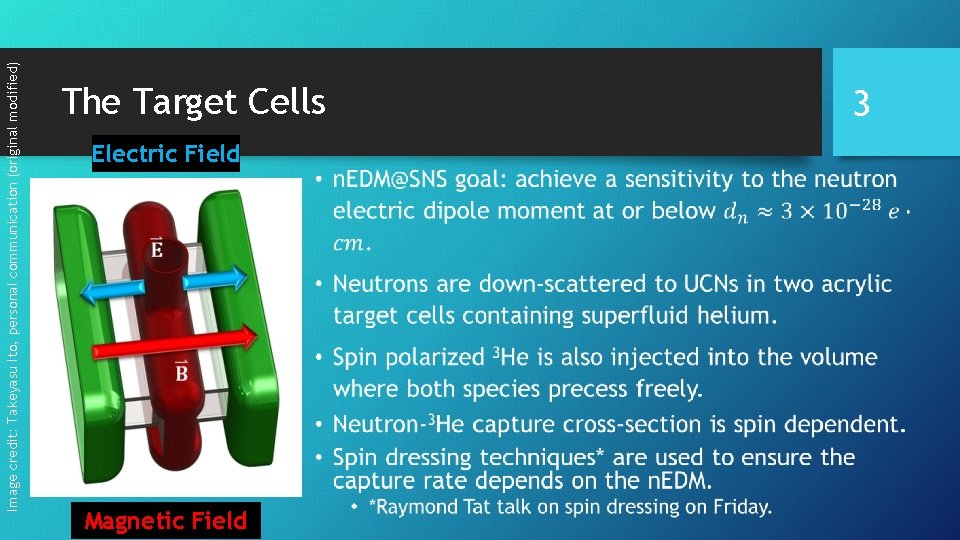
Image credit: Takeyasu Ito, personal communication (original modified) The Target Cells Electric Field Magnetic Field • 3
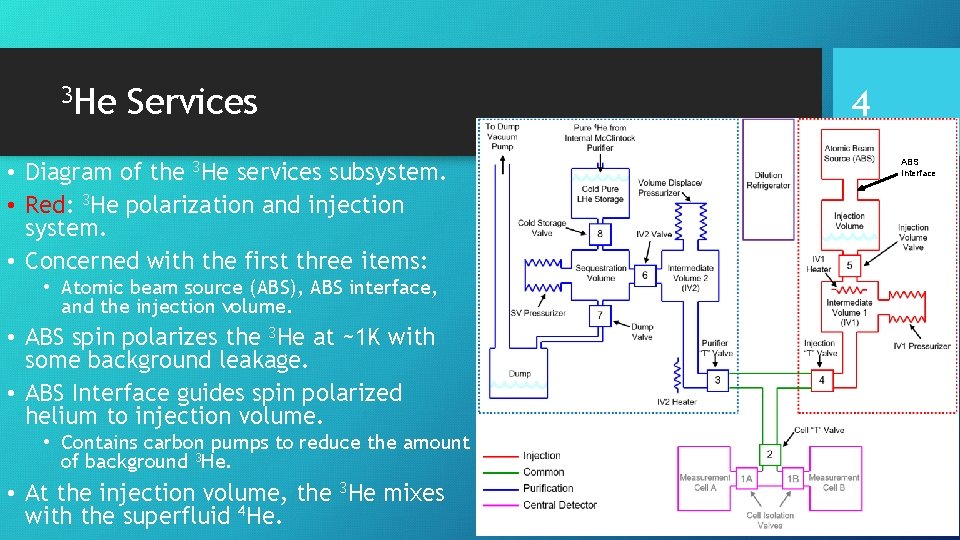
3 He Services • Diagram of the 3 He services subsystem. • Red: 3 He polarization and injection system. • Concerned with the first three items: • Atomic beam source (ABS), ABS interface, and the injection volume. • ABS spin polarizes the 3 He at ~1 K with some background leakage. • ABS Interface guides spin polarized helium to injection volume. • Contains carbon pumps to reduce the amount of background 3 He. • At the injection volume, the 3 He mixes with the superfluid 4 He. 4 ABS Interface
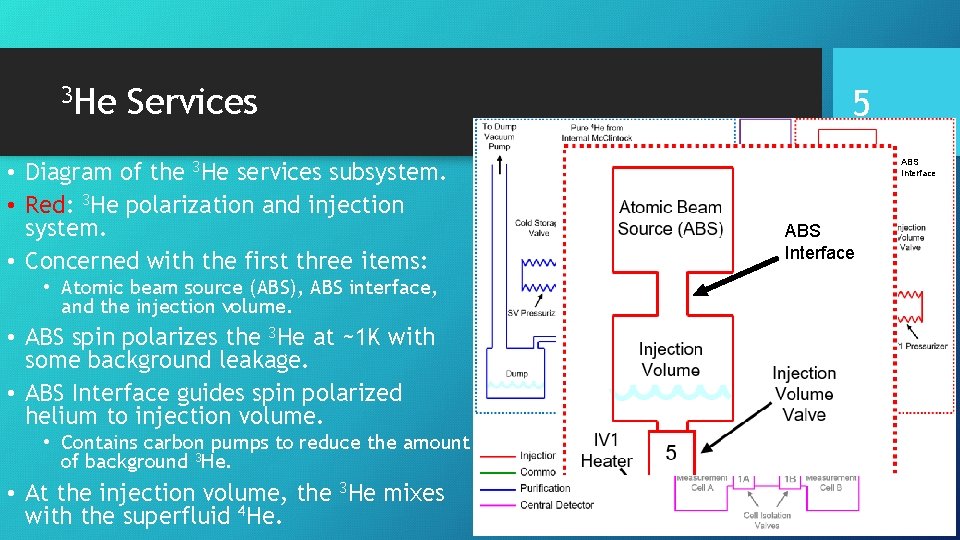
3 He Services • Diagram of the 3 He services subsystem. • Red: 3 He polarization and injection system. • Concerned with the first three items: • Atomic beam source (ABS), ABS interface, and the injection volume. • ABS spin polarizes the 3 He at ~1 K with some background leakage. • ABS Interface guides spin polarized helium to injection volume. • Contains carbon pumps to reduce the amount of background 3 He. • At the injection volume, the 3 He mixes with the superfluid 4 He. 5 ABS Interface
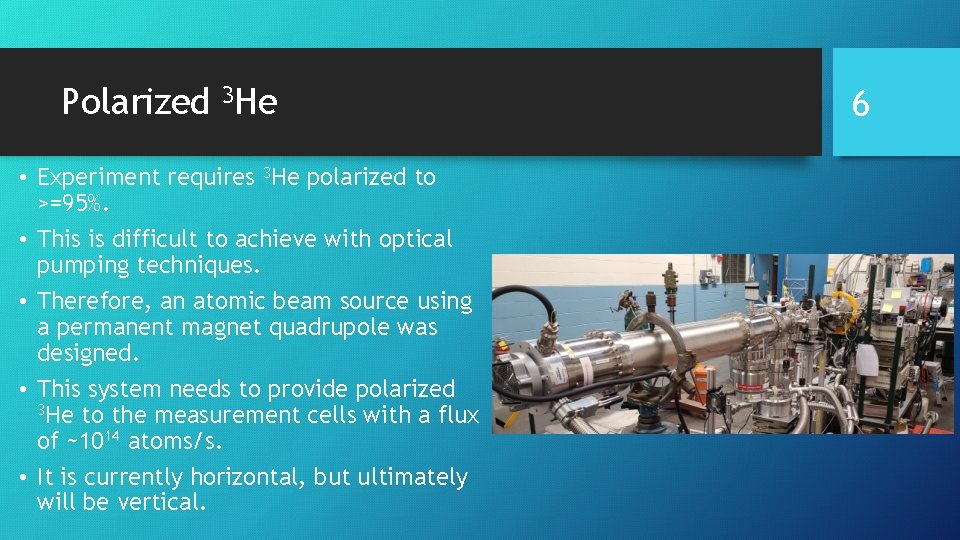
Polarized 3 He • Experiment requires 3 He polarized to >=95%. • This is difficult to achieve with optical pumping techniques. • Therefore, an atomic beam source using a permanent magnet quadrupole was designed. • This system needs to provide polarized 3 He to the measurement cells with a flux of ~1014 atoms/s. • It is currently horizontal, but ultimately will be vertical. 6
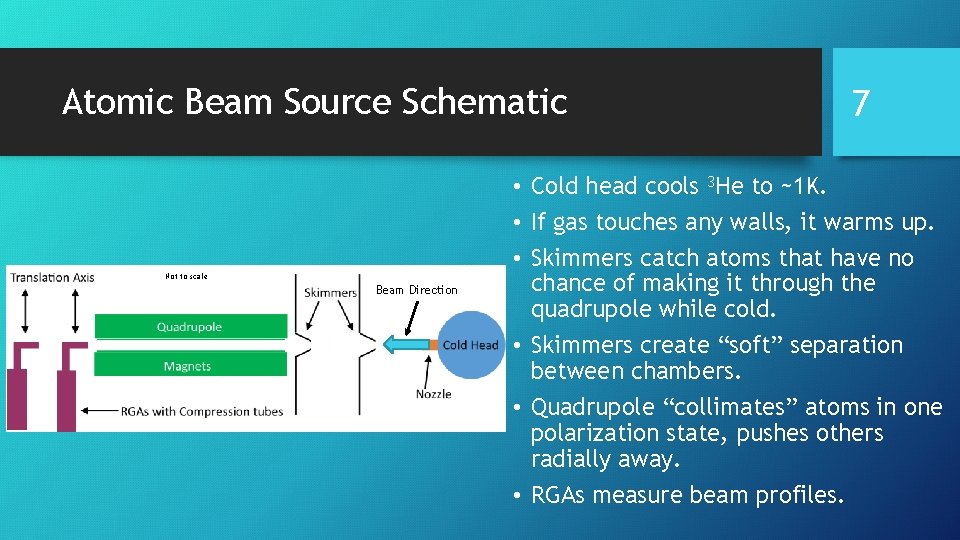
Atomic Beam Source Schematic Not to scale Beam Direction 7 • Cold head cools 3 He to ~1 K. • If gas touches any walls, it warms up. • Skimmers catch atoms that have no chance of making it through the quadrupole while cold. • Skimmers create “soft” separation between chambers. • Quadrupole “collimates” atoms in one polarization state, pushes others radially away. • RGAs measure beam profiles.
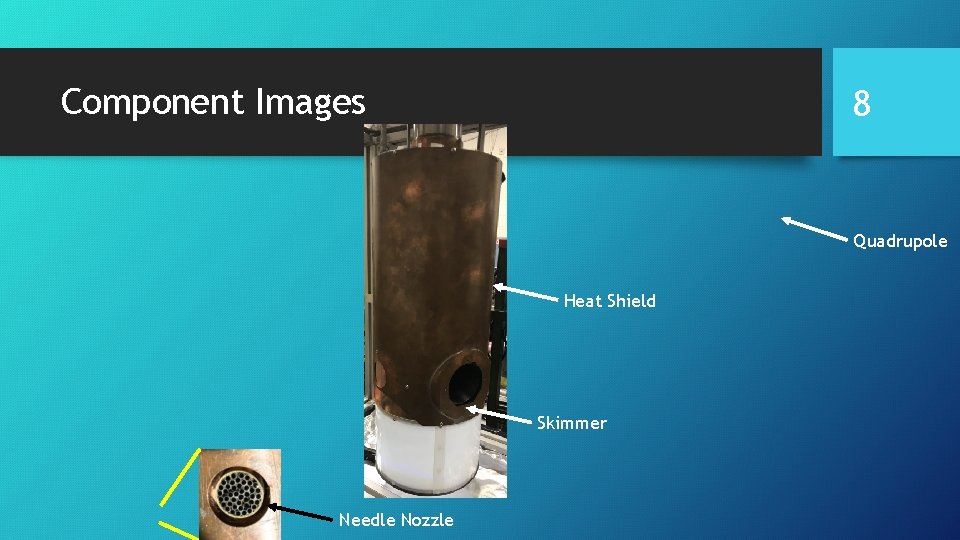
Component Images 8 Quadrupole Heat Shield Skimmer Needle Nozzle
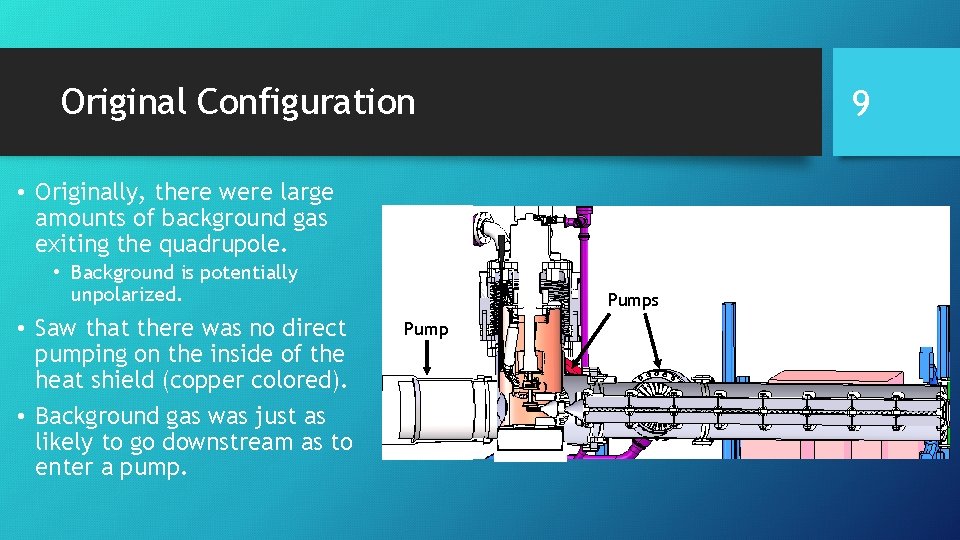
Original Configuration 9 • Originally, there were large amounts of background gas exiting the quadrupole. • Background is potentially unpolarized. • Saw that there was no direct pumping on the inside of the heat shield (copper colored). • Background gas was just as likely to go downstream as to enter a pump. Pumps Pump
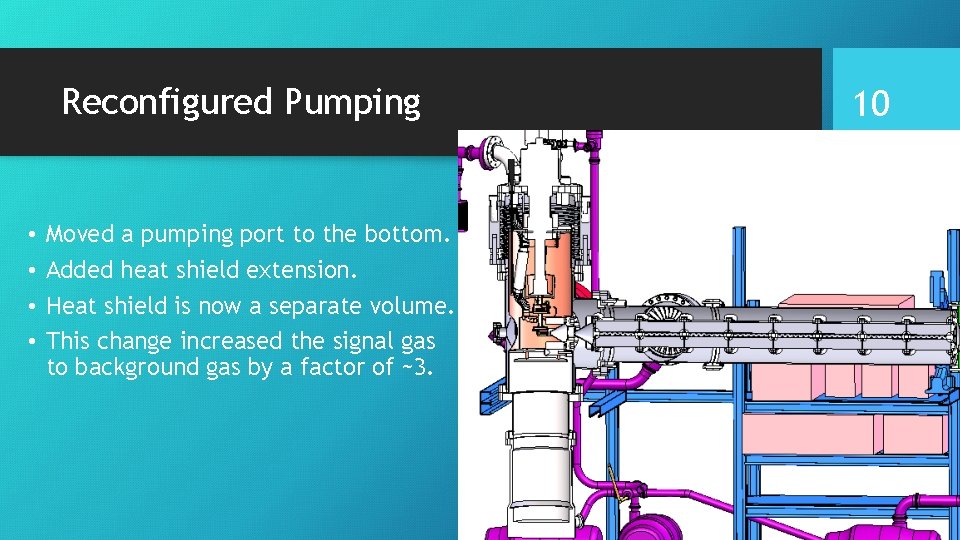
Reconfigured Pumping • • Moved a pumping port to the bottom. Added heat shield extension. Heat shield is now a separate volume. This change increased the signal gas to background gas by a factor of ~3. 10
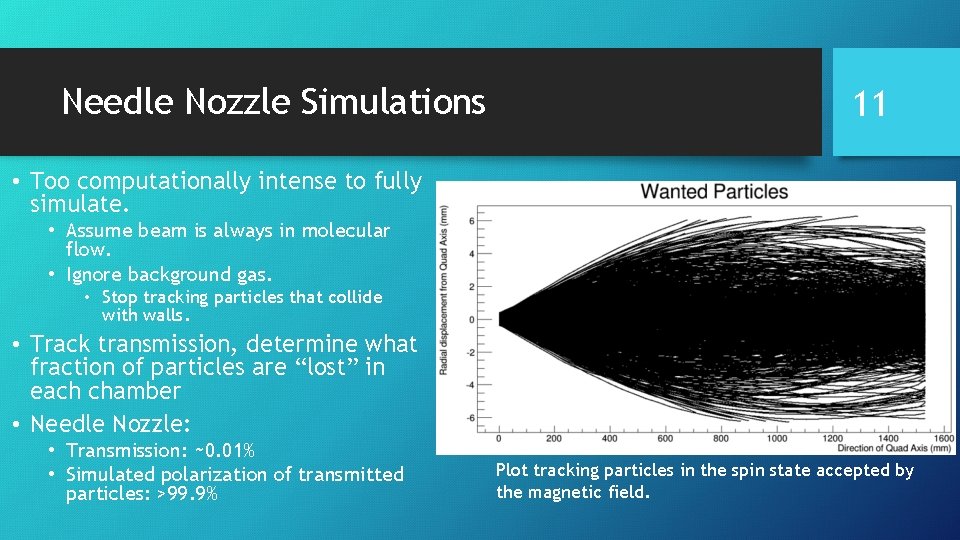
Needle Nozzle Simulations 11 • Too computationally intense to fully simulate. • Assume beam is always in molecular flow. • Ignore background gas. • Stop tracking particles that collide with walls. • Track transmission, determine what fraction of particles are “lost” in each chamber • Needle Nozzle: • Transmission: ~0. 01% • Simulated polarization of transmitted particles: >99. 9% Plot tracking particles in the spin state accepted by the magnetic field.
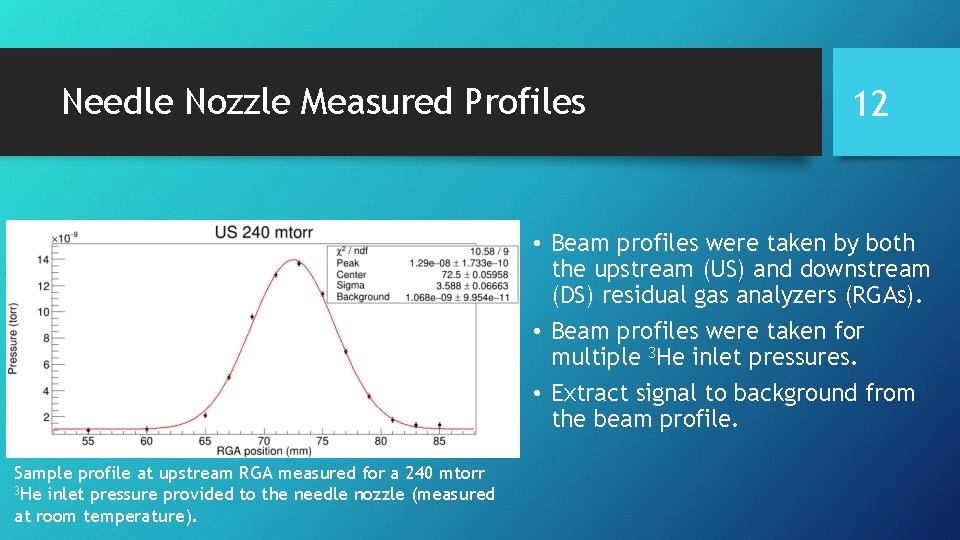
Needle Nozzle Measured Profiles 12 • Beam profiles were taken by both the upstream (US) and downstream (DS) residual gas analyzers (RGAs). • Beam profiles were taken for multiple 3 He inlet pressures. • Extract signal to background from the beam profile. Sample profile at upstream RGA measured for a 240 mtorr 3 He inlet pressure provided to the needle nozzle (measured at room temperature).
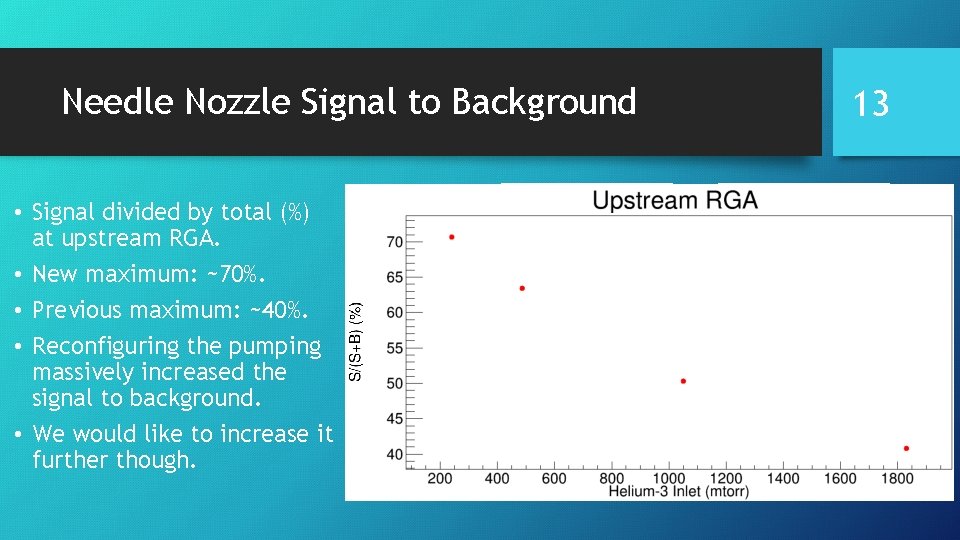
Needle Nozzle Signal to Background • Signal divided by total (%) at upstream RGA. • New maximum: ~70%. • Previous maximum: ~40%. • Reconfiguring the pumping massively increased the signal to background. • We would like to increase it further though. 13
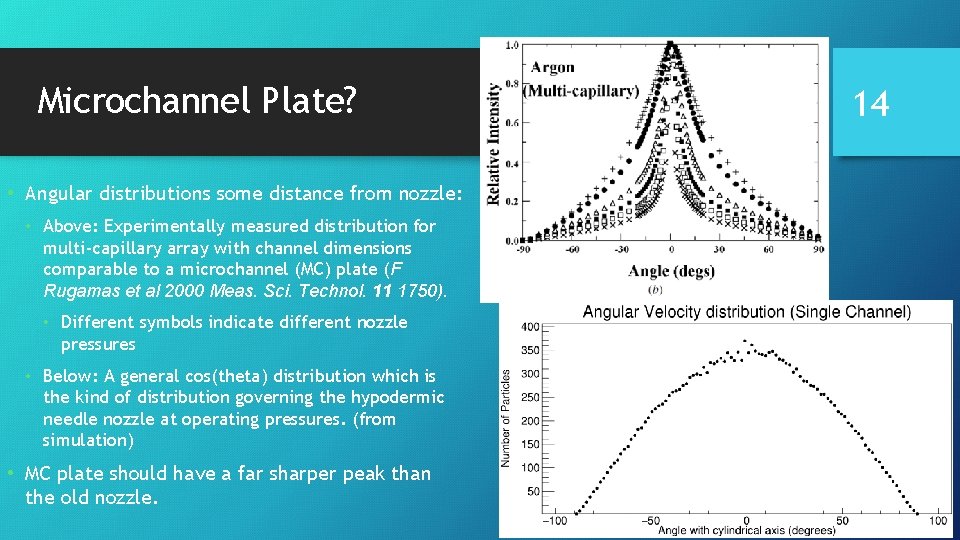
Microchannel Plate? • Angular distributions some distance from nozzle: • Above: Experimentally measured distribution for multi-capillary array with channel dimensions comparable to a microchannel (MC) plate (F Rugamas et al 2000 Meas. Sci. Technol. 11 1750). • Different symbols indicate different nozzle pressures • Below: A general cos(theta) distribution which is the kind of distribution governing the hypodermic needle nozzle at operating pressures. (from simulation) • MC plate should have a far sharper peak than the old nozzle. 14
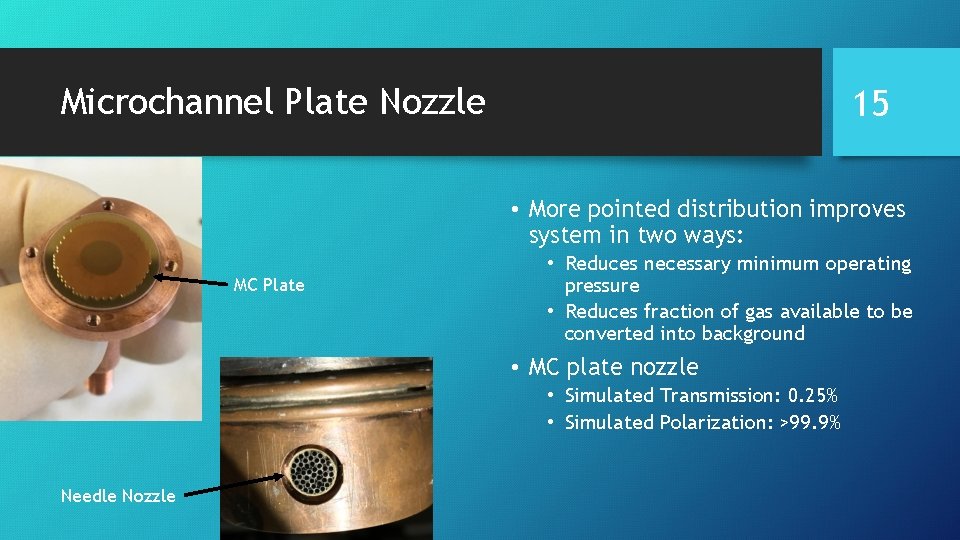
Microchannel Plate Nozzle 15 • More pointed distribution improves system in two ways: MC Plate • Reduces necessary minimum operating pressure • Reduces fraction of gas available to be converted into background • MC plate nozzle • Simulated Transmission: 0. 25% • Simulated Polarization: >99. 9% Needle Nozzle
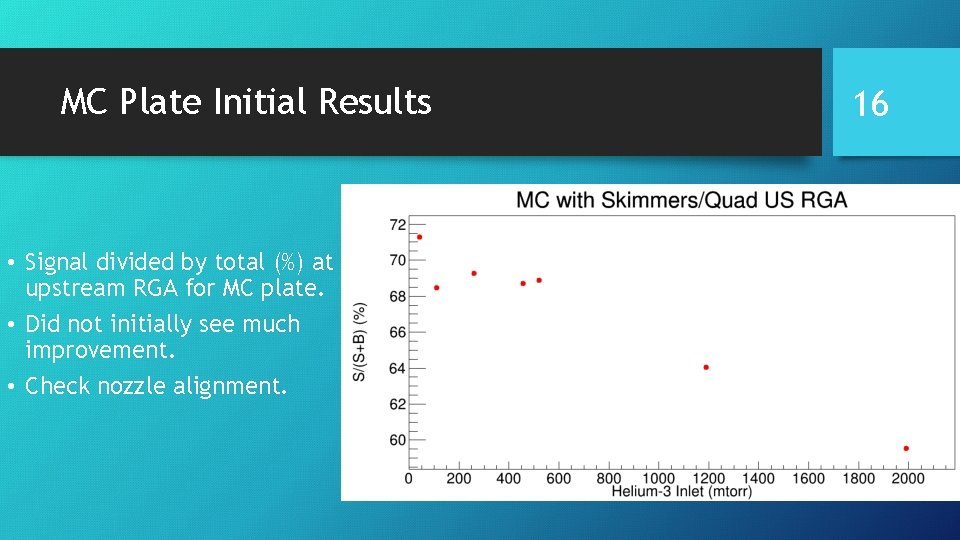
MC Plate Initial Results • Signal divided by total (%) at upstream RGA for MC plate. • Did not initially see much improvement. • Check nozzle alignment. 16
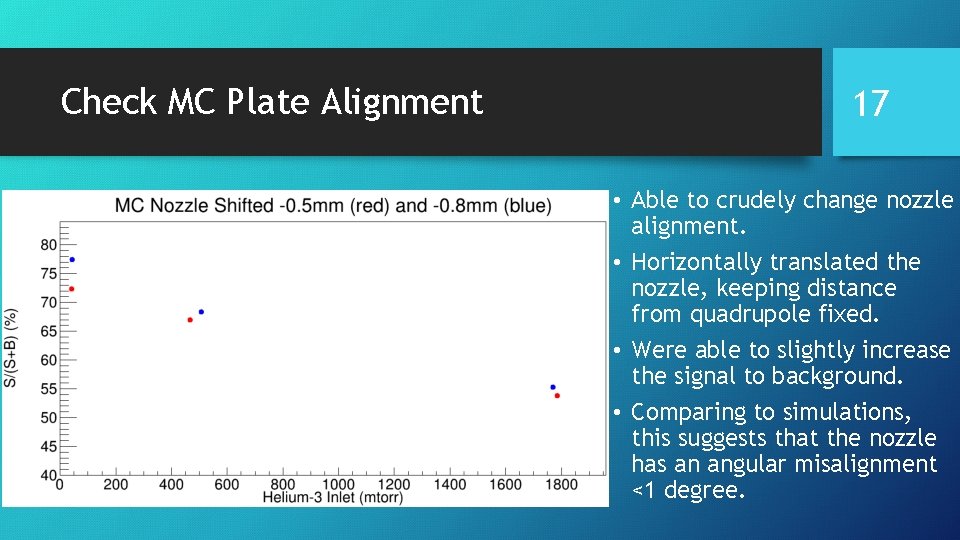
Check MC Plate Alignment 17 • Able to crudely change nozzle alignment. • Horizontally translated the nozzle, keeping distance from quadrupole fixed. • Were able to slightly increase the signal to background. • Comparing to simulations, this suggests that the nozzle has an angular misalignment <1 degree.
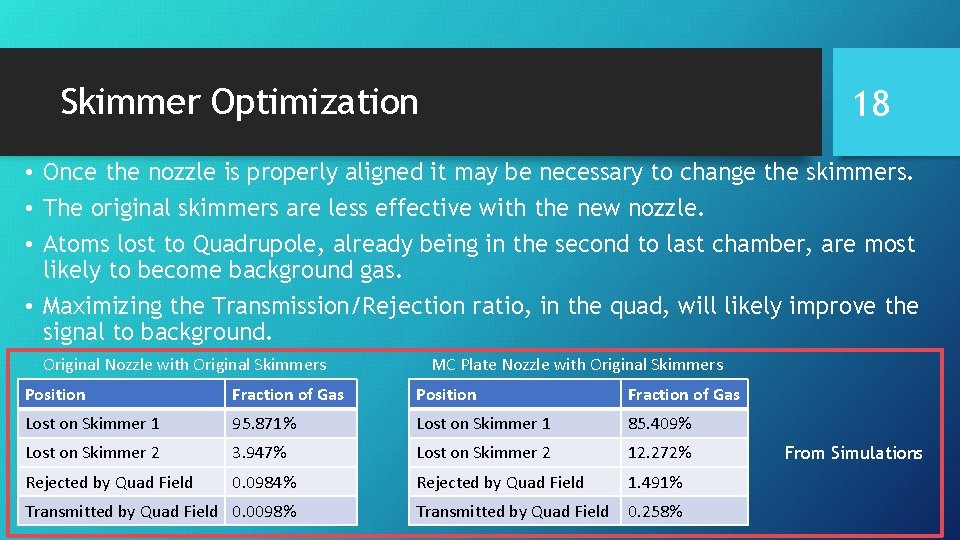
Skimmer Optimization 18 • Once the nozzle is properly aligned it may be necessary to change the skimmers. • The original skimmers are less effective with the new nozzle. • Atoms lost to Quadrupole, already being in the second to last chamber, are most likely to become background gas. • Maximizing the Transmission/Rejection ratio, in the quad, will likely improve the signal to background. Original Nozzle with Original Skimmers MC Plate Nozzle with Original Skimmers Position Fraction of Gas Lost on Skimmer 1 95. 871% Lost on Skimmer 1 85. 409% Lost on Skimmer 2 3. 947% Lost on Skimmer 2 12. 272% Rejected by Quad Field 0. 0984% Rejected by Quad Field 1. 491% Transmitted by Quad Field 0. 258% Transmitted by Quad Field 0. 0098% From Simulations
Summary and Future Work 19 • A 3 He atomic beam source has been tested and modified. • Currently working to further reduce the background being emitted. • Most recent attempt involves a new nozzle with a more pointed velocity distribution. • This new nozzle has some alignment issues which are being explored as of this presentation. • Future optimizations for the skimmers may further reduce background. • These require major changes, which can most efficiently be performed as part of rotating the apparatus into a vertical orientation.

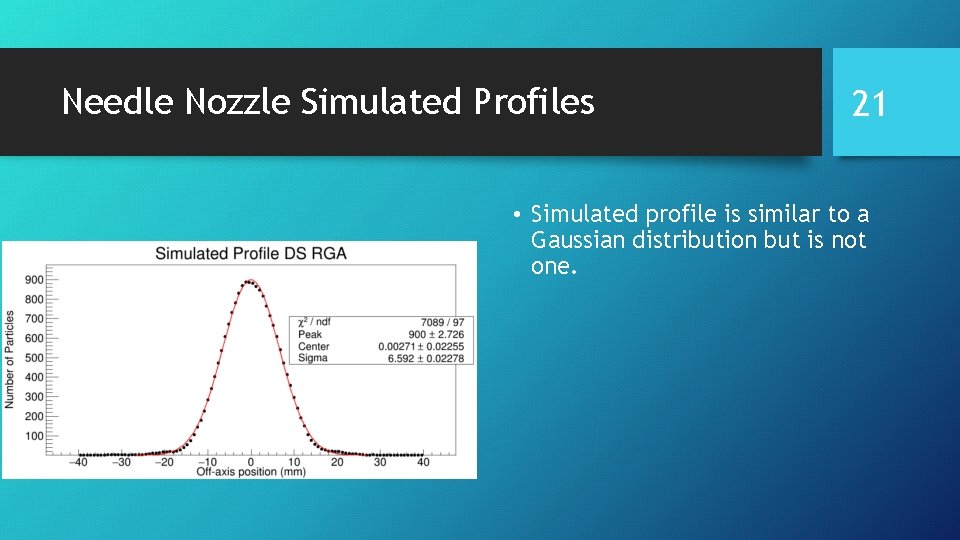
Needle Nozzle Simulated Profiles 21 • Simulated profile is similar to a Gaussian distribution but is not one.
- Slides: 21