
ATOM The is the smallest basic unit of
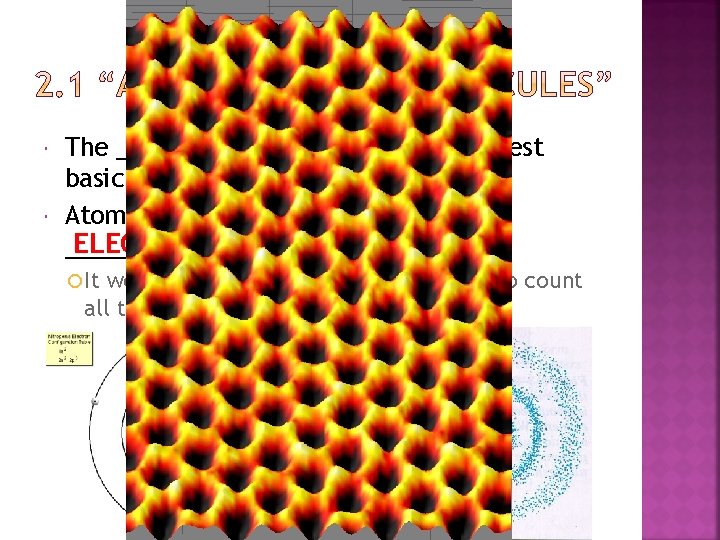
ATOM The __________is the smallest basic unit of matter Atoms cannot be seen without an ELECTRON MICROSCOPE ______________ It would take more than a trillion years to count all the atoms in a grain of sand!!!
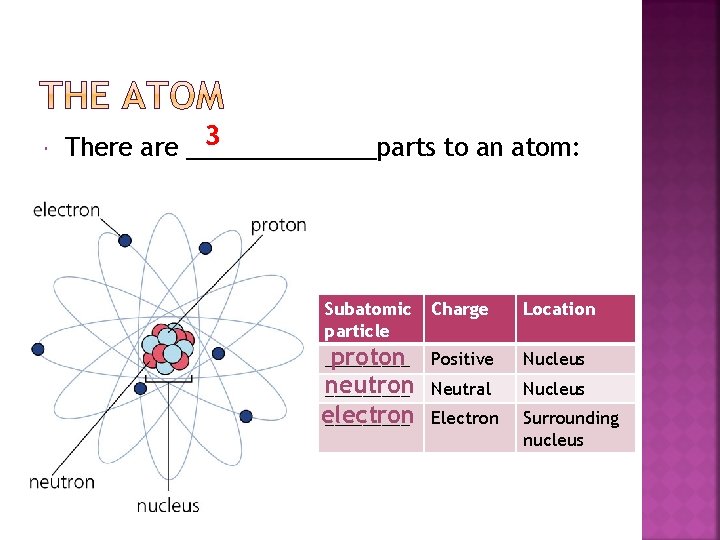
3 There are _______parts to an atom: Subatomic particle Charge Location proton _____ Positive Nucleus neutron Neutral _____ Nucleus electron _____ Surrounding nucleus Electron
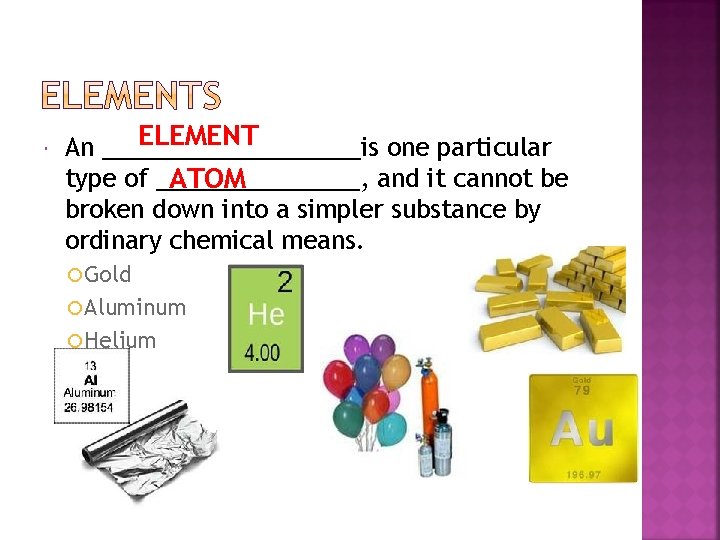
ELEMENT An __________is one particular type of ________, and it cannot be ATOM broken down into a simpler substance by ordinary chemical means. Gold Aluminum Helium
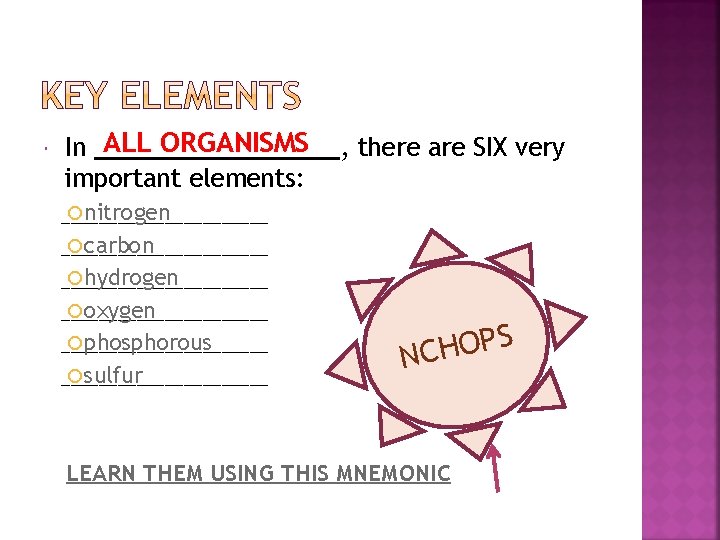
ALL ORGANISMS In _________, there are SIX very important elements: nitrogen ___________ carbon ___________ hydrogen ___________ oxygen ___________ phosphorous ___________ sulfur ___________ S P O NCH LEARN THEM USING THIS MNEMONIC
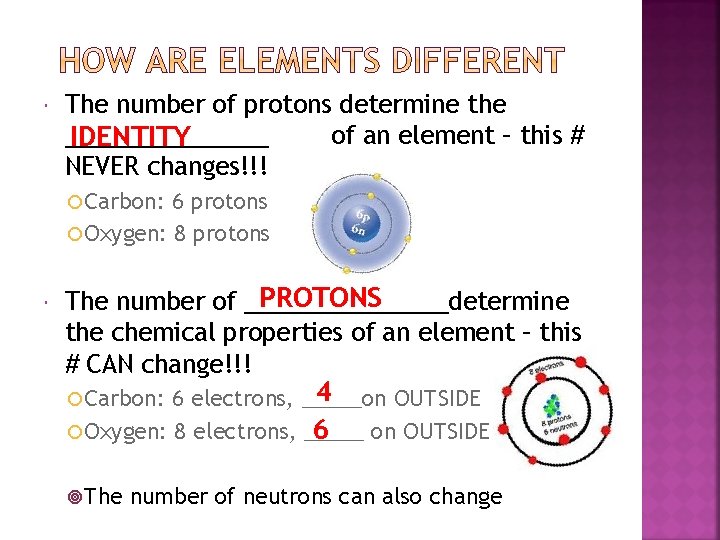
The number of protons determine the ________ of an element – this # IDENTITY NEVER changes!!! Carbon: 6 protons Oxygen: 8 protons PROTONS The number of ________determine the chemical properties of an element – this # CAN change!!! 4 6 electrons, _____on OUTSIDE Oxygen: 8 electrons, _____ 6 on OUTSIDE Carbon: The number of neutrons can also change
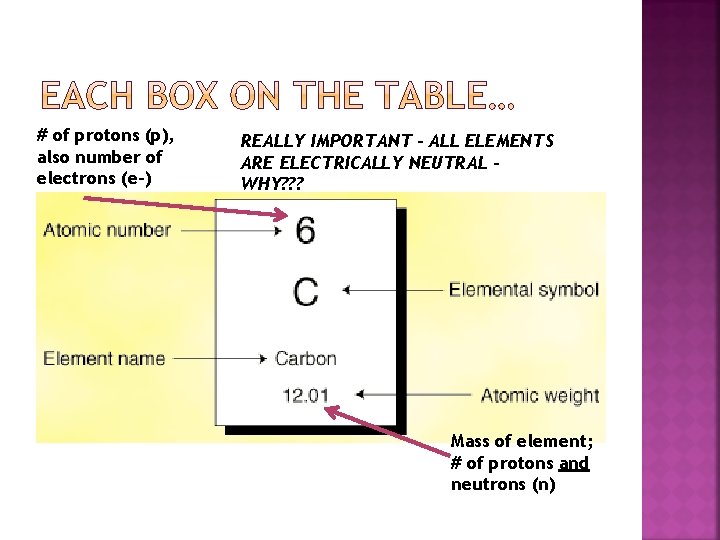
# of protons (p), also number of electrons (e-) REALLY IMPORTANT – ALL ELEMENTS ARE ELECTRICALLY NEUTRAL – WHY? ? ? Mass of element; # of protons and neutrons (n)
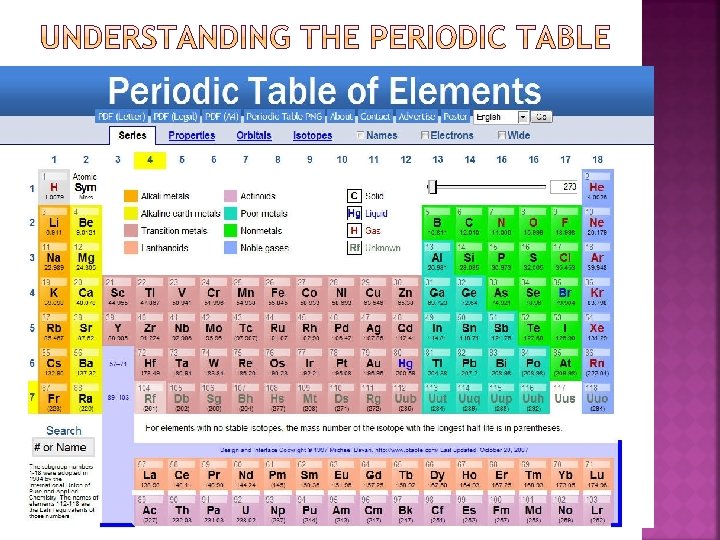
Using your table, find: Atomic number of H ______ Atomic mass of S______ Number of electrons in N_______ Atomic number of Calcium_______ Number of protons in element #8_______
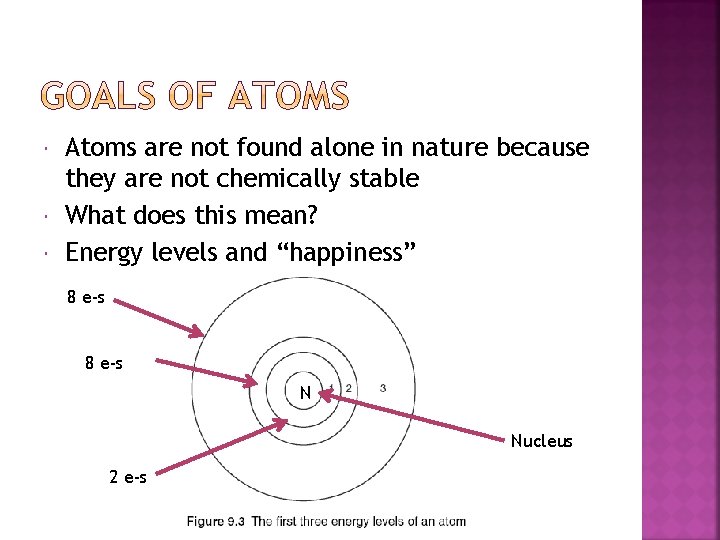
Atoms are not found alone in nature because they are not chemically stable What does this mean? Energy levels and “happiness” 8 e-s N Nucleus 2 e-s
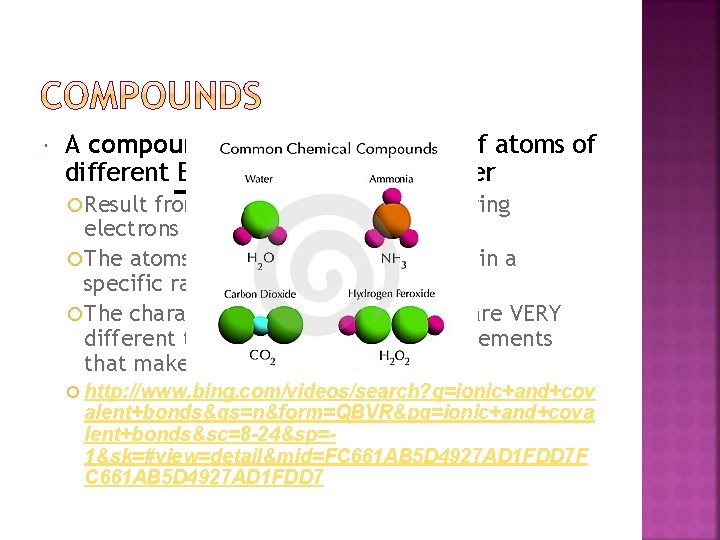
A compound is a substance made of atoms of different ELEMENTS bonded together Result from either sharing or transferring electrons to become stable The atoms in a compound are bonded in a specific ratio The characteristics of the compound are VERY different than the properties of the elements that make them up – Na. Cl http: //www. bing. com/videos/search? q=ionic+and+cov alent+bonds&qs=n&form=QBVR&pq=ionic+and+cova lent+bonds&sc=8 -24&sp=1&sk=#view=detail&mid=FC 661 AB 5 D 4927 AD 1 FDD 7 F C 661 AB 5 D 4927 AD 1 FDD 7
https: //www. youtube. com/watch? v=_M 9 khs 8 7 x. Q 8
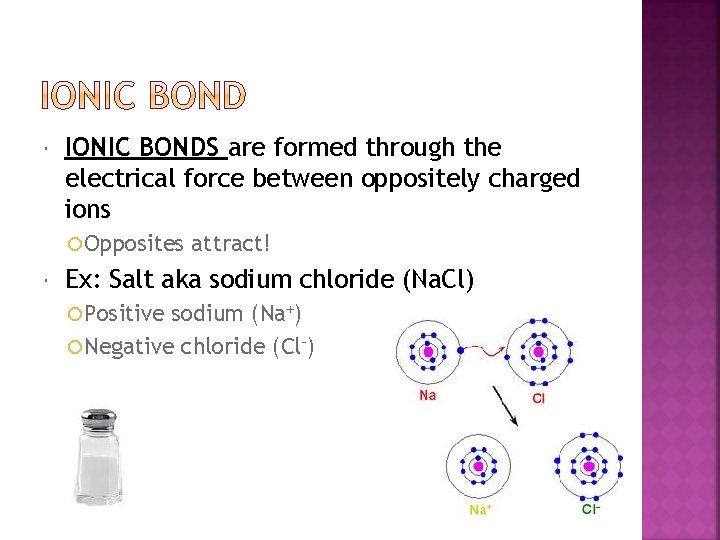
IONIC BONDS are formed through the electrical force between oppositely charged ions Opposites attract! Ex: Salt aka sodium chloride (Na. Cl) Positive sodium (Na+) Negative chloride (Cl-)
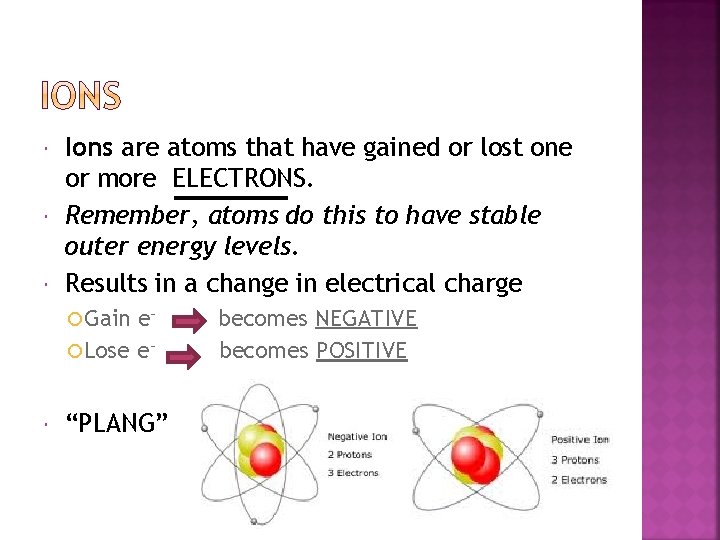
Ions are atoms that have gained or lost one or more ELECTRONS. Remember, atoms do this to have stable outer energy levels. Results in a change in electrical charge Gain e Lose e “PLANG” becomes NEGATIVE becomes POSITIVE
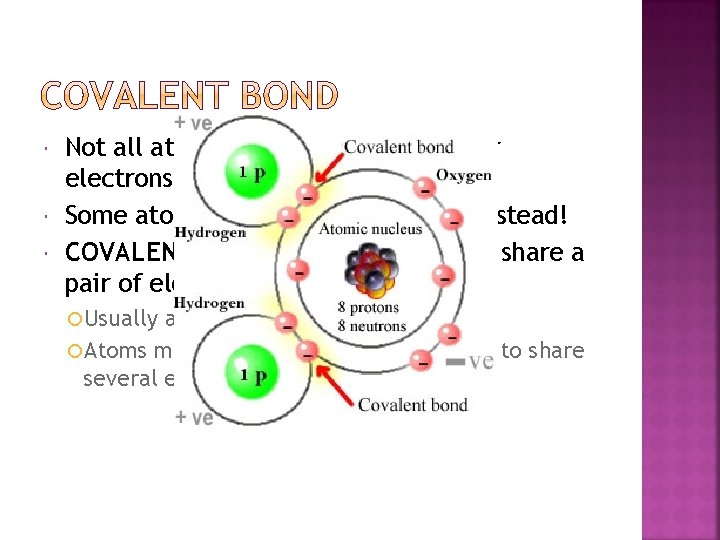
Not all atoms easily gain or lose their electrons! Some atoms SHARE their electrons instead! COVALENT Bond: forms when atoms share a pair of electrons Usually a very strong bond Atoms may have several covalent bonds to share several electrons
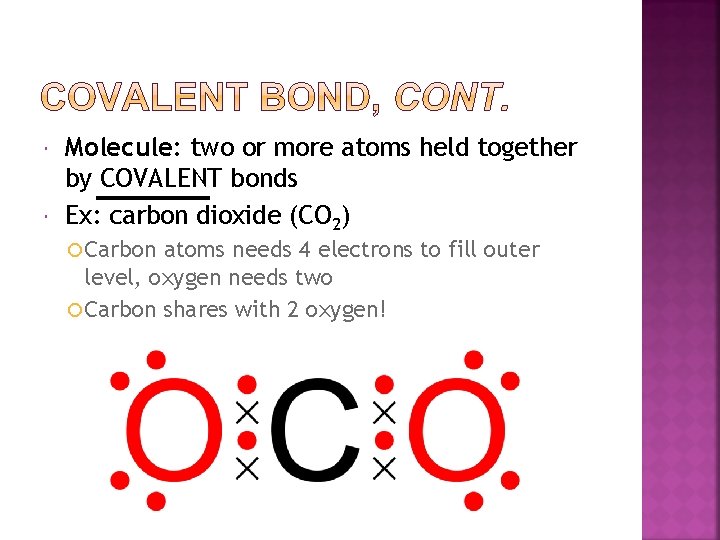
Molecule: two or more atoms held together by COVALENT bonds Ex: carbon dioxide (CO 2) Carbon atoms needs 4 electrons to fill outer level, oxygen needs two Carbon shares with 2 oxygen!
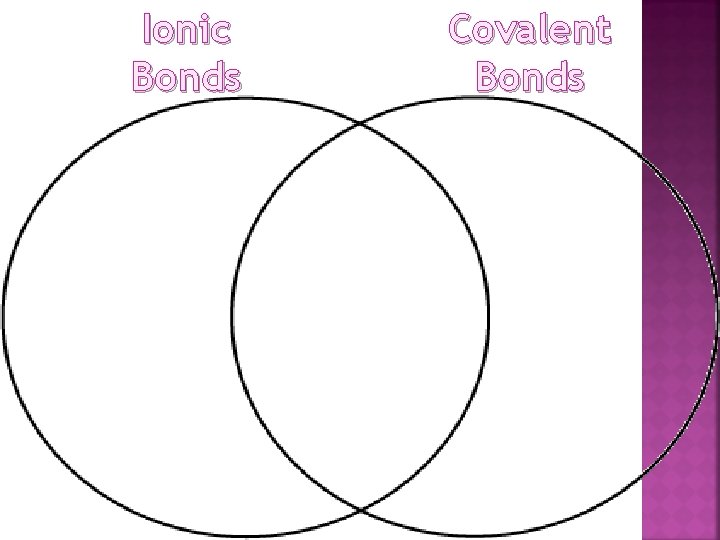
Ionic Bonds Covalent Bonds
Life depends on hydrogen bonds in water. Many compounds dissolve in water. Some compounds form acids or bases.
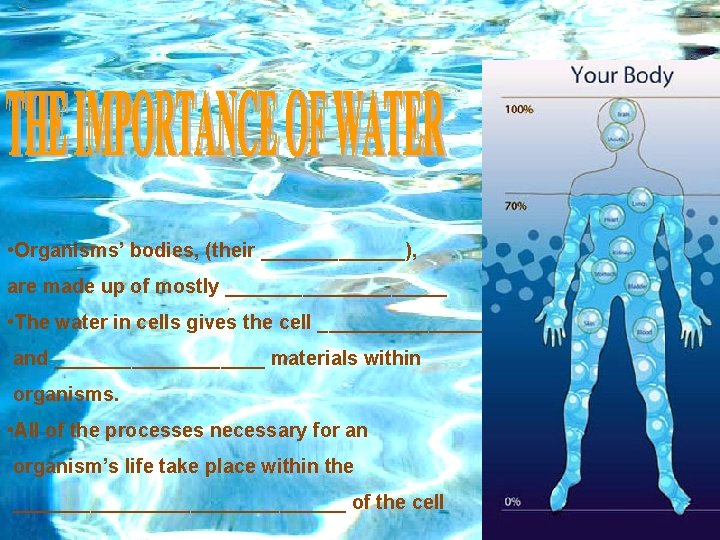
• Organisms’ bodies, (their _______), are made up of mostly __________ • The water in cells gives the cell ________ and __________ materials within organisms. • All of the processes necessary for an organism’s life take place within the _______________ of the cell
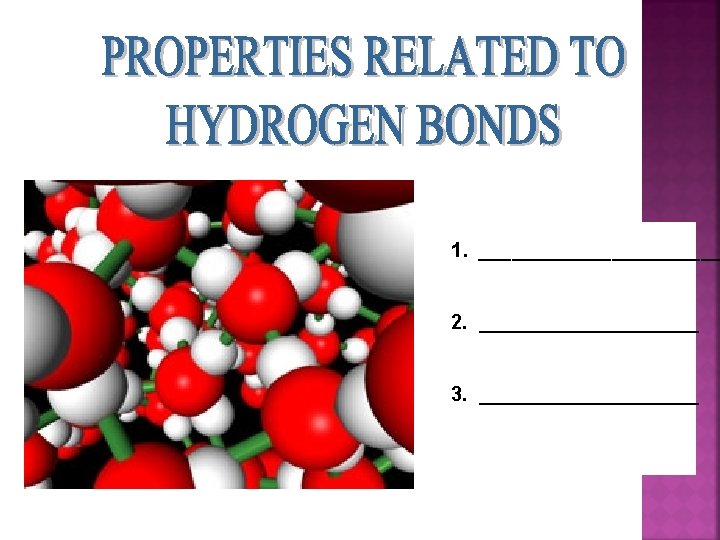
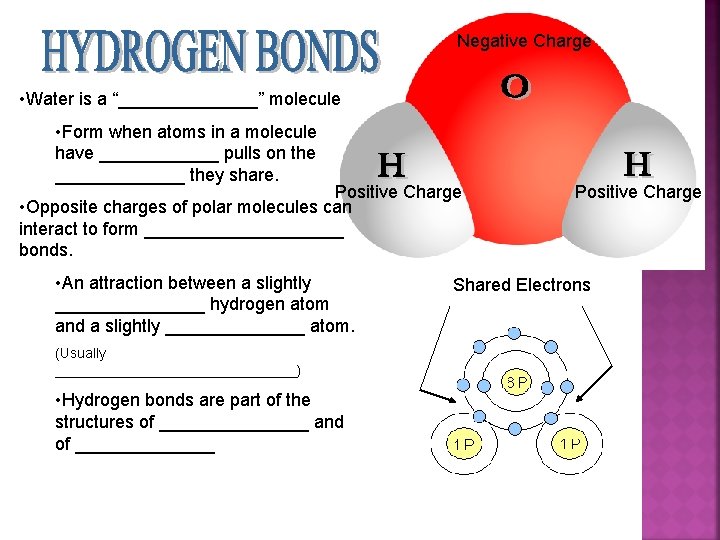
Negative Charge • Water is a “_______” molecule • Form when atoms in a molecule have ______ pulls on the _______ they share. Positive Charge • Opposite charges of polar molecules can interact to form __________ bonds. • An attraction between a slightly ________ hydrogen atom and a slightly _______ atom. (Usually ________________) • Hydrogen bonds are part of the structures of ________ and of _______ Positive Charge Shared Electrons
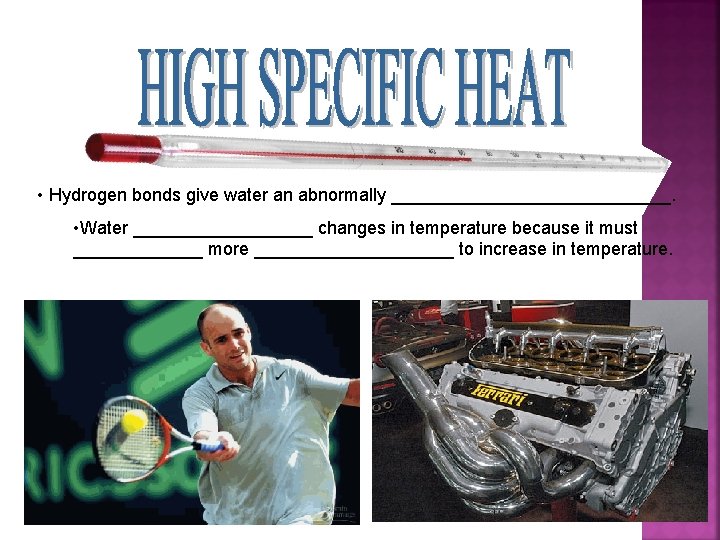
• Hydrogen bonds give water an abnormally ______________. • Water _________ changes in temperature because it must _______ more __________ to increase in temperature.
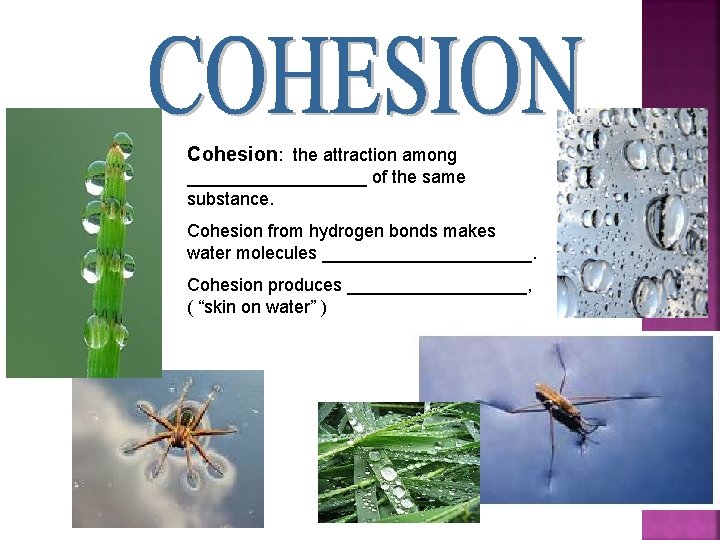
Cohesion: the attraction among _________ of the same substance. Cohesion from hydrogen bonds makes water molecules ___________. Cohesion produces _________, ( “skin on water” )
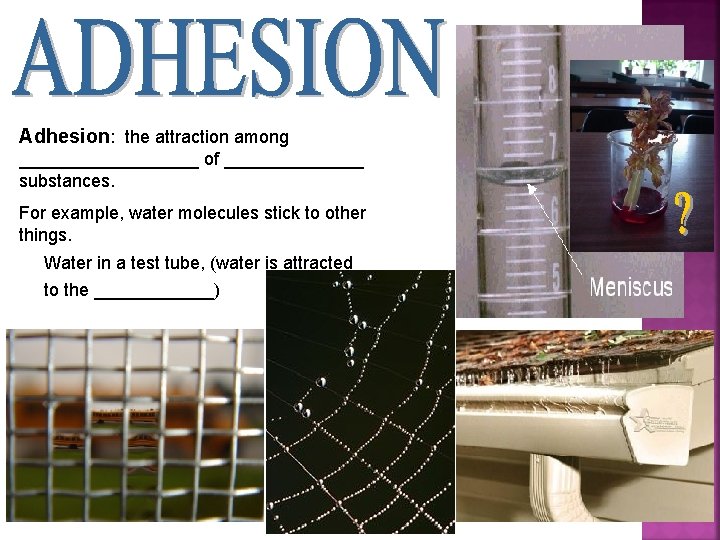
Adhesion: the attraction among _________ of _______ substances. For example, water molecules stick to other things. Water in a test tube, (water is attracted to the ______)
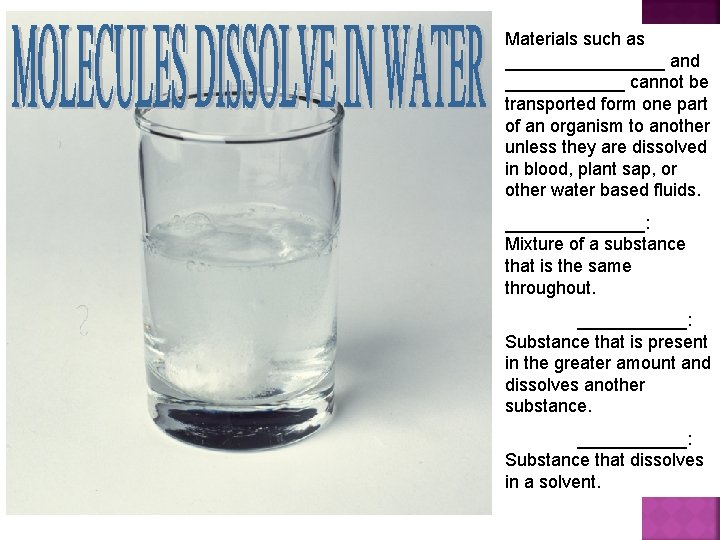
Materials such as ________ and ______ cannot be transported form one part of an organism to another unless they are dissolved in blood, plant sap, or other water based fluids. _______: Mixture of a substance that is the same throughout. ______: Substance that is present in the greater amount and dissolves another substance. ______: Substance that dissolves in a solvent.
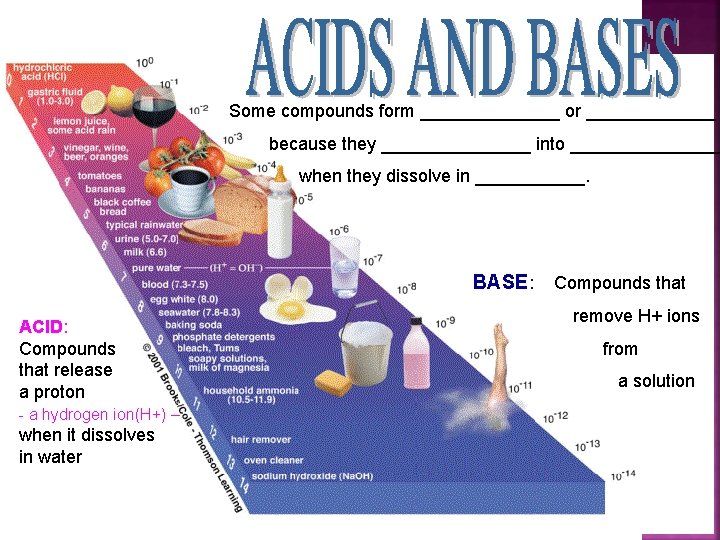
Some compounds form _______ or _______ because they ________ into ________ when they dissolve in ______. BASE : Compounds that ACID: Compounds that release a proton - a hydrogen ion(H+) – when it dissolves in water remove H+ ions from a solution
1. How do polar molecules form hydrogen bonds? 2. What determines whether a compound will dissolve in water? 3. Compare acids and bases. 4. How do polar molecules differ from non-polar molecules? How does this difference affect their interactions? 5. Describe an example of cohesion or adhesion that you might observe during your daily life.
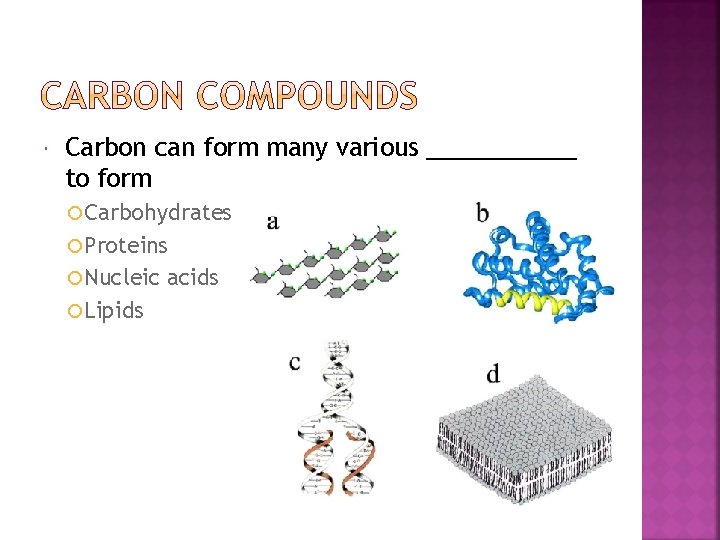
Carbon can form many various ______ to form Carbohydrates Proteins Nucleic Lipids acids
Building large molecules (_____) from smaller ones (_____) • Several step process
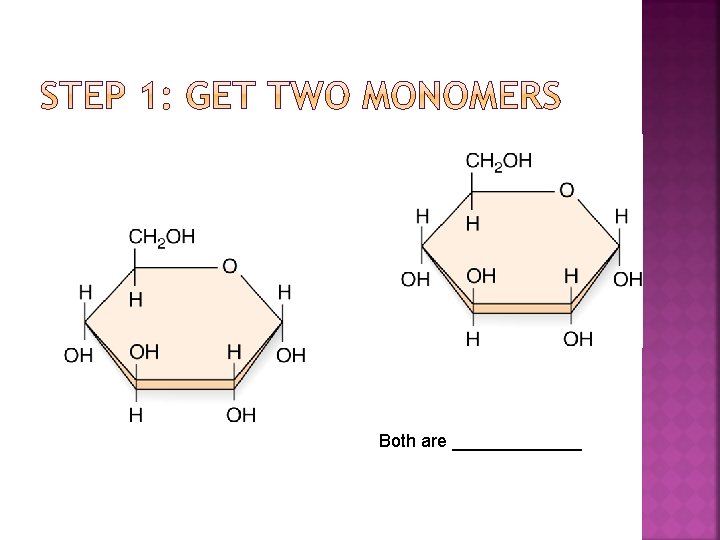
Both are _______
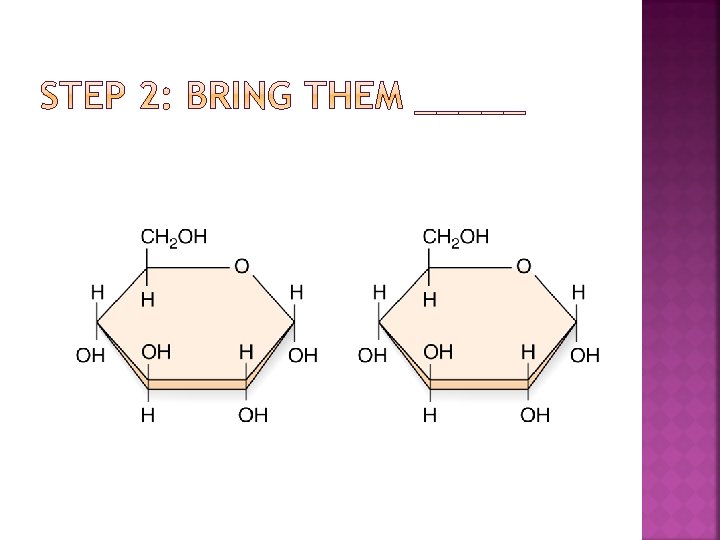
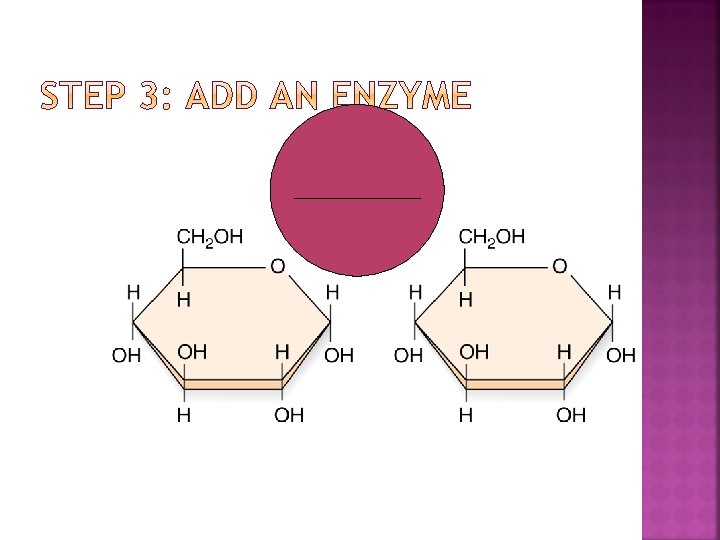
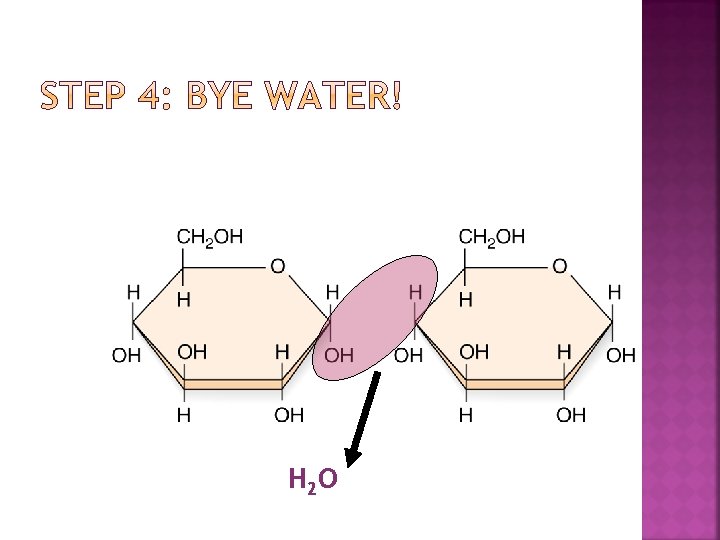
This _____ carries out a reaction between the two monomers • ___________: Joins two molecules together by REMOVING _______ AKA: condensation reaction
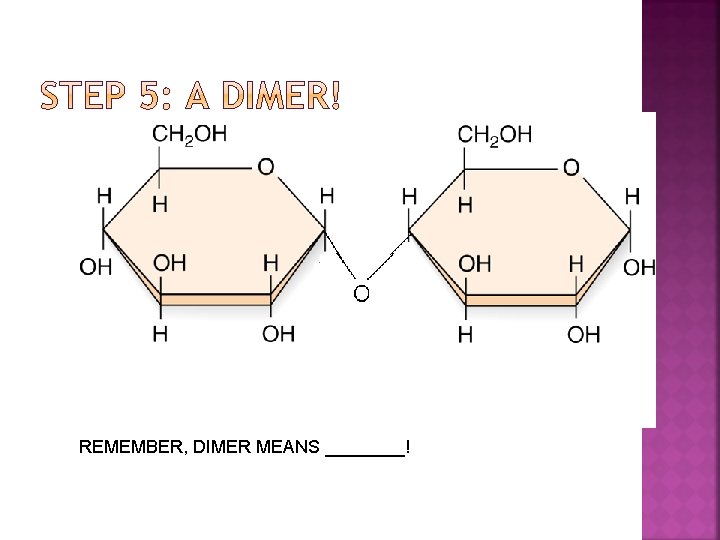
REMEMBER, DIMER MEANS ____!
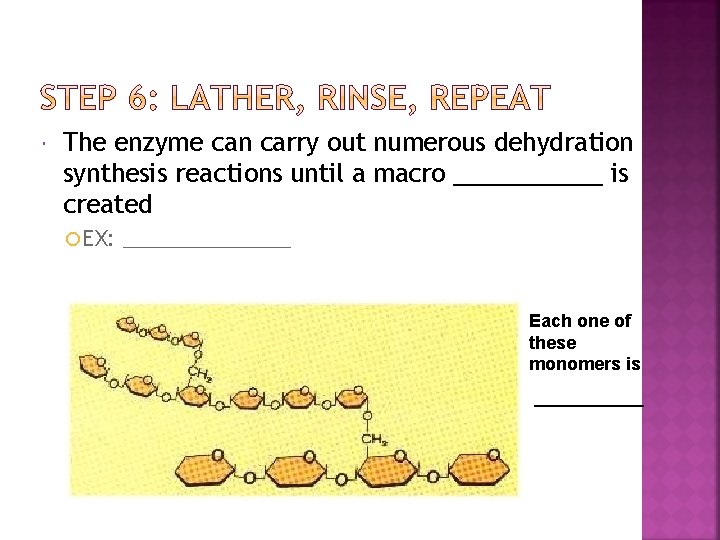
The enzyme can carry out numerous dehydration synthesis reactions until a macro ______ is created EX: _______ Each one of these monomers is ______

You better believe it!
Process called ______. • “ _____” means water • “ _____” means to split or loosen • This enzyme works by _____ water to a polymer General process name: depolymerization turning polymers back into monomers
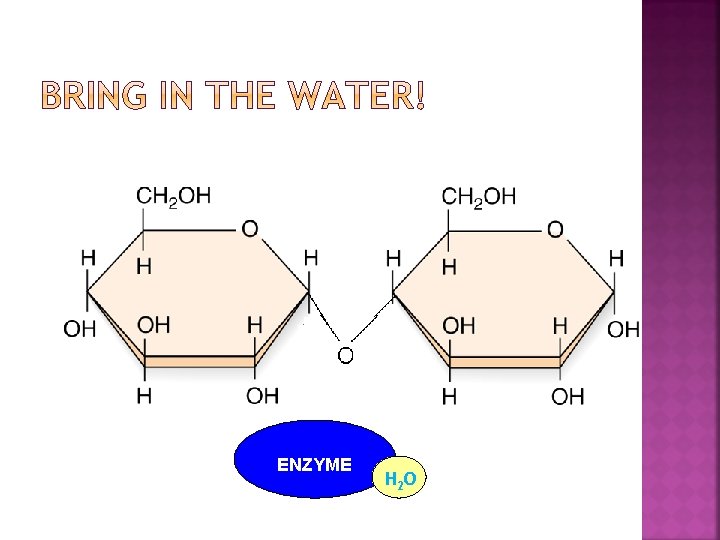
ENZYME H 2 O
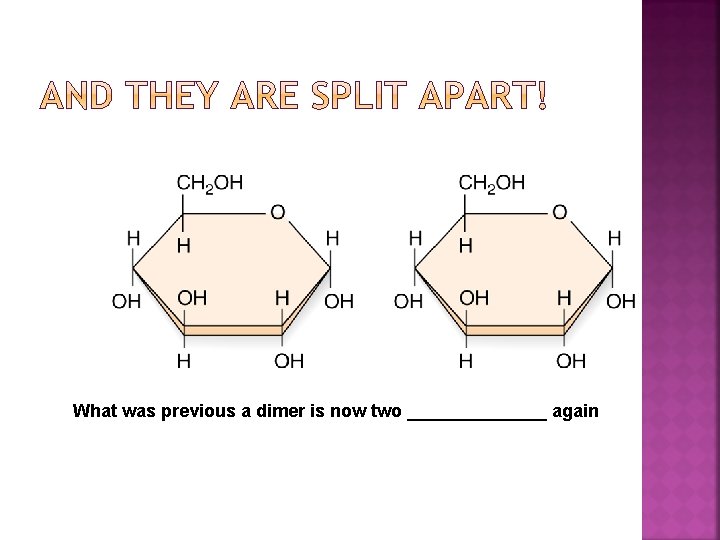
What was previous a dimer is now two _______ again
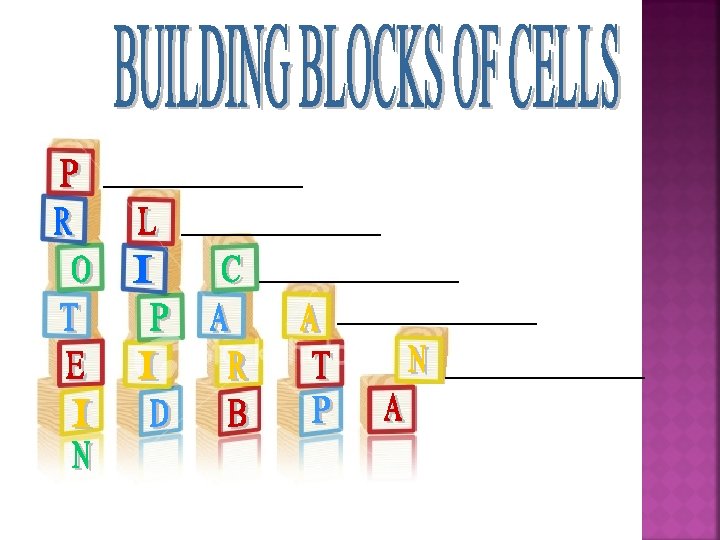
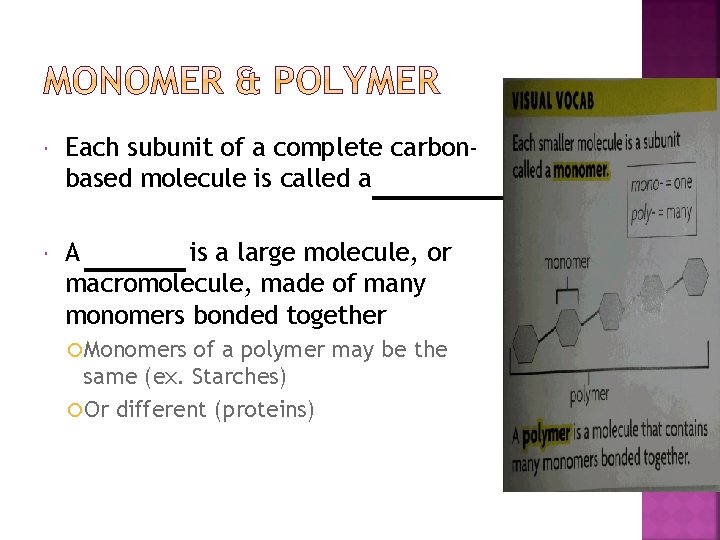
Each subunit of a complete carbonbased molecule is called a A is a large molecule, or macromolecule, made of many monomers bonded together Monomers of a polymer may be the same (ex. Starches) Or different (proteins)
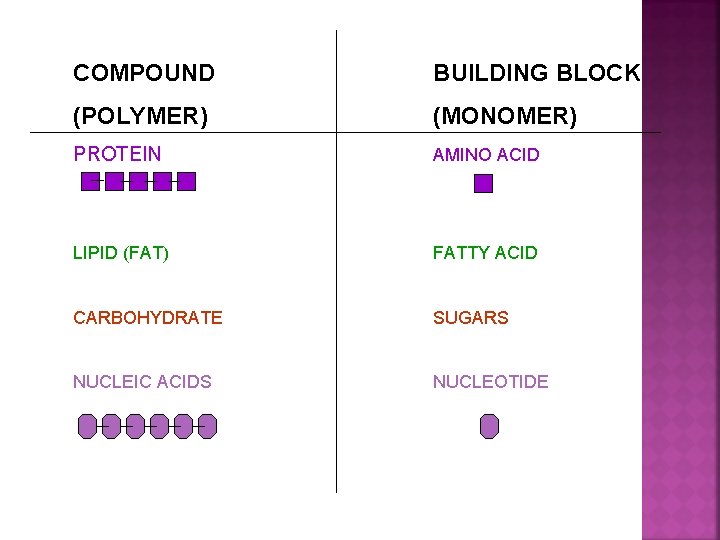
COMPOUND BUILDING BLOCK (POLYMER) (MONOMER) PROTEIN AMINO ACID LIPID (FAT) FATTY ACID CARBOHYDRATE SUGARS NUCLEIC ACIDS NUCLEOTIDE
Carbohydrates are molecules composed of carbon, , and oxygen Include sugars & starches Can be broken down to provide useable energy for cells Major part of plant cell structure The most basic carbs are simple sugars, Polysaccharides are monosaccharides of
Proteins are the most varied of the carbonbased molecules in organisms Have a role in movement, eyesight, digestion, etc A protein is a polymer made of monomers called amino acids are molecules that contain carbon, hydrogen, oxygen, nitrogen, and sometimes sulfur Organisms use 20 different amino acids to build proteins The body makes 12 of the 20, the other 8 come from food
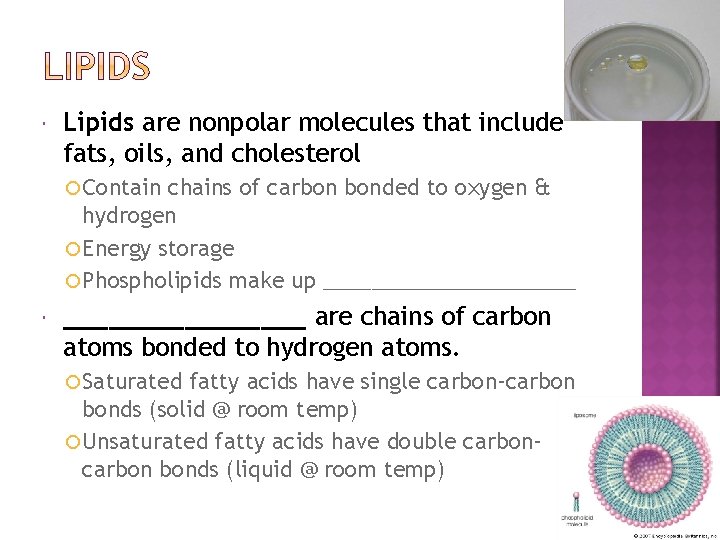
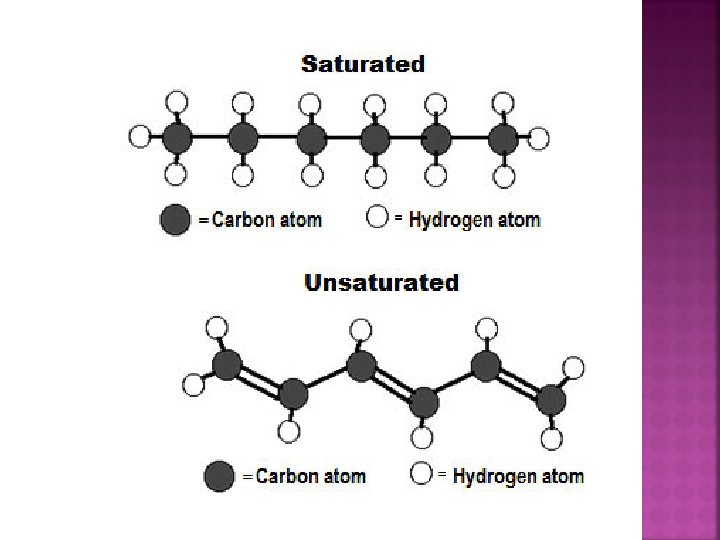
Lipids are nonpolar molecules that include fats, oils, and cholesterol Contain chains of carbon bonded to oxygen & hydrogen Energy storage Phospholipids make up ___________ are chains of carbon atoms bonded to hydrogen atoms. Saturated fatty acids have single carbon-carbon bonds (solid @ room temp) Unsaturated fatty acids have double carbon bonds (liquid @ room temp)
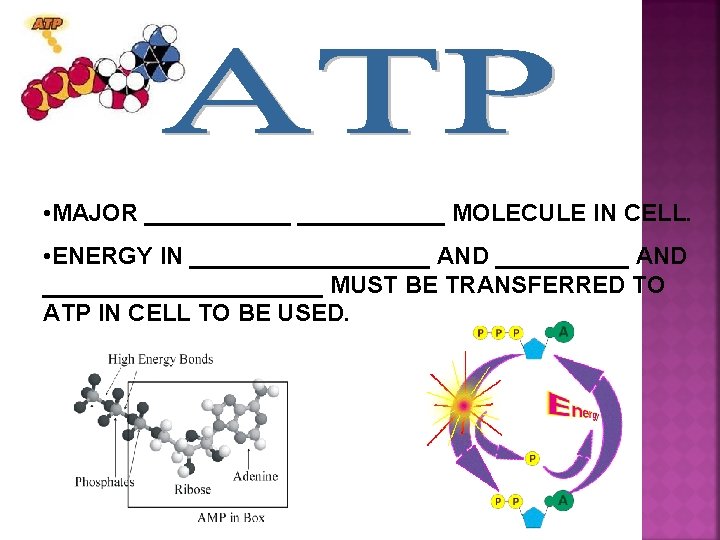
• MAJOR ___________ MOLECULE IN CELL. • ENERGY IN _________ AND ________________ MUST BE TRANSFERRED TO ATP IN CELL TO BE USED.
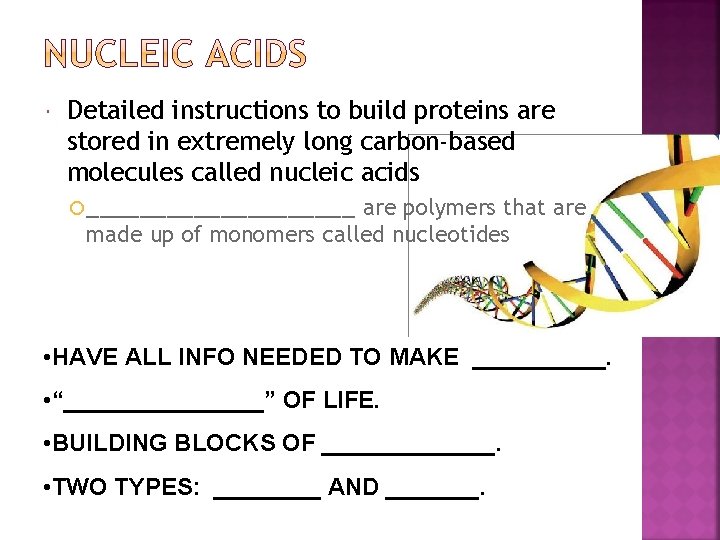
Detailed instructions to build proteins are stored in extremely long carbon-based molecules called nucleic acids __________ are polymers that are made up of monomers called nucleotides • HAVE ALL INFO NEEDED TO MAKE _____. • “________” OF LIFE. • BUILDING BLOCKS OF _______. • TWO TYPES: ____ AND _______.
1. What is the relationship between a polymer and a monomer? 2. Explain how both nucleic acids and proteins are polymers. Be sure to describe the monomers that make up the polymers. 3. How are carbohydrates and lipids similar? How are they different? 4. Explain how the bonding properties of carbon atoms result in the large variety of carbon-based molecules in living things?
Bonds & Plant/Animal during chemical reactions cells break down sugars to get usable energy Cells build protein molecules by bonding amino acids together Chemical reactions change substances into different substances by breaking and forming chemical bonds
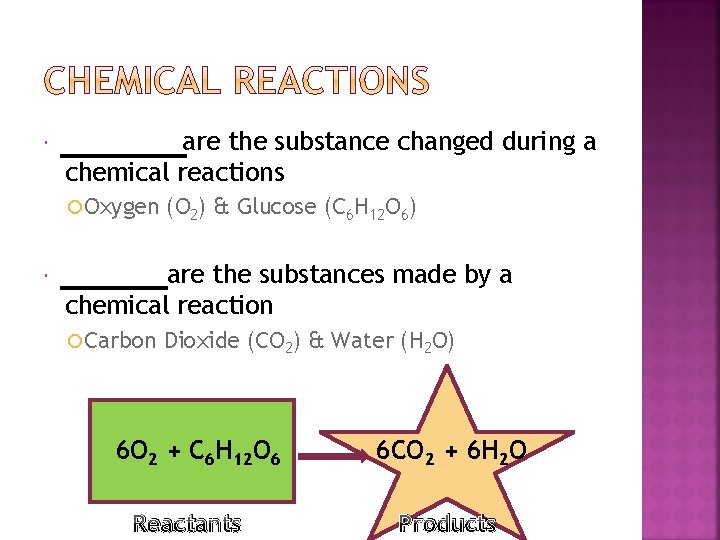
are the substance changed during a chemical reactions Oxygen (O 2) & Glucose (C 6 H 12 O 6) are the substances made by a chemical reaction Carbon Dioxide (CO 2) & Water (H 2 O) 6 O 2 + C 6 H 12 O 6 Reactants 6 CO 2 + 6 H 2 O Products
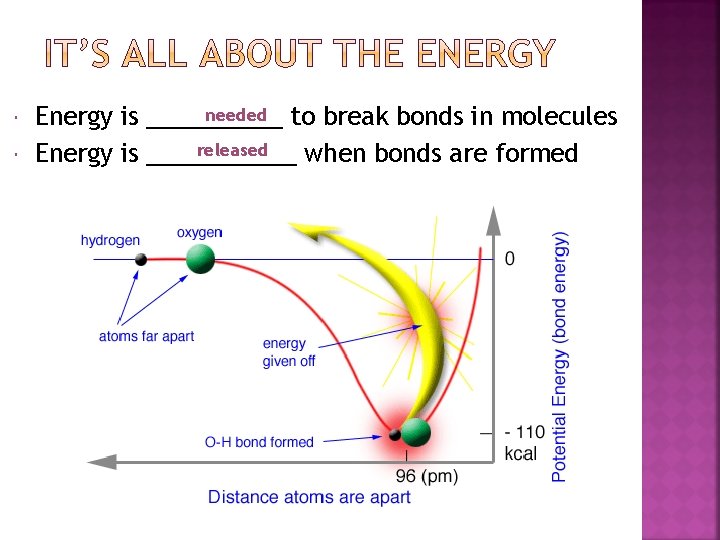
needed to break bonds in molecules Energy is _____ released Energy is ______ when bonds are formed
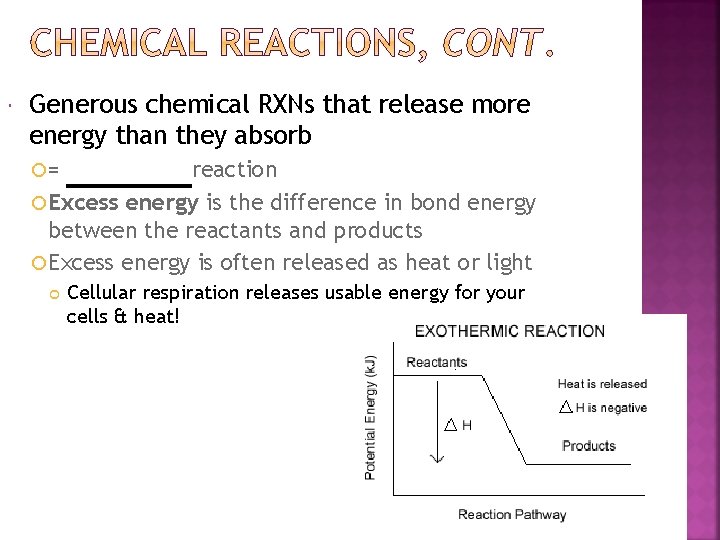
Generous chemical RXNs that release more energy than they absorb = reaction Excess energy is the difference in bond energy between the reactants and products Excess energy is often released as heat or light Cellular respiration releases usable energy for your cells & heat!
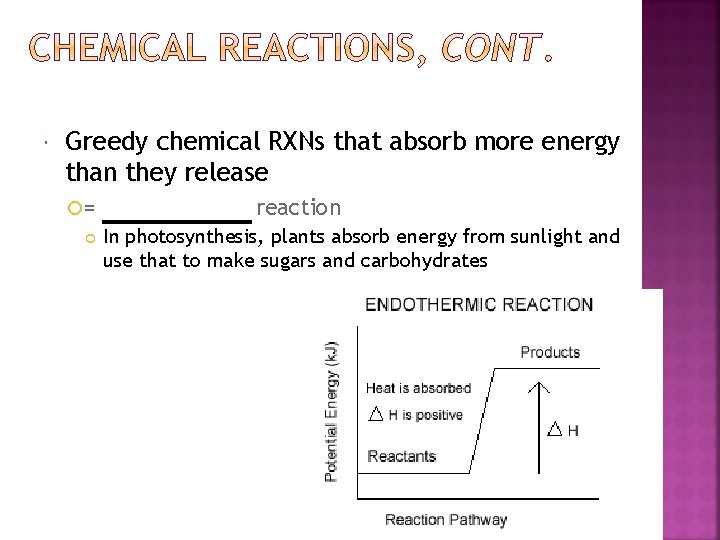
Greedy chemical RXNs that absorb more energy than they release = reaction In photosynthesis, plants absorb energy from sunlight and use that to make sugars and carbohydrates
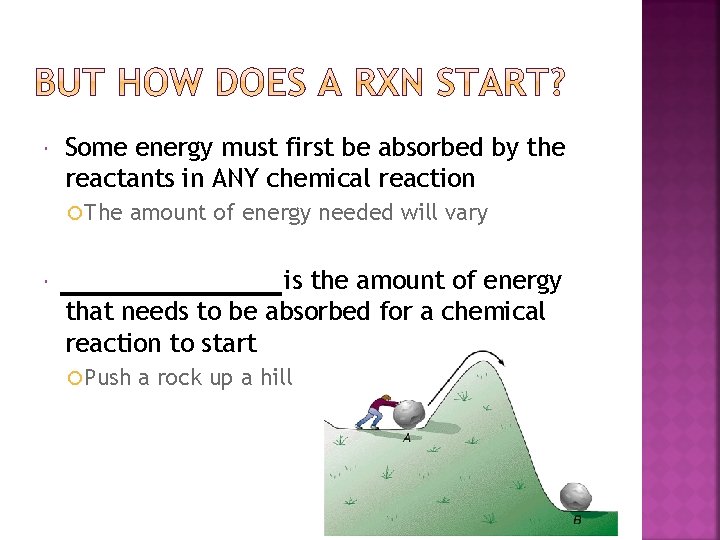
Some energy must first be absorbed by the reactants in ANY chemical reaction The amount of energy needed will vary is the amount of energy that needs to be absorbed for a chemical reaction to start Push a rock up a hill
1. Hydrogen peroxide (H 2 O 2) breaks down into water (H 2 O) and oxygen (O 2). Explain why this is a chemical reaction. What are the reactants and the products in the reaction? 2. How does energy related to the formation and breaking of bonds? 3. How do endothermic and exothermic reactions differ?
To start a chemical RXN, activation energy is necessary The reaction may happen very slowly Reactants may not interact enough, may not be high enough concentration Activation energy & rate of a chemical reaction can be changed by a chemical catalyst A catalyst is a substance that ________ the activation energy needed to start a reaction Also increases the ____ of the reaction
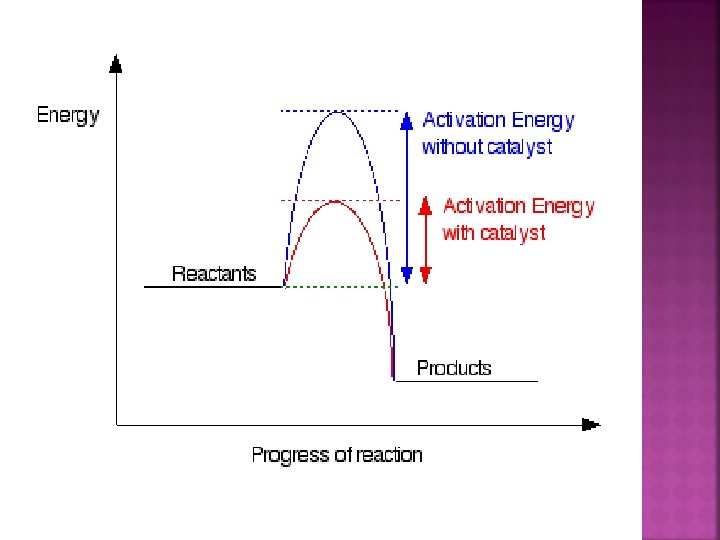
_______ are catalysts for reactions in living things Lower the activation energy Increase the rate of the reaction Do not effect chemical equilibrium Does not change the direction of the reaction Almost all enzymes are Depend on their structure to function correctly Conditions such as temperature and p. H can affect the function
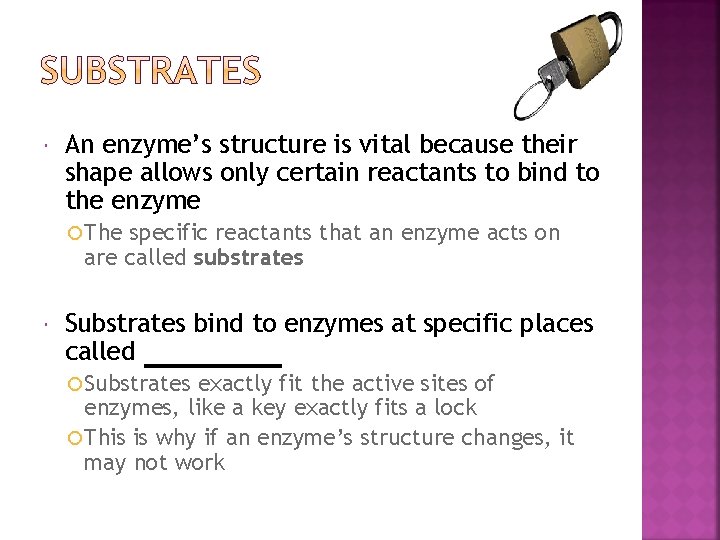
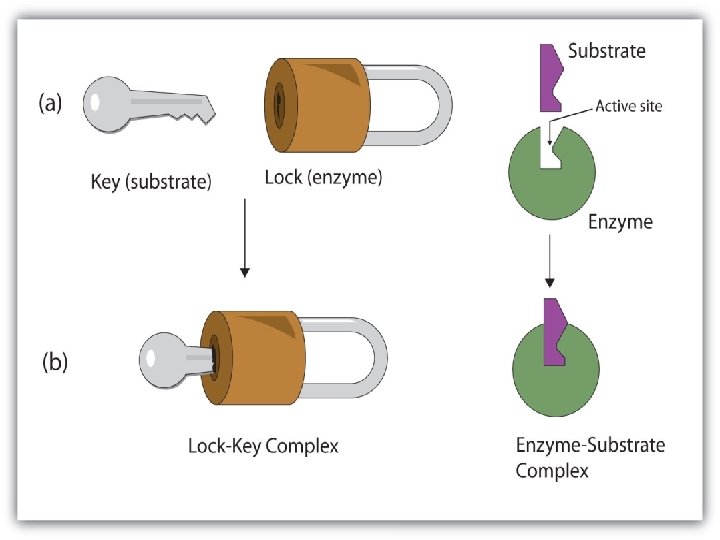
An enzyme’s structure is vital because their shape allows only certain reactants to bind to the enzyme The specific reactants that an enzyme acts on are called substrates Substrates bind to enzymes at specific places called Substrates exactly fit the active sites of enzymes, like a key exactly fits a lock This is why if an enzyme’s structure changes, it may not work
1. How does a catalyst affect the activation energy of a chemical reaction? 2. Describe how the interaction between an enzyme and its substrates changes a chemical reaction. 3. Some organisms live in very hot or very cold acidic environments. Would their enzymes function in a person’s cells? Why or why not? 4. Suppose that the amino acids that make up an enzyme’s active site are changed. How might this change affect the enzyme?
- Slides: 63