
Atom Review The atomic number is ALWAYS the
Atom Review � The atomic number is ALWAYS the same as the number of protons in a nucleus � To calculate the number of neutrons: 1. Round off the atomic mass 2. Calculate: Atomic mass – atomic number = neutrons �Example: �Chlorine – Atomic mass = 36, Atomic # = 17 � 36 – 17 = 19 (the number of neutrons) �You try with Barium – Atomic mass = 137, Atomic # = 56 � 137 – 56 = 81
Vocabulary Review � What is a valence shell? �The outermost shell of electrons � What is a valence electron? �Any electrons that occupy the outermost shell. . . These are the electrons that are involved in bonding �The ones that are not paired are simply called “bonding pairs”… My Bad � What is an “octet”? �When the valence shell has 8 electrons – the most stable condition for the second or third shell.
Ionic Compounds When a metal and a non -metal combine and there is a transfer of ebetween them.
Covalent compounds When 2 non-metals share e- between them so that each of the elements have a full orbit of e-
Ions Form from IONIC Compounds. They are Atoms that have a + or -charge (they are no longer neutral. )
�When atoms have the same # of protons and electrons – the atom is neutral. And it is called an ATOM. �When an atom loses or gains electrons from another element – it gets a charge and is now called an ION. �Ions from when a METAL and a NONMETAL combine to form a new compound. They create an IONIC BOND between them. �In an ionic bond, e- are transferred (not shared)
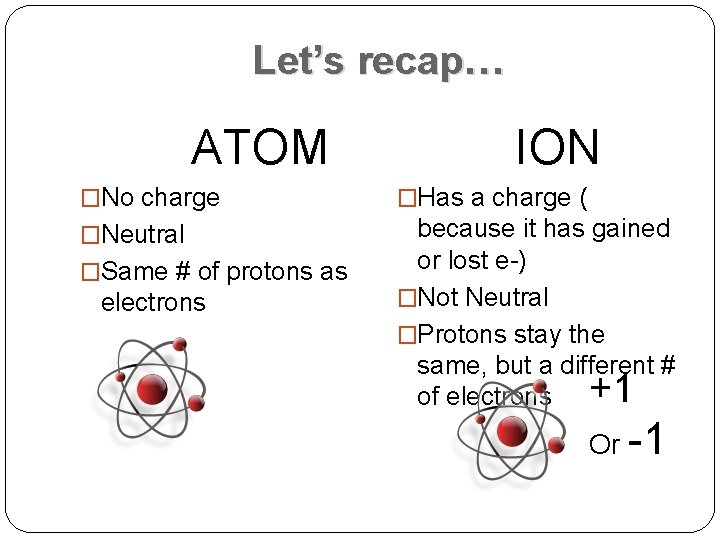
Let’s recap… ATOM ION �No charge �Has a charge ( �Neutral because it has gained or lost e-) �Not Neutral �Protons stay the same, but a different # of electrons +1 �Same # of protons as electrons Or -1
So how did the Ion get a charge? �Every atom in the periodic table wants to be just like the nearest NOBLE GAS, because it has full outer shell of e- and is stable – that is what every atom wants. �Notice that the metals have more electrons than the stable noble gas, and that non-metals don’t have enough electrons to be a noble gas. �So…Metals tend to give up e- to become more stable �Non-metals tend to gain or take e- to become more stable.
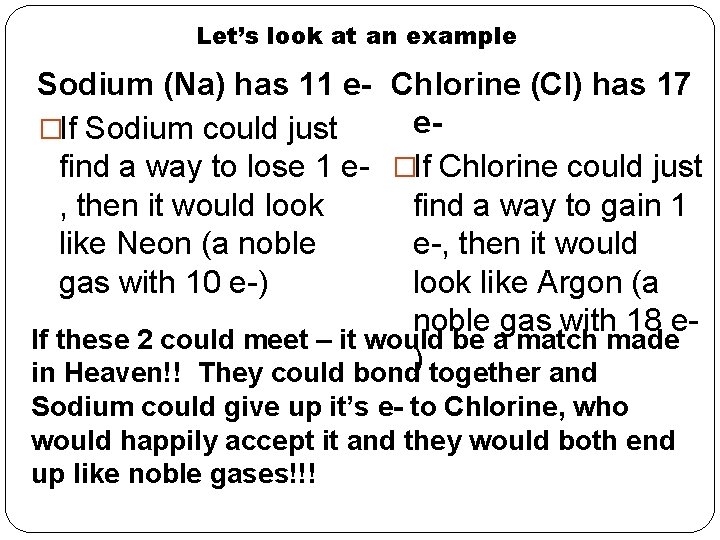
Let’s look at an example Sodium (Na) has 11 e- Chlorine (Cl) has 17 e�If Sodium could just find a way to lose 1 e- �If Chlorine could just , then it would look find a way to gain 1 like Neon (a noble e-, then it would gas with 10 e-) look like Argon (a noble gas with 18 e. If these 2 could meet – it would be a match made in Heaven!! They could bond) together and Sodium could give up it’s e- to Chlorine, who would happily accept it and they would both end up like noble gases!!!
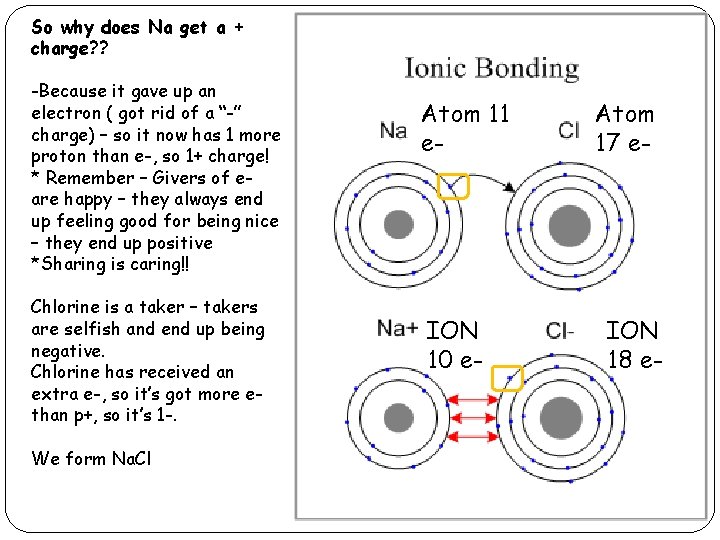
So why does Na get a + charge? ? -Because it gave up an electron ( got rid of a “-” charge) – so it now has 1 more proton than e-, so 1+ charge! * Remember – Givers of eare happy – they always end up feeling good for being nice – they end up positive *Sharing is caring!! Chlorine is a taker – takers are selfish and end up being negative. Chlorine has received an extra e-, so it’s got more ethan p+, so it’s 1 -. We form Na. Cl Atom 11 e- ION 10 e- Atom 17 e- ION 18 e-

Let’s see it happen… �http: //www. youtube. co m/watch? v=Qqjc. Cvz Wwww
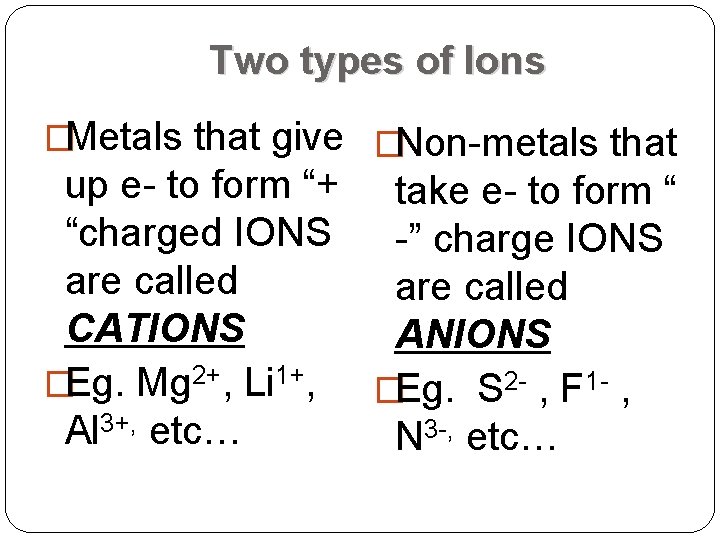
Two types of Ions �Metals that give �Non-metals that up e- to form “+ take e- to form “ “charged IONS -” charge IONS are called CATIONS ANIONS �Eg. Mg 2+, Li 1+, �Eg. S 2 - , F 1 - , Al 3+, etc… N 3 -, etc…
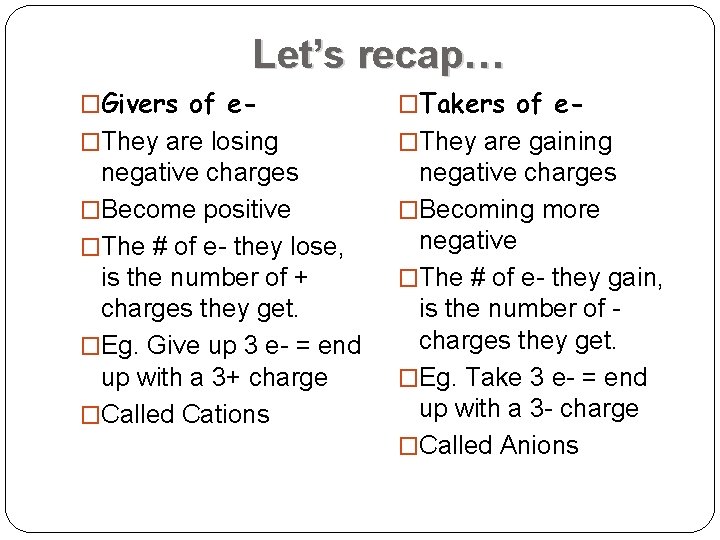
Let’s recap… �Givers of e- �Takers of e- �They are losing �They are gaining negative charges �Become positive �The # of e- they lose, is the number of + charges they get. �Eg. Give up 3 e- = end up with a 3+ charge �Called Cations negative charges �Becoming more negative �The # of e- they gain, is the number of charges they get. �Eg. Take 3 e- = end up with a 3 - charge �Called Anions
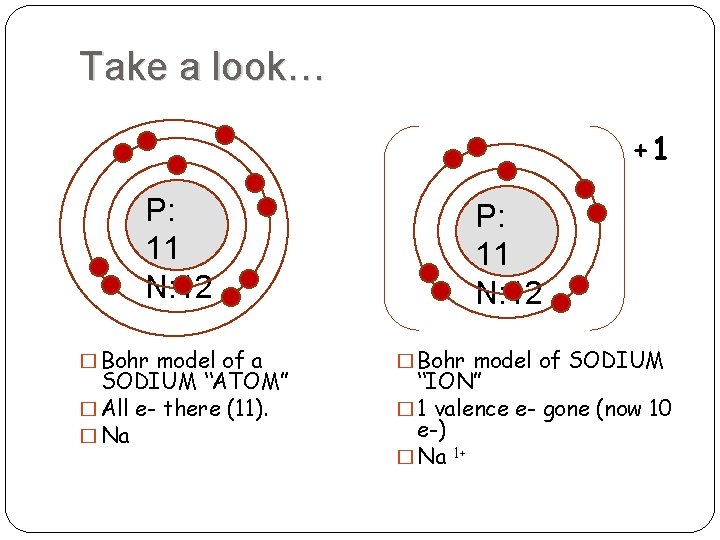
Take a look… +1 P: 11 N: 12 � Bohr model of a SODIUM “ATOM” � All e- there (11). � Na P: 11 N: 12 � Bohr model of SODIUM “ION” � 1 valence e- gone (now 10 e-) � Na 1+

Now you try it… +2 P: 12 N: 12 � Bohr model of a Magnesium “ATOM” � All e- there (12). P: 12 N: 12 � Bohr model of Magnesium “ION” � 2 valence e- gone (now 10 e-) like Neon � Mg 2+
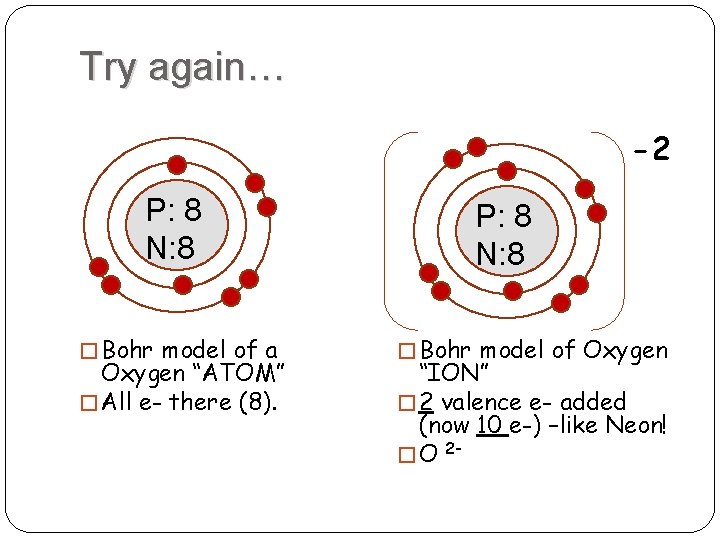
Try again… -2 P: 8 N: 8 � Bohr model of a Oxygen “ATOM” � All e- there (8). P: 8 N: 8 � Bohr model of Oxygen “ION” � 2 valence e- added (now 10 e-) –like Neon! � O 2 -
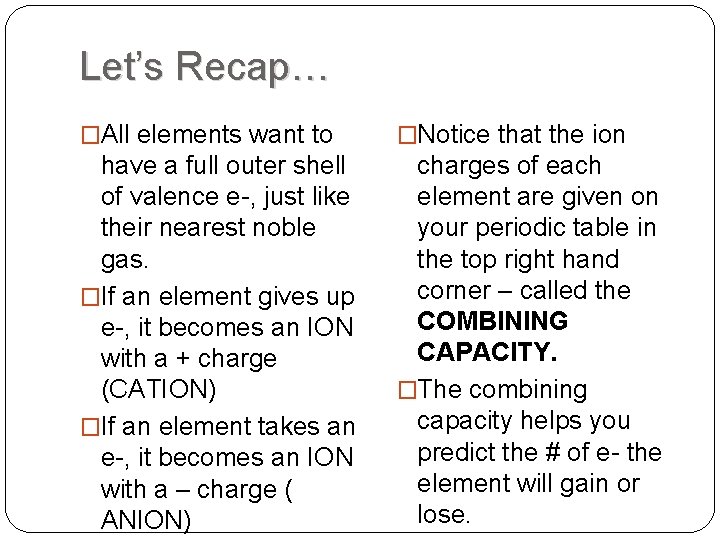
Let’s Recap… �All elements want to �Notice that the ion have a full outer shell of valence e-, just like their nearest noble gas. �If an element gives up e-, it becomes an ION with a + charge (CATION) �If an element takes an e-, it becomes an ION with a – charge ( ANION) charges of each element are given on your periodic table in the top right hand corner – called the COMBINING CAPACITY. �The combining capacity helps you predict the # of e- the element will gain or lose.
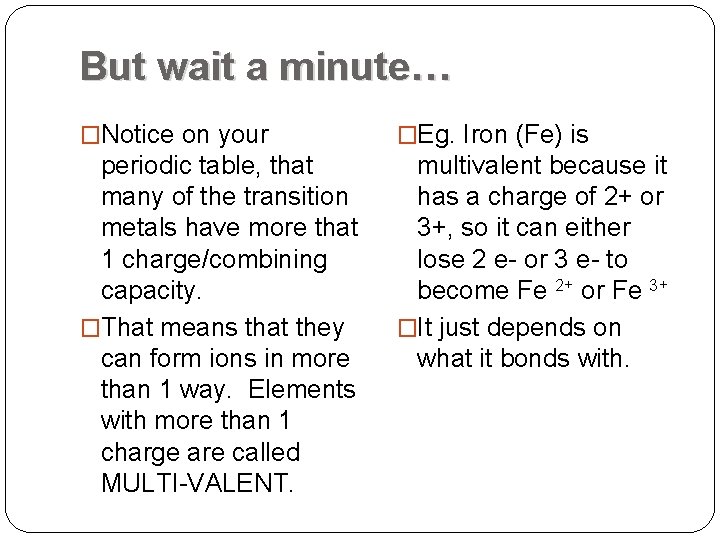
But wait a minute… �Notice on your �Eg. Iron (Fe) is periodic table, that many of the transition metals have more that 1 charge/combining capacity. �That means that they can form ions in more than 1 way. Elements with more than 1 charge are called MULTI-VALENT. multivalent because it has a charge of 2+ or 3+, so it can either lose 2 e- or 3 e- to become Fe 2+ or Fe 3+ �It just depends on what it bonds with.
- Slides: 18