
Atmospheric Windows SOLAR RADIATION Suns visible surface photosphere
Atmospheric Windows
SOLAR RADIATION • Sun's visible surface (photosphere) has temperature - 6000 K • Energy radiated from gamma to radio waves • 99% of sun's radiation fall between 0. 2 - 5. 6 um; 80% - 0. 4 - 1. 5 um (visible and Near infrared) • Atmosphere quite transparent to incoming solar radiation in these spectrum • Maximum radiation occurs 0. 48 um (visible) • About 1/2 of solar radiation passes through the atmosphere and absorbed in varying degrees by surface
Terrestrial radiation • Energy emitted from the Earth and atmosphere • Detectable both day and night • Earth's ambient temperature - 300 K • Earth radiates 160, 000 times less than the sun • Essentially all energy is radiated at (invisible) thermal infrared wavelengths between 4 -25 um • Maximum emission occurs at 9. 7 um
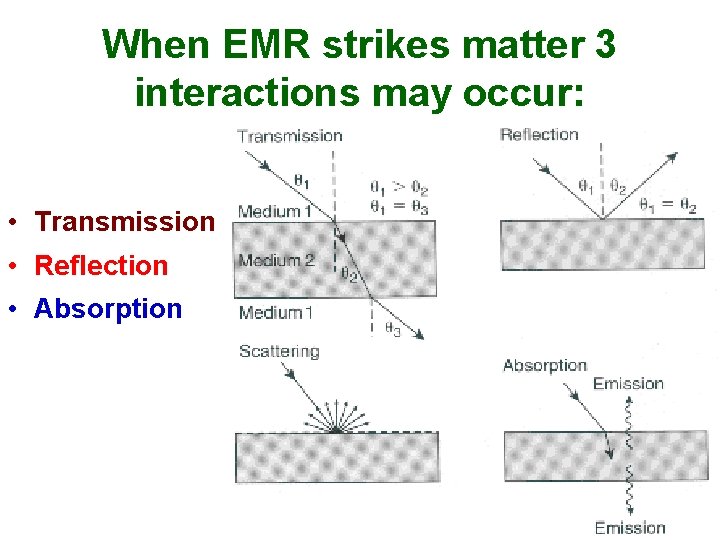
When EMR strikes matter 3 interactions may occur: • Transmission • Reflection • Absorption
• Transmission - process by which incident radiation passes through matter w/o measurable attenuation (transparent to radiation) • Specular reflection - process whereby incident radiation "bounces off" the surface of substance in a single, predictable direction; caused by surfaces smooth relative to wavelengths of incident radiation; no change in velocity or wavelength • Scattering (diffuse reflection) - occurs when incident radiation is dispersed or spread out unpredictably in many different directions; occurs when surfaces rough relative to wavelengths of incident radiation; no change in velocity or wavelength • Absorption - process by which incident radiation is taken in by the medium (e. g. , surface, atmospheric particulates, atmospheric layer); medium opaque to incident radiation
Proportion of energy that is transmitted, reflected or absorbed depends upon: • Composition and physical properties of medium • Wavelength or frequency of incident radiation • Angle at which incident radiation strikes a surface
EMR-Atmosphere Interactions • EMR travels through space w/o modification • Diversion and depletions occurs as solar and terrestrial radiation interact with earth's atmosphere • Interference is wavelength selective - meaning at certain wavelengths EMR passes freely through atmosphere, whereas restricted at other wavelengths
Atmospheric Windows and Absorption bands • Atmospheric windows (transmision bands) - areas of EMS where specific wavelengths pass relatively unimpeded through atmosphere • Absorption bands - areas where specific wavelengths are totally or partially blocked
IMAGING AND SOUNDING • Objective to study earth's surface - different remote sensing instruments designed to operate in windows where cloudless atmosphere will transmit sufficient radiation for detection • Objective to study atmosphere constituents - operate in atmospheric absorption bands
Atmospheric Absorption and Transmission Most significant absorbers of EMR: • Ozone • Carbon dioxide • Water vapor • Oxygen • Nitrogen
Atmospheric Absorption and Transmission • 16% of shortwave solar radiation absorbed directly by atmospheric gases • 2% by clouds
Atmospheric gases - selective absorbers with reference to wavelength • Gamma and X-ray - completely absorbed in the upper atmosphere by Oxygen and Nitrogen • Ultraviolet (<0. 2 um) - absorbed by molecules of oxygen (O and O 2 combine form ozone); ozone absorbs UV w/ wavelengths -0. 2 -0. 3 um in stratosphere • 0. 9 -2. 7 um - water vapor and carbon dioxide absorb in narrow bands • Thermal infrared – strong absorption by water vapor between 5 -8 um and 20 um 1, 000 um (1 cm) – carbon dioxide absorbs 14 -20 um – ozone 9 -10 um • Absorbed radiation heats the lower atmosphere • Microwave region - 3 relatively narrow absorption bands occur between 0. 1 - 0. 6 cm (oxygen and water vapor) • beyond 0. 6 cm , atmospheric gases generally do not impede passage of microwave radiation
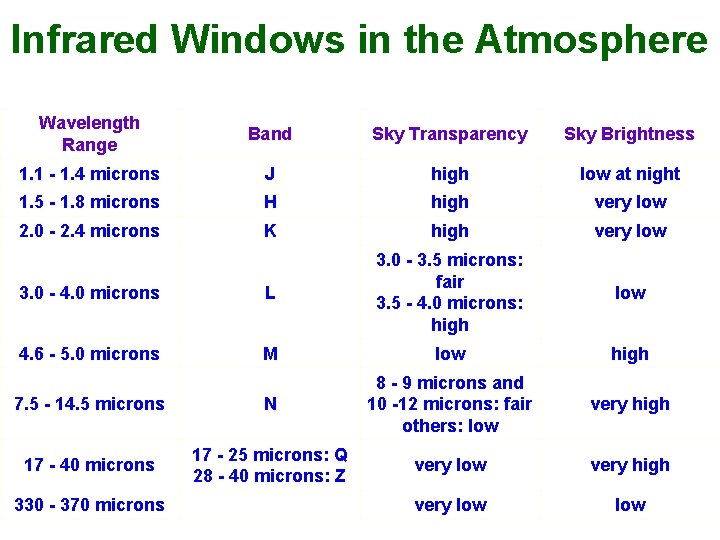
Infrared Windows in the Atmosphere Wavelength Range Band Sky Transparency Sky Brightness 1. 1 - 1. 4 microns J high low at night 1. 5 - 1. 8 microns H high very low 2. 0 - 2. 4 microns K high very low 3. 0 - 4. 0 microns L 3. 0 - 3. 5 microns: fair 3. 5 - 4. 0 microns: high low 4. 6 - 5. 0 microns M low high 7. 5 - 14. 5 microns N 8 - 9 microns and 10 -12 microns: fair others: low very high 17 - 40 microns 17 - 25 microns: Q 28 - 40 microns: Z very low very high very low 330 - 370 microns
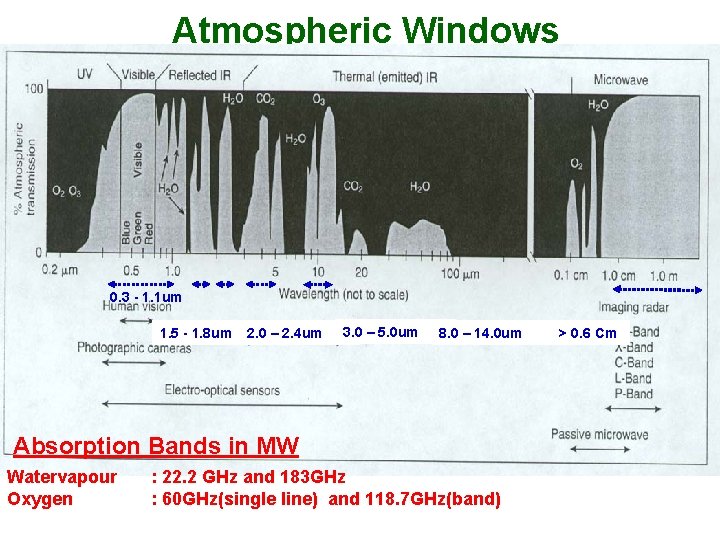
Atmospheric Windows 0. 3 - 1. 1 um 1. 5 - 1. 8 um 2. 0 – 2. 4 um 3. 0 – 5. 0 um 8. 0 – 14. 0 um Absorption Bands in MW Watervapour Oxygen : 22. 2 GHz and 183 GHz : 60 GHz(single line) and 118. 7 GHz(band) > 0. 6 Cm
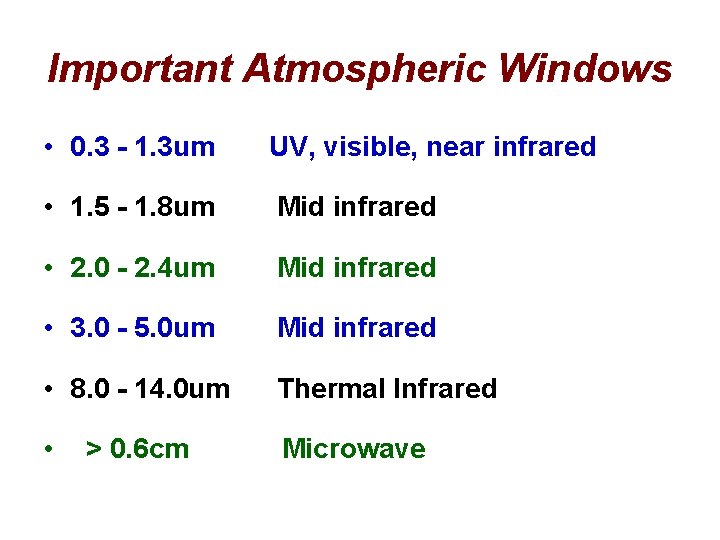
Important Atmospheric Windows • 0. 3 - 1. 3 um UV, visible, near infrared • 1. 5 - 1. 8 um Mid infrared • 2. 0 - 2. 4 um Mid infrared • 3. 0 - 5. 0 um Mid infrared • 8. 0 - 14. 0 um Thermal Infrared • > 0. 6 cm Microwave
- Slides: 15