
Atmospheric turbulence Eric Gendron Wavefront and image The
Atmospheric turbulence Eric Gendron
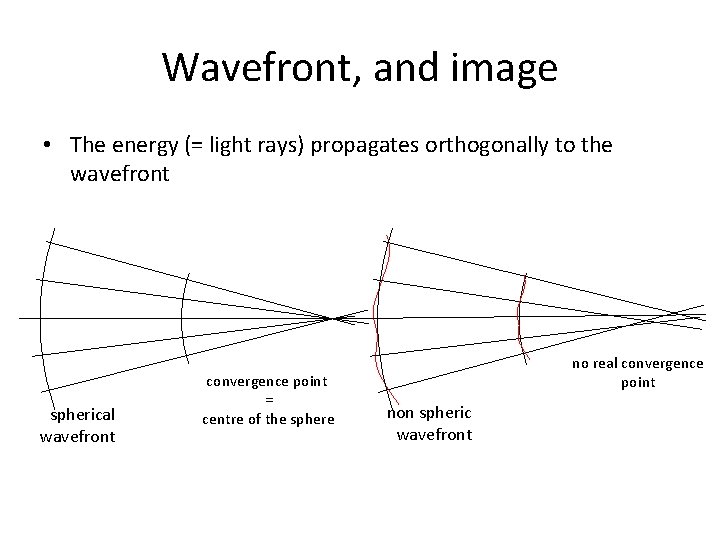
Wavefront, and image • The energy (= light rays) propagates orthogonally to the wavefront spherical wavefront convergence point = centre of the sphere no real convergence point non spheric wavefront
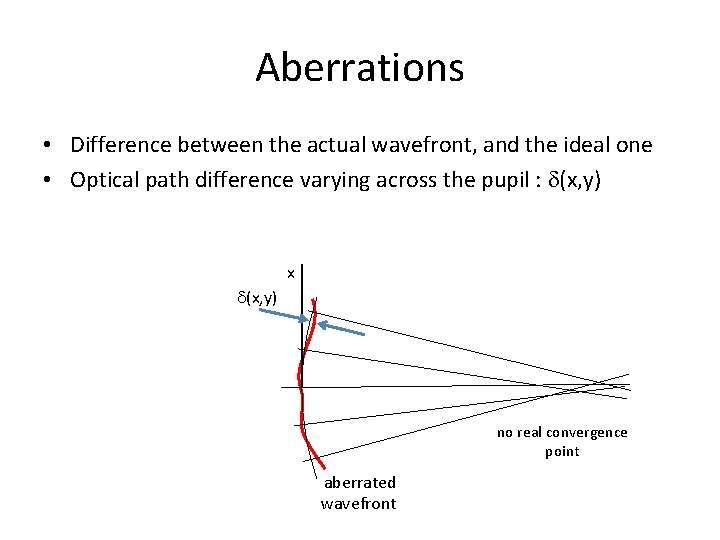
Aberrations • Difference between the actual wavefront, and the ideal one • Optical path difference varying across the pupil : d(x, y) x d(x, y) no real convergence point aberrated wavefront
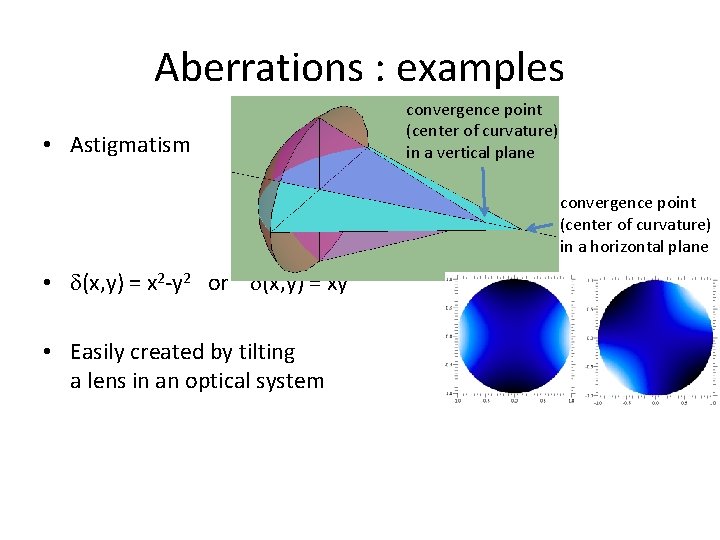
Aberrations : examples • Astigmatism convergence point (center of curvature) in a vertical plane convergence point (center of curvature) in a horizontal plane • d(x, y) = x 2 -y 2 or d(x, y) = xy • Easily created by tilting a lens in an optical system
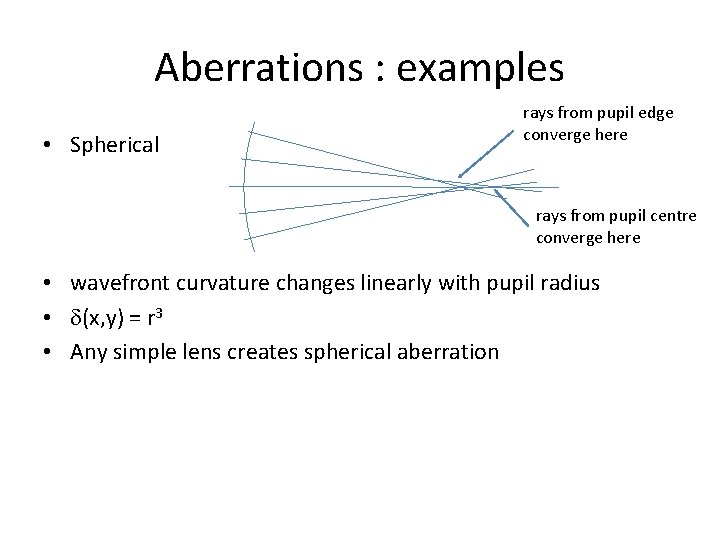
Aberrations : examples • Spherical rays from pupil edge converge here rays from pupil centre converge here • wavefront curvature changes linearly with pupil radius • d(x, y) = r 3 • Any simple lens creates spherical aberration
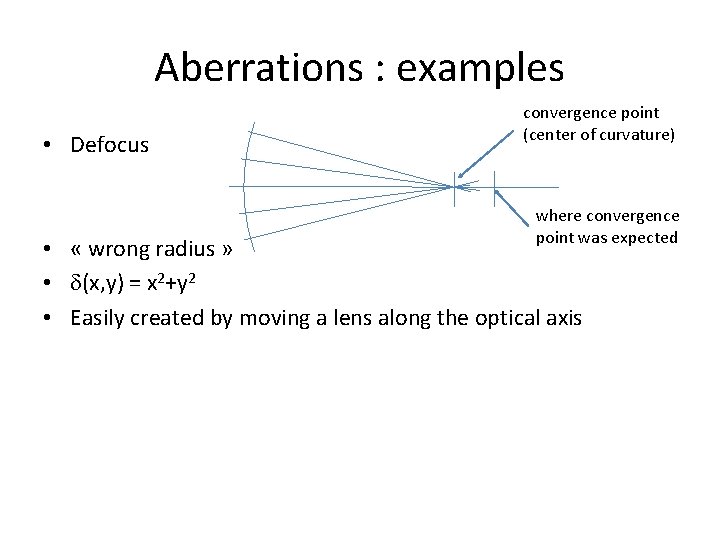
Aberrations : examples • Defocus convergence point (center of curvature) where convergence point was expected • « wrong radius » • d(x, y) = x 2+y 2 • Easily created by moving a lens along the optical axis
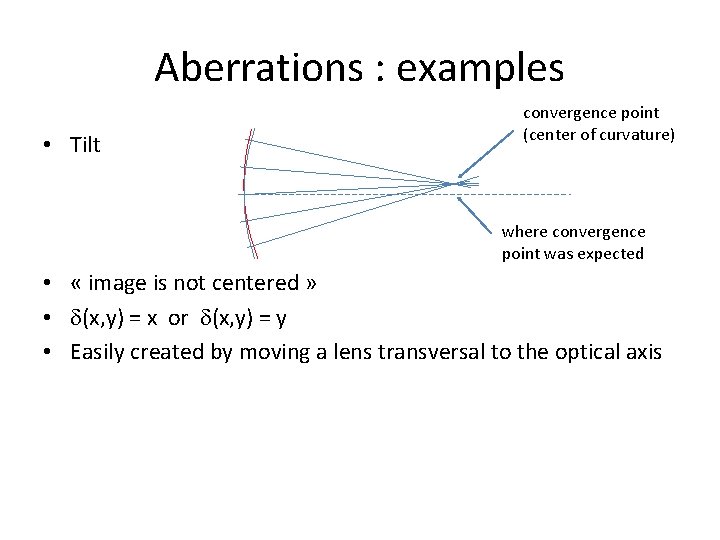
Aberrations : examples • Tilt convergence point (center of curvature) where convergence point was expected • « image is not centered » • d(x, y) = x or d(x, y) = y • Easily created by moving a lens transversal to the optical axis
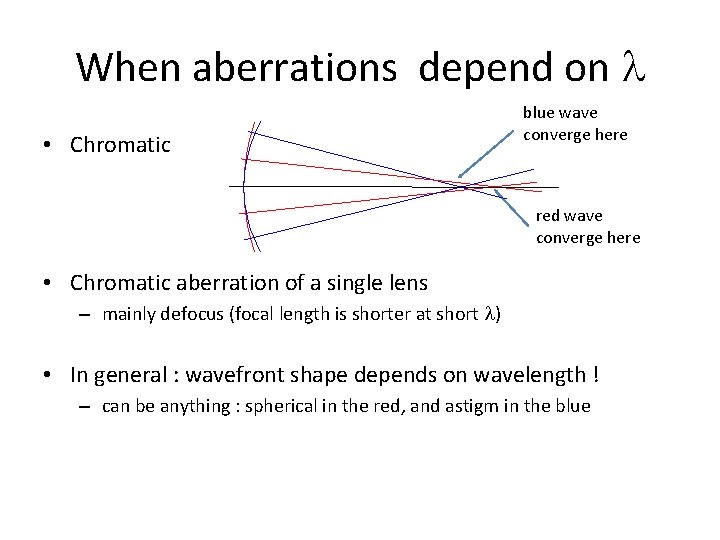
When aberrations depend on l • Chromatic blue wave converge here red wave converge here • Chromatic aberration of a single lens – mainly defocus (focal length is shorter at short l) • In general : wavefront shape depends on wavelength ! – can be anything : spherical in the red, and astigm in the blue
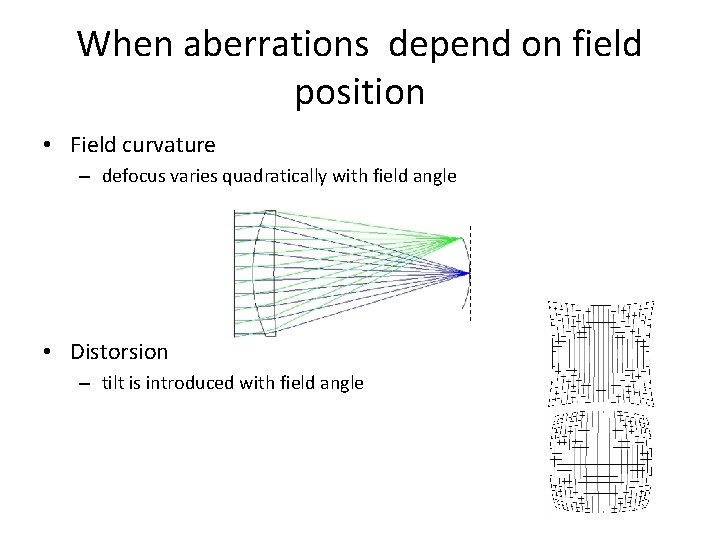
When aberrations depend on field position • Field curvature – defocus varies quadratically with field angle • Distorsion – tilt is introduced with field angle
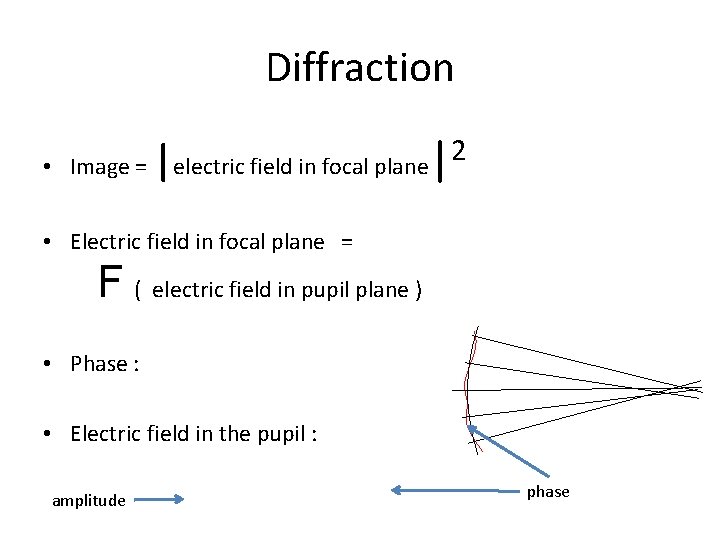
Diffraction • 2 Image = |electric field in focal plane| • Electric field in focal plane = F ( electric field in pupil plane ) • Phase : • Electric field in the pupil : amplitude phase
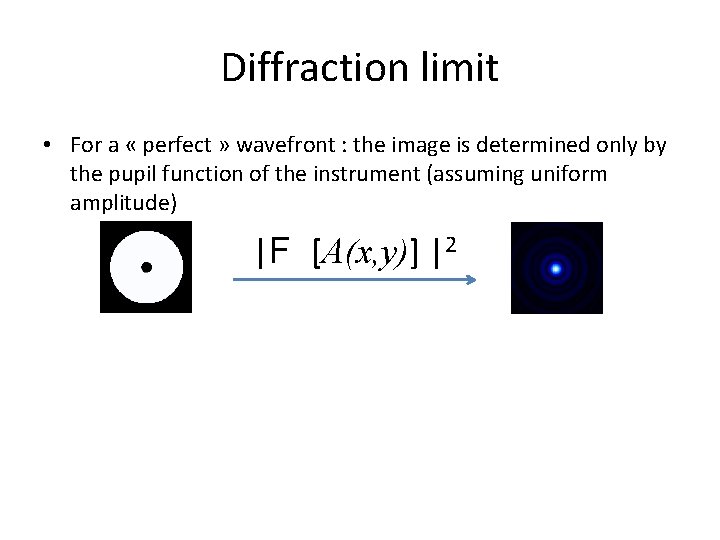
Diffraction limit • For a « perfect » wavefront : the image is determined only by the pupil function of the instrument (assuming uniform amplitude) |F [A(x, y)] |2
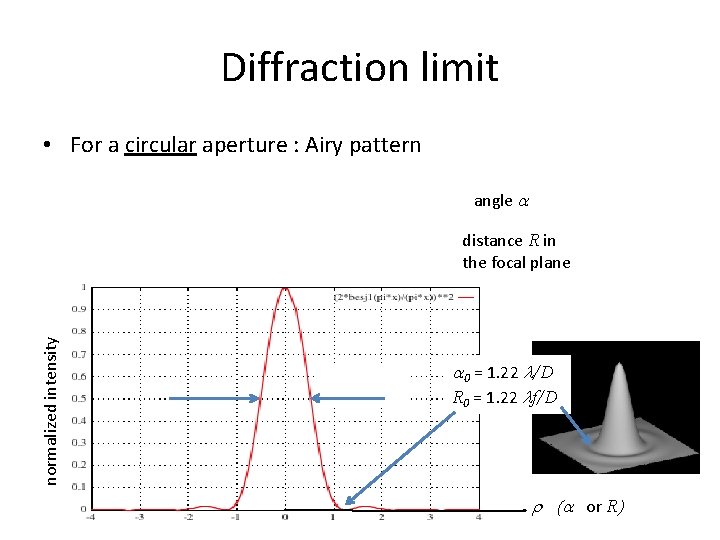
Diffraction limit • For a circular aperture : Airy pattern angle a normalized intensity distance R in the focal plane a 0 = 1. 22 l/D R 0 = 1. 22 lf/D r (a or R)
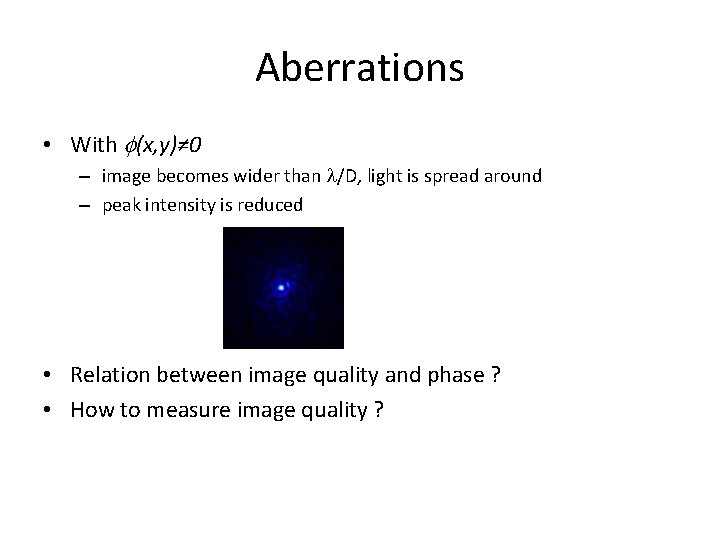
Aberrations • With f(x, y)≠ 0 – image becomes wider than l/D, light is spread around – peak intensity is reduced • Relation between image quality and phase ? • How to measure image quality ?
![Image formation depends on l • Image(u, v) = | F [ ] |2](http://slidetodoc.com/presentation_image_h2/e5d3c5b35e2da507f37b1404e5df499b/image-14.jpg "Image formation depends on l • Image(u, v) = | F [ ] |2")
Image formation depends on l • Image(u, v) = | F [ ] |2 • Same wavefront d(x, y), but different images : l=1 µm l=0. 7 µm l=0. 5 µm
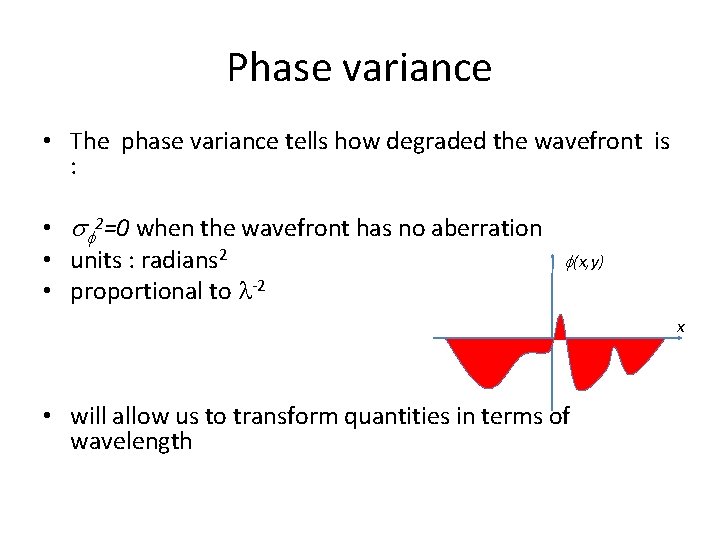
Phase variance • The phase variance tells how degraded the wavefront is : • sf 2=0 when the wavefront has no aberration • units : radians 2 • proportional to l-2 f(x, y) x • will allow us to transform quantities in terms of wavelength
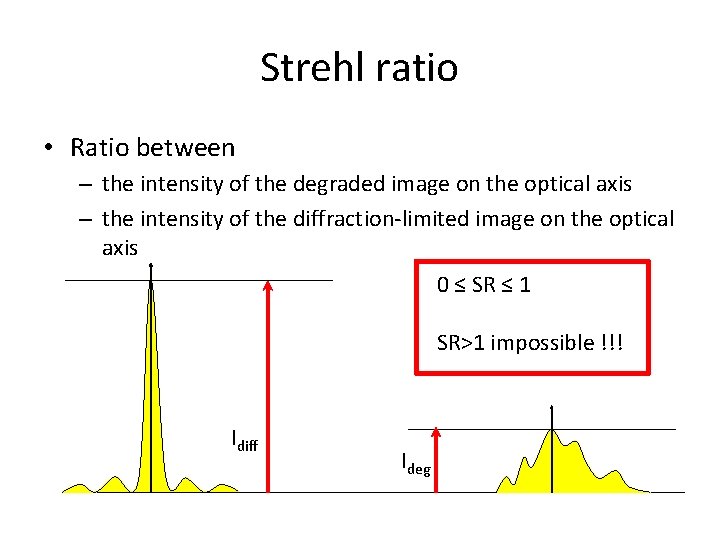
Strehl ratio • Ratio between – the intensity of the degraded image on the optical axis – the intensity of the diffraction-limited image on the optical axis 0 ≤ SR ≤ 1 SR>1 impossible !!! Idiff Ideg
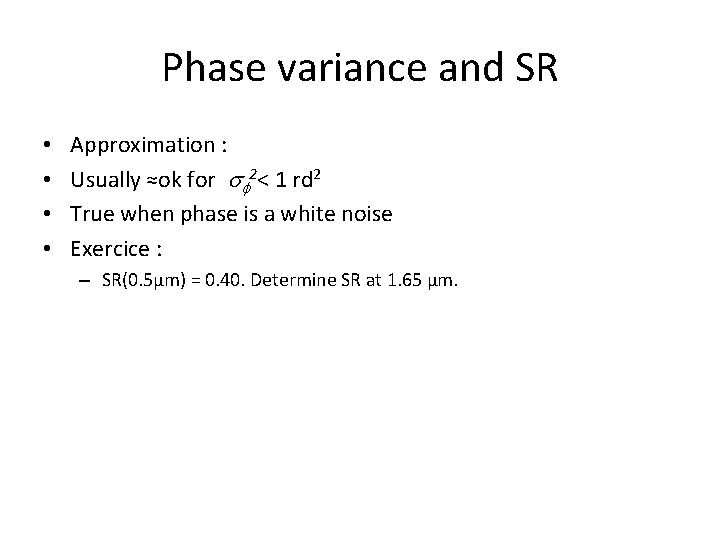
Phase variance and SR • • Approximation : Usually ≈ok for sf 2< 1 rd 2 True when phase is a white noise Exercice : – SR(0. 5µm) = 0. 40. Determine SR at 1. 65 µm.
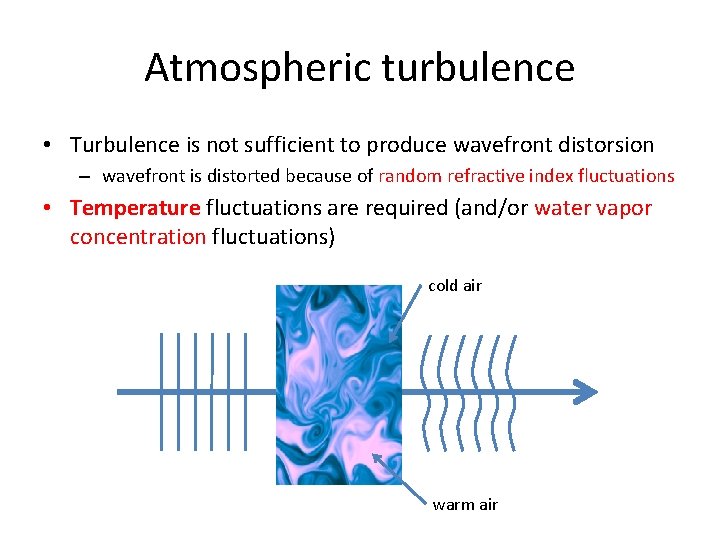
Atmospheric turbulence • Turbulence is not sufficient to produce wavefront distorsion – wavefront is distorted because of random refractive index fluctuations • Temperature fluctuations are required (and/or water vapor concentration fluctuations) cold air warm air
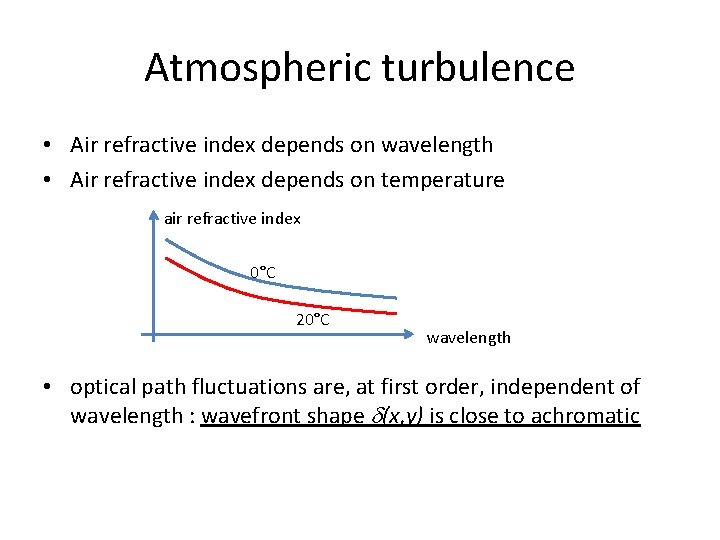
Atmospheric turbulence • Air refractive index depends on wavelength • Air refractive index depends on temperature air refractive index 0°C 20°C wavelength • optical path fluctuations are, at first order, independent of wavelength : wavefront shape d(x, y) is close to achromatic
Atmospheric turbulence • Turbulent temperature mixing occurs mainly – close to the ground (0 -40 m) – at inversion layer (1 -2 km) – at jet-stream level (8 -12 km) • Most of it occurs at interface between air slabs – notion of « turbulent layers »
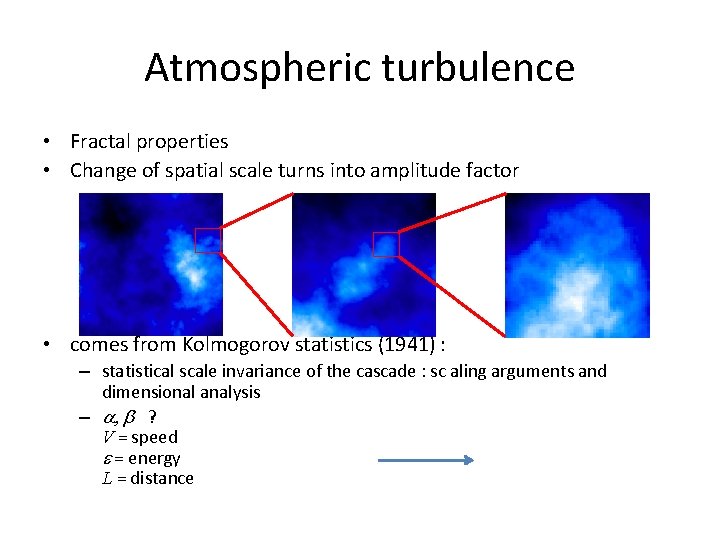
Atmospheric turbulence • Fractal properties • Change of spatial scale turns into amplitude factor • comes from Kolmogorov statistics (1941) : – statistical scale invariance of the cascade : sc aling arguments and dimensional analysis – a, b ? V = speed e = energy L = distance
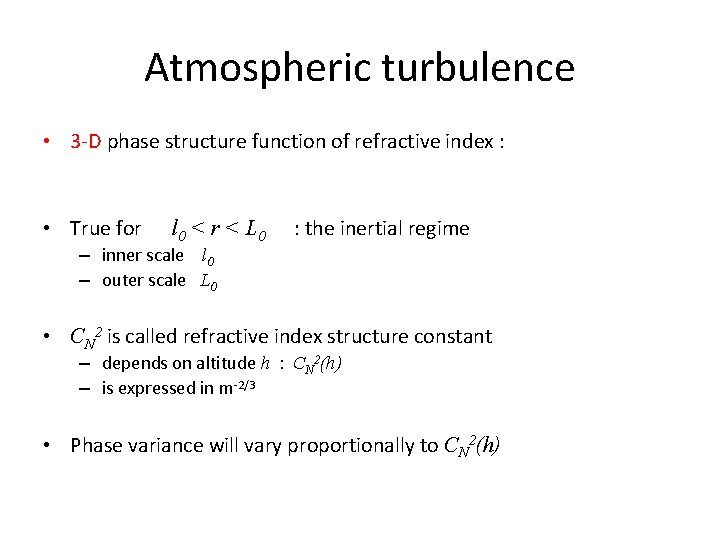
Atmospheric turbulence • 3 -D phase structure function of refractive index : • True for l 0 < r < L 0 : the inertial regime – inner scale l 0 – outer scale L 0 • CN 2 is called refractive index structure constant – depends on altitude h : CN 2(h) – is expressed in m-2/3 • Phase variance will vary proportionally to CN 2(h)
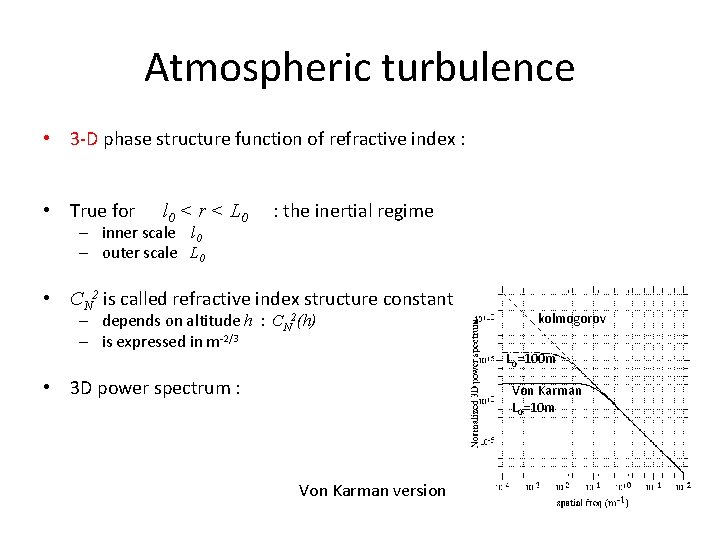
Atmospheric turbulence • 3 -D phase structure function of refractive index : • True for l 0 < r < L 0 – inner scale l 0 – outer scale L 0 : the inertial regime • CN 2 is called refractive index structure constant – depends on altitude h : CN 2(h) – is expressed in m-2/3 • 3 D power spectrum : kolmogorov L 0=100 m Von Karman L 0=10 m Von Karman version
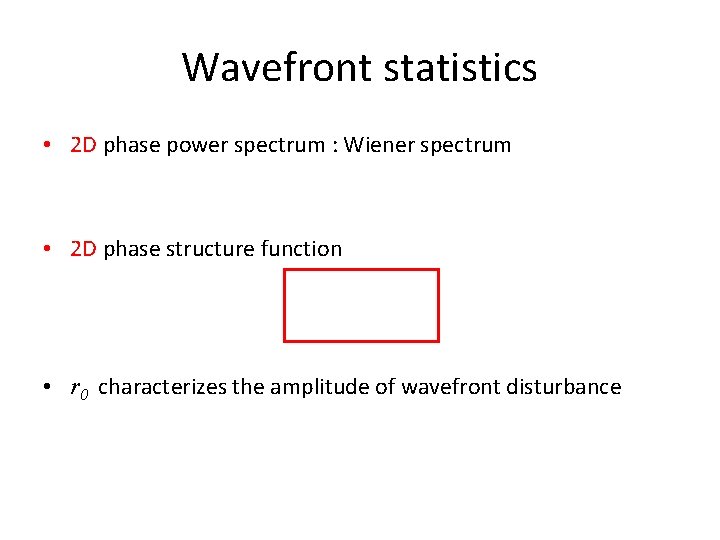
Wavefront statistics • 2 D phase power spectrum : Wiener spectrum • 2 D phase structure function • r 0 characterizes the amplitude of wavefront disturbance
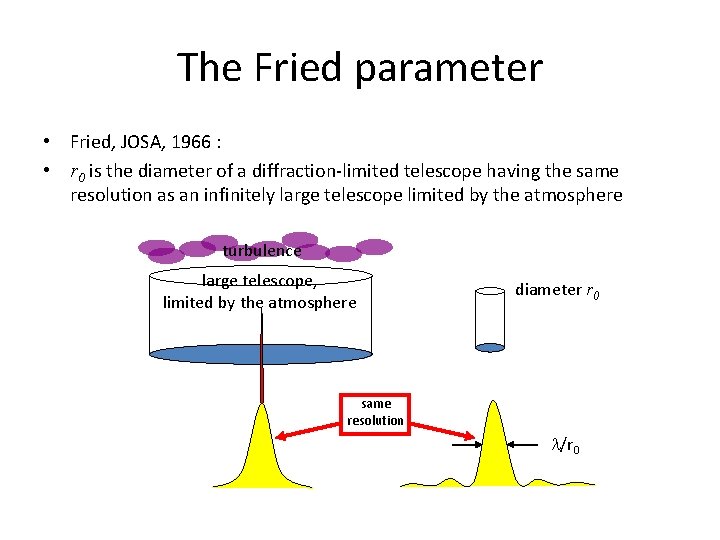
The Fried parameter • Fried, JOSA, 1966 : • r 0 is the diameter of a diffraction-limited telescope having the same resolution as an infinitely large telescope limited by the atmosphere turbulence large telescope, limited by the atmosphere diameter r 0 same resolution l/r 0
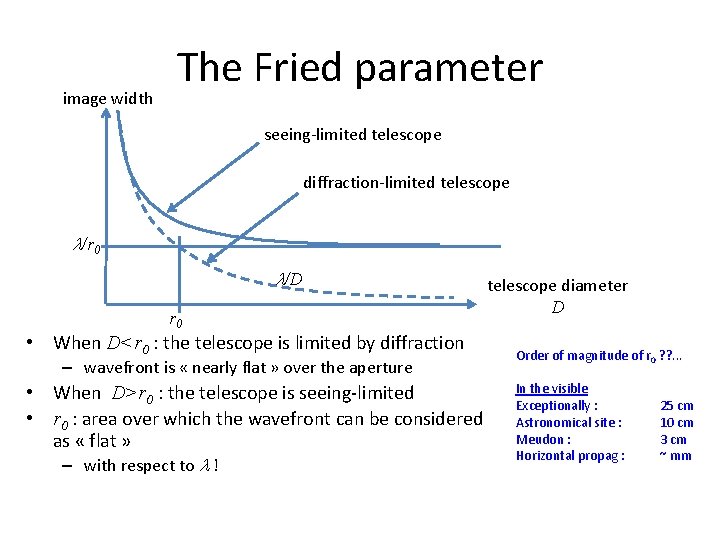
image width The Fried parameter seeing-limited telescope diffraction-limited telescope l/r 0 l/D r 0 • When D<r 0 : the telescope is limited by diffraction – wavefront is « nearly flat » over the aperture • When D>r 0 : the telescope is seeing-limited • r 0 : area over which the wavefront can be considered as « flat » – with respect to l ! telescope diameter D Order of magnitude of r 0 ? ? . . . In the visible Exceptionally : Astronomical site : Meudon : Horizontal propag : 25 cm 10 cm 3 cm ~ mm
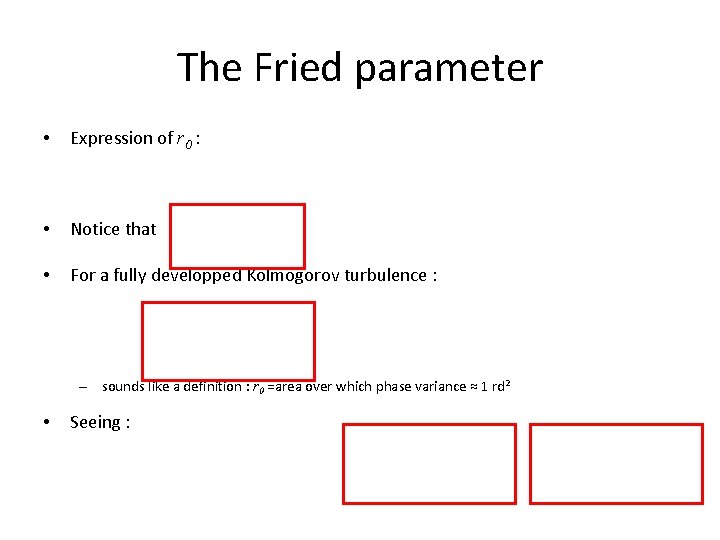
The Fried parameter • Expression of r 0 : • Notice that • For a fully developped Kolmogorov turbulence : – sounds like a definition : r 0 =area over which phase variance ≈ 1 rd 2 • Seeing :
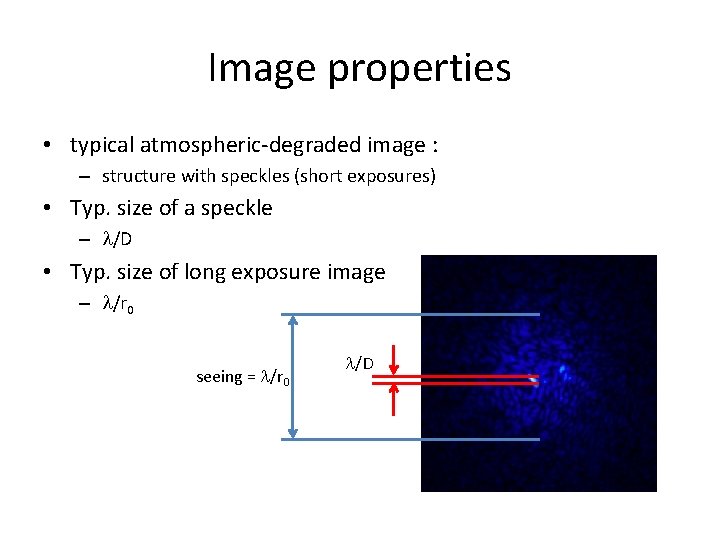
Image properties • typical atmospheric-degraded image : – structure with speckles (short exposures) • Typ. size of a speckle – l/D • Typ. size of long exposure image – l/r 0 seeing = l/r 0 l/D
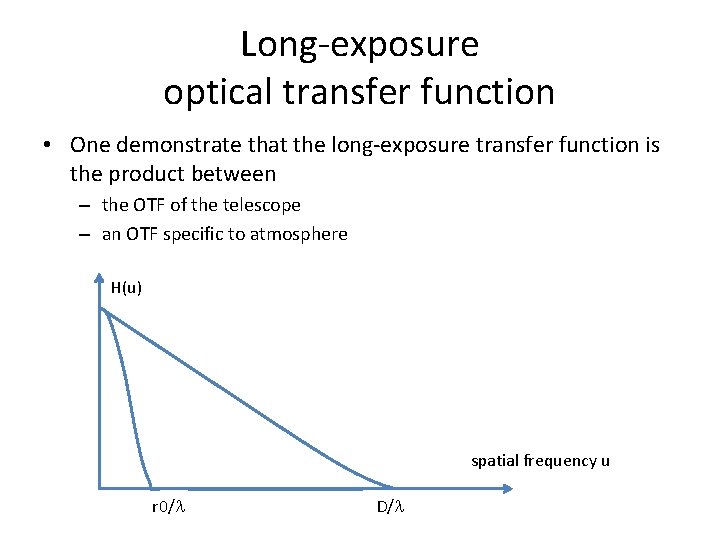
Long-exposure optical transfer function • One demonstrate that the long-exposure transfer function is the product between – the OTF of the telescope – an OTF specific to atmosphere H(u) spatial frequency u r 0/l D/l
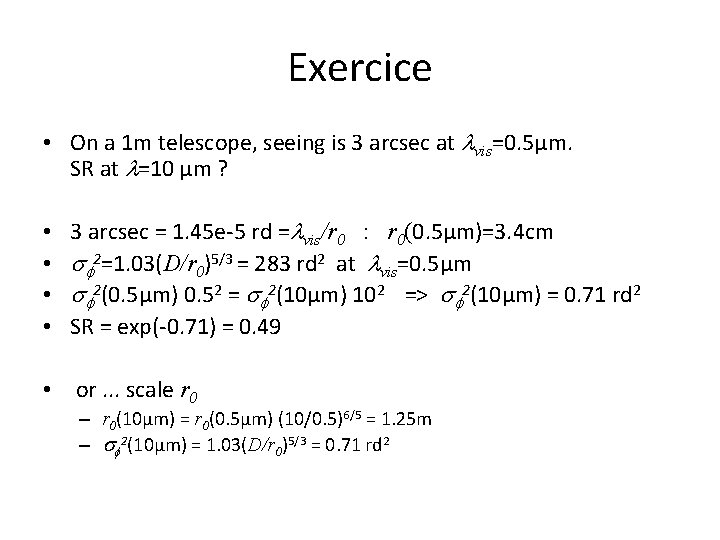
Exercice • On a 1 m telescope, seeing is 3 arcsec at lvis=0. 5µm. SR at l=10 µm ? • • 3 arcsec = 1. 45 e-5 rd =lvis/r 0 : r 0(0. 5µm)=3. 4 cm sf 2=1. 03(D/r 0)5/3 = 283 rd 2 at lvis=0. 5µm sf 2(0. 5µm) 0. 52 = sf 2(10µm) 102 => sf 2(10µm) = 0. 71 rd 2 SR = exp(-0. 71) = 0. 49 • or. . . scale r 0 – r 0(10µm) = r 0(0. 5µm) (10/0. 5)6/5 = 1. 25 m – sf 2(10µm) = 1. 03(D/r 0)5/3 = 0. 71 rd 2
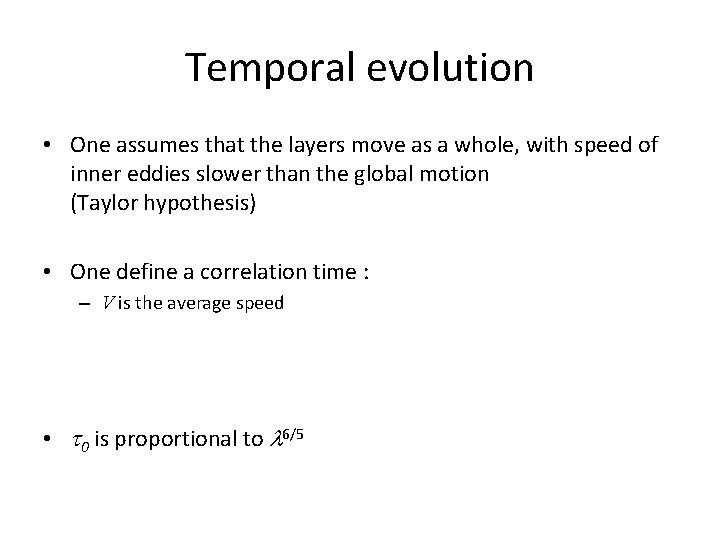
Temporal evolution • One assumes that the layers move as a whole, with speed of inner eddies slower than the global motion (Taylor hypothesis) • One define a correlation time : – V is the average speed • t 0 is proportional to l 6/5
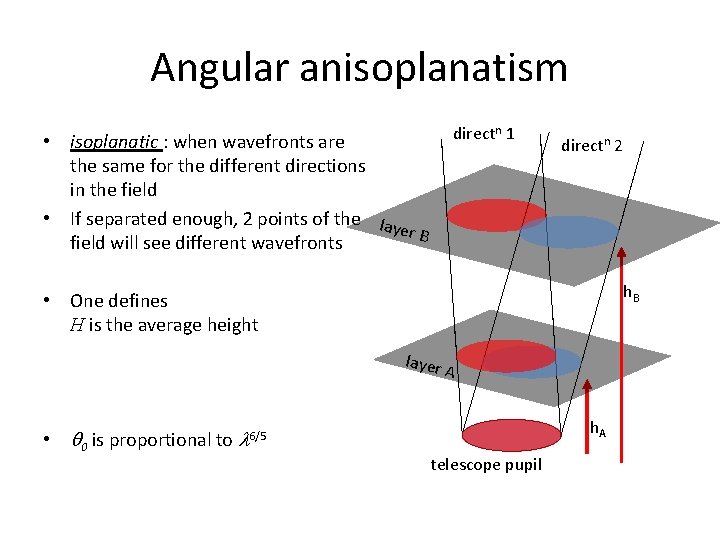
Angular anisoplanatism directn 1 • isoplanatic : when wavefronts are the same for the different directions in the field • If separated enough, 2 points of the laye r. B field will see different wavefronts directn 2 h. B • One defines H is the average height layer • q 0 is proportional to l 6/5 A h. A telescope pupil
Example
Modal decomposition of phase • f(x, y, t) not easy to handle • Decomposition on a modal basis • Zernike modes – – – – defined on a circular aperture analytic expression orthogonal basis look like first order optical aberrations derivatives can be expressed as a simple combination of themselves Fourier transform has analytic expression coefficient ai
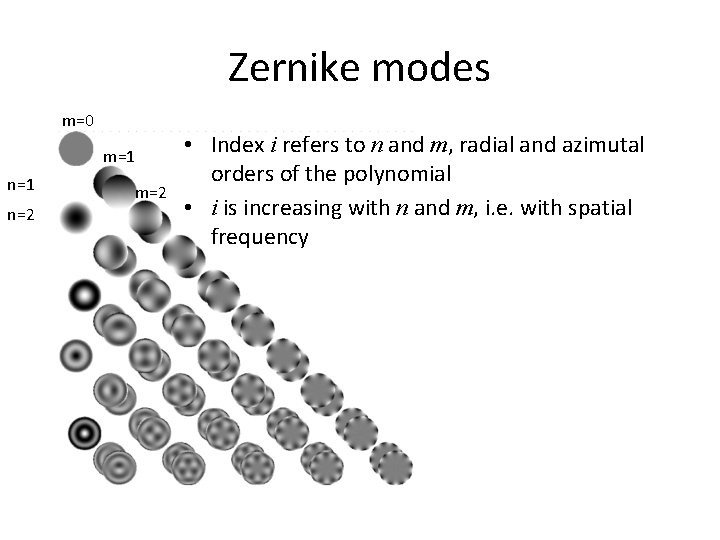
Zernike modes m=0 m=1 n=2 m=2 • Index i refers to n and m, radial and azimutal orders of the polynomial • i is increasing with n and m, i. e. with spatial frequency
Modal decomposition of phase • Phase variance • Setting one of the ai=0 – best way to flatten the wavefront
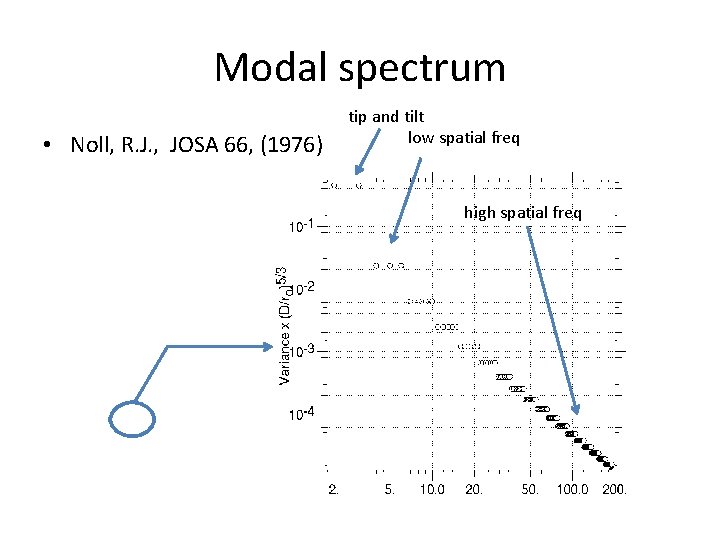
Modal spectrum • Noll, R. J. , JOSA 66, (1976) tip and tilt low spatial freq high spatial freq
Residual error • Phase error after perfect compensation of J Zernike modes • Equivalence Zernike deformable mirror with Na actuators – Greenwood, JOSA, 69, 1979
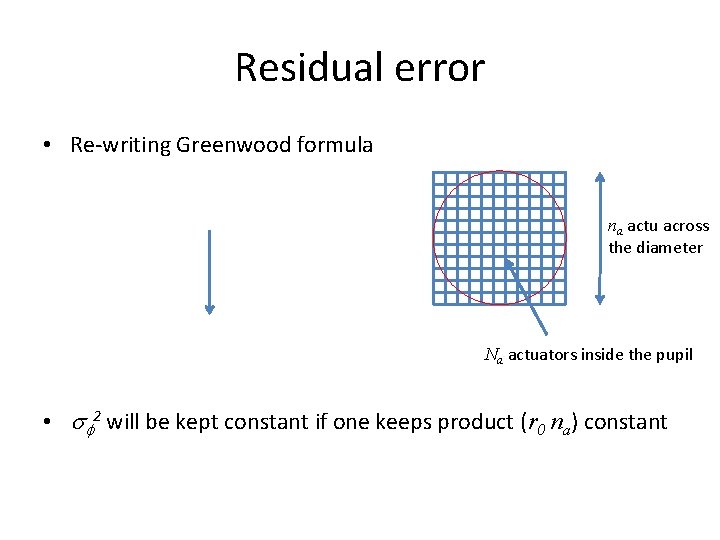
Residual error • Re-writing Greenwood formula na actu across the diameter Na actuators inside the pupil • sf 2 will be kept constant if one keeps product (r 0 na) constant
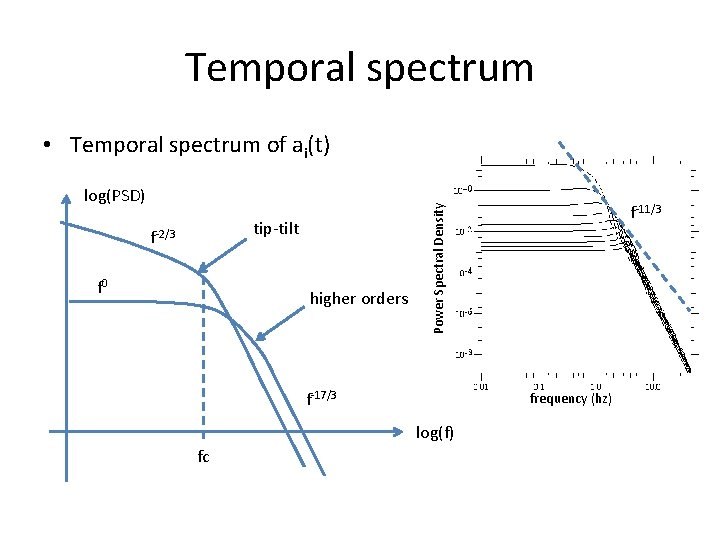
Temporal spectrum • Temporal spectrum of ai(t) tip-tilt f-2/3 f 0 higher orders f-17/3 frequency (hz) log(f) fc f-11/3 Power Spectral Density log(PSD)
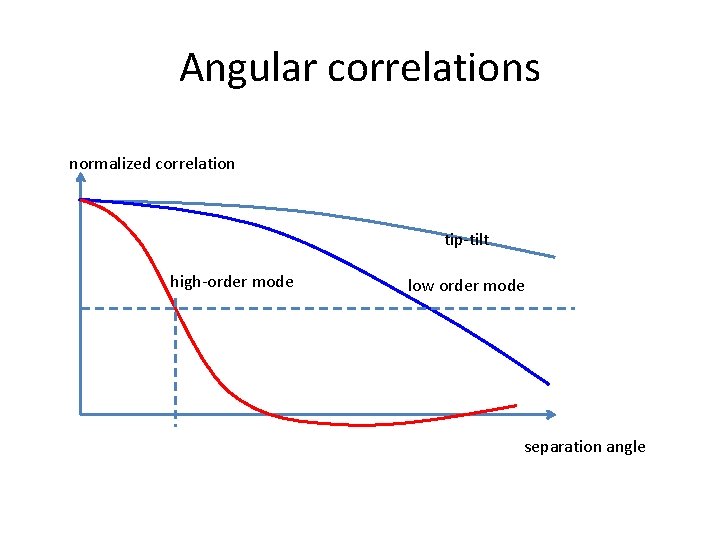
Angular correlations normalized correlation tip-tilt high-order mode low order mode separation angle

Thanks for your attention
- Slides: 42