
Atmospheric Structure and Weather Variables Do Now using
Atmospheric Structure and Weather Variables
Do Now using page 14 ESRT : Mrs. Cohn jumped out of a plane at 13, 500 ft above sea level…yup *1 mile= 5, 280 ft How many miles up did I jump? What layer of the atmosphere was I in?
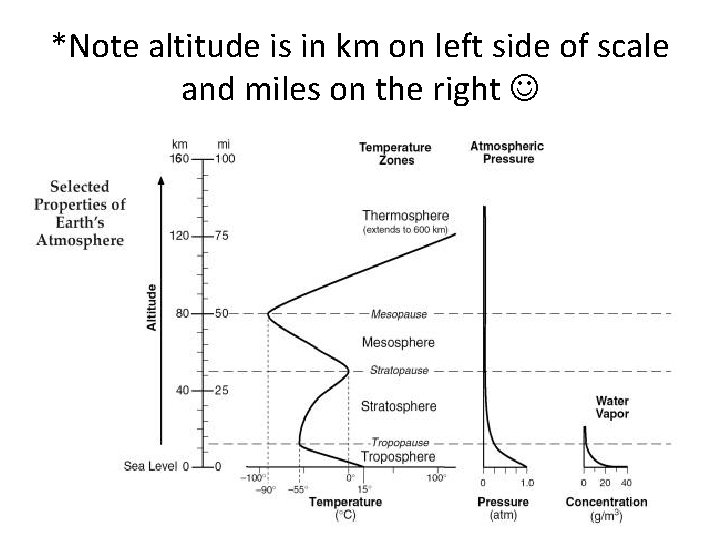
*Note altitude is in km on left side of scale and miles on the right
I. Weather is the condition of the atmosphere at any point in time (what is happening NOW) Weather Variables are individual pieces of information that describe specific conditions of the atmosphere -Temperature -Pressure -Dew Point -Humidity -Relative Humidity -Cloud Cover -Wind Velocity
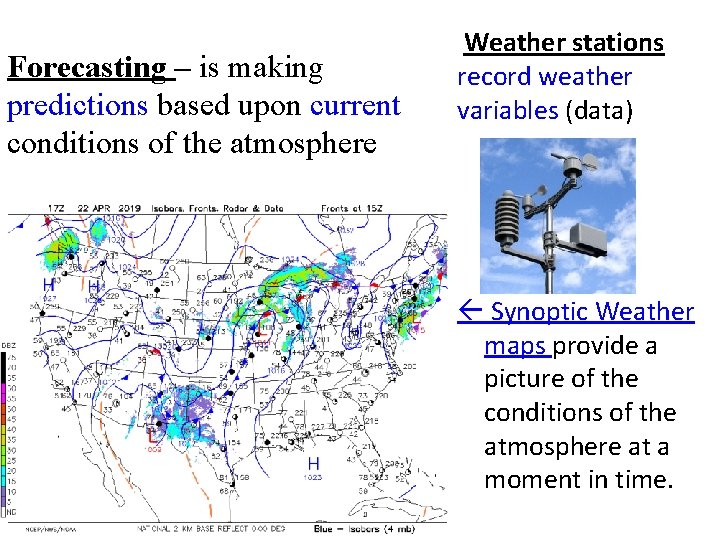
Forecasting – is making predictions based upon current conditions of the atmosphere Weather stations record weather variables (data) Synoptic Weather maps provide a picture of the conditions of the atmosphere at a moment in time.
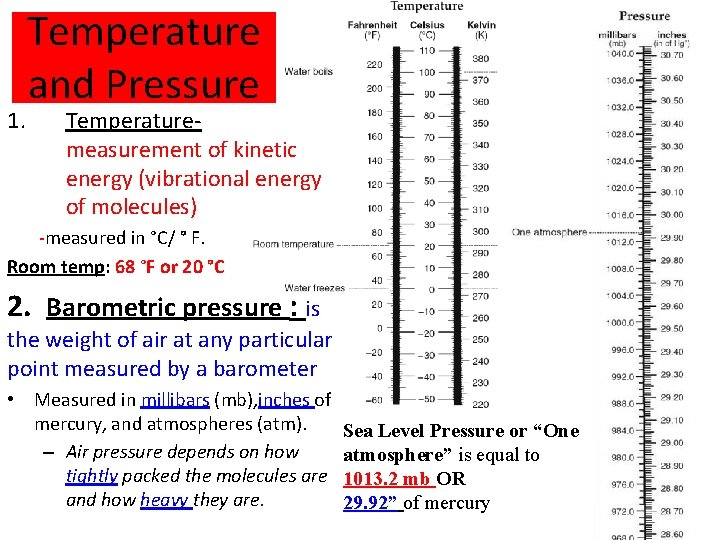
1. Temperature and Pressure Temperaturemeasurement of kinetic energy (vibrational energy of molecules) -measured in °C/ ° F. Room temp: 68 °F or 20 °C 2. Barometric pressure : is the weight of air at any particular point measured by a barometer • Measured in millibars (mb), inches of mercury, and atmospheres (atm). – Air pressure depends on how tightly packed the molecules are and how heavy they are. Sea Level Pressure or “One atmosphere” is equal to 1013. 2 mb OR 29. 92” of mercury
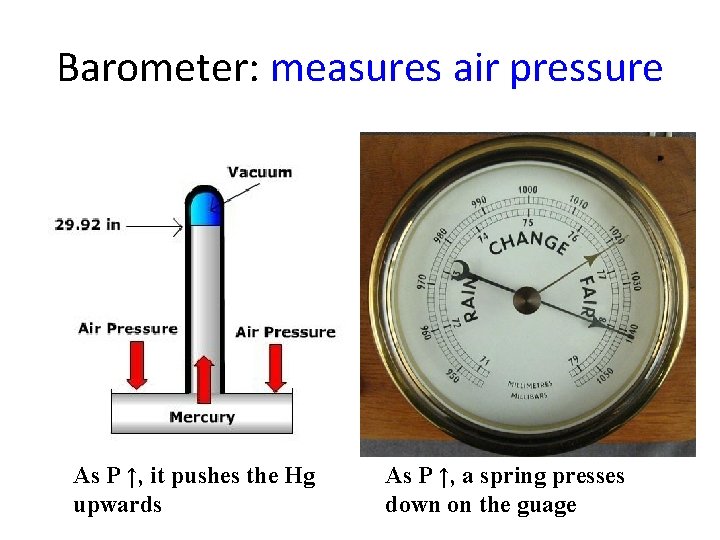
Barometer: measures air pressure As P ↑, it pushes the Hg upwards As P ↑, a spring presses down on the guage
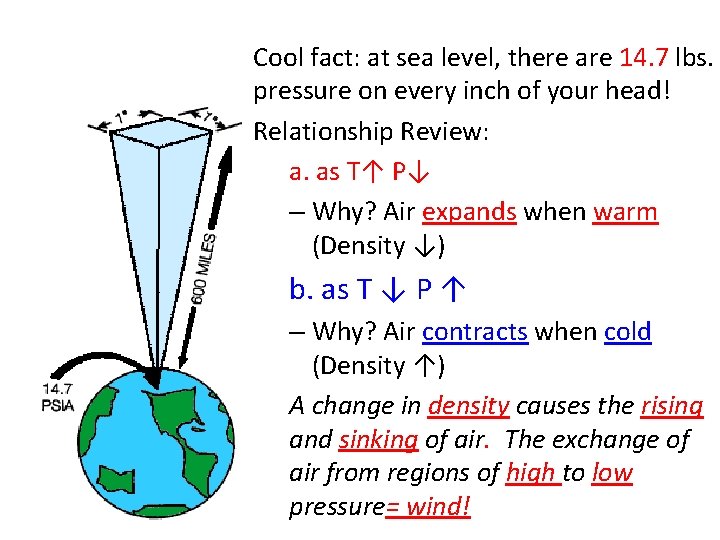
Cool fact: at sea level, there are 14. 7 lbs. pressure on every inch of your head! Relationship Review: a. as T↑ P↓ – Why? Air expands when warm (Density ↓) b. as T ↓ P ↑ – Why? Air contracts when cold (Density ↑) A change in density causes the rising and sinking of air. The exchange of air from regions of high to low pressure= wind!

3. Wind speed and direction – Wind is the horizontal movement of air. – Wind occurs because of uneven heating on earth. – The greater the difference in air pressure, the faster the wind speed. Speed is given in mph or in knots. – Wind is named for the direction from which it comes (a“SW” wind blows NE) – An anemometer measures wind speed – Socks can tell u direction

Air Flow - Air flows from High to Low Pressure - -And is faster where the pressure gradient is the greatest (∆P/Distance)
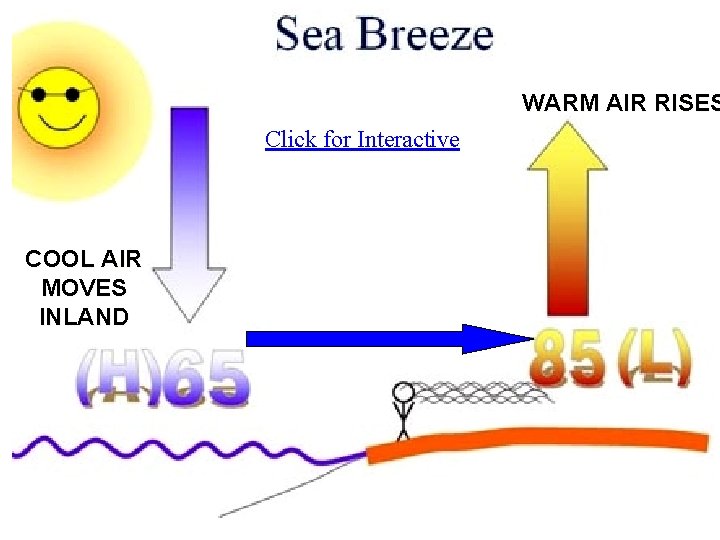
WARM AIR RISES Click for Interactive COOL AIR MOVES INLAND
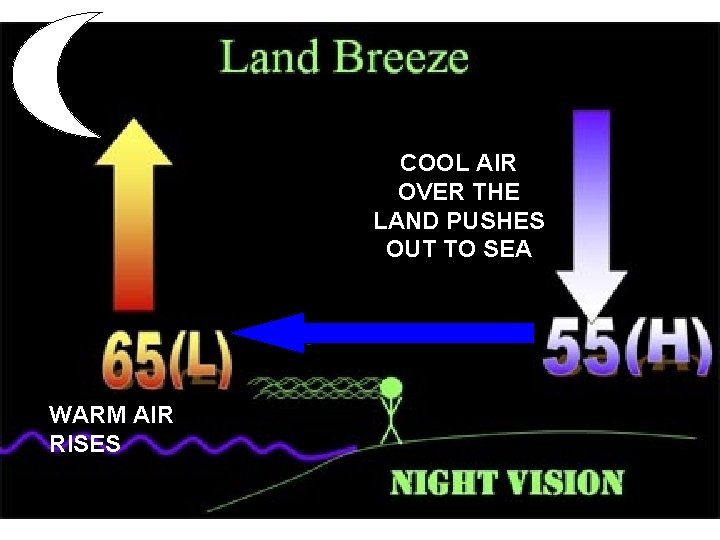
COOL AIR OVER THE LAND PUSHES OUT TO SEA WARM AIR RISES
4. Dewpoint Temperature Is the temperature at which water vapor will CONDENSE to become drops of water or ice crystals. a. It indicates how humid/moist the air is. b. The air must be cooled for this to happen. c. . The dewpoint temperature depends on the amount of water vapor in the air; It DOES NOT depend on the air temperature e. A higher dewpoint temperature indicates a high concentration of water vapor.
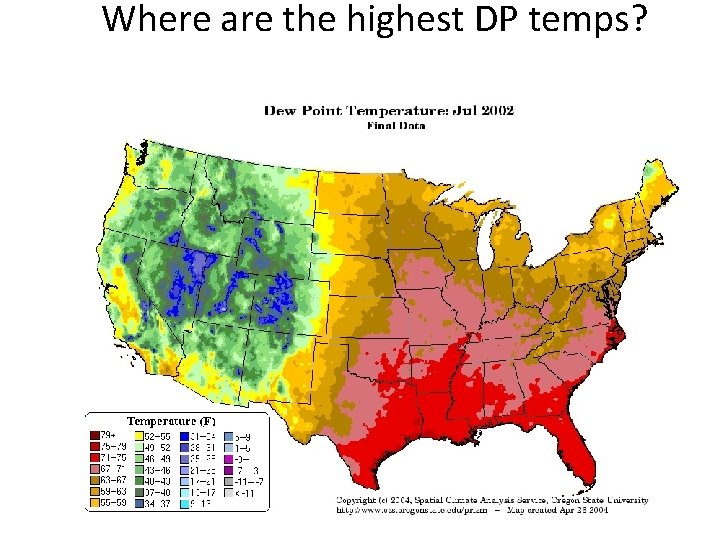
Where are the highest DP temps?
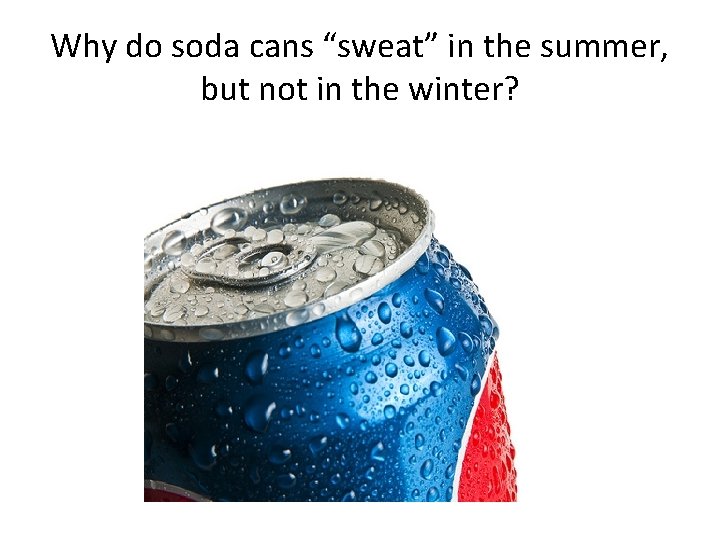
Why do soda cans “sweat” in the summer, but not in the winter?
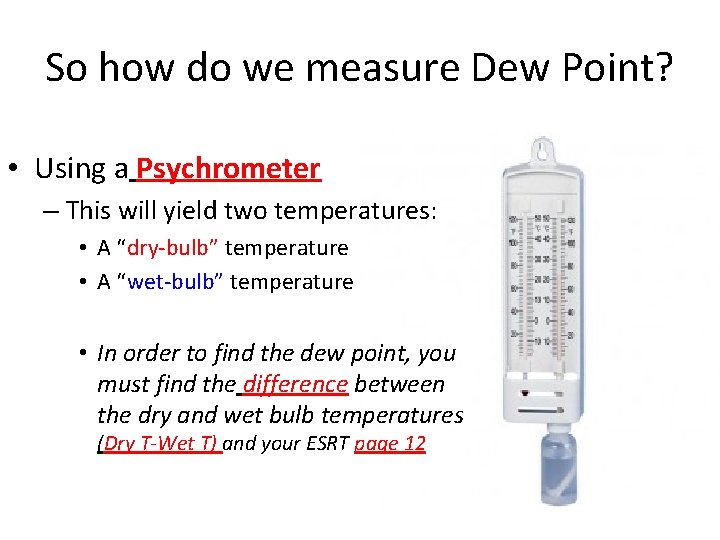
So how do we measure Dew Point? • Using a Psychrometer – This will yield two temperatures: • A “dry-bulb” temperature • A “wet-bulb” temperature • In order to find the dew point, you must find the difference between the dry and wet bulb temperatures (Dry T-Wet T) and your ESRT page 12
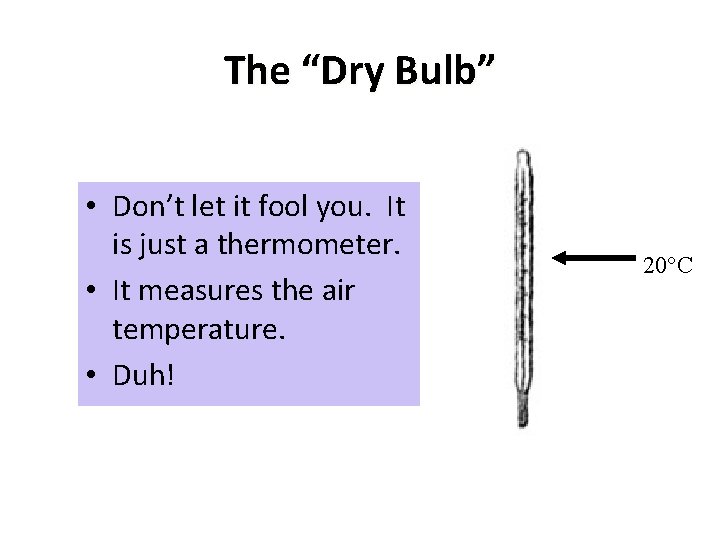
The “Dry Bulb” • Don’t let it fool you. It is just a thermometer. • It measures the air temperature. • Duh! 20°C
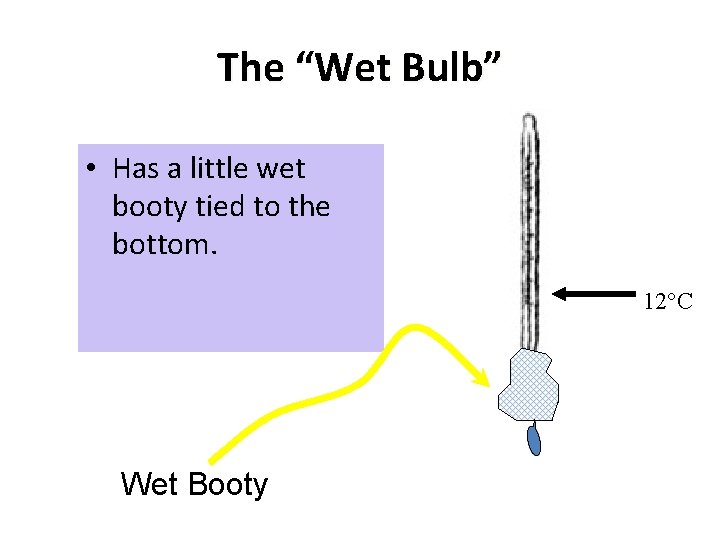
The “Wet Bulb” • Has a little wet booty tied to the bottom. 12°C Wet Booty
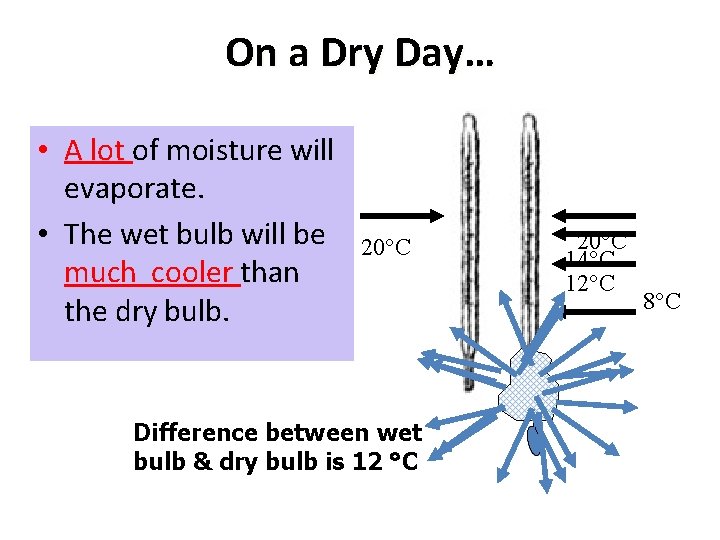
On a Dry Day… • A lot of moisture will evaporate. • The wet bulb will be much cooler than the dry bulb. 20°C Difference between wet bulb & dry bulb is 12 °C 20°C 14°C 12°C 8°C
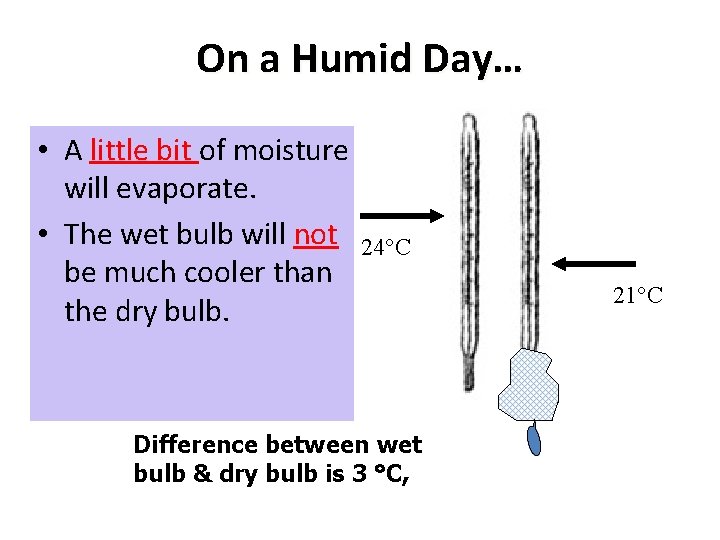
On a Humid Day… • A little bit of moisture will evaporate. • The wet bulb will not be much cooler than the dry bulb. 24°C Difference between wet bulb & dry bulb is 3 °C, 21°C
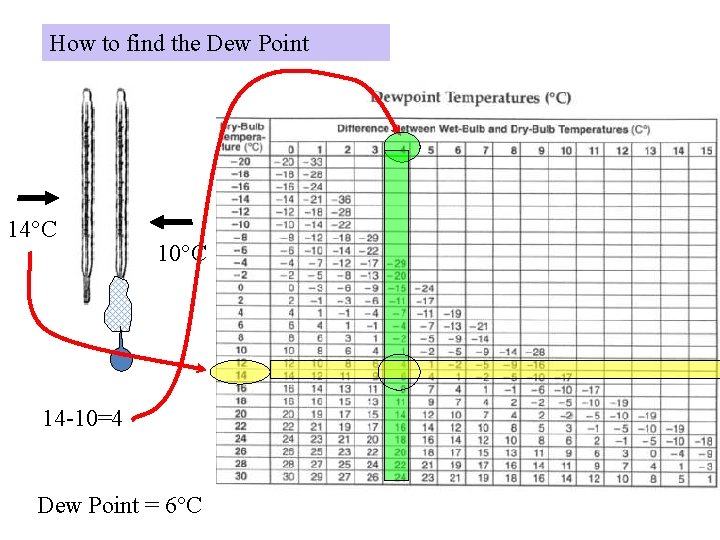
How to find the Dew Point 14°C 10°C 14 -10=4 Dew Point = 6°C
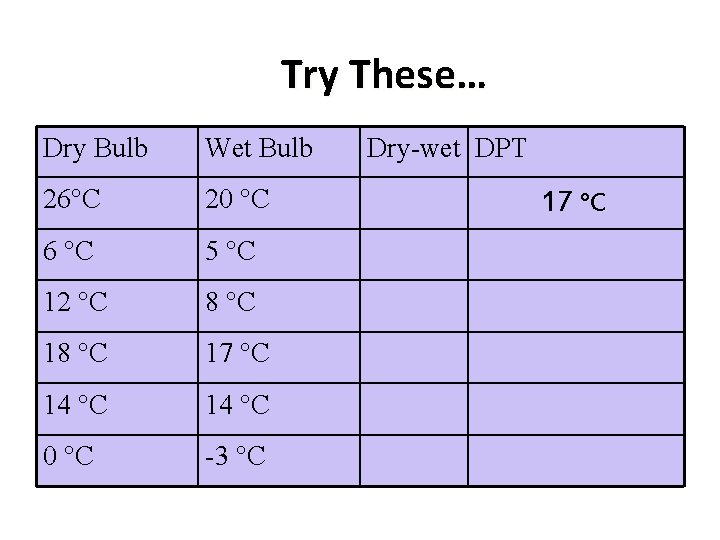
Try These… Dry Bulb Wet Bulb 26°C 20 °C 6 °C 5 °C 12 °C 8 °C 17 °C 14 °C 0 °C -3 °C Dry-wet DPT 17 °C
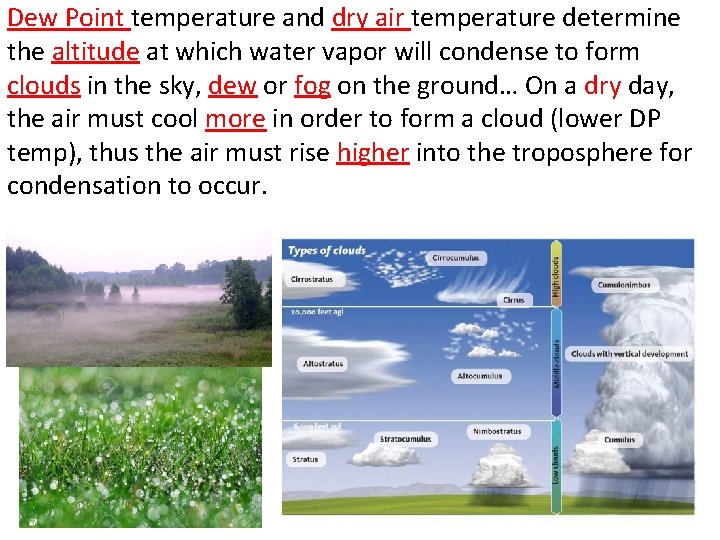
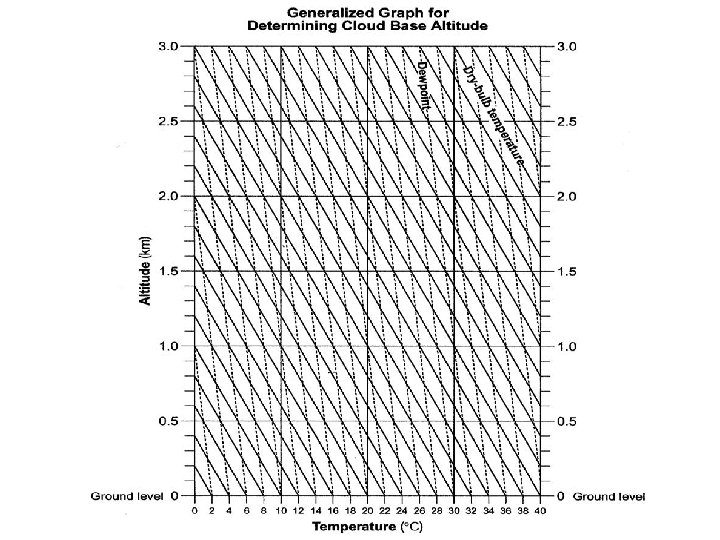
Dew Point temperature and dry air temperature determine the altitude at which water vapor will condense to form clouds in the sky, dew or fog on the ground… On a dry day, the air must cool more in order to form a cloud (lower DP temp), thus the air must rise higher into the troposphere for condensation to occur.
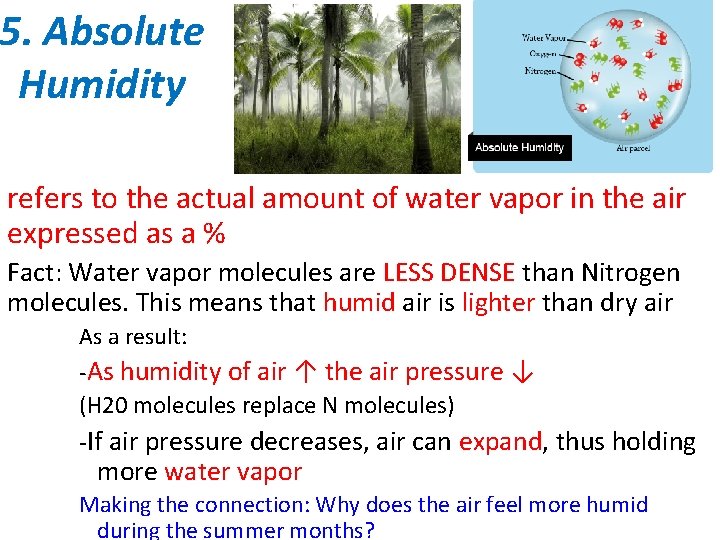
5. Absolute Humidity refers to the actual amount of water vapor in the air expressed as a % Fact: Water vapor molecules are LESS DENSE than Nitrogen molecules. This means that humid air is lighter than dry air As a result: -As humidity of air ↑ the air pressure ↓ (H 20 molecules replace N molecules) -If air pressure decreases, air can expand, thus holding more water vapor Making the connection: Why does the air feel more humid during the summer months?
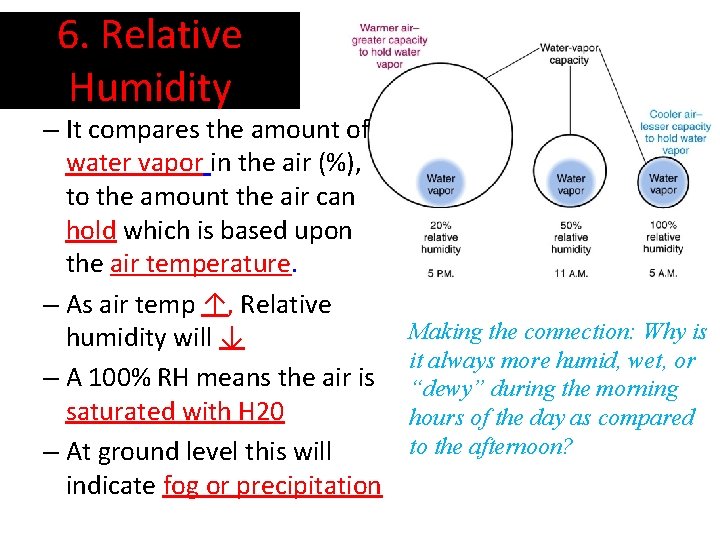
6. Relative Humidity – It compares the amount of water vapor in the air (%), to the amount the air can hold which is based upon the air temperature. – As air temp ↑, Relative humidity will ↓ – A 100% RH means the air is saturated with H 20 – At ground level this will indicate fog or precipitation Making the connection: Why is it always more humid, wet, or “dewy” during the morning hours of the day as compared to the afternoon?
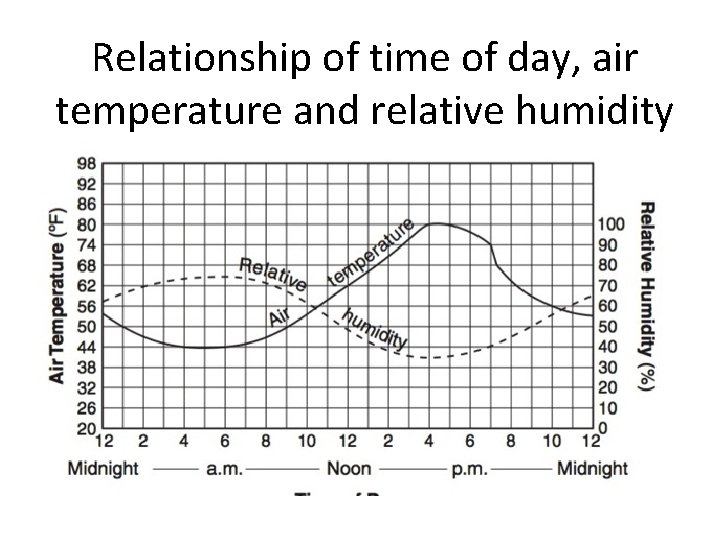
Relationship of time of day, air temperature and relative humidity
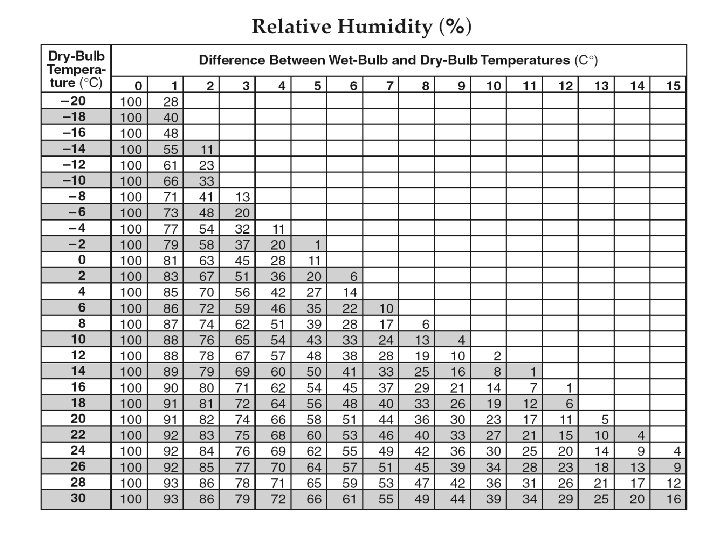
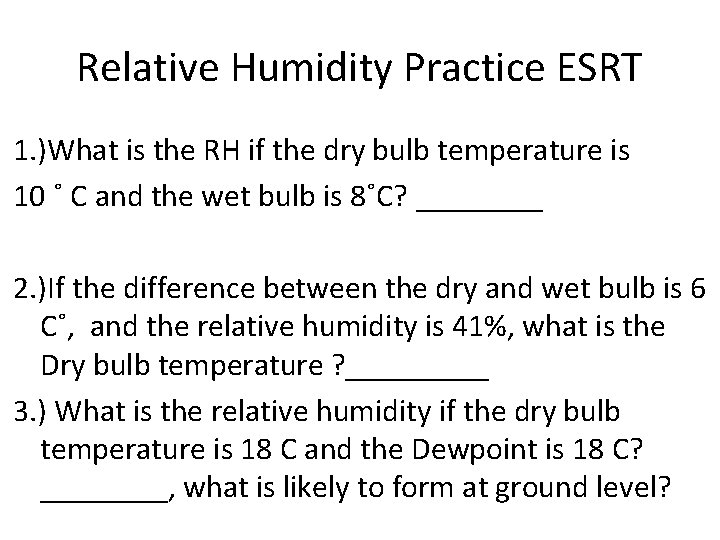
Relative Humidity Practice ESRT 1. )What is the RH if the dry bulb temperature is 10 ˚ C and the wet bulb is 8˚C? ____ 2. )If the difference between the dry and wet bulb is 6 C˚, and the relative humidity is 41%, what is the Dry bulb temperature ? _____ 3. ) What is the relative humidity if the dry bulb temperature is 18 C and the Dewpoint is 18 C? ____, what is likely to form at ground level?
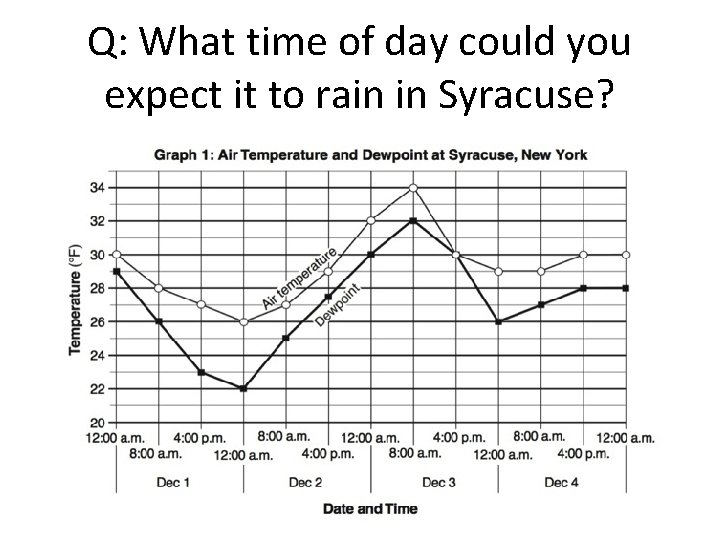
Q: What time of day could you expect it to rain in Syracuse?
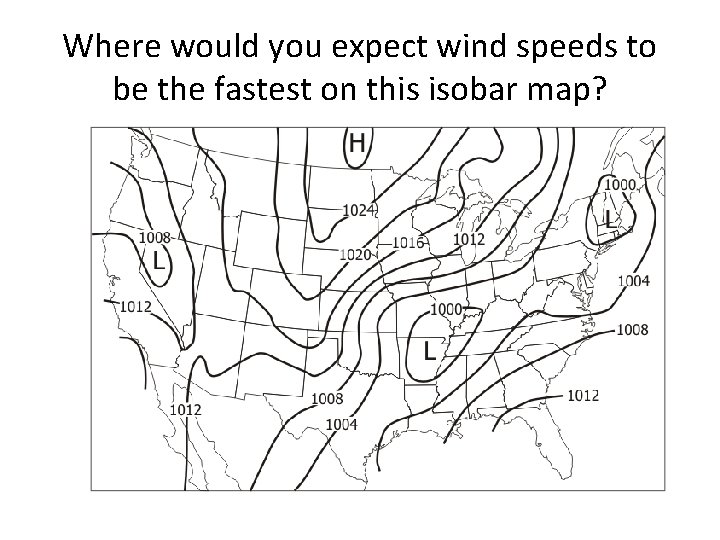
Where would you expect wind speeds to be the fastest on this isobar map?
Comparing Air with Weather Variables • Heavy Air: (high pressure) 1)cooler: because the molecules are packed in closer together (Vibrate less/lower KE) 2. )Dry- air dries out as it sinks (descends) (Temp and DP are further from one another, RH ↓) – Calm, because all air moves away from high pressure areas to low pressure areas • Light Air: (low pressure) – warmer; the molecules have more energy by “bouncing” off one another (Vibrate more/ higher KE) – Humid, - light air rises, cools and condenses (Temp cools to dew point ) *lighter air also because water vapor weighs less than N – Windy, because air flows from other areas high pressure to low pressure
- Slides: 32