
Atmospheric Sciences 501 Introduction to Atmospheric Physics and


- Slides: 37
Atmospheric Sciences 501 Introduction to Atmospheric Physics and Chemistry Atmospheric Radiation: Lecture 1
Community Business Study Chapter 4 of Wallace and Hobbs Hour exam next Tuesday October 23 We’ll work some of the Chapter 4 problems in class as usual, but not sure of dates yet. Questions?
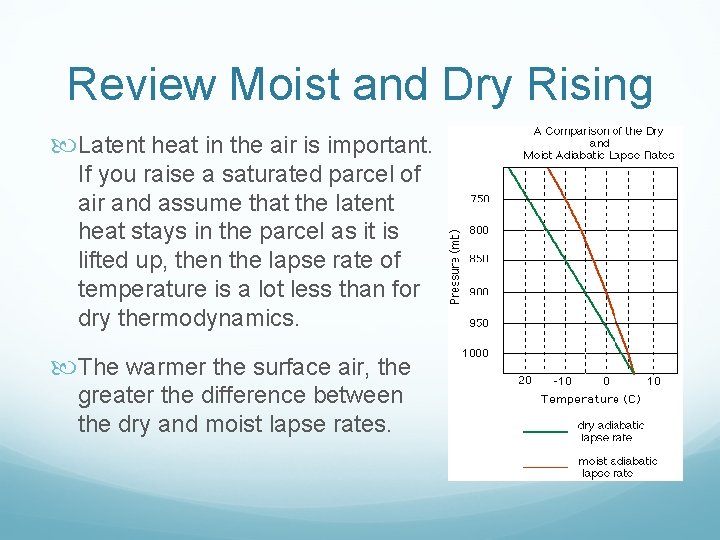
Review Moist and Dry Rising Latent heat in the air is important. If you raise a saturated parcel of air and assume that the latent heat stays in the parcel as it is lifted up, then the lapse rate of temperature is a lot less than for dry thermodynamics. The warmer the surface air, the greater the difference between the dry and moist lapse rates.
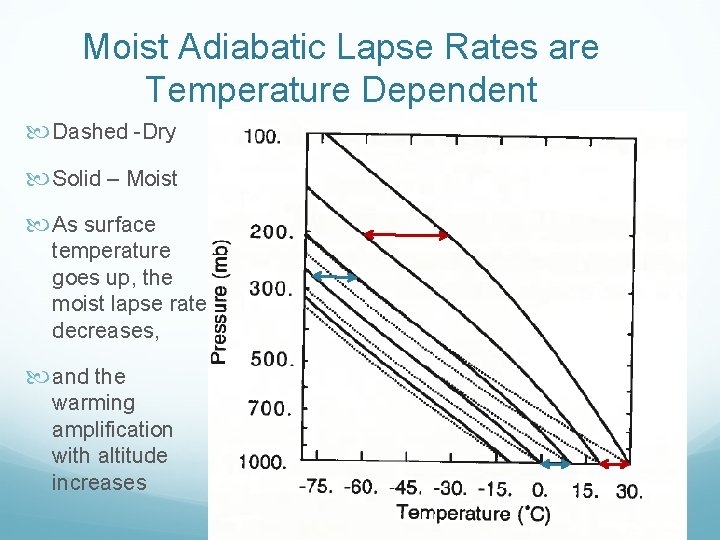
Moist Adiabatic Lapse Rates are Temperature Dependent Dashed -Dry Solid – Moist As surface temperature goes up, the moist lapse rate decreases, and the warming amplification with altitude increases
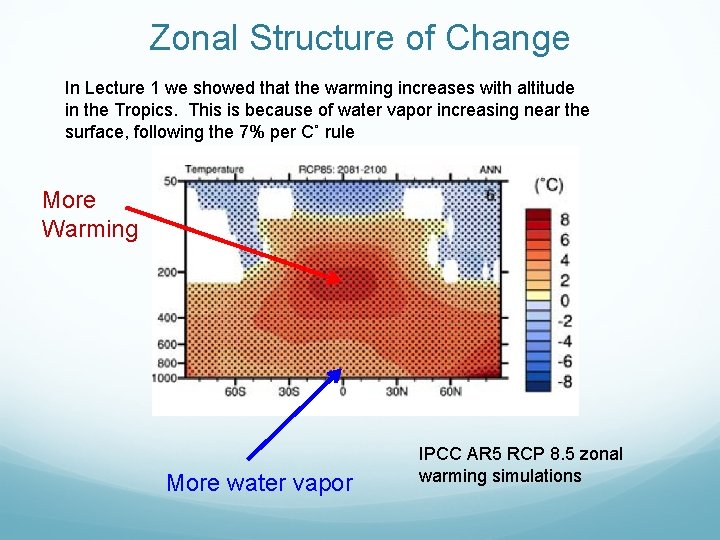
Zonal Structure of Change In Lecture 1 we showed that the warming increases with altitude in the Tropics. This is because of water vapor increasing near the surface, following the 7% per C˚ rule More Warming More water vapor IPCC AR 5 RCP 8. 5 zonal warming simulations
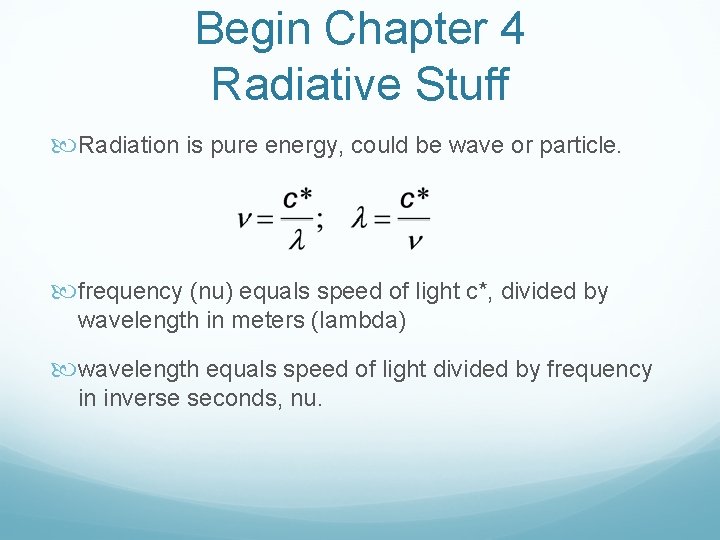
Begin Chapter 4 Radiative Stuff Radiation is pure energy, could be wave or particle. frequency (nu) equals speed of light c*, divided by wavelength in meters (lambda) wavelength equals speed of light divided by frequency in inverse seconds, nu.
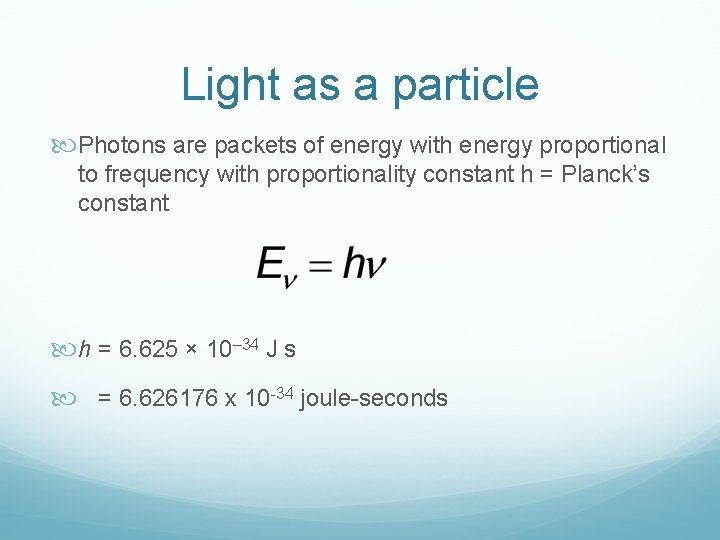
Light as a particle Photons are packets of energy with energy proportional to frequency with proportionality constant h = Planck’s constant h = 6. 625 × 10– 34 J s = 6. 626176 x 10 -34 joule-seconds
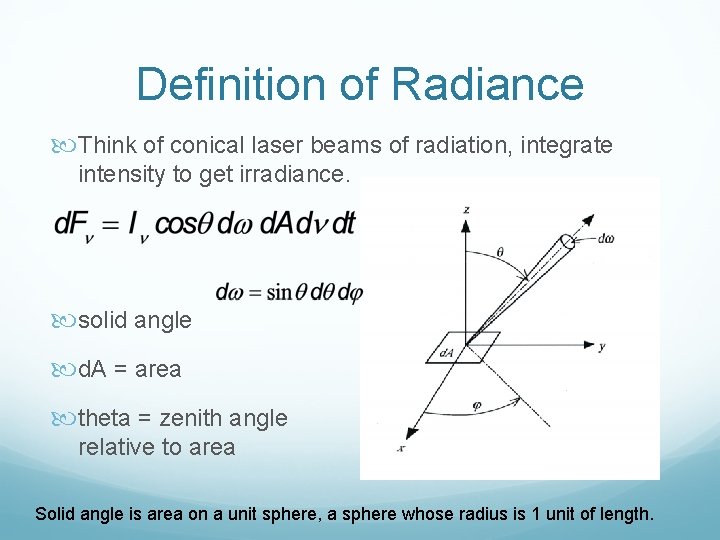
Definition of Radiance Think of conical laser beams of radiation, integrate intensity to get irradiance. solid angle d. A = area theta = zenith angle relative to area Solid angle is area on a unit sphere, a sphere whose radius is 1 unit of length.
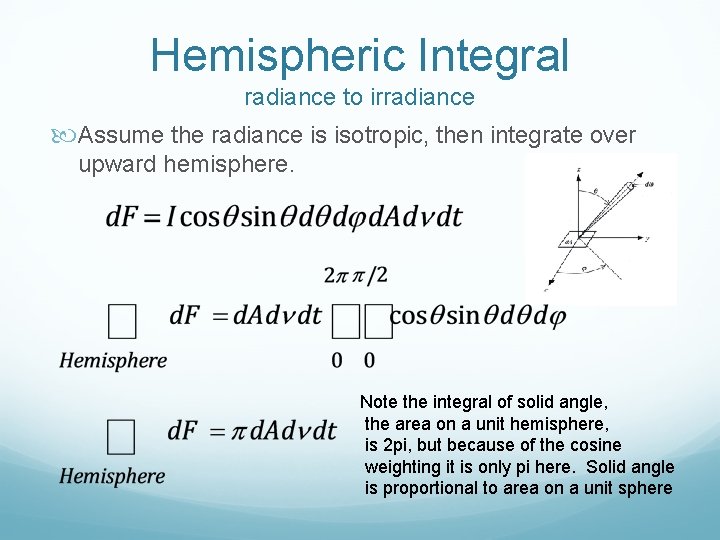
Hemispheric Integral radiance to irradiance Assume the radiance is isotropic, then integrate over upward hemisphere. Note the integral of solid angle, the area on a unit hemisphere, is 2 pi, but because of the cosine weighting it is only pi here. Solid angle is proportional to area on a unit sphere
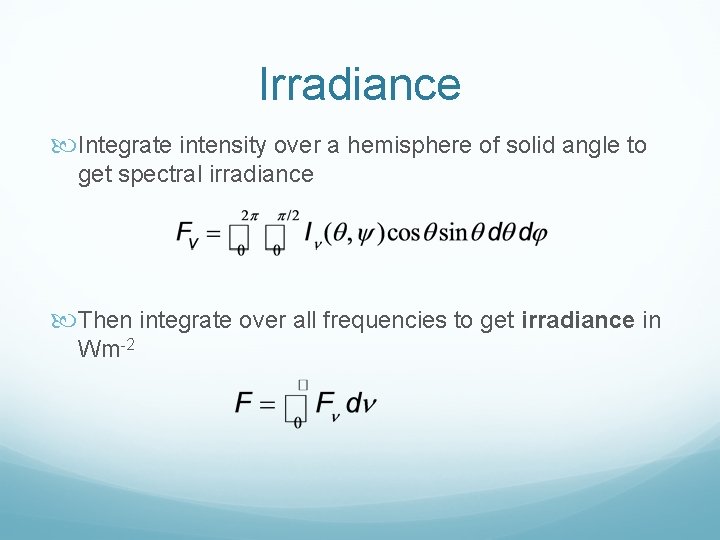
Irradiance Integrate intensity over a hemisphere of solid angle to get spectral irradiance Then integrate over all frequencies to get irradiance in Wm-2
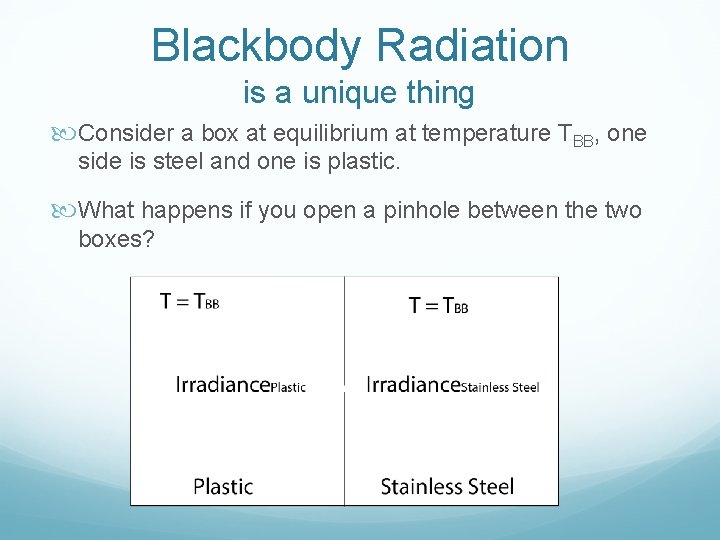
Blackbody Radiation is a unique thing Consider a box at equilibrium at temperature TBB, one side is steel and one is plastic. What happens if you open a pinhole between the two boxes?
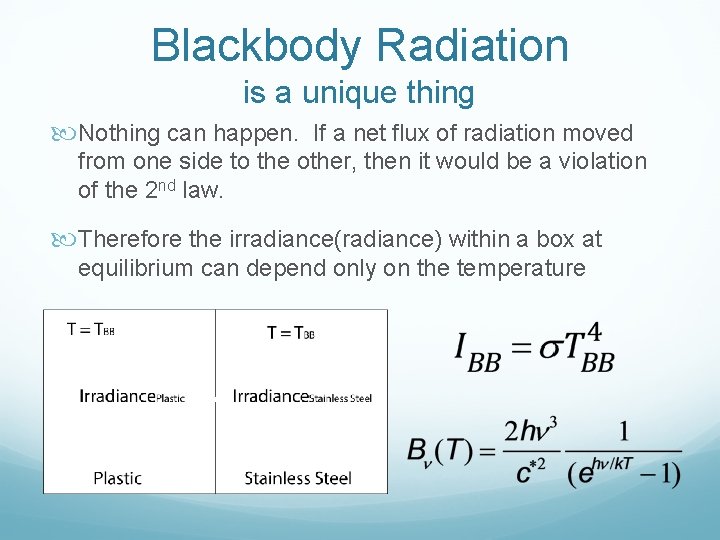
Blackbody Radiation is a unique thing Nothing can happen. If a net flux of radiation moved from one side to the other, then it would be a violation of the 2 nd law. Therefore the irradiance(radiance) within a box at equilibrium can depend only on the temperature
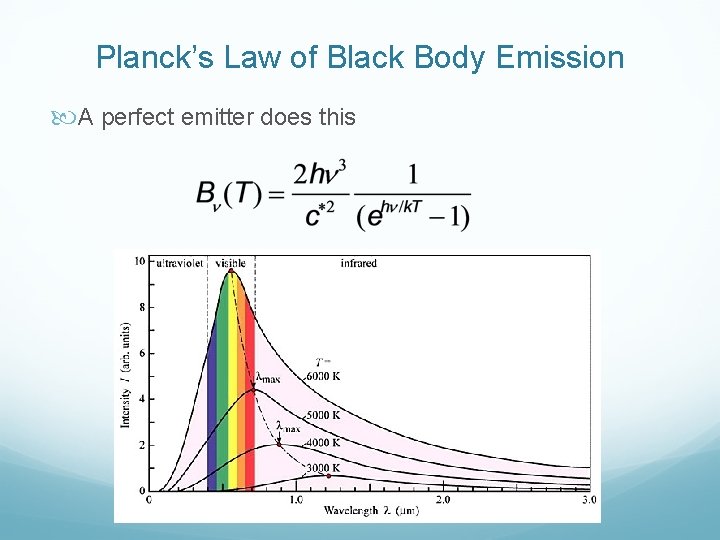
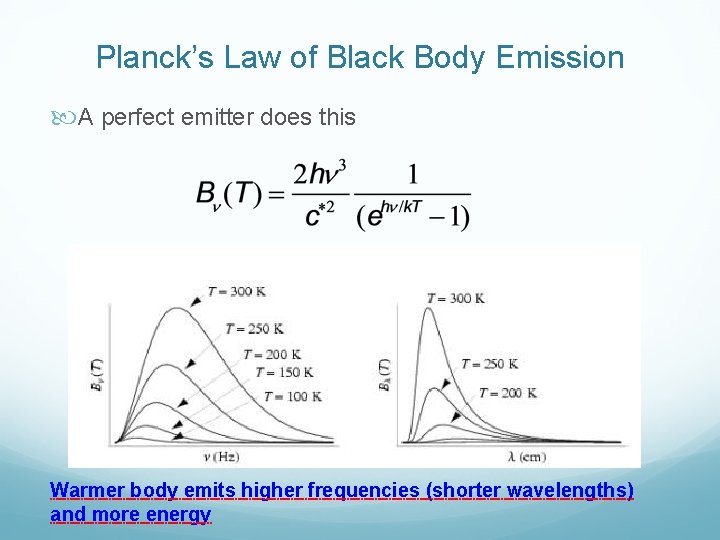
Planck’s Law of Black Body Emission A perfect emitter does this
Planck’s Law of Black Body Emission A perfect emitter does this Warmer body emits higher frequencies (shorter wavelengths) and more energy
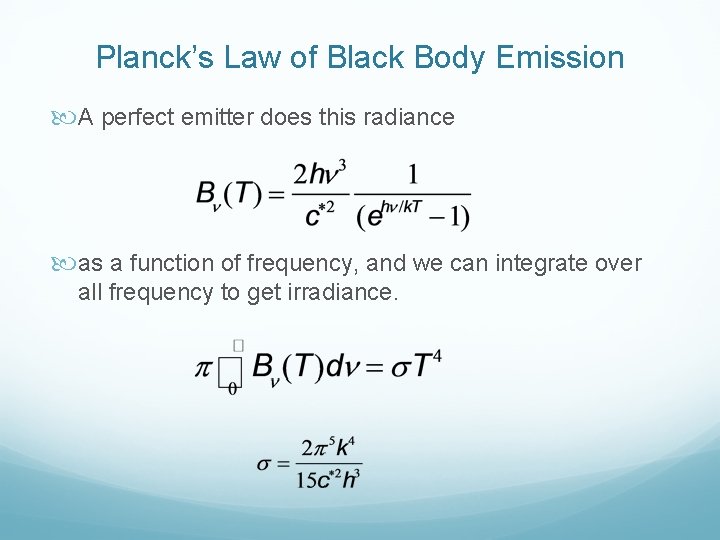
Planck’s Law of Black Body Emission A perfect emitter does this radiance as a function of frequency, and we can integrate over all frequency to get irradiance.
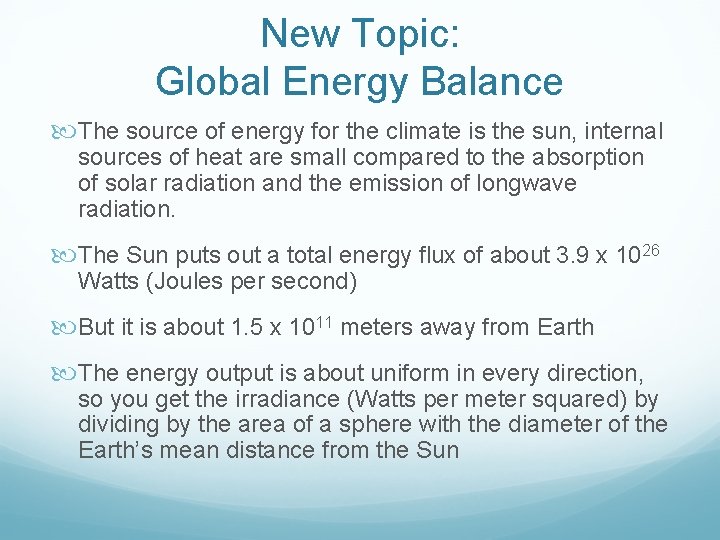
New Topic: Global Energy Balance The source of energy for the climate is the sun, internal sources of heat are small compared to the absorption of solar radiation and the emission of longwave radiation. The Sun puts out a total energy flux of about 3. 9 x 1026 Watts (Joules per second) But it is about 1. 5 x 10¹¹ meters away from Earth The energy output is about uniform in every direction, so you get the irradiance (Watts per meter squared) by dividing by the area of a sphere with the diameter of the Earth’s mean distance from the Sun
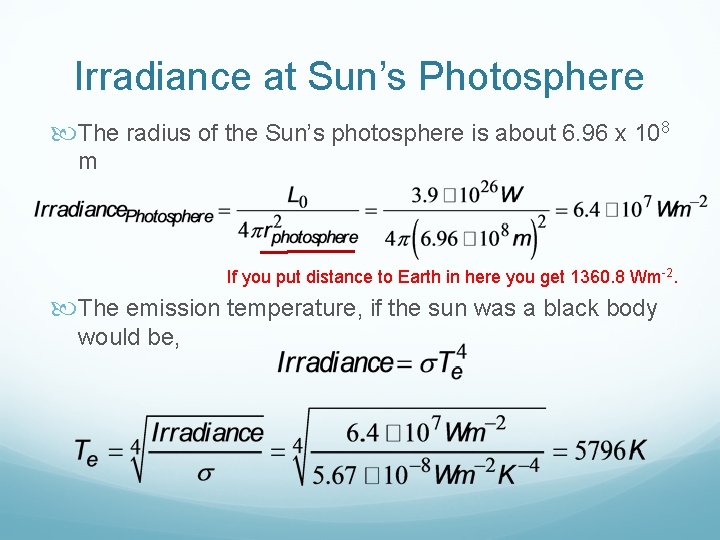
Irradiance at Sun’s Photosphere The radius of the Sun’s photosphere is about 6. 96 x 108 m If you put distance to Earth in here you get 1360. 8 Wm-2. The emission temperature, if the sun was a black body would be,
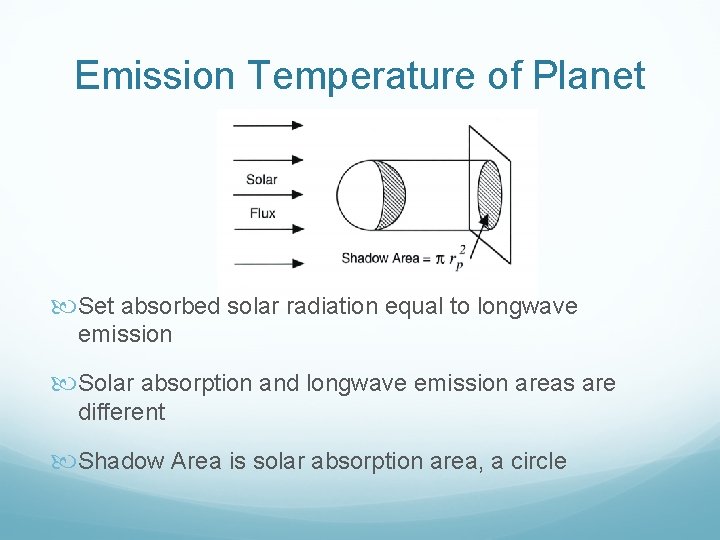
Emission Temperature of Planet Set absorbed solar radiation equal to longwave emission Solar absorption and longwave emission areas are different Shadow Area is solar absorption area, a circle
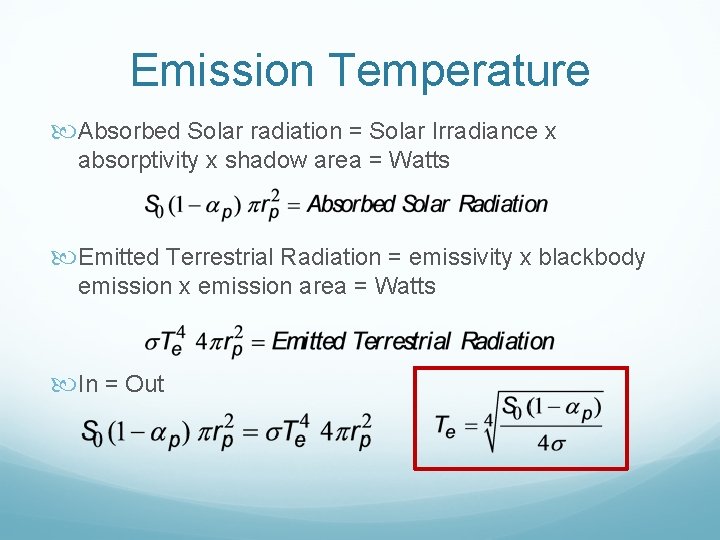
Emission Temperature Absorbed Solar radiation = Solar Irradiance x absorptivity x shadow area = Watts Emitted Terrestrial Radiation = emissivity x blackbody emission x emission area = Watts In = Out
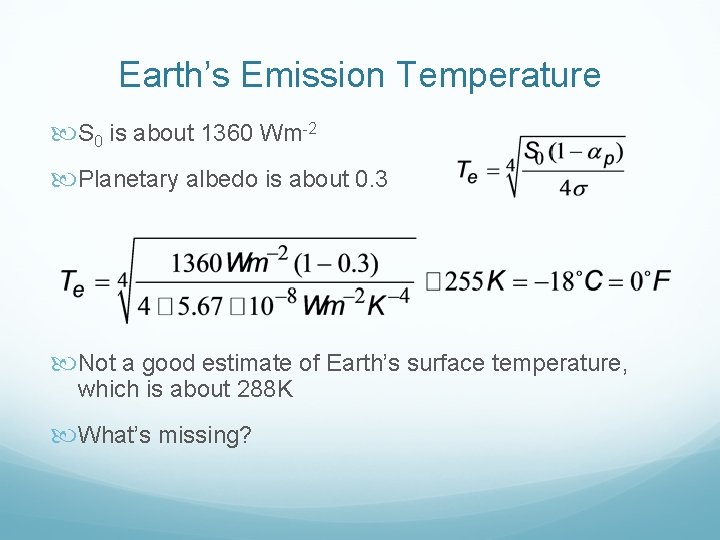
Earth’s Emission Temperature S 0 is about 1360 Wm-2 Planetary albedo is about 0. 3 Not a good estimate of Earth’s surface temperature, which is about 288 K What’s missing?
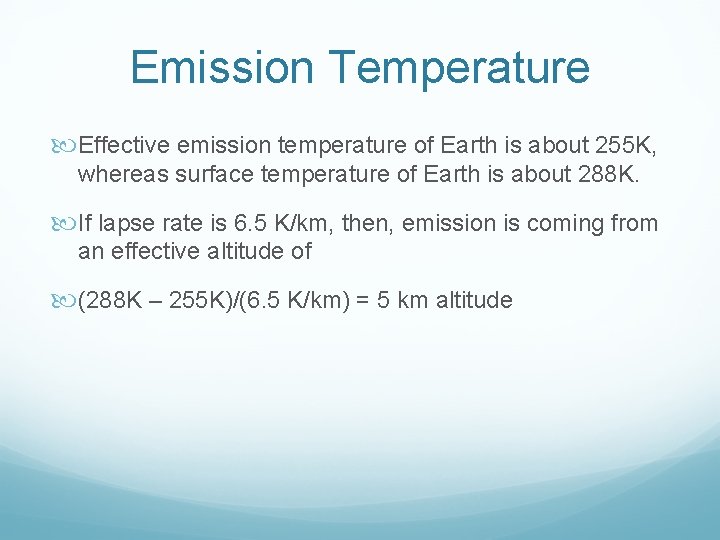
Emission Temperature Effective emission temperature of Earth is about 255 K, whereas surface temperature of Earth is about 288 K. If lapse rate is 6. 5 K/km, then, emission is coming from an effective altitude of (288 K – 255 K)/(6. 5 K/km) = 5 km altitude
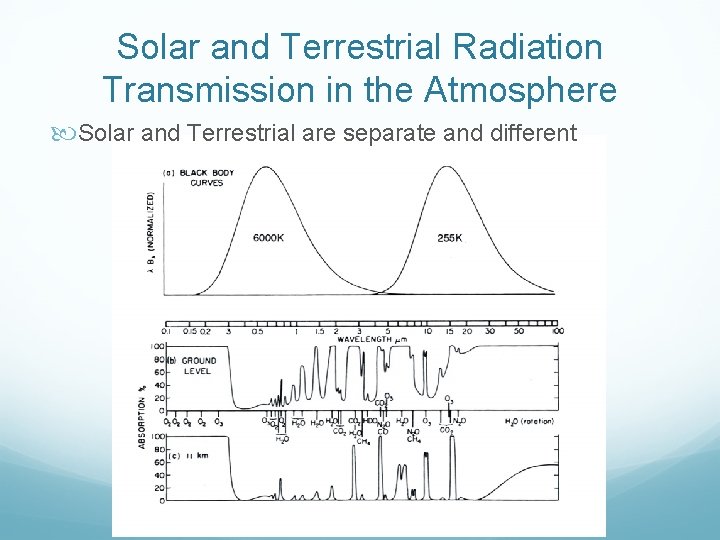
Solar and Terrestrial Radiation Transmission in the Atmosphere Solar and Terrestrial are separate and different
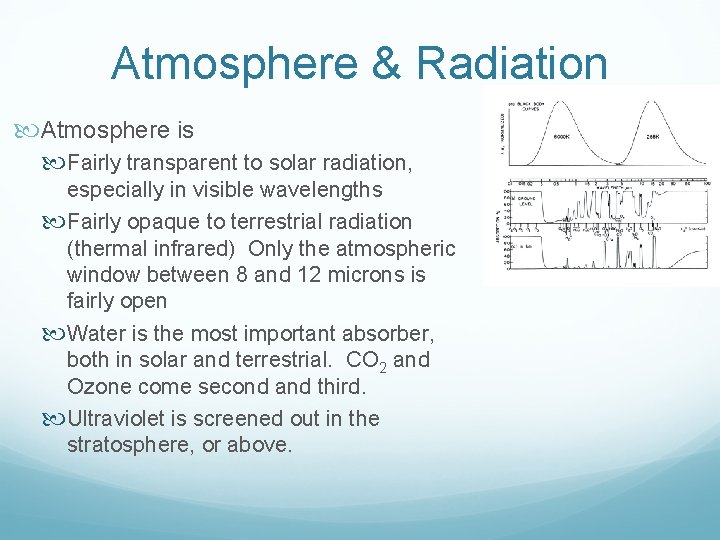
Atmosphere & Radiation Atmosphere is Fairly transparent to solar radiation, especially in visible wavelengths Fairly opaque to terrestrial radiation (thermal infrared) Only the atmospheric window between 8 and 12 microns is fairly open Water is the most important absorber, both in solar and terrestrial. CO 2 and Ozone come second and third. Ultraviolet is screened out in the stratosphere, or above.
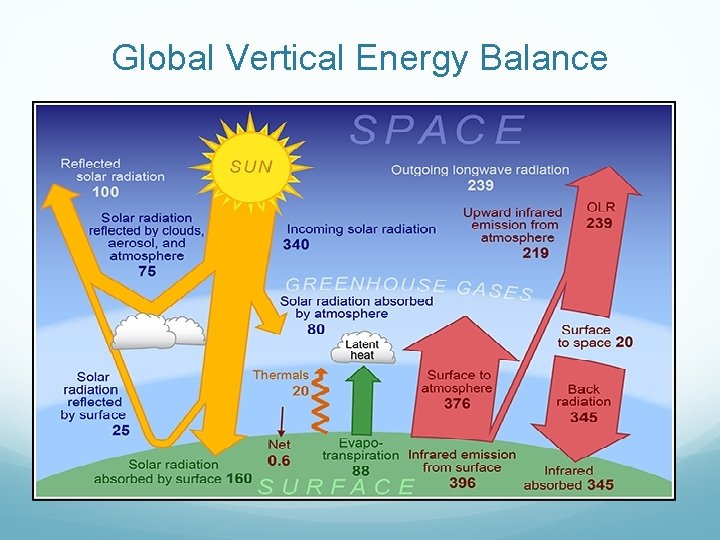
Global Vertical Energy Balance
Energy Balances Top of Atmosphere Incoming solar – reflected solar - emitted terrestrial radiation = storage 340 Wm-2 - 100 Wm-2 - 239 Wm-2 = 0. 6 Wm-2 Atmosphere Absorbed solar + Thermals + Evaporation + surface longwave – OLR = 0 80 Wm-2 + 20 Wm-2 + 88 Wm-2 +51 Wm-2 – 239 Wm-2 = 0 Surface Absorbed solar – Thermals – latent heating – surface longwave = Storage 160 Wm-2 – 20 Wm-2 – 88 Wm-2 – 51 Wm-2 = 0. 6 Wm-2
Magnitude of Greenhouse Effect for Earth Outgoing Longwave Radiation (OLR) is 239 Wm-2, Surface longwave emission is 396 Wm-2 Magnitude of TOA greenhouse effect = 396 – 239 = 157 Wm-2 heating of system. Solar heating of surface is 160 Wm-2 Downward longwave heating of surface by atmosphere is 345 Wm-2 Magnitude of surface greenhouse effect = twice the solar heating of the surface.
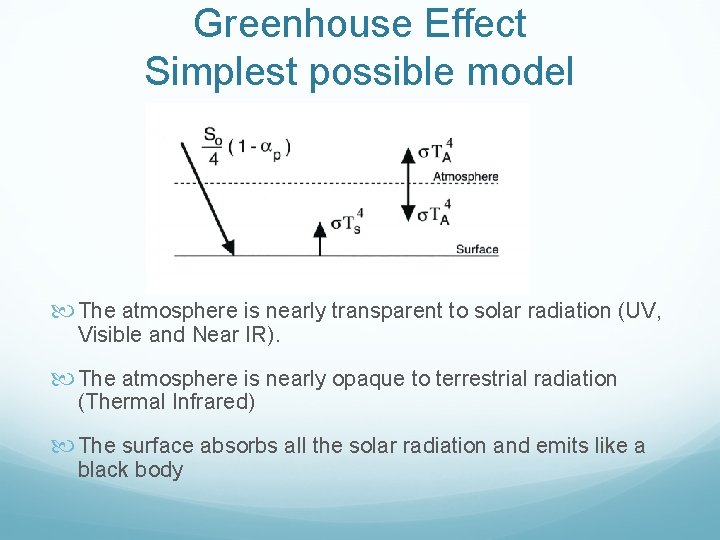
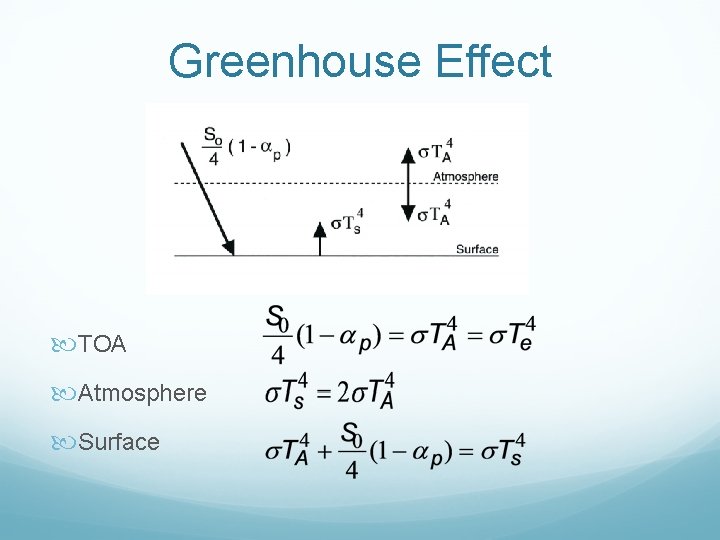
Greenhouse Effect Simplest possible model The atmosphere is nearly transparent to solar radiation (UV, Visible and Near IR). The atmosphere is nearly opaque to terrestrial radiation (Thermal Infrared) The surface absorbs all the solar radiation and emits like a black body
Greenhouse Effect TOA Atmosphere Surface
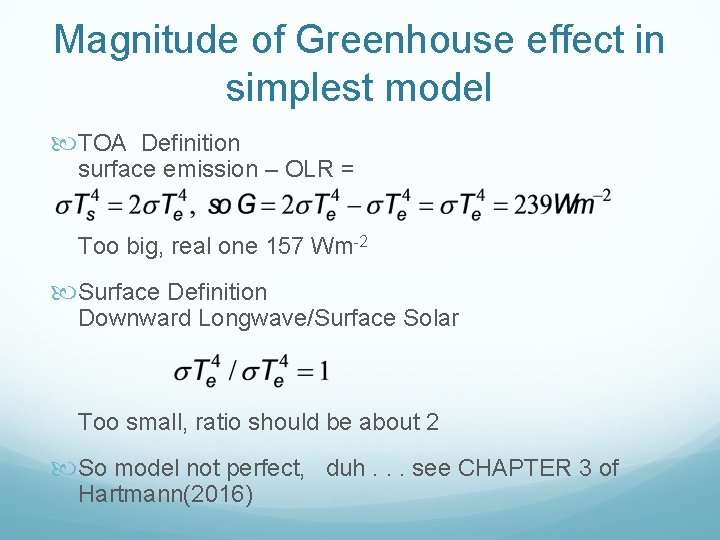
Magnitude of Greenhouse effect in simplest model TOA Definition surface emission – OLR = Too big, real one 157 Wm-2 Surface Definition Downward Longwave/Surface Solar Too small, ratio should be about 2 So model not perfect, duh. . . see CHAPTER 3 of Hartmann(2016)
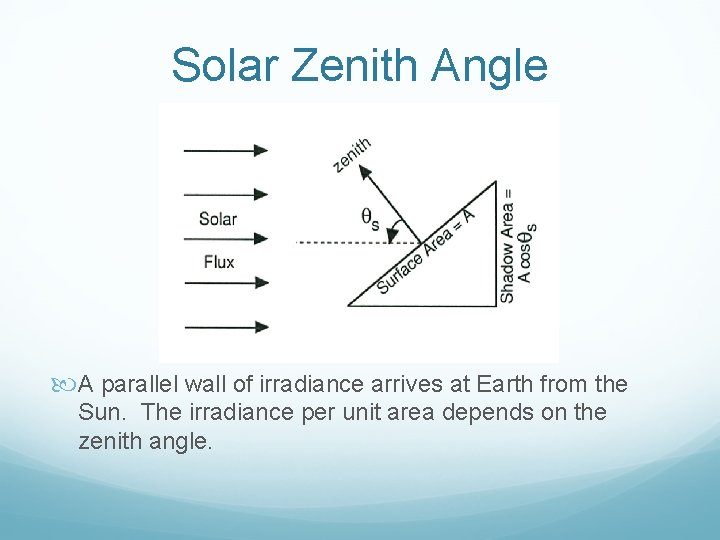
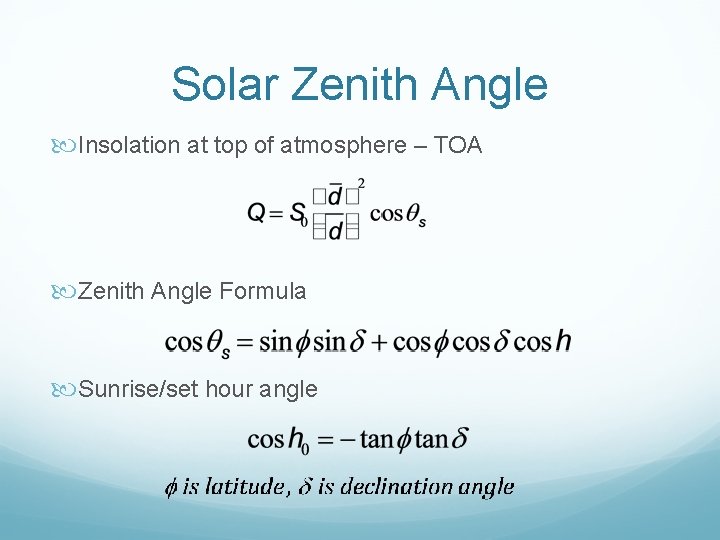
Solar Zenith Angle A parallel wall of irradiance arrives at Earth from the Sun. The irradiance per unit area depends on the zenith angle.
Solar Zenith Angle Insolation at top of atmosphere – TOA Zenith Angle Formula Sunrise/set hour angle
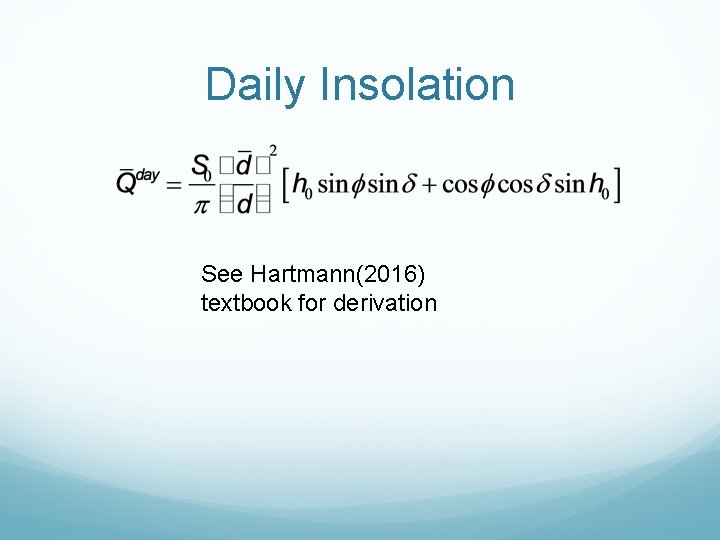
Daily Insolation See Hartmann(2016) textbook for derivation
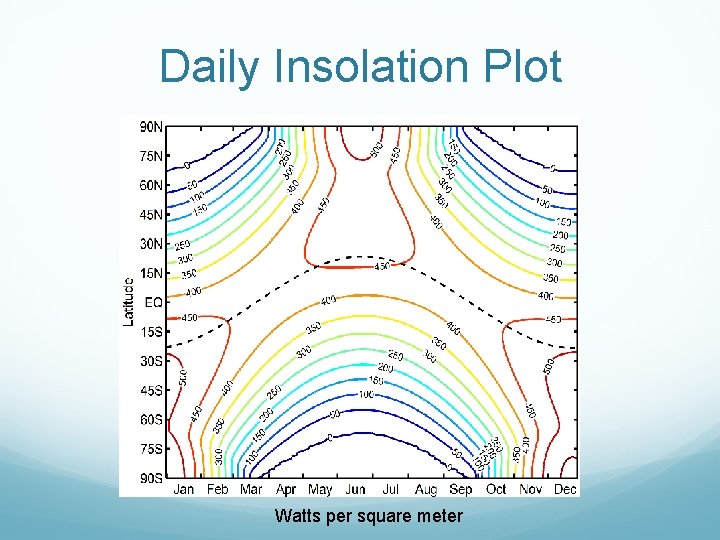
Daily Insolation Plot Watts per square meter
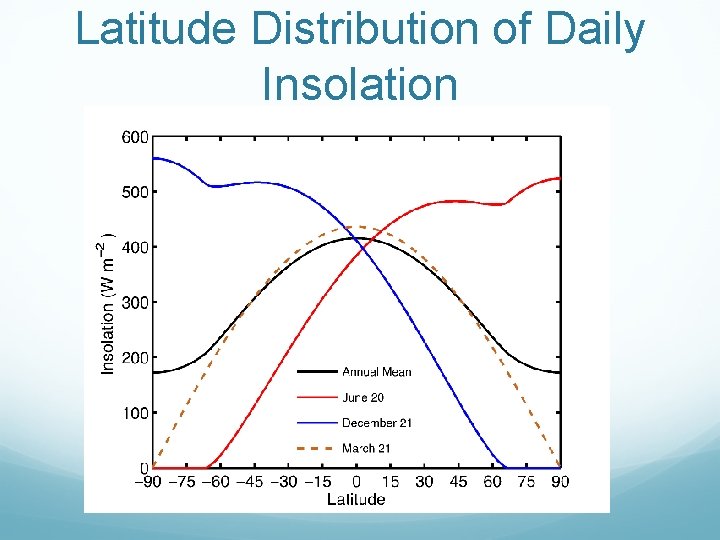
Latitude Distribution of Daily Insolation
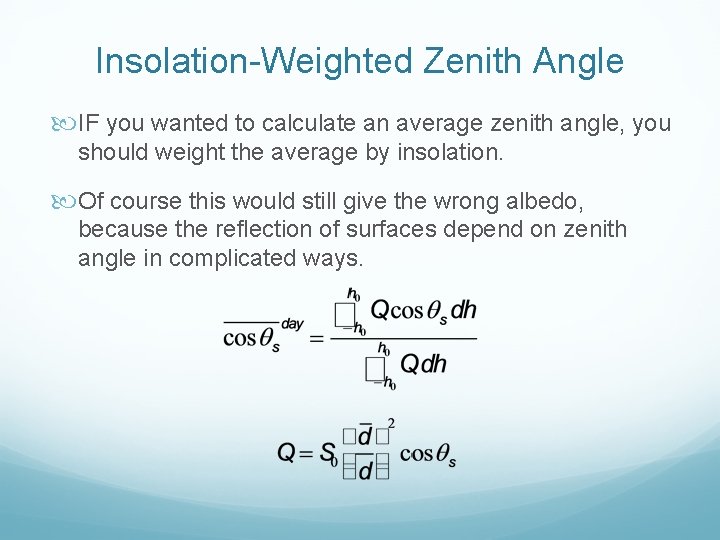
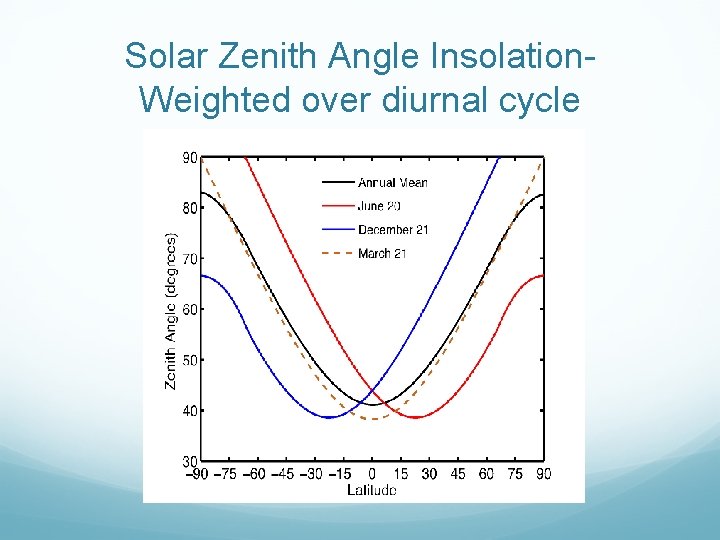
Insolation-Weighted Zenith Angle IF you wanted to calculate an average zenith angle, you should weight the average by insolation. Of course this would still give the wrong albedo, because the reflection of surfaces depend on zenith angle in complicated ways.
Solar Zenith Angle Insolation. Weighted over diurnal cycle
Thanks!