
ATMOSPHERIC PRESSURE AND AVIATION Presented by Mr Jannie
ATMOSPHERIC PRESSURE AND AVIATION Presented by: Mr. Jannie Stander SAWS: Regional Training Centre 1
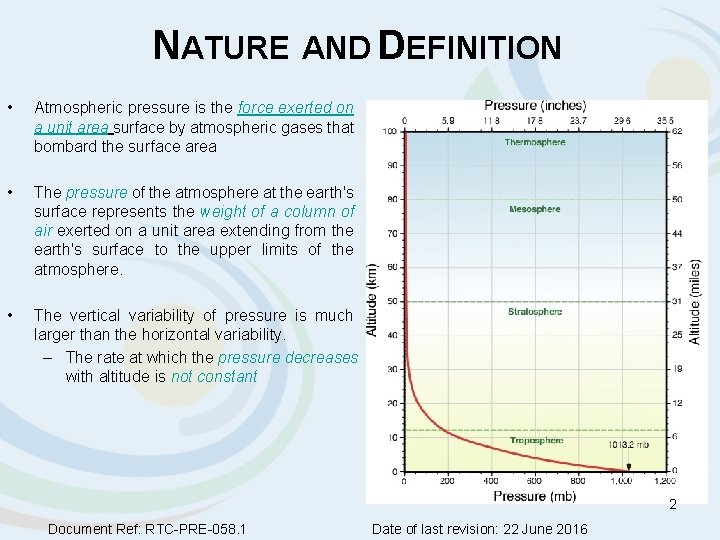
NATURE AND DEFINITION • Atmospheric pressure is the force exerted on a unit area surface by atmospheric gases that bombard the surface area • The pressure of the atmosphere at the earth's surface represents the weight of a column of air exerted on a unit area extending from the earth's surface to the upper limits of the atmosphere. • The vertical variability of pressure is much larger than the horizontal variability. – The rate at which the pressure decreases with altitude is not constant 2 Document Ref: RTC-PRE-058. 1 Date of last revision: 22 June 2016
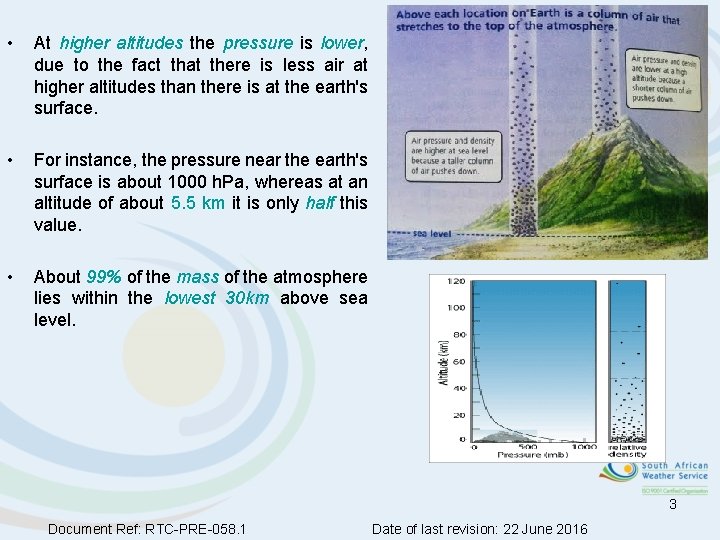
• At higher altitudes the pressure is lower, due to the fact that there is less air at higher altitudes than there is at the earth's surface. • For instance, the pressure near the earth's surface is about 1000 h. Pa, whereas at an altitude of about 5. 5 km it is only half this value. • About 99% of the mass of the atmosphere lies within the lowest 30 km above sea level. 3 Document Ref: RTC-PRE-058. 1 Date of last revision: 22 June 2016
• The density (i. e. the number of particles per volume) gradually decreases with height. • Air pressure differences lead to the wind flow of air from one place to another. • At MSL (Mean Sea Level), pressure would rise to 1013. 25 h. Pa and this is considered to be the standard mean sea level pressure. • It is worth noting that pressure to feet conversion would not be constant with an increasing or decreasing height. Under standard conditions • At MSL: 1 h. Pa = 30 ft • At 20000 ft: 1 h. Pa = 47 ft • At 40000 ft: 1 h. Pa = 98. 9 ft. 4 Document Ref: RTC-PRE-058. 1 Date of last revision: 22 June 2016
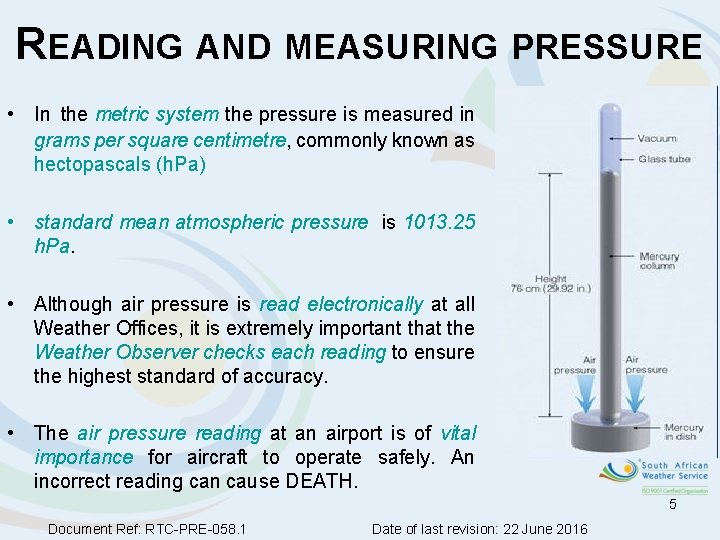
READING AND MEASURING PRESSURE • In the metric system the pressure is measured in grams per square centimetre, commonly known as hectopascals (h. Pa) • standard mean atmospheric pressure is 1013. 25 h. Pa. • Although air pressure is read electronically at all Weather Offices, it is extremely important that the Weather Observer checks each reading to ensure the highest standard of accuracy. • The air pressure reading at an airport is of vital importance for aircraft to operate safely. An incorrect reading can cause DEATH. 5 Document Ref: RTC-PRE-058. 1 Date of last revision: 22 June 2016
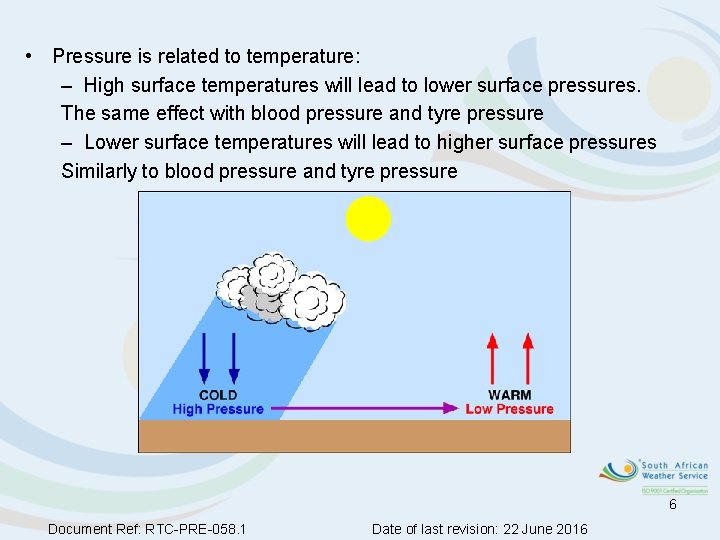
• Pressure is related to temperature: – High surface temperatures will lead to lower surface pressures. The same effect with blood pressure and tyre pressure – Lower surface temperatures will lead to higher surface pressures Similarly to blood pressure and tyre pressure 6 Document Ref: RTC-PRE-058. 1 Date of last revision: 22 June 2016
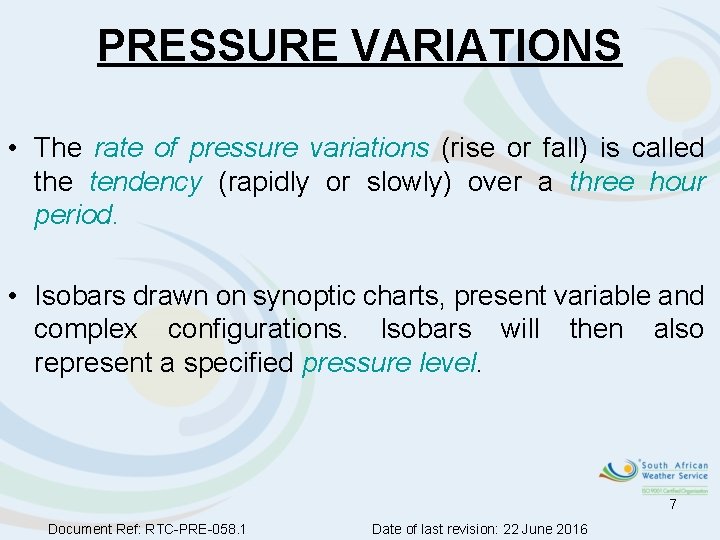
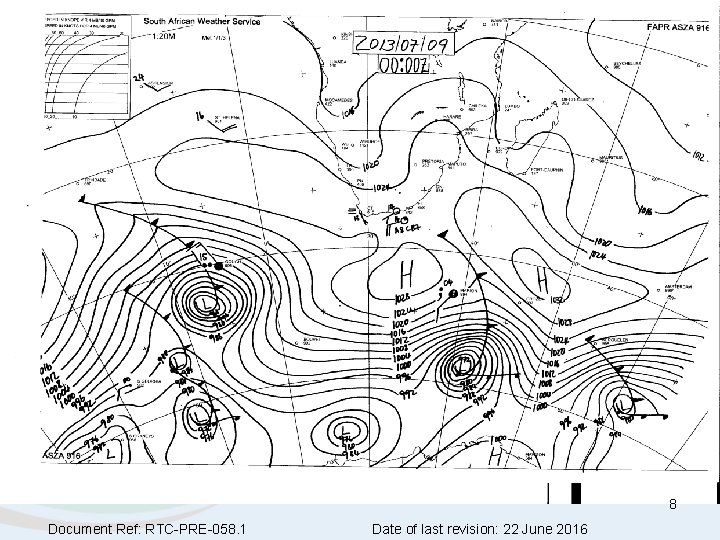
PRESSURE VARIATIONS • The rate of pressure variations (rise or fall) is called the tendency (rapidly or slowly) over a three hour period. • Isobars drawn on synoptic charts, present variable and complex configurations. Isobars will then also represent a specified pressure level. 7 Document Ref: RTC-PRE-058. 1 Date of last revision: 22 June 2016
8 Document Ref: RTC-PRE-058. 1 Date of last revision: 22 June 2016
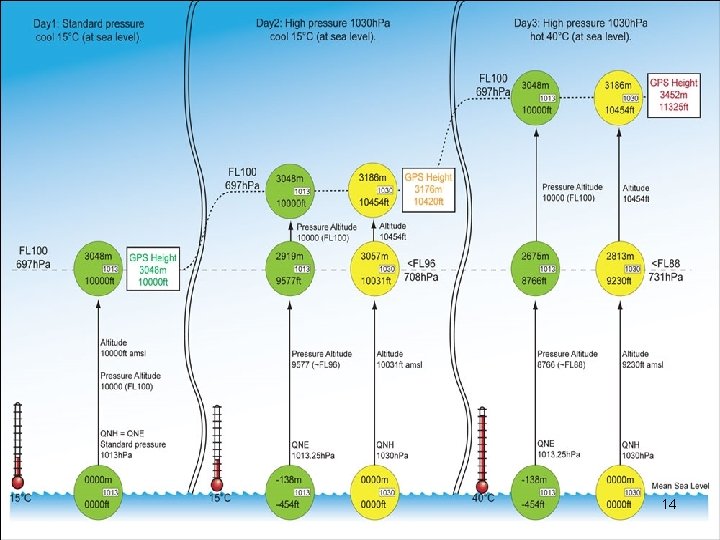
The Altitude of a Pressure Level • The actual altitude of a pressure level will vary due to changes in density (due to temperature difference) and changes in mean sea level pressure. Consider two columns of air, at different temperatures, but exerting the same pressure at the surface. . . • The cold air will have greater density than the warm air and will therefore occupy a smaller volume than the warm air. 9 Document Ref: RTC-PRE-058. 1 Date of last revision: 22 June 2016
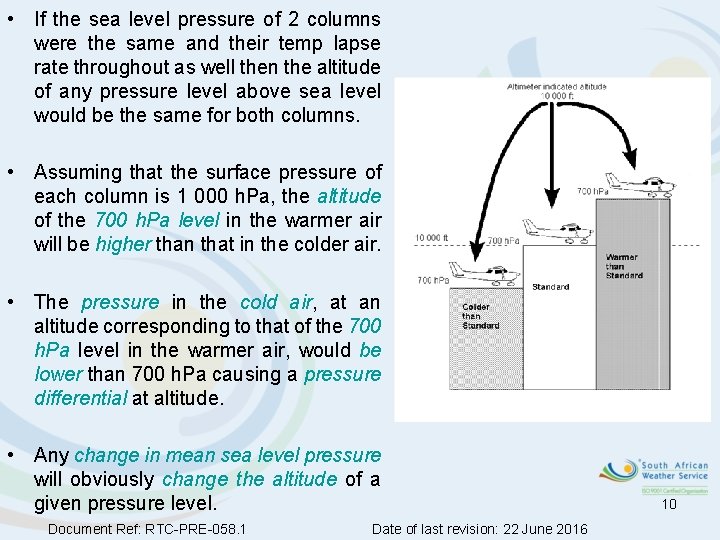
• If the sea level pressure of 2 columns were the same and their temp lapse rate throughout as well then the altitude of any pressure level above sea level would be the same for both columns. • Assuming that the surface pressure of each column is 1 000 h. Pa, the altitude of the 700 h. Pa level in the warmer air will be higher than that in the colder air. • The pressure in the cold air, at an altitude corresponding to that of the 700 h. Pa level in the warmer air, would be lower than 700 h. Pa causing a pressure differential at altitude. • Any change in mean sea level pressure will obviously change the altitude of a given pressure level. Document Ref: RTC-PRE-058. 1 Date of last revision: 22 June 2016 10
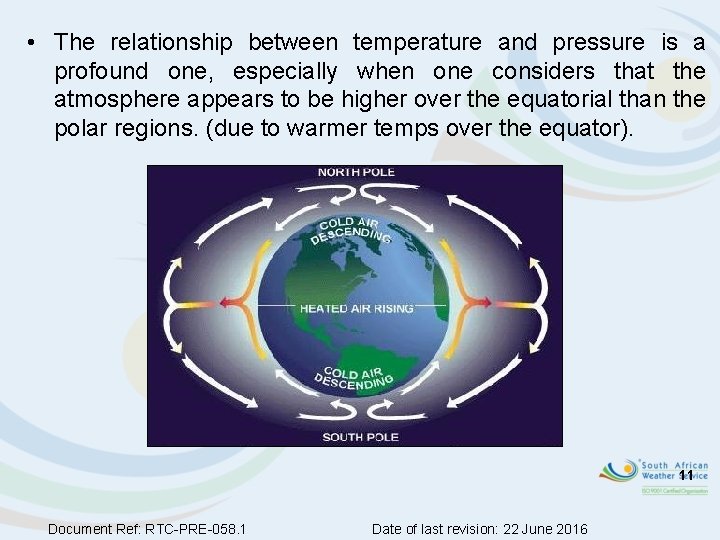
• The relationship between temperature and pressure is a profound one, especially when one considers that the atmosphere appears to be higher over the equatorial than the polar regions. (due to warmer temps over the equator). 11 Document Ref: RTC-PRE-058. 1 Date of last revision: 22 June 2016
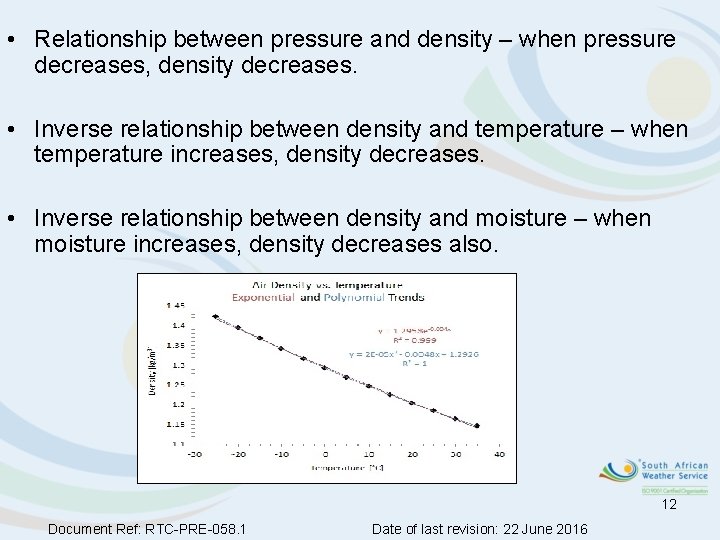
• Relationship between pressure and density – when pressure decreases, density decreases. • Inverse relationship between density and temperature – when temperature increases, density decreases. • Inverse relationship between density and moisture – when moisture increases, density decreases also. 12 Document Ref: RTC-PRE-058. 1 Date of last revision: 22 June 2016
CHANGES IN MEAN SEA LEVEL PRESSURE • Any changes in mean sea level pressure will change the altitude of a given pressure level. • Consider the scenario of an aircraft flying from A (1047 h. Pa) to B (1013 h. Pa) at FL 050 (840 h. Pa). • Point B will be 1020 ft lower than point A 13 Document Ref: RTC-PRE-058. 1 Date of last revision: 22 June 2016
14
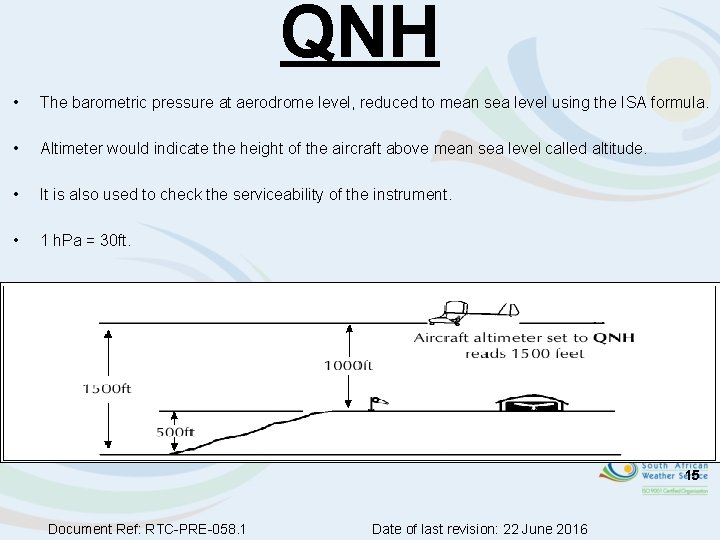
QNH • The barometric pressure at aerodrome level, reduced to mean sea level using the ISA formula. • Altimeter would indicate the height of the aircraft above mean sea level called altitude. • It is also used to check the serviceability of the instrument. • 1 h. Pa = 30 ft. 15 Document Ref: RTC-PRE-058. 1 Date of last revision: 22 June 2016
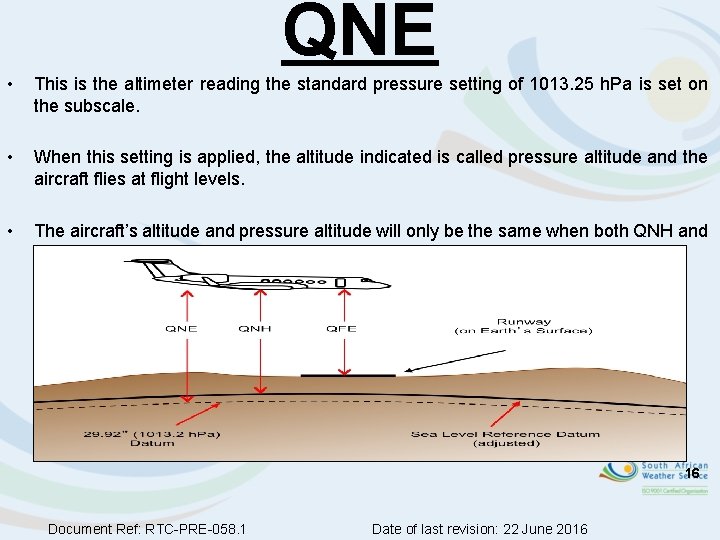
QNE • This is the altimeter reading the standard pressure setting of 1013. 25 h. Pa is set on the subscale. • When this setting is applied, the altitude indicated is called pressure altitude and the aircraft flies at flight levels. • The aircraft’s altitude and pressure altitude will only be the same when both QNH and QNE are 1013. 25 h. Pa. 16 Document Ref: RTC-PRE-058. 1 Date of last revision: 22 June 2016
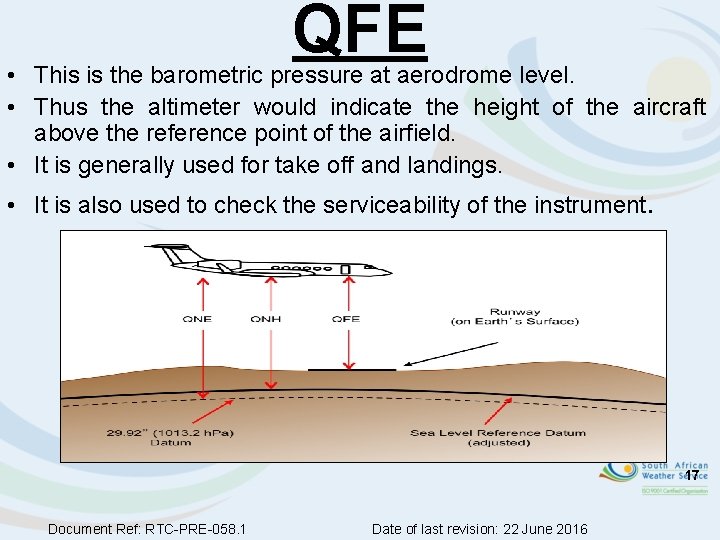
QFE • This is the barometric pressure at aerodrome level. • Thus the altimeter would indicate the height of the aircraft above the reference point of the airfield. • It is generally used for take off and landings. • It is also used to check the serviceability of the instrument. 17 Document Ref: RTC-PRE-058. 1 Date of last revision: 22 June 2016
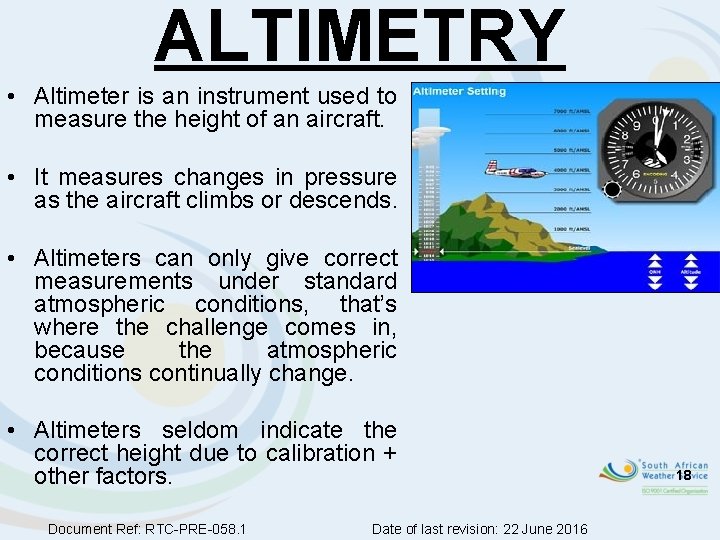
ALTIMETRY • Altimeter is an instrument used to measure the height of an aircraft. • It measures changes in pressure as the aircraft climbs or descends. • Altimeters can only give correct measurements under standard atmospheric conditions, that’s where the challenge comes in, because the atmospheric conditions continually change. • Altimeters seldom indicate the correct height due to calibration + other factors. Document Ref: RTC-PRE-058. 1 Date of last revision: 22 June 2016 18
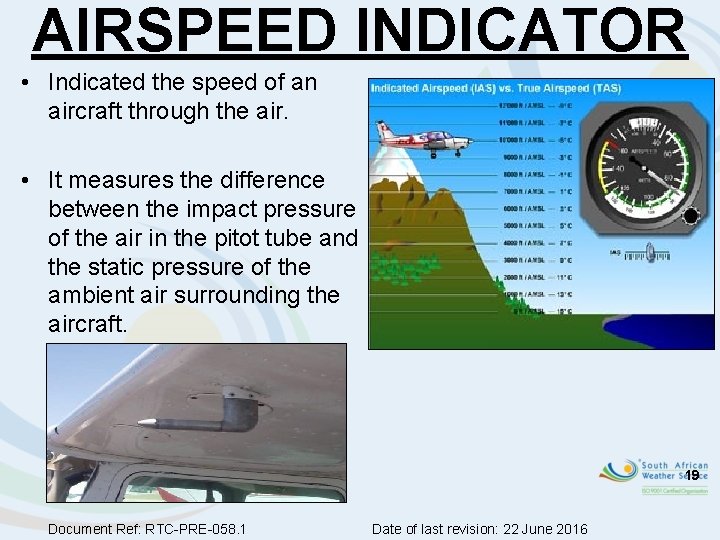
AIRSPEED INDICATOR • Indicated the speed of an aircraft through the air. • It measures the difference between the impact pressure of the air in the pitot tube and the static pressure of the ambient air surrounding the aircraft. 19 Document Ref: RTC-PRE-058. 1 Date of last revision: 22 June 2016
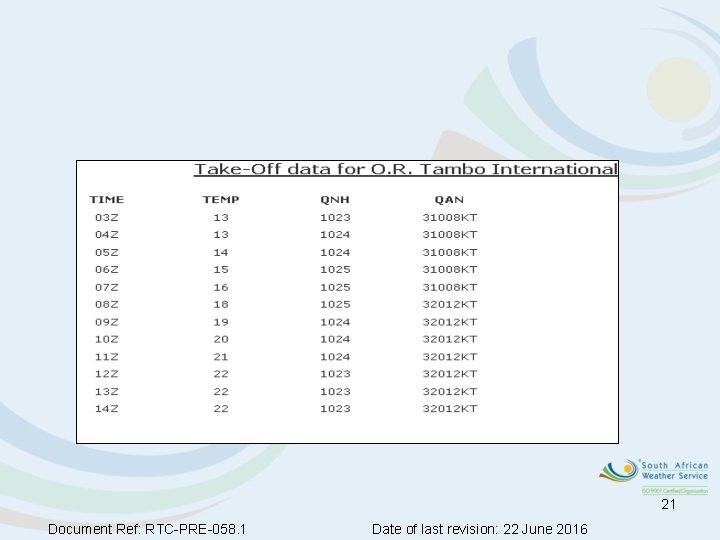
Take-off Forecasts • Take-off forecasts contains information on expected conditions over the runway complex with regard to temperature, wind variations and pressure (QNH) and other elements, as agreed locally. • It is supplied on request to operators and flight crew members within the 3 hours before the expected time of departure. 20 Document Ref: RTC-PRE-058. 1 Date of last revision: 22 June 2016
21 Document Ref: RTC-PRE-058. 1 Date of last revision: 22 June 2016

Thank you 22 Document Ref: RTC-PRE-058. 1 Date of last revision: 22 June 2016
- Slides: 22