
Atmospheric Neutrino Event Reconstruction Andy Blake Cambridge University
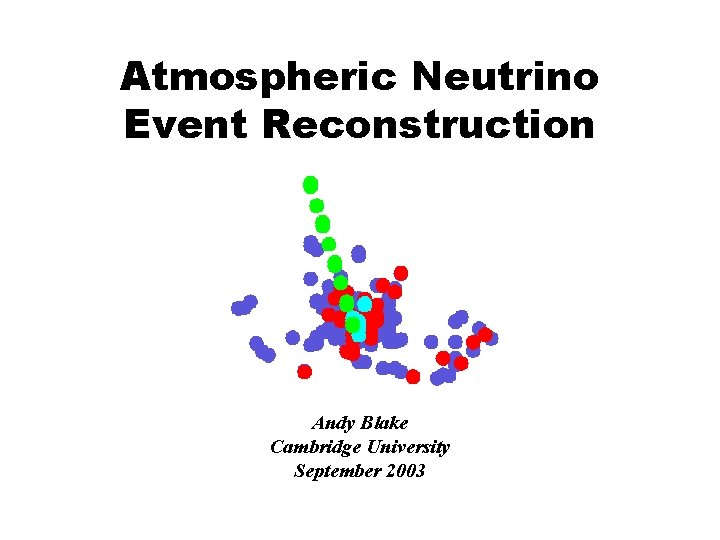
Atmospheric Neutrino Event Reconstruction Andy Blake Cambridge University September 2003
Introduction • Cambridge reconstruction software development is ongoing. • New version of At. Nu. Reco now in CVS. • At. Nu. Reco is a track + shower reconstruction package developed for use in atmos neutrino analysis. • tracks + showers reconstructed concurrently. • This talk presents a study of atmos neutrino reconstruction and separation.
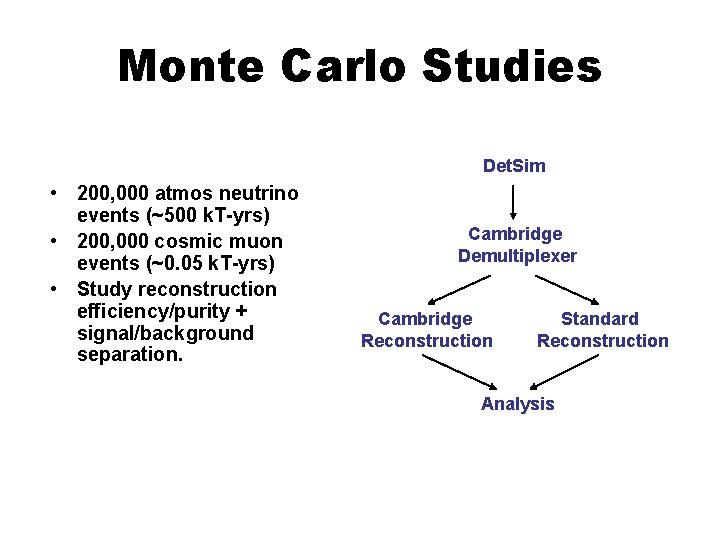
Monte Carlo Studies Det. Sim • 200, 000 atmos neutrino events (~500 k. T-yrs) • 200, 000 cosmic muon events (~0. 05 k. T-yrs) • Study reconstruction efficiency/purity + signal/background separation. Cambridge Demultiplexer Cambridge Reconstruction Standard Reconstruction Analysis
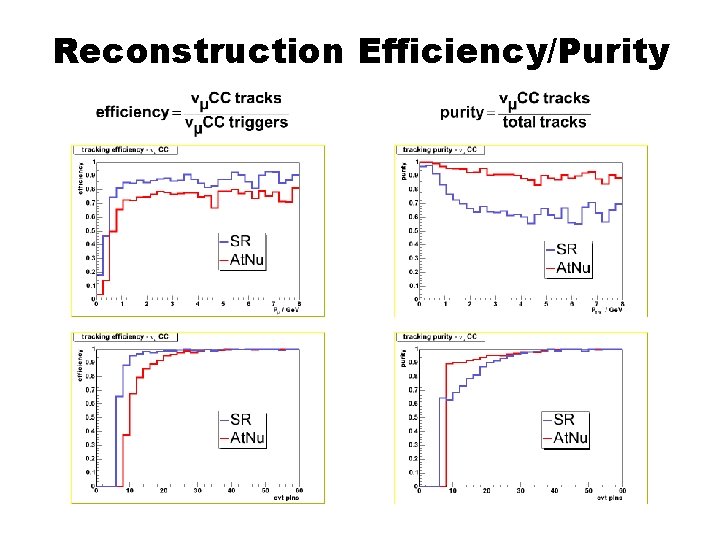
Reconstruction Efficiency/Purity
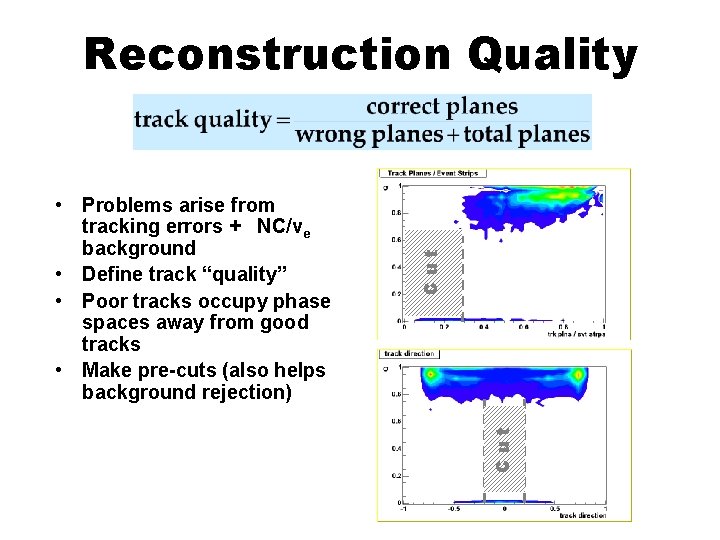
Cut • Problems arise from tracking errors + NC/νe background • Define track “quality” • Poor tracks occupy phase spaces away from good tracks • Make pre-cuts (also helps background rejection) Cut Reconstruction Quality

Efficiency/Purity after Pre-cuts efficiency purity
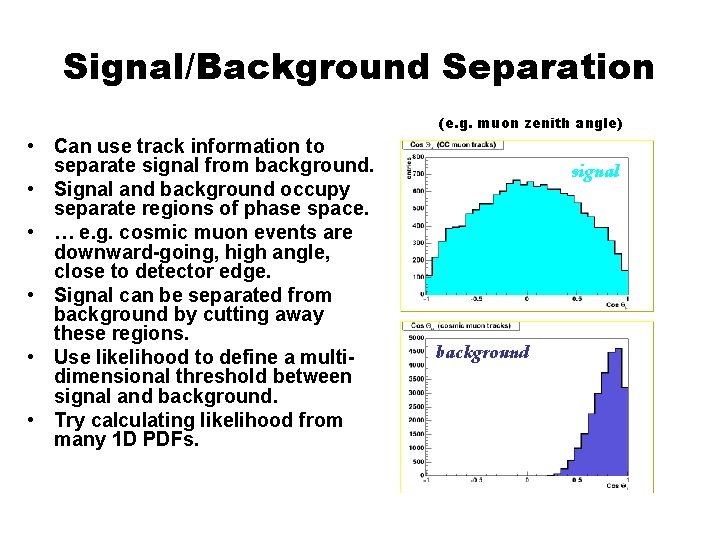
Signal/Background Separation (e. g. muon zenith angle) • Can use track information to separate signal from background. • Signal and background occupy separate regions of phase space. • … e. g. cosmic muon events are downward-going, high angle, close to detector edge. • Signal can be separated from background by cutting away these regions. • Use likelihood to define a multidimensional threshold between signal and background. • Try calculating likelihood from many 1 D PDFs. signal background
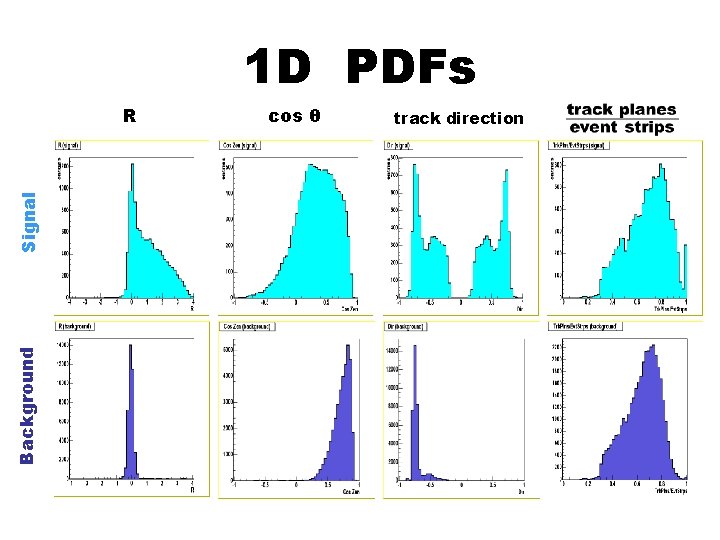
1 D PDFs Background Signal R cos θ track direction
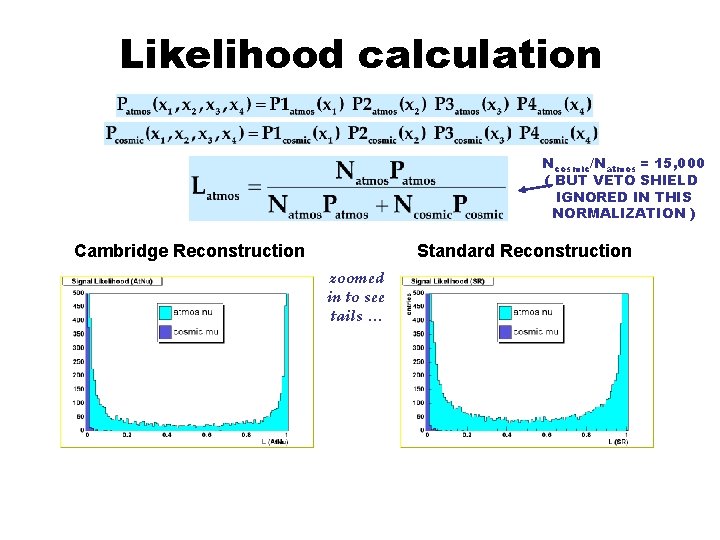
Likelihood calculation Ncosmic/Natmos = 15, 000 ( BUT VETO SHIELD IGNORED IN THIS NORMALIZATION ) Cambridge Reconstruction Standard Reconstruction zoomed in to see tails …
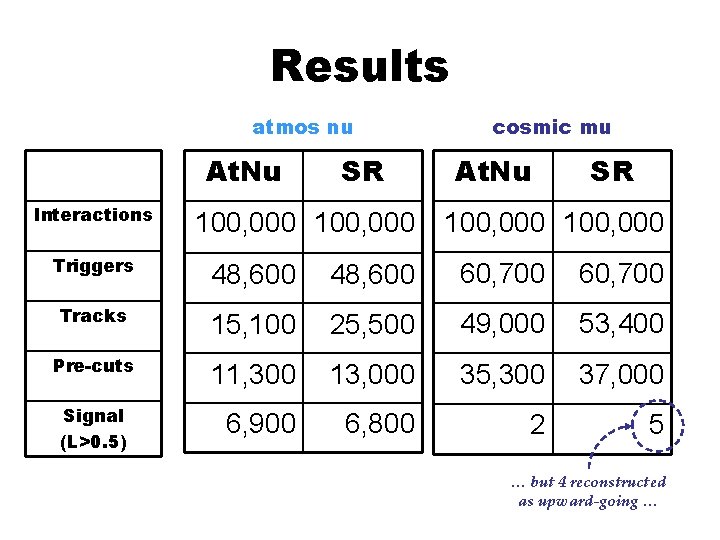
Results atmos nu At. Nu Interactions SR 100, 000 cosmic mu At. Nu SR 100, 000 Triggers 48, 600 60, 700 Tracks 15, 100 25, 500 49, 000 53, 400 Pre-cuts 11, 300 13, 000 35, 300 37, 000 6, 900 6, 800 2 5 Signal (L>0. 5) … but 4 reconstructed as upward-going …
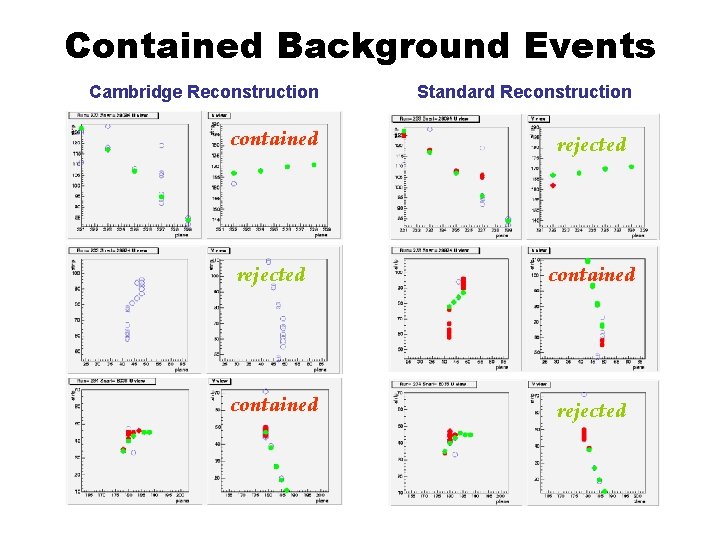
Contained Background Events Cambridge Reconstruction Standard Reconstruction contained rejected
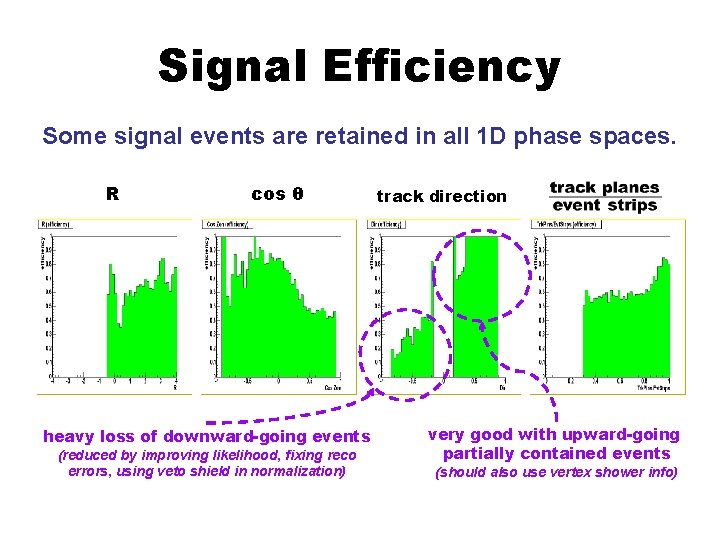
Signal Efficiency Some signal events are retained in all 1 D phase spaces. R cos θ heavy loss of downward-going events (reduced by improving likelihood, fixing reco errors, using veto shield in normalization) track direction very good with upward-going partially contained events (should also use vertex shower info)
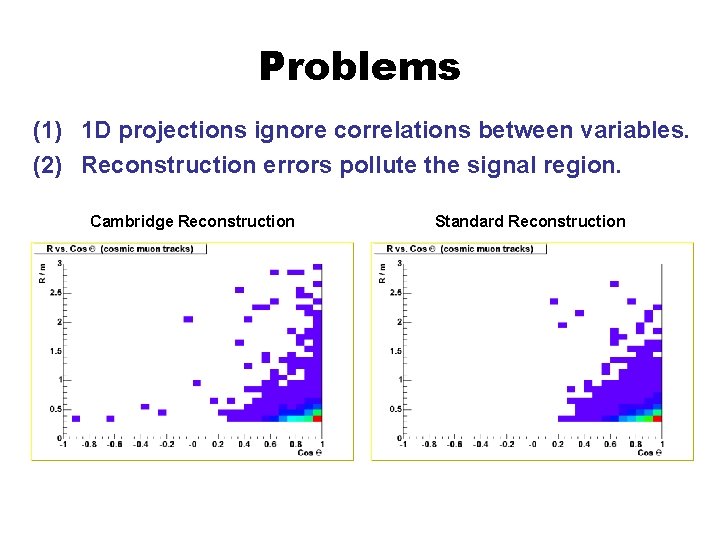
Problems (1) 1 D projections ignore correlations between variables. (2) Reconstruction errors pollute the signal region. Cambridge Reconstruction Standard Reconstruction
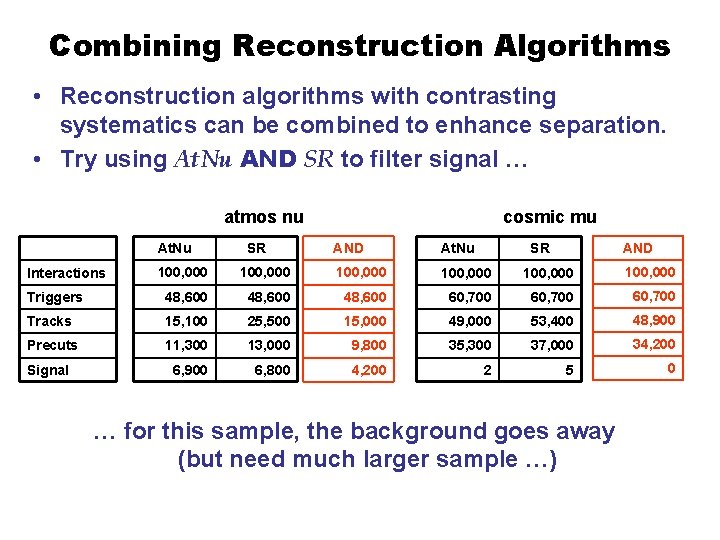
Combining Reconstruction Algorithms • Reconstruction algorithms with contrasting systematics can be combined to enhance separation. • Try using At. Nu AND SR to filter signal … atmos nu At. Nu SR cosmic mu AND At. Nu SR AND 100, 000 100, 000 Triggers 48, 600 60, 700 Tracks 15, 100 25, 500 15, 000 49, 000 53, 400 48, 900 Precuts 11, 300 13, 000 9, 800 35, 300 37, 000 34, 200 6, 900 6, 800 4, 200 2 5 0 Interactions Signal … for this sample, the background goes away (but need much larger sample …)
Conclusion • Cambridge reconstruction effort continuing. • Signal separation could be carried out using likelihood techniques but … (i) need better likelihood functions. (ii) need improved reconstruction. • Particularly promising for upward-going partially contained events. • Reconstruction algorithms could be combined to improve background rejection. • So much for Monte Carlo studies … … time to tackle the data too!
- Slides: 15