
Atmospheric modelling activities inside the Danish AMAP program
- Slides: 22
Atmospheric modelling activities inside the Danish AMAP program Jesper H. Christensen NERI-ATMI, Frederiksborgvej 399 4000 Roskilde
The Danish Eulerian Hemispheric Model (DEHM) System • The model work is financially supported by the Danish Environmental Protection Agency with means from the MIKA/DANCEA funds for Environmental Support to the Arctic Region • It is a part of the Danish contribution to the international AMAP programme • Purpose: Study the long-range transport in the troposphere of pollutants into the Arctic • Developed since 1990. In the beginning only for Sulphur, later Lead and now also with a full photochemical scheme and Mercury.
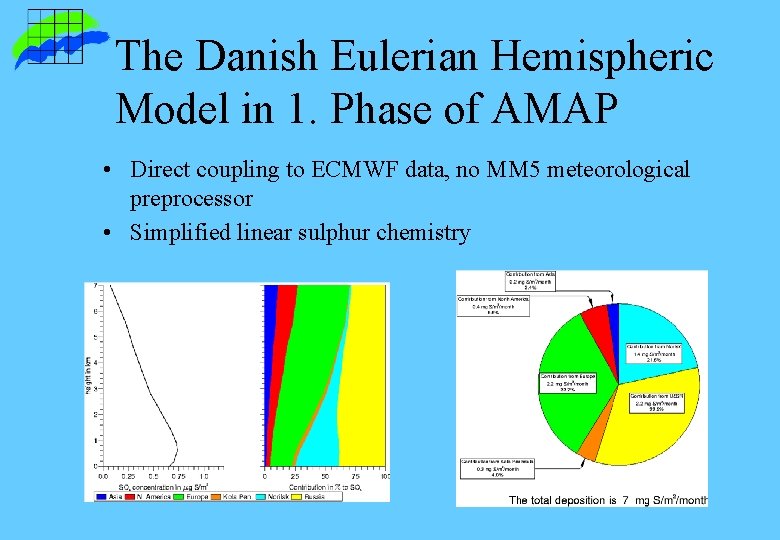
The Danish Eulerian Hemispheric Model in 1. Phase of AMAP • Direct coupling to ECMWF data, no MM 5 meteorological preprocessor • Simplified linear sulphur chemistry
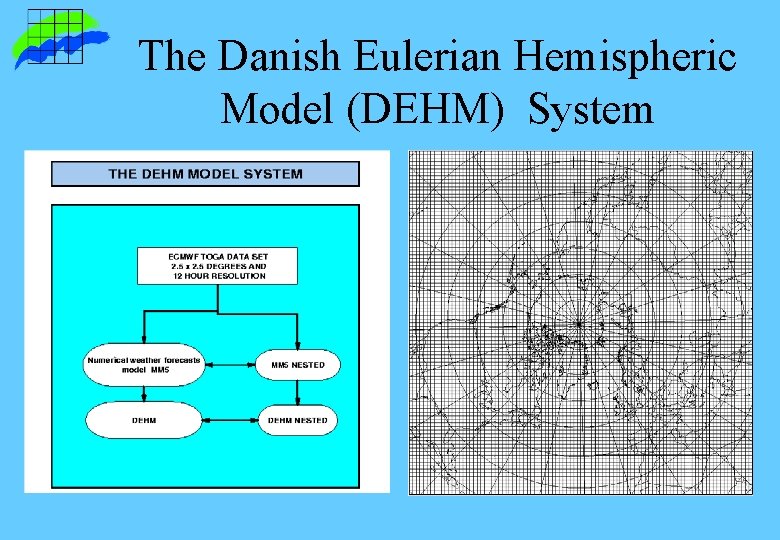
The Danish Eulerian Hemispheric Model (DEHM) System
MM 5 model • Hydrostatisk version (version 2) • 150 km resolution at 60° N, 50 km for nested domain • 97 x 97 horizontal grid-points (for mother domain and 100 x 100 horizontal gridpoints for nested domain) and 20 vertical layers • Mixed Phase (Reisner) explicit moisture • Betts-Miller cumulus parametrization • MRF boundary layer parametrization with 5 layer soil model • Cloud-radiation scheme
• Input data: Met data from ECMWF, 2. 5°x 2. 5° lat-lon, 12 hour resolution, 21 years data from 1979 to 2000 • Output every 3 hours • Only run for 1990 to 2000 for hemispheric domain and for 1995 and 1998 to 2000 for Europe (50 km) 1 month for Greenland (50 km) as demonstration
The Danish Eulerian Hemispheric Model • • Full three dimensional advection-diffusion equations 150 km grid resolution (Mother domain) 20 vertical levels up to 16 km Dry deposition based on the resistance method with 8 different surfaces • Wet deposition based on scavenging coefficients Numerical methods: • Horizontal advection: Accurate Space Derivatives with nonperiodic boundary conditions and 2 -way nesting capabilities • Vertical advection: Finite Elements • Diffusion: Finite Elements
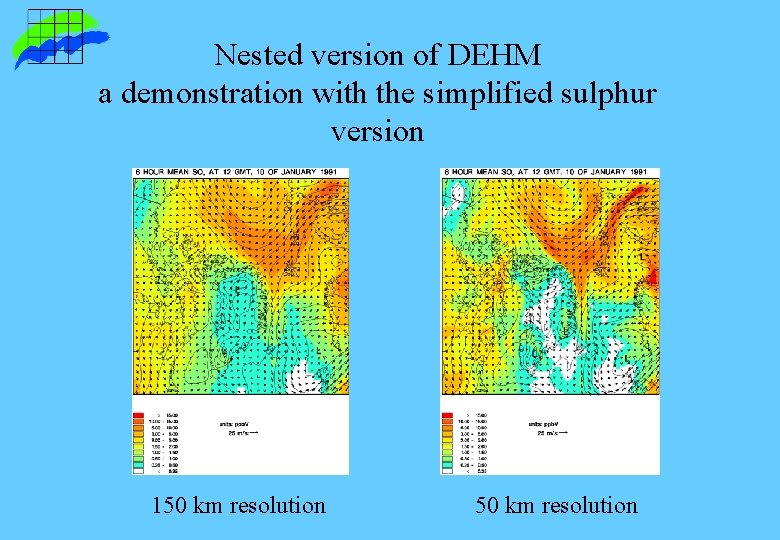
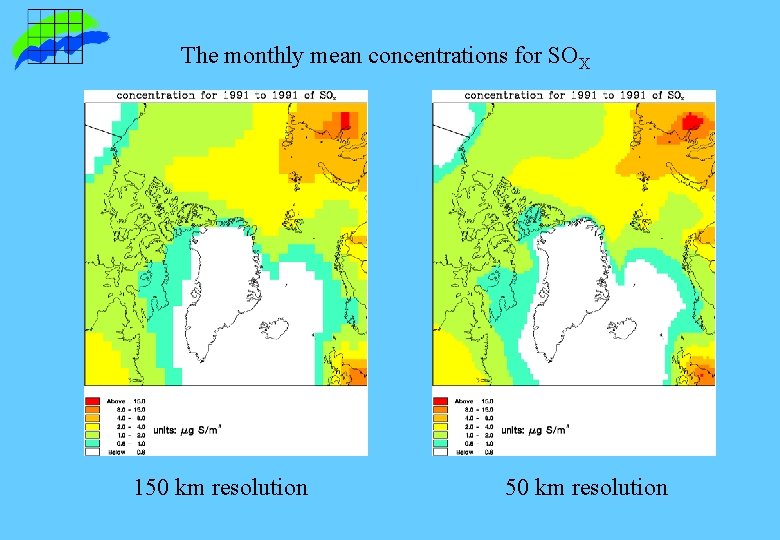
Nested version of DEHM a demonstration with the simplified sulphur version 150 km resolution
The monthly mean concentrations for SOX 150 km resolution
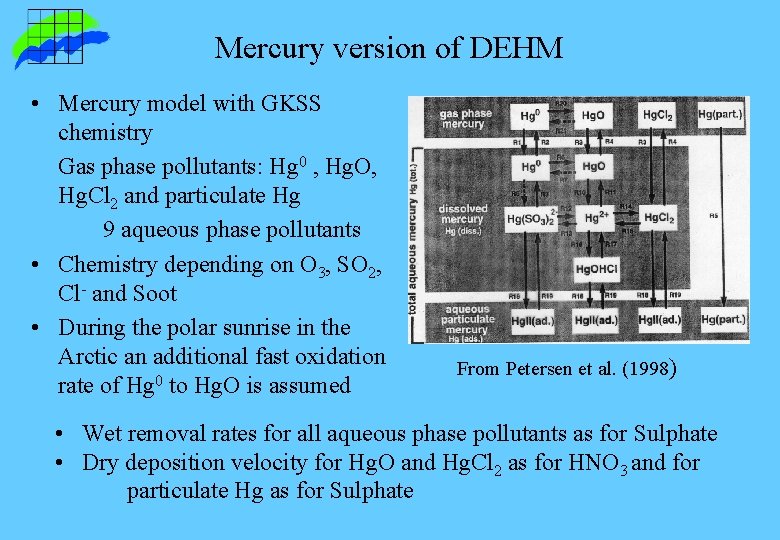
Mercury version of DEHM • Mercury model with GKSS chemistry Gas phase pollutants: Hg 0 , Hg. O, Hg. Cl 2 and particulate Hg 9 aqueous phase pollutants • Chemistry depending on O 3, SO 2, Cl- and Soot • During the polar sunrise in the Arctic an additional fast oxidation rate of Hg 0 to Hg. O is assumed From Petersen et al. (1998) • Wet removal rates for all aqueous phase pollutants as for Sulphate • Dry deposition velocity for Hg. O and Hg. Cl 2 as for HNO 3 and for particulate Hg as for Sulphate
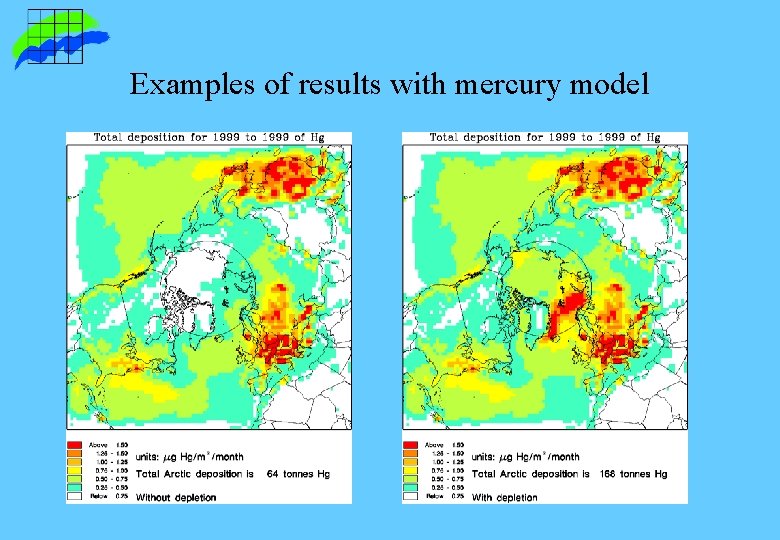
Examples of results with mercury model
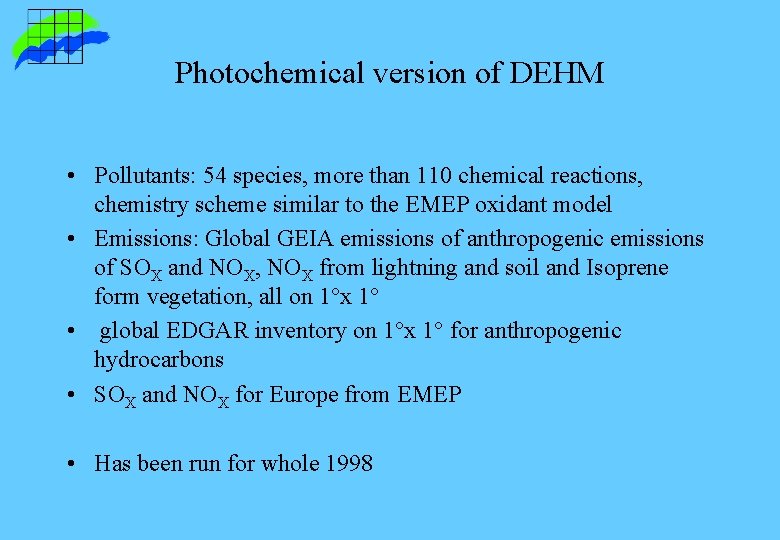
Photochemical version of DEHM • Pollutants: 54 species, more than 110 chemical reactions, chemistry scheme similar to the EMEP oxidant model • Emissions: Global GEIA emissions of anthropogenic emissions of SOX and NOX, NOX from lightning and soil and Isoprene form vegetation, all on 1°x 1° • global EDGAR inventory on 1°x 1° for anthropogenic hydrocarbons • SOX and NOX for Europe from EMEP • Has been run for whole 1998
Purpose with the photochemical version • Improvement of the parameterization of the chemistry compared to the simple sulfur model • Provided necessary input concentrations for the Mercury model • Be a useful contribution for the understanding of the atmospheric chemistry in the Arctic, especially during the Polar Sunrise in connection with field measurements • Provided necessary hemispheric background concentrations for the regional models, e. g. for Europe
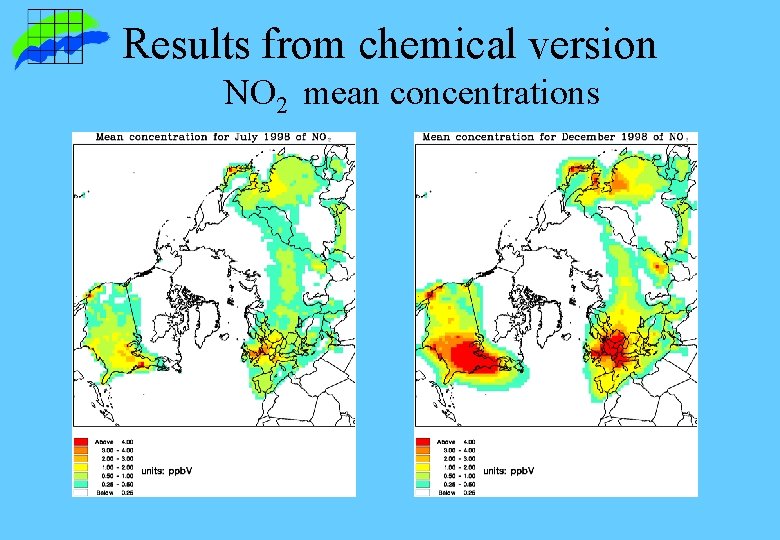
Results from chemical version NO 2 mean concentrations
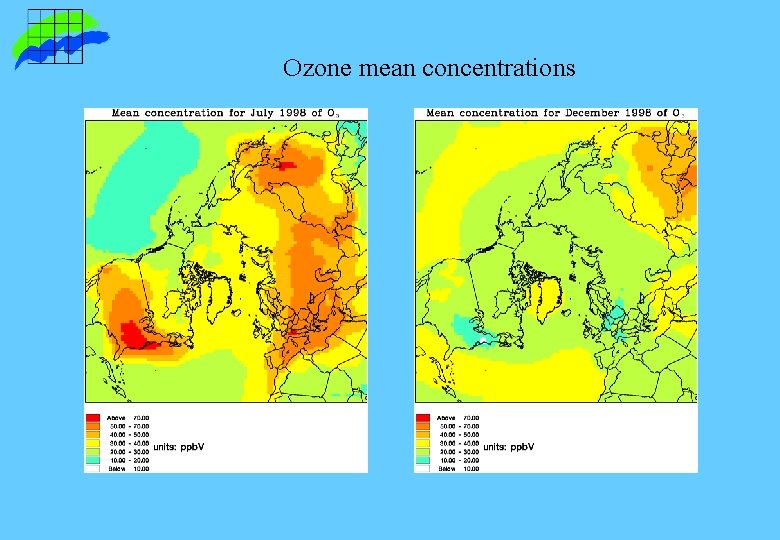
Ozone mean concentrations
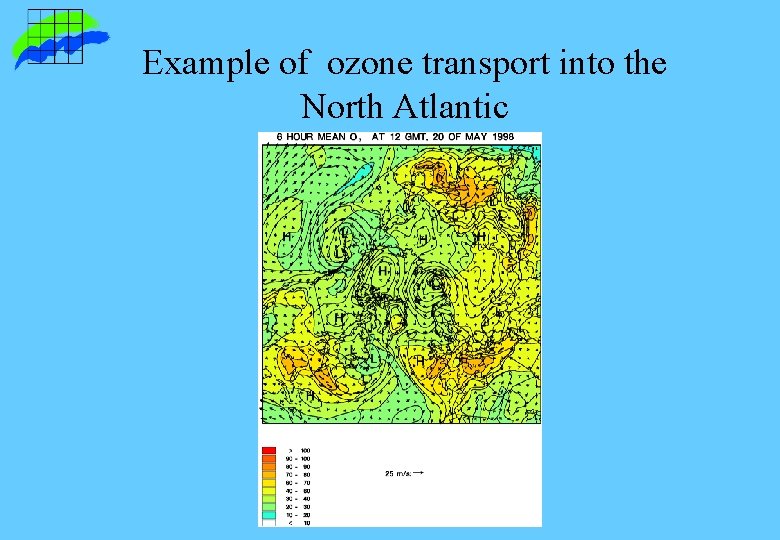
Example of ozone transport into the North Atlantic
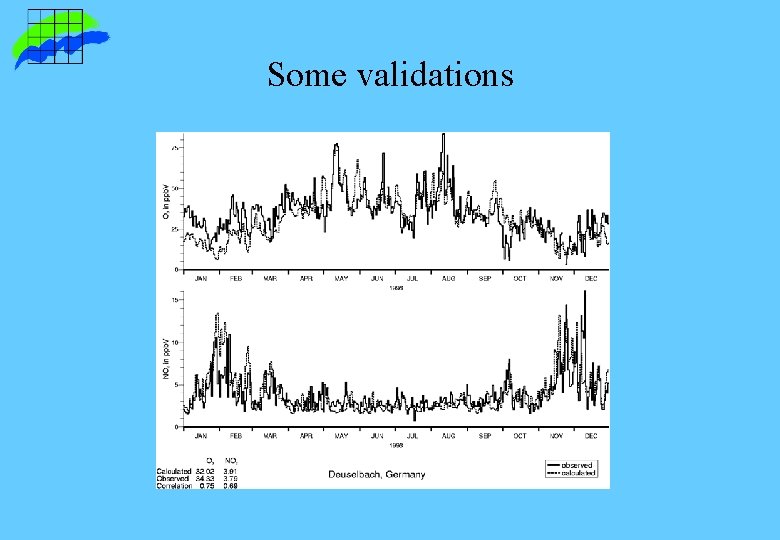
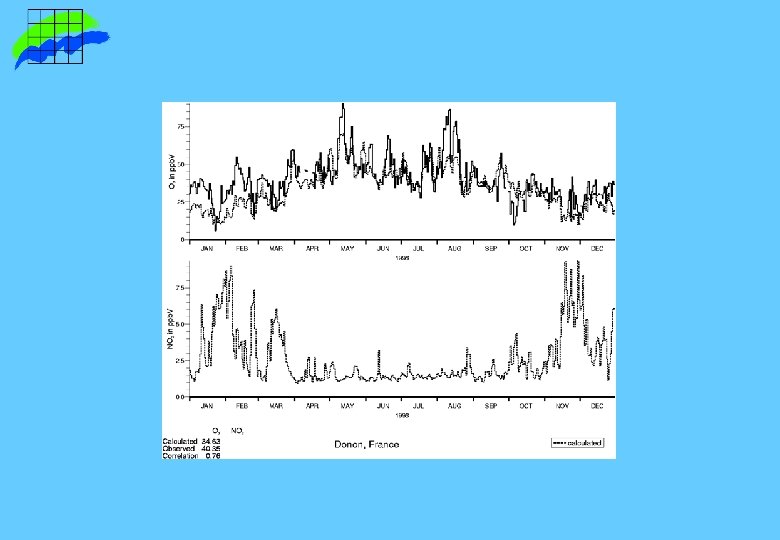
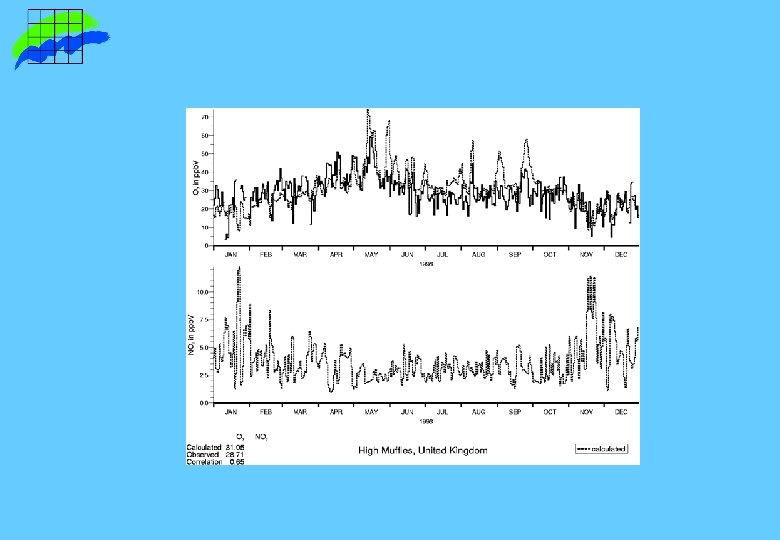
Some validations
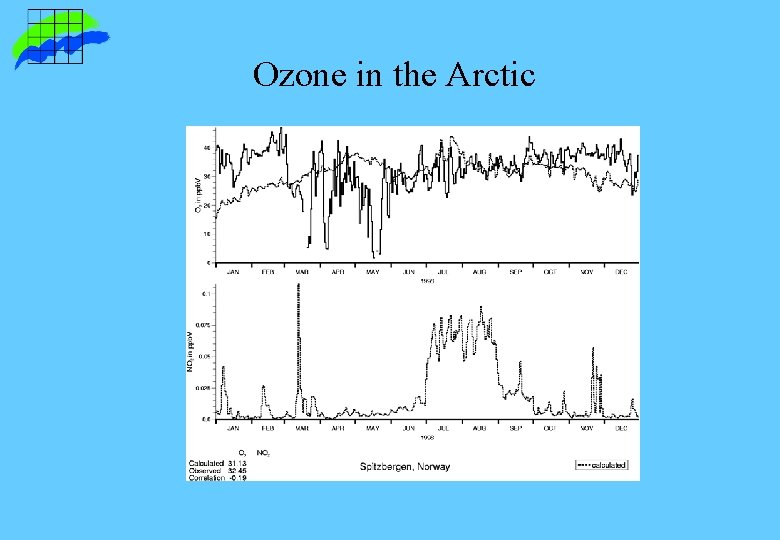
Ozone in the Arctic
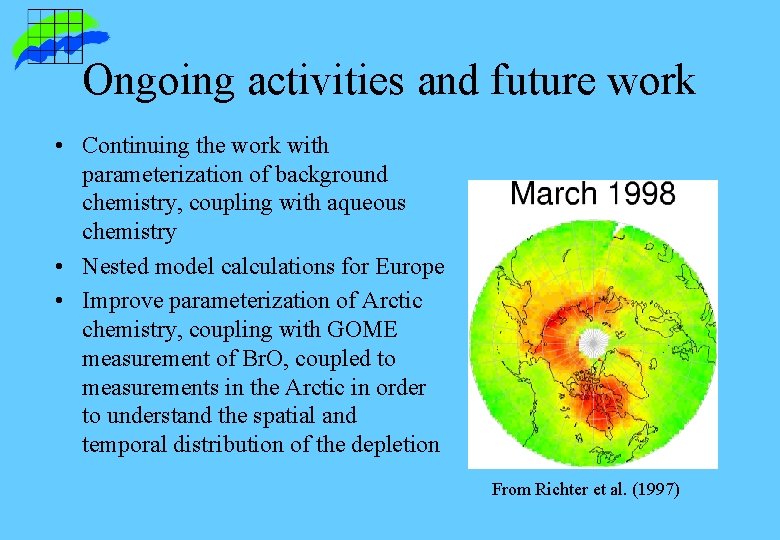
Ongoing activities and future work • Continuing the work with parameterization of background chemistry, coupling with aqueous chemistry • Nested model calculations for Europe • Improve parameterization of Arctic chemistry, coupling with GOME measurement of Br. O, coupled to measurements in the Arctic in order to understand the spatial and temporal distribution of the depletion From Richter et al. (1997)
ACKNOWLEDGEMENTS The model work is financially supported by the Danish Environmental Protection Agency with means from the MIKA/DANCEA funds for Environmental Support to the Arctic Region