
Atmospheric Methane Distribution and Trends Impacts on Climate
Atmospheric Methane Distribution and Trends: Impacts on Climate and Ozone Air Quality Arlene M. Fiore Larry Horowitz (NOAA/GFDL) Jason West (Princeton) Ed Dlugokencky (NOAA/GMD) Earth, Atmospheric, and Planetary Sciences Department Seminar Massachusetts Institute of Technology December 16, 2005
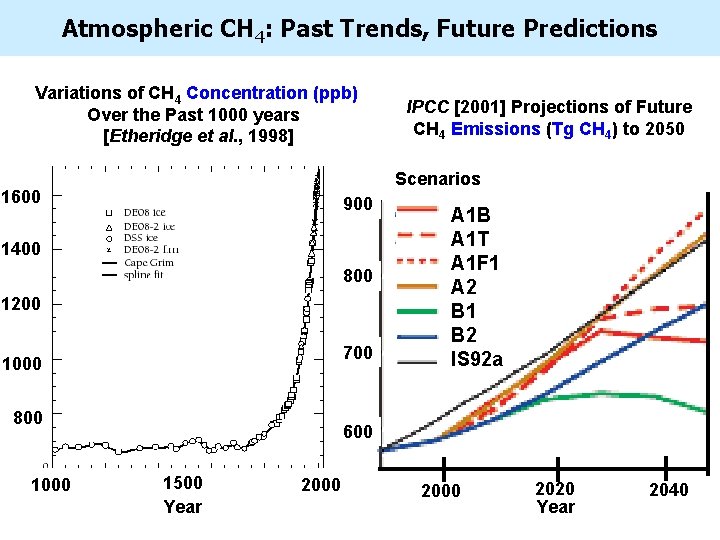
Atmospheric CH 4: Past Trends, Future Predictions Variations of CH 4 Concentration (ppb) Over the Past 1000 years [Etheridge et al. , 1998] Scenarios 1600 900 1400 800 1200 700 1000 800 1000 IPCC [2001] Projections of Future CH 4 Emissions (Tg CH 4) to 2050 A 1 B A 1 T A 1 F 1 A 2 B 1 B 2 IS 92 a 600 1500 Year 2000 2020 Year 2040
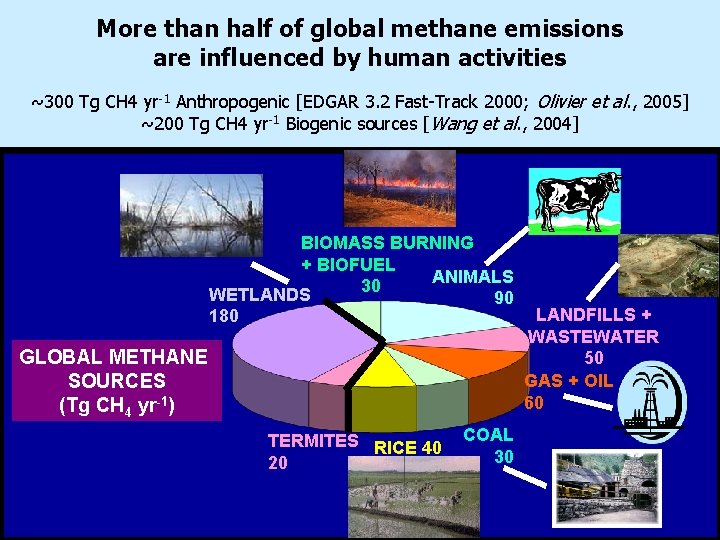
More than half of global methane emissions are influenced by human activities ~300 Tg CH 4 yr-1 Anthropogenic [EDGAR 3. 2 Fast-Track 2000; Olivier et al. , 2005] ~200 Tg CH 4 yr-1 Biogenic sources [Wang et al. , 2004] BIOMASS BURNING + BIOFUEL ANIMALS 30 WETLANDS 90 180 GLOBAL METHANE SOURCES (Tg CH 4 yr-1) TERMITES RICE 40 20 COAL 30 LANDFILLS + WASTEWATER 50 GAS + OIL 60
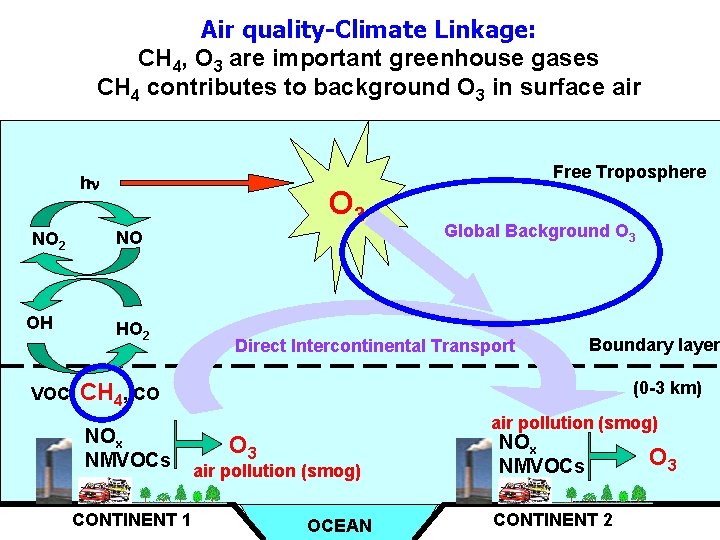
Air quality-Climate Linkage: CH 4, O 3 are important greenhouse gases CH 4 contributes to background O 3 in surface air Free Troposphere hn O 3 NO 2 NO OH HO 2 Global Background O 3 Direct Intercontinental Transport Boundary layer (0 -3 km) VOC, CH 4, CO NOx NMVOCs CONTINENT 1 air pollution (smog) O 3 air pollution (smog) OCEAN NOx NMVOCs CONTINENT 2 O 3
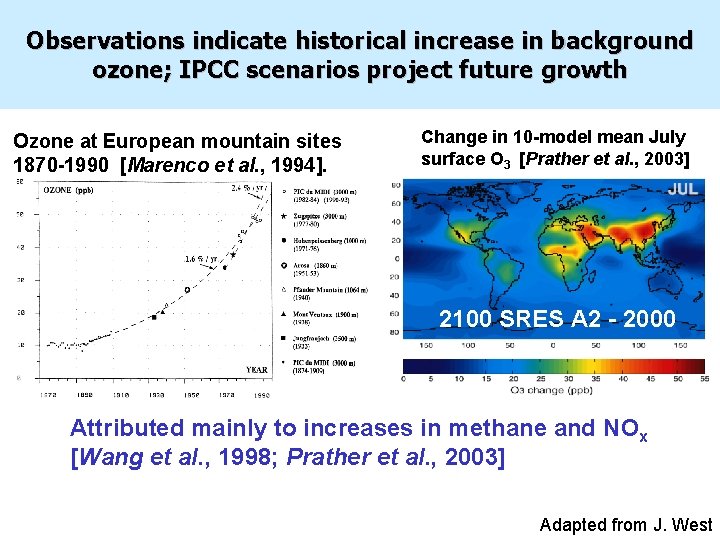
Observations indicate historical increase in background ozone; IPCC scenarios project future growth Ozone at European mountain sites 1870 -1990 [Marenco et al. , 1994]. Change in 10 -model mean July surface O 3 [Prather et al. , 2003] 2100 SRES A 2 - 2000 Attributed mainly to increases in methane and NOx [Wang et al. , 1998; Prather et al. , 2003] Adapted from J. West
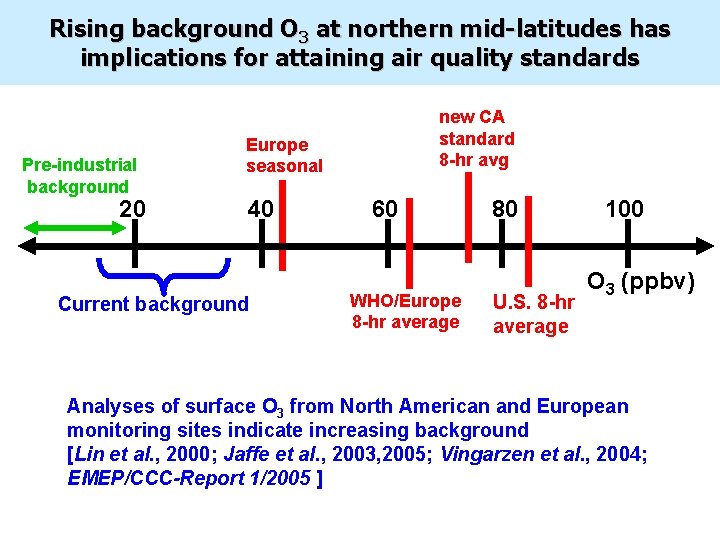
Rising background O 3 at northern mid-latitudes has implications for attaining air quality standards Pre-industrial background 20 new CA standard 8 -hr avg Europe seasonal 40 Current background 60 WHO/Europe 8 -hr average 80 U. S. 8 -hr average 100 O 3 (ppbv) Analyses of surface O 3 from North American and European monitoring sites indicate increasing background [Lin et al. , 2000; Jaffe et al. , 2003, 2005; Vingarzen et al. , 2004; EMEP/CCC-Report 1/2005 ]

Radiative Forcing of Climate from Preindustrial to Present: Important Contributions from Methane and Ozone Hansen, Scientific American, 2004
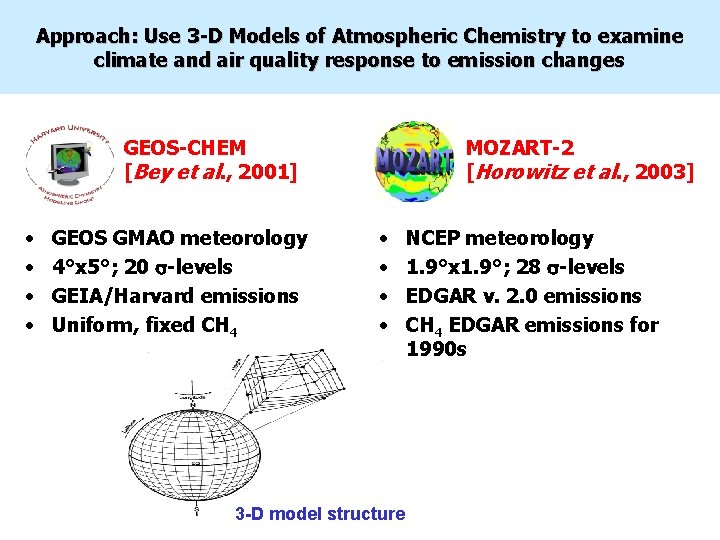
Approach: Use 3 -D Models of Atmospheric Chemistry to examine climate and air quality response to emission changes GEOS-CHEM [Bey et al. , 2001] • • GEOS GMAO meteorology 4°x 5°; 20 s-levels GEIA/Harvard emissions Uniform, fixed CH 4 MOZART-2 [Horowitz et al. , 2003] • • 3 -D model structure NCEP meteorology 1. 9°x 1. 9°; 28 s-levels EDGAR v. 2. 0 emissions CH 4 EDGAR emissions for 1990 s
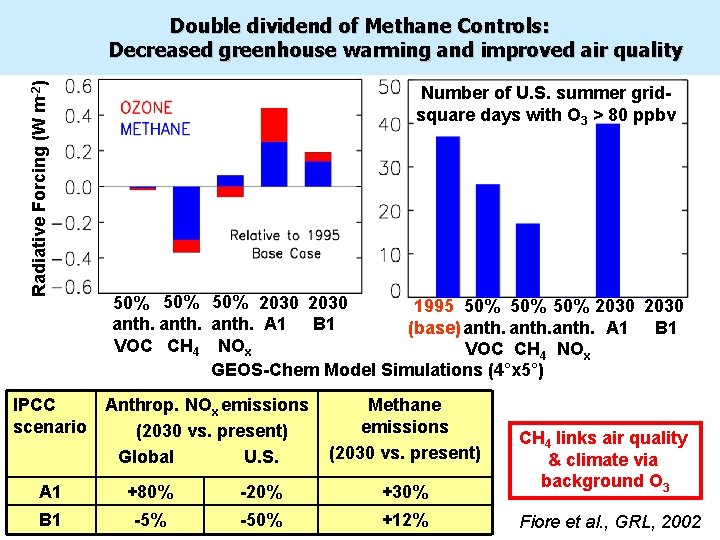
Radiative Forcing (W m-2) Double dividend of Methane Controls: Decreased greenhouse warming and improved air quality Number of U. S. summer gridsquare days with O 3 > 80 ppbv 50% 50% 2030 1995 50% 50% 2030 anth. A 1 B 1 (base) anth. A 1 B 1 VOC CH 4 NOx GEOS-Chem Model Simulations (4°x 5°) IPCC Anthrop. NOx emissions scenario (2030 vs. present) Global U. S. Methane emissions (2030 vs. present) A 1 +80% -20% +30% CH 4 links air quality & climate via background O 3 B 1 -5% -50% +12% Fiore et al. , GRL, 2002
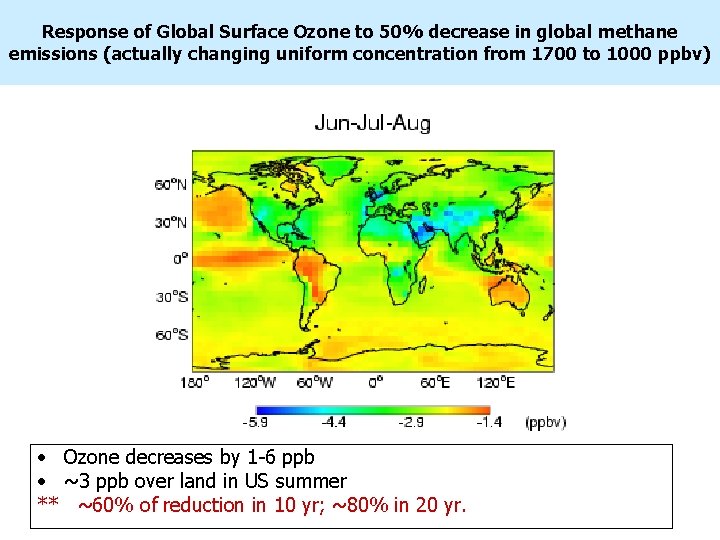
Response of Global Surface Ozone to 50% decrease in global methane emissions (actually changing uniform concentration from 1700 to 1000 ppbv) • Ozone decreases by 1 -6 ppb • ~3 ppb over land in US summer ** ~60% of reduction in 10 yr; ~80% in 20 yr.
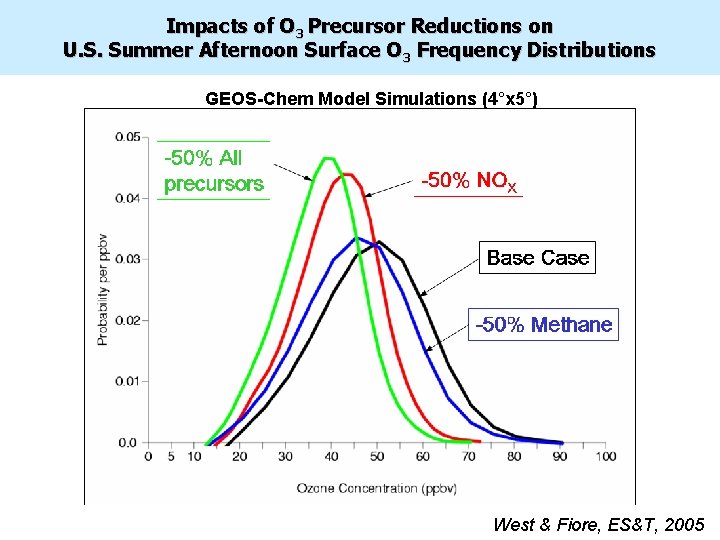
Impacts of O 3 Precursor Reductions on U. S. Summer Afternoon Surface O 3 Frequency Distributions GEOS-Chem Model Simulations (4°x 5°) West & Fiore, ES&T, 2005
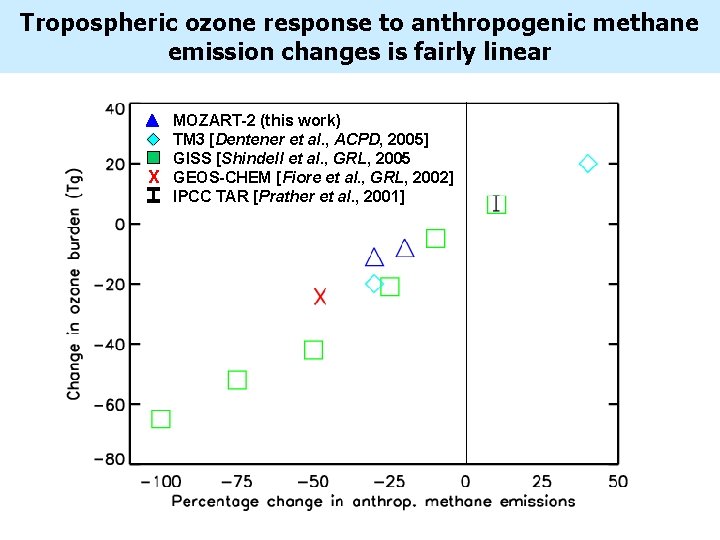
Tropospheric ozone response to anthropogenic methane emission changes is fairly linear MOZART-2 (this work) TM 3 [Dentener et al. , ACPD, 2005] GISS [Shindell et al. , GRL, 2005 X GEOS-CHEM [Fiore et al. , GRL, 2002] IPCC TAR [Prather et al. , 2001]
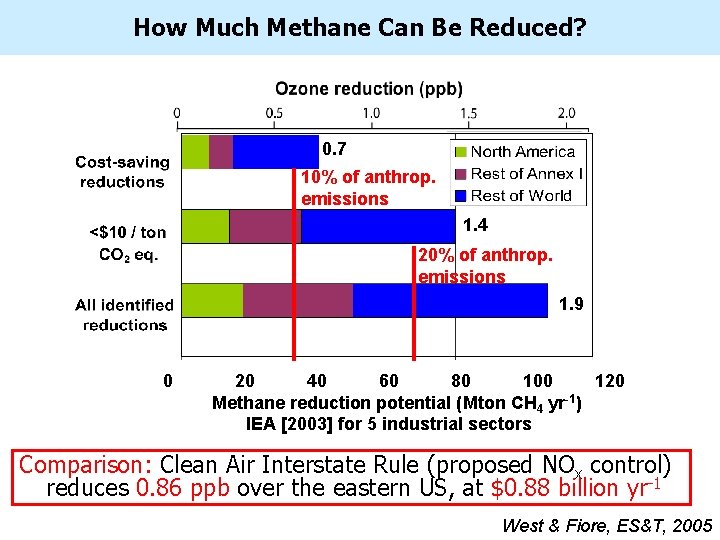
How Much Methane Can Be Reduced? 0. 7 10% of anthrop. emissions 1. 4 20% of anthrop. emissions 1. 9 0 20 40 60 80 100 120 Methane reduction potential (Mton CH 4 yr-1) IEA [2003] for 5 industrial sectors Comparison: Clean Air Interstate Rule (proposed NOx control) reduces 0. 86 ppb over the eastern US, at $0. 88 billion yr-1 West & Fiore, ES&T, 2005
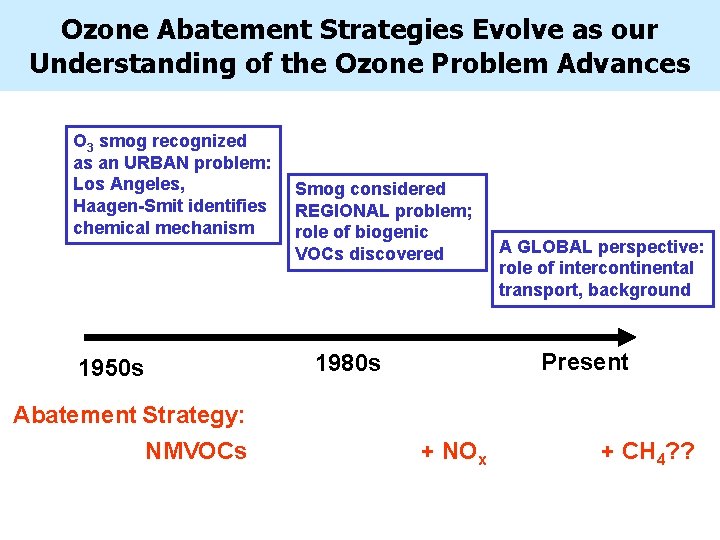
Ozone Abatement Strategies Evolve as our Understanding of the Ozone Problem Advances O 3 smog recognized as an URBAN problem: Los Angeles, Haagen-Smit identifies chemical mechanism 1950 s Abatement Strategy: NMVOCs Smog considered REGIONAL problem; role of biogenic VOCs discovered A GLOBAL perspective: role of intercontinental transport, background Present 1980 s + NOx + CH 4? ?
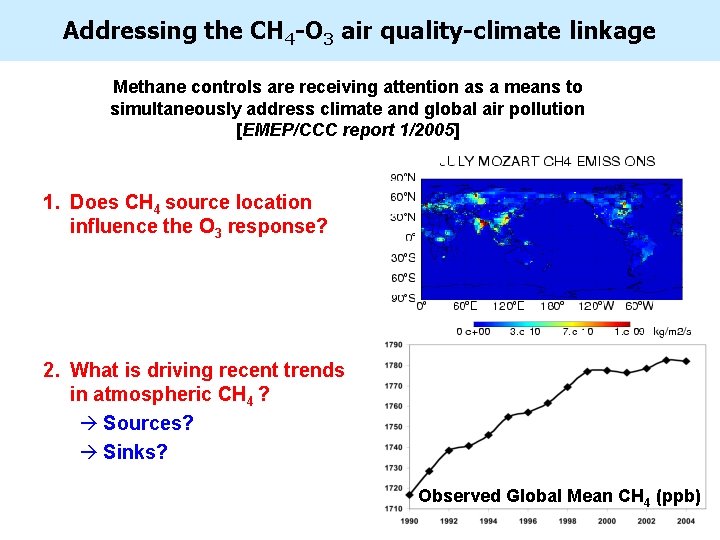
Addressing the CH 4 -O 3 air quality-climate linkage Methane controls are receiving attention as a means to simultaneously address climate and global air pollution [EMEP/CCC report 1/2005] 1. Does CH 4 source location influence the O 3 response? 2. What is driving recent trends in atmospheric CH 4 ? à Sources? à Sinks? Observed Global Mean CH 4 (ppb)
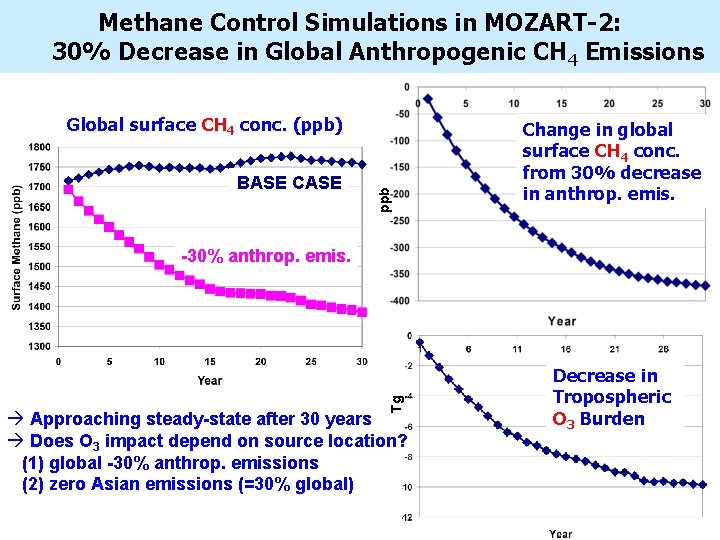
Methane Control Simulations in MOZART-2: 30% Decrease in Global Anthropogenic CH 4 Emissions BASE CASE ppb Global surface CH 4 conc. (ppb) Change in global surface CH 4 conc. from 30% decrease in anthrop. emis. Tg -30% anthrop. emis. à Approaching steady-state after 30 years à Does O 3 impact depend on source location? (1) global -30% anthrop. emissions (2) zero Asian emissions (=30% global) Decrease in Tropospheric O 3 Burden
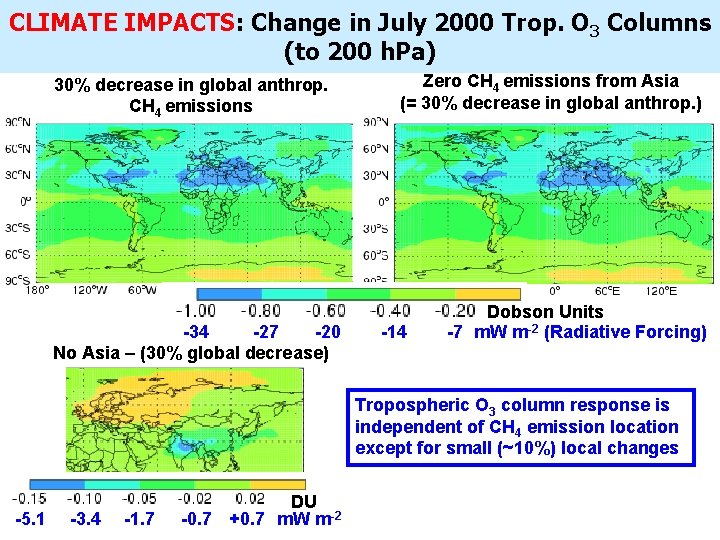
CLIMATE IMPACTS: Change in July 2000 Trop. O 3 Columns (to 200 h. Pa) 30% decrease in global anthrop. CH 4 emissions -34 -27 -20 No Asia – (30% global decrease) Zero CH 4 emissions from Asia (= 30% decrease in global anthrop. ) -14 Dobson Units -7 m. W m-2 (Radiative Forcing) Tropospheric O 3 column response is independent of CH 4 emission location except for small (~10%) local changes -5. 1 -3. 4 -1. 7 DU -0. 7 +0. 7 m. W m-2
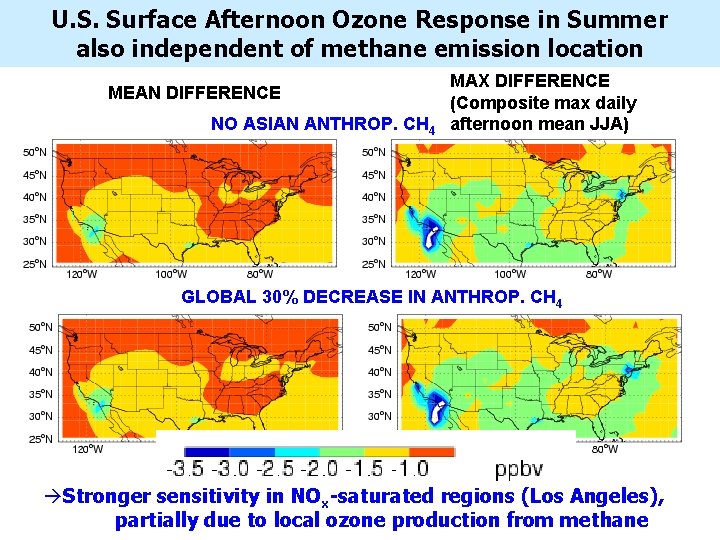
U. S. Surface Afternoon Ozone Response in Summer also independent of methane emission location MEAN DIFFERENCE NO ASIAN ANTHROP. CH 4 MAX DIFFERENCE (Composite max daily afternoon mean JJA) GLOBAL 30% DECREASE IN ANTHROP. CH 4 àStronger sensitivity in NOx-saturated regions (Los Angeles), partially due to local ozone production from methane
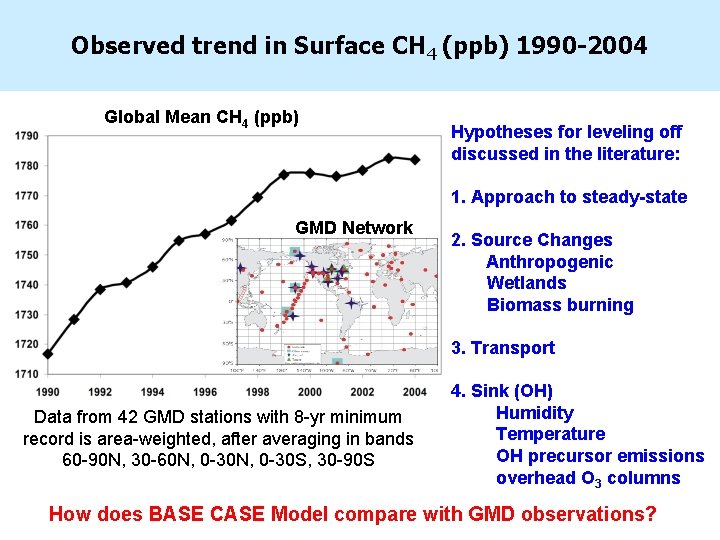
Observed trend in Surface CH 4 (ppb) 1990 -2004 Global Mean CH 4 (ppb) Hypotheses for leveling off discussed in the literature: 1. Approach to steady-state GMD Network 2. Source Changes Anthropogenic Wetlands Biomass burning 3. Transport Data from 42 GMD stations with 8 -yr minimum record is area-weighted, after averaging in bands 60 -90 N, 30 -60 N, 0 -30 S, 30 -90 S 4. Sink (OH) Humidity Temperature OH precursor emissions overhead O 3 columns How does BASE CASE Model compare with GMD observations?
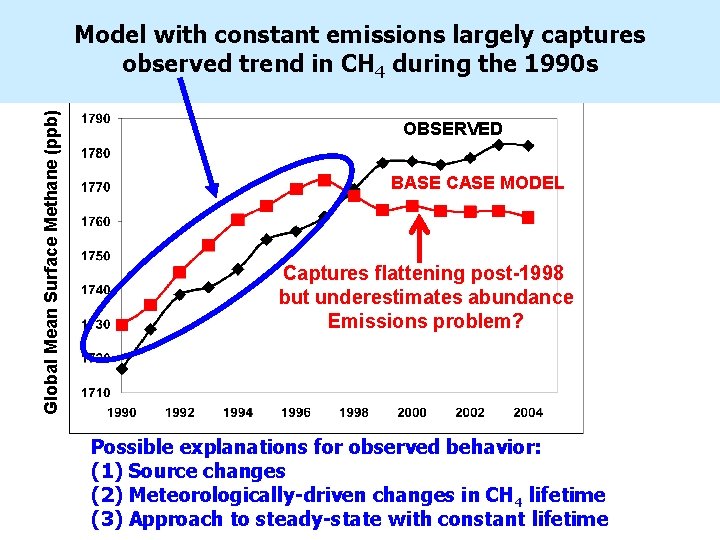
Global Mean Surface Methane (ppb) Model with constant emissions largely captures observed trend in CH 4 during the 1990 s OBSERVED BASE CASE MODEL Captures flattening post-1998 but underestimates abundance Emissions problem? Possible explanations for observed behavior: (1) Source changes (2) Meteorologically-driven changes in CH 4 lifetime (3) Approach to steady-state with constant lifetime
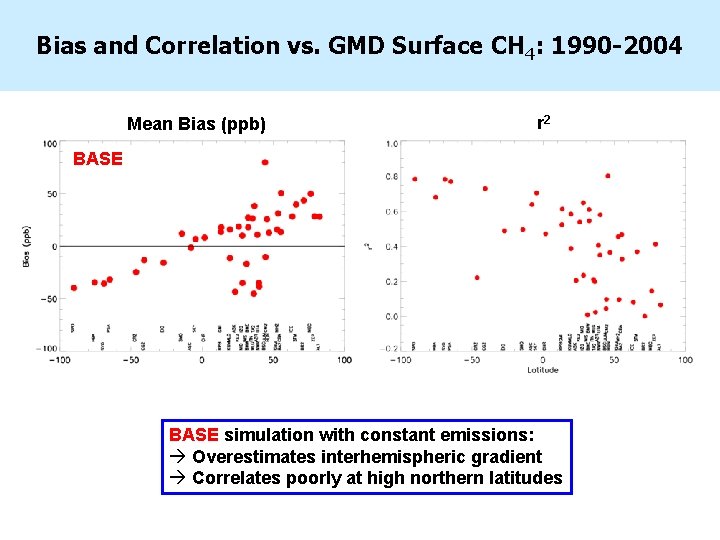
Bias and Correlation vs. GMD Surface CH 4: 1990 -2004 Mean Bias (ppb) r 2 BASE simulation with constant emissions: à Overestimates interhemispheric gradient à Correlates poorly at high northern latitudes
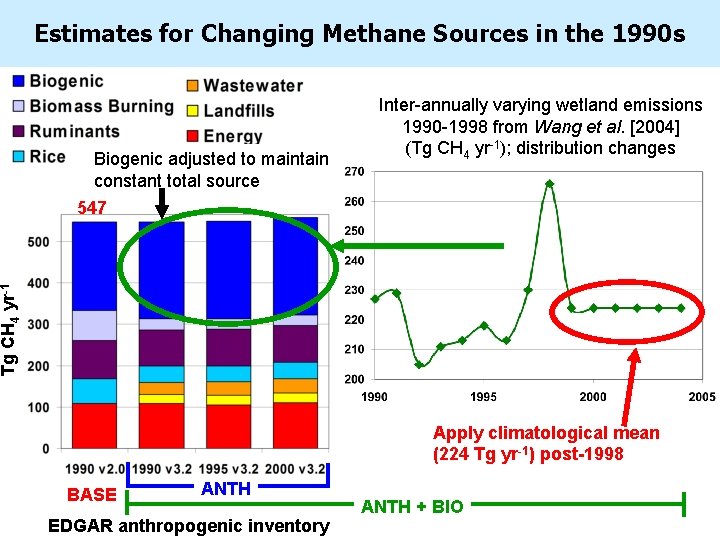
Estimates for Changing Methane Sources in the 1990 s Biogenic adjusted to maintain constant total source Inter-annually varying wetland emissions 1990 -1998 from Wang et al. [2004] (Tg CH 4 yr-1); distribution changes Tg CH 4 yr-1 547 Apply climatological mean (224 Tg yr-1) post-1998 BASE ANTH EDGAR anthropogenic inventory ANTH + BIO
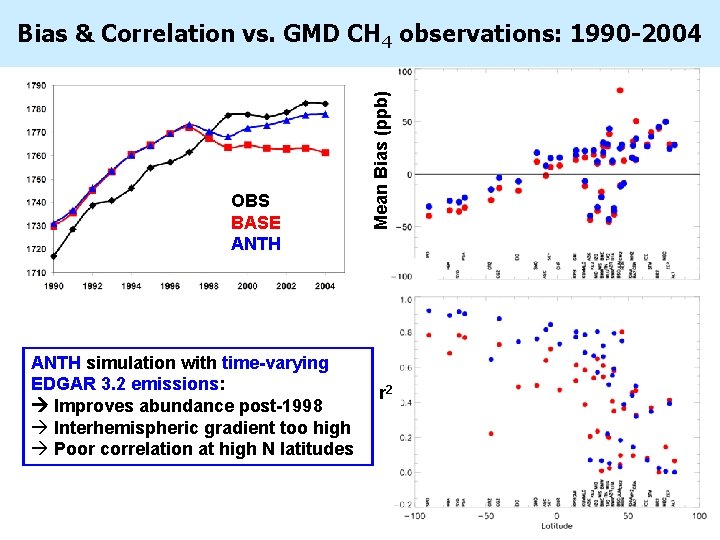
OBS BASE ANTH simulation with time-varying EDGAR 3. 2 emissions: Improves abundance post-1998 à Interhemispheric gradient too high à Poor correlation at high N latitudes Mean Bias (ppb) Bias & Correlation vs. GMD CH 4 observations: 1990 -2004 r 2
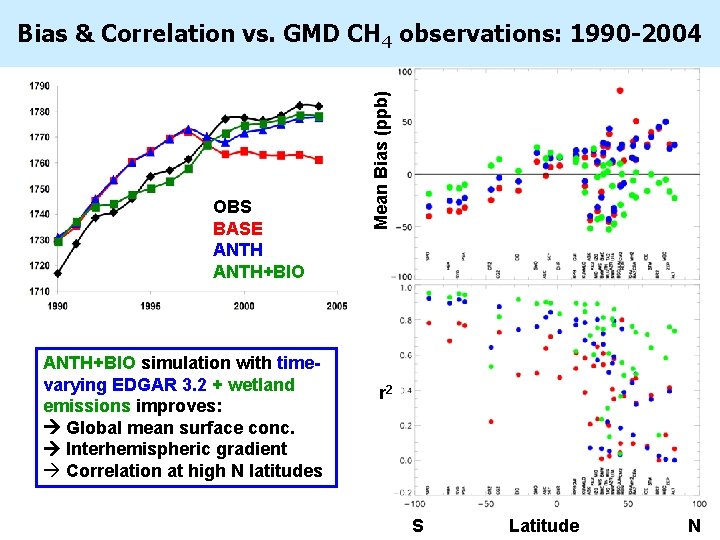
OBS BASE ANTH+BIO simulation with timevarying EDGAR 3. 2 + wetland emissions improves: Global mean surface conc. Interhemispheric gradient à Correlation at high N latitudes Mean Bias (ppb) Bias & Correlation vs. GMD CH 4 observations: 1990 -2004 r 2 S Latitude N
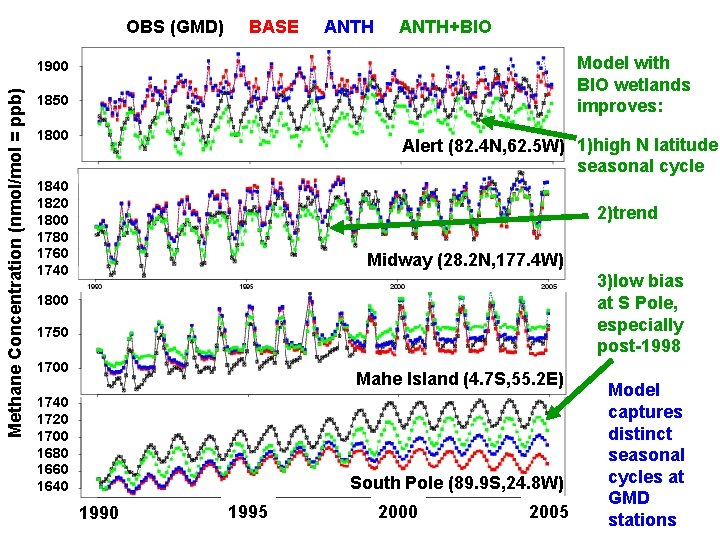
OBS (GMD) BASE ANTH+BIO Model with BIO wetlands improves: Methane Concentration (nmol/mol = ppb) 1900 1850 1800 Alert (82. 4 N, 62. 5 W) 1)high N latitude seasonal cycle 1840 1820 1800 1780 1760 1740 2)trend Midway (28. 2 N, 177. 4 W) 3)low bias at S Pole, especially post-1998 1800 1750 1700 Mahe Island (4. 7 S, 55. 2 E) 1740 1720 1700 1680 1660 1640 South Pole (89. 9 S, 24. 8 W) 1990 1995 2000 2005 Model captures distinct seasonal cycles at GMD stations
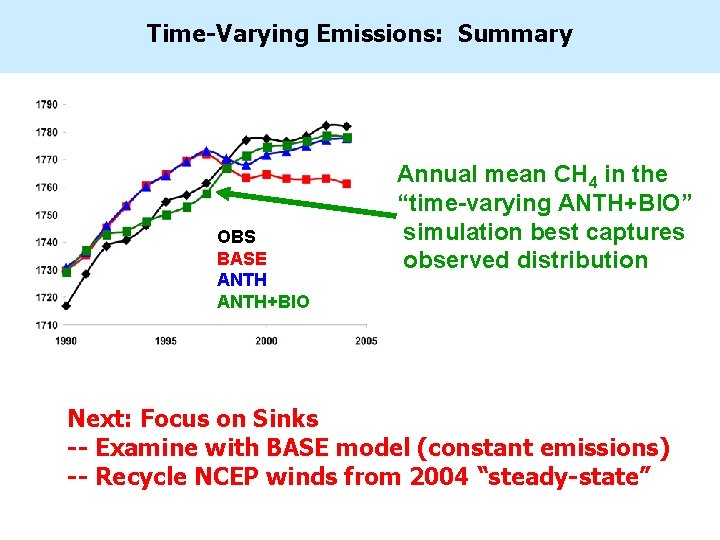
Time-Varying Emissions: Summary OBS BASE ANTH+BIO Annual mean CH 4 in the “time-varying ANTH+BIO” simulation best captures observed distribution Next: Focus on Sinks -- Examine with BASE model (constant emissions) -- Recycle NCEP winds from 2004 “steady-state”
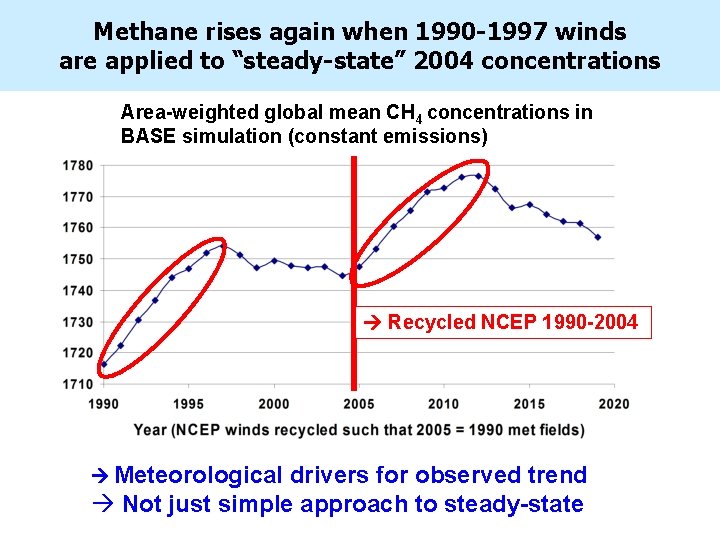
Methane rises again when 1990 -1997 winds are applied to “steady-state” 2004 concentrations Area-weighted global mean CH 4 concentrations in BASE simulation (constant emissions) Recycled NCEP 1990 -2004 Meteorological drivers for observed trend à Not just simple approach to steady-state
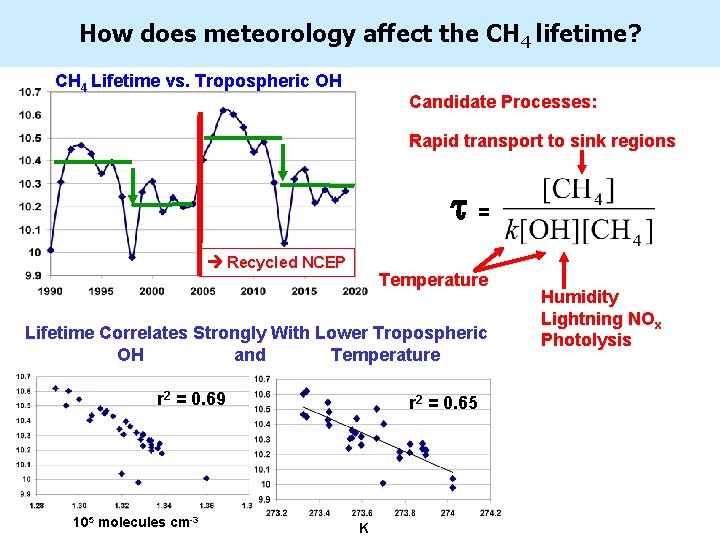
How does meteorology affect the CH 4 lifetime? CH 4 Lifetime vs. Tropospheric OH Candidate Processes: Rapid transport to sink regions t= Recycled NCEP Temperature Lifetime Correlates Strongly With Lower Tropospheric OH and Temperature r 2 = 0. 69 105 molecules cm-3 r 2 = 0. 65 K Humidity Lightning NOx Photolysis
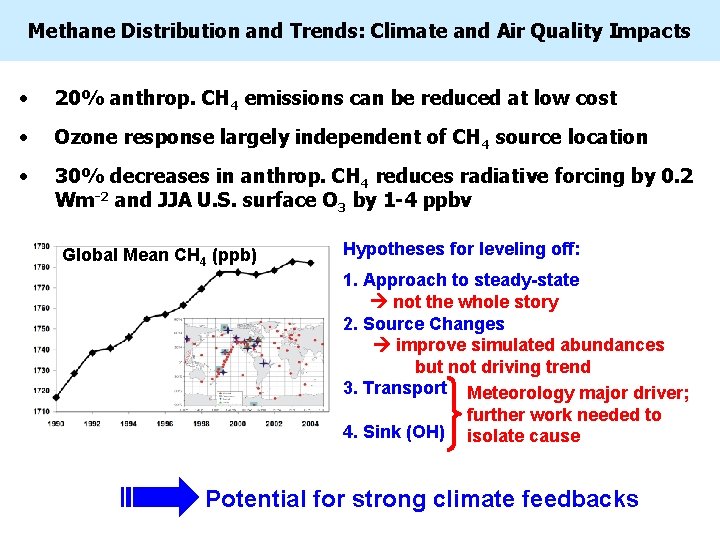
Methane Distribution and Trends: Climate and Air Quality Impacts • 20% anthrop. CH 4 emissions can be reduced at low cost • Ozone response largely independent of CH 4 source location • 30% decreases in anthrop. CH 4 reduces radiative forcing by 0. 2 Wm-2 and JJA U. S. surface O 3 by 1 -4 ppbv Global Mean CH 4 (ppb) Hypotheses for leveling off: 1. Approach to steady-state not the whole story 2. Source Changes improve simulated abundances but not driving trend 3. Transport Meteorology major driver; further work needed to 4. Sink (OH) isolate cause Potential for strong climate feedbacks
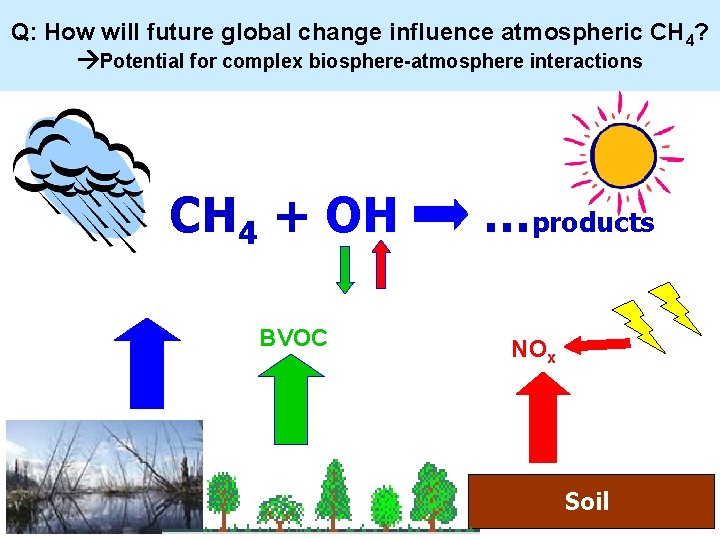
Q: How will future global change influence atmospheric CH 4? Potential for complex biosphere-atmosphere interactions CH 4 + OH BVOC …products NOx Soil
- Slides: 30