
Atmospheric Mercury Measurements Winston Luke NOAAAir Resources Laboratory
Atmospheric Mercury Measurements Winston Luke NOAA/Air Resources Laboratory June 22, 2016
Why Monitor Atmospheric Mercury? • ARL has a long history of research monitoring • Trend detection in response to regulatory emissions reductions and/or emissions increases (global) • Local/regional/global source attribution and characterization • Model evaluation • Test bed for process & QA studies, method evaluation and development ARL Science Review, June 21 -23, 2016 2

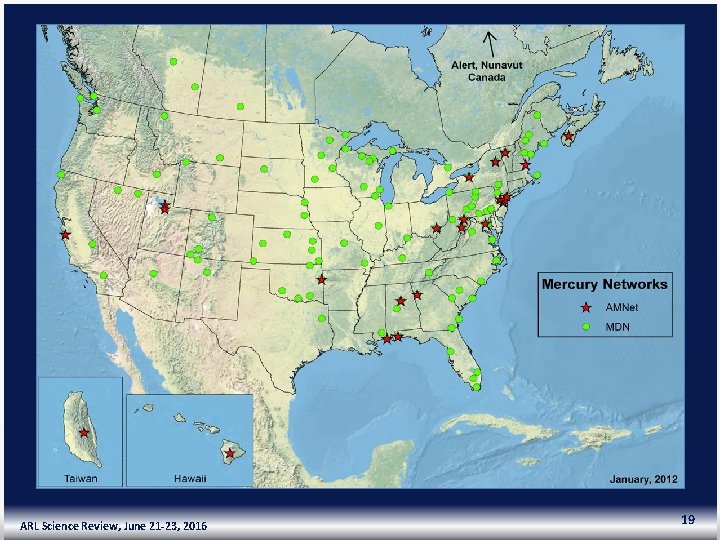
Long-Term Mercury Monitoring (National Atmospheric Deposition Program) Wet Deposition of Hg Mercury Deposition Network (MDN) Weekly precipitation collection, analysis at a central laboratory Beltsville 113 Active Sites Gas- and Aerosol-Phase Hg Atmospheric Mercury Network (AMNet) Grand Bay 23 Active Sites Real-time measurements of mercury species –expensive, technically challenging Mauna Loa ARL operates 3 flagship AMNet sites (Beltsville, MD; Grand Bay NERR, MS; Mauna Loa, HI). ARL Science Review, June 21 -23, 2016 3
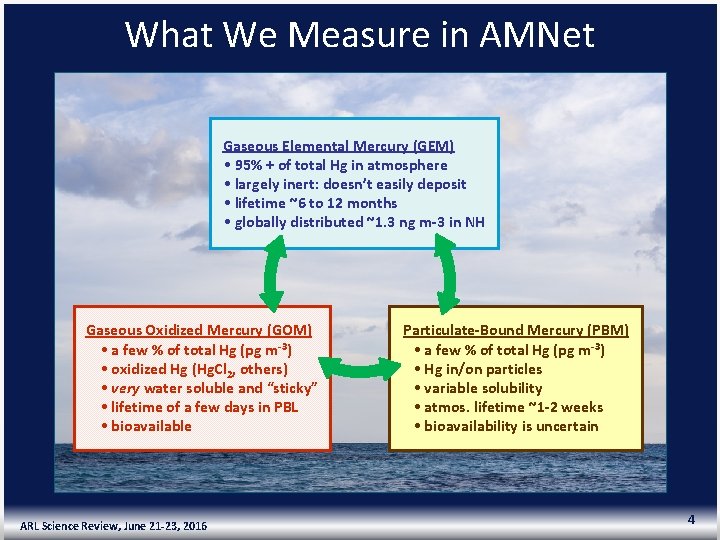
What We Measure in AMNet Gaseous Elemental Mercury (GEM) Gaseous Elemental (GEM) • most of total. Mercury Hg in atmosphere • 95% + of total Hg in atmosphere • doesn’t easily dry or wet deposit • largely inert: doesn’t easily deposit • globally distributed • lifetime ~6 to 12 months • globally distributed ~1. 3 ng m-3 in NH Gaseous Oxidized Mercury (GOM) • a few % of total Hg (pg m-3) • oxidized Hg (Hg. Cl 2, others) • very water soluble and “sticky” • lifetime of a few days in PBL • bioavailable ARL Science Review, June 21 -23, 2016 Particulate-Bound Mercury (PBM) • a few % of total Hg (pg m-3) • Hg in/on particles • variable solubility • atmos. lifetime ~1 -2 weeks • bioavailability is uncertain 4

Mercury and Ancillary Measurements § Grand Bay NERR, NOAA-NCCOS § MS Dept. of Env. Quality § U. S. Fish and Wildlife Service • • • • Mauna Loa (HI) § U. S. EPA § NOAA ESRL § Many others • • • Other Meteorology Grand Bay (MS) • • Throughfall • • • CO Beltsville (MD) § EPA Clean Air Markets Division § Univ. of MD; Maryland DNR § AMEC Foster-Wheeler; USGS; USDA O 3 Collaborators SO 2 Site Dry Deposition Surrogate Surface Trace Metals Mercury (MDN) Precipitation Major Ions (NTN) Black Carbon NO/NOy Mercury Speciation Ambient Air Measurements • • NOAA/ARL Measurements by Partners ARL Science Review, June 21 -23, 2016 5
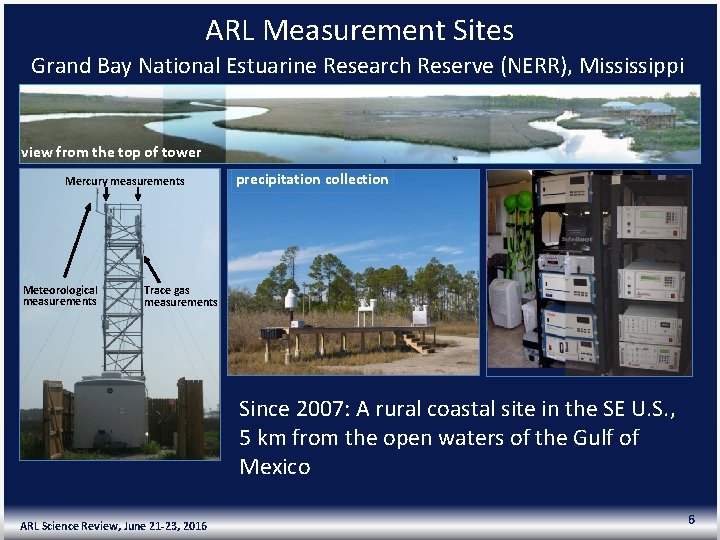
ARL Measurement Sites Grand Bay National Estuarine Research Reserve (NERR), Mississippi view from the top of tower Mercury measurements Meteorological measurements precipitation collection Trace gas measurements Since 2007: A rural coastal site in the SE U. S. , 5 km from the open waters of the Gulf of Mexico ARL Science Review, June 21 -23, 2016 6
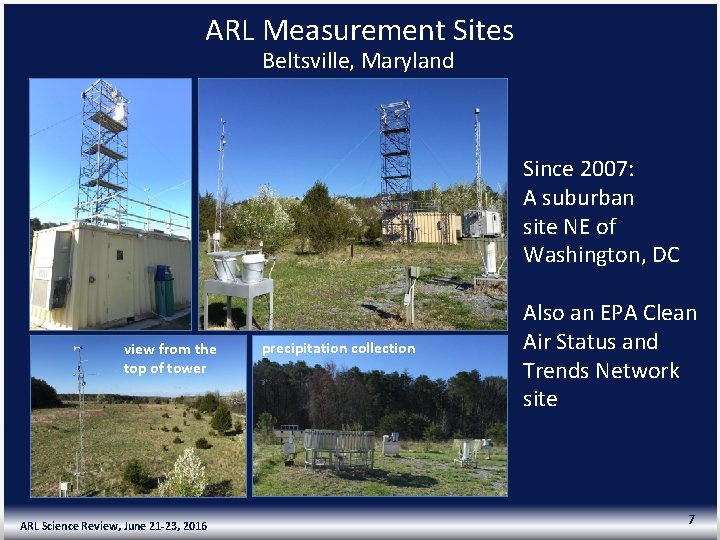
ARL Measurement Sites Beltsville, Maryland Since 2007: A suburban site NE of Washington, DC view from the top of tower ARL Science Review, June 21 -23, 2016 precipitation collection Also an EPA Clean Air Status and Trends Network site 7
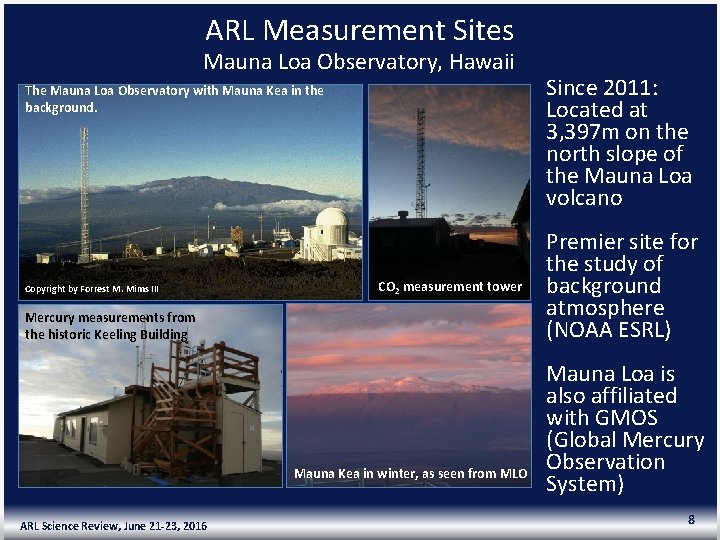
ARL Measurement Sites Mauna Loa Observatory, Hawaii The Mauna Loa Observatory with Mauna Kea in the background. Copyright by Forrest M. Mims III CO 2 measurement tower Mercury measurements from the historic Keeling Building Mauna Kea in winter, as seen from MLO ARL Science Review, June 21 -23, 2016 Since 2011: Located at 3, 397 m on the north slope of the Mauna Loa volcano Premier site for the study of background atmosphere (NOAA ESRL) Mauna Loa is also affiliated with GMOS (Global Mercury Observation System) 8
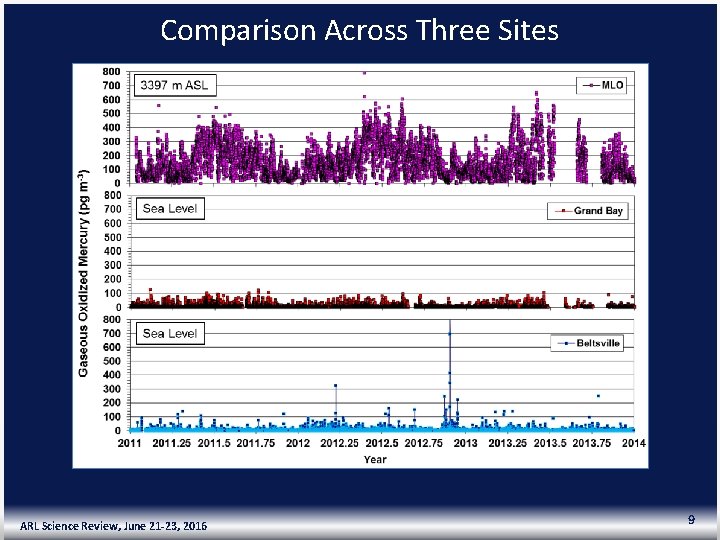
Comparison Across Three Sites ARL Science Review, June 21 -23, 2016 9
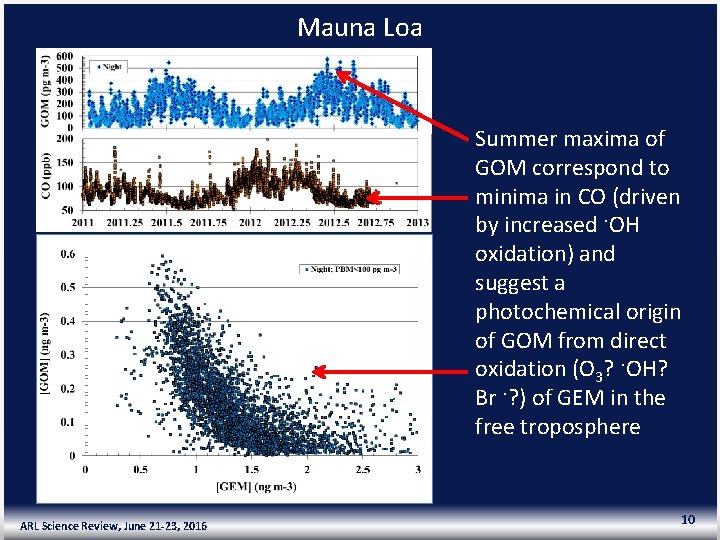
Mauna Loa Summer maxima of GOM correspond to minima in CO (driven by increased ·OH oxidation) and suggest a photochemical origin of GOM from direct oxidation (O 3? ·OH? Br ·? ) of GEM in the free troposphere ARL Science Review, June 21 -23, 2016 10
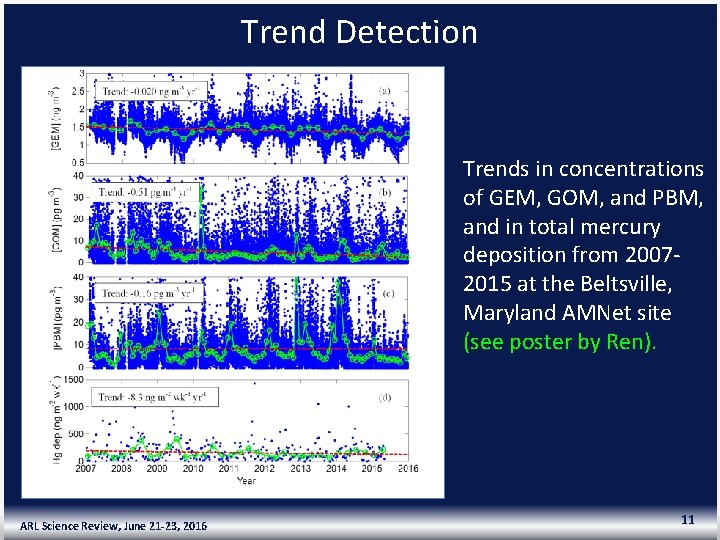
Trend Detection Trends in concentrations of GEM, GOM, and PBM, and in total mercury deposition from 20072015 at the Beltsville, Maryland AMNet site (see poster by Ren). ARL Science Review, June 21 -23, 2016 11
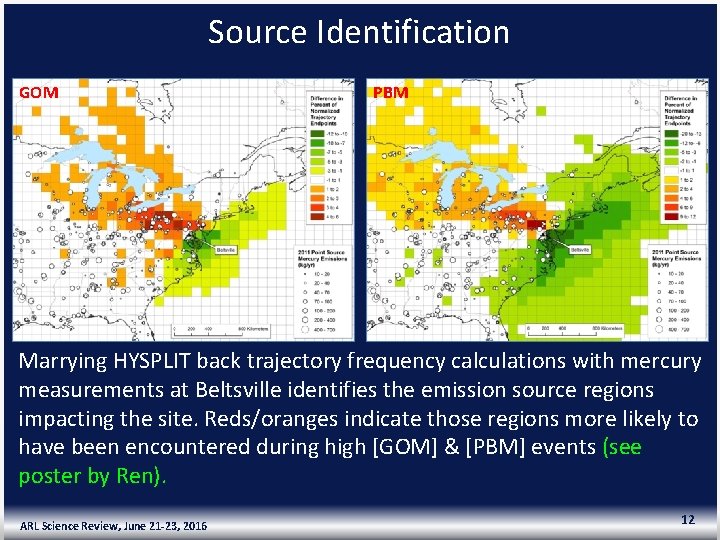
Source Identification GOM PBM Marrying HYSPLIT back trajectory frequency calculations with mercury measurements at Beltsville identifies the emission source regions impacting the site. Reds/oranges indicate those regions more likely to have been encountered during high [GOM] & [PBM] events (see poster by Ren). ARL Science Review, June 21 -23, 2016 12
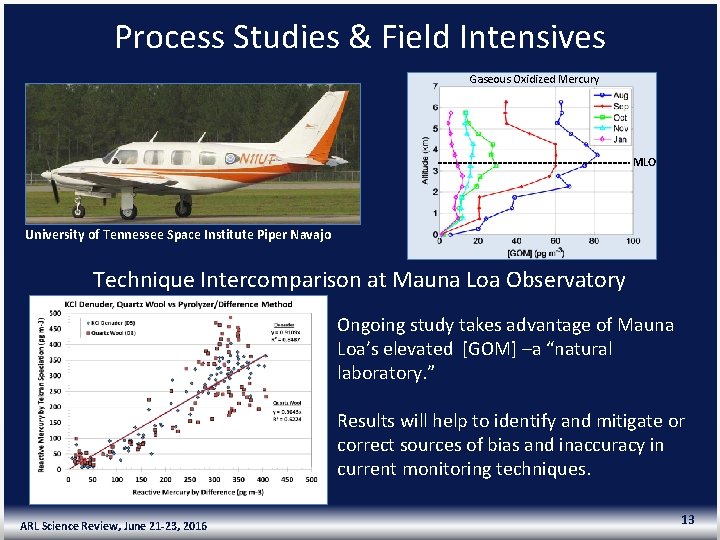
Process Studies & Field Intensives Gaseous Oxidized Mercury MLO University of Tennessee Space Institute Piper Navajo Technique Intercomparison at Mauna Loa Observatory Ongoing study takes advantage of Mauna Loa’s elevated [GOM] –a “natural laboratory. ” Results will help to identify and mitigate or correct sources of bias and inaccuracy in current monitoring techniques. ARL Science Review, June 21 -23, 2016 13
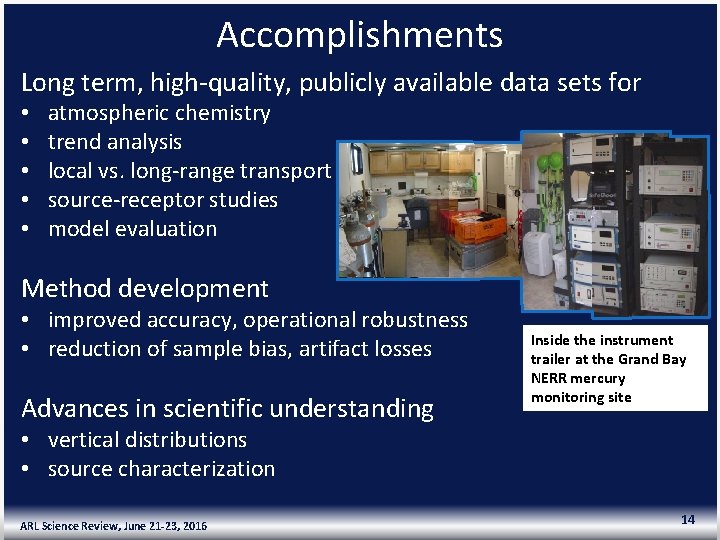
Accomplishments Long term, high-quality, publicly available data sets for • • • atmospheric chemistry trend analysis local vs. long-range transport source-receptor studies model evaluation Method development • improved accuracy, operational robustness • reduction of sample bias, artifact losses Advances in scientific understanding Inside the instrument trailer at the Grand Bay NERR mercury monitoring site • vertical distributions • source characterization ARL Science Review, June 21 -23, 2016 14
Quality, Relevance, and Performance • NOAA/ARL is a founding member of and key contributor to AMNet, and operates 3 of 23 sites in the network. ARL measurements are regarded as being of high quality, and the sites feature redundant Hg measurements. • Collaborates with and secures funding from other agencies (e. g. , EPA). • Was instrumental in developing standard operating protocols for AMNet in 2008, and held a Mercury Measurement Workshop in Sept. 2015 to revisit, assess and improve initial AMNet protocols. • Provides technical guidance (with NADP and EPA partners) for development and implementation of Asia-Pacific Mercury Monitoring Network. • To date, 10+ peer reviewed publications using ARL-generated data, several additional manuscripts in preparation. ARL Science Review, June 21 -23, 2016 15
Collaborations NOAA Grand Bay National Estuarine Reserve Nat’l Centers for Coastal & Ocean Science Earth Systems Research Laboratory (ESRL) National Weather Service (NWS) Other Federal Agencies EPA Clean Air Markets Division (CAMD) U. S. Fish and Wildlife Service Department of Agriculture National Park Service U. S. Geological Survey State and Local Governments Maryland, Mississippi, Pennsylvania, Texas, Alaska, Virginia, West Virginia Industry TEKRAN Electric Power Research Institute Southern Company ARL Science Review, June 21 -23, 2016 Universities and Institutes Florida State University of Houston University of Maryland University of Tennessee Space Institute University of Miami (Florida) Georgia Institute of Technology University of Nevada University of Illinois Valparaiso University Exploratorium (San Francisco) International European Commission/GMOS Environment Canada Asia-Pacific Mercury Monitoring Network EPA Taiwan National Central University (Taiwan) University of Toronto 16
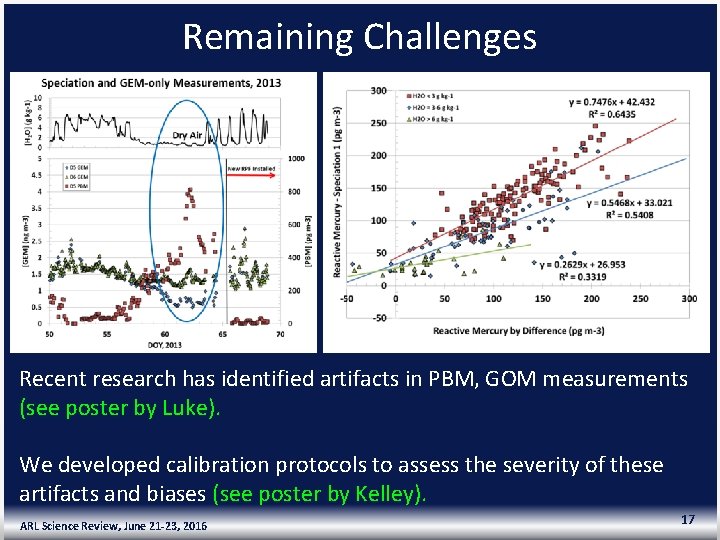
Remaining Challenges Recent research has identified artifacts in PBM, GOM measurements (see poster by Luke). We developed calibration protocols to assess the severity of these artifacts and biases (see poster by Kelley). ARL Science Review, June 21 -23, 2016 17
Future Directions • Evaluate, intercompare, and optimize existing measurement methods • Develop new methods, e. g. , – pyrolysis-difference method – relaxed-eddy-accumulation (REA) system for dry deposition • Additional measurements at long-term sites • Field intensives at ground (and aloft? ) for process studies to address key uncertainties • Analysis and publication of datasets ARL Science Review, June 21 -23, 2016 18
ARL Science Review, June 21 -23, 2016 19
- Slides: 19