
ATMOSPHERIC CHEMISTRY MODELS Daniel J Jacob Harvard University
ATMOSPHERIC CHEMISTRY MODELS Daniel J. Jacob Harvard University http: //www-as. harvard. edu/chemistry/trop
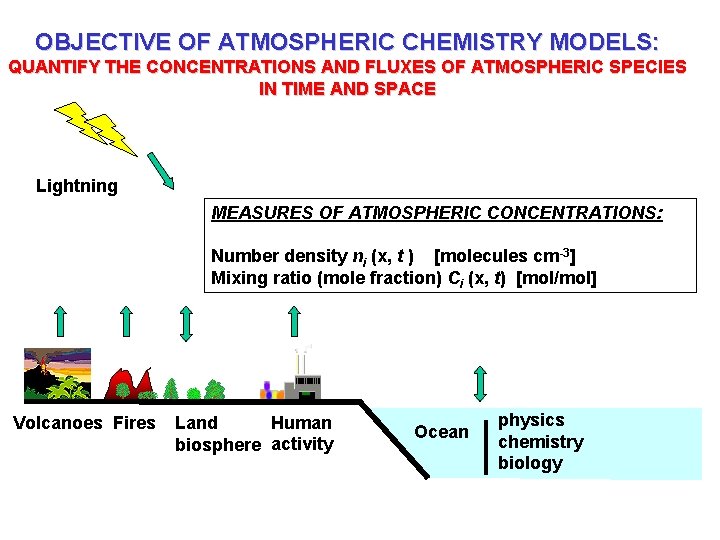
OBJECTIVE OF ATMOSPHERIC CHEMISTRY MODELS: QUANTIFY THE CONCENTRATIONS AND FLUXES OF ATMOSPHERIC SPECIES IN TIME AND SPACE Lightning MEASURES OF ATMOSPHERIC CONCENTRATIONS: Number density ni (x, t ) [molecules cm-3] Mixing ratio (mole fraction) Ci (x, t) [mol/mol] Volcanoes Fires Human Land biosphere activity Ocean physics chemistry biology
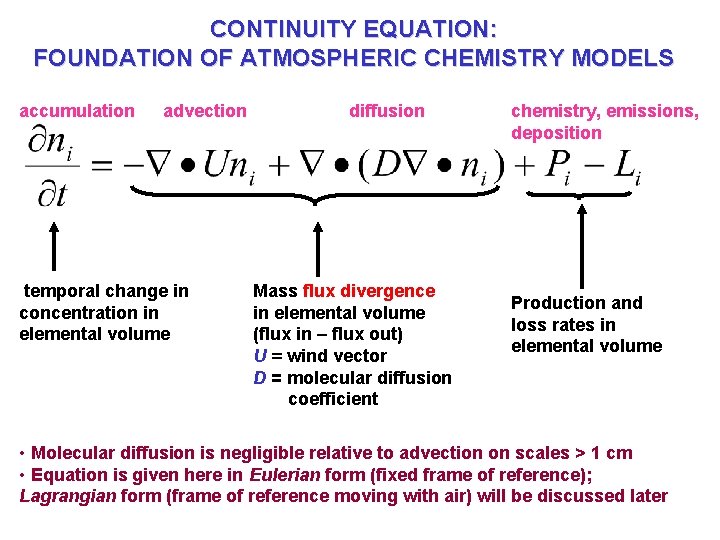
CONTINUITY EQUATION: FOUNDATION OF ATMOSPHERIC CHEMISTRY MODELS accumulation advection temporal change in concentration in elemental volume diffusion Mass flux divergence in elemental volume (flux in – flux out) U = wind vector D = molecular diffusion coefficient chemistry, emissions, deposition Production and loss rates in elemental volume • Molecular diffusion is negligible relative to advection on scales > 1 cm • Equation is given here in Eulerian form (fixed frame of reference); Lagrangian form (frame of reference moving with air) will be discussed later
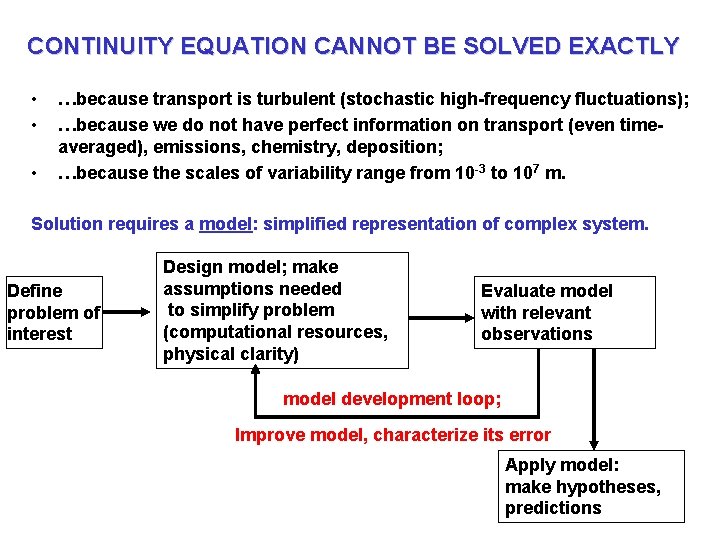
CONTINUITY EQUATION CANNOT BE SOLVED EXACTLY • • • …because transport is turbulent (stochastic high-frequency fluctuations); …because we do not have perfect information on transport (even timeaveraged), emissions, chemistry, deposition; …because the scales of variability range from 10 -3 to 107 m. Solution requires a model: simplified representation of complex system. Define problem of interest Design model; make assumptions needed to simplify problem (computational resources, physical clarity) Evaluate model with relevant observations model development loop; Improve model, characterize its error Apply model: make hypotheses, predictions
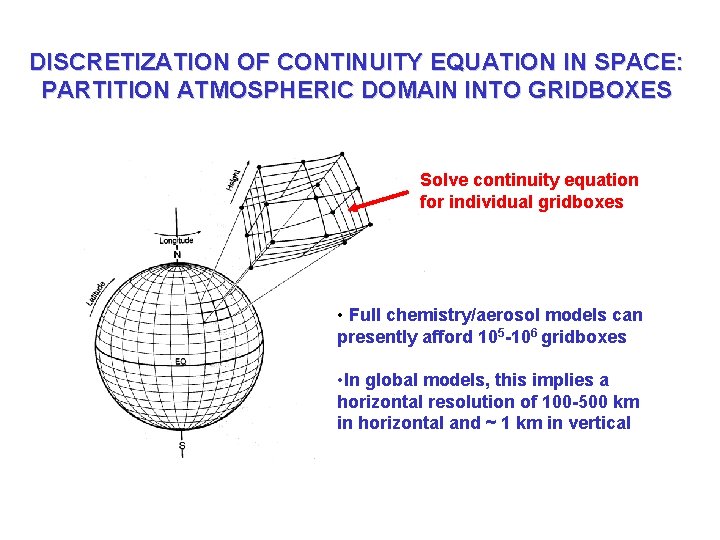
DISCRETIZATION OF CONTINUITY EQUATION IN SPACE: PARTITION ATMOSPHERIC DOMAIN INTO GRIDBOXES Solve continuity equation for individual gridboxes • Full chemistry/aerosol models can presently afford 105 -106 gridboxes • In global models, this implies a horizontal resolution of 100 -500 km in horizontal and ~ 1 km in vertical
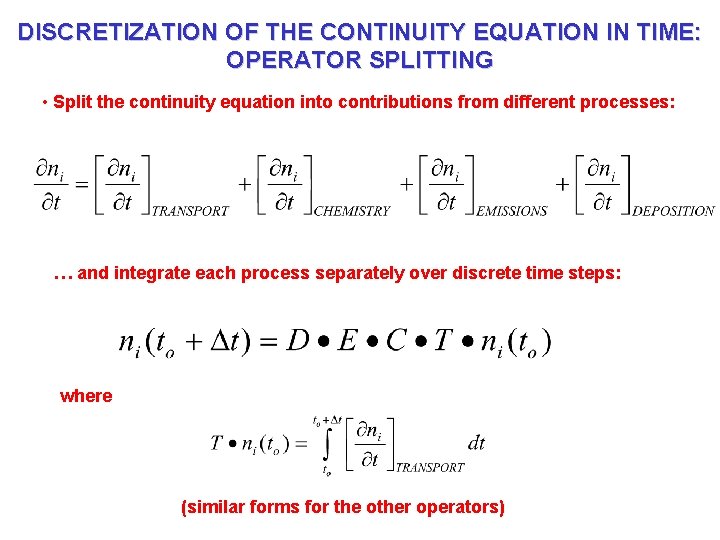
DISCRETIZATION OF THE CONTINUITY EQUATION IN TIME: OPERATOR SPLITTING • Split the continuity equation into contributions from different processes: … and integrate each process separately over discrete time steps: where (similar forms for the other operators)
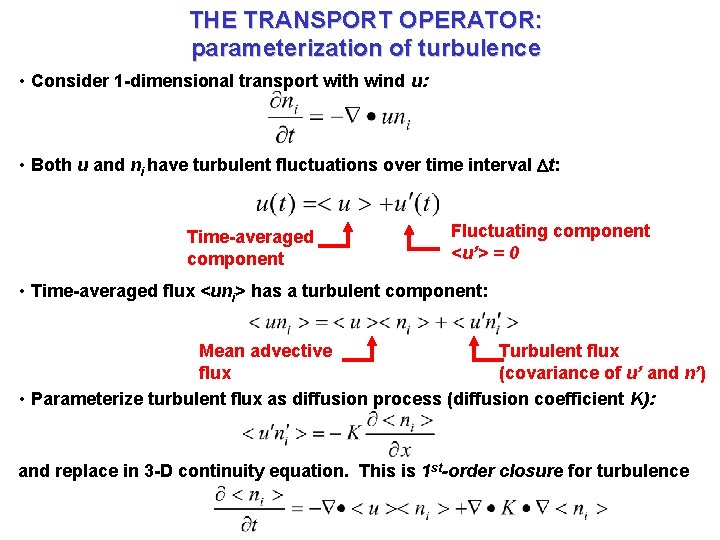
THE TRANSPORT OPERATOR: parameterization of turbulence • Consider 1 -dimensional transport with wind u: • Both u and ni have turbulent fluctuations over time interval Dt: Time-averaged component Fluctuating component <u’> = 0 • Time-averaged flux <uni> has a turbulent component: Mean advective Turbulent flux (covariance of u’ and n’) • Parameterize turbulent flux as diffusion process (diffusion coefficient K): and replace in 3 -D continuity equation. This is 1 st-order closure for turbulence
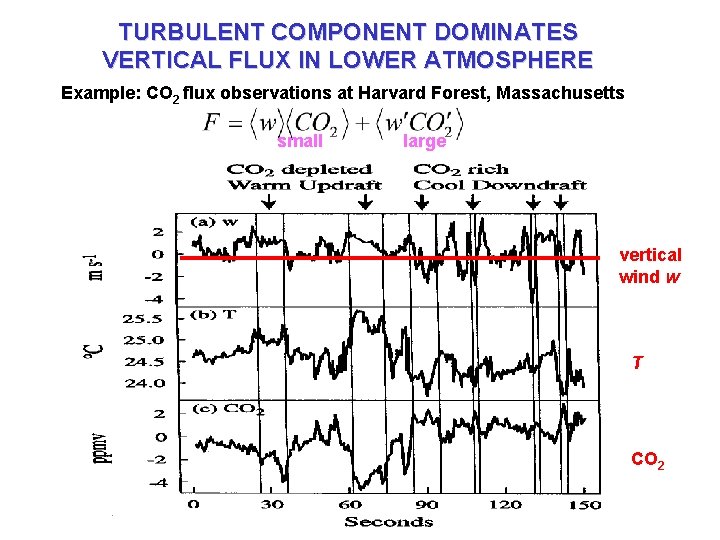
TURBULENT COMPONENT DOMINATES VERTICAL FLUX IN LOWER ATMOSPHERE Example: CO 2 flux observations at Harvard Forest, Massachusetts small large vertical wind w T CO 2
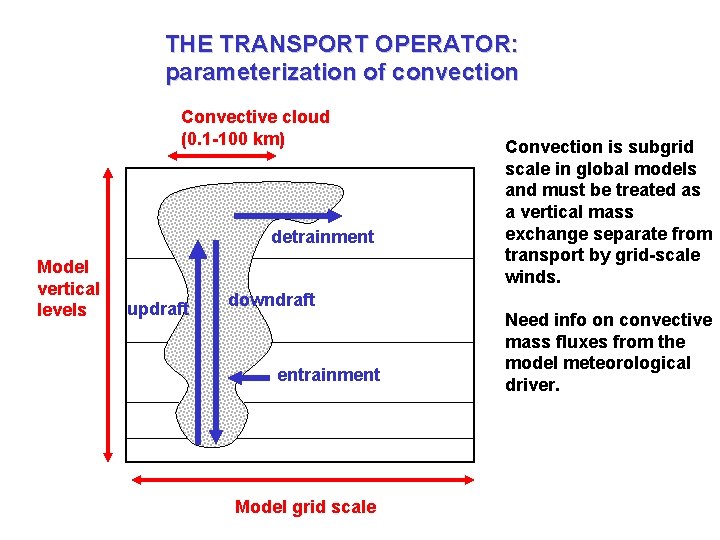
THE TRANSPORT OPERATOR: parameterization of convection Convective cloud (0. 1 -100 km) detrainment Model vertical levels updraft downdraft entrainment Model grid scale Convection is subgrid scale in global models and must be treated as a vertical mass exchange separate from transport by grid-scale winds. Need info on convective mass fluxes from the model meteorological driver.
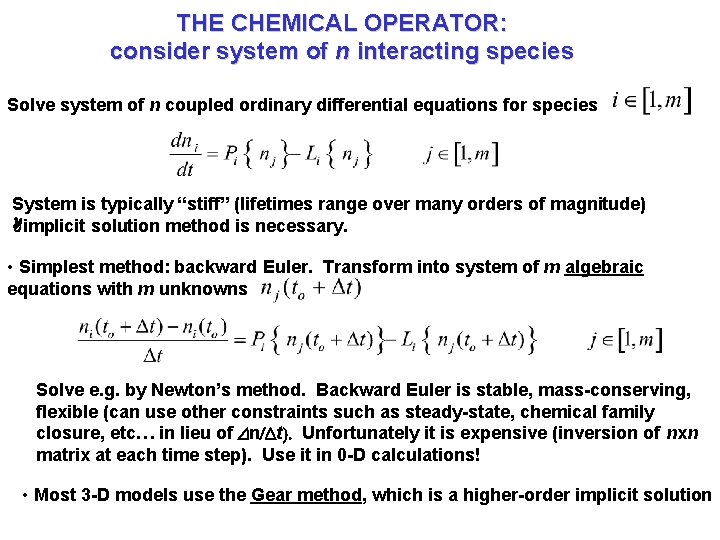
THE CHEMICAL OPERATOR: consider system of n interacting species Solve system of n coupled ordinary differential equations for species System is typically “stiff” (lifetimes range over many orders of magnitude) Aimplicit solution method is necessary. • Simplest method: backward Euler. Transform into system of m algebraic equations with m unknowns Solve e. g. by Newton’s method. Backward Euler is stable, mass-conserving, flexible (can use other constraints such as steady-state, chemical family closure, etc… in lieu of Dn/Dt). Unfortunately it is expensive (inversion of nxn matrix at each time step). Use it in 0 -D calculations! • Most 3 -D models use the Gear method, which is a higher-order implicit solution
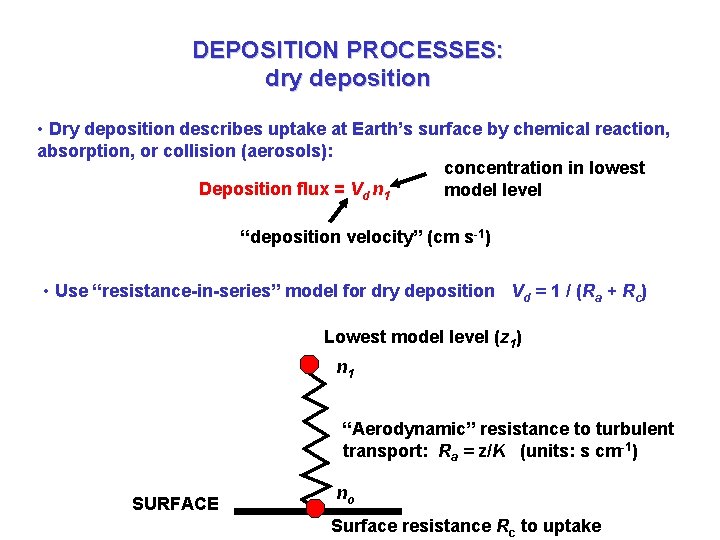
DEPOSITION PROCESSES: dry deposition • Dry deposition describes uptake at Earth’s surface by chemical reaction, absorption, or collision (aerosols): concentration in lowest Deposition flux = Vd n 1 model level “deposition velocity” (cm s-1) • Use “resistance-in-series” model for dry deposition Vd = 1 / (Ra + Rc) Lowest model level (z 1) n 1 “Aerodynamic” resistance to turbulent transport: Ra = z/K (units: s cm-1) SURFACE no Surface resistance Rc to uptake
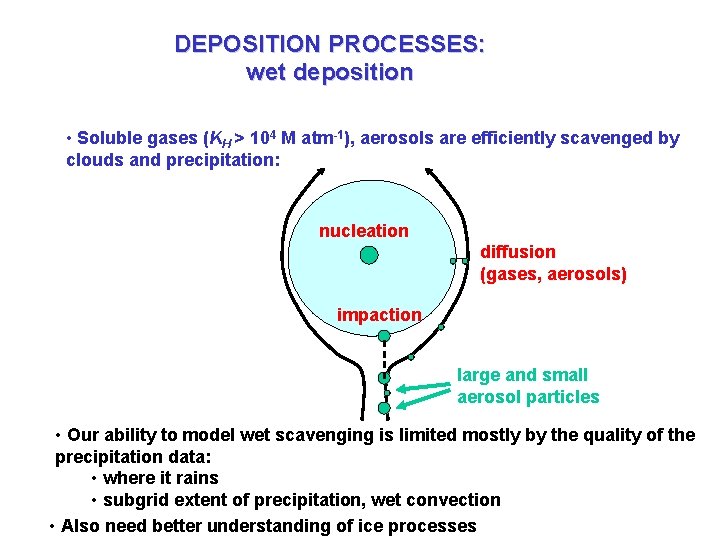
DEPOSITION PROCESSES: wet deposition • Soluble gases (KH > 104 M atm-1), aerosols are efficiently scavenged by clouds and precipitation: nucleation diffusion (gases, aerosols) impaction large and small aerosol particles • Our ability to model wet scavenging is limited mostly by the quality of the precipitation data: • where it rains • subgrid extent of precipitation, wet convection • Also need better understanding of ice processes
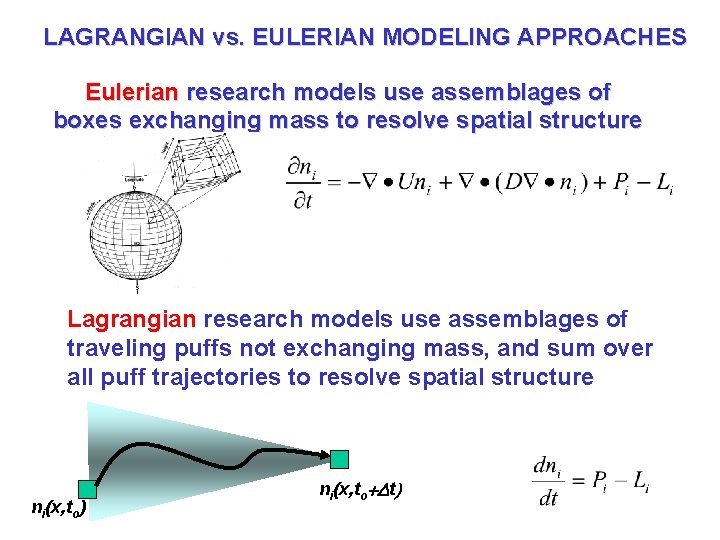
LAGRANGIAN vs. EULERIAN MODELING APPROACHES Eulerian research models use assemblages of boxes exchanging mass to resolve spatial structure Lagrangian research models use assemblages of traveling puffs not exchanging mass, and sum over all puff trajectories to resolve spatial structure ni(x, to) ni(x, to+Dt)
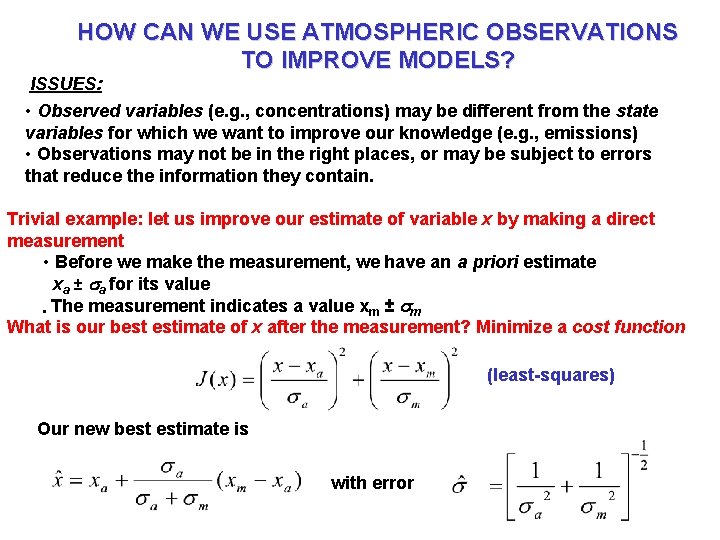
HOW CAN WE USE ATMOSPHERIC OBSERVATIONS TO IMPROVE MODELS? ISSUES: • Observed variables (e. g. , concentrations) may be different from the state variables for which we want to improve our knowledge (e. g. , emissions) • Observations may not be in the right places, or may be subject to errors that reduce the information they contain. Trivial example: let us improve our estimate of variable x by making a direct measurement • Before we make the measurement, we have an a priori estimate xa ± sa for its value • The measurement indicates a value xm ± sm What is our best estimate of x after the measurement? Minimize a cost function (least-squares) Our new best estimate is with error
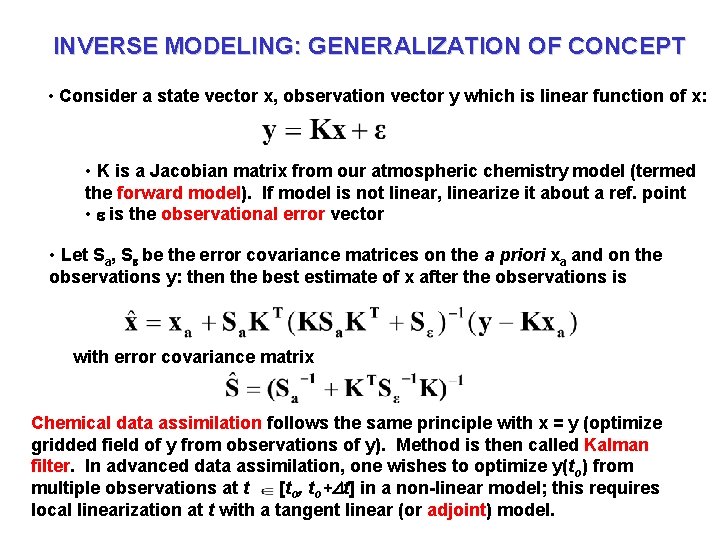
INVERSE MODELING: GENERALIZATION OF CONCEPT • Consider a state vector x, observation vector y which is linear function of x: • K is a Jacobian matrix from our atmospheric chemistry model (termed the forward model). If model is not linear, linearize it about a ref. point • e is the observational error vector • Let Sa, Se be the error covariance matrices on the a priori xa and on the observations y: then the best estimate of x after the observations is with error covariance matrix Chemical data assimilation follows the same principle with x = y (optimize gridded field of y from observations of y). Method is then called Kalman filter. In advanced data assimilation, one wishes to optimize y(to) from multiple observations at t [to, to+Dt] in a non-linear model; this requires local linearization at t with a tangent linear (or adjoint) model.
SOME APPLICATIONS USING THE GEOS-CHEM GLOBAL 3 -D MODEL OF TROPOSPHERIC CHEMISTRY (http: //www-as. harvard. edu/chemistry/trop/geos) • • • Meteorological input fields from NASA/DAO assimilated data, 1988 present; 1 ox 1 o to 4 ox 5 o horizontal resolution, 20 -48 vertical levels Ozone-NOx-CO-hydrocarbon chemistry, aerosols, CH 4, CO 2: up to 80 interacting species depending on application Applied to a wide range of problems, e. g. , – Testing of atmospheric transport with chemical tracers – Long-range transport of pollution – Support of aircraft missions – Satellite retrievals – Inversion of sources
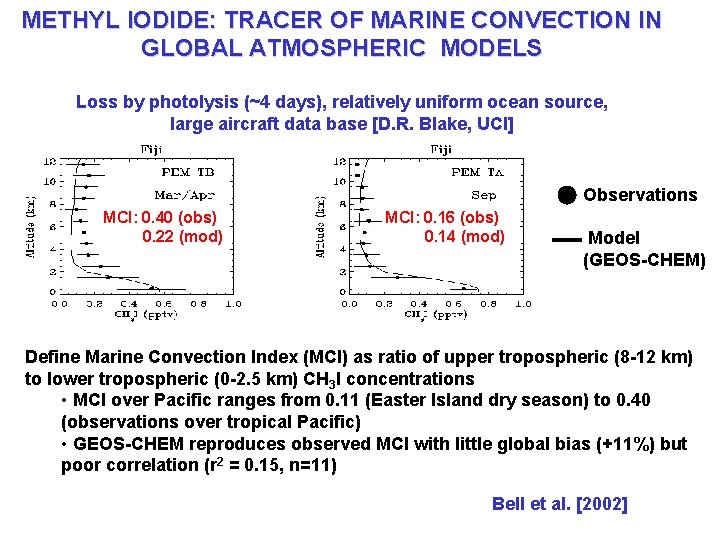
METHYL IODIDE: TRACER OF MARINE CONVECTION IN GLOBAL ATMOSPHERIC MODELS Loss by photolysis (~4 days), relatively uniform ocean source, large aircraft data base [D. R. Blake, UCI] Observations MCI: 0. 40 (obs) 0. 22 (mod) MCI: 0. 16 (obs) 0. 14 (mod) Model (GEOS-CHEM) Define Marine Convection Index (MCI) as ratio of upper tropospheric (8 -12 km) to lower tropospheric (0 -2. 5 km) CH 3 I concentrations • MCI over Pacific ranges from 0. 11 (Easter Island dry season) to 0. 40 (observations over tropical Pacific) • GEOS-CHEM reproduces observed MCI with little global bias (+11%) but poor correlation (r 2 = 0. 15, n=11) Bell et al. [2002]
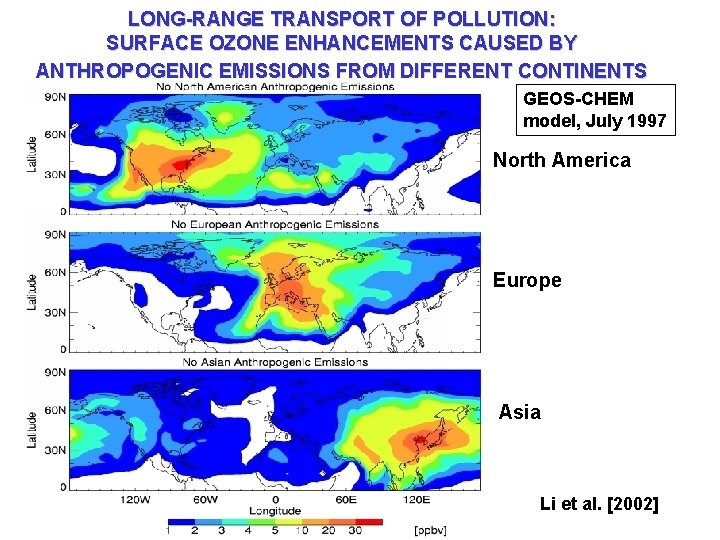
LONG-RANGE TRANSPORT OF POLLUTION: SURFACE OZONE ENHANCEMENTS CAUSED BY ANTHROPOGENIC EMISSIONS FROM DIFFERENT CONTINENTS GEOS-CHEM model, July 1997 North America Europe Asia Liet etal. [2002] [2001] Li
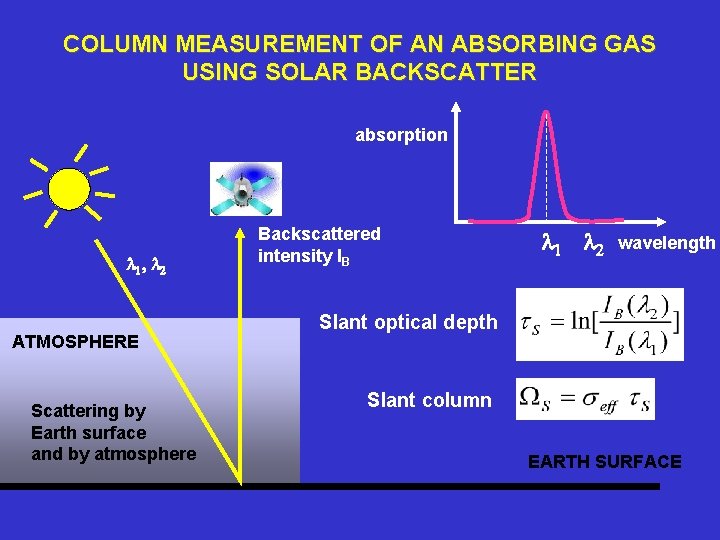
COLUMN MEASUREMENT OF AN ABSORBING GAS USING SOLAR BACKSCATTER absorption l 1 , l 2 ATMOSPHERE Scattering by Earth surface and by atmosphere Backscattered intensity IB l 1 l 2 wavelength Slant optical depth Slant column EARTH SURFACE
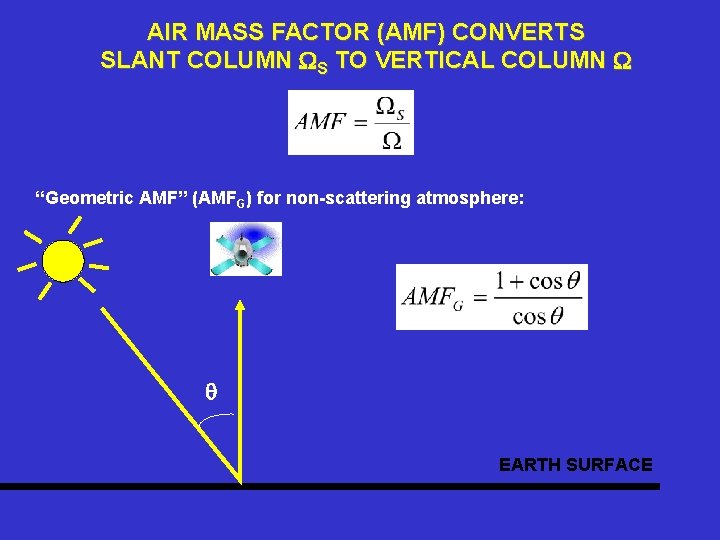
AIR MASS FACTOR (AMF) CONVERTS SLANT COLUMN WS TO VERTICAL COLUMN W “Geometric AMF” (AMFG) for non-scattering atmosphere: q EARTH SURFACE
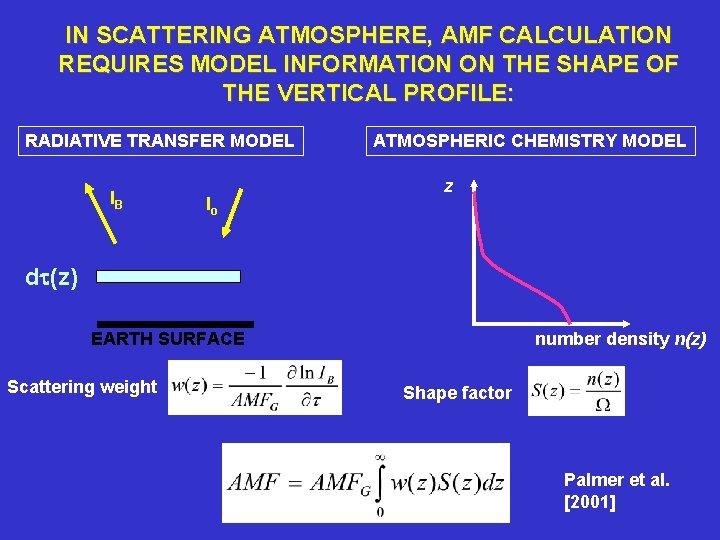
IN SCATTERING ATMOSPHERE, AMF CALCULATION REQUIRES MODEL INFORMATION ON THE SHAPE OF THE VERTICAL PROFILE: RADIATIVE TRANSFER MODEL IB Io ATMOSPHERIC CHEMISTRY MODEL z dt(z) EARTH SURFACE Scattering weight number density n(z) Shape factor Palmer et al. [2001]
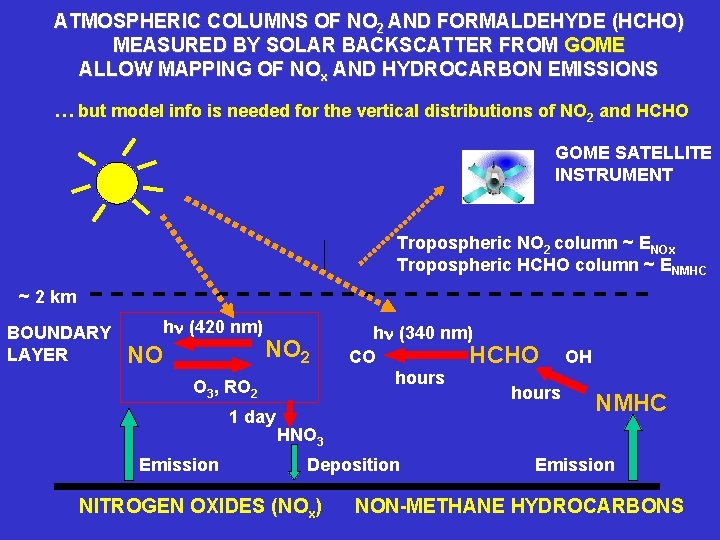
ATMOSPHERIC COLUMNS OF NO 2 AND FORMALDEHYDE (HCHO) MEASURED BY SOLAR BACKSCATTER FROM GOME ALLOW MAPPING OF NOx AND HYDROCARBON EMISSIONS … but model info is needed for the vertical distributions of NO 2 and HCHO GOME SATELLITE INSTRUMENT Tropospheric NO 2 column ~ ENOx Tropospheric HCHO column ~ ENMHC ~ 2 km BOUNDARY LAYER hn (420 nm) NO NO 2 O 3, RO 2 1 day Emission hn (340 nm) HCHO OH CO hours NMHC HNO 3 Deposition NITROGEN OXIDES (NOx) Emission NON-METHANE HYDROCARBONS
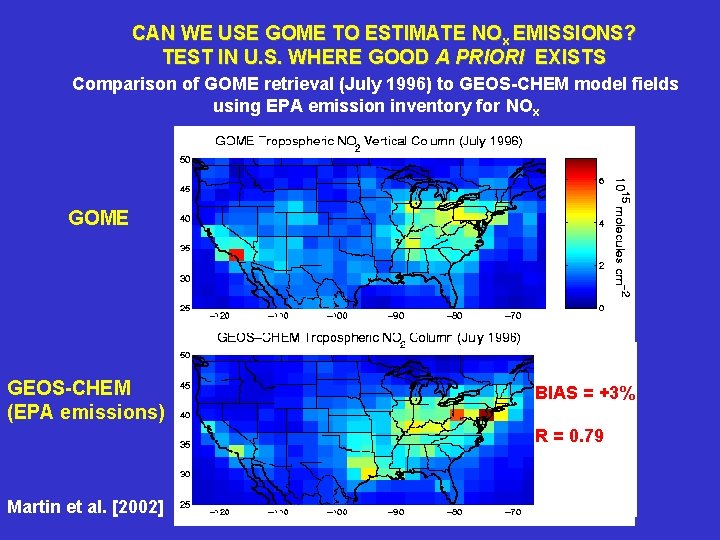
CAN WE USE GOME TO ESTIMATE NOx EMISSIONS? TEST IN U. S. WHERE GOOD A PRIORI EXISTS Comparison of GOME retrieval (July 1996) to GEOS-CHEM model fields using EPA emission inventory for NOx GOME GEOS-CHEM (EPA emissions) BIAS = +3% R = 0. 79 Martin et al. [2002]
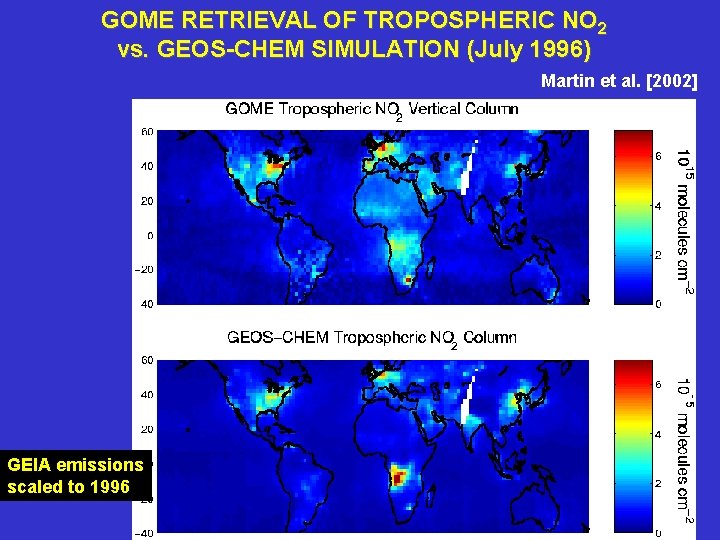
GOME RETRIEVAL OF TROPOSPHERIC NO 2 vs. GEOS-CHEM SIMULATION (July 1996) Martin et al. [2002] GEIA emissions scaled to 1996
![FORMALDEHYDE COLUMNS FROM GOME: July 1996 means Palmer et al. [2001] BIOGENIC ISOPRENE IS](http://slidetodoc.com/presentation_image_h2/59448953314735ae75a9632a57399aa0/image-25.jpg "FORMALDEHYDE COLUMNS FROM GOME: July 1996 means Palmer et al. [2001] BIOGENIC ISOPRENE IS")
FORMALDEHYDE COLUMNS FROM GOME: July 1996 means Palmer et al. [2001] BIOGENIC ISOPRENE IS THE MAIN SOURCE OF HCHO IN U. S. IN SUMMER
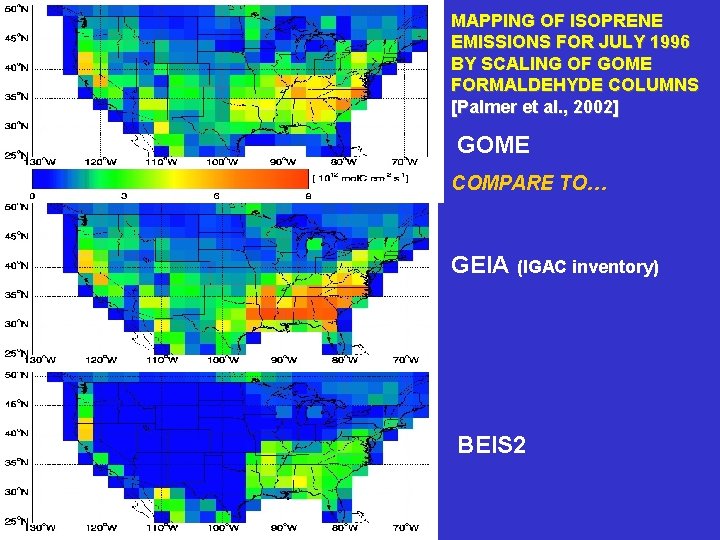
MAPPING OF ISOPRENE EMISSIONS FOR JULY 1996 BY SCALING OF GOME FORMALDEHYDE COLUMNS [Palmer et al. , 2002] GOME COMPARE TO… GEIA (IGAC inventory) BEIS 2
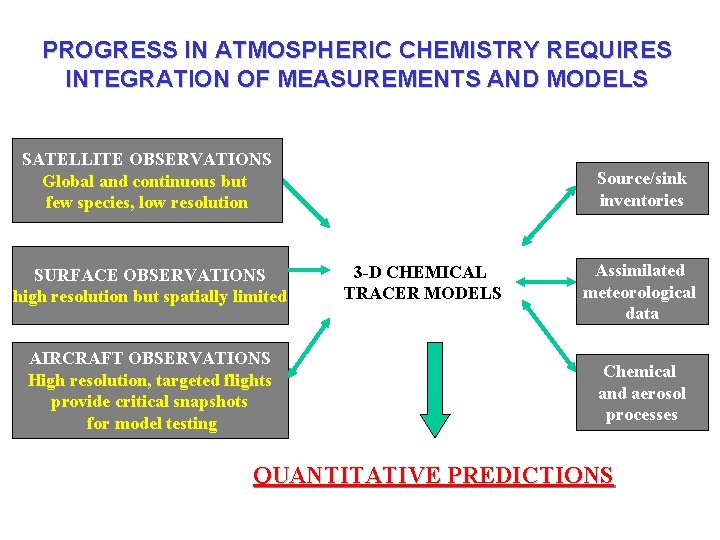
PROGRESS IN ATMOSPHERIC CHEMISTRY REQUIRES INTEGRATION OF MEASUREMENTS AND MODELS SATELLITE OBSERVATIONS Global and continuous but few species, low resolution SURFACE OBSERVATIONS high resolution but spatially limited AIRCRAFT OBSERVATIONS High resolution, targeted flights provide critical snapshots for model testing Source/sink inventories 3 -D CHEMICAL TRACER MODELS Assimilated meteorological data Chemical and aerosol processes QUANTITATIVE PREDICTIONS
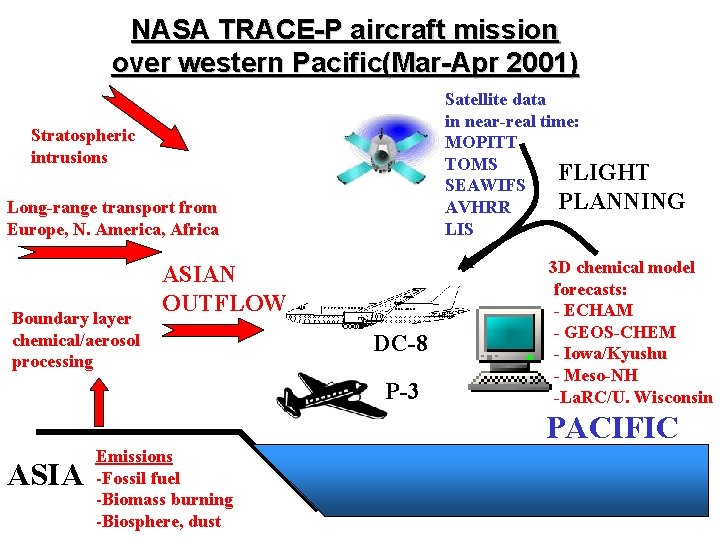
NASA TRACE-P aircraft mission over western Pacific(Mar-Apr 2001) Satellite data in near-real time: MOPITT TOMS FLIGHT SEAWIFS PLANNING AVHRR LIS Stratospheric intrusions Long-range transport from Europe, N. America, Africa Boundary layer chemical/aerosol processing ASIAN OUTFLOW DC-8 P-3 3 D chemical model forecasts: - ECHAM - GEOS-CHEM - Iowa/Kyushu - Meso-NH -La. RC/U. Wisconsin PACIFIC ASIA Emissions -Fossil fuel -Biomass burning -Biosphere, dust PACIFIC
FURTHER READING • Jacob, D. J. , Introduction to Atmospheric Chemistry, Princeton University Press, 1999 Basic treatment of model design • Brasseur, G. P. et al. (eds), Atmospheric Chemistry and Global Change, Oxford University Press, 1999 Chap. 12 (“Modeling”) is concise and excellent • Seinfeld, J. H. , and S. Pandis, Atmospheric Chemistry and Physics, Wiley, 1996 Excellent insights into modeling principles • Jacobson, M. Z. , Fundamentals of Atmospheric Modeling, Cambridge University Press, 1999 Excellent presentations of modeling techniques
- Slides: 29