
Atmosphere What Makes Up the Atmosphere Earths Atmosphere


- Slides: 13
Atmosphere What Makes Up the Atmosphere?
Earth’s Atmosphere • Different from other planets – A mix of nitrogen and oxygen gases • Gradually developed over 4. 5 billion years • Developed because: – Volcanoes erupted & gases contained water vapor – Water vapor condensed, filling oceans and caused chemical reactions
Layers of the Atmosphere • Troposphere-closest to Earth’s surface, dense, nearly all life is here. • Stratosphere-air is thinner and drier than 1 st layer, ozone blocks UV rays from sun. • Mesosphere-coldest layer, air is very thin, shooting stars and meteoroids are here! • Thermosphere-high temperatures, space exploration begins here and space shuttles fly here. • Exosphere-outermost layer, artificial satellites explore and orbit here.
Air Masses • Large masses of air • Temperature and humidity are affected by the area they are formed over. • Humidity: the amount of water vapor in the air. – Example: Gulf of Mexico=warm and wet
Weather Terminology • Weather: the condition of the atmosphere at a particular time and place. – Maritime air masses are humid because they form over the ocean. – Continental=dry-form over land – Tropical=warm-form over the tropics – Polar=cold-form over Artic • Air Pressure: the force of the weight of air pressing down on a unit of area – Warm air masses=fewer air molecules, so it is less dense and has lower air pressure
Terminology Continued • Relative Humidity: actual amount of humidity vs. greatest amount of moisture possible – Example: if it’s raining, the relative humidity is probably 100%. • Front: the boundary between two air masses that collide (not mix or combine) – Example: Thunderstorms are caused when cold air masses move very rapidly and push up a lot of warm air very quickly. • Global Wind: winds that blow over long distances in predictable patterns.
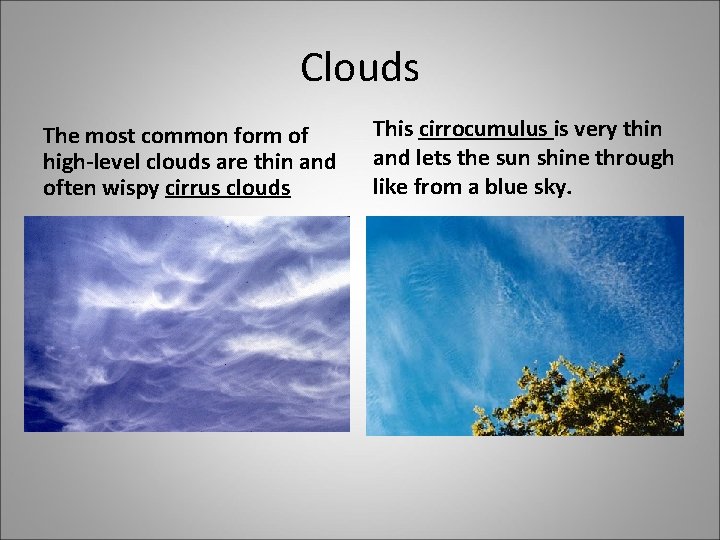
Clouds The most common form of high-level clouds are thin and often wispy cirrus clouds This cirrocumulus is very thin and lets the sun shine through like from a blue sky.
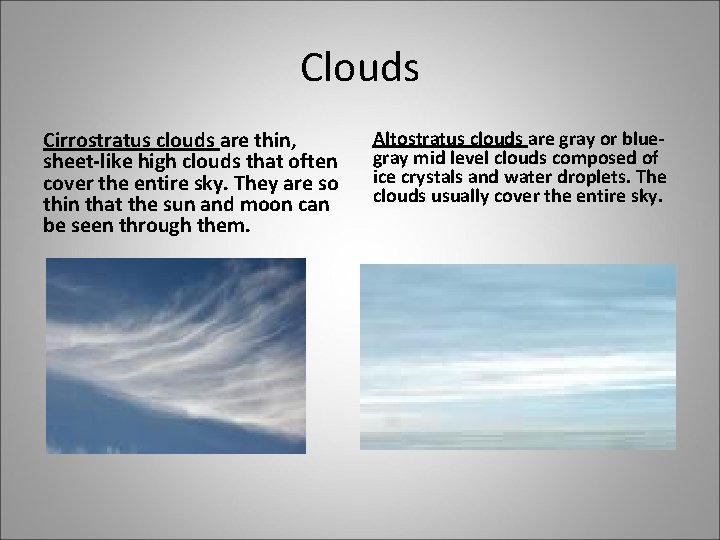
Clouds Cirrostratus clouds are thin, sheet-like high clouds that often cover the entire sky. They are so thin that the sun and moon can be seen through them. Altostratus clouds are gray or bluegray mid level clouds composed of ice crystals and water droplets. The clouds usually cover the entire sky.
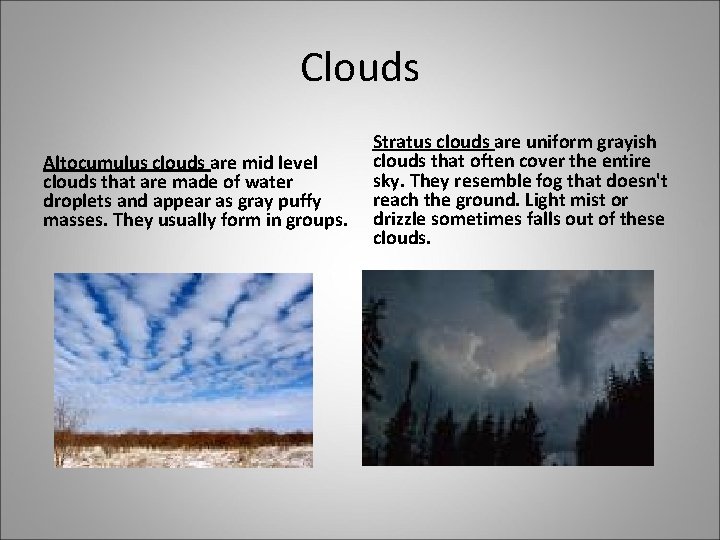
Clouds Altocumulus clouds are mid level clouds that are made of water droplets and appear as gray puffy masses. They usually form in groups. Stratus clouds are uniform grayish clouds that often cover the entire sky. They resemble fog that doesn't reach the ground. Light mist or drizzle sometimes falls out of these clouds.
Clouds Cumulus clouds are white, puffy clouds that look like pieces of floating cotton. Cumulonimbus clouds are thunderstorm clouds. They are associated with heavy rain, snow, hail, lightning and even tornadoes.
Weather Forecasts • Meteorologist-scientists who study weather conditions to provide forecasts. – Instruments Used: • Barometers: to measure air pressure • Anemometers: to measure wind speed. • Weather balloons & satellites: collect data high up in the troposhpere. (weather patterns & storm info that can’t be obtained at ground level. • Weather map: shows recent weather conditions across a large area.
Types of Weather Thunderstorm: begins to form when warm, humid air moves quickly through colder surrounding air. Tornado: a violently rotating column of air that extends downward from thunderclouds and touches the ground. It is smaller and more intense than a thunderstorm.
Weather Hurricanes: a large rotating tropical storm system with wind speeds of at least 74 miles per hour. Blizzard is a storm with snow and wind blowing for at least three hours at 35 miles per hour. Visibility is almost zero during the storm.