
Atmosphere Section 1 Atmospheric Basics Section 2 Properties
Atmosphere Section 1: Atmospheric Basics Section 2: Properties of the Atmosphere Section 3: Clouds and Precipitation
• Section 1: Energy is transferred throughout Earth’s atmosphere. • Section 2: Atmospheric properties such as temperature, air pressure, and humidity describe weather conditions. • Section 3: Clouds vary in shape, size, height of formation, and type of precipitation.

Section 1 – Atmospheric Basics • Essential Questions: – What is the gas and particle composition of the atmosphere? – What are the five layers of the atmosphere? – How is energy transferred in the atmosphere?
• The air is a combination of gases such as nitrogen and oxygen, and particles, such as dust, water droplets, and ice crystals. • These gases and particles form Earth’s atmosphere. • About 99% of the atmosphere is nitrogen (N₂) and oxygen (O₂).
• The remaining 1% consists of argon (Ar), carbon dioxide (CO₂), water vapor (H₂O), and other trace gases. • Water vapor is an invisible gaseous form of water. • The amount of water vapor varies over time and from one place to another. • The concentration varies with the seasons.
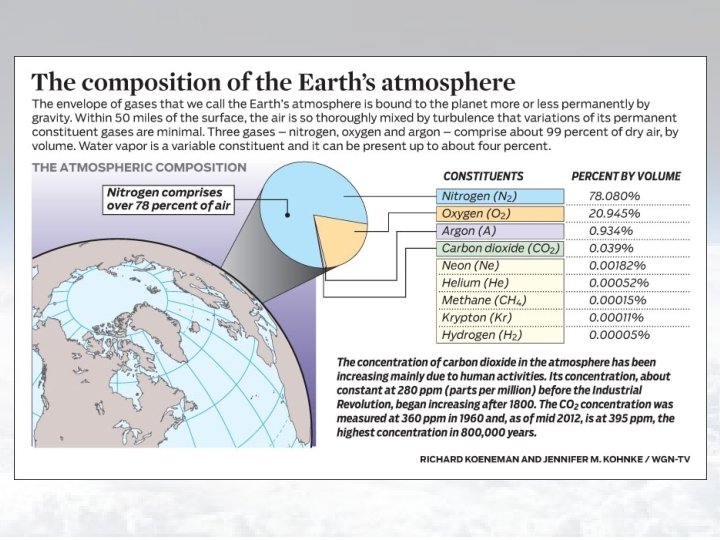
• Air over deserts contain less water vapor than air over the oceans. • Carbon dioxide (CO₂) currently makes up about 0. 038% of the atmosphere. • During the past 150 years the amount of CO₂ has increased from 0. 028%. • The recent increase is due primarily to the burning of fossil fuels.
• Ozone (O₃) is found in the ozone layer 2050 km above Earth’s surface. • O₃ has decreased in the past several decades due to chlorofluorocarbons (CFCs) that react with ozone and break it down. • Ozone limits the amount of ultraviolet rays that hit Earth. • Particles of salt, dust, microorganisms, and ice are also found in the atmosphere.
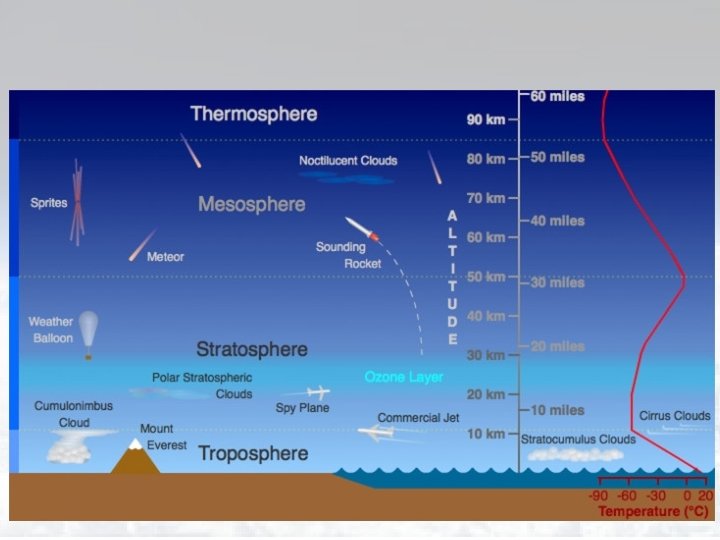
Atmospheric Layers • The atmosphere is classified into five layers. • Each layer differs in composition and temperature. • Troposphere is the layer closest to the Earth. • Weather occurs in the troposphere. • The temperature decreases as altitude increases.
• The altitude where the temperature stops decreasing is the tropopause. • The height of the tropopause varies from about 16 km in the tropics to about 9 km above the poles. • Temperatures at the tropopause can be as low as -60°C.
Stratosphere is above the tropopause. The temperature increases with altitude. Contains the ozone layer. As the altitude increases the temperature increases. • At the stratopause the temperature stops increasing and is about 50 km above Earth. • About 99. 9% of Earth’s atmosphere is below the stratopause. • •
• Mesosphere is above the stratopause and is about 50 -85 km above Earth. • Air temperature decreases with altitude. • This occurs because very little solar radiation is absorbed. • The mesopause is above the mesosphere.
• Thermosphere is the layer at about 85 -600 km above Earth. • Because of the low density of air the temperature rises. • The temperature can be up to 2000°C. • The ionsphere which is made up of electrically charged particles, is part of thermosphere.

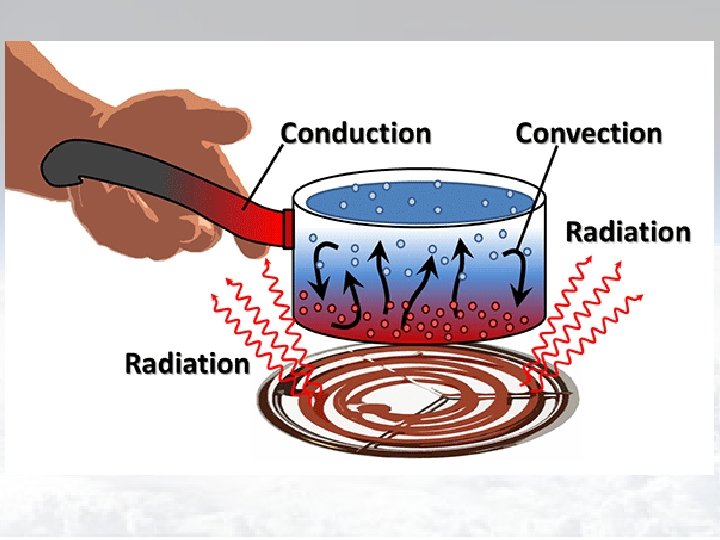
• Exosphere is the outermost layer of the atmosphere. • It is 600 km to 10, 000 km above Earth’s surface. • In the atmosphere, thermal energy is transferred by radiation, conduction, and convection.
Radiation • Light from the Sun heats up the surface of the Earth. • Radiation is the transfer of thermal energy by electromagnetic radiation. • Waves carry the heat through the atmosphere and is absorbed or reflected by Earth’s surface.

• Different objects absorb radiation at different rates. • Darker objects absorb heat faster. • Land heats up and cools down faster than water. • That is why it is cooler at the beach because the water is cooler than the sand on the beach.
• Conduction occurs when two objects at different temperatures come into contact. • In solids and liquids the particles transfer thermal energy from hot particles to cold particles.
• Convection is the transfer of thermal energy in the atmosphere and water. • Warm air or water is less dense and will rise above the more dense cold air or water. • When the air or water cools it will become dense again and move down. • This movement is called convection currents.
Section 2 – Properties in the Atmosphere • Essential Questions: – What are three main properties of the atmosphere and how do they interact? – Why do atmospheric properties change with changes in altitude?
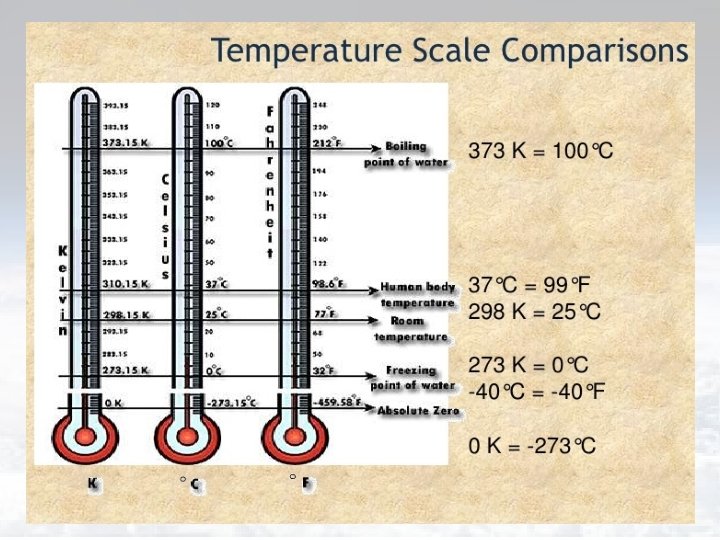
Temperature • Temperature is the measure of the average kinetic energy of the particles in motion. • Temperature is measured in Fahrenheit (°F), Celsius (°C), and Kelvin (K). • The Fahrenheit and Celsius scales are based on the freezing and boiling points of water. • The zero point of Kelvin is absolute zero – the lowest temperature that a substance can have.
Air Pressure • Earth’s atmosphere exerts pressure on you due to the weight of the atmosphere on top of you. • Air pressure is the pressure exerted on a surface by the weight of the atmosphere above a surface. • Air pressure is often measured in units of millibars (mb).
• At sea level the atmosphere exerts 1000 mb. • As you get higher in the atmosphere there is less atmosphere on top of you so there is less pressure. • That is why your ears pop when you go up in a plane. • As you get higher in the atmosphere the density of the air also becomes less.
Pressure-Temperature-Density Relationship • Air with the same density is warmer at a higher pressure than cooler air. – Particles crash into each other more and the temperature goes up. • If the temperature remains the same, the density increases as the pressure increases. – The particles are closer togetherefore increasing the density.
• Heating air causes the particles to move faster and move apart. This causes the density to decrease. – At the same pressure warm air is less dense than cold air.
Temperature Inversion • In the troposphere temperature decreases with altitude. • However, sometimes in a localized region warmer air is on top of colder air • Rapid cooling of the land can cause a temperature inversion. • A temperature inversion can lead to fog.
Wind • On a summer day when you approach a large building in the city and the door is opened the air conditioned air rushes out. • This is because the warm air is less dense and at a lower pressure so the cold air comes out. • The movement of air is wind. • Wind is the movement of air from an area of high pressure to low pressure.
• Wind along Earth’s surface is slowed by friction. • As you get higher the wind gets faster because of less friction.
Humidity • Humidity is the amount of water vapor in the atmosphere at a given location on Earth. • The amount of water vapor in a volume of air relative to the amount of water vapor needed for that volume of air to reach saturation is called relative humidity. • Saturation occurs when the amount of water vapor in a volume of air has reached its maximum amount.
• A saturated solution cannot hold anymore of the substance being added. • Dew point is the temperature to which air must be cooled at constant pressure to reach saturation. • Latent heat is the extra thermal energy contained in water vapor compared to liquid water.
Section 3 – Clouds and Precipitation • Essential Questions: – What is the difference between stable and unstable air? – How do low, middle, high, and vertical development clouds differ? – How does precipitation form?
Cloud Formation • A cloud can form when a rising air mass cools. • As less dense, warm air rises it cools and becomes more dense. • The cooling of the air mass causes condensation. • Condensation nucleus is a small particle in the atmosphere around which water droplets can form.
• When the number of droplets are large enough a cloud is visible.
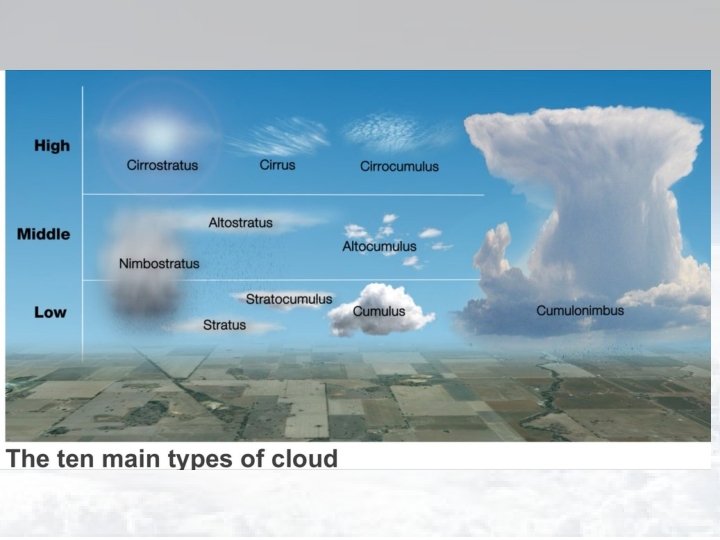
Types of Clouds • Cumulus clouds are puffy, lumpy looking clouds below 2000 m. • Stratus clouds are layered, sheet-like clouds that can cover much or all of the sky. • Altocumulus and altostratus clouds form at altitudes between 2000 m and 6000 m. • They are made up of ice crystals and water droplets.
• Cirrus clouds are wispy are made up of ice crystals at heights above 6000 m. • Cirrostratus and cirrocumulus are also high clouds.
Precipitation • All forms of water that falls from the clouds to the ground are precipitation. • The droplets in the clouds are so small that the upward movement of air keeps them in the cloud. • Coalescence occurs as larger droplets fall and collide with each other and become larger. • When the particles become too large, they fall.
• Up and down motion of particles in the clouds will cause hail to form. • The more the hail moves up and down the larger the hail.
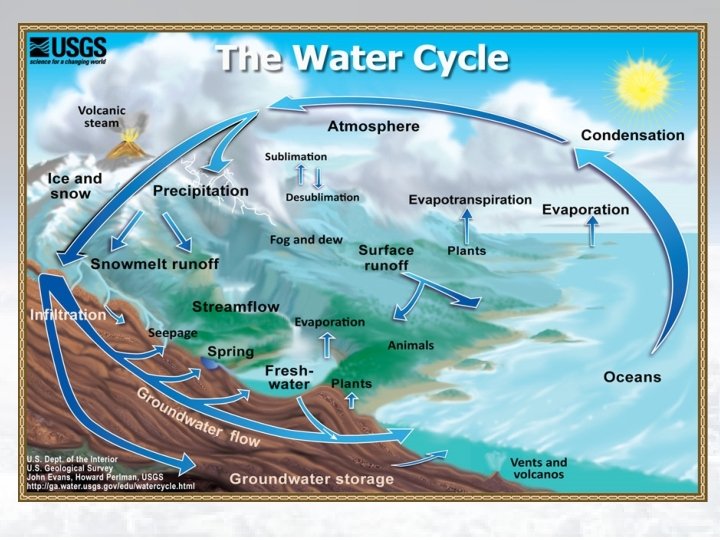
• The water cycle is the movement of water between the atmosphere and Earth’s surface. • Radiation from the Sun causes liquid water to evaporate. • Water evaporates from lakes, streams, and oceans and rises into the atmosphere. • As the vapor rises, it cools and condenses to form clouds
• Water droplets combine to form larger droplets that fall to the ground as precipitation. • This water soaks into the ground or enters lakes, streams, and oceans. • The water eventually evaporates continuing the water cycle.
- Slides: 43